Nuclear power not viable for South Australia, says Premier Jay Weatherill
SA Premier rejects nuclear argument THE AUSTRALIAN June 05, 2012 Premier Jay Weatherill says the South Australian Government remains opposed to nuclear energy as an avenue to cutting carbon
emissions…
.. Mr Weatherill says using nuclear energy is not on the table. “It doesn’t represent the policy of this Government,” he said. “Leaving aside the broader objections, there is a practical, financial objective that means that nuclear power for South Australia is unlikely to be viable.”
New report on the prospects for solar thermal energy
CSP: It needs a new way of thinking about energy REneweconomy, By Giles Parkinson 6 June 2012 A new report outlining the prospects of solar thermal energy has underlined its enormous potential for Australia, saying it could provide between a third and even one half of the nation’s energy needs, but notes it may require a new of thinking about energy production and delivery. Continue reading
The true value of Concentrated Solar Power is underestimated
market mechanisms are a long way from recognising and rewarding the full value of CSP – 100 per cent renewable, zero carbon, zero waste, dispatchable power – as compared with incumbent coal, gas and diesel.
As Australia considers how to gain best advantage from the huge investment we will make in our electricity system in the coming 20 years, the evidence points to solar thermal power as having very significant value for Australia – value our markets are not currently reflecting….
Not all electrons are created equal REneweconomy, By Andrew Want on 6 June 2012 All electrons look the same, so the saying goes. It only matters that the electricity comes out of the consumer’s power point when needed. Modern economies and consumers demand reliability of electricity supply. The question modern electricity markets need to answer is, what is the most economically efficient way to meet that expectation? And that question is about value, not cost.
The new report, Realising the Potential of Concentrating Solar Power in Australia, confirms that, as much as they may all look the same, not all electrons are created equal – some are indeed more valuable than others.
Commissioned by the Australian Solar Institute (ASI) and undertaken by international renewable energy consultancy IT Power, the report is the result of an extensive 12 month collaborative review involving Australian Solar Thermal Energy Association (AUSTELA), the Clean Energy Council, the Australian Solar Energy Society, CSIRO and Boston Consulting Group.
The report confirms that assessments of the costs of concentrating solar thermal power used in Australia for many years are well and truly outdated. Continue reading
Majority of Australians oppose sale of uranium to India
 ‘Most Australians against Uranium sale to India’, Hindustan Times, Melbourne, June 05, 2012 The Australian government might have overturned a ban on uranium sale to India but a majority of people in the country still appear opposed to the idea of selling the mineral to New Delhi. In a new survey, a majority of Australians were found to be
against the recent Labor party decision of lifting ban on Uranium sale to India with 61% opposing it.
“More than 60% of Australians say they are against ‘Australia selling uranium to India’, with 39% saying they are ‘strongly against’,” according to the eight annual Lowy Institute poll 2012.
In December 2011, the Australian Labor Party had overturned a ban on the sale of uranium to India following a heated national conference debate.
The results were published by the Lowy institute Poll after a nationally representative opinion survey of 1,005 Australian adults was done…… http://www.hindustantimes.com/world-news/Australia/Most-Australians-against-Uranium-sale-to-India/Article1-866178.aspx
Queensland’s government in the service of fossil fuel industries
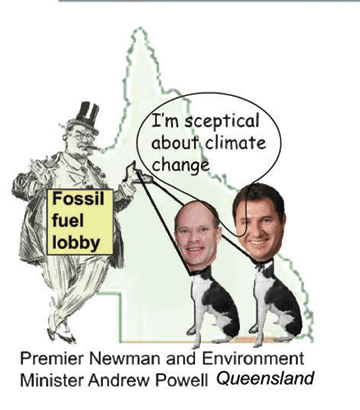 Premier Newman can do climate denial, REneweconomy , By Graham Readfearn 6 June 2012
Just in case anyone was in any doubt, Queensland Premier Campbell Newman reminded Australia earlier this week that his state was most certainly “in the coal business” and that protecting the Great Barrier Reef wouldn’t come before fossil fuel exports.
But as well as being “in the coal business”, it appears that Premier Newman and his environment minister Andrew Powell are taking their first steps into the business of climate science denial.
Minister Powell repeated a statement he had made to ABC’s Radio National that he was not convinced that humans were having an impact on climate change, a position which immediately puts him at odds with every national scientific academy in the world, the advice from his own chief scientist and the position of the CSIRO, the Bureau of Meteorology and the United Nations.
While Minister Powell made a point of saying that the environment should be protected (what else could the environment minister say, after all) his boss, Premier Campbell Newman, decided his minister’s view on climate change was “refreshing“. I’d choose a different word……
Hinting that we should be waiting until we’re 100 per cent sure what will happen before we take firm action, is a bit like saying you’re happy to drive your car at double the speed limits because no-one can say for sure that you’ll definitely crash. And while everyone has heard the stories of a grandparent who smoked 50 cigarettes a day and lived until they were 90, most people acknowledge that smoking massively increases your chances of dying of cancer.
Perhaps the Premier’s statements are instead an attempt to offset his own cognitive dissonance – the sick feeling that you get inside when you try and hold two conflicting positions simultaneously……. The then Lord Mayor [ Campbell Newman in 2009] even launched the Green Heart City Smart scheme, with its ubiquitous “I [green heart] Brisbane” catchphrase and branding.
It seems now though, that Mr Newman’s heart is conflicted with coal and climate science denial. http://reneweconomy.com.au/2012/premier-newman-can-do-climate-denial-97405
Will Tony Abbott say “yes” to the Greenhouse and Energy Minimum Standards Bill (GEMS)
 One hopes that Tony Abbott might expand his vocabulary from ‘no’ in this particular case. After all it was under the Coalition’s watch that the energy efficiency standards and labelling program started to make an impact. Minimum standards for the energy efficiency of residential and commercial buildings, refrigerators, water heaters, fluorescent tubes, air conditioners, electric motors, and transformers were put in place by the Howard government. Indeed, thanks to Malcolm Turnbull, we started a worldwide trend in phasing out conventional incandescent light globes that create 99 times more heat than light.
Abbott’s power bill ‘yes’ test, CLIMATE SPECTATOR, Tristan Edis, 5 Jun 2012 A little noticed piece of legislation was introduced into parliament last week which is likely to make a big difference to energy bills and carbon emissions – the Greenhouse and Energy Minimum Standards Bill (GEMS).
This bill aims to move the country toward a single national system for implementing and enforcing minimum standards of energy efficiency and energy rating labels, instead of the current state-based model we currently have.
What many people may not realise is that the measures which have made the greatest impact to date on reducing Australia’s energy emissions have nothing to do with renewable energy, or natural gas, or clean
coal. Instead it has been lots of little incremental improvements in the energy efficiency of mundane things like refrigerators, light bulbs, houses, office buildings, water heaters, air-conditioners, televisions, and electric motors driven by regulated minimum standards and mandatory energy rating labels. Continue reading
Hypocrisy of Australian govt in helping USA against Julian Assange
The Australian government has liaised closely with the US from the beginning of the US WikiLeaks investigation, which rapidly gathered steam following Bradley Manning’s arrest in Iraq in March 2010.
the released cables showed that the Australian embassy had confirmed through US officials that the US Justice Department was conducting an ”active and vigorous inquiry into whether Julian Assange can be charged under US law, most likely the 1917 Espionage Act”.
ever anxious to demonstrate its loyalty to the US alliance, the Australian government has not uttered any objection to the prospect that Assange may be prosecuted for espionage.
 Ministers cagey over Assange, The Age, Philip Dorling, June 2, 2012, Julian Assange fears extradition to Sweden to be questioned about sexual assault allegations.
PRIME Minister Julia Gillard, Attorney-General Nicola Roxon and Foreign Minister Bob Carr all sang from the same hymn sheet this week on the continuing legal saga of WikiLeaks publisher Julian Assange. But they chose their words very carefully.
The issue was whether the United States intends to charge and extradite Assange – the Australian journalist labelled by US Vice-President Joe Biden as ”a high-tech terrorist” – with criminal offences for WikiLeaks’ publication of hundreds of thousands of secret US military and diplomatic reports…..
Well aware of successive polls that show a high level of support for WikiLeaks and Assange across the Australian political spectrum, the Australian government has been insistent this week that it has no knowledge whatsoever of any intention by the US to prosecute and extradite the WikiLeaks publisher……. Continue reading
Aboriginal opposition to “Stronger Futures” laws is growing
In recent weeks a group of traditional owners representing 8000 people in west, central and east Arnhem Land wrote to the prime minister and others calling for the scrapping of the Stronger Futures laws.
Northeast of Alice Springs, Alyawarr homeland communities – including Lake Nash, Utopia and Ampilatwatja, covering 3500 people – also pledged to fight the laws.
 Indigenous groups angry at intervention 9 News Jun 5 2012, Xavier La Canna. Two more Aboriginal groups have joined calls for the federal government to abandon laws that would intensify intervention in indigenous communities.
On Tuesday the New South Wales Aboriginal Land Council (NSWALC) and the Tangentyere Council became the latest groups to speak out about the proposed Stronger Future laws, which are expected to pass the Senate this month…… Continue reading
Australia’s politicians ignorant about the economic impact of solar photovoltaic energy
rooftop solar PV was about to play a significant role in the electricity market, so much so that rooftop solar alone could add 12,000 megawatts to 18,000MW to Australia’s electricity capacity by 2031
the economics of solar PV has changed dramatically in recent years.
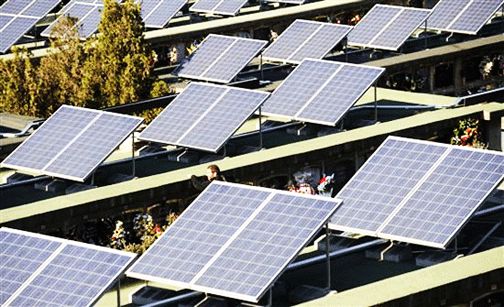
Politics must catch up with solar BY: GILES PARKINSON The Australian June 01, 2012 IT is time politicians in state and federal parliaments had a look at what’s happening in the solar photovoltaic market. There is a revolution going on in the electricity industry and no one in politics seems to have noticed.
This was made clear this week by a report from the Australian Energy Market Operator, which supervises the operation of the electricity grid in the eastern states, and which for the first time has produced a separate report analysis the impact of rooftop solar PV. It came to conclusions that would appear remarkable to those not close to the solar industry. Continue reading
Martin Ferguson got Australian government to weaken protection of iconic species, the giant cuttlefish
 There is no publicly available explanation as to why and on what basis Minister Burke overturned his
  Department’s advice and acted in accordance with lobbying comments by the Minister for Resources and downgraded the recommended required level of protection accorded to the Australian Giant Cuttlefish from any adverse impacts by the operations of BHP Billiton’s proposed desalination plant.
Ferguson lobbying on Olympic Dam & Burke downgrading protection to the Australian Giant Cuttlefish, by David Noonan, 4 June 12 FOI documents reveal that on the same day that Min Burke signed the EPBC Act Approval to Olympic Dam (10th Oct 2011) a final key change was made to the conditions of approval – in accordance with lobbying by the Resources Minister [Martin Ferguson] and against Department of Environment advice that had already taken account of comments by the Resources Minister – to downgrade the recommended level of required protection that the activities covered by the approval must not result in any adverse impact on the abundance and distribution of Australian Giant Cuttlefish and to restrict the department to only prosecute BHP Billiton for non-compliance representing significant adverse impacts on the Cuttlefish breeding population resulting from operations of the proposed Desalination plant at Point Lowly in Upper Spencer Gulf. Continue reading
Unique Australian species – the giant cuttlefish now more threatened by Olympic Damn expansion.
It has also emerged that subtle changes to the wording of the Olympic Dam mine’s approval watered down recommended protection of the giant cuttlefish.
following a meeting with Mr Burke, the department [had] backflipped.
Greens SA leader Mark Parnell, who obtained the documents under Freedom of Information, said it would be much harder for the department to prosecute BHP Billiton if anything went wrong.
Cuttlefish population in decline: BHP, Heather Kennett | Brad Crouch, 4 June 12 http://www.adelaidenow.com.au/news/south-australia/cuttlefish-population-in-decline-bhp/story-e6frea83-1226381517382 June 02, 2012 A NEW study has found a serious reduction in giant cuttlefish numbers in the region around Whyalla. Research commissioned by BHP Billiton – which wants to build a desalination plant near Whyalla – has found the cuttlefish population is already in serious decline ahead of hyper-saline brine being pumped from a future plant into Spencer Gulf….
. Tens of thousands of giant cuttlefish head to the Whyalla region each
winter to breed, which has become a tourist attraction. Their annual ritual has also become a pivotal environmental argument against BHP Billiton’s coastal desalination plant, which is part of its planned expansion of the Olympic Dam mine. ….. Continue reading
Tony Abbott and Campbell Newman on behalf of the polluting industries
The move comes as a UNESCO report warned coastal developments in Queensland were posing a risk to the reef.
Tony Abbott’s push to cut green tape would benefit (?) Queensland first by: Steven Scott The Courier-Mail June 04, 2012 QUEENSLAND would become the first state to gain greater control over environmentally sensitive developments if Tony Abbott wins the next election.
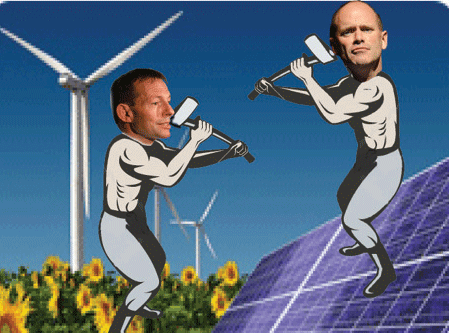
The federal Opposition has struck a preliminary deal with the Newman Government to allow it to take control of all approvals under federal environment laws, with the exception of offshore developments. Continue reading
Overwhelming majority of Australians support solar power
In the long run, big solar is also a big money-saver. Initial set up costs are high. But because the energy source is free, big solar will save many billions of dollars worth of coal and gas bills in coming decades.
The 100% renewables survey reported many of those polled said they supported big solar power because it would help boost employment. Unlike fossil fuels, solar power is a job-rich option.
Big solar power needs democracy to switch on, Green Left June 2, 2012, By Simon Butler If Australia were a democracy and governments had no choice but to carry out the will of the majority, we’d be well on our way to a 100% renewable power grid.
Recent polling organised by climate action groups around the country found that 94% of 12,000 people polled said they wanted big solar power stations built in Australia . And 93% of those polled said the government should invest public money to make that happen. Continue reading
A climate-friendly urban renewal
Barangaroo will have big impact but no footprint SMH, June 3, 2012 IT IS the biggest urban renewal project since the Olympic site was built at Homebush Bay, but Barangaroo is also likely to be the greenest.
The Barangaroo Delivery Authority’s goal is to make the precinct the first of its size in the world to be ”climate positive”. That means the site will generate more renewable energy than it uses, it will recycle and export more water than it uses and recycle more waste than it generates.
The Green Building Council of Australia expects the $6 billion Lend Lease development will be the benchmark by which similar projects could be measured in the future…… It will generate enough solar energy to serve the public areas of the site. There will be a recycled water service and a waste recycling service. Only recycled water will be used for flushing toilets, irrigation and fire sprinklers.
Conventional cars will be discouraged with electric car power stations in the car parks, walking and cycling networks through the precinct and strong public transport links…….. http://www.smh.com.au/nsw/barangaroo-will-have-big-impact-but-no-footprint-20120602-1zohp.html#ixzz1wr0vpgxT
Despite the anti-wind hype, South Australia’s success shows the power of renewable energy
Australian energy ministers have been so keen on geothermal, because they can most readily understand the concept of drilling for energy. You can’t dig up solar and wind power.
Not only are wind and solar playing increasingly significant roles in the power grid, but they are also helping to make wholesale electricity prices cheaper.
the progress with renewable energy in South Australia is promising and shows that with a friendly policy environment – for example, no 2km wind farm exclusion zones – great strides can be made.

Are the lights still on in South Australia? Business Spectator, Daniel Palmer , 1 Jun 2012 “……I was concerned for the state of South Australia after receiving some interesting news during the day – wind now makes up 31 per cent of the state’s power supply, with solar PV accounting for another 3.5 per cent.
According to a leading energy advisory firm (Energy Quest), wind already “appears to be the new baseload.” Not bad in spite of the campaign against wind by they-who-shall-not-be-named……. . I have been told for years that wind and solar are not capable of supplying power consistently enough to power one house, yet alone be able to supply a third of the energy needs for an entire state.
It appears to be all a Y2K-like false alarm however, with everything operating as normal…. Continue reading
1 This month


Help Aunty Sue Protect Her Land and Sacred Sites From Destructive Rocket Testing.
.

Australians deserve the truth
about
AUKUS – https://aukuspublicinquiry.com/

PETITION – To: Prime Minister Anthony Albanese and the Australian Labor Government

of the week – Australians for War Powers Reform (AWPR)
To see nuclear-related stories in greater depth and intensity
 Antinuclear