South Australian government framed laws for BHP Billiton’s uranium mining, not for the people
 Commercial vested interests of uranium mining companies are writing the script for Australia’s uranium sales deals under both Liberal and now ALP federal governments…….
South Australia should come to its senses and recognise our society’s responsibilities to get out of the uranium trade and not be made complicit in nuclear risks for BHP Billiton’s vested interests.
Our uranium fuelled Fukushima, David Noonan, The Guardian, 22 Feb 12 “……..How did the SA government perform in exercising their responsibilities after Fukushima? Indigenous people bear a disproportionate burden of impacts from uranium mining and this will certainly continue to be the case in SA
under the Roxby Indenture deal “negotiated” by the state with BHP Billiton that is being pushed through Parliament with bi-partisan support.
BHP Billiton is not bound by the Aboriginal Heritage Act 1988 in the “Stuart Shelf Area” of some 1.5 percent of the area of SA around the Olympic Dam mine.
Aboriginal heritage obligations that apply to every other miner or developer do not apply to the Big Australian for the 70-year extended period of the Roxby Indenture, and the state further agreed that this can only be changed in future with the agreement of the company. Continue reading
Australian uranium mining companies ripping off African countries?
IGF’s views follow remarks by Reserve Bank of Malawi Governor Perks Ligoya last December during which he protested the generous allowances the Malawi government provided to Australia’s Paladin Energy in the Kayelekera uranium mining deal in Karonga.
 Mining deals worry industry grouping The Daily Times, 21 February 2012 Isaac Masingati An international mining industry grouping, Intergovernmental Forum on Mining, Minerals, Metals and Sustainable Development (IGF), says it is concerned with contracts between investors and governments especially in developing countries, saying they tend to be skewed in favour the investor.
IGF President Leonard Kalindekafe told the Business Times in Zomba on Friday that there was a concern among members of the grouping that some investors were taking advantage of governments’ lack of expertise to strike deals that bring little profits. “This is a big concern to the Forum because some bona fide countries are not able to realise full benefits from their minerals,” he said. Continue reading
USA wants to sell or lease nuclear submarines to Australia
 US offers Australia nuclear subs: report, Business Spectator, 22 Feb 2012 The United
  States has signalled that it is willing to lease or sell a nuclear-powered submarine to Australia, as the local Defence Department searches for a replacement for its Collins class vessels, according to The Australian Financial Review.
US Ambassador to Australia, Jeffrey Bleich, told the newspaper Washington viewed Australia’s
submarine program as crucial to security in the Asia-Pacific region.
While Defence Minister Stephen Smith has previously ruled out the purchase of a nuclear sub, Coalition leader Tony Abbott would be expected to consider the option if he becomes prime minister, the AFR said…..
Australia’s uranium industry – open slather for BHP Billiton’s Olympic Dam mine
Uranium mining companies in Australia are in denial. They cited “commercial in confidence” so as not to disclose their contracts and not to reveal which reactors were fuelled with their uranium.

 Olympic Dam mine is a dam designed to leak an average of three million litres of liquid radioactive waste a day from the tailings storage facility through decades of mining up to 2050.
The federal and SA governments agreed to surface dumping of the tailings rather than to require best practice disposal into the pit.
Our uranium fuelled Fukushima, David Noonan, The Guardian, 22 Feb 12, Australian uranium fuelled the Fukushima nuclear disaster yet our governments have just approved the world’s largest uranium project in BHP Billiton’s proposed new pen pit mine at Roxby Downs. “We can confirm that Australian obligated nuclear material was at the Fukushima Daiichi site and in each of the reactors – maybe five out of six, or it could have been all of them; almost all of them”.
This frank smoking gun admission by Dr Floyd, the Director-General of the Australian Safeguards and Non-Proliferation Office (ASNO) in the Department of Foreign Affairs and Trade came some seven months after the Fukushima crisis had started to unfold. It is quite likely this Australian uranium came from Roxby Downs in SA.
Denial runs deep in the nuclear industry. Continue reading
Whole body CT scans; their radiation may do more harm than good
 the findings suggest that pan-scanning may be 26 times as likely to harm patients in the long run as to immediately help them in the acute care setting…. the results should serve as warning for the emergency department physician against ordering pan-scans for lower-risk patients
CT Pan-Scans Raise Radiation Dose Without Improving Results, Medscape Today, James Brice, February 21, 2012 — An Australian study of emergency department imaging practices has raised radiation safety concerns and new arguments about the clinical benefits of whole-body computed tomography (CT) imaging for the initial emergency department evaluation of critically injured patients.
Pan-scans, a wide field-of-view CT imaging protocol covering the body from the head to the pubic symphysis, stirred intensive debate when they were first introduced in the mid-2000s. A majority of academic authorities eventually accepted the high-speed application for diagnosing life-threatening, multifocal trauma in the emergency department, despite its propensity for exposing patients to levels of radiation of 20 mSv or more.
That single dose is double the amount of ionizing radiation the National Academy of Science’s Seventh Assembly of the Committee on Biologic Effects of Ionizing Radiation says will give a 40-year-old adult a 1-in-1000 chance of future cancer. Continue reading
Solar energy a good financial deal for Australian homes
 Double quick time for solar returns, The Border Mail, 22 Feb 12, Solar power systems are offering a return on investment in half the time it took a decade ago, according to an industry leader. Eco-Kinetics general manager South Australia, Mark Hofner, said solar power investments today would pay for themselves in about five years.
“A return on investment a decade ago would have taken 10 years,” Mr Hofner said. “Today it is around half the time; even a little 1.5 kilowatt system is under three-and-a-half years for a return. Solar is a good deal.” Continue reading
Renewable energy helped Australia to lower greenhouse gas emissions
Mixed Greens: Clean power cut carbon in 2011, RENeweconomy, By Sophie Vorrath 21 February 2012 Australia has cut its total carbon emissions for the second year running, according to new figures released by the federal government yesterday, an achievement – coming at a time of economic growth – that is being largely attributed to the electricity sector and, more specifically, the introduction of more clean, renewable energy into the power mix
. Clean Energy Council acting CEO Kane Thornton said the analysis from the Australian National Greenhouse Accounts shows that overall greenhouse emissions dropped about 1 per cent in the year to September 2011, while electricity emissions dropped 3.2 per cent during this period……. http://reneweconomy.com.au/2012/mixed-greens-clean-power-cut-carbon-in-2011-2011
Where to trash Australia’s dead but radioactive Hifar nuclear reactor?
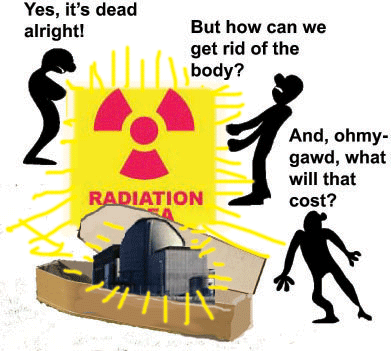 Australia’s media rarely covers anything to do with the nuclear industry, and never covers the issue of trashing the dead nuclear reactor, sorry, I mean “decommissioning’ it. That’s a much nicer word. You can visualise the general pulling the epaulettes off the shoulder of the disgraced captain – decommissioning him – a nice formal protocol.
But what is ANSTO going to do with its dead Hifar nuclear reactor in Sydney? After all, there was a helluva fuss about the uranium left in posh Hunter’s Hill. No doubt ANSTO and the New South Wales government will find some working class suburb in which to dump ANSTO”s old trashed reactor – seeing that ANSTO has a nice new one which is not trash (yet).
But, no – I forgot, the Australian Government will step in and promise some Aborigines the normal facilities that the rest of us have anyway, – if they’ll just be obliging and “volunteer” to have the dead but radioactive nuclear reactor. – Christina Macpherson
 Australian Senate, ANSTO transcripts, 19 Feb, 2012,
……Senator LUDLAM: If this is complex, perhaps you can table it, but can you provide me with a current timetable and order of works for the decommissioning of the former HIFAR reactor in the site?
Dr Paterson: There is no formal decommissioning plan which has been adopted at the moment. As we indicated, I believe, at a previous estimates, there is a window of time in which we would like to begin that decommissioning process. A will take on notice the current status of how we are thinking about that window and when the works can begin.
Senator LUDLAM: Can I see it if I look in the right spot in the four-year forward estimates, or is it not there?
Dr Paterson: It is not in the four-year.
Senator LUDLAM: Did you want to add something, Mr McIntosh?
Mr McIntosh: No, certainly not in the four-year. Clearly, there will be a number of issues to be taken into account. One of them is obviously funding, but there is also: there is not much point demolishing a reactor if you have got nowhere to put the waste.
Senator LUDLAM: That is what I am going to come to now. Is it too early for me to ask you what the cost is going to be of pulling that facility apart?
Dr Paterson: I think the engineering estimates for the moment can be tabled.
Senator LUDLAM: Can be?
[ I couldn’t make much sense of the lengthy answer here. C.M.]…. and the second thing that can happen is that the cost estimates which are based on normative numbers that you can extract from quantity surveyors and others in the marketplace may have changed because the marketplace itself has changed. So there are two bases for having reasonable contingencies in these projects: one is scope changes and the other is cost changes because of market forces….
….. Senator LUDLAM: Is it still ANSTO’s intention to store that material which is contracted to return from Europe temporarily in Sydney while the issue of the remote waste dump is resolved one way or another?
Dr Paterson: That is our current planning.
South Australia, the Uranium State, moves further away from clean energy
Labor pulls plug on energy role, by:Belinda Willis , The Advertiser , February 21, 2012 THE State Government has ended Renewable Energy Commissioner Tim O’Loughlin’s position more than a year before his contract was due to expire. Mr O’Loughlin was appointed in mid-2009 with some fanfare by then Premier Mike Rann. His contract was meant to run until 2013.
A spokesman for Energy Minister Tom Koutsantonis said he would not be replaced. Yesterday’s Budget and Finance select committee heard Mr O’Loughlin’s job ends about 18 months short of his contract by “mutual agreement”, and that there had been a payout……
The move follows a budget decision late last year to scrap the $11.7 million remaining in the $20 million Renewable Energy Fund. This fund was overseen by RenewablesSA, and industry said there were now no state funding support avenues available for renewable energy.
The South Australian branch of the Australian Solar Energy Society and the Australian Geothermal Energy Association have raised concerns that the State Government had lost interest in renewable energy.
“It makes a complete mockery of the fact that in the last week of Rann being premier, he released a new renewable statement for South Australia,” said Mr Marshall. “It’s clear the new Premier has no interest in this sector whatsoever.” http://www.adelaidenow.com.au/business/labor-pulls-plug-on-energy-role/story-e6frede3-1226276364284
Aboriginal Peter Watts warns on the radiation danger of uranium
From Aboriginal land to Japan’s nuclear reactors, Antinuke activists draw attention to the link between Australian uranium and Fukushima , Japan Times, By ERIKO ARITA Feb. 19, 2012 Peter Watts, co-chair of the Australian Nuclear Free Alliance, was recently in Japan as one of some 100 speakers at the Global Conference for a Nuclear Power Free World held in Yokohama on Jan. 14 and 15. During an interview with The Japan Times, Watts — who is a member of the Arabunna people, one of several Aboriginal groups living in South Australia — said that among the many things his ancient ancestors knew, such as how to hunt animals in a sustainable way, was the potential danger of radiation released from the uranium beneath their land.
“Our ancestors knew of the uranium,” he said, “They called the places (of uranium deposit) ‘Poison Country.’ It meant: ‘Don’t go there to hunt. Don’t go there to collect food. Don’t go there.’ ” Continue reading
Hans Joseph Fell warns on Australia’s economic need to foster renewable energy
The end of baseload? It may come sooner than you think, RENeweconomy, By Giles Parkinson 20 February 2012 Hans Joseph Fell interviewe d by RENeweconomy
“…….Q: What is your assessment of policies in Australia?
 A: You have wonderful research for renewables in Australia, at ANU, Sydney University and elsewhere. Research is very important but without market introduction it is not so useful, and you do not have enough deployment. You need a good feed-in-tariff. But you do have a carbon price, which balances a bit the high external cost of fossil fuel production, so it balances a little the uncompetitiveness of renewables.
The main thing is that Australia is the biggest exporter of uranium and coal – most investors believe that when uranium and coal prices rise, it is good for their business, because they have a bigger income. But I believe that this is not stable in future. It happens already in Germany, the higher the coal price is rising, the more coal fired power stations they close, because they are uncompetitive with renewables. The higher they go, the less coal other countries will buy from Australia. I see most new investment in coal is a stranded investment.
Q: That message is not getting across.
A: That’s because they believe it will go on., but it will not go on. The oil price will be the leading price for all energies. Peak oil is already here, the IEA says it is. In coming years we must fear declining oil production. This will lift price very high, and that will increase pressure on people, banks and nations. The only chance to come out of this economic crash is to go renewables…… http://reneweconomy.com.au/2012/the-end-of-baseload-it-may-come-sooner-than-you-think-29425
Michael Anderson backs Nyoongar Aboriginal Embassy in Perth
from Diet Simon, Goodooga, Northwest NSW, 19 February 2012 – – The last surviving co-founder of the Aboriginal Embassy in Canberra has expressed his support for the Nyoongar Embassy encampment set up on Heirisson Island in Perth a few days ago and now under threat of eviction.
Michael Anderson, leader of the Euahlayi tribe, endorses the call by Robert Eggington, spokesman of the Nyoongar Embassy, that it’s the Perth City Council that should “move on”.
State, Territory and federal governments should now be seeking legal advice on the true nature of the Aboriginal sovereignty claim as it will not be going away, Anderson writes in a media release.
“Our assertion of sovereignty over this continent is real and legally just. It is in English Law, and the English and the Australians have no choice but to deal with it in a mature and just manner,” he argues.
He says Aborigines now foresee Australian governments depending very heavily on police to terrorize the sovereignty movement, “rather than speak to us, as one would expect diplomacy would dictate”.
“We are in the process of alerting the Secretary-General of the United Nations to our sovereignty movement. If necessary, we will be calling upon the United Nations to send in peace keepers to prevent our people from being harassed and terrorized.”
“The Nyoongar Embassy spokesperson, Mr. Eggington, is correct when he says that the offer of $1billion for the city area of Perth and their Native Title claim area is a joke of monumental proportions. Some of the house blocks in the more affluent areas of Perth are collectively worth more. Then to say to the people that they cannot access any of the money for 10 years is an insult.”
Anderson warns of the danger of Aboriginal society in the Perth area imploding from fighting over whether to accept or reject the offer.
Australian rare earths company Lynas – the Ugly Australian in court?
Lynas itself had admitted it had no prepared any such permanent waste storage facility
I cannot understand why Malaysia is prepared to tolerate the potential hazards to occur here from a plant which will give no substantial benefit of Malaysia because of the pioneer status granted to Lynas for 10 years
Lynas Corp failed to meet any of the conditions in its first proposals, according to the regulator.
Anti-Lynas groups are planning a mammoth rally in Kuantan on February 26 to pressure Putrajaya to terminate the project.

 A year on, anti-Lynas campaign goes to court http://www.themalaysianinsider.com/malaysia/article/a-year-on-anti-lynas-campaign-goes-to-court The Malaysian Insider By Debra Chong , February 17, 2012 KUALA LUMPUR, — A nationwide campaign to stop Lynas heads into the courtroom with damaging allegations against the Australian rare earths producer and Malaysia’s regulators.

The court filing also accuses Lynas of economic imperialism and points out that until today it does not have a plan to permanently dispose of its waste, some which contain potentially harmful levels of radiation. Continue reading
Australia’s has inadequate renewable energy policy , in opposing solar feed-in tariffs
The Australian laws – dubbed the ”clean energy future package” by the government….The package also includes a
$10 billion Clean Energy Finance Corporation to invest in and underwrite the development of fledgling technologies.
But the government opposes feed-in tariffs and is reducing a national solar incentive scheme. State solar feed-in tariffs have been wound back
German experience: clean energy requires subsidies, The Age, Adam Morton February 18, 2012 AN ARCHITECT of Germany’s rapid growth in clean energy – it has nearly half the world’s rooftop solar power – has warned that Australia’s climate policies will not alone drive a switch to greenhouse-gas-free electricity.
Germany reached its 2020 target of generating a fifth of its electricity from renewable sources nine years ahead of schedule, largely through feed-in tariffs that guarantee new power forms an inflated rate for the power they use to make them competitive.
It installed 3 gigawatts of solar photovoltaic panels in December alone – roughly enough for 1.5 million homes. Australia has less than half this in total. Continue reading
Paul Howes, the nuclear lobby’s man aiming for Canberra?
Until very recently, both Liberal and Labor parties in New South Wales opposed uranium mining in that State.
Now the Liberal Party in government will allow uranium exploration, and no doubt permission for uranium mining will follow. Why else would uranium mining companies bother to dig?
New South Wales Labor opposition opposes the new move towards uranium mining.
But it’s interesting to see how forthright is Paul Howes, a very prominent union leader, with his eye on apolitical career, presumably in the Labor Party – in his enthusiasm for the nuclear industry. Ziggy, and Barry, and the rest of the Nuclear Push must be thrilled to bits, with this little union go getter.
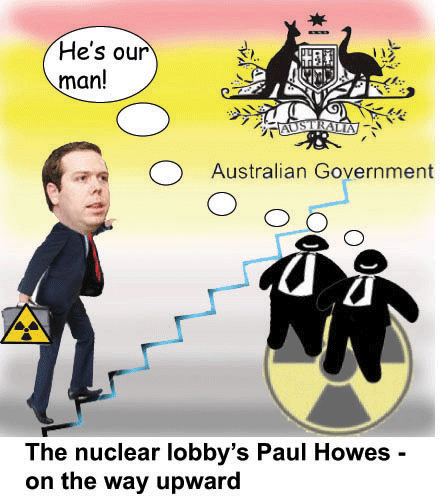
Paul Howes is quoted in today’s Cowra Community News, as saying that ” uranium exploration
is a step in the right direction, particularly as Australia looks to develop cleaner energy sources into the future.”
“cleaner?” – Paul – you’ll have to think of a more sophisticated term that that. Nobody believes in “clean” nuclear any more.
1 This month


Help Aunty Sue Protect Her Land and Sacred Sites From Destructive Rocket Testing.
.

Australians deserve the truth
about
AUKUS – https://aukuspublicinquiry.com/

PETITION – To: Prime Minister Anthony Albanese and the Australian Labor Government

of the week – Australians for War Powers Reform (AWPR)
To see nuclear-related stories in greater depth and intensity
 Antinuclear