A truly valuable legacy for Premier Mike Rann, to repeal South Australia’s unjust Indenture Act
the Indenture Act trumps all other SA legislation…..Over to you, Mr Rann − repealing the indefensible legal privileges in the current Indenture Act would be a good way to end your tenure as SA Premier.
 Above the law: Olympic Dam’s legal privileges, Jim Green and Gavin Mudd, 27 Aug 11 Premier Mike Rann has done us a favour by insisting on concluding negotiations with BHP Billiton over the SA Roxby Downs Indenture Act before leaving office. It is by no means clear that the outcome will be
improved with Mr Rann’s involvement, but he has at least drawn attention to this remarkable legislation.
The Indenture Act governs the operations of the Olympic Dam copper/uranium mine. The legislation was controversial when it was enacted in 1982 and it is all the more inappropriate as the basis for the planned expansion of
the mine.
The Act provides BHP Billiton with the legal authority to override important state legislation including the Aboriginal Heritage Act 1988,
the Environmental Protection Act 1993, the Freedom of Information Act
1991, the Natural Resources Act 2004 (including water management issues),
the Development Act 1993 and the Mining Act 1971. Continue reading
As Australia’s groundwater declines, BHP BIlliton should not extract GAB water for free
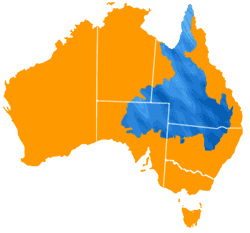 It is within the power of the Federal and South Australian governments to require, as a condition of consent to the BHP Billiton proposal, that at the time the desalination plant is commissioned, the company will surrender any and whatever licence it has to extract water from the Great Artesian Basin ….
It is our submission that, as the largest single extractor of water from the GAB in South Australia, BHP Billiton has created its own ethical obligation to the future of the GAB …
It is our further submission that this is not an economic issue, it is not even an environmental issue, it is about the ethics of any company continuing to assert its current right to a public resource when that company has the financial capacity to secure the same resource from its own private reserves. ….
Re:- BHP Billiton – Olympic Dam Expansion Proposal, 22 August, 2011 Letter to Senate Standing Committees on Rural Affairs and Transport from Richard Quilty BHP Billiton Shareholder Willem Vervoort,Associate Professor, Hydrology & Catchment Management The University of Sydney
Preamble
On the dry Australian continent groundwater is the only consistently reliable source of water; it is thus an extremely valuable resource. The Great Artesian Basin (GAB) is the largest of those groundwater resources.
The total value of production supported by GAB water is estimated at $3.5 billion per annum. Without that groundwater there would be little to no economic activity and in fact little opportunity for life in much of regional Australia.
Currently, many groundwater resources are over-allocated leading to declining water tables and water quality. Federal and State governments as well as private business are investing large amounts of money to rectify this problem. An example is the $140 million GABSI program to save GAB water. Continue reading
Australian federal government abdicating its role in environmental protection?
 States get a bigger say on the environment, The Age, Tom Arup, August 25, 2011, THE Gillard government has rolled out a business-friendly overhaul of national environment laws, boosting the states’ role in approving or rejecting controversial new projects like pulp mills and mines…….
Under the reforms the Commonwealth will seek deals with the states that would mean most projects would need either state or federal environmental approval, not both….
Australian National University environmental legal expert Andrew Macintosh said yesterday the proposal had to ensure adequate protection of national environmental assets and ”leave an opening for the Commonwealth to intervene where the national interest is threatened by parochial state interests”.
The Australian Conservation Foundation’s Dr Paul Sinclair said delegating power to the states to approve projects would be a backwards step, adding “if business wants a one-stop shop, it must be a federal shop”..….
opposition environment spokesman Greg Hunt. Mr Hunt yesterday welcomed the proposed reforms and said the Coalition was broadly supportive.
Greens environment spokeswoman Larissa Waters said she was disappointed the reforms did not include measures to consider a project’s carbon emissions and impact of water resources…http://www.theage.com.au/national/states-get-a-bigger-say-on-the-environment-20110824-1ja8n.html
Friends of the Earth write to South Australian politicians about Roxby Downs Indenture Act
exemptions from the Environmental Protection Act (1993) are of particular concern. The exclusion of this Act means that the Olympic Dam mine is not subject to the same environmental regulatory framework as other industrial projects in South Australia, and the Environmental Protection Authority (EPA), which administers the Act, is excluded from its monitoring role. BHP’s environmental performance is instead the responsibility of the Minister for Mineral Resources Development, who, based on BHP’s own reports, has full discretion to approve or reject programmes for the management and rehabilitation of the environment, without any obligation to consult with other agencies. Given the Ministers role in promoting mining in SA, this arguably amounts to a conflict of interest.
Re: ROXBY DOWNS INDENTURE ACT
Dear
The Roxby Downs Indenture Act is currently the subject of negotiations between the SA Government and BHB Billiton, owner of the Olympic Dam copper/uranium mine. We expect that in the near future amendments will beintroduced into parliament extending the operation of the Act to the proposed Olympic Dam expansion.
Friends of the Earth is concerned that indefensible legal privileges in the Indenture Act will be retained in the context of the proposed mine expansion, including exemptions and overrides from the SA Aboriginal Heritage Act1988, the Environmental Protection Act 1993, the Freedom of Information Act 1991, and the Natural Resources Act 2004. Continue reading
BHP Billiton above the law, exporting megalitres of Australia’s water – for free!

 BHP Billiton: Billions in profits and not paying a cent for water in SA, Friends of the Earth Adelaide, 24th AUGUST 2011 Today mining giant BHP Billiton announced record financial results for the 2011 financial year, recording a total net profit of US$23. 95 billion, nearly double its 2010 figure of US$13.01 billion.
Despite its profits more than tripling in the last three years, BHP has never paid a cent for the vast amounts of water used by the Olympic Dam copper and uranium mine near Roxby Downs. The mine currently uses approximately 35 million litres of water a day from the Great Artesian Basin. Under the Roxby Downs Indenture Act BHP is not required to pay for this water usage.
The Indenture Act applies specifically to the Olympic Dam mine, and provides for wide-ranging legal exemptions and overrides from environmental and Aboriginal heritage protection laws that apply elsewhere in the state, including the Environmental Protection Act and the Natural Resources Act (which incorporates water management issues).
“The Indenture Act means that the Olympic Dam mine is not subject to the same environmental regulatory framework as other industrial projects in the state,’ explained Nectaria Calan of Friends of the Earth Adelaide. “Additionally, by allowing BHP to take water from the Great Artesian Basin for free, the South Australian government is essentially providing BHP with a massive subsidy,” she continued.
The water intake from the Great Artesian Basin has already had adverse impacts on the unique Mound Springs found near Lake Eyre, which are fed by the underlying Artesian Basin, and are sacred to the Arabunna people, the traditional owners of the area.
As part of the proposed expansion of the Olympic Dam mine, BHP Billiton proposes to increase its water consumption by an additional 200 million litres per day. Water intake from the Great Artesian Basin will increase to up to 42 million litres per day, with the remainder to come from a proposed desalination plant at Point Lowly. This amounts to over 100,000 litres of water per minute.
“The vast water usage of uranium mines is often forgotten in the debate about uranium and nuclear energy. Here we are, in the driest state on the driest continent on earth, host to a mine which needs millions of litres of water each day. Due to the Indenture Act, we are essentially exporting our water overseas for free,” said Ms. Calan.
The Indenture Act is currently the subject of negotiations between BHP Billiton and the South Australian government. In the near future amendments will be introduced into parliament to extend the Indenture Act to the proposed expansion.
“The South Australian government is planning to allow the largest uranium mine in the world to go ahead with legal privileges that will allow BHP an impunity characteristic of some third world states,” said Ms. Calan. “The Indenture Act should be repealed completely, allowing BHP to be subject to the same laws as other corporations operating in the state.”
USA now officially seeking to send nuclear wastes back to uranium mining countries

 Official: U.S. in Early Talks About Int’l Nuclear Leasing Arrangements, NYT. By HANNAH NORTHEY, August 23, 2011 Department of Energy officials have spent weeks trying to knock down reports that they have been interested in building a nuclear waste repository in Mongolia.
Now, the Obama administration is going a step further, disclosing that what DOE hopes to do is “lease” uranium from other countries, then return the spent fuel to the originating country.
A senior Obama administration official told Greenwire earlier this month that the government is in preliminary talks with several countries, including Mongolia, Japan and the United Arab Emirates, about setting up commercial nuclear fuel leasing arrangements.
In one example of how a fuel leasing arrangement could work, countries with uranium reserves could mine, enrich and fabricate the material and lease it to reactor companies abroad. Spent nuclear fuel would then be sent back to the originating country, the official said.
Discussions have not touched upon what those countries would do with the waste, the official said, but the United States hopes to prevent proliferation by providing alternatives to domestic enrichment and reprocessing capabilities…..

Hypocrisy of Country Liberal Party in Northern Territory, over uranium mining.

 Gloves off in Angela Pamela uranium mine scrap ABC News, Jane Bardon and Lucy McNally, 23 Aug 11, “…..The Country Liberals’ Robyn Lambley won the Araluen by-election last year while opposing development of the Angela Pamela uranium deposit after a backlash from Alice Springs residents.
The party has now changed its policy to say it will encourage all applications for uranium developments….
The Arid Land Environment Centre says neither party in the Territory can be trusted when it comes to the proposed Angela Pamela mine.
Opposition environment spokesman Peter Chandler took part in a debate in Alice Springs on the weekend and said the CLP would support a uranium mine there if it met environmental standards.
That prompted the Government to accuse the party of ignoring the community’s concerns on the issue.
Environment Centre spokesman Jimmy Cocking says a CLP government is more likely to approve a mine at the site, but he wouldn’t put it past the Labor party either.”In terms of policy outside of Angela Pamela they are both the same,” he said…http://www.abc.net.au/news/2011-08-23/20110823angela-pamela-mine-scrap/2852248
Uranium company sells Australian projects
Uranex sells Australian uranium assets, Channel 9 News, 24 Aug 11,”……The Melbourne-based uranium explorer on Tuesday said the projects, including Thatcher Soak in Western Australia and Alligator Rivers in the Northern Territory, were being sold to a “Chinese based investment group”.
Uranex plans to focus on its uranium and coal assets in Tanzania, a spokesman said.
The deal is subject to shareholder and regulatory approvals including the Foreign Investment Review Board.
“We are confident the Australian uranium projects will successfully progress towards production and further opportunities will be created through our alliance,” Uranex managing director Matthew Gauci said in a statement.
The Chinese party holds the first right of refusal for the sale of any other Uranex tenements in Australia.
Cockburn City Council, Western Australia, shows how renewable energy and efficiency, can be done economically
 Since 2001, the council has reduced carbon dioxide emissions by about 330,000 tonnes……
City of Cockburn climate change strategy leading by example, Science Network Western Australia , Chris Thomas, 24 August 2011 THE City of Cockburn has scored one of the 2011 National Awards for Local Government, recognising its work in climate change and sustainability. “Our energy-efficiency and renewable energy projects have resulted in reduced operating costs, reduced dependence on grid-supplied electricity and reduced vulnerability to electricity price increases.” —Ms Harrison.
The WA council first made a commitment to reducing greenhouse gas emissions in 1996 and now spends $650,000 each year on renewable energy systems, research, new technology and community engagement. Continue reading
Australian company Silex Sytems involved in dangerous nuclear technology
 Security fears over laser-enriched uranium, New Scientist 23 August 2011 by Jeff Hecht It’s pretty hard to disguise the fact you are enriching uranium, whether for use in nuclear power stations or bombs. Now a method that uses lasers to complete the process could make it more efficient – and easier to hide.
General Electric and Hitachi are joining forces to build a laser facility in Wilmington, North Carolina, powerful enough to produce more than 1000 tonnes of enriched fuel every year….
The current approach was developed only 10 years ago by an Australian company called Silex.General Electric-Hitachi have now licensed Silex’s technology. The original process was hampered by inefficient lasers but the fact that GE-Hitachi are prepared to go ahead with a full-scale plant suggests they have developed a more efficient laser.
Why is the idea so controversial?
A key concern is that the high efficiency of a laser enrichment process would reduce energy requirements, allowing a uranium enrichment plant to be smaller and more distant from power sources. That would make it harder to detect using satellite imagery. Such a small plant could also be used to make enriched uranium for atomic bombs – with little chance of being spotted.
What happens next?
The US Nuclear Regulatory Commission is scheduled to review the proposal on 30 June 2012. If the NRC approves the plan, a joint venture called Global Laser Enrichment would build the plant in six stages, eventually reaching a capacity of 6 million work units, a standard measure of enrichment capacity. If the product was standard-grade reactor fuel, the facility could produce more than 1000 tonnes a year…..http://www.newscientist.com/article/dn20819-briefing-security-fears-over-laserenriched-uranium.html
Australian unions join Aboriginal opposition to nuclear waste dump
the unions were quite clear about not wanting nuclear material on highways or railway tracks. “All it takes is one accident, one ruptured container,”..“It’s simply not worth the risk and Territorians don’t need this in their backyard.”..
a legal challenge to the Federal Government’s waste dump plans at Muckaty will be heard in October.

Unions pledge support to oppose nuke waste dump – , – Tennant & District Times,19 April 11,TRADE union officials from across Australia have pledged support to traditional owners who oppose the construction of a nuclear waste dump on their land. Continue reading
Mining giant Xstrata (and Glencore?) in court over global warming
it will be the first in Australia to argue for an outright refusal of a mine based on its climate change impacts

 Graziers, greenies ally against Xstrata, Brisbane Times, Christine FlatleyAugust 22, 2011 – Global giant Xstrata should be refused permission to open a new coal mine in Queensland that will have serious adverse impacts on the climate and nearby graziers, a court has heard.
Green group Friends of the Earth appeared in the Brisbane Land Court today in an attempt to scuttle an 11,000-hectare coal mine planned for the small town of Wandoan, 400km northwest of Brisbane. Continue reading
Silex, a supposedly solar company deeply involved in the nuclear industry
progress hinges on a world-leading uranium processing method called laser enrichment.
The technology has been acquired by a heavy-hitting US consortium of nuclear companies, Global Laser Enrichment, which has completed a testing program.
(repeating this item, lest we forget Australia’s involvement – C.M.)
Heavy weather for nation’s solitary solar-panel maker, The Australian, TIM BOREHAM , July 18, 2011 AS the head of Australia’s only solar-panel maker, Silex Systems’ Michael Goldsworthy sticks to script and welcomes the pending carbon tax and accompanying billion-dollar renewable subsidy programs that will benefit companies such as Silex….. Continue reading
Climate Denialism is old hat – now Australia joins in Radiation Denialism
 After Fukushima: the rise of nuclear radiation denialists Independent Australia 22 Aug 11, After the Fukushima disaster, the nuclear industry has urgently redoubled its efforts to convince the world that nuclear radiation is safe. Now it seems they are trying to say that radiation is actually good for us. Noel Wauchope reports.
In 2001, President Bill Clinton authorised funds to research the effects of radiation on the “downwinders” from the Nevada and Utah atomic bomb tests. The funds went to the Department of Energy, who designed the research project. They then allocated the project to Flinders University in South Australia, under the leadership of Professor Pam Sykes.
But the original intention of the research has taken a strangely perverted course. Pam Sykes has joined the proponents of “adaptive radiation” and “radiation hormesis” – the theory that “low level ionising radiation is good for you” It’s quite an old theory, but now, after Fukushima, it has suddenly become very useful to the nuclear and uranium lobbies……..
HOW PAM SYKES HAS CHANGED DIRECTION (SUITING THE NUCLEAR LOBBY) Early on in her research, Pam Sykes was following up the idea that human individuals vary in their susceptibility to low level radiation — that some are more susceptible than others.
Dr Sykes’ current view deviates markedly from the statements she made prior to the signing of the 2001 US Department of Energy research contract which funded her. US DOE still funds her. The aim of the original funding as authorised by President Clinton was in service of US Downwinder victims.
In 2001, Dr Sykes and Flinders University issued a press release which stated in part: “….If you have a limit based on the whole population but some the population are more sensitive, then perhaps you need a lower limit.”
They [Pam Sykes, Bobby Scott etc] are the “radiation sceptics”, very much comparable to “climate change sceptics”. Their belief in “radiation hormesis” is comparable to “intelligent design” — as opposed to evolution.
Their common funding sources are nuclear energy agencies — in particular the USA Department of Energy…… (DOE)…..http://www.independentaustralia.net/2011/health/after-fukushima-the-rise-of-nuclear-radiation-denialists/
Does your superannuation fund invest in uranium mining?
 Disclosure would also allow fund members who oppose uranium mining, for example, to discover whether their retirement savings are invested in a miner with substantial uranium mining interests.
Portfolio details must be disclosed, SMH, John Collett, August 20, 2011 — Super funds will soon list their investments for all to see The Australian Securities and Investments Commission wants superannuation funds and fund managers to disclose the investments they hold. Disclosure among super funds and fund managers is patchy. Some will list the biggest 10 holdings in their disclosure documents and perhaps on their websites.
But investors are mostly left guessing on how their super is invested – the biggest investment most people will have alongside the family home. Continue reading
1 This month


Help Aunty Sue Protect Her Land and Sacred Sites From Destructive Rocket Testing.
.

Australians deserve the truth
about
AUKUS – https://aukuspublicinquiry.com/

PETITION – To: Prime Minister Anthony Albanese and the Australian Labor Government

of the week – Australians for War Powers Reform (AWPR)
To see nuclear-related stories in greater depth and intensity
 Antinuclear