Environmentalists want independent review on plans for rocket launch from Eyre Peninsula
SA rocket launch amid calls for conservation site review Stephanie Richards, IN DAILY,
Environmentalists are calling on the State Government to order an independent review into alternate sites for a rocket launchpad facility, as a company today launches its first test rocket from the Eyre Peninsula conservation zone it hopes to make a permanent base.
Space industry company Southern Launch will today launch a 10-metre-high, three-tonne test rocket from its Whalers Way Oribital Launch Complex in a conservation zone about 25-kilomtres southwest of Port Lincoln.
The rocket, owned by Taiwan-based space company tiSPACE, will travel southwards over the Great Australian Bight, with Southern Launch using the launch to gather noise and vibration data to determine the impact of rocket launches on native wildlife.
Southern Launch was granted permission by the State Commission Assessment Panel to launch the test rockets in June, but it is still waiting on approval to build two permanent launchpads at the Whalers Way site to host regular satellite launches into orbit around the Earth’s poles.
The proposal has received significant backlash from conservationists and local residents, who argue a rocket launchpad complex should not be built in a conservation zone that is home to several state and federal-listed threatened bird species.
In a joint statement issued yesterday, South Australian conservation groups including the Nature Conservation Society, Wilderness Society, Conservation Council, the National Trust, Birds SA and Trees for Life expressed “major concerns” with the imminent launch and plans for a permanent launchpad facility at the site.
They called on the State Government to order an independent review of possible alternate locations for the launchpads, arguing “the only analysis that has been done on possible locations is by the company that stands to profit from this operation”.
“We have urged the Government to work with the company to find an alternative site for the proposed rocket launch facility, but so far, none have been put forward,” Trees for Life CEO Natasha Davis said.
According to Southern Launch’s Environmental Impact Statement, which is currently out for public consultation, the company considered several sites to build its permanent launchpad facility before settling on Whalers Way.
Alternate sites in South Australia included Kangaroo Island, Cape Jervis, Cape Douglas, Ceduna and the Mid Eyre Peninsula, while a RAAF base in regional Victoria and a national park in Western Australia were also considered.
The site was the subject of a Heritage Agreement; however, some areas of the site were specifically excluded from the agreement.”
Asked whether the Government supported an independent review into alternate locations for the launchpad facility, a state government spokesperson told InDaily that as Southern Launch’s proposal had been classed as a “major project”, the company would need to submit an analysis of why Whalers Way is a suitable site.
“The proponent’s Environmental Impact Statement is currently out for public consultation, and South Australians are urged to have their say,” the spokesperson said.
The public has until next Thursday to submit feedback via the Plan SA website.
The site was the subject of a Heritage Agreement; however, some areas of the site were specifically excluded from the agreement.”
Asked whether the Government supported an independent review into alternate locations for the launchpad facility, a state government spokesperson told InDaily that as Southern Launch’s proposal had been classed as a “major project”, the company would need to submit an analysis of why Whalers Way is a suitable site.
“The proponent’s Environmental Impact Statement is currently out for public consultation, and South Australians are urged to have their say,” the spokesperson said.
The public has until next Thursday to submit feedback via the Plan SA website.
According to Southern Launch’s Environmental Impact Statement, six threatened bird species were located during field surveys at the launch site, and another ten threatened species were known to live in the area………………..
In a Facebook post this morning, Premier Steven Marshall said the test launches “put South Australia in the box seat to tap in to the nation’s booming space industry”. https://indaily.com.au/news/2021/09/10/sa-rocket-launch-amid-calls-for-conservation-site-review/
Planned UK-Australia trade deal – a dangerous precedent for climate change policy
Green groups and opposition MPs have responded angrily to news the UK
government has agreed to drop binding climate targets from the planned
UK-Australia trade deal, accusing Ministers of “a massive betrayal of our
country and our planet”.
Greenpeace’s John Sauven offered a withering
assessment of the government’s decision, warning that it set a dangerous
precedent for future trade deals with other carbon intensive nations. “It
will be a race to the bottom, impacting on clean tech sectors and farmers’
livelihoods. There should be a moratorium on trade deals with countries
like Australia until they improve on their weak climate targets and end
deforestation. At the moment the public and parliament are being duped by
the Prime Minister into thinking this deal is great for Britain when in
reality nothing could be further from the truth.”
Business Green 9th Sept 2021
News Corpse’s climate change shame

News Corp’s climate change shame. The Age, September 9, 2021 From next month, News Corp Australia will end its long-standing editorial hostility towards carbon reduction policies and advocate that the world’s leading economies hit net zero emissions by 2050.
The outsized influence of News Corp in Australia on public discourse – and perhaps more importantly on the right-wing rump of the Coalition – still puts the handbrake on reform. Despite growing pressure from other like-minded Western nations, led by Britain and America, Prime Minister Scott Morrison has for months been slow-walking towards a net zero emissions target by 2050 and has failed to embrace the tougher action by 2030 the world is demanding.
No doubt Mr Morrison’s approach factors in the backlash from within his own government, a faction led these days by Nationals leader Barnaby Joyce and undergirded by News Corp’s commentators…….
there is reason to be doubtful. Only a month ago, in response to the latest report by the United Nations Intergovernmental Panel on Climate Change, News Corp commentator Andrew Bolt repeatedly chose to mock it with arguments that would not stand up in a high school science class, including the bizarre claim that “if a warming world is better for plants, why not for humans?” It’s hard to imagine him changing…… https://www.theage.com.au/national/news-corp-s-climate-change-shame-20210908-p58prk.html
Sloppy and unconvincing pro nuclear propaganda from the Australian Nationals and the Murdochracy

The Australian nuclear promotion is less persuasive. Coming predominantly from Murdoch media, the content of nuclear propaganda is sloppy, inaccurate, and at times downright weird.
The Nationals and Murdoch media support nuclear power ahead of COP26, Independent Australia,By Noel Wauchope | 9 September 2021.
On 1 September 2021, Senator Matt Canavan called for Australia to boycott the 2021 United Nations Climate Change Conference (COP26) to be held in Glasgow in November.
Was he speaking on behalf of the coal or oil industries? Well, not exactly.
This was the latest and strangest call from Australia’s noisy little band of pro-nuclear promoters. Canavan was responding to the news that the nuclear industry has been banned from having exhibits at COP26. He complained that the Climate Summit was a ”sham” for excluding nuclear power, a view supported by MP Ken O’Dowd.
O’Dowd said that nuclear power should be at the top of the climate agenda. Other National Party notables, David Littleproud and Bridget McKenzie, recently spoke out for nuclear power.
Like the nuclear industry worldwide, they are now taking up the cause of climate action with a vengeance. The nuclear lobby’s motives are clear. First, they likely want the tax exemptions and other subsidies that come with being declared as clean and sustainable. Secondly, they need that seal of approval, the public respectability which goes with acquiring the clean and green label.
The global lobby’s most persuasive argument is that a nuclear reactor’s operation generates a lot of electricity, with only a minuscule production of CO2.
They don’t, of course, talk about the processes of the nuclear fuel chain from uranium mining through to demolition of dead reactors and disposal of wastes. Their favourite phrase ”emissions-free energy” doesn’t count emissions of radioactive strontium-90.
The Australian nuclear promotion is less persuasive. Coming predominantly from Murdoch media, the content of nuclear propaganda is sloppy, inaccurate, and at times downright weird. The Australian newspaper provides two outstanding examples
The first is this eye-catching article ‘Savvy activists cast nuclear benefits in a fresh green light‘ subtitled:
‘For baby boomers, nuclear weapons and nuclear energy were conflated as an existential risk. This created an irrational fear that persists today.’
From the outset, the argument is an attack on anti-nuclear activists, instead of arguing the case for nuclear power.
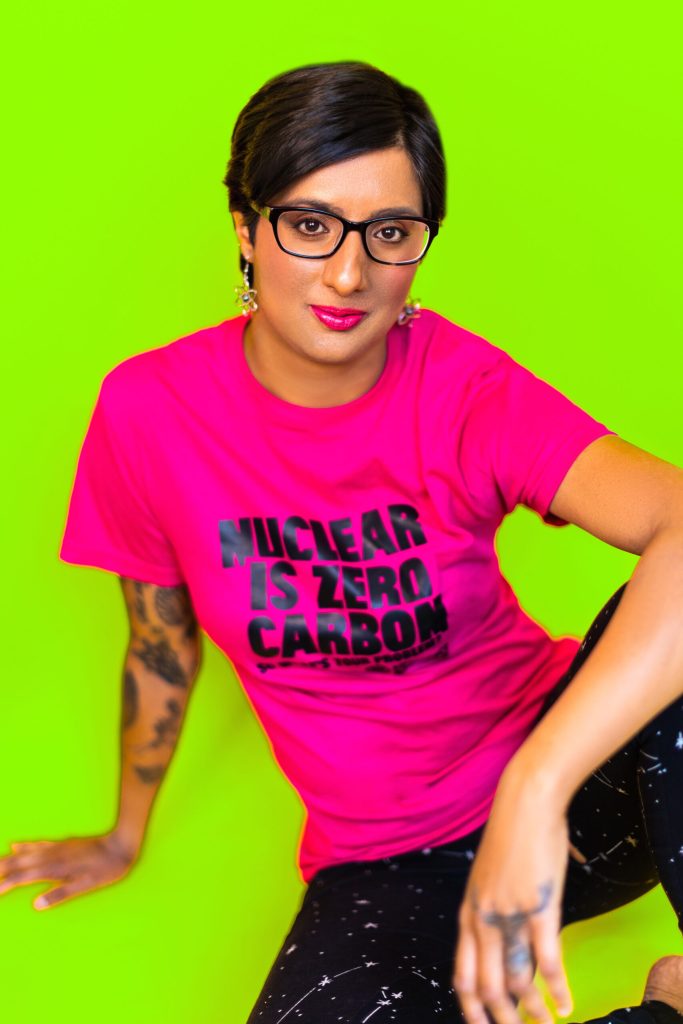
The hero of the piece is Zion Lights, formerly of Extinction Rebellion, who created her own pro-nuclear group, Emergency Reactor.
She works closely with Michael Shellenberger, who, himself, has lost the support of the general nuclear lobby, due to his many inaccurate statements. Zion Lights and The Australian go into a lengthy digression on the foibles of the baby boomers, who have ‘conflated nuclear weapons and nuclear energy as an existential risk that could wipe out humanity’.
The health effects of the Chernobyl and Fukushima disasters are minimised and renewable energy is rubbished as being ineffective.
The author, Claire Lehmann, concludes that the too-slow movement towards carbon neutrality is the fault of the misguided anti-nuclear baby boomers.
The second article is ‘Nuclear stacks up — cue the meltdown‘ by Greg Sheridan, who starts by accusing Australians as being ‘environmental outliers’ for prohibiting nuclear power…………..
the main thrust of this pro-nuclear argument moves on to an attack on Labor, the Greens and so forth:
‘… the deadly, wretched, wholly negative, nihilistic scare campaigns and demonising that the ALP left and its Green allies have conducted against nuclear energy.’
There is no attempt to address any of the worrying issues that surround nuclear power — costs, safety, environmental damage, radioactive waste. He reminds us that Bill Gates backs nuclear power. Well of course Gates does — he owns a nuclear power company, Terra Power.
He also quotes the European Union (EU) as backing nuclear power. While several EU countries do have nuclear power, the EU as a whole is not recommending nuclear powers as a climate solution. In fact, the nuclear industry is banned from exhibiting at the green zone at COP26………
As I write this comes the breathtaking news that the Murdoch media is changing its attitude to global warming. From a rather crude sort of climate denialism, they will likely move to supporting technical “climate fixes” spruiked by the fossil fuel industries. This is a more subtle way of sabotaging real climate action.
Perhaps we can expect them also to provide something more credible on the nuclear issue in the future. https://independentaustralia.net/environment/environment-display/the-nationals-and-murdoch-media-support-nuclear-power-ahead-of-cop26,15496
Senator Matt Canavan – a chameleon of contradictions on coal and nuclear power

One minute all for coal, the next it’s nuclear. Can you believe a word this guy says?
Resources Minister Matt Canavan has hosed down the prospect of nuclear power helping solve the nation’s energy woes, saying the disposal of low-level radioactive waste was already a problem.
Canavan cold on the push for nuclear powerhttps://www.afr.com/companies/energy/canavan-cold-on-the-push-for-nuclear-power-20190903-p52nir?fbclid=IwAR2dHiUWJ4cplt9pkNCTfajuqpIYTGoaCzMTWoirS2N2dpVTy2hOJllIhqgMark Ludlow
While there has been a push for nuclear energy to replace coal-fired power stations when they finally exit the National Energy Market, the pro-coal Queensland senator said he had his doubts, saying it was still too expensive and did not have bipartisan support.
The issue of disposal of radioactive waste was still a major hurdle to overcome, he said.
Senator Canavan said he was the minister responsible for trying to find a home for low and intermediate-level radioactive waste from the sole nuclear reactor at Lucas Heights in Sydney’s south-west that is used for the production of nuclear medicine.
We’ve been trying to find a home for 40 years for that waste. It’s difficult because of the concerns about managing that waste. I completely understand that,” he said before a speech to the Queensland Resources Media Club in Brisbane.
“Obviously, if we can’t find a long-term solution for that level of waste it’s pretty hard to fathom that we could go beyond that for the production of nuclear energy that does produce a larger amount and more waste of a higher category to manage.”
………. Pro-nuclear advocates say next-generation smaller nuclear reactors could be built for about $2.7 billion each. Other sceptics say nuclear power would not be viable for another 20 years – and only if there were some form of carbon price.
But Senator Canavan said despite the inquiry and the support of some prominent conservative politicians, he had reservations about the price of nuclear power. ”No one is going to make predictions about what happens in 20, 30 or 40 years’ time. All I want to see is a system which allows the most affordable and sustainable energy solutions coming forward,” he said.
“I have previously expressed that it’s relatively expensive and, obviously, we do have a task at hand domestically at the moment to get down our high power prices.
“We’re not afraid of the discussions or conversations and we have rightly said any change would have to be bipartisan, which is unlikely right now.”
Talking up coal
Senator Canavan talked up the prospects of coal exports………….https://www.afr.com/companies/energy/canavan-cold-on-the-push-for-nuclear-power-20190903-p52nir?fbclid=IwAR2dHiUWJ4cplt9pkNCTfajuqpIYTGoaCzMTWoirS2N2dpVTy2hOJllIhqgMark Ludlow
Australia is part of Asia, and is unwise and unsafe in parroting the USA agression about China.
As tensions rise with China, Australia is ‘not so safe’, warns Mahathir,
more https://www.theage.com.au/world/asia/as-tensions-rise-with-china-australia-is-not-so-safe-warns-mahathir-20210907-p58pmg.html-–, By Chris Barrett, September 9, 2021 ,

What is happening now is, of course, people regard Australia almost as an extension of America,” said the 96-year-old. “Your policies are seldom different from America.
Singapore: Australia is needlessly risking its security with a standoff with China, says former Malaysian prime minister Mahathir Mohamad, who claims Canberra must make the first move to settle tensions with Beijing.
In an interview with The Sydney Morning Herald and The Age, Mahathir also attacked the use of the Quadrilateral Security Dialogue – comprising the US, Australia, Japan and India – as a vehicle to try and stand up to China.
He believes it risks provoking Xi Jinping’s regime and that rallying countries together against the Chinese Communist Party is not the way to raise concerns about its behaviour, from its claims to most of the South China Sea to alleged human rights abuses in Xinjiang province.
“It is an aggressive move,” Mahathir said.
“We should have just bilateral relations with countries without any appearance of trying to force our policies on China. Yes, of course, we are unhappy about the treatment of the Uighurs. But for Malaysia, we can’t fight against China. We have to continue to work with them and try to influence them in a small way so that they will treat the Uighurs better.”
Australia’s ties with China remain at an all-time low as Foreign Minister Marise Payne and Defence Minister Peter Dutton embark on a diplomatic tour this week with visits to Jakarta, Seoul, Delhi and Washington DC.
Treasurer Josh Frydenberg is foreshadowing a further rising of tension with China, declaring Australia will not compromise on its “core values” even in the midst of damaging economic coercion.
However, Mahathir, who led Malaysia between 1981 and 2003 and from 2018 to 2020, argues Australia is largely responsible for turning its differences with China into a full-blown diplomatic and trade dispute.
“What is happening now is, of course, people regard Australia almost as an extension of America,” said the 96-year-old. “Your policies are seldom different from America. And America is aggressive because it thinks it is safe. But Australia is not so safe.
“This idea that Australia is part of Europe is still there. You don’t think you are an eastern nation but over time you have to think that you are here. Therefore, what policies you follow must take into consideration your geographical position. But when you just reflect the policies of America sometimes, of course, it will not work because you are not as safe and powerful as America.”
The Australian government has been trying to reopen a dialogue with China for months to no avail, with Beijing still incensed by issues it laid out in a list of 14 grievances it released last November.
They include Australia’s call for an independent probe into the origins of COVID-19, the blocking of Huawei from the 5G network in 2018, Australia’s prominence in an international “crusade” on Taiwan, Hong Kong and Xinjiang and the barring of multiple Chinese investment deals on the grounds of national security.
China was further angered by the cancellation in April of Victoria’s Belt and Road Initiative agreement under the Australian government’s new foreign veto laws.
It has retaliated with continuing sanctions against Australian exports including coal, barley and wine while demanding Australia walk back some of its policies on China.
n 2018, Mahathir himself pushed back against $22 billion in contracts Malaysia had signed with China’s Belt and Road Initiative under predecessor Najib Razak, who has since been found guilty of corruption over the country’s 1MDB sovereign wealth fund scandal.
Warning China could secure influence with debt traps, he renegotiated the terms of the East Coast Rail Link, the signature Belt and Road project in Malaysia, to save a third of the cost but says he did so because it was a bad deal not because it was Chinese.
Mahathir believes Australia needs to loosen restrictions on Chinese investment.
“The country which first made the move should also make the move to reduce that tension,” he said. “And for that, you should remove the restrictions you have on Chinese products. Maybe having Huawei coming in to Australia is too dangerous. But you may think of other things.
“And slowly, I think the Chinese will respond by opening up the imports of Australian products. It may be a gradual process, but I think in the meantime, as you reduce the bans and all that you should also talk to the Chinese about human rights, about things you think they have done wrong.”
China will inevitably be high on the agenda in next week’s Australia-United States Ministerial (AUSMIN) talks between Payne, Dutton and their counterparts in President Joe Biden’s administration.
Australia and the US last week celebrated the 70th anniversary of the ANZUS Treaty, with US Defence Secretary Lloyd Austin saying the Western military power was committed to a “shared vision for a free and open Indo-Pacific” for decades to come.
The mode of the US exit from Afghanistan, however, has raised questions about its dependability as a security guarantor, particularly in a regional landscape in which China is increasingly assertive.
“Americans think of America first,” Mahathir said. “America is forever trying to help people but when the help is extended it’s in the interest of America, not in the interest of the country concerned.”
Radioactive waste dump plan puts the Eyre Peninsula’s reputation at risk, lacks genuine community consent
Stock Journal, Terry Schmucker, Cootra 2nd September 2021 The radioactive waste site at Napandee does not have genuine community support. Farmers and farmland within as little as 20 kilometres from the radioactive waste dump at Napandee were not included in the official community vote.
Voting was centred on the Kimba local government area, which splits the community near the waste dump by the local council boundary. The vote also excluded Native Title holders because their traditional land extends beyond the council area and they live outside the district.Temporarily storing intermediate level waste at the headwaters of the Eyre Peninsula will seriously impact on the reputation of our prime food production from our agriculture and fisheries. https://www.facebook.com/groups/344452605899556
Murdoch’s News Corpse hasn’t seen the light on climate – they’re just updating their tactics —

Is News Corp really seeing the light on climate? More likely it’s pivoting to a modern style of greenwashing and delay, just like Morrison. .
What might reasonably seem like a surprising change of heart in News Corp’s stance on climate is actually a long-term tactical shift that has been occurring for at least a few years. Whatever policies they failed to destroy through their earlier campaigns, they will try and reframe through racist, nationalistic, technocratic and pro-business frames.
Whatever policies they can delay or destroy, they’ll simply keep running scare campaigns about, insisting that ‘the balance isn’t right’, and that the threat of climate action is greater than climate change, as they always have (in Australia, News Corp’s partnerships with Google and Facebook mean these campaigns to destabilise climate action are growing more powerful and more harmful every day). When the next federal election comes around, the “COSTS OF NET ZERO” scare campaigns will ramp up in Australia as they are in the UK, and News Corp will be at the forefront, pleading that acting too fast will cause catastrophe. Absolutely mark my damn words: this is what will happen.
Net zero by 2050 isn’t enough. We’ll know that the denialism has truly ended when organisations like News Corp treat the IPCC’s latest report like it’s real.
News Corp hasn’t seen the light on climate – they’re just updating their tactics, https://reneweconomy.com.au/news-corp-hasnt-seen-the-light-on-climate-theyre-just-updating-their-tactics/, 5 Sept 21, Have you heard the good news? One of the key institutions holding back climate action in Australia – Rupert Murdoch’s News Corporation – is suddenly on Team Climate Action! Today, the Sydney Morning Herald revealed that the company’s Australian outlets are set to launch a campaign urging “the world’s leading economies” to embrace a target of net zero emissions by 2050; to be fronted by columnist Joe Hildebrand. The details aren’t out yet, but I contend that we can comfortably predict what it will look like.
It will be a centrist, pro-business approach to climate action. It will make a show of dismissing the “hysterics” of climate activists, while urging governments, including Australia’s, to set distant, meaningless and non-binding climate targets. It won’t allow any room for emissions reductions in line with the 1.5C goals or the Paris agreement; no short-term meaningful targets or actions such as those highlighted in the IEA’s recent ‘net zero’ report. It won’t argue for a coal phase-out by 2030, or the end of all new coal, gas and oil mines in Australia, or a ban on combustion engine sales by 2030-2035; all vital actions if Australia is to align with any net zero target.
It’ll champion controversial technologies like CCS and fossil hydrogen. It’ll highlight personal responsibility: tree planting, recycling and electric vehicle purchases. It will not propose or argue in favour of any new policies; at least none that might reduce the burning of fossil fuels.
How can we know all this before we’ve seen the actual campaign? It’s easy – let me explain.
Done with denial
Here’s a remarkable statistic for you. In the month of August this year, global media coverage of climate saw its highest volume since the December 2009 Copenhagen climate meetings. That’s partly down to the release of the IPCC’s AR6 Working Group one report into climate change, six years in the making.
That report reiterated something extremely important: every single tonne of carbon dioxide does damage. Actions must be immediate and aggressive to align with the most ambitious pathways. Delay is deadly.
No media coverage records for Australia: coverage of climate change has dropped almost entirely off the radar relative to the high volumes of late 2019 and early 2020 (partly driven by the Black Summer bushfires).
During the Black summer bushfires of 2019-20, I did a few interviews about Australia with baffled and perplexed international reporters. “What is going on over there? Why did the people elect such a climate laggard?”. A key part of my response was to pin blame on Australia’s media industry. Mostly on News Corp, which dominates the country’s uniquely concentrated media landscape, and which is notorious for its heavily politicised climate views. In fact, a recent study quantified this in historical terms, analysing media coverage within Canada, New Zealand, the United Kingdom, the United States and Australia for its climate science accuracy.
By a comfortable margin, News Corp’s Daily Telegraph and the Courier Mail scored the second and fourth worst among every media outlet analysed between 2005 and 2019 (The Australian wasn’t included in the analysis). Australia has, in general, seen the least accurate climate science coverage from 2013 onwards, despite a general rising trend in scientific accuracy over the past decade. For a decade and a half, News Corp lied about climate science with the blatant aim of protecting the revenue streams of the fossil fuel industry, and protecting its political allies.
This is important as a historical study, but today, it’s increasingly irrelevant. As the study points out, the accuracy of climate science has essentially plateaued in media coverage, with outright denial consigned to the dustbin.
The authors highlights that “the terrain of climate debates has shifted in recent years away from strict denial of the scientific consensus on human causes of climate change toward ‘discourses of delay’ that focus on undermining support for specific policies meant to address climate change”. The fundamental goal is the same – staving off action – but the way it manifests is very different.
Delay is the main game
There are many substantial recent examples of this. A good one was the severe blackouts that spread across Texas in February this year, which were immediately blamed on wind power failures, alongside easily debunked claims that snows and ice were blocking solar panels and freezing up wind turbines in Texas and around the world.
This isn’t climate change denial: it’s “mitigation denial“. That is, a move away from denying the problem exists and towards decrying its solutions as utterly unacceptable. An important part of this performance is pretending to have a moment of having seen the light, but then continuing to commit the same acts of delay as before.
Murdoch’s The Sun, in the UK, did precisely this. In October 2020, The Sun launched a ‘Green Team‘ campaign that focused on ‘individual responsibility’ in the lead-up to COP26, to be held in Glasgow at the end of this year. It wasn’t long until they were celebrating their own victory in freezing fossil fuel taxes.
how it started how it’s going pic.twitter.com/p1ZVOnOKmX— Zach Boren (@zdboren) March 3, 2021
The UK’s Daily Express, another hyper-conservative outlet that ‘saw the light’, continues to publish articles attacking climate activism and, more significantly, framing climate action in an explicitly “eco nationalist” way, as UK writer Sam Knights highlights in this article in Novara media. He says,
“Make no mistake: these newspapers are not your friends. They are not your allies. Their politics are not in any way ecological. They are deeply racist, reactionary, right-wing publications. Their sudden interest in climate change is not to be celebrated – it is a terrifying indication of things to come:”
Last week, @GreenpeaceUK, @WWF, @nationaltrust, and @friends_earth signed up to the “green crusade” of the Daily Express. Just ten days later, the rightwing newspaper has already run two articles attacking Greta Thunberg… Surely these charities will now withdraw their support? pic.twitter.com/Xz5NcjLu8N
— Sam Knights (@samjknights) February 18, 2021
It’s notable that these examples seem to manifest in the UK, and less so in similar anglophone countries like Canada or the US or New Zealand. Those are led by centre-left parties and politicians, but the UK’s conservative embrace of climate action is surely a model that Australia’s PM Scott Morrison pines to replicate. Sure, the UK certainly is miles ahead of Australia in terms of climate action – but there remains a very significant gap between Boris Johnson’s climate policies and where the country actually needs to be to align with the carbon budget that its independent climate advisor body has laid out.
A technocratic, rich white country with a government more concerned with optics than doing what needs to be done to protect people from being hurt by fossil fuels. Morrison’s obviously inspired by the UK, but Australia’s conservative media outlets are increasingly inspired, too.
Net zero by sometime after I retire, please
This is all coming to a head at COP26. George Brandis, Australia’s attorney general, who once declared that “coal is very good for humanity indeed”, is now High Commissioner for Australia to the UK, and has significantly ramped up the broader greenwashing exercise that the government has been enacting over the latter half of last year and most of this one. As I wrote in RenewEconomy, that means creative accounting, dodgy charts and deceptive framing, all designed to paper over Australia’s significant failure to reign in emissions.
Morrison will almost certainly set a net zero by 2050 target before COP26, but it’ll be packaged with a collection of loop holes that allow for rising emissions in the short term. It is dawning on the government just as it is dawning on News Corp: the best way to protect the fossil fuel industry today is not to deny the science, but to pretend to accept it. This is not the end of climate denial. It’s evolution from a common ancestor.
That this effort will be lead by Joe Hildebrand is telling enough. His previous work on climate change does exactly what a centre-right campaign like this would be best at – decrying both sides as ‘hysterical’ while failing to propose anything meaningful or substantial.
This @Joe_Hildebrand piece is a near-perfect example of what I mean when I say that this is more about reassurance and excuses than it is about persuasion.
This is about figuring how to be internally okay with their own antagonism towards climate action.https://t.co/TLiiIVY2ih pic.twitter.com/k1HIoxUFIR
— Ketan Joshi (@KetanJ0) October 6, 2019
We can also see hints of what a conservative climate message looks like in a previous editorial from the more progressive News Corp outlet, NT News, which – of course – continues to host syndicated climate denial from the Sky News Australia channel. Ditto for News dot com.
This is News Corp’s northern territory outlet.
Note the ‘affordable’ – a reference to the conservative meme that decarbonisation is bad because it’s too expensive.
Even in accepting the need for action, they need to throw in messaging from previous fossil fuel advocacy. https://t.co/HifYmyX2R3
— Ketan Joshi (@KetanJ0) January 15, 2020
What might reasonably seem like a surprising change of heart in News Corp’s stance on climate is actually a long-term tactical shift that has been occurring for at least a few years. Whatever policies they failed to destroy through their earlier campaigns, they will try and reframe through racist, nationalistic, technocratic and pro-business frames.
Whatever policies they can delay or destroy, they’ll simply keep running scare campaigns about, insisting that ‘the balance isn’t right’, and that the threat of climate action is greater than the threat of climate change, as they always have (in Australia, News Corp’s partnerships with Google and Facebook mean these campaigns to destabilise climate action are growing more powerful and more harmful every day). When the next federal election comes around, the “COSTS OF NET ZERO” scare campaigns will ramp up in Australia as they are in the UK, and News Corp will be at the forefront, pleading that acting too fast will cause catastrophe. Absolutely mark my damn words: this is what will happen.
Net zero by 2050 isn’t enough. We’ll know that the denialism has truly ended when organisations like News Corp treat the IPCC’s latest report like it’s real. That is, when they acknowledge that every additional unit of greenhouse gases causes harm to life on Earth, and that actions to stop their release must be as fast as possible. That climate change is an emergency that requires rapid action to wind down the fossil fuel industry in a just and equitable way, and that its replacement must be grown to full size with just as much passion and urgency.
This campaign won’t look anything like that. We know what it will look like – and it won’t be anything surprising at all.
New Australian law allows security agencies to spy on, and manipulate your data – mainstream media ignores this.

Human rights violations now enshrined in legislation – in Australia, https://www.michaelwest.com.au/human-rights-violations-now-enshrined-in-legislation-in-australia/, By Greg Barns, September 5, 2021 Last week, the Morrison government, supported by the ALP, passed a law that allows for security agencies, on the most flimsy of pretexts, to access and manipulate the electronic data of any citizen. It continues the slide into authoritarianism that started with the Tampa affair 20 years ago.
The “Identity and Disrupt Bill 2021” shows the dangerous capture of the body politic by Australian Federal Police (AFP) and Australian Crime Commission (ACC) and other agencies is today. It shows little or no regard for the right to privacy and the rule of law more broadly. And it adds to the already wide suite of powers security agencies have acquired in recent years to surveil and track us.
Here is how this law works. An AFP or ACC officer “may apply to a judge or a member of the Administrative Appeals Tribunal” for what is called a “data disruption warrant”. This means the officer can add, copy, delete or alter data held in the computer.
The threshold for getting such a warrant is low. All the officer needs to show is that he or she “suspects on reasonable grounds that” an offence is being, or is “likely to be” committed or has been committed, and that disruption of data held in the computer “is likely to substantially assist in frustrating the commission of offences involving that computer”.
If that is not troubling enough, there is power for the officer to seek the immediate issue of the warrant, if it is “impracticable” for them to prepare an affidavit setting out the basis for seeking the warrant. The affidavit does not have to be filed until 3 days later. And they can get the warrant by “telephone, fax, email or any other means of communication.”
But this warrant is not the only new surveillance tool in the legislation. There is a “network activity warrant” which lets law enforcement access, for example, the dark web.
And perhaps most troubling of all, is the ability, again with a low threshold set, for law enforcement officials to take over a person’s online accounts. The so called “account takeover warrant” can be sought from magistrate if the AFP or ACC officer has the same reasonable grounds belief as for a data disruption warrant, and they are of the view that:
But don’t worry, because the law has a 5 year sunset clause. It will be overseen by the Inspector General of Intelligence and Security, and the Independent National Security Legislation Monitor will review the bill in 2024. Of course the minister responsible, Peter Dutton, will ensure the powers are not abused by the AFP and ACC.
The self-serving rhetoric and justification for this latest assault on the rule of law and human rights in Australia from the AFP and ACC is that they need to be able to fight online criminal activity with all available tools. When have you ever heard a security or law enforcement agency say anything different?
This legislation reflects another failure on the part of the legislature to scrutinise and check the power of executive government. But this is now de rigueur when it comes to legislation involving an increase of intrusive powers which governments of all persuasions introduce these days.
The capacity of the AFP and ACC to invade an individual’s online accounts could lead to the destruction of exculpatory data, the manipulation of data, and the unlawful sweeping up of “evidence” that is unrelated to the warrant; or even remove what may be used as proof of innocence.
There will also be the enhanced capacity to entrap individuals. This is a practice rightly outlawed in the US and most European democracies, but sadly condoned here by the High Court in a series of cases.
Australia does not have a national human rights charter or law. Such instruments are a bulwark against authoritarianism and help to ensure abuses of power by law enforcement and security agencies are kept in check. A proper human rights charter would render such sweeping powers as we see in the Identity and Disrupt Bill illegal.
The fourth estate is also not doing its job. Other than some coverage in the tech media, there has been very little by way of comment from the mainstream media. While the frenzied criticising of the Government’s use of Covid powers continues unabated, legislation that violates our rights to privacy and threatens our human rights hardly cause a stir.
Wollemi Mine? Experts label Barilaro’s plan for new coal “corrupt”, unviable
 |
|
Wollemi Mine? Experts label Barilaro’s plan for new coal “corrupt”, unviable Michael West Media, By Callum Foote|September 3, 2021
The NSW government is pushing through new coal exploration areas in the state’s mid-west, which have been labelled unviable and “corrupt” by independent experts even as the G7 call a halt on all new coal mining reports Callum Foote.
It’s better known for its rare Wollemi Pine but in the grotesque tradition of aggressive fossil fuel development, even as the world pulls out of coal mining, it may now be known for its Wollemi Mine.
Rylstone, a small town in the Central Tablelands of NSW, 25 km from Mudgee, is under threat from a suite of proposed coal exploration areas that the NSW government has been trying to auction off since mid-last year.
Despite the NSW government’s attempts to cultivate a green brand, John Barilaro’s 2020 Strategic Statement on Coal Exploration and Mining in NSW has opened up productive farmland, adjacent to the world-heritage listed Wollemi national park to brand new coal exploration.
Together, the proposed new coal release areas will encompass over 10 thousand hectares of land in Hawkins and Rumker areas surrounding Rylstone. This comes after the federal and Northern Territory governments together opened a landmass totalling 110,000km sq to gas exploration in 2021 alone.
Expert analysis
The NSW Government’s support of new coal infrastructure makes little sense to Rod Campbell, Research Director at The Australia Institute, “as an economist, it seems inconceivable that a new thermal mine in Rylstone, that couldn’t begin operations till 2030 could be economically viable.” According to Campbell, the proposed exploration areas “only makes sense that it is either a political deal or corruption.”
The NSW Government might have a difficult time finding buyers for their coal exploration licences as coal miners rush to disinvest from the industry. BPH, the worlds largest miner, is currently trying to pay anyone US$275 million to take Mt Authur, the biggest thermal coal mine in Australia, off their hands. In a report to investors this year, BHP wrote down a further $2.2 billion on their thermal coal assets as they attempt to transition to “future-facing” commodities.
Campbell believes that “it seems incredibly unlikely any serious mining company would be interested in developing a mine in the region.” Any proposed development would not be operational till “at least the second half of this decade and would face intense opposition and be very hard to finance,” said Campbell. ……………. https://www.michaelwest.com.au/wollemi-mine-experts-label-barilaros-plan-for-new-coal-corrupt-and-unviable/
Australia’s business leaders want stronger climate policy, but nuclear lobby stooge Senator Matt Canavan wants Australia to boycott COP 26

On Wednesday, Queensland Nationals Senator Matt Canavan called on Australia to boycott Glasgow, labelling the conference a “sham” in reaction to news that the nuclear industry has not been granted permission to host exhibits at the conference.
“They have banned nuclear technologies – reliable, emission-free power – from presenting. Climate change activism is not about changing the climate, it is about changing our politics. Australia should not bother going,” Senator Canavan tweeted.
Retiring Flynn MP Ken O’Dowd said Britain, the USA and Canada use nuclear power and he would “tend to agree” with Mr Canavan.
“Why would the Glasgow conference not want to discuss it? It should be one of the first items on the agenda,” Mr O’Dowd said.
Business urges government to take net zero pledge to UN climate talks, https://www.theage.com.au/politics/federal/business-urges-government-to-take-net-zero-pledge-to-un-climate-talks-20210831-p58nma.html By Mike Foley, September 2, 2021 Australia’s energy, business and oil and gas lobbies are joining calls from key international allies for Prime Minister Scott Morrison to set a net zero emissions deadline ahead of the United Nations climate conference in Glasgow this November.
But division within the federal government threatens to block the Prime Minister’s push for a commitment, with the Nationals still opposed to a deadline that is supported by every major farming group.
Senior officials from the European Union, Britain and US have urged Australia to set more ambitious goals. US presidential climate envoy John Kerry said scientists’ dire warnings over global warming placed more pressure on Australia.
Australia has pledged to reduce its greenhouse gas contribution by at least 26 per cent by 2030, based on 2005 emissions, but has not set a deadline to hit net zero emissions. Most other developed nations have committed to roughly halve their emissions by 2030 and reach net zero by 2050 or earlier.
But the government has not committed to greater action because the Nationals party, which has not yet backed a carbon-neutral deadline, has demanded to see the economic cost of greater climate action before signing up.
Mr Morrison says he wants to achieve net zero as soon as possible – “preferably by 2050.”
On Wednesday, Queensland Nationals Senator Matt Canavan called on Australia to boycott Glasgow, labelling the conference a “sham” in reaction to news that the nuclear industry has not been granted permission to host exhibits at the conference.
Australia’s petroleum lobby, its peak employer association, big power generators and investors from the booming clean energy industry say the government should head to the high-profile international climate talks armed with a 2050 commitment for carbon neutrality.
“They have banned nuclear technologies – reliable, emission-free power – from presenting. Climate change activism is not about changing the climate, it is about changing our politics. Australia should not bother going,” Senator Canavan tweeted.
Retiring Flynn MP Ken O’Dowd said Britain, the USA and Canada use nuclear power and he would “tend to agree” with Mr Canavan.
“Why would the Glasgow conference not want to discuss it? It should be one of the first items on the agenda,” Mr O’Dowd said.
However, former Nationals leader Michael McCormack said, in response to Mr Canavan, that Australia must be “at the table” in Glasgow.
“We have to be part of discussions, part of finding the way forward,” Mr McCormack said.
Australian Energy Council, which represents Australia’s largest electricity providers and major emitters including AGL, Origin and EnergyAustralia, backs a net zero deadline. Chief executive Sarah McNamara said the industry had a key role in climate action.
Settling on an economy-wide target will let us then decide the best ways to get there at the lowest cost and undoubtedly prompt a steady reduction in our emissions,” Ms McNamara said.
The Australian Industry Group chief executive Innes Willox said it was crucial government deliver on its promise to release a long-term strategy for climate change before Glasgow.
“(It) should include a clear long term national goal of net zero emissions by 2050 to guide government policy and private investment (and) medium term emissions reduction goals in line with the long-term goal and Australia’s peers,” Mr Willox said.
Australian Petroleum Production and Exploration Association also backed net zero by 2050 and said the industry was investing heavily to reduce emissions.
“Anyone reading the sobering report from the Intergovernmental Panel on Climate Change this week knows the world has no other option but to take practical steps to address the climate challenge,” an APPEA spokesman said.
Peak mining lobby the Minerals Council backs the Prime Minister’s current policy stance to reach net zero by as soon as possible and preferably by 2050. It called for Australia to open its carbon credit scheme, which pays private industry for emissions reduction, to international trading.
The council lodged a submission this week on the Japan-Australia Economic Partnership Agreement which said Japan’s commitment to decarbonise its economy provided a significant opportunity for the mining industry to supply “technologies of the future, including hydrogen with carbon capture storage”.
The Clean Energy Investor Group, which represents Macquarie Bank, Andrew Forest’s Squadron Energy and the world’s largest asset manager BlackRock said Australia would take an economic hit if it took weaker climate commitments to Glasgow.
Chief executive Simon Corbell said Australia should set an economy-wide net zero deadline of 2040 including a 2035 deadline for the electricity sector.
“This would only result in the cost of capital for clean energy projects in Australia remaining more expensive than other advanced economies,” he said.
The Investor Group of Climate Change, backed by funds managing $2 trillion of assets, said many nations had moved beyond net zero and were making more ambitious near term goals
“Australia risks being the only major advanced economy to not substantially and formally increase its 2030 target by Glasgow,” said policy director Erwin Jackson.
“Capital is mobile and will move to countries which deliver the best long-term returns. For long-term investors this is a net zero emission economy. Investors expect nations to demonstrate strong ambition to 2030 to get on an orderly pathway to net zero emission by 2050.”
Napandee nuclear waste site is in fact on farming land, and all too close to the town of Kimba
|
Roni Skipworth No nuclear waste dump anywhere in South Australia , 2 Sept 21,
Not many people know where the nominated site ‘Napandee property’ is. Let me assist with showing you where this property is, there is a purple cross showing this property on a map. The land is not a flat unproductive site as stated in many reports as last time we travelled pass there were many sheep eating its grass https://www.facebook.com/groups/1314655315214929

Scrutiny on possible fraud in the process of the government bribery grants for South Australian communities to accept a nuclear waste dump

Recently information has become available that has indicates a new path of attack against the planned nuclear waste dump in South Australia.
It is is being reported to the Federal Police Fraud Investigation Branch that several individuals made application for a
community grant fraudulently. These individuals participated in a conspiracy with a “resource agency” who
assisted in making application for the grant fraudulently on behalf of an “Aboriginal Corporation” that does not meet the requirements or criteria for the grant.
Grant approval was obtained successfully and was publicly announced. What this proves is that the entire process was rushed and the money grab that divided and separated local communities was able to be manipulated so easily that some unscrupulous people could illegally take advantage.
The federal police will have all the available evidence shortly (there is a lot) and the corporation and persons involved
in the fraudulent funding application will be held to account and prosecuted under federal law. A win for transparency in the local area.
But it will be a bigger win for the overall fight because it would put the entire grant bribery process and purpose under scrutiny. Hopefully it will lead to very publicly broadcasted news stories following the progress of the investigation and prosecution proceedings.
The ANZUS treaty does not make Australia safer. Rather, it fuels a fear of perpetual military threat

Instead of viewing our region with empathy and generosity — or partnering with the US to prevent the world from becoming poorer, more dangerous or more disorderly — the Australian government seeks to arm itself.
In the process, it serves only to perpetuate a world in which conflict becomes ever more likely, and economic, racial and environmental inequality more entrenched.
The ANZUS treaty does not make Australia safer. Rather, it fuels a fear of perpetual military threat https://theconversation.com/the-anzus-treaty-does-not-make-australia-safer-rather-it-fuels-a-fear-of-perpetual-military-threat-165670?utm_medium=email&utm_campaign=Latest%20from%20The%20Conversation%20for%20September%201%202021%20-%202047620154&utm_content=Latest
Emma Shortis, Research Fellow, RMIT University, September 1, 2021 In June 2020, the Australian federal government announced a new, A$270 billion defence strategy. Part of this entailed spending $800 million on new AGM-158C long-range anti-ship missiles from the United States.
The new spend formed part of a long tradition of Australian defence procurement from the US. In 2017, the Australian National Audit Office estimated the Australian Defence Force (ADF) had spent an eye-watering $10 billion on American weapons and equipment in the previous four years alone.
This trend looks set to continue. This May, for example, the ADF announced the establishment of a $7 billion space division, which will inevitably deepen Australia’s security and economic ties with the US.
And as the Biden administration focuses more attention on “the Quad” — the quadrilateral security arrangement between the US, Australia, Japan and India — to counter Chinese influence in the Asia-Pacific region, Australia will most likely purchase even more American weapons and military equipment.
ANZUS is no security guarantee
These close security linkages reflect the broader consensus underpinning the Australia, New Zealand, United States Security Treaty (ANZUS), which marks its 70th birthday today.
This consensus – shared not just by US and Australian governments, but also by the broader foreign policy and media establishments in both countries – is that ANZUS makes Australia, and the world, safer.
The belief is the treaty — and the deep friendship between our two countries — gives Australia special access to advanced American military technology that we need (although not at a discount).
And, more importantly, that it keeps us under an American security umbrella. Australians can rely, in the recent words of one senior bureaucrat, on the “protection afforded” by ANZUS.
This assumption rests specifically on Article IV of the treaty, in which each party “declares that it would act to meet the common danger”. This language is widely assumed to constitute a security guarantee from the US. However, the reality is, it does not.
The belief is the treaty — and the deep friendship between our two countries — gives Australia special access to advanced American military technology that we need (although not at a discount).
And, more importantly, that it keeps us under an American security umbrella. Australians can rely, in the recent words of one senior bureaucrat, on the “protection afforded” by ANZUS.
This assumption rests specifically on Article IV of the treaty, in which each party “declares that it would act to meet the common danger”. This language is widely assumed to constitute a security guarantee from the US. However, the reality is, it does not.
Reinforcing a perception of perpetual military threat
Why is this? One reason is the treaty (and Australia’s relationship with the US more broadly) reinforces and perpetuates a belief that Australia faces a perpetual military threat.
It also reinforces the idea that military might is needed to meet that threat. The purchase of more American weapons, in the words of Prime Minister Scott Morrison, has the effect of “deterring an attack on Australia and helping to prevent war”.
Even putting the questionable basis of this assumption aside, this focus on military threat at the expense of all else has had significant consequences for both Australia and our region. Other genuine threats, such as climate change, are always treated as peripheral to the core of Australia’s relationship with the US.
It was perhaps telling that as Australian officials were negotiating the purchase of more American weaponry last year, they weren’t using our uniquely close relationship to secure priority access to something that would actually make Australians safer: American vaccines.
When Morrison announced the country’s new defence strategy, he justified both the spending and aggressive posturing on the basis a post-COVID world will be “poorer, more dangerous and more disorderly”.
As I argue in my new book, Our Exceptional Friend: Australia’s Fatal Alliance with the United States, ANZUS reinforces this way of seeing the world.
Instead of viewing our region with empathy and generosity — or partnering with the US to prevent the world from becoming poorer, more dangerous or more disorderly — the Australian government seeks to arm itself.
In the process, it serves only to perpetuate a world in which conflict becomes ever more likely, and economic, racial and environmental inequality more entrenched.
A shift in mentality is needed
ANZUS was born out of a shared experience of war in the 1950s, and particularly Australian perceptions of ongoing, existential threats from non-white neighbours. These perceptions, based on deep racism and fear, were wrong then, and they are wrong now.
Yet, the current US-Australia strategic relationship still requires an enemy – a “common danger”. As a result, the US and Australia will always find one, together.
The only way to change this is through a deep, honest reckoning with the origins of Australia’s security alliance with the US — and its consequences.
This doesn’t mean scrapping ANZUS. Even if that were possible, the structures that exist around it and the ideas that inform Australian foreign policy would endure.
It does mean, however, trying to find different ways for Australia to manoeuvre within those structures, stepping back from a fear-mongering, military threat mentality, and forging genuine relationships with our neighbours.
It means trying to forge a relationship with the United States that is not, in the words of a former US president, “sealed with … blood”.
Yet, even as the recent events in Afghanistan make the consequences of our unquestioning security alliance so glaringly obvious, there is no indication Australia will do anything other than double down on it.
The mindset that has led successive Australian governments to follow the US will not change, no matter what Washington does or who is in charge. The position of the current government is to strengthen the treaty, rather than try to dismantle it.
That’s dangerous for us and the world. Happy birthday, ANZUS.
Emma Shortis’s new book, Our Exceptional Friend: Australia’s Fatal Alliance with the United States, was published last month by Hardie Grant Books.
Macedon Ranges joins 36 local councils to call on Australian government to sign and ratify the UN Treaty on the Prohibition of Nuclear Weapons.
Council raises voice on nuclear weapons Midland Express 01/09/2020 Macedon Ranges has joined the call for the federal government to sign and ratify the UN Treaty on the Prohibition of Nuclear Weapons.
The council last week joined 36 local councils to pass a motion in support of the International Campaign to Abolish Nuclear Weapons Cities for Peace Appeal.
Spearheading the move, Cr Annette Death was adamant that local government needed to consider the consequences of nuclear warfare and voice concern.
…….. Macedon Ranges doctor and Medical Association for Prevention of War member, Jenny Grounds, briefed the council in August on the impact nuclear war would inflict on local communities………… McEwen MP Rob Mitchell signed the International Campaign to Abolish Nuclear Weapons pledge in 2018, and last week welcomed the council’s move.
“Labor in government will sign and ratify the ban treaty and has recommitted to act with urgency and determination to rid the world of biological, chemical and nuclear weapons,” he said. https://midlandexpress.com.au/latest-news/2021/09/01/macedon-ranges-shire-council-adds-voice-to-anti-nuclear-campaign/
1 This month



Help Aunty Sue Protect Her Land and Sacred Sites From Destructive Rocket Testing.
.

Australians deserve the truth
about
AUKUS – https://aukuspublicinquiry.com/

PETITION – To: Prime Minister Anthony Albanese and the Australian Labor Government

of the week – Australians for War Powers Reform (AWPR)
To see nuclear-related stories in greater depth and intensity

