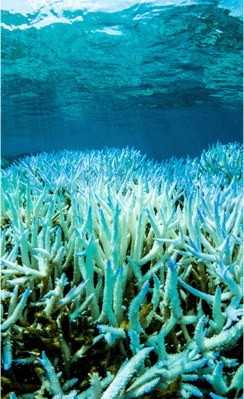
https://wordpress.com/read/feeds/17124327/posts/1359555949 John Pratt 2 Mar 17 Just when you thought the situation couldn’t get much worse for the Great Barrier Reef comes news that devastating coral bleaching will almost certainly increase significantly — again — in the coming months.
Record bleaching hit the 1,400-mile-long reef system in 2016, for the third year in a row, killing more than 65 percent of the coral of the northern reef. Climate change has impacted the ecosystem, as the colorful zooxanthellae are expelled from the coral during times of stress, according to numerous studies and the Australian Government’s Great Barrier Reef Marine Park Authority.
Coral can rebound in good times — though it takes as long as a decade — but scientists say that’s not likely to happen soon, if ever. The reef is already warmer than it was at this time last year and there’s a strong strong possibility that March and April will set new temperature highs ― and a new record for coral bleaching. Marine park authority workers are already seeing significant bleaching this season.
“The Queensland Government appointed an Adani company director to chair the authority overseeing the Abbot Point coal port, despite being warned of “potential conflicts of interest”.
Key points:
“It’s undoubtedly a conflict of interest,” said law professor on Mr Fish’s appointment
Treasurer’s office confirms it knew of Mr Fish’s directorship and that he “disclosed potential conflicts of interest prior to his appointment”
But Mr Fish’s link to Adani was not disclosed publicly by the Treasurer when he was appointed … “
Adani coal mine is a public health catastrophe http://www.examiner.com.au/story/4485747/adani-coal-mine-is-a-public-health-catastrophe/?cs=97Dr Kate Charlesworth 26 Feb 2017,The international medical community is watching Australia with alarm. This month The Lancet, one of the world’s leading medical journals, published a report about the giant Adani mine, titled: Australia’s new coal mine plan: a “public health disaster”.
Coal mines are a health risk for miners, workers and local communities: they cause higher rates of childhood asthma, heart and lung disease, and some cancers. Frighteningly, there has been a recent resurgence in black lung disease – a potentially fatal disease caused by breathing in coal dust. More widely, the overwhelming majority of scientists say there can be no more coal mines if we’re to have any chance of a safe climate. Medical organisations are increasingly recognising the health risks, with the British Medical Journal describing climate change as, “a health emergency”.
The global health risks include increased severity and frequency of extreme weather, adverse changes in air pollution, the spread of disease vectors such as mosquitoes, food insecurity and under-nutrition, displacement and mental ill health.
In the UK, an alliance of 15 health bodies including seven royal medical colleges and the British Medical Association are calling for a rapid phase-out of coal to protect health and reduce costs. In Australia, the Royal Australasian College of Physicians recently described climate change as a “public health emergency”. The RACP board determined fossil fuel projects are inconsistent with its core business and, along with many other organisations around the world, has divested from fossil fuels.
Just as health professionals advocated against the tobacco industry, so we have a responsibility to speak up against fossil fuel projects such as the Adani mine, which present such unacceptably high risks.
REneweconomy By Giles Parkinson & Sophie Vorrath on 24 February 2017 The world’s biggest battery manufacturing brands and clean energy lobby groups have signalled they will fight proposed new guidelines and recommendations that could effectively ban battery storage units from inside homes and garages, saying the restrictions are over the top and don’t conform to international standards.
Standards Australia is believed to be preparing the release of new standards that would effectively force most battery storage units to be put in a free-standing and fireproof enclosure, possibly adding thousands of dollars to the cost of installation and making it uneconomic.
The brief is the result of months of international investigation by Environmental Justice Australia and
USA-based environmental law non-profit EarthJustice into the global legal compliance record of the Adani Group.
It puts governments and private stakeholders on notice that backing Adani’s Carmichael
coal mine and rail project in Queensland’s Galilee Basin
may expose them to financial and reputational risks.
“Key findings
“Environmental destruction:
Adani Group companies have a record of environmental destruction and non-compliance with environmental regulations.
Some examples are: …
“‘Black money’: …
“Bribery and illegal exports: …
“Confusing and opaque corporate structures: …
“This is a company the government is entrusting: … ”
The number of high-priced events in Queensland so far this year are 40 (yes, forty) times more common than in renewables-strong South Australia. Did we hear a peep of protest from the Coalition about this? No.
There is no doubt that more renewables, and more competition, will reduce that pricing power. That is a given.
But the Coalition and many in the mainstream media simply don’t want to know. They have barely reported on the high-priced events in Queensland and NSW, or on the real cause of those events in South Australia.
They don’t want to know: politics and ideology are at play.
High energy prices? Blame fossil fuel generators, not renewables, REneweconomy, By Giles Parkinson on 8 February 2017 It seems that you can ask the Coalition government a question about pretty much anything – plunging polls, Donald Trump, Cory Bernardi or even the weather – and the answer will always be the same: “We’re focused on electricity prices.”
Great. But what exactly is the Coalition doing about it? On the evidence to date, not a whole lot, apart from blaming renewables for soaring wholesale electricity costs and promoting something called “clean coal,” despite all the evidence pointing to the fact that coal generation it is not very clean, and not cheap.
They are chasing the wrong target. Australia has experienced some extraordinary high wholesale electricity prices this summer, and most of these price surges have come in states with little large-scale wind or solar.
It is the activities of the fossil fuel generators that are to blame. This is about competition, or the lack of it, and the fossil fuel generators have been going to extraordinary lengths to get rid of competition.
The Australian Energy Regulator has been investigating more than half a dozen “high priced” events, as it is required to do when prices jump above $5,000/MWh. Some of the reports it has already completed make astonishing reading. Continue reading →
Carmichael mine jobs need ’21 times the subsidies’ of renewables, says lobby group
Federal funding for Adani project amounts to $683,060 a job, compared with $32,191 a worker in Queensland’s clean energy sector, 350.org says, Guardian, Joshua Robertson, 8 Feb 17, Clean energy projects in Queensland are already on track to create more employment than Australia’s largest proposed coalmine, which if funded federally would cost taxpayers 21 times more per job, according to new study.
Federal government agencies are investing $71.4m in seven solar farms and a windfarm in Queensland, which are set to deliver a total of 2,218 jobs, according to analysis by climate advocacy group 350.org.
Adani’s proposed Carmichael coal project in central Queensland, which has obtained conditional approval for a $1bn federal infrastructure loan, is predicted to deliver 1,464 jobs.
The level of federal subsidy for Adani would amount to $683,060 a job, compared with $32,191 a worker in Queensland’s clean energy sector.
The Queensland government has accused the federal government of misrepresenting key data while talking up coal in an ideological attack on renewable energy. Continue reading →
“Lawyers for the Wangan and Jagalingou (W&J) Traditional Owners Councilhave today written to Adani
demanding it withdraw its application to have an Indigenous Land Use Agreement (ILUA)
for its proposed Carmichael mine registered by the National Native Title Tribunal (NNTT).
Should Adani refuse, a declaration will be sought in the Federal Court to have the ILUA struck out.
See the Letter. http://wanganjagalingou.com.au/wj-council-acts-on-adanis-invalid-indigenous-land-use-agreement/
“Members of the W&J Council lodged a formal objection last year to the purported ILUA.
The NNTT was due to make its decision this Friday, however the Federal Court in the matter of
McGlade v Native Title Registrar [2017] throws doubt on whether Adani’s agreement is a valid ILUA.
“Leading Aboriginal rights advocate, a primary W&J Traditional Owner and Council spokesperson, Mr. Adrian Burragubba, says,
“We make it plain to the Queensland and Federal Governments that we will not surrender our ancestral homelands for Adani’s mine of mass destruction.
We will defeat this company’s attempts to divide and conquer us and continue our legal battles to remove the leases issued by the Queensland Government.
““Our fight is far from over.
Anyone who wants to bankroll Adani, and the Queensland and Commonwealth Governments,
are on notice that we will not stand by if attempts are made, in response to the Noongar decision,
to put our rights and interests, and our laws and customs, on the chopping block for the mining lobby,” he said. …
W&J youth leader and Council spokesperson, Ms. Murrawah Johnson, says,
“We have maintained all along that Adani does not have the consent of the rightful Traditional Owners.
Our Traditional Owners group have rejected an ILUA with Adani three times.
We will defeat Adani’s fake ILUA and continue to fight for our land and culture until the company
and Governments respect our rights and abandon this disastrous proposal”.
“In seeking Adani’s withdrawal, W&J Council has not removed its objection to the registration of the Adani ILUA by the NNTT. … “
No new coal-fired power stations planned for Queensland, Australian Financial Review, by Mark Ludlow, 7 Feb 17 The Palaszczuk Labor government said it had no plans to back any new coal-fired power stations in Queensland, despite the Turnbull government planning to use the $5 billion Northern Australia Infrastructure Fund to help bankroll new base-load power in the state’s far north.
Energy Minister Mark Bailey – who is attempting to transform the state’s power mix from 7 per cent to 50 per cent renewables in the next 13 years – said new “clean coal” power stations were too expensive and there was more than enough wind, solar and hydro projects about to come online in the state.
“There is simply no need for new coal-fired base load generation in North Queensland,” Mr Bailey said.
“With the start of a large scale renewable industry under the Palaszczuk government, North Queensland is getting its own power stations, with twenty-first century producing affordable, clean energy.”
It comes as Mr Bailey has written to federal Energy Minister Josh Frydenberg to accuse him of using flawed modelling to criticise the state Labor governments and their ambitious renewable energy targets.
In the letter, obtained by The Australian Financial Review, Mr Bailey questioned the $27 billion figure Mr Frydenberg has repeatedly claimed would be the cost of the state renewable programs, asking since late last year to publicly release the modelling to back up the figure.
“I am disappointed by the lack of detail provided in your response in which you simply outlined some of the data sources used in your department’s analysis,” Mr Bailey said in the letter.
“As a consequence, your response leaves me no clearer as to how the capital cost estimate of $27 billion was calculated. It confirms my concerns, however, about your use of this figure which even with limited visibility of your modelling is clearly flawed.”
Mr Bailey said the Turnbull government was continuing to “demonise renewable energy” and undermine Queensland’s consumer confidence by attacking the state renewable targets. He said the state was committed to moving away from fossil fuels, with more than 680 megawatts of new renewable projects, worth $1.5 billion, in the pipeline.
Meanwhile, the Clean Energy Regulator has warned electricity retailers that they have until the deadline of February 14 to meet their obligations under the Renewable Energy Target. It follows ERM Power, one of Australia’s largest electricity retailers, choosing to pay a $123 million penalty rather than their RET liabilities.
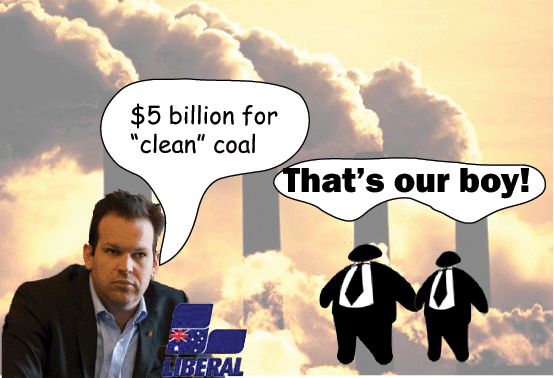
Resources Minister Matt Canavan opens $5 billion infrastructure fund for clean-coal power stations, ABC News, 3 Feb 17 By political reporter Henry Belot Resources Minister Matt Canavan has opened the $5 billion Northern Australia Infrastructure Fund to fund new so-called clean-coal power stations.
Key points:
The Federal Government has invested close to $590 million in clean-coal technology since 2009
Australia does not have a high-efficiency, low-emission power station
Prime Minister Turnbull announced the push for more clean-coal technology earlier this week
Mr Canavan said he had received interest from energy generators to tap into the billion-dollar investment fund and explore North Queensland. “I’ve received some interest over the past week associated with our commitment to build base load power stations, including to support clean coal options,” he told ABC AM. Mr Canavan would not say which companies had expressed interest but said there were viable options near the Galilee Basin and other parts of the state’s north.
The Federal Government has invested close to $590 million in clean-coal technology since 2009 but Australia does not have a high-efficiency, low-emission power station. The Resources Minister cited a 2012 report by industry consultants GHD, which indicated clean-coal power stations could be commercially viable in Australia’s north.
Mr Canavan dismissed comments by some Australia’s energy generators — including AGL and Energy Australia — saying new power stations would be expensive to build and require significant public funds……
Bloomberg New Energy finance researcher Leonard Quong said new coal would be the most expensive form of energy supply. “New coal is made particularly expensive due to the substantial carbon, reputation, trading and construction risks the technology presents to an investor,” he said.
The renewed focus on clean-coal has drawn criticism from Labor and the Greens, who have accused the Government of trying to protect “the coal club”.
Opposition spokesman for climate change and energy Mark Butler said a preference for coal over renewables would mean higher power bills for Australians. Greens leader Richard Di Natale said the cleanest form of electricity would remain wind and solar, while raising concerns about the cost of new base-load coal plants. http://www.abc.net.au/news/2017-02-03/infrastructure-fund-opened-for-clean-coal-power-stations/8237866
Push for coal-fired power Malcolm Turnbull has formed a new, powerful cabinet committee to oversee national energy policy.
Turnbull taskforce to push coal-fired power for north The Australian February 4, 2017 DENNIS SHANAHAN Political Editor Canberra MICHAEL OWEN, Malcolm Turnbull has formed a new, powerful cabinet committee to oversee national energy policy as the government proposes to use some of the $5 billion Northern Australia Fund to help build a new, commercially viable coal-fired power station in northern Queensland……
As parliament resumes next week the Prime Minister is putting energy security and lower power prices at the heart of the Coalition’s policy and political campaign with the new cabinet sub-committee — including Mr Turnbull, Barnaby Joyce, Julie Bishop, Scott Morrison, Mathias Cormann, Josh Frydenberg, Matt Canavan and Arthur Sinodinos — starting to co-ordinate and develop a national energy policy…….
Mr Turnbull and the Treasurer have flagged using funds from the Clean Energy Development Fund for modern coal-powered generators the government has convinced the $100 billion Asia Infrastructure Investment Bank to lend for coal-fired electricity generation in Asia. Senator Canavan, the Minister for Northern Australia, yesterday suggested the government help fund a coal-fired power station in the Galilee Basin in Queensland……
“We back clean-coal options in the north and I want to make clear that we will back investment in clean coal through our $5bn Northern Australia Infrastructure Facility. We set up that facility to build infrastructure in the north, to build specific infrastructure like power stations,” Senator Canavan said….
Defence told to look elsewhere as plan to seize Queensland cattle country sparks outcry
PM tells defence to find other sites to train foreign troops amid anger at plan to expand Shoalwater Bay training area, Guardian, Joshua Robertson, 2 Feb 17, Malcolm Turnbull has ordered the Department of Defence to find alternative sites for foreign military training in Queensland after uproar over plans to take over as many as 60 grazing properties in prime cattle country.
The state opposition leader, Tim Nicholls, on Thursday said the prime minister intervened after a growing backlash over the prospect of compulsory acquisitions, revealed months after an election campaign in which the federal government trumpeted a $2.2bn training deal with Singapore.
The controversy prompted Nicholls to write to Turnbull imploring him to step in after what he said was defence’s mishandling of the proposed training site expansion at Shoalwater Bay and near Townsville.
The federal opposition leader, Bill Shorten, wrote to Turnbull on Wednesday calling for him to urgently review the matter and explain what “alternatives to acquiring prime grazing land” had been considered.
Nicholls’ statement raised doubts about what other options defence, which has compulsory land acquisition powers, had explored to date for expanding training bases to host 14,000 Singapore troops a year………
The parties all warned the loss of drought-resistant grazing land in areas that contain up to 100,000 head of cattle would have a dramatic and harmful impact on the beef industry.
In November landholders in the Marlborough and Charters Towers regions first learned of the possibility their properties would be acquired in letters from defence, which had planned an expansion of about 170,000 hectares.
Defence is yet to decide which properties it will target but the defence minister, Marise Payne, recently ordered the process be sped up with those plans to be revealed next month.
More than half of Liberal voters also oppose plan to loan Indian company $1bn to build a rail line between proposed Carmichael coalmine and Abbot Point, Guardian, Michael Slezak, Three-quarters of Australians, including most Liberal voters, oppose the government giving a $1bn loan to Adani to build a rail line between its proposed Carmichael coalmine and the Abbot Point shipping terminal.
The rail line, if built, would allow Adani to build the country’s biggest coalmine and open up the Galilee Basin to further mines by linking them to an export terminal.
Coral scientists have argued the coal needs to stay in the ground if the Great Barrier Reef is to be protected from the impacts of climate change.
The government has argued there is no definite link between the coal from the Adani mine being burned and climate change, and the resources minister, Matthew Canavan, has said the mine would “be a good thing for the environment”.
But a ReachTel poll of 2,126 people across Australia conducted on 12 January, commissioned by GetUp, found 74.4% of respondents said “no” when asked whether “lending $1bn to an offshore mining company to build a coal rail line is a good use of public money”.
Just 16.2% of respondents thought it was a good use of public money, with 9.5% saying they didn’t know.
The opposition was strong regardless of voting intention, with 53.7% of those who said they would vote Liberal opposing the loan. Just over 80% of “undecided” voters, 85.5% of Labor voters and 89.9% of Greens voters said the loan was a bad use of public money.
A previous survey of people living in the region that would host the mine found two-thirds opposed public money being used to support the mine. Analysis from Greenpeace has suggested the rail project does not meet the requirements for a loan under the scheme, since it will not be “of public benefit” and it is not clear Adani will be able to repay the loan.
GetUp’s Miriam Lyons said: “A mere 16% of Australians think this is a good way to invest public money. While we see hospitals and schools starved of resources, the government sees fit to hand over a billion bucks to build Adani’s shiny new train.”
Lyons called on Malcolm Turnbull to stop the loan going ahead.
“Prime minister Turnbull’s not even playing for his own team – only 32% of Liberal voters agree with this use of public money,” she said.
Adani coalmine activists gear up to fight: ‘This will dwarf the Franklin blockade’
As the protest against the Carmichael project – Australia’s largest proposed coalmine – moves beyond the courts and into the realm of civil disobedience, activists have a clear warning: ‘If you’re in bed with Adani, you’re a target’, Guardian, Joshua Robertson, 14 Jan 17, Across Australia a secretive network of activists are laying the groundwork for what they expect will be the biggest environmental protest movement in the country’s history.
Of course this won’t materialise if Adani and the rest of the miners proposing to open up one of the world’s biggest coalfields walk away from Queensland’s Galilee basin first.
Sunny Brisbane rooftops well placed to capitalise on solar power, experts say, ABC 6 Jan 17, PM By Katherine GregoryBrisbane has the potential to capitalise on solar power’s more competitive pricing, according to experts.
New research by the not-for-profit solar energy company Australian PV Institute and the University of New South Wales has revealed solar panels in Brisbane’s CBD could generate significant savings.
“We’ve done this stocktake of the solar potential of Brisbane’s CBD and from that we’ve worked out that Brisbane could install 188 megawatts of solar on the rooftops of the CBD and produce enough power to meet 11 per cent of demand of the CBD,” the Institute’s chair Renate Egan said.
“This could be done with upfront investment of about $200 million and would payback in electricity repayments $30 million a year.”
To conduct the stocktake the institute used its new Solar Potential Map, which calculates how much electricity can be generated from any particular roof in Brisbane’s CBD.
Ms Egan said it had found close to 50 per cent of roofs could have solar panels.
“We’ve started with Brisbane CBD because Brisbane and Queensland are really proactive around solar,” she said.
“Queensland has got the largest update of solar in Australia, with 1.6 gigawatts of solar installed in Brisbane [and] in Queensland, and they have a target of getting to three gigawatts by 2020.”
Ms Egan said the institute had also engaged with the Queensland Government about it providing the initial upfront investment to install the panels on government buildings such as Suncorp Stadium and the Queensland Performing Arts Centre (QPAC).
“Anything that helps achieve our renewable energy target of 50 per cent by 2030 is being considered,” a spokesman for Queensland’s Energy Minister Mark Bailey said in a statement.
‘Like trying to develop an alpine skiing industry in Queensland’
But the Federal Minister for Northern Australia, Matt Canavan, said Queensland’s renewable energy target was mad.
“It’s like trying to develop an alpine skiing industry in Queensland, it’s about as realistic as that,” he said.
“We don’t have the same renewable resources as say South Australia.
“It would cost an enormous amount of money to build in Queensland and put at risk huge amounts of jobs, particularly in the power sector.







 Antinuclear