Your Say: Comments on safety in importing nuclear wastes
 Lachlan Childs 14 Sep 2016 We are not a rich country, we don’t have money to just throw in the air. A Nuclear waste dump would not only harm the environment, and radiate the land for future generations, but it would put the country into bankruptcy. The nuclear waste dump may in fact cost millions of dollars just to set up and manufacture. I understand that the government will then say “Oh! but if we go forward with the Nuclear Waste Dump, a total of $279 billion dollars with be made,” Yea but at the risk of thousands being affected by radiation and if the shipping makes a mistake which could possibly happen, Australia would become another wasteland.
Marisol Da Silva 12 Sept 16 People predicted the Fukushima accident could happen years before it did happen. Chernobyl had it’s disaster because of human error. Because, as humans we do get it wrong. Years after both of these major catastrophes it is still costing money to maintain, clean up, not to mention the health issues of the people and children left behind to live with nuclear devastation. To this date there has been no real solution on how to store nuclear waste. It has been proven that it costs way to to much to plan, build, maintain now and far into the future as this stuff is going to stick around for what is essentially a forever (far beyond several human lifespans and our imaginations into the future). With all the information out there on radiation sickness and the unpredictability of natural disasters occurring, how can anyone hold a straight face and claim nuclear waste, power, mining, bombs are safe? Because ultimately all these things are linked. If you feel you have forgotten then ask the children of Chernobyl and the former USSR, Fukushima, the Marshall Islands, the survivors of the atomic bomb, British Maralinga SA tests, the tribals in Jagugoda Jharkhand India, and the list goes on. We don’t learn. Why don’t we learn from their stories? Why do you think South Australia suddenly will solve what no one has solved? Do you think future children are ever going to thank you for even entertaining this idea? It is a shame that a few greedy people can ruin the earth for the rest of us. We can’t let this happen. We wont let this happen here.
Craig Gordon 01 Sep 2016 I have a question relating to sea transport and geology.
When I stopped at a “Know Nuclear” stand recently the person I spoke to mentioned that with 10km’s of the coast lost cargo would be retrievable.. but past that it wouldn’t be accessible/safe/whatever to bring the waste back to the surface.
She wasn’t quite sure how to answer my follow up question though.. (her expertise was physics, not geology).
My (limited) understanding is that unlike continental crust, which is stable, oceanic crust is constantly being subducted into the core of the earth into the mantle… I understand the rate of this is slow.. but I was wondering how that process might relate to any high level waste that was lost at sea?
http://nuclear.yoursay.sa.gov.au/get-invol…/statewide-survey
Your Say: Immoral and illegal for Jay Weatherill to spend taxpayer money to promote nuclear waste dump
 Peter Lazic 12 Sep 2016 What consent does Jay Weatherill have to spend $600 million dollars of taxpayer money to plan a nuclear waste dump, when the proposed dump may never get approved. This and the money spent to date on the Royal Commission, the road show, now TV advertisements, etc, is obscene and immoral
Ed note : Especially as the SA Law says:
13—No public money to be used to encourage or finance construction or
operation of nuclear waste storage facility Nuclear Waste Storage Facility (Prohibition) Act 2000https://www.legislation.sa.gov.au/LZ/C/A/NUCLEAR%20WASTE%20STORAGE%20FACILITY%20(PROHIBITION)%20ACT%202000/CURRENT/2000.68.UN.PDF
http://nuclear.yoursay.sa.gov.au/get-invol…/statewide-survey
When will Premier Weatherill admit that the nuclear bonanza is a really bad idea.
an illusion http://www.adelaidenow.com.au/news/opinion/margaret-beavis-claims-south-australia-will-make-a-fortune-out-of-nuclear-waste-are-just-an-illusion/news-story/de432ce34d9deac7cfbfab406ec32c71 Margaret Beavis, The Advertiser September 13, 2016 THE acclaim around the pot of gold to be made importing nuclear waste into South Australia increasingly feels more like an illusion.There are so many invisible parts making up this story, it is probably only a matter of time before Premier Jay Weatherill finds the courage to say the nuclear bonanza is a really bad idea.
So what are these invisible items?
Firstly, there are no high level nuclear waste facilities anywhere in the world. None. Anywhere.
Both Germany’s efforts have leaked radiation into the water table, and they are currently spending billions pulling the waste out again.
 In Nevada, the US government has spent over US$10 billion building a site, only to find multiple problems including deliberately falsified data about the water table, and massive community opposition. It will never open. The Waste Isolation Pilot Plant in New Mexico closed two years ago after a fire and later an explosion exposed 22 workers and contaminated the whole site. Official investigation found cost cutting, corner cutting and human error was to blame, with a “loss of safety culture”.
The high level nuclear sites in Sweden and Finland were described by the recent Nuclear Fuel Cycle Royal Commission in South Australia as “successful”.
These locations have been researched for 40 years, and will not even start taking waste for at least another six years and, in the Swedish case, well over a decade. It is easy to succeed when there is no radioactive stuff to actually deal with.
 For the last forty years we have counselled pregnant women to avoid X-rays as we know their babies have much higher rates of leukemia.
Evidence from Hiroshima and Nagasaki, from vast human trials literally involving hundreds of thousands of nuclear workers to research about Cat scans and nuclear heart scans, all point to significant harms with additional radiation.
There is no evidence of a safe lower dose; the higher the exposure the higher the risk.
And recent large research trial found rates of stroke and heart attack are also increased.
There is a good reason why countries want so badly to be rid of this material, which is toxic for over 100,000 years.
Thirdly, we have nowhere to put it.
The plan is to import it, and then find some poor remote community to take it.
The problem with that theory is that for almost twenty years the government has been looking for a site for Australia’s own intermediate level waste, without success.
 Aboriginal communities have been disproportionately targeted. We clearly already have more nuclear waste than we know what to do with.
Finally the promised billions, so pivotal to the whole proposal, are risky.
They have been modelled by a firm that works in this area and has potentially a strong vested interest in this venture going ahead
They have not allowed for potential competition, which would massively reduce the prices paid. They have included countries like Ukraine as clients, when Ukraine is looking into building its own facility at Chernobyl.
They have included countries like Bangladesh, which does not even have a reactor yet.
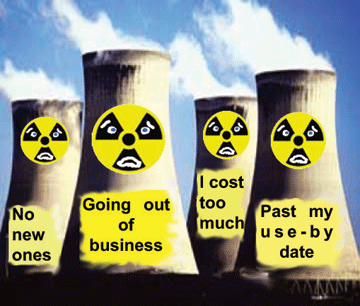 And it has made assumptions about the viability of the nuclear power industry, when plants in places like the US are closing down as they cannot compete financially.
Nuclear waste facilities are very expensive to build, and historically costs inevitably blow out. For example, in the current French waste construction project costs have doubled in the last decade.
There has been no independent financial modelling done by the government, which is extraordinary given the enormous financial risks and the extraordinary time frames.
And the income to cover the clean up — decommissioning and other costs — does not start until 2042.
In essence, this proposal is startling in its optimism.
The likely outcome if it goes ahead is a whole lot of highly toxic radioactive waste lasting for 100,000 years in South Australia, and billions of taxpayers’ money spent trying to find a way that works to get rid of it.
If it is such a financial bonanza, many countries would be racing to do it.
The reality is that a royal commission, lots of clever marketing, 100 consultation sites and a couple of citizens’ juries still don’t make this a smart idea.
Margaret Beavis is president of the Medical Association for Prevention of War
An expert witness to the Nuclear Citizens Jury – sceptical of the “economic bonanza”
 The price is a guess; there is no market price for accepting dumped waste at the present time.
The cost of shipping the waste to South Australia seems also to be a notional allowance in Appendix J ($0.20m/tonne heavy metal). Where this comes from is not obvious.
far from being a financial bonanza, as proposed by the Royal Commission, the project could make minimal returns, and be a real distraction from alternative paths to the economic future of the state
The SA economy, the nuclear waste dump and democracy Richard Blandy INDaily, 12 Sept 16 ANALYSIS As TV messages encourage South Australians to become informed about a proposed nuclear waste dump, Richard Blandy argues the project could prove a distraction from exploring alternative solutions to the state’s economic challenges.
Several times in recent days I have seen a brief message on our TV in which a South Australian mother advises her small daughter that everyone must become informed about the proposed high-level nuclear waste dump in the state. Her daughter looks suitably mystified.
No doubt this is part of the exercise in citizens’ democracy that is currently underway to determine whether there is a “social licence” to proceed with such a dump. Other elements in this process include two meetings of citizens’ juries (one of which has already been held), as well as citizens’ information meetings.
The TV message could have come from the satirical 1970 movie The Rise and Rise of Michael Rimmer, in which conman Rimmer (Peter Cook) eventually becomes British Prime Minister. …….
my experience of the first citizens’ jury, which I attended as an expert witness on July 9, was very positive. I was invited principally as a result of my InDaily articles opposing the dump.
There was one other expert economics witness present questioning the economics of the dump: Rod Campbell, research director of the Australia Institute in Canberra.
Several of the expert witnesses present who supported the economics of the dump had been involved in undertaking the economic/financial analysis for the Nuclear Fuel Cycle Royal Commission.
The citizens’ jury operated as a free-flowing discussion rather than with set pieces presented by the witnesses followed by questions from the jurors. The issues are difficult and technical, but the jurors were great. They made me think that if I am ever in deep trouble with the law, I will always opt for trial by jury.
The 54 South Australian citizens on the jury were sensible, common-sense people who asked pertinent questions. They quite properly insisted that the business case for the dump should be made watertight – or the dump abandoned. Continue reading
Taxpayers up for huge costs in South Australia – just for the PLANNING for nuclear waste importing
 Political Reporter Sheradyn Holderhead, The Advertiser September 11, 2016 THE State Government will need to find up to $600 million to plan a nuclear waste dump even if the project never gets off the ground, a consultant working on the Royal Commission has revealed.
Jacobs Engineering Group project manager Tim Johnson told a parliamentary committee investigating the project that the total cost prior to the decision to proceed and sign contracts with client countries would likely be $300 million to $600 million.
Premier Jay Weatherill said precommitment from participating countries could reduce the risk for taxpayers.
But Dr Johnson questioned the likelihood of doing that earlier than year six of the project, at which time up to $600 million would already have been spent.
Late last week, the committee visited a dump site in Nevada where more than $10 billion has been spent by US government. The project has stalled for years as the state and federal governments fight over approvals.
Liberal MLC and committee member Rob Lucas said the large costs were “a potential deal breaker”.
“I don’t speak for the committee or my party at this stage. Personally, I would find it very hard to support any proposal which meant we could spend $600 million and then decide we wouldn’t proceed with the project,” he said.
“That would simply mean taxpayers had wasted $600 million for nothing.” Continue reading
Confusion about the two South Australian nuclear waste dump plans
 Are these 2 proposals really so separate, or is the Federal dump choice of South Australia planned so as to soften up South Australians and Australia at large, to view South Australia as a suitable radioactive trash toilet? South Australian Liberals, and the Federal Liberal and Labor are all staying quiet about the Scarce Nuclear Commission plan – but are they secretly in support of it?
Two nuclear proposals ‘confusing discussion’ about potential waste dumps in South Australia, ABC News 2 Sept 16 By Lauren Waldhuter Two separate proposals for storing nuclear waste in South Australia have caused widespread confusion in communities and the Premier has conceded public consultation was badly timed.
 The State Government has launched a state-wide public consultation program on royal commission recommendations to store the world’s high-grade nuclear waste in SA.
But at the same time the Federal Government hasshort-listed Wallerberdina station, near Hawker in the Flinders Ranges, as a preferred site for Australia’s first storage facility for low-to-intermediate level radioactive waste.
Hawker Community Development Board chairperson Janice McInnis said SA’s public consultation was clouding discussion about the federal plan.
“I’ve had phone calls from friends in Adelaide who said, ‘what’s this about a waste dump at Hawker?’, thinking it was the state one and they hadn’t heard about the federal one at all,” she said.
| March 2015 | Nuclear Fuel Cycle Royal Commission established. |
May 2015 |
Landholder nominations to host Australia’s Radioactive Waste Management Facility close. |
| May 2015 |
Royal commission releases four issues papers. Public consultation period begins. |
November 2015 |
Six sites around Australia identified for further assessment, including three in SA. Consultation period begins. |
| February 2016 |
Royal commission releases tentative findings. It suggests SA builds a dump for the world’s high-level nuclear waste. |
April 2016 |
Federal Government announces Wallerberdina station as its preferred site. |
| May 2016 | Final report released and consultation continues. | Present | Consultation continues until next year. |
Premier Jay Weatherill admitted the timing could have been better.
“Certainly we would’ve preferred if the federal process had have waited until our process had been underway,” he said.
“There’s no doubt there’s been confusion between the federal process and the South Australian Government process.
“We’ve detected that as we’ve gone out and spoken to people.
“I think the Commonwealth support the approach that we’ve taken but we’re going to have to find a way to bring those two decision-making processes together.”……..
Two sets of conversations ‘insulting’ Despite disagreeing with both government plans to pursue a nuclear future for SA, environmental groups agree the issue has become too confusing.
The Conservation Council of SA held an expo in Port Augusta on Friday to highlight concerns about both proposals as well as their differences.
“It’s actually insulting to have two sets of governments having two sets of conversations on two different proposals at the same time,” chief executive Craig Wilkins said.
“No wonder the community is confused. “It’s incredibly important that these two plans are kept separate because the impacts are very, very different.” http://www.abc.net.au/news/2016-09-04/nuclear-proposals-confusing-discussion-in-sa/7812646?pfmredir=sm
South Australia’s Premier Weatherill is proud that his nuclear waste import plan is RISKY!
 Voters will reward my courage, Weatherill insists, INDaily, 1 Sept 16 Tom Richardson
 Tom Richardson “……….the Premier believes the South Australian public will reward his own Government at the 2018 election for courting “political risk” with contentious changes to the state’s healthcare system and a royal commission into the nuclear fuel cycle………
I think ultimately people will give credit to people that are taking on the big decisions,” he insisted.
“There will always be complaints around the edges, but in their heart of hearts they understand somebody’s got to tackle these big questions.”……
On the nuclear issue, acting Liberal leader, Vickie Chapman said: “Weatherill scans the world and tries to find an idea, then thinks, ‘I’ll be bold and brash about this’ – but he’s years late, so it just becomes a sideshow.”……http://indaily.com.au/news/politics/2016/09/01/voters-will-reward-my-courage-weatherill-insists/
Secret forum – for the Nuclear Royal Commission to indoctrinate kids?
 The South Australian government is going to a lot of trouble to set up a forum for 160 students and 60 teachers to hear a presentation from the former Nuclear Royal commissioner, Kevin Scarce, and the Chief Executive of the Nuclear Consultation and Response Agency, to tell them all about the plan for South Australia to import foreign nuclear waste.
Surface nuclear waste spurs community concern
Community concern is mounting about plans to store high level radioactive waste above ground for years before building a proposed nuclear waste dump, warns Conservation SA CEO Craig Wilkins.
“From our public consultation, most people think this proposed dump is an ‘out of sight, out of mind’ idea, where we bury the waste deep in the outback and that’s it,” he said. “The reality is very different.
“The Nuclear Fuel Cycle Royal Commission was very candid: The project only stacks up financially if we import and stockpile 50,000 tonnes of nuclear waste above ground for as long as 17 years before we can deposit it in an underground disposal site. Indeed, that ‘interim’ surface site will store tens of thousands of tonnes above ground for the next 100 years.

“So, we acquire the risk and responsibility for this nuclear waste before we know if we can actually build and operate the ultimate repository – let alone obtain community consent for it.
“Before we get there, ships containing that high-level waste enter South Australian waters through problem areas such as the South China Sea, then traverse our prawn and tuna fisheries, aquaculture zones and tourism hotspots every month for 70 years. That is a huge amount of risk.
“The plan would require a purpose-built nuclear port and rail line with nuclear waste being stored at five different locations across the state. While these facts are publicly accessible, they’ve been obscured by the promise of eye-popping windfall profits from this proposal.”
However, community concern has grown as South Australian citizens identify problems with the financial viability, environmental impact and community effects of the proposed nuclear waste dump.
In Port Augusta, a two-day community forum, called Exposure 2016, will run this weekend, from September 2-4, at the city’s Institute Theatre, starting on Friday night with ‘Talking Straight Out’. This exhibition showcases the famous Irati Wanti campaign when senior Aboriginal women from Coober Pedy, the Kupa Piti Kungka Tjuta, defeated Federal Government plans to dump radioactive waste on their land.
The free event will also include sessions on the SA Government’s international nuclear waste dumping plans; current Federal Government plans to dump waste in the Flinders Ranges; traditional owners’ voices and rights; impacts of radiation on people and the environment; impacts on industries including tourism, farming and recreation and the track record of radioactive waste management / mismanagement in South Australia and globally.
For many South Australians, the proposed nuclear waste dump in the State’s outback invokes memories of Maralinga and Emu Fields, the South Australian sites of nine British secret nuclear tests between 1953 and 1963. The tests exposed local Aboriginal communities to radiation that caused cancers, blindness and ongoing genetic damage. British and Australian servicemen were also exposed and radioactivity was detected in SA, NT, NSW and Queensland.
South Australian singer Mike Roberts also communicates concern about the nuclear waste dump in his new song Welcome to the Nuclear State. Listen at http://www.cdbaby.com/cd/mikeroberts23#. For community concerns about the SA nuclear waste dump, visit http://www.nodumpalliance.org.au/.
South Australia’s nuclear waste dump plan not economically viable? The nuclear lobby doesn’t care
The global nuclear lobby surely does not care about whether or not the South Australian nuclear waste importing scheme is economically viable. Their fairly desperate need is to sell nuclear reactors to those countries that don’t already have them. In particular, the ‘small nuclear” lobby sees an urgency now, with ‘big nuclear’ failing, to get their industry happening.
A commitment by an Australian State to take in nuclear waste could do the trick for them – as Oscar Archer put it – by unblocking the back end of the nuclear fuel cycle.
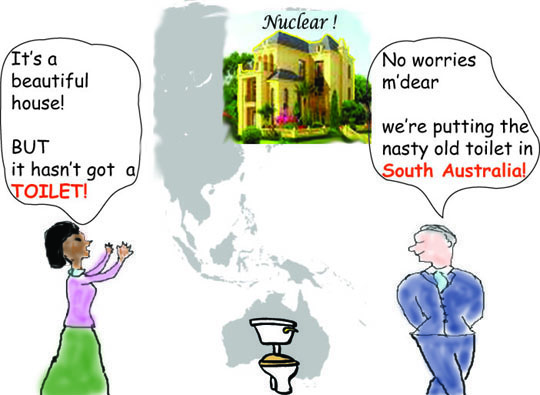
Mixed motives in South Australia’s nuclear waste import plan. Online Opinion, Noel Wauchope, 23 Aug 16 In South Australia the continued nuclear push focusses solely on a nuclear waste importing industry. Yet that might not be economically viable. Behind the scenes, another agenda is being pursued – that of developing new generation nuclear reactors.
First, let’s look at the message. The message from the Nuclear Fuel Cycle Royal Commission (NFCRC) is clearly a plan to make South Australia rich, by importing foreign nuclear wastes. …..This theme has been repeated ad nauseam by the NFCRC’s publicity, by politicians, and the mainstream media.…..
Whereas other countries are compelled to develop nuclear waste facilities, to deal with their waste production from civil and military reactors,that is not a necessity for Australia, (with the exception of relatively tiny amounts derived from the Lucas Heights research reactor).
So, the only reason for South Australia to develop a massive nuclear waste management business is to make money.
If it’s not profitable, then it shouldn’t be done.
Or so it would seem.
There is another, quieter, message. When you read the Royal Commission’s reports, you find that, while the major aim is for a nuclear waste business, in fact, the door is kept open for other parts of the nuclear fuel chain……… Continue reading
Nuclear waste plan for South Australia not economically viable? Global nuclear lobby doesn’t care
The global nuclear lobby surely does not care about whether or not the South Australian nuclear waste importing scheme is economically viable.
A commitment by an Australian State to take in nuclear waste could do the trick for them – as Oscar Archer put it – by unblocking the back end of the nuclear fuel cycle. The NFCRC plan also promises the chance of a market in Australia for the mini nuclear reactors.
Mixed motives in South Australia’s nuclear waste import plan, Noel Wauchope, Online Opinion, 23 Aug 16, In South Australia the continued nuclear push focusses solely on a nuclear waste importing industry. Yet that might not be economically viable. Behind the scenes, another agenda is being pursued – that of developing new generation nuclear reactors.
First, let’s look at the message. The message from the Nuclear Fuel Cycle Royal Commission (NFCRC) is clearly a plan to make South Australia rich, by importing foreign nuclear wastes……This theme has been repeated ad nauseam by the NFCRC’s publicity, by politicians, and the mainstream media.…..
Meanwhile, the South Australian Parliament is holding a Committee Inquiry into the NFCRC’s recommendations. This Committee asked witnesses about various aspects of the plan. However, an intense focus in questioning Royal Commissioner Kevin Scarce, and Dr Tim Johnson from Jacob Engineering (financial reporter to the NFCRC) was directed at the economic question. It was clear that the politicians were concerned that there’s a possibility of the State spending a significant amount of money on the project, which might then not go ahead. And, indeed, Dr Johnson acknowledged that, financially,” there is a very significant risk”
Whereas other countries are compelled to develop nuclear waste facilities, to deal with their waste production from civil and military reactors,that is not a necessity for Australia, (with the exception of relatively tiny amounts derived from the Lucas Heights research reactor).
So, the only reason for South Australia to develop a massive nuclear waste management business is to make money.
If it’s not profitable, then it shouldn’t be done.
Or so it would seem.
There is another, quieter, message. When you read the Royal Commission’s reports, you find that, while the major aim is for a nuclear waste business, in fact, the door is kept open for other parts of the nuclear fuel chain…….
The clearest explanation of this came early in 2015, just as the NFCRC was starting, in an ABC Radio National talk by Oscar Archer…….
Archer’s plan is significant because it illustrates a very important point about South Australia’s nuclear waste plan – IT SOLVES A GLOBAL NUCLEAR INDUSTRY PROBLEM. Both in ‘already nuclear’ countries, especially America, and in the so far non nuclear counties, such as in South Asia, the nuclear industry is stalled because of its nuclear waste problem. In America, the “new small nuclear”, such as the PRISM, technologies (Power Reactor Innnovative Small Module) cannot even be tested, without a definite waste disposal solution. But, if South Australia provided not only the solution, but also the first setting up of new small reactors, that would give the industry the necessary boost……..
Once Australia has set up a nuclear waste importing industry, the nuclear reactor salesmen of USA, Canada, South Korea, will have an excellent marketing pitch for South Asia, as the nuclear waste problem has been removed from their shores.. And South Asia is exactly the market that the NCRC has in its sights. The NFCRC eliminated most of the EU, Russia, China, North America as customers. This was explained by Dr Tim Jacobs, of Jacobs Engineering, (financial reporters to the NFCRC), at the recent hearing of the South Australian Parliamentary Joint Committee on Findings of the Nuclear Fuel Cycle Royal Commission ………
South Australia’s government is influenced by a strong nuclear lobby push and the Royal Commission advocacy for solving that State’s present financial problems by a futuristic nuclear waste repository bonanza scheme…….
The global nuclear lobby surely does not care about whether or not the South Australian nuclear waste importing scheme is economically viable. Their fairly desperate need is to sell nuclear reactors to those countries that don’t already have them. In particular, the ‘small nuclear” lobby sees an urgency now, with ‘big nuclear’ failing, to get their industry happening.
A commitment by an Australian State to take in nuclear waste could do the trick for them – as Oscar Archer put it – by unblocking the back end of the nuclear fuel cycle. The NFCRC plan also promises the chance of a market in Australia for the mini nuclear reactors. http://www.onlineopinion.com.au/view.asp?article=18465&page=1
South Australian Parliamentary Inquiry asks inconvenient questions about nuclear waste import costs
 SA parliamentary committee questions economics of importing nuclear waste, Independent Australia, 19 August 2016, The economic benefits of SA’s push for a global nuclear waste dump took a negative turn during the current parliamentary committee inquiry. Noel Wauchope reports.
THE SOUTH Australian Parliament is holdinga Joint Committee on Findings of the Nuclear Fuel Cycle Royal Commission (NFCRC).
The five committee members, with one exception, the Greens Mark Parnell, have pro-nuclear opinions. I thought that it was going to be just a rubber stamp for the NFCRC. Now I am not so sure. The committee gave the NFCRC a grilling on the economics of the plan to develop a nuclear waste import industry in South Australia.
Answers indicated that the NFCRC is keen to have discussions with other countries before the matter is resolved at the political level…….
Trawling through the 173 pages transcript of hearings of this committee, I was surprised at the rigour of the questioning of witnesses by the politicians. They did ask hard questions about the arrangements for contracts from overseas countries, customers sending radioactive wastes to South Australia. They asked questions about who pays and when, and for what aspects of the process.
The most intensive questioning of witnesses was certainly on that subject of economics. After all, the plan is to make a financial bonanza for the state. There is no other reason for it. I sensed that the parliamentary committee was indeed focussed on this one basic question:
If it’s not going to make money, why do it?……
Dr Johnson went on to rather confusing statements about the contractual arrangements, and particularly about at what stage revenue would come to South Australia. I don’t think that the committee was inspired with confidence as Johnson discussed this. It was a very lengthy discussion. A few extracts illustrate the economic problems that were revealed in this discussion:
(Transcript p.24) Dr JOHNSON:
We recognised that, once waste got to South Australia, it was very unlikely to leave South Australia. It was very unlikely that there would be anywhere else you could move it on to, so the liability and the responsibility for that waste would be transferred to South Australia. What was a realistic value of that willingness to pay number? We looked at that in a number of different ways because there is no market for it……
a rare mention of the probability of a serious nuclear accident happening – who knows when? It raised the spectre of the expected nuclear waste bonanza suddenly fizzling out, after South Australia had committed to building the nuclear waste repository …..
Dr Johnson seemed to get a bit rattled:
Dr JOHNSON:
In essence we are spending money up until we start signing the contracts, and at this stage on the 28-year timeline that occurs at year six-ish, but if it’s a 40-year timeline and there are delays, then it may well be that you keep spending money and you don’t get the precommitments until later than year six. : I am not an economist; I am a chemist. Quite clearly, we were not looking at this from an economic perspective. Our remit was to look at it from a financial perspective…….
Kristen Jelk asks:
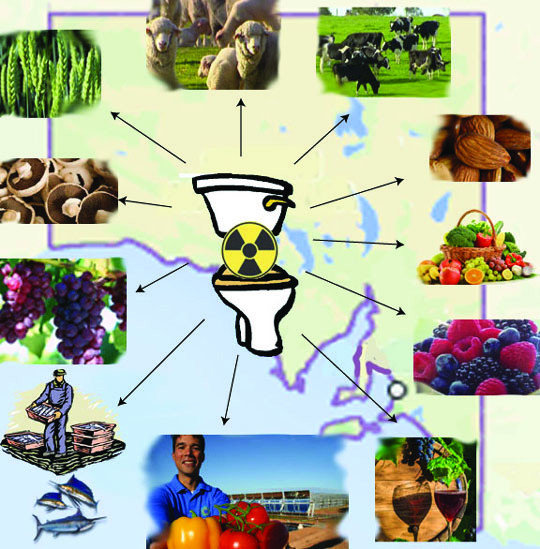
Who is talking about “Brand South Australia”? ……….If SA is pitching safe products to an international market, and it becomes known that this Australian state has established a dump for nuclear waste, then the damage to brand SA will be immeasurable….It will not matter that the dump is in a desert, nor will it matter if the dump is a distance from prime agricultural land, nor will it matter if experts assure of safety standards. The perception that would prevail is that SA will be a dumping ground for nuclear waste. Perception is everything….
China is our largest trading partner. At present, Australia has clear marketing opportunities in China, and for our other nearer neighbours. In assessing the so called golden coin to be gained for bringing in radioactive trash, South Australia needs to also consider the other side of that coin —the economic opportunities that could be lost, along with the risk of a poor or no return on the waste facility investment. https://independentaustralia.net/environment/environment-display/sa-parliamentary-committee-questions-economics-of-importing-nuclear-waste,9371
The “heroic” assumptions of the Nuclear Fuel Chain Royal Commission
 Submission to Joint Committee on Nuclear Royal Commission South Australian Parliament, – Mothers for a Sustainable South Australia, August 2016 http://www.parliament.sa.gov.au/Committees/Pages/Committees.aspx?CTId=2&CId=333
The assumptions underpinning the century-long cost-benefit calculation that this proposal relies upon, are heroic.
Price: There is no market for disposing of HLNW, so the proposed ‘price’ is a guess. It is ‘an illustrative benchmark’ (p 293) – but is critical to the $51 billion profit figure. Experts cannot predict the price of gas, coal or iron ore one year ahead – despite well developed markets for all three. How can a century-long price for something that is not yet traded be sensibly predicted? The price used by the RC is much higher than that suggested by Finnish experience. It is nothing more than a guess.
Cost: There is no existing deep geological storage anywhere in the world, so no experience with what it actually costs. The cost estimate – from transport through to maintenance of the site for 100,000 years – is also simply a guess. The Finns who must dispose of about 6,000 tonnes of their own high level nuclear waste have recently granted construction approval for a deep geological dump at Onkalu – after 40 years lead up. This is the first of its kind in the world – expected to be operational in the 2020s. But until it is built, there is no reliable cost experience for the experimental technology. Further, Onkalu is much smaller than that proposed for SA. What are the costs of something 23 times larger likely to be? Who knows? There are no reliable estimates of what it will cost to transport 138,000 tonnes of HLNW or intermediate waste from, say, Korea to Port Augusta – and then to store it and re-transport it to the far north of the state. Such international transport has not been done before.
A single quote from a nuclear industry insider: As we have pointed out, all these rely on a single consultant report by Jacobs & MCM. Jacobs are industry insiders. They have been in the nuclear industry for 50 years – on projects from construction through to clean up. They have a business interest in the nuclear industries expansion. Jacobs’ website prides itself on ‘ongoing business relationships’ with nuclear industry clients, promising ‘to serve as their advocates and support them in their global aspirations’. They are hired consultants who pride themselves on acting in the interests of their hirers – not for an objective critical viewpoint on behalf of the larger community
The nuclear industry consistently overestimates returns and underestimate risk. For example, academic analysis of the cost of building 180 nuclear reactors up until 2014 (for which cost data is known) found that on average they cost double their original estimates – and most took years longer than expected to build, increasing the costs of finance very significantly (Sovacook, Gilbery and 4 Nugent, 2014). The costs of the US Yucca Mountain deep disposal project also blew out very significantly (prior to it being mothballed). The RC offers ‘sensitivity analysis’ on price, costs and quantity but keeps its analysis within parameters that mean it remains profitable on paper. There are many other plausible assumptions about price, cost and amount of waste received, accidents, and changes in legal, contractual, market or community circumstances that make it not only unprofitable, but potentially extremely costly to Governments – who would own and control the project – and who would have to pick up the tab. The financial risks of the project throw the losses of SA’s state bank debacle into the shade.
What happens if the amount of high level nuclear waste does not eventuate? The economics of the project rely on a minimum quantity of high and medium level nuclear waste. What happens if it does not arrive – for any number of reasons? What if China or the US – or companies from anywhere in the world – enter the market for waste disposal? Both countries – and others – plan to build dumps for their own waste. If this is so profitable, why would they not enter the market to take waste, easily undercutting SA’s price and reducing the quantity in the SA facility – which must achieve a very large share of the international market to be viable, let alone profitable? The nuclear industry consistently overestimates returns and underestimate risk. For example, academic analysis of the cost of building 180 nuclear reactors up until 2014 (for which cost data is known) found that on average they cost double their original estimates – and most took years longer than expected to build, increasing the costs of finance very significantly (Sovacook, Gilbery and 4 Nugent, 2014). The costs of the US Yucca Mountain deep disposal project also blew out very significantly (prior to it being mothballed).
The RC offers ‘sensitivity analysis’ on price, costs and quantity but keeps its analysis within parameters that mean it remains profitable on paper. There are many other plausible assumptions about price, cost and amount of waste received, accidents, and changes in legal, contractual, market or community circumstances that make it not only unprofitable, but potentially extremely costly to Governments – who would own and control the project – and who would have to pick up the tab.
The financial risks of the project throw the losses of SA’s state bank debacle into the shade. What happens if the amount of high level nuclear waste does not eventuate? The economics of the project rely on a minimum quantity of high and medium level nuclear waste. What happens if it does not arrive – for any number of reasons? What if China or the US – or companies from anywhere in the world – enter the market for waste disposal? Both countries – and others – plan to build dumps for their own waste. If this is so profitable, why would they not enter the market to take waste, easily undercutting SA’s price and reducing the quantity in the SA facility – which must achieve a very large share of the international market to be viable, let alone profitable?
Festering doubts on impartiality of Nuclear Royal Commissioner Kevin Scarce
Kevin Scarce, head of SA’s Nuclear Fuel Cycle RC, also has a conflict of interest, 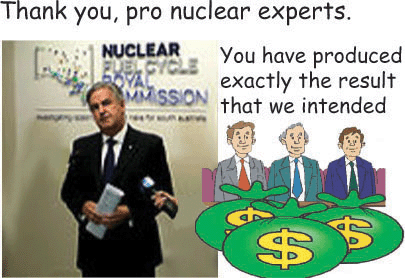 Independent Australia, 4 August 2016, Given the public outcry over Brian Martin’s conflict of interest as head of the Royal Commission into Juvenile Justice in the NT, Noel Wauchope asks why Kevin Scarce’s suitability as head of SA’s Nuclear Fuel Cycle RC wasn’t questioned……..
Brian Martin did not think that he had a conflict of interest in relation to his previous role as a Northern Territory judge. He did not doubt his “capacity to be both independent and competent in the role of the commissioner”. However, he recognised that a community perception of his having a conflict of interest would compromise the Royal Commission and its results.
As Mark Kenny wrote in The Age on 2 August 2016:
‘Indeed, Martin acknowledged this [public confidence] was the crucial factor — irrespective of the facts. He observed if any public doubts about the impartiality or commitment to the unvarnished truth were allowed to “fester” during the commission’s long months, its outcomes would be compromised.’
Why no outcry about the conflict of interest in appointing Kevin Scarce as head of SA’s Nuclear Fuel Cycle RC?
Apparently, while it’s not OK to have a conflict of interest in a National Royal Commissioner, this has not yet been a problem for a State one…….
Unlike the situation with Brian Martin, this is not a case of a perception of conflict of interest by some special sections of the community. It looks more like a choice of a royal commissioner that is unusual and inappropriate and involving a much more obvious conflict of interest.
The general practice in royal commissions is to appoint a serving or retired judge, due to the quasi-legal nature of the process…….Kevin Scarce with no legal background, was a most unusual choice as royal commissioner for South Australia’s Nuclear Fuel Cycle Royal Commission. Furthermore, his military career and close involvement with defence agencies, raises questions about his impartiality…….
There is a strong defence lobby pushing for Australia to acquire nuclear powered submarines. Kevin Scarce was previously the head of Maritime Systems at the Defence Materiel Organisation.
Kevin Scarce is a shareholder in Rio Tinto Group, the owner and operator of Ranger and Rossing uranium mines in Australia and Namibia
Prior to his appointment as Royal Commissioner, Kevin Scarce advocated a nuclear industry for South Australia. Speaking in November 2014 at a Flinders University guest lecture, Scarce acknowledged being “an advocate for a nuclear industry”. ……
2014 Investigator Lecture – Rear Admiral the Honourable Kevin Scarce AC CSC RAN Rtd
Will the outcome of the SA nuclear RC be compromised, given the criticisms so far?…..
The selection of pro nuclear advisers and speakers continued through the Royal Commission’s year-long proceedings and subsequent Citizens’ Jury sessions, as Independent Australia has shown in recent articles. ..
Numerous well researched criticisms sent to this Royal Commission seem to have been ignored. Kevin Scarce has dismissed opposition as based on emotion or opinion, rather than on facts,saying: “The debate has been formed upon fear…”
in South Australia, the outcome of its Nuclear Royal Commission may well be compromised, as public confidence in Kevin Scarce might fester amongst Australians in general, and even amongst South Australians, despite that State’s government now bombarding them with pro nuclear propaganda. https://independentaustralia.net/environment/environment-display/kevin-scarce-head-of-sas-nuclear-fuel-cycle-rc-also-has-a-conflict-of-interest,9310
Manufacturing social licence – South Australia’s Nuclear Fuel Chain Royal Commission
 The concerns that this approach is focussed more on manufacturing social license or acceptance of the dump plan, rather than forensically and objectively analysing the full range of risks and opportunities, have increased following news that a key adviser to the nuclear Royal Commission was an industry “true believer” linked to a failed attempt to open a global radioactive waste dump in Australia in the 1990s.
In the late 1990s, public outrage forced Pangea to abandon its dumping plan. Today, a pro-nuclear Royal Commission is using public funds to facilitate Pangea’s inheritors to rewrite the proposal.
Big bucks, radioactive waste and a biased SA Royal Commission https://independentaustralia.net/environment/environment-display/big-bucks-radioactive-waste-and-a-biased-sa-royal-commission,9304 1 August 2016 Following SA’s nuclear fuel cycle Royal Commission, a publicly-funded PR campaign is attempting to make the largest ever radioactive waste dump in the world, a tepid topic, writes Dave Sweeney.
A STATE-BASED Royal Commission unleashed a plan with massive national implications when it recommended, in May, that South Australia should move to import, store and bury around a third of the globe’s high level radioactive waste ‘as soon as possible’.
The Royal Commission, initiated by PremierJay Weatherill in 2015 and presided over by former governor and self-proclaimed state salesman Kevin Scarce, has unsurprisingly generated column inches, congratulations and critics.
With its pro-nuclear terms of reference and advisory panel, and its often oblique process, the exercise has been a case study in issue management. Radioactive waste may be hot but a well-funded series of rolling roadshows, a citizens’ jury, and a social media initiative are all part of a state campaign working to make the topic tepid and the “conversation” constrained. Continue reading
1 This month

of the week – Australians for War Powers Reform (AWPR)
To see nuclear-related stories in greater depth and intensity
 Antinuclear