MARK COLVIN: The head of BHP Billiton, Marius Kloppers, says he cannot guarantee that the company will redevelop the Olympic Dam mine in the future.
BHP prolongs the indecision on Olympic Dam uranium mine
BHP Billiton’s request for an indenture extension keeps the Olympic Dam project alive, says Greg Kelton. Adelaide Now 27 Sept 12 GET ready for another four years of “will they or won’t they”. South Australians will have to play the pol-itical guessing game of what will happen to the much-vaunted Olympic Dam mine expansion, albeit on a much smaller scale.
The state has already gone through one major economic disappointment with BHP Billiton shelving the planned $30 billion expansion last month, claiming it was due to world economic conditions.
The proposed expansion had been sold to the public by Government, economic commentators and many in the mining industry as the state’s economic saviour, the major project which would put SA up with the mining giant states of WA and Queensland.
BHP Billiton’s decision to ask for an extension of the indenture which was due to expire at the end of this year, keeps the project, in some form at least, alive….. Both parties now realise the project cannot be seen as the be-all and end-all for the state’s economy. Both have stated the need for more diversification of the state’s economic base. However, whatever they think, both parties will be keen for some form of Olympic Dam expansion to proceed. Their political futures might well depend on it. http://www.adelaidenow.com.au/news/opinion/bhp-billiton-guessing-game-set-to-continue-in-south-australia/story-e6frealc-1226482133887
ABC Radio interview: Alice McCleary spruiks for nuclear power, nuclear waste dump in South Australia
 Alice Mc Cleary from Uranium SA appears to not understand the question of toxic wastes. Hers is an extraordinary point of view, in the light of the continuing slide in uranium prices.
No surprise that Ben Heard, from the Barry Brook nuclear lobby cheer squad, appeared. Ian Henschke (ABC interviewer) seems unaware that in fact the Barry Brook clique are the ONLY environmentalists in Australia known to be pro nuclear.
I note with amusement that McCleary mentioned “emotion” three times in this discussion – that naughty feeling that we must eliminate. Hes is a point of view that would not go down well with many cancer victims, and with those who have recently visited Fukushima, or Chernobyl.
The silly part about it all is that the new nuke promoters are all for nuclear reprocessing, and Thorium reactors – and they need very little uranium.
Uranium fuelled nuclear reactors are so last century now.
BHP knew when to get out.
Should South Australia go nuclear? 13/09/2012 ABC Radio Adelaide, PM by john Thompson-Mills Despite safety fears and environmental concerns, would switching to nuclear power benefit South Australia in the long run? Alice McLeary is the chairman of Uranium SA and she says it is time South Australians had a rational debate about going nuclear.
891 Mornings host Ian Henschke spoke to Alice from the Royal Adelaide Show and took calls from some very passionate listeners.
Christina’s notes from audio:
Alice McCleary We need to start the debate. Include nuclear option. Let the market decide. At the moment nuclear power would not be economic in Australia. Carbon tax designed to eliminate fossil fuels. For baseload power nuclear should be one of those things to talk about. Uranium SA exploring South of Whyalla
Presenter doesn’t think that wind farms are particularly efficient.
McCleary There’s been a lot of emotion, a lot of scare mongering. No source of energy provides a free lunch.
Question: what is her position on nuclear waste?
Presenter: there are now nuclear power plants that have minimal waste?
McCleary: research being done to use 100% of enegy, (?no waste?) We can earn by creating a nuclear waste repositary in South Australia.
Nothing is free. Wind power has all sorts of issues. I’m calling for an unemotional debate about the options.
Caller: uranium mining is a crime against humanity. Everyone in Sweden was exposed. Grandkids, twins – dead in womb – autopsy found no apparent reason. I say – poison from Fukushima. I’m sorry to be emotional.
Presenter: talking about fallout – something much more deadly
McCleary ; those were very old technologies, Fukushima, Chernobyl. I’m trying to get some of the emotion out of it. We should look at the scientific evidence. Current pollution [from coal] is an issue.
Presente. David Evan{?} saying before 9 that manny in parliament agree with McCleary.
Caller, Ben Heard, for Decarbonise Australia. [one of Barry Brook’s pro nuke mob] Chernobyl and Fukushima pollution much less than existing coal plants.
In South Australia quite soon we have to make expensive choices.
In long run, nuclear will reduce the cost of power. Fuel is so cheap. As carbon price goes up, nuclear becomes cheaper. To make the right decision need all the options on the table.
Presenter: a lot of people in environmental movement are moving towards your point of view.
Asks McCleary about Abbott removing carbon tax. She doesn’t really know what Abbott would do… http://blogs.abc.net.au/sa/2012/09/should-south-australia-go-nuclear.html
How nuclear lobbyists like Barry Brook trivialise the health impacts of ionising radiation
 Nuclear sector seeks to regain trust after Fukushima, Paul Langley’s NUclear History Blog, Sep 13, 2012“……..March 11 was an error,” said Ric Perez, president and chief operating officer of Westinghouse, also a leading nuclear company and majority-owned by Japan’s Toshiba.
…….Earlier this year, the was a public meeting held at the Walkerville Hall. Barry Brook of Adelaide University, passed around little sealed plastic bags containing uranium ore to the gathered crowd. Perfectly safe he said. True enough at the level of radiological laboratory Barry. People measured the gamma dose emitted by the ore, the gamma penetrating, largely unattenuated, the little plastic bags. The alpha radiation was not measured. It presents only as a severe internal hazard if taken into the body.
Barry, how many little plastic bags, glued to the shattered Fukushima reactors, will it take to seal the inside the reactors the radionuclides which have been venting and leaking from them since March 2011?
A rough number will do. What the hell were you thinking? That a broken reactor complex is anything remotely like a rad lab, the main aim of which is to keep its radioactive sources sealed?
A rad lab and a broken rank of reactors are two very different things Barry. So what was your point?
The idea of the myth of progress is to enable a false claim that present “mistakes” are not actually mere repeats of the deliberate crimes of the past.
That is why, sometimes, “progress” is indeed a myth.
Sometimes, the nuclear victims of the earlier nuclear escapades had children. And those children often remember precisely what happened to their parents, and sometimes, to themselves, as a result of nuclear “mistakes”.
The children of Fukushima will retain their memories for a long time, and will perhaps pass onto their children their recollections of what Mr Perez calls an “error”.
http://nuclearhistory.wordpress.com/2012/09/13/fukushima-was-mistake-wetinghouse-chief-boy-he-thinks-its-still-1954/
Australia’s mainstream media mindlessly regurgitates Uranium SA’s media release
 The Australian media mindlessly regurgitates corporate media releases. Yesterday’s Herald Sun provided a glowing account of Uranium SA’s Annual Report, by its chairman Alice McCleary. But – did any mainstream media look into that report, and its claims?
I was fascinated by Alice McCleary’s mention of “stripped of emotion” – nuclear processes are  environmentally OK etc. . That is the traditional nuclear spin way of answering any claims of danger, environmental damage, health damage, nuclear weapons risk and so on. Nuclear’s opponents are “emotional” “not rational” – so no need to answer their arguments.
Then she goes on to “Generation IV nuclear reactors which consume 100% of the energy in the uranium fuel, plus the depleted uranium from the enrichment process”. What Is she talking about? There are at least 6 different types of “Generation IV nuclear reactors’ – all still in the design stage. They all use uranium in lesser quantities only. In the case of the much-touted Thorium reactor, uranium is used in small amounts to set off the fission process. But really thorium reactors are being touted as a “welcome” alternative to uranium powered ones.
Anyway, the whole promotion for most the Gen IV reactors is to use up the world’s embarrassing piles of plutonium as fuel – hardly a recipe for expanded uranium mining.
The optimism of the report is in fact, in contrast to the reality of the uranium industry’s prospects. Even BHP’s cancelling of expansion of Olympic Dam has not helped the uranium industry’s market forecast. Paladin Energy made a huge loss on uranium , as did ERA last year.
“Stripped of emotion” Uranium SA’s chairman Alice McCleary wins Furphy Of The Year award
 Uranium SA’s Annual Report 12 Sept 12, Alice McCleary, Chairman , “…..As all shareholders will be aware, 2012 continued to be challenging [that’s the understatement of the year!] for small companies. However, the Board maintains its great confidence [amazing!] in the future prospects of UraniumSA ….
Uranium is used for energy generation in proven and safe industrial processes that – stripped of emotion – have lower environmental footprints and higher sustainability than any competing established technology
Generation IV nuclear reactors are now being developed which consume 100% of the energy in the uranium
fuel, plus the depleted uranium from the enrichment process
These are exciting developments. As the world moves away from carbonintensive energy sources, uranium’s benefits will become more and more obvious to all….”
South Australia: uranium licence agreement scrapped by BHP
BHP scraps Olympic Dam licence deal THE AUSTRALIAN, BY: ROBB M. STEWART From: Dow Jones Newswires September 10, 2012 BHP Billiton has scrapped plans to buy a basket of exploration licenses in the region of its Olympic Dam copper and uranium mine in South Australia after it last month shelved a $US30 billion plan to greatly expand the operation.
Exploration firm Tasman Resources said today that it had received a notice from BHP terminating conditional contracts that would have seen BHP buy five exploration licenses and one license application for the
Stuart Shelf region, which hosts the Olympic Dam deposit.
Tasman in mid-June had said BHP had agreed to buy the licenses in a $3 million deal subject to several conditions. It at the time said the land contains several targets that are thought to be deep and relatively high risk and therefore more suited to companies with larger exploration budgets…… http://www.theaustralian.com.au/business/
South Australia’s extraordinary wind energy peak – at 85% of the State’s electricity
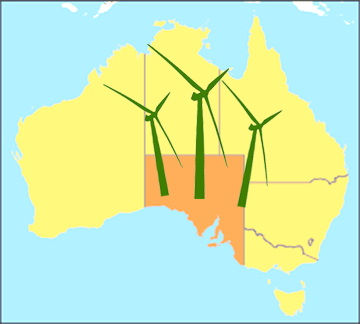 Wind power peaks in SA http://news.ninemsn.com.au/national/8528671/wind-power-peaks-in-sa Sep 6 2012 South Australia’s wind farms briefly provided 85 per cent of the state’s electricity during windy conditions this week, the Clean Energy Council says.
Policy director Russell Marsh said data from the Australian Energy Market Operator showed 55 per cent of all the electricity used by South Australians on Wednesday was generated by wind power.
But it said wind power peaked briefly at 85 per cent on Monday morning. “South Australia has proven once again that wind energy can generate real power and lots of it,” Mr Marsh said. “All this wind is putting South Australia well ahead of the curve on Australia’s 20 per cent renewable energy target.”
South Australia’s wind energy bonanza
Wind accounts for 58% of energy use in South Australia, By Giles Parkinson on 6 September 2012 It’s been another big week for wind production in South Australia – as another spring weather system with high winds makes wind energy the dominant force in local energy production.
According to figures pulled together by consultants Intelligent Energy Systems using data from the Australian Market Operator, wind energy produced accounted for 57.9 per cent of demand in the state on Tuesday, and followed up with 55 per cent of total demand on Wednesday……
exports from South Australia to other states. On Tuesday, the state was exporting almost all day, as the wind output was quite consistent. On Wednesday, it exported for most of the day and there is a bit of pink at the top in the late afternoon to indicate coal imported from Victoria. (South Australia’s coal generators are in mothballs right now due to the impact of wind, and lower demand, and the carbon price)……
These one day graphs, of course, are just snapshots of an overall trend happening in the state, and across the National Electricity Market, that will only become more apparent as the amount of wind and solar installed in the country increases. Indeed drew Reidy, from IES says these days only rank as the 6th and 12th highest in terms of energy produced on a single day, and 5th and 6th in terms of percentage of demand. The highest day in terms of output was on August 17 this year, while the highest in terms of percentage of demand came in February 5, when wind accounted for 64.1 per cent of demand across the day.
The Clean Energy Council’s Russell March said it was proof that wind energy can generate real power – and lots of it. “This type of significant wind generation is common in South Australia,” he said. In 2011/12, according to AEMO data, wind produced 24 per cent of the state’s generation, overtaking coal. And, Russell noted, AEMO data shows that emissions from South Australia’s electricity sector have dropped every year since 2005/06, and have reduced by more than 27 per cent over the last five years.
“All this wind is putting SA way ahead of the curve on the national Renewable Energy Target, helping provide farmers and local business owners in regional areas with extra income. It also means that the state’s residents collectively have a lower carbon price bill, while getting fully compensated from the Federal Government under the scheme.” Indeed, on Tuesday and Wednesday, the state enjoyed not just by far the cleanest energy in the country, but also the cheapest, with average prices over the day at $43/MWh, compared to more than $52/MWh for NSW….. http://reneweconomy.com.au/2012/wind-accounts-for-58-of-energy-use-in-south-australia-75810
South Australia’s massive Olympic Dam dream down the toilet
Analysts had calculated the expansion would have cost BHP close to US$30 billion over several years as it developed a pit more than 4 kilometers long, 3.5 kilometers wide and 1 kilometer deep…. the plans had also envisaged the construction of a desalination plant, new port andairport facilities and expanded work accommodation.
 BHP Gives South Australia No Guarantees For Olympic Dam Fox Business September 03, 2012 Dow Jones Newswires BHP Billiton (BHP) Chief Executive Marius Kloppers in a meeting Monday could provide no revised schedule, or guarantees, to the state premier of South Australia for the expansion of the Olympic Dam copper and uranium mine… Continue reading
South Australian govt and BHP Billiton gloomy about the future of Olympic Dam uranium mine
Kloppers’ bleak Olympic hopes by: Michael Owen, The Australian September 04, A BLEAK outlook has been presented by BHP Billiton chief executive Marius Kloppers for an expanded Olympic Dam mine ever operating in South Australia.
Mr Kloppers yesterday held talks with Premier Jay Weatherill in Adelaide to explain why the miner’s board last month indefinitely shelved the $28.7 billion project. He emerged from the hour-long meeting to say there was no timeframe for the project and no guarantee it would ever go ahead.
This came more than a week after The Weekend Australian revealed that Mr Kloppers had warned the expansion might never happen because the project was now dependent on the uncertain development of cheaper “leaching” technology to expand the mine’s future production. He had said that unlike “optimistic” scientists, the miner was “insufficiently certain that an eventual project will happen”. Mr Kloppers reiterated that message yesterday after meeting with the Premier. “We have been working and expending a lot of money on trying to make this project a reality,” Mr Kloppers said…… “I can’t give you any timeframe on how these things could progress.”
Asked if he could give a guarantee the mine would be redeveloped, he said: “No, I cannot.”
Mr Weatherill tried to maintain a positive message, but conceded the current model planned for the expansion “does not work”.. they are not able to advance a time when the technology will be proven, nor are they able to give us certainty about whether the technology will be capable of being proven, and therefore they will not be in a position to give us certainty about when the mine proceeds.”…
Mr Weatherill said that after his meeting yesterday, any future expansion was even further away than he had previously thought……
The opposition said all of the government’s tough-talking about BHP meeting its December deadline to go-ahead with the expansion and the project’s benefits for the state, had proven to be “bluff and bluster”. http://www.theaustralian.com.au/national-affairs/kloppers-bleak-olympic-hopes/story-fn59niix-1226464289847
BHP talking about leaching methods for Olympic Dam uranium mine
 AUDIO No guarantee for Olympic Dam mine expansion ABC Radio P.M. http://www.abc.net.au/pm/content/2012/s3581996.htm Nicola Gage reported this story Sept 3 2012,
“……NICOLA GAGE: Mr Weatherill says he was informed on the different technologies BHP are looking into. That included new forms of conveyor belts, and the potential use of heap leach technology.

JAY WEATHERILL: Which has been investigated in laboratories and is, over a period of six years, has been scaled up to a certain size in terms of tests, but needs to be tested further to see whether it can be brought to scale and be used for full production.
NICOLA GAGE: Heap leach technology was flagged as an alternative extraction option in BHP’s original environmental impact statement in May 2009. The company already uses it in South America.
Professor Bill Skinner specialises in environmental surface science at the University of South Australia.
BILL SKINNER: There is a precedent for heap leaching technology in Australia, so it’s not exactly a unique process in Australia.
NICOLA GAGE: While it might be considered a new technology in the public arena, the process has been around for years. But Professor Skinner says difficulties with constancy made it expensive.
BILL SKINNER: In the last few years, quite a lot more has been learned about the process that goes on inside a heap leach, and how one treats the ore in order to make sure that one heap behaves very similar to another, and sort of keep reproducibility up, because after all, that reproducibility of the process governs the constant, if you like, valuable recovery from those heaps.
NICOLA GAGE: Questions have been raised about whether another environmental impact statement would be needed with any future expansion. Premier Jay Weatherill.
JAY WEATHERILL: Because we don’t know what the technology is, it’s, it becomes difficult for us to make an assessment about whether there is any additional environment risk. We know that there are some leaching technologies that are used in different parts of the state, but on the face of it, yes, they do raise environmental issues. So, of course, there’s the feasibility of the technology, but then there’s the environmental approvals that may go with that.
NICOLA GAGE: The company’s 15,000-page environmental impact statement expires in 2016. …
Flinders University participates in USA Department of Energy’s pro nuclear propaganda
 Christina Macpherson 3 Sept 12, 18 months after the Fukushima nuclear accident, the truth is filtering out, about the continuing release of radiation from the crippled reactors, as radioactive water seeps into the ground below them, and radiation levels linger in the Fukushima area. The Chernobyl disaster’s health effects on the Ukrainian population are becoming widely known, but the evacuation following the 1986 Chernobyl nuclear accident was managed more swiftly, and permanently, than the Fukushima evacuation.
How important is the impact of continuing low level radiation on children’s health? We have our answer already in the high rate of thyroid disorders among Fukushma’s children.
It is shameful that an Australian university should participate in the USA’s Department of Energy’s propaganda to promote nuclear power, and whitewash the reality of ionising radiation’s harmful effect on human health:
Radiation response a meltdown in reason Flinders University News, July 14th, 2011 Published by FU Marketing and Communications. The possibility that low doses of radiation may prevent or delay the progression of cancer is being explored by a Flinders University research team led by Professor Pam Sykes in a move that runs counter to the widely held perception that exposure to any radiation is harmful.
Professor Sykes, recently appointed to the University’s Strategic Professorship in Preventive Cancer Biology in the Flinders Centre for Cancer Prevention and Control says the public panic in response to nuclear accidents such as that at Fukushima in Japan is the result of a general ignorance about radiation.
“…….. radiation is not the poison, the dose is,” Professor Sykes said……. “It’s now been accepted that they should not have evacuated so many people because the biggest detriment from Chernobyl was that they were dramatically disadvantaged, both economically and socially. Many suffered depression thinking they were going to die of cancer…..
Professor Sykes’ research, which involves doses of radiation that are up to three orders of magnitude lower than those used by other investigators, has been funded by the US Department of Energy Low Dose Radiation Research Program for almost 10 years…… Studies in Canada and Japan have also shown that low doses of radiation given to mice delay the onset of cancer, and reduce the symptoms of diabetes and atherosclerosis, improving the span and quality of life of the affected animals.
Professor Sykes and her team are currently examining low dose radiation therapy in reducing or preventing prostate cancer
BHP Billiton downsizes Olympic Dam project, as uranium market collapses
BHP Billiton Shrinks Project Team for Olympic Dam Mine, WSJ, BY ROBB M. STEWART, August 29, 2012, MELBOURNE—BHP Billiton Ltd. is reducing the size of the project team working on scaled-back plans to expand its Olympic Dam copper and uranium mine in South Australia, with roughly 140 employees facing transfer or lay off.
Melbourne-based BHP, the world’s largest mining company by market value, last week cut or deferred billions of dollars in proposed investments and said it wouldn’t approve any new major project until at least the middle of next year as costs continue to soar and commodity prices slump. The highest-profile casualty of the clamp down on spending was its US$30 billion Olympic Dam project, and …subscribers only http://online.wsj.com/article SB10000872396390444506004577618130532297156.html
South Australia can now develop its diversified economy, with the Olympic mirage gone
Mining in SA is still a minnow compared with the state’s traditional economic base. Manufacturing accounts for about 11  per cent of economic activity, agriculture 6 per cent and mining 4 per cent, boosted by high commodity prices…. despite government rhetoric, SA is far from a mining state.
those things that are the reason why South Australia existed: our agriculture, fishing, aquaculture, food processing,
Prospects take a dive with shelving of Olympic Dam expansion BY: SARAH MARTIN, SA POLITICAL REPORTER The Australian August 25, 2012 BHP Billiton’s Olympic Dam mine expansion would have created a hole in the ground as deep as South Australia’s highest peak.
An open pit 4km long, 5km wide and 1km deep was to be dug across five years to create the world’s largest copper and uranium mine at Roxby Downs in the state’s outback, 560km north of Adelaide.
But it was not to be.
{ at left, BHP’s CEO Marius Kloppers and former S.A. Premier Mike Rann, in the heady days of their ill-judged fervour for Olympic Dam) BHP’s decision this week to shelve the $30 billion project has left SA without the mining boom it was promised. For almost a  decade, former premier Mike Rann and treasurer Kevin Foley spruiked the transformative power of the mine project,
proclaiming it an economic panacea for the state……
The mine’s promise continued to be sold by the Weatherill administration after Rann’s departure, with budget figures predicated on the mine going ahead, even while a global commodity downturn made its prospects doubtful…..
Adelaide-based chief economist of Prescott Securities Darryl Gobbett
says the government had promised a mining boom that would not
eventuate.
“I think they have hyped up what was going to happen before the
event,” he says. …… Continue reading
King Uranium is losing not only its Big Mine, but also its Adelaide Castle!
 BHP dumps Adelaide tower plans BY: SARAH DANCKERT The Australian August 25, 2012 BHP Billiton has scrapped plans to take a long-term lease on a purpose-built $250 million office tower in central Adelaide following its decision to shelve the expansion of its Olympic Dam mine.
The miner is also understood to be considering reducing the amount of existing office space it leases, said to be about 10,000sqm, in what will be a blow for the Adelaide office market…. Adelaide property professionals are maintaining a stiff upper lip despite the miner’s devastating decision to put on ice the $US30 billion ($28.6bn) expansion of the uranium and copper mine, 560km north of the city.
Earlier this year the miner began sounding out developers for a purpose-built office tower in the city’s central business district to house the new employees. BHP Billiton established its uranium headquarters in Adelaide in 2009 when the company created the Uranium Customer Sector Group.
Up until recently BHP Billiton was seeking a long-term lease on a state-of-the-art office that would be built for the resources group in the heart of the city. The lease was to include naming rights over the building. Continue reading
1 This month

of the week – Australians for War Powers Reform (AWPR)
To see nuclear-related stories in greater depth and intensity
 Antinuclear