In this time of critical drought, water shortage, South Australia’s govt lets BHP expand its water-guzzling Olympic Dam uranium mine
Why does BHP get this water for free?
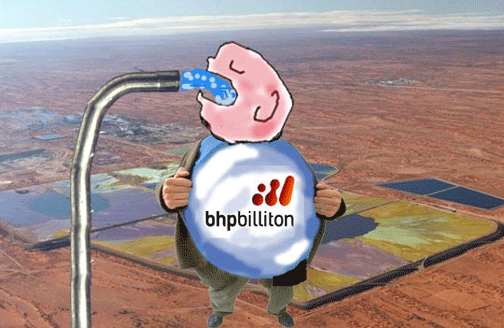
SA boost for Olympic Dam expansion https://www.sbs.com.au/news/sa-boost-for-olympic-dam-expansion 15 Feb 19, The South Australian government has granted the expansion of the Olympic Dam project major development status. BHP’s plans for a $3 billion expansion of its Olympic Dam project in South Australia’s north have been granted major development status by the state government.
The government’s move, gazetted on Thursday, clears the way for the company to increase annual copper production from 200,000 to 350,000 tonnes.
It also allows it to boost gold, silver and uranium production and to lift water extraction from the Great Artesian Basin to a maximum of 50 megalitres a day.
Declaring BHP’s proposed expansion of Olympic Dam a major development is a key milestone in this important project,” Mining Minister Dan van Holst Pellekaan said.
“Olympic Dam is already the state’s largest mining operation, providing jobs, investment and royalties for South Australia.
“(This is) a very important project that, if it goes ahead, would contribute 1800 additional jobs in South Australia during construction, and another permanent 600 jobs on site at Olympic Dam.”
But the minister said the project was still subject to thorough assessment, particularly the plan to extract more water.
“All potential environmental impacts, potential social impacts, potential economic impacts will be considered incredibly thoroughly,” Mr van Holst Pellekaan said.
Local communities will also be consulted on the company’s plans.
Mr van Holst Pellekaan said it would be several years before an expanded mine could begin operation.
The state government’s declaration also covers BHP’s development plans outside the mining lease, including proposals for extra accommodation. The proposed expansion of Olympic Dam has had a chequered history after first being mooted by the previous owners, Western Mining, back in 2002.
BHP initially proposed a $30 billion expansion, including development of one of the world’s largest open cut mines, but put the plans on hold in 2012.
The company has since been looking at lower-cost, smaller scale, alternatives to its original proposals.
Mental health issues in Kimba community divided by nuclear waste dump proposal
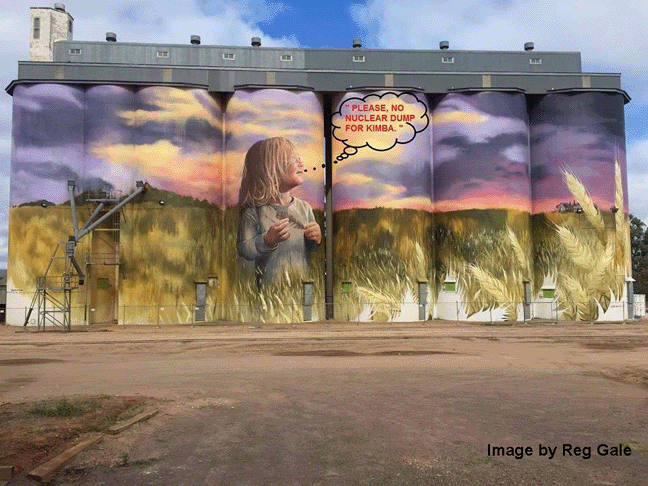
Nuclear waste site selection process triggers mental health concerns, business boycotts and division, FOI documents reveal https://www.abc.net.au/news/2019-02-13/foi-documents-show-kimba-divided-over-nuclear-waste-site/10807462 ABC North and West By Gary-Jon Lysaght (FOI documents are attached on the original) Freedom of Information (FOI) documents reveal the Federal Government has been aware of potential mental health issues, from as early as 2017, caused by the search for a site to store the nation’s nuclear waste.The Federal Government is currently considering two sites at Kimba and one near Hawker for a facility that would permanently store low-level waste and temporarily store medium-level waste.
Kimba, a small town on South Australia’s Eyre Peninsula, has been divided on whether to support or oppose the facility. Some residents believe the facility could help bring much-needed business to the rural town, while others suggest it could damage the region’s agricultural reputation.
“Many of the opposed group have raised the issue of mental health in submissions and direct discussions,” the FOI documents, written in 2017, said.
They believe mental health issues are arising in Kimba due to the stress of being in this process.
“These issues have been raised with the Kimba doctor and counsellor.”
Centre Alliance Senator Rex Patrick obtained the Freedom of Information documents and hoped the concerns were a catalyst for change.
“In my view, that creates a very strong obligation for the Government to act,” he said.
“They’ve clearly known about this issue since 2017 and it is now time to ask the minister exactly what he is doing in relation to that.”
Industry, Innovation and Science Minister, Matt Canavan, is responsible for determining which site should be chosen for the facility.
“If anyone in Kimba advises they have concerns about their health, they can be referred to the Kimba Mental Health and Wellbeing Group,” a department spokesman said. “Following a Community Benefit Program application, that group received funding of $30,000 for Healthy Mind Healthy Community workshops to improve resilience, mental health and wellbeing.”
Site selection process ongoing
The site selection process has been put on hold since traditional owners took the District Council of Kimba to court over a proposed community ballot on support for the facility.
The Barngarla Native Title Determination Aboriginal Corporation took the matter to the Federal Court because not all native title holders were included in the ballot.
A decision will be made on the court action this year, with Native Title holders claiming the ballot would breach the Racial Discrimination Act.
owever, an early technical assessment gave the Napandee property a score of 90, while Lyndhurst received 82.
“Both sites were ranked as ‘highly suitable’ by the initial desktop assessment,” the FOI documents said.
“This assessment involved a multi-criteria site assessment where the sites were evaluated against criteria of health, safety, security, environment protection, equity, economic viability, and stable environment.
“On balance, it is recommended that if there is a decision to proceed, both sites should be taken forward.
“If only one site is taken forward, it is recommended to be Napandee.”
This is despite a consultation in 2016, mentioned in the documents, found “that the Lyndhurst site was preferred by the community”.
“Given the perception it is ‘further out of town’ and on less productive land, but there is no strong basis for this assessment.”
Community divided
The documents also revealed that the Federal Government was aware of the “strong division” within Kimba that the site selection process was causing.
“It is unlikely community views will change significantly in the short to medium term, with a block of around 40 per cent persistently strongly opposed,” the documents said. “There is strong division in the town and this is expected to continue and may become more vocal in the short term.”
Jeff Baldock owns Napandee, the site indicated to be preferred by the Federal Government in the FOI documents.
“It’s been a very long process,” he said.
“When it first started out, there was probably a few things that could have been done better.
“But as it’s gone along, everyone’s had plenty of opportunity to find out what they want to know.”
Mr Baldock said there had been “vague references” to mental health concerns. (Below: Jeff Baldock and family)
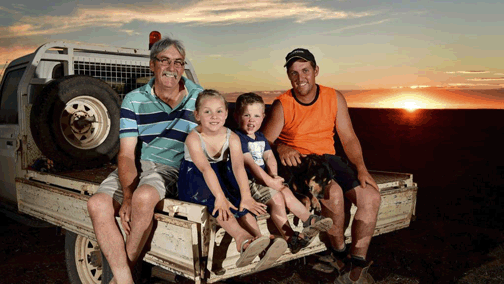
“But I’ve never actually spoken to anyone who feels particularly that way and I know that the department did have an open offer that they could contact them.”
Peter Woolford is Chair of No Radioactive Waste on Agricultural Land in Kimba or South Australia, an organisation against the facility.
He said there was no doubt that the site selection process had caused mental health concerns within the community.
“We’ve lost people from our community because of it,” he said.
“People I speak to are reluctant to go into Kimba much these days.
“It’s disappointing to say the least that if you went up the street and tried to have a conversation about the nuclear waste facility from people from opposite sides, you wouldn’t get much of a conversation.”
Boycotting businesses
Another section of the documents found there had been some cases of businesses being boycotted by locals if the owner either supported or opposed the facility.
“Business owners have noted that boycotting of businesses by the opposed group is occurring,” the documents said.
“While these claims may be exaggerated, this would appear valid and detrimental to the town.”
The ABC has also been told that those opposed to the facility were boycotting businesses that supported it.
It has also been told that up to 90 per cent of businesses at Kimba supported the facility.
Senator Patrick was concerned about the impact boycotting businesses could have on a town like Kimba.
“Kimba is a very small township and the last thing you want to have is animosity developing across members of the community,” he said.
“To the point where they simply won’t go and shop in a particular shop because of someone’s view on this issue.”
Mark Parnell calls on South Australian government to stop its plans to diminish environmental department
 Mark Parnell MLC, 2 Feb 19, The Marshall Liberal Government is planning more cuts to staff and programs in the SA Department of Environment and Water and will transform the Department into an “economic development agency”.
This is outrageous! This Government’s wilful abandonment of the environment will send species extinct and further degrade struggling eco-systems.
The hypocrisy of the Liberals knows no bounds. In opposition, they criticised Labor’s annual budget cuts to the environment, but as soon as they were elected they did the same, with 100 jobs axed last year and more to come. And now they’re going one step further!
The clear message is that if the environment doesn’t make money for someone, it’s not worth protecting. Heaven help our endangered wildlife. If creatures like the Glossy Black Cockatoo or Yellow-footed Rock Wallaby don’t start earning their keep, the Government has made it clear that they are a lower priority. This is not a good time to be a Hooded Plover or an Orange-bellied Parrot in South Australia.
The Marshall Liberal Government’s honeymoon period is now well and truly over. The Government has shown its true anti-environment colours. Any notion that they might care about species, eco-systems, sustainability and the climate, has all but disappeared. Now, they have left us in no doubt that, in their eyes, only those parts of the environment that make money deserve protection.
The Greens are calling on the Liberals to stop the cuts and retain a Department that is focussed on protecting our environment and waterways. They need to stand up for South Australia’s environment and River Murray. The Government should heed the warning of the Royal Commissioner into the management of the River Murray that kow-towing to economic interests upstream only results in further degradation of the environment.
Declaring war on the environment pits this government against everyone who cares about our natural heritage. We must protect the environment for its own sake as well as for future generations.
Our environment and all the species that depend upon it for their survival, deserve better. South Australians deserve better!
Let the Marshall Liberal Government know that you expect the Environment Minister to stand up for South Australia’s environment at all times – not just when there is an economic advantage. Sign our petition and share your concern with family and friends.
South Australian government changing Environment Dept, and cutting its budget
REVEALED: Staff, budget cuts as Environment Dept becomes “new agency” , In Daily, Tom Richardson@tomrichardson, 1 Feb 19, The state’s Department of Environment and Water will become primarily an “economic development agency” that will be forced to operate with “less staff and smaller budgets” under a major restructure announced to staff yesterday.
The timing of the shift is ironic, with today’s release of a scathing Royal Commission report into the management of the River Murray, itself critical of Environment and Water Minister David Speirs.
Chief executive John Schutz – who replaced former boss Sandy Pitcher, one of four top bureaucrats axed by the incoming Marshall Government last March – yesterday wrote to staff telling them they would be “transitioning to a new agency”……….
“We balance environmental protection with economic development – this means we contribute to our state’s economy by driving sustainable economic development, and unlocking the potential of our natural and heritage resources.” …..
The department will be split into five divisions – Boards and Councils; Strategy, Science and Corporate Services; National Parks and Wildlife; Water and River Murray; and Sustainable Economic Development. https://indaily.com.au/news/2019/01/31/revealed-staff-budget-cuts-as-environment-dept-becomes-new-agency/
Kimba District Council excluded Bangarla Aboriginal people from vote on nuclear waste dump site proposal
 Traditional owners left out of dump vote https://www.eyretribune.com.au/story/5878759/traditional-owners-left-out-of-dump-vote/?cs=9397, Kathryn Bermingham , 30 Jan 19, A South Australian council did not consider native title holders when deciding who should vote on a proposed nuclear waste dump, a court has heard.
Kimba District Council chief executive officer Deborah Larwood gave evidence at a Federal Court hearing between the council and the Barngarla Determination Aboriginal Corporation on Wednesday.
She said there was never any discussion about including traditional owners in the poll until after that decision was made, when the council received a letter from the Barngarla people.
“There was a lot of issues that would arise if the Barngarla Determination Aboriginal Corporation went outside of the guidelines to be allowed to vote,” she said. “It (would have) then opened up: should we be letting all other owners who are non-ratepayers have a vote?”
Two sites near Kimba, on the Eyre Peninsula, have been short-listed as potential locations for a low-level radioactive waste storage facility, while a third is near the Flinders Ranges town of Hawker.
The Kimba vote was stalled last year after the Barngarla people won an injunction in the South Australian Supreme Court, where the case was then referred to the Australian Human Rights Commission.
Lawyer Dan O’Gorman, for the Barngarla people, again argued on Wednesday the ballot was in contravention of the Racial Discrimination Act.
He said the breach occurred because the council chose to use the eligibility guidelines established under the Act – it was not compelled to do so.
Also called to give evidence on Wednesday was Bruce Wilson, principal advisor to the National Radioactive Waste Management Taskforce.
Mr Wilson said the ballot was a “tried method that had community understanding and integrity” after a similar vote was conducted by the Australian Electoral Commission on behalf of the council in 2017.
“That process was run, that worked well… it was agreed by ourselves and the council that they would use that method in the second ballot for that reason,” he said.
Adelaide – hottest capital city on record
|
Adelaide has hit a sweltering 46.6 degrees Celsius, surpassing the previous record set in Melbourne a decade ago to officially become the hottest capital in the country. Key points:
Earlier on Thursday, Adelaide topped its 1939 heat record after hitting 46.2C. The temperature then climbed up to 46.6C, topping the previous capital city record of 46.4C set in Melbourne in 2009. More than 20 locations hit record temperatures in South Australia on Thursday, including Adelaide Airport, Minlaton, Noarlunga, Snowtown and Port Lincoln. Ceduna set a record for the second day in a row, reaching 48.6C. Meteorologist Hilary Wilson said records had been broken right across the state………. ‘Incredibly high’ temperatures overnight for Victoria BOM Victoria’s Richard Russell said temperatures in parts of the state were going to be “nothing short of oppressive”, particularly in northern Victoria where it was expected to reach the mid-40s………https://www.abc.net.au/news/2019-01-24/sa-heating-up-with-records-expected-to-be-broken/10745220 |
|
|
About nuclear wastes: Ignorance, incompetence and hypocrisy of Dan van Holst Pellekaan, South Australian Minister for Energy and Resources

Meetings with Minister Pellekaan and the DIIS, Anti-Nuclear Coalition of South Australia,  January 2019
Report back from ANC members’ meetings with SA Minister for Energy and Resources, Dan van Holst Pellekaan, on Nov. 14, and with two bureaucrats from the DIIS (Department of Industry, Innovation & Science).
This second meeting was held in Adelaide at the Department of Industry, Innovation & Science (DIIS) offices on November 28. Ms Sam Shard the GM for the NRWMFT (National Radioactive Waste Management Taskforce) fielded all questions, and Wendy (no one heard her surname), Head of Policy, who only spoke once throughout the hour-long meeting. Requests for meetings with federal Minister Canavan (delegated to his department’s officials) and his SA counterpart, Minister Pellekaan, were made several months ago, and both only came about as a result of persistent efforts.
In this summary, the NRWMF (National Radioactive Waste Management Facility)=the dump.
Pellekaan Meeting: In his initial response to the ANC’s request to meet – first declined – Pellekaan outlined his government’s support for a national dump, “in one central, secure location” for LLW (low level waste) the justification being that such waste resulted from “life-saving medical procedures and research”. Notably, he omitted any reference to the planned ‘temporary’ storage of ILW (intermediate level waste).
(Last year on talkback radio, then, Premier Weatherill, similarly, omitted any mention of co-location of the very long-lived ILW at a national dump.)
Pellekaan and his leader’s support for a national dump (“one dump is better than many”) are predicated entirely on there being a willing host community. He wouldn’t, “refuse a dump to a community that gave its broad support”.
During the half-hour (only) meeting the emphasis from five ANC participants was on his omission to mention the co-location of the ILW (he did say that he had talked about it on radio). Also, on the significance of a radioactive dump for all South Australians, not only the two small communities targeted for a dump. On the latter point, Pellekaan argued that, if the wider community were to prevent a willing local community from hosting a dump it would disenfranchise local people(!) It was pointed out to him that it is South Australians, in general, who are being disenfranchised by the federal government’s strategy.
Regarding the ILW, Pellekaan was not overly concerned about the temporary storage, considering it would be just as safe at a rural SA location as at Lucas Heights, saying, “It has to be stored somewhere”.
Other questions and comments were about the classification of radioactive waste; the regulator’s (ARPANSA) licensing arrangements, about which he said that he was, “not across the detail”; the longevity of the ILW and the implications of the SA Nuclear Waste (Prohibition) Act.
He downplayed any special role he might have as either the responsible SA Minister or as the Member for Sturt, the electorate in which a national dump could well be located, emphasising that it would not be his decision, but a cabinet decision.
Regarding the South Australian legislation, he considers that at least, in part, it would have to be altered to allow the dump. This was not seen in any way as a hindrance because legislation can be enacted and repealed, if the parliament wishes.
In summary, Pellekaan follows faithfully the federal government’s arguments for the dump. His apparent lack of knowledge about High Level Waste (HLW) and Intermediate Level Waste (ILW); the length of time the ILW could remain stored above ground at the ‘interim’ site; the lack of any permanent plans for its disposal, or facilities and technical expertise for dealing with radioactive hazards at an interim dump is deeply troubling and unacceptable.
Note: Ally apologises for inaccurately stating in the prepared questions to put to Pellekaan that the ARPANSA licencing arrangement for the temporary storage of ILW at Lucas Heights is conditional on it being transferred to a permanent site. This is not the case. However, what it does say is, “The NRWMF will cater for the long-term above ground storage (approximately 100 years) of Intermediate Level Waste including the waste processed in France and the United Kingdom.”https://www.arpansa.gov.au/sites/g/files/net3086/f/legacy/pubs/comment/iws/IWSO-LA-WCP-WasteContingencyPlan_ Final_ARPANSA.pdf
Department of Industry Innovation and Science (DIIS) Meeting: Four people from ANC met with two departmental bureaucrats (see above) for an hour – not a minute more. Unfortunately, no full set of notes was taken. This report is based on notes taken by Mnem Giles, Colin Mitchell and Ally Fricker. Getting into the commonwealth offices in Franklin St was farcical with security having difficulty establishing who qualified as bone fide visitors, and negotiating with a boss up on the thirteenth floor to allow a fourth person to attend. Another five people remained on the street with placards and leaflets. A press release was sent out. The main entrance door was locked and only unlocked after we departed the building.
Mnem presented Sam Chard with a submission to the Senate Standing Committee from WILPF as requested by Ruth Russell. It was explained who WILPF is.
NOTE: Sam Chard’s comments are not always direct quotes. They are highlighted in red to make it clearer when it is her comments.
Sam Chard was the only person who responded to our questions. We established very quickly that we had not come to hear the government’s PR; that we were quite familiar with it. Head of Policy Wendy … commented only once saying that a permanent national dump for the intermediate waste would require two decades to plan.
The questions and comments attached were largely followed. We emphasised our request for the DIIS to hold a public meeting in Adelaide to inform politicians, media and public (who remain very confused) about the full plans for the national dump.
Response: The state is aware of the details and all the information is on-line.
It was also stressed that a national radioactive waste dump is an issue of national significance, not only an issue for locally targeted communities. (There is little likelihood that an Adelaide meeting would occur without follow up with a formal letter from the ANC and persistent demands to DIIS, the Minister and other relevant agencies.)
Chard agreed that a national dump was an issue of national significance because 1 in 2 people in Australia need nuclear medicine.
Other Issues Raised: 1. The lack of transparency at the Barndioota Consultative Committee meeting held at Quorn on the previous day (Nov 27) NO observers were allowed to attend, even after several had signed the usual request to sign confidentiality statements!
Response: This is entirely at the Chairman’s discretion and to allow free and frank discussion. The reason for the cancellation of the Kimba meeting (due on Nov 28) was because of it being “harvest time”, not because of the Barngarla legal challenge, as people inside the committee meeting at Quorn were told.
- Disposal of DoD (Department of Defence) waste.
Response: it is not wanted at Woomera for “operational reasons”, which would be classified. Re the quantity and location of DoD waste, the document, Australian Radioactive Waste Framework April 2018, was distributed to everyone, and referred to throughout the meeting, but this document fails to give any detail about what activities created the waste in the first place. Chard took on notice further questions relating to DOD waste stored at Woomera.
- Illegality of a national dump in SA: Response – Once land is acquired by the commonwealth, the federal Act (2012) would override the SA Act prohibiting a nuclear dump. Note this differs from Pellekaan’s response.
- Still after decades of planning, there remains no full inventory of waste intended for a national dump.
Response: A new ARPANSA document is now available which discusses the possible acceptance criteria for a national dump, but no further information, apart from the Framework document available (at the meeting). The first phase of acceptance criteria is available on the web.
- DIIS document titled,National Radioactive Waste Management Facility. Lucas Heights Sydney 2017 says, about long-term disposal of waste at Lucas Heights, “ . . .it’s not allowed. ANSTO’s Lucas Heights campus is only licenced . . . to store waste on a temporary basis, and on the condition that a plan is developed by the end of the decade for final disposal pathway for its waste.” (Our emphasis) It was pointed out that this was unambiguous. Response: There was no elaboration. ARPANSA document,Information to Stakeholders (May 2017) notes that temporary storage of ILW at a national dump ‘could be in excess of 100 years.’
Response: this is not correct. We responded in which case, ARPANSA should be corrected. Response: 100 years refers to the LLW only. ILW would only remain at an interim location for a couple of decades, or up to 30 years, or up to 40 years – 40 years is, conveniently, the approximate lifetime of the TN81 steel containers in which the reprocessed spent fuel is packaged.
- What facilities would be available at a temporary dump for re-packaging the TN81 containers?
Response: Waste entering the dump would be checked, but there are no plans for re-packaging facilities. The waste would not be there for long enough to require them. There are also, as yet, no facilities at Woomera for re-packaging any of the CSIRO waste currently stored there that might require
- These would need to be established.
- Co-location of LLW and ILW in other countries:
Response – There are models overseas for this. Where is it occurring? Response – Would take on notice. It was pointed out that the LLW and ILW stored permanently at Aube, France was not the equivalent of the co-location planned in SA because French classification of ILW is not the same as Australia’s, and definitely does not include reprocessed spent fuel. Response – Don’t know the specifics of Frances’ arrangements.
- Storage of ILW at Lucas Heights: Response -It’s in a dedicated facility. It is only there on a temporary basis; it’s quite safe there. Storage at a national dump would be the same as at Lucas Heights.
- Difference between French and Australian classification of the returned reprocessed spent fuel:
Response – The French have now changed their reference to HLW and brought the classification into line with Australia’s requirements. France now agrees with Australian authorities.
- Future availability of reprocessing facilities in France and any alternative arrangements: Response – Would take on notice.
- Commercial in confidence re the business case for the expansion of medical radioisotope production at Lucas Heights: Response – the expansion is for the export business (therefore commercial?)
- Classification of spent fuel: Response –Spent fuel from a nuclear power reactor is HLW, but from a research reactor it is ILW – there is a significant difference between ILW and HLW. A request to explain the difference was taken on notice.
- Permanent disposal of ILW, no site, no plans and no technology on the horizon: Response: That entity not yet defined.
- Permanent disposal of waste, ‘too dangerous’ to leave at Lucas Heights: ALP Shadow Minister for Energy and Resources, Kim Carr, spoke to Susan Craig and said that this was the reason why waste had to be removed to another interim site. Response: DIIS could not comment on this.
Formal minutes taken by DIIS staff were requested and an undertaking to forward them to ANC was made. Mnem followed this up and was told the minutes were being ‘cleaned up’. Mnem said we would prefer them as they were recorded. As with minutes from the Minister Pellekaan meeting, we are still waiting . . .
Thanks to Mnem for persisting with the arrangements for this meeting with DIIS, and the people who waited outside, and to Kate who distributed many leaflets.
Bushfire in Adelaide Hills is still a threat
Just after 4pm on Sunday, the Country Fire Service issued an alert to residents around the Mt Lofty Ranges after a fire started on Montacute Rd, Montacute.
The fire, started from a discarded cigarette butt, was burning steep terrain, making it difficult for crews to access. The spread of the fire has been contained, however the hot and dry conditions forecast this week mean it could pick up again, the CFS say……….A severe fire danger warning, as well as a total fire ban, has been issued today for the Mt Lofty Ranges due to very hot and dry conditions. https://www.adelaidenow.com.au/news/south-australia/sas-breaking-news-blog-the-pulse-fire-crews-battle-uncontained-fire-in-mt-lofty-ranges/live-coverage/dc7bcd73c3c461533c4d8f911319fd20
Defence Department accused of deception over Woomera radioactive wastes
Defence under attack on nuclear waste dump https://www.theaustralian.com.au/national-affairs/defence/defence-under-attack-on-nuclear-waste-dump/news-story/fd851b6cefd7c5701d354c7ed1adf09d LUKE GRIFFITHS @_LukeGriffiths DECEMBER 27, 2018
Woomera must be revisited as a potential site for Australia’s first nuclear waste dump, says Centre Alliance senator Rex Patrick, who accuses the Defence Department of deception over claims the site is unsuitable.
Senator Patrick said he would question Defence officials at Senate estimates hearings over why the department dismissed Woomera as a potential site because of an “intolerable risk” and its “impracticability” — a position since backed by Resources Minister Matt Canavan.
The 122,000sq km Woomera Prohibited Area, located in the South Australian outback 450km northwest of Adelaide, is a military testing range under federal government control.
Senator Patrick said significant nuclear waste materials had been stored there since 1994, including 10,000 drums of low and intermediate-level waste from a CSIRO research facility at Fishermans Bend in Melbourne.
In a report published on its website last week, the CSIRO said tests had found the material posed no threat to health or the environment. Tests in May found radiation levels adjacent to the storage had “natural background values” for Australia, as would be found in typical soil and rock.
“The report findings make a mockery of Defence claims there’s no way a national radioactive waste management facility could be located anywhere in the enormous expanse of the WPA,” Senator Patrick said.
“The reality is radioactive waste has been safely stored at Woomera for a quarter of a century. Defence can expect considerable scrutiny in the new year over the bureaucratic obfuscation and deception on this issue. It seems Defence is never stronger in defending territory than when it comes to defending its own.”
Senator Canavan has short-listed two sites near Kimba, 465km northwest of Adelaide, and one site near Hawker, in South Australia’s mid-north, for the waste facility.
The process, which has divided both communities, stalled after a Kimba ballot scheduled for August 20 was delayed by court action from an Aboriginal group that believes traditional owners should vote, despite not living within the shire’s boundaries.
In a similar move, traditional owners at Hawker last week lodged an Australian Human Rights Commission complaint, prepared by Maurice Blackburn Lawyers, that alleged a “fundamentally flawed process”.
Labor has not said how it would proceed should it form government after the election, which must be held by mid-May.D The Department of Defence did not respond to questions.
Radioactive waste at the Woomera Test Range
 CSIRO 19 Dec 18 “……..Where did the waste come from?Almost 10,000 210-litre drums of waste now stored at the Woomera Test Range came from the clean-up of a former research site at Fishermans Bend, Melbourne, in the early 1990s and comprises of mainly soil and building materials…..
What is CSIRO doing about it?
CSIRO is using robotic equipment to better understand the physical condition and contents. This work will take 12–24 months and will inform future activities to characterise, separate and repackage waste and reduce its volume for transfer to the NRWMF. The robots are able to travel between the tightly packed drums which cannot be reached by people.
The robotic work will also help us better understand the physical integrity of the drums before further testing. The painted or galvanised drums are just over half way through their expected useful life of around 40 years……
Some material will be low level radioactive waste (LLW) and a very small amount may be intermediate level waste (ILW). Measures will be taken to ensure the material is safely stored to meet ARPANSA regulations until a final disposal pathway has been identified.
What does this mean for a National Radioactive Waste Management Facility (NRWMF)?
Further analysis and separation of material is needed to clarify how much of the material currently at the Woomera Range will require future disposal (LLW) or storage (ILW) at the proposed NRWMF.
The waste could not be transferred to a NRWMF until its contents are known and it is packaged to comply with the strict Waste Acceptance Criteria for the Facility. The current storage arrangement at the Woomera Test Range poses no health or environmental threat……. https://www.csiro.au/en/Research/Environment/Land-management/Radioactive-waste-Woomera?fbclid=IwAR2WeaBCrmpzBS5rZEqa-wH3IMh_sG7_L3Me5C3Ur5V6XhZo7WmiLCw7kEs
Exciting South Australian film project “Unwilling Nation”
 Kim Mavromatis Fight To Stop Nuclear Waste In The Flinders 10 Dec 18 Ranges SELECTED FOR DOCULAB 2018 – We are really excited to be one of 6 teams selected to participate in the South Australian Film Corporation and Screen Australia Doculab Initiative.
OUR PROJECT : “Unwilling Nation” – a film about the 40 year fight to stop Nuclear Waste getting dumped in South Australia.
PROJECT KEY CREATIVES (Participating in the Doculab) :
Kim Mavromatis and Quenten Agius (Producers).
Robyn Ravenna (Writer / Researcher).
Supporting the development of a range of documentary and factual projects in South Australia, Doculab is an intensive three day lab for factual screen-makers.
Courtney Gibson (SAFC Chief Executive ) said “Doculab is about putting weight behind SA documentary projects and teams, bringing them together as a community to provide latest market intelligence and develop their projects to optimal creative strength before they’re out to market, and we’re so pleased to be partnering with Screen Australia to make this happen”.
Sally Caplan (Head of Content at Screen Australia) said “The calibre of content emerging from SA is both locally and internationally recognised and it’s important to continue nurturing its vibrant screen community. The Doculab initiative is committed to developing the skills and knowledge of diverse documentary filmmakers. We firmly believe that incubating people and projects through mentorships, funding and fostering pitching skills to penetrate specific markets is essential. We’re excited to see new South Australian projects develop from this initiative that we hope provide longevity for the industry.”
Read the fine print: future funding for Kimba/Hawker nuclear waste dump is NOT guaranteed
 Kim Mavromatis Fight To Stop Nuclear Waste Dump In Flinders Ranges SA 8 Dec 18, Funding for Hawker / Kimba – WILL ERODE – GUARANTEED. Out of the proposed 31 million carrots, 21 million carrots will be supposedly delivered after the proposed site is built – do we really trust the fed liberal govnt to deliver the 21 million carrots after the site is built?? Read the fine print – how gullible do they think we are?? The same mob stabbed their leaders (prime ministers) in the back – told us the 10,000 barrels of radioactive waste dumped at woomera was only low level and nothing to worry about, then Rex Patrick discovers the waste includes intermediate level radioactive nuclear waste – lie after lie after lie – the fed libs deserve to get clobbered at the next election.
Bushfires near Kimba, proposed site for nuclear waste dump
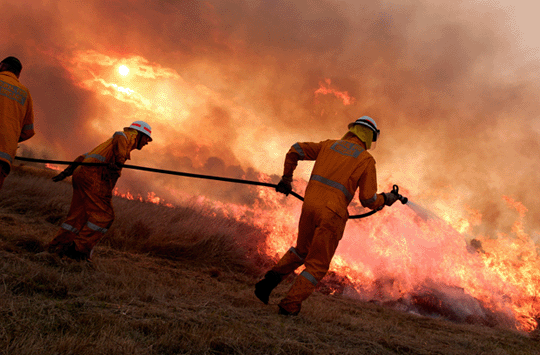
Adelaide weather: Another scorcher as KI bushfire continues to burn, Adelaide Now Gabe Polychronis, Mitch Mott, The Advertiser, December 7, 2018 A large bushfire continues to burn on Kangaroo Island, as the CFS bring in dozens of reinforcement firefighters and trucks ahead of expected wind charges later today.
South Australia now supplying electricity to Victoria, as wind power surges
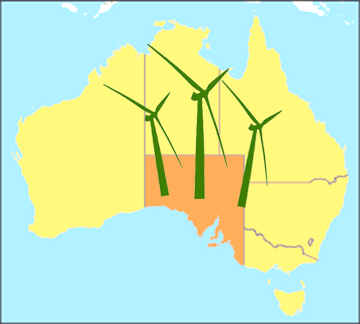 Victoria now relying on SA for power as wind production rises and coal plants close, Adelaide Now Daniel Wills, State Political Editor, The Advertiser December 3, 2018 Green-powered South Australia is now sending Victoria more electricity than it takes back as wind production surges, leading energy experts to warn that more storage is the key to keeping the local grid stable. Victoria now relying on SA for power as wind production rises and coal plants close, Adelaide Now Daniel Wills, State Political Editor, The Advertiser December 3, 2018 Green-powered South Australia is now sending Victoria more electricity than it takes back as wind production surges, leading energy experts to warn that more storage is the key to keeping the local grid stable.
|
|
|
1 This month


Help Aunty Sue Protect Her Land and Sacred Sites From Destructive Rocket Testing.
.

Australians deserve the truth
about
AUKUS – https://aukuspublicinquiry.com/

PETITION – To: Prime Minister Anthony Albanese and the Australian Labor Government

of the week – Australians for War Powers Reform (AWPR)
To see nuclear-related stories in greater depth and intensity

