Total fire ban South Australia – a dangerous place to put a nuclear waste dump?

Total fire bans declared for most of South Australia, The Advertiser, December 1, 2018 Total fire bans have been issued for most of South Australia on the first day of summer.
The Country Fire Service’s state operation centre is ready to react to any large fires today as the mercury soars to 30C across the state before a possible storm late in the afternoon.
A severe fire danger rating has declared for the following regions:
West Coast, Eastern Eyre Peninsula, Lower Eyre Peninsula, Flinders, Mid North, Yorke Peninsula, Riverland, Murraylands, Upper South East, Lower South East and Mount Lofty Ranges
The official bushfire season has also begun today for Kangaroo Island and will run until April.
When total fire bans are declared, well prepared and actively defended houses can offer safety during a fire.
But the Country Fire Service warns that if residents do not have a bushfire survival plan, leaving early before a fire start is the safest option.
CFS State Duty Commander Nick Stanley told ABC radio certain activities that could cause a fire risk are banned during the fire danger season…..
Multiple bushfires on Yorke Peninsula South Australia
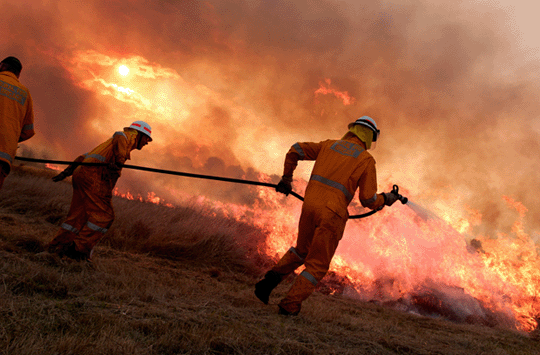 Bushfires in SA after lightning hits https://www.sbs.com.au/news/bushfires-in-sa-after-lightning-hits
A band of lightning moving across South Australia is believed to be the cause of multiple bushfires, in particular on the Yorke Peninsula at Minlaton. 2 Dec 18 Multiple fires are burning in South Australia and are believed to have been caused by a band of lightning moving across the state.
The most serious fire is on the Yorke Peninsula at Minlaton, the SA Country Fire Service said.
Just before 3pm, the CFS was telling nearby residents to “leave if the path is clear to a safer place” however the authority now says the rate of spread of the fire has halted.
However the CFS says it’s concerned that could change when the wind changes in a few hours.
“The CFS has concern that when the wind change arrives, there may be an increase in fire behaviour,” a warning message said.
“People east of the fire ground need to remain alert to this wind change and enact their Bushfire Survival Plan.”
There are smaller grass fires near Ettick in the Murraylands district, the Globe Derby Trotting track in the northern Adelaide metro area, Kangaroo Island, Hindmarsh Island, Kanmantoo, Barabba and Long Plains.
There is a total fire ban for most of the state.
Woomera the suitable site for a nuclear waste dump – Senator Rex Patrick
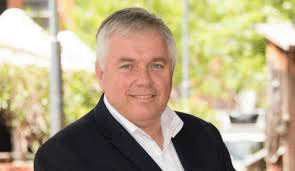 Woomera must be considered fWor radioactive waste facility, Senator Rex Patrick says https://www.adelaidenow.com.au/business/sa-business-journal/woomera-must-be-considered-for-radioactive-waste-facility-senator-rex-patrick-says/news-story/3b8171ca619079bc36b1b35c19861cf9?fbclid=IwAR0FQ-25ObeztDdNn5d9xLWOpJuDHJkaEBAIIT9r6sSpj52tRW_uTaCCLhc Erin Jones, Regional Editor, The Advertiser, November 28, 2018 Renewed calls have been made for Woomera to be considered as the site for the national nuclear waste repository to end the divide in two South Australian country towns.
Centre Alliance Senator Rex Patrick said the 122,000sq km Woomera Prohibited Area should be revisited after a freedom of information document showed the reasons why it was rejected were “shallow”.
His calls come as Kimba and Hawker remain in limbo as to whether they will be chosen to host the low-level waste facility, with community ballots delayed until early next year.
“We have a divided community in both Hawker and Kimba and there is a site that may well be very suitable but has been dismissed on very shallow grounds,” Senator Patrick said
“We need to revisit the defence site properly.”
Renewed calls have been made for Woomera to be considered as the site for the national nuclear waste repository to end the divide in two South Australian country towns.
Centre Alliance Senator Rex Patrick said the 122,000sq km Woomera Prohibited Area should be revisited after a freedom of information document showed the reasons why it was rejected were “shallow”.
His calls come as Kimba and Hawker remain in limbo as to whether they will be chosen to host the low-level waste facility, with community ballots delayed until early next year.
“We have a divided community in both Hawker and Kimba and there is a site that may well be very suitable but has been dismissed on very shallow grounds,” Senator Patrick said.
“We need to revisit the defence site properly.”
Woomera was one of four defence sites in SA to be identified by the Federal Government that met suitability criteria for the repository.
The Defence Department, in 2016, said it did not support the facility at Woomera as it was “incompatible” with its weapons testing range and missile launch site.
However, a 2002 Education, Training and Science Department report found the site would be a preferred location, in part because both low and intermediate-level radioactive waste had been stored there since 1994-95 without incident. This includes the CSIRO storing 10,000 drums of waste at the site.
Resources Minister Matt Canavan told The Advertiser the site was unsuitable due to defence operations. He said waste at the site must be moved outside of the controlled defence area.
Woomera was identified by the Howard Government as the potential repository site in 1998, but was shelved following backlash from the Rann Government.
Community excluded from Australia’s nuclear waste dump Community Consultation
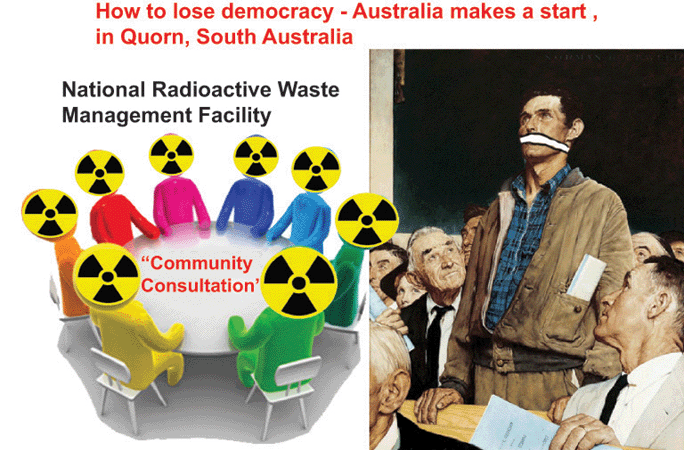 Katrina Bohr No Nuclear Waste Dump Anywhere in South Australia
After a few of us attempted to enter the closed and impenetrable BCC meeting on Tuesday in Quorn, we were left with some guidelines.
‘There will be an opportunity to attend one of the other meetings coming up’
The transcript from this meeting will be available on line.
Why all the community exclusion now, Ian Carter?
More boxes ticked on their Government to-do list….that’s all! https://www.facebook.com/groups/1314655315214929/
Earthquake close to Federal govt’s planned nuclear waste dump site – Kimba South Australia
Earthquake Felt In Cleve Kimba Area Last Night. 3.7 On The Scale.
Geoscience Australia said 13 reports of the tremor had been received from Whyalla. The tremor was magnitude 3.7 on the Richter scale at a depth of 10 kilometres.
It was felt as far away as Kadina on Yorke Peninsula.
A Geoscience spokesman at the National Earthquake Alerts Centre in Canberra said that In the past 100 years there had been more than 300 earthquakes in the region. …https://www.whyallanewsonline.com.au/story/5772041/tremor-hits-whyalla/
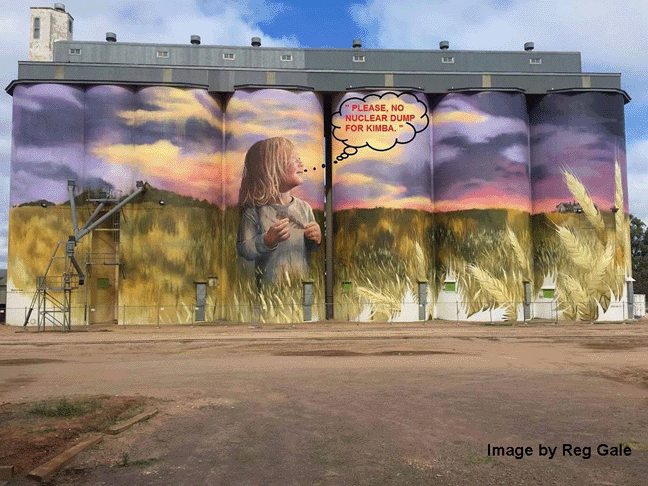
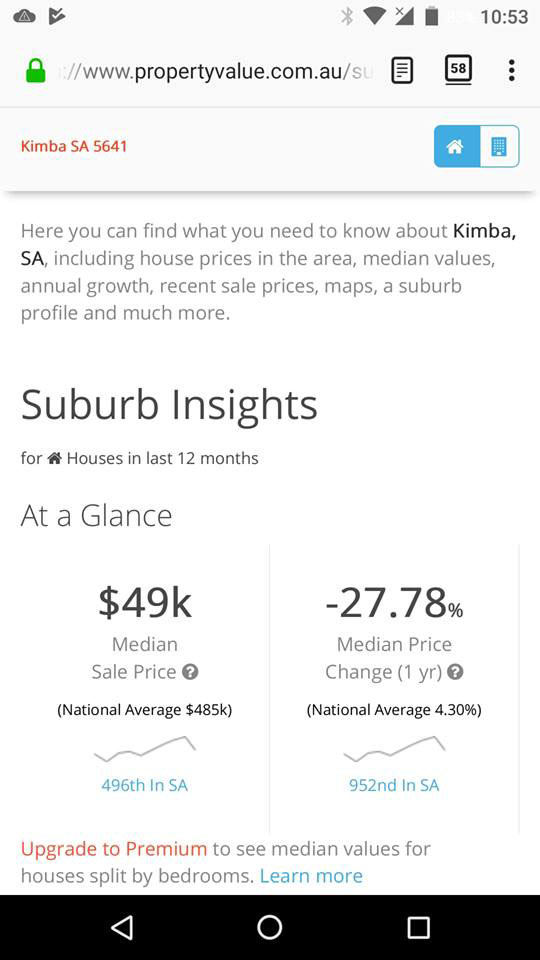
Kimba property values plunge, following plans for nuclear waste dump there
Zac Eagle Fight To Stop Nuclear Waste Dump In Flinders https://www.facebook.com/groups/344452605899556/RangesSA 9 Nov 18
This is what happens to a property market when a town is going for a nuclear waste dump.
Kimba 28% down in 12 months.
Protestors rally at South Australian Parliament against nuclear waste dump plan
 Nuclear protesters converge at Parliament House https://www.transcontinental.com.au/story/5745040/nuclear-protesters-converge-at-parliament-house/, Marco Balsamo
About 1500 people congregated at the steps of Parliament House in Adelaide to let the government know that they still oppose nuclear waste.
Protesters travelled from the Eyre Peninsula and the Flinders Ranges to join other South Australians on Saturday, November 3 at the rally organised by Don’t Dump on SA.
Federal government had initially planned to make a decision on the facility by the end of the year.
The protest aimed to deliver a message to federal government to abandon the site selection process and to the South Australian government to uphold the state legislation that makes radioactive waste facilities illegal.
“We want the government to take all sites in SA off the table and to hold a full independent inquiry into the best way to manage our most dangerous waste,” Mara Bonacci from Don’t Dump on SA said.
“The government must stop targeting remote and regional areas and give Aboriginal people a right of veto for proposals that threaten their country and culture.”
Two sites in Kimba and one site at Wallerberdina Station near Hawker have been nominated to host the facility.
Among the many speakers at the Parliament House rally was Adnyamathanha man Dwayne Coulthard, who described the selection process as “cultural genocide”.
“We have had enough of being ignored. No radioactive waste dump on Adnyamathanha country in the Flinders Ranges. No waste dump in Kimba,” Mr Coulthard said.
Other speakers at the rally included state Member for Giles Eddie Hughes and federal Greens Senator Sarah Hanson-Young.
Community members from both Kimba and the Flinders Ranges gathered in Port Augusta in August to march across the Joy Baluch AM Bridge in protest against the proposed nuclear facility.
Australian govt’s nuclear waste dump plan has put Flinders Ranges/ Kimba residents through 3 years of hell
The Federal Government needs to come clean on this and stop keeping our communities in the Flinders Ranges and Kimba dangling as part of their political game. Ever since they made plans for a federal nuclear waste dump for the Flinders Ranges/or Kimba, many people in our communities have become very unwell, some suicidal, which can be directly linked to the stress, bullying and division that this dump business has put upon us all. The government is culpable, and they should be held accountable for our past three years of hell. more https://www.facebook.com/groups/344452605899556/
Despite South Australia’s renewable energy success, are the Liberals targetting S.A. again for an international nuclear trash dump?
|
Peter Malinauskas, 31 Oct 18, Fight To Stop Nuclear Waste Dump In Flinders Ranges SA
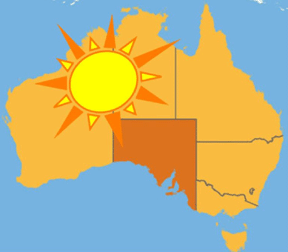
The announcement of the Port Augusta solar thermal plant was a triumph for the people of Port Augusta and all South Australians.
It was yet another example of South Australia’s leadership in renewable energy, delivering additional generation here to reduce reliance on the eastern states. I fear the Liberals’ decision to bring in consultants and launch a review raises serious questions about the future of this project. https://www.facebook.com/PMalinauskasMP/?__tn__=%2CdkCH-R-R&eid=ARA9wZFVO6K1Yf4iuQdXwuqm_ILh3yd-wNnFA-6nFFSIfvolHfmNYeWS0zOo0gyZLKSKzXcPcVV6NfmD&hc_ref=ARSWfctYX7ZwbQuJUeIxXfPqqClGqdM3 Barb Walker shared a post. Fight To Stop Nuclear Waste Dump In Flinders Ranges SA, 31 Oct 18 What’s to review??? The sun is shining and it’s been pushing towards 40° in Port Augusta and the Flinders Ranges today. We are the renewable energy capital of Australia up here!!! Sunshine galore! But instead the Federal Government have steamrolled our communities and are pushing a federal nuclear waste dump. On top of that, Cori Bernardi now has a dumb idea that a nuclear power station in our State would bring down power prices!!! What next? Are they also targeting S.A. to be the toilet for an international high grade nuclear waste dump to pay for his filthy, nuclear, multi billion dollar folly? |
|
ZEN Energy and the stunning solar future for South Australia
 Natural Advantage, 14 years ago, Richard Turner rigged up a solar-powered battery to bring some modern convenience to his kids’ cubby house. In 2018, after an incredible journey, the business is ready to revolutionise the economy and transform our state’s prosperity.
Established in 2004 in South Australia, ZEN Energy was created by Richard to get solar powered battery storage into Australian homes.
In 2010 ZEN was the state’s fastest growing company. In 2012, BRW magazine wrote up ZEN as the fourth fastest growing company in the country.
This year, British billionaire industrialist Sanjeev Gupta bought 50.1 per cent of ZEN, creating the new entity SIMEC ZEN Energy as part of his plan to own the power supply to the Whyalla Steelworks – purchased in 2017.
Gupta’s plan for ZEN is simple: power the steelworks and the associated businesses nationally with the cheapest electricity available. And in 2018 the cheapest electricity available is renewable.
But cheap doesn’t come easy. ZEN Energy is only around for Sanjeev Gupta to invest in because a lot of hard work across many generations has come before it………..
Richard isn’t mad the State Government awarded Tesla the contract for the Hornsdale battery; in many ways the Tesla brand cleared the political path for action. Richard is more frustrated by the language and mindset of the state that seems – at so many levels – to believe it’s helpless.
Tech-billionaire batteries and steel factory saviours make good headlines – but ZEN Energy tells the far more credible story of this state’s ongoing industry, creativity and resilience.
It just so happens that ZEN Energy’s story starts in a cubby house in a suburban backyard.
Richard’s children Laura and James wanted to put a little light and TV in the cubby house to make it feel more homely and play later into the evening, and so Richard scooped the kids up into the car and headed for the local hobby shop to see what they could buy. The family bought a little solar panel, a regulator, a converter and a battery. Richard recalls the guy at the shop pulling out a whiteboard marker and writing Ohm’s Law on the shop’s whiteboard.
Watts = Volts x Amps.
Rigging up the system and flicking the switch, a light went on in Richard’s mind at the same time as he lit up his kid’s cubby house. There was a business here……….
“South Australia could be the Middle East of the new world,” says Richard.
The statement catches us off guard both in its simplicity and its severity.
“We’ve got the very best renewable energy generation resource in the world,” says Richard.
“We’ve got the best sun here. We’ve got the best wind here. We’ve got these unique wind patterns that come across the roaring forties, across the Australian Bight that split up and down the Eyre Peninsula. We have nearly two gigawatts of wind power here, and there’s bugger all in the rest of Australia.”
But it’s not the raw product Richard is referring to explicitly when he says South Australia could be the Saudi Arabia of renewable energy. Richard is talking about the whole value chain of the renewable economy epitomised by Sanjeev’s GFG Alliance.
Liberty One Steel in Whyalla (as it has been renamed) and its associated heavy industry across the country will have massive demand for electricity. ZEN will be the clean, green and low-cost energy supply. Off the back of our natural and renewable resources, Richard forecasts radical change in the fortunes of this state.
“When we produce the very lowest cost of power you’re going to have all this new industry evolve. All these traditional industries will revive and gravitate to the region and will employ five times as many people as you employed in a coal-fired power station,” says Richard.
Whyalla – a town built for 100,000 people – has never had more than a quarter of that live there. “We can see, in five years, there’ll be close to 100,000 in Whyalla,” says Richard.
And with low-cost energy we can start to refine – not just mine.
Richard skips from the lithium to graphite reserves of Australia (graphite makes up lithium ion batteries 30 per cent by weight). He speaks with vigour about our clean hydrogen future – hydrogen being a huge and growing fuel source for the energy intensive economies of Korea and Japan who don’t have the renewable energy resources of South Australia.
Sanjeev Gupta will build cars in Australia – electric vehicles – Richard confirms. They’ll be built in either Victoria or South Australia. Regardless of where the cars are built, Richard says, “all the car metals and composite materials will come out of our own factories, powered by the natural energy of the sun”.
Within three-to-five years, renewables will become the dominant energy source in Australia – with coal and gas very much playing a secondary role to fill gaps in energy supply until new hydro facilities come online. Vast arrays of batteries will support critical areas prone to power fluctuations and the national energy regulator AEMO has committed to running immediate pilot programs in the worst affected areas.
Grid scale batteries will reduce severe outages by kicking into action microseconds after a power fluctuation occurs, effectively stabilising the grid. The stability these batteries will create is already causing the industry to predict electricity prices to fall by up to 30 per cent next year.
From bottom of the ladder in the old fossil-fuel energy system, South Australia is set to jump to the top in the new, renewable energy economy. And while the headlines published in our daily paper may continue to put us down, the story of this next stage in our state’s history is far more fantastic.
“South Australia is going to have the most abundant, stable electricity production centre in Australia and probably on earth,” says Richard – a fifth generation South Australian. “In years to come you won’t want to be protecting SA’s power – you’ll be exporting it both interstate and around the world.” https://citymag.indaily.com.au/habits/power/natural-advantage/?fbclid=IwAR0pgkI1MFhRalb81RPawsieK-NCgyYLxAYyqGNo0aGKsnC-SQcSMvvmBc4
Port Augusta – proudly the ‘renewables capital of Australia’
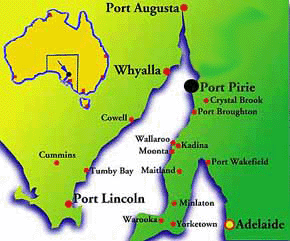 ‘Renewables capital of Australia’? Port Augusta shows off its green energy credentials, ABC
Thirteen renewable energy projects are underway or under consideration — from wind farms and pumped hydro-electric power to solar with storage that can shift electricity made when the sun’s shining to meet peak demand in the evening.
“The one great resource we have here in Port Augusta and the upper Spencer Gulf is this wonderful natural resource called the sun,” Mr Johnson said.
“It’s no different to having a massive uranium deposit, a massive gold deposit, a massive copper deposit.”
In a country drenched in sun, this natural resource is particularly abundant in the arid landscape around Port Augusta, and there are also plenty of flat expanses on which to build the facilities needed to exploit it.
Framed by the Flinders Ranges, stage one of the Bungala solar farm stretches over 300 hectares of land owned by the Bungala Aboriginal Corporation about 10 kilometres north-east of town.
Bungala uses a solar photovoltaic technology, with panels mounted on a tilting axis that can follow the sun’s path from east to west, maximising output and efficiency.
“It’s not only the largest solar project in Australia,” Mr Johnson said. “It’s also the largest in the southern hemisphere. And it’s only half complete.”
When stage two is complete, the entire project will cover more than 800 hectares — an expanse nearly as big as the Melbourne CBD — and generate up to 570 gigawatt hours of electricity a year, enough to power about 82,000 households, according to its owners, Italian multinational Enel Green Power and the Dutch Infrastructure Fund.
“Note that the Northern Power Station, when it was operating, was only producing between 500 and 540 megawatts,” Mr Johnson said.
“Obviously, it was operating 24-7, while the solar plant will only operate when the sun is shining, but when you start to incorporate battery storage and solar thermal, you then build in the energy security.”
Solar that releases energy even when the sun doesn’t shine
The Aurora project about 30 kilometres north-west of Port Augusta addresses the criticism often levelled at renewable energy — that when the sun doesn’t shine, and the wind doesn’t blow, the power doesn’t flow.
Construction is due to start soon on the concentrated solar thermal power station. It will able to store a massive 1,100 megawatt-hours of electricity, according to the project proponent, SolarReserve.
When it is built, an impressive sight will greet observers: a tower full of molten salt standing about 250 metres high, surrounded by more than 10,000 heliostats — movable mirrors, the size of billboards, algorithmically programmed to track the sun.
Those thousands of mirrors will reflect and concentrate sunlight, beaming it onto a receiver straddling the top of the tower.
During the day, molten salt will flow through the receiver and be heated to temperatures as high as 566 degrees Celsius, then stored in tanks overnight.
The energy will be dispatchable as electricity when needed — after dark in the evening peaks, or in the morning, hours after it was generated. It will be enough energy to power 90,000 homes, according to SolarReserve, which wants to build six of these plants in South Australia.
Crescent Dunes in the Nevada desert uses an identical technology.
There is one key difference: the price of the power.
“Pricing has come down dramatically, as it has throughout the renewable energy industry,” Kevin Smith, the chief executive of SolarReserve, said.
Crescent Dunes, the first plant of its kind, began operating in 2014.
Construction was aided by a concessional loan of $US737 million ($1,040 million) from the US Department of Energy. Despite that subsidy, it was contracted to supply electricity to Nevada at $190 a megawatt hour. Not cheap.
The Aurora project is receiving a much smaller concessional loan from the Australian Government — about $110 million — but will supply energy at a fraction of the price.
SolarReserve is cagey about the precise figure (the contractual conditions are complex) but Mr Smith agreed with reports that put the cost at about $78 a megawatt hour.
At current exchange rates, that is well under half the price of electricity from its inaugural plant in the US — and far cheaper than new coal-fired power.
“In terms of cents per kilowatt hour, we can supply electricity 30 to 40 per cent cheaper than new-build coal,” Mr Smith maintained.
A town blanketed in ash
Coal used to be Port Augusta’s lifeblood………
“We have incredible geography. We have everything we need to become the renewables capital of the world.”
An exaggeration? Maybe, but it’s not far off the mark.
The arid-zone landscape of the upper Spencer Gulf has solar resources ideally suited for concentrating solar thermal power, wind in abundance at speeds well suited for turbines, and a coastal location that opens the possibility of pumped hydro energy using seawater.
What you won’t find are fields of fruit and vegetables — but where there’s a will, there’s a way.
That white beacon of light on the edge of town? It’s a solar thermal power plant that runs a massive greenhouse that grows truss tomatoes.
Sundrop Farm is using the solar thermal electricity to desalinate water, create electricity to power the operation, and pump heat through 60 kilometres of pipe around the vines.
It’s a testament to human ingenuity, like much of what’s happening in the renewal of Port Augusta. http://www.abc.net.au/news/2018-10-05/port-augusta-becomes-australian-renewable-energy-hub/10338812
Flinders Ranges – a top tourist destination – a crazy choice for a nuclear waste dump

TODAYS ADELAIDE NEWS HEADLINE (3rd October 2018): “South Australia’s outback landscapes, such as Wilpena Pound, are attracting domestic tourists.
Staggering, the Flinders Ranges hosting the Jewel in our tourism crown “Wilpena Pound” recently nominated for consideration as one of Australia’s “7 Wonders” is being celebrated here yet as we speak, Scott Morrison (ScoMo)‘s Federal Government is planning to build an above ground National Nuclear Waste Storage Dump within a short drive from Wilpena Pound and the Hawker, South Australia Township.
Our Premier Steven Marshall committed in the lead up to the last State Election that: “A Marshall Liberal Government will not support the building of a nuclear waste repository in South Australia”..”Let’s Aim Much Higher” yet he will not be drawn on this topic. It would seem his Federal counterparts have his measure and have compelled him to silence as it also seems our Tourism Minister, David Ridgway has also been silenced on this matter.
Curiously David Ridgway was quoted in this article as saying: “Our outback landscapes and other assets are attracting 62 per cent of all domestic visits – that’s huge,”
Huge! yet clearly not huge enough to advocate for its protection.
If that doesn’t concern you, we have learnt in recent times that: Project leaders demonstrate little to no knowledge of the life cycle of a TN81 storage canister, ANSTO’s safety record is deplorable, it is proposed to be built within one of Australia’s most seismic regions, on a fault line, on a flood plain, above ground, with national parks either side, neighbouring working farmland, near human habitation, defying traditional ownership appeals to not do this, heck the list for lunacy goes on.
In the light of all this, it would be safe to say Brand South Australia will certainly be swimming against the tide trying to sell one of our great Wonders once it has the NUCLEAR tag over the top of it. https://www.facebook.com/groups/344452605899556/?multi_permalinks=838591016485710¬if_id=1538530176717096¬if_t=group_activity
SA tourism: visitors expenditure reaches record $4 billion, Jade Gailberger, Federal Political Reporter, The Advertiser, October 3, 2018 FAMILY and friends visiting South Australians are splashing a record amount of cash and choosing day trips to the state’s iconic regions, new tourism data shows.
SA’s national visitor expenditure reached a record $4 billion, up four per cent for the year ending June 2018. (subscribers only)
Jobs for South Australians at nuclear morgue? That is a shaky promise.
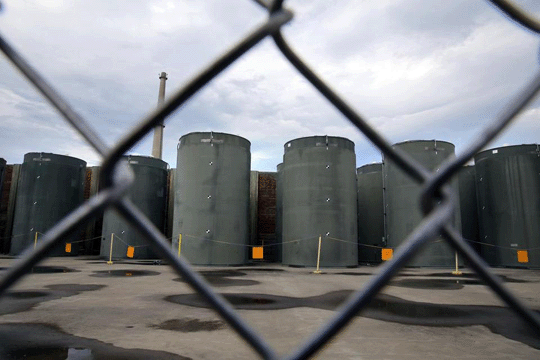
A nuclear waste jobs bonanza for regional South Australia? http://www.onlineopinion.com.au/view.asp?article=19959, – Jim Green, 27 Sept 19
The federal government is trying to persuade regional communities in South Australia to host a national radioactive waste facility – an underground burial repository for lower-level radioactive wastes and an above-ground ‘interim’ store for long-lived intermediate-level waste. One site under consideration is near Hawker in the Flinders Ranges, and two other sites under consideration are on farming land near Kimba at the top of the Eyre Peninsula.
The government is promising 45 jobs, three times its earlier claim that there would be 15 jobs at the proposed facility. The compensation package on offer has also tripled and now stands at $31 million.
Forty-five jobs would be welcome in small regional communities. But is it plausible that 45 jobs would be created? When the Howard government was attempting to establish a radioactive waste repository in SA from 1998 – 2004, the government said there would be zero jobs – not even any security guards. The government-commissioned PR company Michels Warren said: “The National Repository could never be sold as “good news” to South Australians. There are few, if any, tangible benefits such as jobs, investment or improved infrastructure.”
From 2005 to 2014, Coalition and Labor governments targeted sites in the Northern Territory for a radioactive waste repository and said there would be just six jobs, all of them security guards.
Last year, with SA once again in the firing line, the government said: “At least 15 full-time equivalent jobs will be needed to operate the facility. These will be in site management, administration, security, environmental monitoring, site and building maintenance as well as receiving and packaging waste materials.”
Recently, the jobs estimate was upped to 45, with the government saying: “In addition to the 15 operational jobs already confirmed, the structure now includes roles for community liaison, management, tourism, environmental monitoring, security, health and safety: a total of 45 staff.”
This is the breakdownof the 45 jobs:
14 – security and safeguards
13 – waste operations and technicians
8 – site management and community outreach
5 – environmental protection and quality control
5 – safety and radiation protection
That estimate comes with caveats: “the final workforce design and structure will be based on a number of factors including advice from security agencies, the views of the independent regulator and the details of the final business case, with inputs from across government.”
Overseas comparisons
The Centre de Stockage de l’Aube (CSA) radioactive waste facility in France handles over 200 times more waste per yearcompared to the proposed facility in SA yet it employs only four times as many staff as the proposed facility in SA. CSA processes 73 cubic metres (m3) per employee per year (13,164 m3 / 180 staff).
Is the estimate of 45 jobs credible? Not if overseas radioactive waste facilities are any guide.
The El Cabril radioactive waste facility in Spain has a staff of 137 people and processed an average of 1,395 m3 per year from 1993 to 2016. That equates to 10.2 m3 per employee per year.
Yet the Australian government estimates a workforce of 45 people to process 45 m3 per year: 1 m3 per employee per year compared to 10.2 in Spain and 73 in France. The government evidently has a dim view of the productivity of Australian workers, or, more likely, its jobs estimate is grossly inflated.
Will the government pay staff to do nothing?
Measuring jobs-per-employee doesn’t account for some jobs required whether a facility processes 1 m3 or 1 million m3 per year: administration, security and so on. As a government official stated: “There are a base number of jobs related to the management of the waste which are not linear with volume and a number of jobs that would scale with larger volumes.”
Nevertheless, productivity at the proposed Australian facility would be dramatically lower than comparable facilities overseas.
If we assume that Australia matched the lowest of the figures given above – 10.2 m3 per employee per year at El Cabril in Spain – then the staff at an Australian facility would be processing waste for just one month each year and they’d have 11 months to play ping-pong.
The current government might be willing to pay 45 staff to play ping-pong for 11 months each year, but it’s not a sustainable situation. The Department of Finance wouldn’t tolerate it. If staff at the waste facility are paid by the federal government to do nothing for most of the time, what sort of a precedent does that set, and why shouldn’t the rest of us be paid to do nothing for 11 months out of 12 at a cost to taxpayers of several million dollars each year?
Almost certainly, staffing would be dramatically culled. Almost certainly, a future government would revert to the plan pursued by previous governments: keeping the waste facility closed most of the time, and opening it occasionally for waste disposal and storage. In the jargon, this is called a campaign-based approach with occasional waste disposal ‘campaigns’.
Previous governments said that waste would be sent to the facility just once every 3 – 5 years. For example, the government said in 2003 that waste would be transferred to the facility just once every five years: “It is considered for planning purposes that an average period of 5 years between campaigns will be appropriate” (Volume III of DEST application to ARPANSA, Ch.9, ‘Waste – Transfer and Documentation’, p.5).
In a recent attack on me for questioning its estimate of 45 jobs, the Department of Industry, Innovation and Science said it was unable to locate any previous government documents regarding periodic, campaign-based plans. The federal government can’t find federal government documents? Seriously?
The government says that it wants continuous operation of the repository (for reasons unexplained) rather than a periodic, campaign-based approach. But even so, the government only plans to shift waste to the facility once or twice each yearaccording to a 2016 document. A July 2018 government document states: “This facility will be an operational facility and not as some have suggested, a minimally crewed warehouse to be opened once or twice a year.” But it is the government itself which says that waste will only be transported to the facility once or twice each year!
Broader economic impacts Continue reading
Weapons-making corporation, Raytheon hoping for nuclear industry in SouthAustralia?
Flooding Dangers to proposal for Nuclear Morgue in South Australia
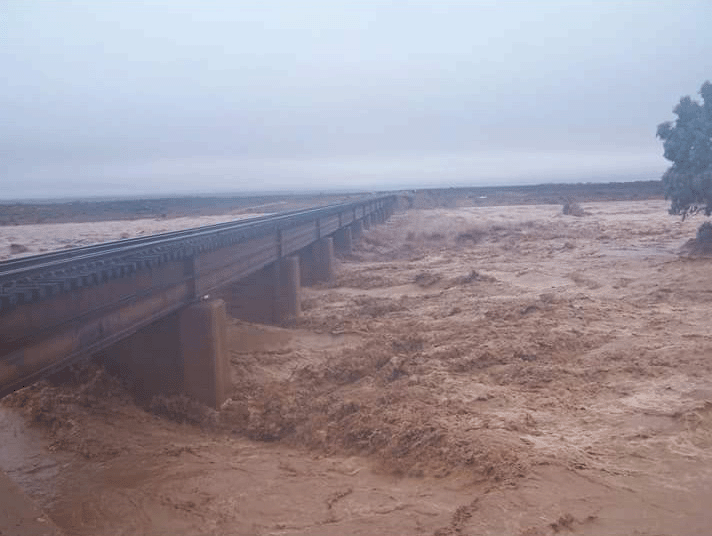 Susan Craig Susan and 4 others are consistently creating meaningful discussions with their posts. .Fight To Stop Nuclear Waste Dump In Flinders Ranges SA, 12 Sept 18 There is also some other interesting news regarding Lake Torrens National Park and it’s proximity to the proposed site being outside the site characteristic criteria.
 There are so many evidence based flaws in this proposal that are now percolating to the surface. The AECOM report under Hydrology and Flood Risks Assessment Finding referred ONLY to the floods of 1955 and 2005. The report DID NOT take into account the floods of 1989.
1 This month


Help Aunty Sue Protect Her Land and Sacred Sites From Destructive Rocket Testing.
.

Australians deserve the truth
about
AUKUS – https://aukuspublicinquiry.com/

PETITION – To: Prime Minister Anthony Albanese and the Australian Labor Government

of the week – Australians for War Powers Reform (AWPR)
To see nuclear-related stories in greater depth and intensity

