New York Times buys into ANSTO’s nuclear spin about Kimba?

This New York Times author gives a fair coverage to the Kimba radioactive waste dump issue. But it’s misleading in 3 important ways, as if the author completely buys the nuclear lobby’s propaganda.:
- States that “The country has no nuclear power plants.” But fails to mention the Lucas Heights nuclear reactor [which is the source of the really important radioactive trash for Kimba]
- Fails to mention the fact that South Australia has a clear law prohibiting establishment of any nuclear waste facility
- Seems unaware of the huge distances (2000 km) involved, which would mean that the vast majority of medical wastes would no longer be radioactive, in transport from the main points of production and use.
A Farming Town Divided: Do We Want a Nuclear Site that Brings Jobs?, NYT, By MARCH 7, 2018 “……… Now, as the federal government considers whether to build the site on one of these two farms in Kimba, this community of about 650 people finds itself divided and angry. The prospect of jobs and subsidies that the site would bring has split locals between those who want to preserve rural Australia’s way of life and those who say the glory days of farming are over…..
Despite the distances, locals say Kimba always had a strong sense of community, at least until the nuclear site was proposed. Some said the allure of millions of dollars’ worth of grants and subsidies that the government was offering the host community had blinded people to the risks.
Protesters unite against nuclear waste in Port Augusta
https://www.transcontinental.com.au/story/5271501/protesters-unite-against-nuclear/ Marco Balsamo
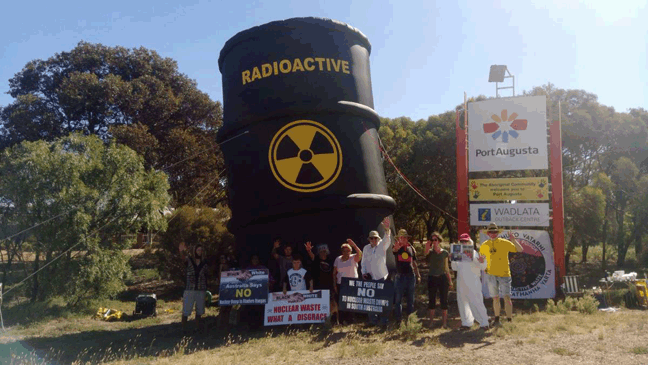
Members of the Flinders Local Action Group (FLAG) stood side-by-side with Adelaide-based group Don’t Dump on SA in Port Augusta to protest against a potential radioactive waste facility in South Australia.
The two groups, together with local Adnyamathanha and Barngarla people, joined forces on the Princes Highway ahead of the state election, highlighting their concerns to locals and passing traffic with signs and information packs.
The protesters also encouraged locals to get involved by sending submissions to the Senate Inquiry into the selection process for a national radioactive waste management facility.
FLAG member and Hawker general practitioner Dr Susi Andersson said the broader community needed to know about the issue.
“The federal government is treating this as an issue for the local people only, but many people visit and care about the Flinders Ranges and don’t want a dump there,” Dr Andersson said.
-
Parliament passed the Nuclear Waste Facility (Prohibition) Act 2000 in order to “protect the safety and welfare of the people of South Australia” and the protesters encouraged locals to vote for parties who would defend this legislation.
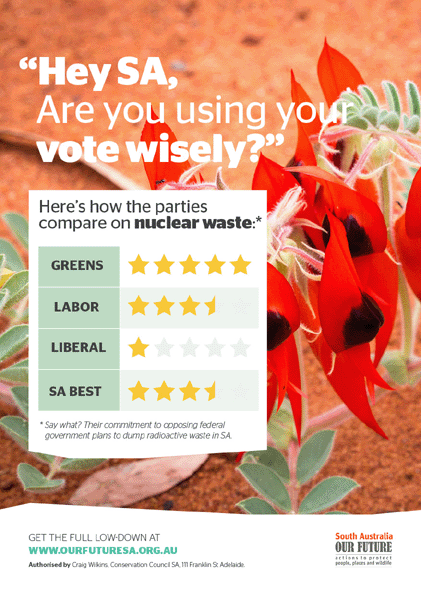
The Greens scored a five-star rating in a scoreboard conducted by an alliance of environment and community organisations across the state.
The scoreboard was based on responses to a survey sent to the leaders of the state’s five parties, rating them on their commitment to stopping climate pollution, ramping up clean energy and protecting nature.
SA Best scored second-best with a three-star rating, while Labor scored two stars followed by Liberal with 1.5 stars.
The Australian Conservatives, who recently backed a nuclear waste facility in SA, did not respond to the survey.
ANSTO spin and lies : Kimba nuclear fans shouted a visit to Lucas Heights
“Australia does not produce any high level waste.” [???] said Bruce McCleary, the General Manager of the National Radioactive Waste 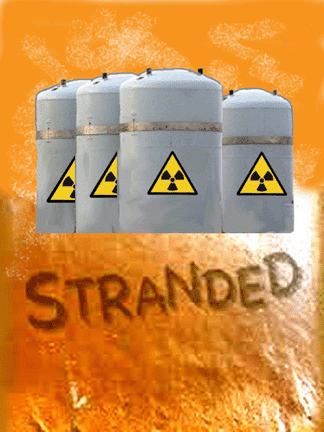 Management Taskforce
[He also did not mention that these wastes for Kimba will be temporary, i.e. STRANDED WASTES]
ANational Radioactive Waste Management Facility:
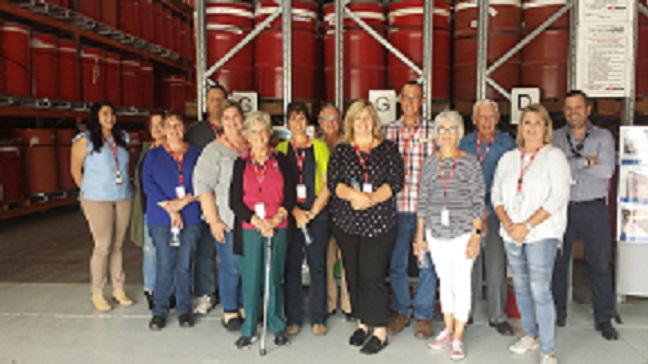
Kimba locals welcomed to Australia’s nuclear facility Eleven members of the Kimba community were on site at Lucas Heights yesterday, to see first-hand Australia’s nuclear technology and radioactive waste management expertise.
The delegation to the Australian Nuclear Science and Technology Organisation (ANSTO) included people with a variety of views on Kimba hosting the National Radioactive Waste Management Facility.
It included four neighbours of the two volunteered sites in Kimba, and three members of the Kimba Consultative Committee (KCC), as well as other interested community members.
Patricia Beinke saw the OPAL multi-purpose reactor, where ANSTO stores low and intermediate level radioactive waste, and how waste is prepared for transportation.
“It was a much bigger campus and complex than I had ever envisaged. I read all the information that comes my way, but wasn’t expecting this scale,” Mrs Beinke, who is a member of the KCC, said.
“I just found the trip so good. The scientists and engineers spoke on a level that everyone could understand.
“I saw the reactor, and we had a great discussion about how the waste is prepared for transportation, including the processes it would go through before being sent to a national facility.”
Austen Eatts has property that neighbours one of the volunteered sites, and is opposed to the facility, but was pleased to have seen ANSTO’s campus.
“I have always had a reasonable idea of what happens at ANSTO regarding medicine and industry, and what they are doing there is very good actually,” Mr Eatts said.
“The waste has to be put somewhere. I am still of two minds about whether it should be located in Kimba, but I found the trip very informative.”
Mr Eatts stressed that he is against the idea of a facility anywhere in Australia that could store high level, imported waste from overseas – a proposition not being put forward by the Federal Government.
Bruce McCleary is the General Manager of the National Radioactive Waste Management Taskforce, and said it was great to host people with a variety of views on trips such as this.
“Tours of ANSTO’s medicine manufacturing and radioactive waste facilities are a great information tool for communities considering if they want to host a radioactive waste industry,” Mr McCleary said.
“They are also a way of us establishing what questions the community still has, and for them to see and hear from experts who work with this material every day, first-hand.
“I can confirm for Mr Eatts – and anyone else who shares his concern – that the national facility will not hold international or high level waste, because it is for Australian waste only, and Australia does not produce any high level waste. [????]
“Our national facility needs 100-hectares for an above ground low-level waste disposal and temporary storage of intermediate-level waste, whereas an international high-level facility would need to be far larger and would require a deep underground facility in order to be safe and economically viable.”
For more project information: www.radioactivewaste.gov.au
Which South Australian parties have the guts to say NO to the Federal nuclear waste dump plan? – theme for March 18
 Is there some reason why the greedy nuclear lobby, the secretive agency ANSTO, and the weak Australian government all seem to think that it’s OK to transport nuclear reactor trash for thousands of km across the land, and dump it on agricultural land in South Australia?
Is it because they’ve decided that South Australia is already radioactively trashed, because the Australian government allowed the British to test 12 major nuclear weapons and hundreds of “minor” ones on Maralinga, S.A.?
It is some sort of weird payback because this State never had convicts dumped on them – so the dominant Eastern States want to put the South Australians in their place?
South Australia is a beautiful place. It has never generated nuclear trash. Let the nuclear trash be kept, (as international conventions and best practice dictate) near to the point of production – AT LUCAS HEIGHTS in Sydney. And then let Australia come to its senses and stop making the foul stuff.
This is NOT a “Kimba” issue, not just a regional issue, – it’s certainly a STATE issue, and a NATIONAL issue.
Aware citizens in Australia are waiting to see if the South Australian Labor Party, Liberal Party, SA Best Party have the guts to join the Greens in saying NO to the Federal nuclear waste dump plan.
South Australia election: Greens OPPOSE, SA Best nearly oppose, nuclear waste dump in SA: Labor and Liberal vacillate
 “SA Best is pleased to provide the following response to … :
level radioactive waste storage and disposal facility
Yes
Refer to SA-BEST environment policy.
11c. Actively support the state Nuclear Waste Storage Facility (Prohibition) Act 2000.
Commit to further strengthen this legislation by removing the modified section
level radioactive waste storage and disposal facility
Yes
Commit to further strengthen this legislation by removing the modified section
 Note: The Liberal response (as published) does not provide an answer to Q 11b:
“The Greens have made the following commitments in response to … :
 11a Categorically rule out the creation of an international high and/or intermediate
level radioactive waste storage and disposal facility
Yes
Commit to further strengthen this legislation by removing the modified section
 Labor: “Thanks for opportunity to outline our position. A detailed response to your questions is attached:
level radioactive waste storage and disposal facility more https://www.ourfuturesa.org.au/scorecard

Nuclear Waste issue highlighted in Port Augusta ahead of state election
 Mara Bonacci, 5 March 2018 On Saturday 3rd March, members of Adelaide-based group Don’t Dump on SA joined Adnyamathanha and Barngarla people and members of the Flinders Local Action Group (FLAG) on the Princes Highway in Port Augusta to highlight concerns over the Federal government’s plan to site a radioactive waste facility in South Australia.
The lively and colourful event involved a giant inflatable radioactive waste barrel, music, free cuppas and a lime green three-headed kangaroo. It received a positive response and lots of encouragement from locals and passing traffic.
Locals who stopped for a chat were given showbag-style information packs and encouraged to send a submission to the federal Senate Inquiry into the selection process for a national radioactive waste management facility in South Australia. An online submission template can be found athttps://nowastedump.good.do/wastedumpsenateinquiry/submission/.
Barngarla woman Linda Dare said “We’re here today to tell people that we don’t want a radioactive waste facility in South Australia. We want people to support us in the fight to stop it”.
FLAG member and Hawker GP, Dr Susi Andersson, said “The federal government is treating this as an issue for the local people only, but many people visit and care about the Flinders Ranges and don’t want a dump there. I feel the broader community need to know about and discuss this issue”.
In response to earlier federal moves to dump radioactive waste in SA our Parliament passed the Nuclear Waste Facility (Prohibition) Act 2000. The objects of this Act are “to protect the health, safety and welfare of the people of South Australia and to protect the environment in which they live by prohibiting the establishment of certain nuclear waste storage facilities in this state.”
In the lead up to the state election on 17 March, people concerned about the imposition of a nuclear waste facility in SA are being encouraged to vote for parties who will defend this legislation. Information can be found at https://www.ourfuturesa.org.au/scorecard.
Federal govt cannot override South Australia law against nuclear waste dump
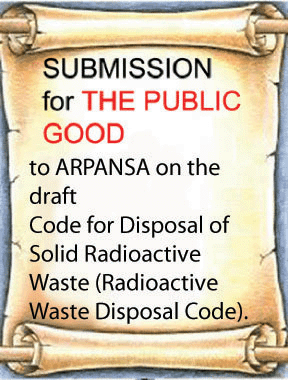 Cameron Scott, Submission to ARPANSA on draft Code for Radioactive Waste, 4 Mar 18 It needs to be stated in the Code for Disposal of radioactive Waste that the Federal Government can not override state legislation for building a national facility. The code needs to include a clause protecting farming land from becoming home to hazardous waste. Licensing should require communities to nominate land not individuals.
Xenophon’s SA Best – interesting on renewables, (but what about the planned nuclear waste dump?)
my personal prediction is that this will result in around 90 per cent renewables [in South Australia] by 2030. This is a prediction, not a target.
SA can lead the nation not just on energy generation, but all the manufacturing, construction and jobs that could go with this in areas such as PV panels, components, smart energy, CST mirrors, etc.
 What’s Best for South Australia’s energy policy http://reneweconomy.com.au/whats-best-for-south-australias-energy-policy-28835/, By Graham Davies on 28 February 2018
At a recent energy event in Adelaide where I presented for Nick Xenophon’s SA-BEST, it was encouraging that the Greens, SA-BEST, Labor and Liberal all stated that renewables was the future.
However, the Liberal Party is going to be hamstrung by Turnbull/Abbott and the National Energy Guarantee (a thought bubble to appease the Abbott ilk, masquerading as policy); inaction on climate; and offering a $1 billion loan to Adani. Continue reading
South Australia Liberal Party – confused policy on nuclear waste dumping
From the Liberals current policy website: 
NUCLEAR INDUSTRY – OUR POSITION
South Australia and the Nuclear Industry
The Liberal Party has always been willing to fully and openly investigate the pros and cons of the nuclear fuel cycle to grow our economy and build our State. https://www.stevenmarshall.com.au/nuclear_industry
From ABC news
SA power cuts: Nuclear energy should be considered as solution, state Liberals say, By Daniel Keane,
today he said that did not mean he or his party were against the production of high-level nuclear waste in South Australia, via nuclear energy generation.
“We’ve never ruled out the nuclear opportunity for energy. We made it very clear that we were not in the slightest bit interested in continuing to pour money into the hopeless case which was a nuclear repository in South Australia,” he said.
“The royal commissioner ruled out nuclear energy in South Australia but there will be a time when it may become viable, and desperate times call for desperate solutions, and we are in a desperate situation.”
Mr Marshall denied the policy was hypocritical, but did not offer an explanation as to what would become of the highly radioactive spent fuel rods if a nuclear reactor was built in South Australia. http://www.abc.net.au/news/2017-02-09/sa-power-cuts-could-be-solved-by-nuclear-energy-say-liberals/8256814
Nick Xenophon’s SA BEST party promises community electricity co-op.
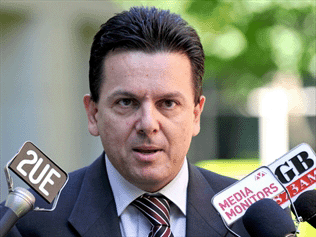 Xenophon’s SA BEST unveils community electricity co-op plan http://reneweconomy.com.au/xenophons-sa-best-unveils-community-electricity-co-op-plan-11721/ By Sophie Vorrath on 27 February 2018
Nick Xenophon’s SA BEST party has waded into the South Australia energy war, with an election promise to cut power prices by as much as 20 per cent, by setting up a community electricity co-op.
Billed as an “exciting plan to lower power prices using the co-operative model of community electricity trusts,” the policy was unveiled on Tuesday ahead of the March 17 state election.
It follows a battery of energy policy promises from Jay Weatherill’s Labor Party, including plans to boost the state renewables target to 75 per cent, to introduce an energy storage target, and to adopt nation-leading electric vehicle incentives.
The SA Liberal Party has been less ambitious, but in October last year promised $100 million in grants to help homes to buy and install battery storage.
The SA BEST policy proposal gives form to one of Xenophon’s most favoured campaign slogans, which promised to give power back to the South Australian people.
To be named the Community Electricity Trust of SA (cETSA), the co-operative retailer would be made up of 50,000 lower-income households and up to 5000 small businesses, and power prices for those members would come down by 20 per cent.
The retailer would also be able to tender to develop 150MW of new renewable energy generation.
“The co-operative (energy) model has an internationally proven track record for delivering services,” said Business Council of Cooperatives and Mutuals CEO Melina Morrison.
“(It) is already being deployed in countries around the world, including the USA, Germany and Denmark,” she said.
“Nick Xenophon has been a long-time champion of co-operative and mutual enterprises – the Business Council of Co-operatives and Mutuals is confident this won’t be the last creative solution to SA’s problems using the co-op and mutual model from SA BEST.”
This article was originally published on RenewEconomy’s sister site, One Step Off The Grid, which focuses on customer experience with distributed generation. To sign up to One Step’s free weekly newsletter, please click here.
Senator Cory Bernardi promises $445 billion for South Australia, if it hosts international nuclear waste dump

Cory Bernardi says a nuclear power dump could make us the ‘Saudi Arabia of the south’, news.com.au 26 Feb 18 CORY Bernardi is pushing to reignite a controversial development in South Australia, saying it could make the state the “Saudi Arabia of the south”.
LEADER of the Australian Conservatives party Cori Bernardi is pushing for a nuclear waste dump in South Australia, which he says will transform the state into the economic “Saudi Arabia of the south”.
Speaking at the party’s election launch in South Australia on Sunday, founder and federal Senator Cory Bernardi said he wanted to reopen the debate on an outback nuclear dump.
He called for changes to the law to allow for “all forms of energy production”, including nuclear power, urging authorities to “complete a full rigorous analysis” of the idea.
According to The Advertiser, he claimed the dump would generate up to $6.7 billion in gross state product, allow for $3 billion in annual taxes to be scrapped, and see the state reaping in $445 billion over the next century.
“Imagine that legacy for our children … to draw on in developing this state,” he said. “We would be an economic powerhouse. We would be the strongest state in the Commonwealth.”
Upper House candidate Robert Brokenshire said the party is “committed to looking at all types of energy production including nuclear energy to find the cheapest and most reliable form of energy”.
Labor Premier Jay Weatherill was quick to rule out the suggestion.
“That’s dead,” he said on Sunday. “Labor Party policy has been opposed to a nuclear waste facility in the past and there’s no prospect of changing that in the future.”
Mr Weatherill did not rule out pursuing a High Court case against the Turnbull government if a national nuclear waste dump was to be approved in South Australia, The Australian reported last month.
……..Earlier this month, the Australian Conservatives announced it will field 33 Lower House and two Upper House candidates at the state election on March 17. http://www.news.com.au/technology/environment/cory-bernardi-says-a-nuclear-power-dump-could-make-us-the-saudi-arabia-of-the-south/news-story/eb3f1ada5ed978646f53a2911f0e1c3d
South Australia: Senator Cory Bernardi ridicules Elon Musk, as he launches Australian Conservatives pro nuclear election Campaign
SA election: Australian Conservatives launch nuclear dump idea and ridicule Elon Musk, By Daniel Keane , ABC News 25 Feb 18
Department of Industry, Innovation and Science to set up another pro nuclear ‘Economic Working Group’ (EWG)
Kimba residents to be involved with nuclear economic investigation https://www.eyretribune.com.au/story/5241635/kimba-residents-to-be-involved-with-nuclear-economic-investigation/
Kimba residents have the chance to be directly involved in investigating economic opportunities and issues relating to the proposed National Radioactive Waste Management Facility.
As part of the Department of Industry, Innovation and Science’s ongoing consultation, an Economic Working Group (EWG) consisting of local community members will be established to consider the proposal.
Working group members will consider how economic benefits could be realised, or issues addressed, if Kimba is selected as the location for the national facility.
Opportunities that could come from the facility may include contracting works in construction, ongoing work during operation, and flow on roles in everything from the service industry to tourism.
Head of the National Radioactive Waste Management Facility Taskforce Bruce McCleary said the project had economic potential.
“This project has potential to generate significant local economic opportunities and this committee will give locals the chance to directly explore that,” he said.
“We know that local community members are best placed to highlight where there are local opportunities, and where more opportunities need to be created.
“Members of the Economic Working Group will work with the Kimba Consultative Committee and the department’s project team to discuss the ways the proposed facility could enhance the local community.
“The committee members will also be tasked with identifying any economic activities that could be impacted by the facility.”
The group will be based on the model already implemented in Barnidoota.
“I encourage all interested local community members – those for, against or undecided on the proposal, to put in an Expression of Interest in joining the Kimba Economic Working Group,” Mr McCleary said.
The Kimba Economic Working Group will consist of a maximum of 10 members, including a Chairperson.
Expressions of interest are now open and close at 5pm EDT on March 13 2018.
For more information on the selection criteria and how to apply to be a member of the Economic Working Group, go to www.radioactivewaste.gov.au.
Premier Jay Weatherill says that South Australia’s election will be a referendum on renewables
 Weatherill: Why state election will be referendum on renewables, REneweconomy, By Giles Parkinson on 22 February 2018
South Australia Premier Jay Weatherill might not be able to see much daylight between his Labor Party and the rival Liberals and SA Best, but he’s certainly making sure there is a big difference between his energy policy and those of the Opposition and the upstart party of Nick Xenophon.
Over the past few weeks, before and since the start of the official election campaign, Weatherill has been trotting out almost daily announcements about significant new investments and new targets for renewable energy and energy storage in the state.
It was capped this week with his world-leading 75 per cent renewables target by 2025, the Australia-first “renewable storage” target of 750MW, Australia’s first battery manufacturing plant, to be built by Germany’s sonnen, and any number of individual renewable and storage projects.
There is good reason for this. Renewable energy, according to the polls, is a lot more popular than the Labor government, struggling under the burden of 16 years in power and about an even bet with the Liberals, with Xenophon the wild-card.
…….Weatherill insists the pursuit of renewable energy has been a success. The Australian Energy Market Operator, having “dropped the ball” is now managing the system properly (new CEO Audrey Zibelman has been a “breath of fresh air”, he says), and renewables have not been the cause of any outages.
“What we have demonstrated is that despite having 48.9 per cent renewable energy, we haven’t had any reliability issues that caused outages because of the size of our renewable energy,” Weatherill says
The blackouts in September 2016, and in February last year, were caused by major weather events and failures in the National Energy Market, the latter when “perfectly good supply” (a major unit at the Pelican Point gas generator) was not switched on because of “the way the market works.”
That prompted the SA government to intervene, building its own emergency back-up, and launching a series of initiatives that has seen the world’s biggest lithium-ion battery built by Tesla, and the world’s biggest solar tower with molten salt storage due in 2020.
This has been accompanied by a series of investments and studies in battery storage, pumped hydro and hydrogen energy projects, along with virtual power plants and micro-grids.
And the Tesla big battery, next to the Hornsdale wind farm, is already having an impact, particularly in markets that provide network services known as FCAS (Frequency Control and Ancillary Services).
“The Tesla big battery is already smashing the FCAS market, and we will get fantastic benefits from not being ripped of by the existing generators for those FCAS services,” Weatherill says.
………Labor’s 75 per cent renewable energy target compares to the Liberals pledge to can any state-based initiative, even though both have programs to encourage battery storage in households.
Xenophon’s SA Best is only now starting to roll out its policy proposals, which include creating a new “not-for-profit” retailer, and a tender for 150MW of “dispatchable” renewables.
Weatherill is hopeful Labor can continue without having to strike a deal with Xenophon’s SA Best, but says he is confident, if he must, in being able to convince Xenophon to come on board with Labor’s energy policy, notwithstanding Xenophon’s support of anti-wind campaigns in the past.
“I think I can persuade Nick that this is an appropriate future for South Australia,” he says. “I hope to get there on my lonesome without a coalition. If we do (need to strike a deal), I won’t be compromised on this, because it is critical for the future of the state.”…….http://reneweconomy.com.au/weatherill-why-state-election-will-be-referendum-on-renewables-47132/
1 This month


Help Aunty Sue Protect Her Land and Sacred Sites From Destructive Rocket Testing.
.

Australians deserve the truth
about
AUKUS – https://aukuspublicinquiry.com/

PETITION – To: Prime Minister Anthony Albanese and the Australian Labor Government

of the week – Australians for War Powers Reform (AWPR)
To see nuclear-related stories in greater depth and intensity

