What tests go on at Woomera – ‘the largest land testing range in the world’ ?
What IS the army testing in the South Australian desert? Mysterious mushroom cloud erupts over historic Woomera range just after a drone flying near the secretive site was ‘forced to the ground’ http://www.dailymail.co.uk/news/article-4616616/Mystery-mushroom-cloud-erupts-Woomera-range.html By Bryant Hevesi For Daily Mail Australia
A man has captured image of ‘mushroom cloud’ near Lake Hart, South Australia Jason Wright said loud explosion occurred after his drone was forced to ground . The cloud formed over the Woomera Prohibited Area, used for military testing The prohibited area is known as ‘the largest land testing range in the world’
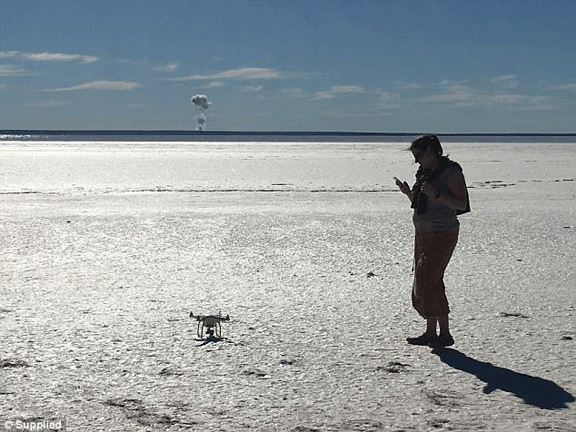
Jason Wright snapped images of the cloud shortly after he says his drone was forced to the ground prior to hearing a loud explosion while he was near the testing range.
Mr Wright told Daily Mail Australia he had stopped off along the Sturt Highway with his partner and children to see Lake Hart on Saturday when the unusual incident occurred. The experienced drone flyer had set-up his drone to take photos near the Lake Hart tourist rest area on the edge of the salt lake when he says it came down out of his control and made a hard landing.
Mr Wright, who lives in Coober Pedy, believes the drone’s GPS-based tracker may have been interfered with. About a minute after the drone fell, a ‘fireball’ erupted in the far distance, estimated to be as high as a 30-storey building, with the ‘mushroom cloud’ forming.
‘It was quite a spectacular explosion. It was very bright and there was a lot of heat in it,’ he said.
Mr Wright said despite criticisms he should not have been flying a drone in the area, he said the Civil Aviation Safety Authority’s ‘Can I fly there?’ app showed was able to have a drone up to 45 metres where he was standing.
The Woomera Prohibited Area ‘is used for the testing of war materiel’ and is ‘the largest land testing range in the world’.
Exclusion zones are in place at various locations within the prohibited area at different times of the year while military equipment is tested.
One is currently in place until June 30.
In a statement to Daily Mail Australia, the Department of Defence said: ‘No weapons were being tested; the activity was a demolition of war materiel’.
Defence did not carry out any action to impact the unmanned aircraft,’ the statement said.
‘Defence carries out operations for the testing of war materiel within the Woomera Prohibited Area. This includes capability being developed and tested for use for defence purposes. The photograph was the result of the demolition of war materiel.
‘An unauthorised person must obtain a permit or approval to enter the Woomera Prohibited Area.
‘In addition to the entry requirements, all unmanned aerial vehicle or remotely piloted aircraft operators must comply with the requirements of Part 101 of the Civil Aviation Safety Regulations 1998, this includes requirements associated with operating within a designated restricted area (for the purpose of regulation 6 of the Airspace Regulations 2007).
‘The Woomera Prohibited Area includes restricted areas for the purposes of the Airspace Regulations 2007 and these areas may be active during periods of defence testing activities.’
Kimba community divided over federal nuclear waste dump plan – fairly narrow “yes” vote
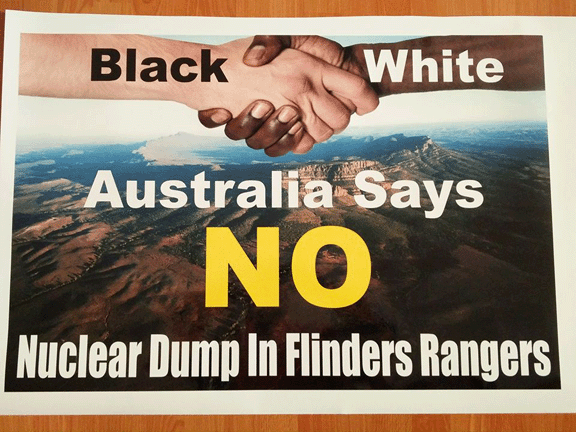 Kimba votes yes to radioactive waste dump in Eyre Peninsula http://www.adelaidenow.com.au/news/south-australia/kimba-votes-yes-to-radioactive-waste-dump-in-eyre-peninsula/news-story/96ca27ddaa0f67519b60a366584156bc, Polly Haynes, The Advertiser, June 22, 2017
RESIDENTS of Kimba have voted in favour of building a radioactive waste dump in their Eyre Peninsula district. Posted on the council’s website, the interim results for the postal ballot on the National Radioactive Waste Management Project show 698 ballot papers were received by the Australian Electoral Commission.
Of those, 396 voted for and 294 voted against, while eight ballot papers were informal votes.
The Federal Government is considering two properties near Kimba, in addition to a previously short-listed block of land at Barndioota, near Hawker in the Flinders Ranges.
In March, the Kimba Council called in the Australian Electoral Commission to run a postal vote of the 1100-strong community on the options. At the time, Mayor Dean Johnson said he believed there was strong support in the community for the two local sites to be formally considered. This morning he said: “The numbers are what they are… in the end the people have voted.”
However, a group opposing the dump — No Radioactive Waste on Agricultural Land in Kimba or SA — said the results of the vote showed the community was still divided.
“There has been no shift in community sentiment over the past two years,” a statement said. “Despite the Working for Kimba’s future group’s claims of a large swing toward support … results from three rounds of consultation and surveying show sentiments much the same as previously recorded.”
“This last consultation has resulted in a waste of government time, money and resources. Not to mention unnecessary pressure and stress on our already fractured community.”
The Federal Government is expected to make a decision early next year on the location for the centre, which will host radioactive waste currently held at sites around Australia.
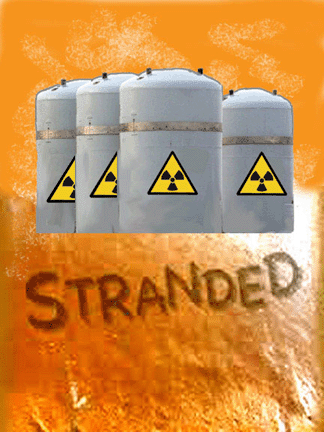 The centre will initially store low and medium-level waste before a second purpose-built centre is opened for the medium-level waste.
Opponents of the waste dump say Australia’s radioactive waste should be centrally stored at the Lucas Heights nuclear reactor campus in Sydney.
Conservation and anti-nuclear groups have petitioned the Federal Government to scrap any plans for a dump at Kimba.
The groups, including Conservation SA, Friends of the Earth and the Australian Conservation Foundation have lodged a submission with the federal Department of Industry, Innovation and Science calling on the government to abandon any plans for a dump at Kimba.
Friends of the Earth campaigner Jim Green says the process to find a dump site had been flawed and divisive.
“The Federal Government has consistently misled Kimba residents about its intentions. Residents have been repeatedly told that the above-ground store for long-lived intermediate-level waste (including spent nuclear fuel reprocessing waste) would hold waste for ‘several decades’ until a deep underground disposal facility is available,” Mr Green said.
“But in fact, several documents from the national regulator ARPANSA indicate long-term storage for 100 years or more. Moreover the Federal Government has no idea what sort of deep underground disposal facility might be built, where or when it might be built, and ‒ incredibly ‒ the Federal Government is doing next to nothing to progress the matter.”
“All Australians have a right to be involved to help make sure that this difficult issue is given the best possible consideration,” he said. “What is planned is a national radioactive waste facility so while local community consultation is useful, an evidence based, national conversation is essential.”
Mark Parnell on South Australia’s budget
 Mark Parnell MLC, Parliamentary Leader, Greens, 22 June 17
 The Government is spending two thirds of their $550 million energy security fund on fossil fuels. This includes a $360 million gas fired power station and $48 million to gas companies for exploration, including in high value farm land in the South East. These priorities are all wrong. We need to phase out fossil fuels and move to a more reliable and affordable renewable energy future with battery storage, such as the proposed solar thermal plant at Port Augusta.
Every budget in the last decade has cut funding to the Environment Department. This budget is no exception, cutting 43 full-time jobs at a time when the urgency of climate change requires even more attention than ever.
Kimba vote to investigate nuclear waste facility, but opposition to this is strong
Kimba votes to investigate nuclear waste facility on Eyre Peninsula, The Australian, June 23, 2017, MEREDITH BOOTH, Reporter, Adelaide, @MeredithBooth
The thought of having a nuclear waste dump in your backyard would be a step too far for many.
But for wheat farmer Andrew Baldock and the majority of his fellow residents in the shrinking rural South Australian town of Kimba, the promise of a $10 million community fund and better internet was enough to convince them that the positives outweighed the negatives.
Mr Baldock, a father of two, hopes Kimba’s “yes” vote for a nuclear waste dump on South Australia’s Eyre Peninsula will kickstart the town’s shrinking rural economy, which has seen a steady exit of businesses and people over the past two decades.
Kimba’s 700 residents have for years been divided on whether to allow a waste dump near the town, but this week voted 396 to 294 in favour of advancing consultation on building a low- and medium-level facility on the town’s edge.
Mr Baldock and his brother stand to inherit from their parents one of the two farms nominated to house the nuclear waste dump……..
A series of rejected sites was put forward between 1991 and 2004 and the Northern Land Council put forward Muckaty Station in the Northern Territory in 2005. But nine years of opposition, including a Federal Court challenge, saw the NLC withdraw its nomination in 2014 and a fresh search began.
The result of the Kimba vote, reported by the Australian Electoral Commission yesterday, is in line with the opinion polls that have pitted neighbour against neighbour in the rural service centre over the past two years.
Farmer Peter Woolford, part of opposition group No Radioactive Waste on Agricultural Land in Kimba or SA, said the vote had not changed anything and he expected continued railing against the project. “The opposition is still strong,” he said. “The results of the vote showed the community was still divided.”http://www.theaustralian.com.au/news/nation/kimba-votes-to-investigate-nuclear-waste-facility-on-eyre-peninsula/news-story/dab04e32a1be76f1e48ecb2f26fe37ae
Strong calls to have Kimba nuclear dump plan dumped
Groups call for nuclear dump to be dropped, http://www.9news.com.au/national/2017/06/20/22/22/groups-call-for-nuclear-dump-to-be-dropped Conservation and anti-nuclear groups have petitioned the federal government to scrap plans for a low-level nuclear waste dump on South Australia’s Eyre Peninsula.
The groups, including Conservation SA, Friends of the Earth and the Australian Conservation Foundation have lodged a submission with the federal Department of Industry, Innovation and Science calling on the government to abandon any plans for a dump at Kimba.
Farming land near Kimba is one of two sites being targeted for the dump, the other near Hawker in SA’s Flinders Ranges.
He says most of the waste is located at the Lucas Heights reactor site south of Sydney and that is where it should stay.
Australian Conservation Foundation campaigner Dave Sweeney said radioactive waste was a national issue that demanded the highest level of inclusion and scrutiny.
“All Australians have a right to be involved to help make sure that this difficult issue is given the best possible consideration,” he said.
“What is planned is a national radioactive waste facility so while local community consultation is useful, an evidence based, national conversation is essential.”
South Australians very definitely dumped the nuclear dump plan, but a new battle looms.
Australia’s handful of self-styled ‘ecomodernists’ or ‘pro-nuclear environmentalists’ united behind a push to import spent fuel and to use some of it to fuel Generation IV fast neutron reactors. They would have expected to persuade the stridently pro-nuclear Royal Commission to endorse their ideas. But the Royal Commission completely rejected the proposal
Another dump proposal is very much alive: the federal government’s plan to establish a national nuclear waste dump in SA, either in the Flinders Ranges or on farming land near Kimba, west of Port Augusta.
How the South Australians who dumped a nuclear  dump may soon have another fight on their hands http://www.theecologist.org/News/news_analysis/2989048/how_the_south_australians_who_dumped_a_nuclear_dump_may_soon_have_another_fight_on_their_hands.html 15th June, 2017 The rejection of a plan to import vast amounts of high-level nuclear waste from around the world for profit was a significant result for campaigners but that threat is still far from over, writes JIM GREEN
Last November, two-thirds of the 350 members of a South Australian-government initiated Citizens’ Jury rejected “under any circumstances” the plan to import vast amounts of high-level nuclear waste from around the world as a money-making venture.
The following week, SA Liberal Party Opposition leader Steven Marshall said that “[Premier] Jay Weatherill’s dream of turning South Australia into a nuclear waste dump is now dead.” Business SA chief Nigel McBride said: “Between the Liberals and the citizens’ jury, the thing is dead.”
And after months of uncertainty, Premier Weatherill has said in the past fortnight that the plan is “dead”, there is “no foreseeable opportunity for this”, and it is “not something that will be progressed by the Labor Party in Government”.
So is the plan dead? The Premier left himself some wriggle room, but the plan is as dead as it ever can be. If there was some life in the plan, it would be loudly proclaimed by SA’s Murdoch tabloid, The Advertiser. But The Advertiser responded to the Premier’s recent comments, to the death of the dump, with a deafening, deathly silence.
Royal Commission
It has been quite a ride to get to this point. Continue reading
Senator Scott Ludlam probes the Australian government’s plan to dump Lucas Heights’ nuclear waste on rural South Australia
 Assuming that the long-lived intermediate-level stuff does go to the sites that you are busy characterising at the moment, how long is it envisaged that it actually stays there before it gets taken somewhere else?
Mr B Wilson: We cannot give a definitive answer on that because we have not commenced a process to identify a permanent disposal solution for the long-lived intermediate-level waste—
Senator LUDLAM: Ouch!
if the really dangerous intermediate-level stuff is to be stored there you cannot tell them how long it is meant to be there for
so we kind of do not really know what is going on there or how long it is meant to be there for.
 ECONOMICS LEGISLATION COMMITTEE, Department of Industry – RADIOACTIVE WASTE 1st June 2017
Full Transcript here: http://parlinfo.aph.gov.au/parlInfo/download/committees/estimate/e3ddf88b-3e9c-4546-9d90-8f646689a98c/toc_pdf/Economics%20Legislation%20Committee_2017_06_01_5134.pdf;fileType=application%2Fpdf
Senator Canavan: I have been to Hawker and I am going there again tomorrow, and I would like to put on record my thanks to many in the Hawker community who engage in this process. Some have certainly changed their mind as they have come to have more understanding of it. I think you have probably been to Lucas Heights, and it I think it makes a big difference to people when they see it. There is a lot of misinformation spread about this, and we are trying to engage with people in a genuine way in good faith to give them the information to make informed decisions.
Senator LUDLAM: Who is spreading this information, Senator Canavan?
Senator Canavan: I hear it from time to time. I do not have any particular allegations to make about individual groups here, but you do hear lots of information from time to time about the potential danger of this material. But, of course, as you would probably know, much of the low-level waste is stored safely at Lucas Heights, a place where people go to and from work every day.
Senator LUDLAM: That begs the question of why it needs to move. ……
Senator LUDLAM: Staying in South Australia: has there been any consideration at all—this is for the department or the minister, whoever wants to take this one on—of the tension between the proposed national radioactive waste facility and the existing South Australian legislation, which would be the Nuclear Waste Storage Facility (Prohibition) Act 2000? The tension between the fact that your entire project is presently illegal under South Australian law: what is being done about that?
Mr B Wilson: We are certainly aware of the South Australian prohibition under their law. However, the National Radioactive Waste Management Act that we operate under overrides South Australian law.
Senator LUDLAM: And that is it? You are just going to squash them? Or are there discussions progressing with the South Australian government?….
Senator LUDLAM: Is the department, or you, Senator Canavan, or any of the federal agencies or other actors in communication with the South Australian government environment or heritage departments, or representatives of any body, actually, in relation to the tension between the two acts?
Senator Canavan: I have raised it with the South Australian government. They have indicated that they may seek to make changes. I am not aware of the status of that at the moment. Obviously, they have their own process, which is a separate to ours, on radioactive waste. Certainly, the issue has been raised. Mr Wilson is also right that we are confident that is not a barrier to this project. But Mr Wilson will be giving you that.
Mr B Wilson: We engage—I would have to characterise it as infrequently—with the South Australian government. It is more in the line of updating where we are. We have not had any recent engagements. They are certainly very well aware of the prohibitions under their law about what the South Australian government and its officials can do in this space….
When I said that the National Radioactive Waste Management Act overrides South Australian law, that is the fact. But what we are trying to do in the development of this project is to develop it and act in a way that is consistent with requirements under other South Australian legislation. For instance, in terms of Indigenous heritage protection and other aspects. While we are not necessarily bound by those laws we want to act in a way that is consistent with them.
Senator LUDLAM: With waste that is as dangerous as this, I am very glad to hear it! Is the department still accepting site nominations?
Senator Canavan: The government remains open to further nominations, as we announced on selecting the Hawker site last year. But the ones we have announced are those that we are proceeding with at this stage.
Senator LUDLAM: Wallerberdina and two at Kimba. Continue reading
South Australian Premier Jay Weatherill declares the nuclear waste importing plan “dead”
 There’s no foreseeable opportunity for this”: Jay declares nuke dump “dead” INDaily, Tom Richardson @tomrichardson, 7 June 17,
Premier Jay Weatherill has officially walked away from one of the major policy hallmarks of his term in Government, pronouncing the nuclear waste dump “dead” and vowing he will not revisit it if he wins another term in office.
The position appears a significant rhetorical shift from his stance last November, when he pledged to keep the debate alive ahead of a future referendum on the issue of nuclear waste storage, after his own Royal Commission found establishing a local industry could net a “$100 billion income in excess of expenditure”.
At the time, his position was seen by critics both inside the Labor Party and more broadly as a refusal to abandon the nuclear dream.
But asked about the future of the nuclear dump at a public forum in Victor Harbor this week, Weatherill declared the project “dead”.
“Yeah it is,” he reaffirmed to InDaily today……..
After the Victor Harbor forum, Conservation SA chief executive Craig Wilkins said the rhetorical shift should be enshrined in Labor policy, calling on Weatherill to “bury the nuke dump plan for good”.
South Australia reaches its renewable energy target 8 years in advance
 South Australia already at 57% wind and solar in 2016/17, http://reneweconomy.com.au/south-australia-already-57-wind-solar-201617/ By Giles Parkinson on 6 June 2017
The South Australian government’s official target for renewable energy is 50 per cent of local demand by 2025. According to the Australian Energy Regulator, it didn’t just reach that target in 2016/17, eight years early, it is literally blowing past it.
Data released in the AER’s state of the energy market report released last week suggests that the combined contribution of large scale wind power and rooftop solar PV has already reached 57 per cent in the first nine months of 2016/17.
The report showed that wind power accounted for 38 per of the state’s demand in 2015/16, jumped to about 43 per cent in calendar 2016, and then jumped even further in 2016/17 as new wind farms such as Snowtown and Hornsdale came on line.
“In the nine months to 31 March 2017, the contribution of wind generation was even greater, supplying 50 per cent of South Australia’s electricity,” the AER says.
Add in the at least 7.6 per cent contribution from rooftop solar – the AER report says that the 728MW of rooftop solar contributed 7.6 per cent of South Australia’s annual energy requirements in 2015–16 – that takes the state up to at leat 57 per cent for the nine months to the end of March.
That figure is expected to jump again as households and businesses continue to add rooftop solar, and as the third 109MW stage of the Hornsdale wind project comes on line.
Over the next year, the 220MW Bungala solar project and the 212MW Lincoln Gap wind farm, both near Port Augusta, will also come on line, taking the state up towards 65 per cent renewables, and there are numerous other projects said to be near the point of financial close.
As we reported in April, The Australian Energy Market Operator predicts that the state is heading towards 80 per cent renewable energy by 2021/22, saying that capacity of large scale renewables (wind and solar) will double to around 3,100MW over the next five years.
Those additions could be affected, however, by the structure of the state’s proposed energy security target, and whether it allows wind and solar farms to be paired with battery storage, or whether its insistence on “real inertia) (i.e. from spinning turbines) results in curtailment of wind and solar.
AEMO also expects the amount of rooftop solar capacity in South Australia to double and reach over 1500 MW by 2025, by which time the state’s minimum demand could on occasions be met entirely by rooftop solar, suggesting the need for something smarter to happen with battery storage.
Interestingly, the AER notes that the wild swings in prices often attributed to high renewable energy penetration are in fact being matched by states with rely almost exclusively on coal and gas.
This is because the prices are, in the end, set by the high price of gas-fired generation, and often manipulated when states have few major generators. Both South Australia and Queensland are dominated by just two or three major generation companies, and this is seen as a major cause of the problem
The AERs analysis shows that the most number of price spikes occurred in Tasmania in recent years, thanks to the failure of its Basslink cable, the drought that depleted its hydro resources and the subsequent reliance on fossil fuel generation.
The number of price spikes in South Australia and Queensland is roughly even, although the South Australia number is higher for the latest year after the work on the upgrade to the inter-connector to Victoria saw the gas generators in the state push prices to the maximum level on multiple occasions.
Major commercial shopping sites in NSW and South Australia to go solar
In an ASX announcement on late last week, Queensland-based solar supplier ReNu Energy said it had entered an agreement with SCA Property to own and operate solar PV and embedded network systems across four shopping centres, for a period of 10 years with an additional three, five year options……..http://reneweconomy.com.au/four-shopping-centres-to-go-behind-the-meter-in-major-commercial-solar-deal-31391/
Calls to cut support for coal mines after latest Great Barrier Reef report
 Greens believe Great Barrier Reef future at crucial crossroads after new report released, Brisbane Times Toby Crockford
 JUNE 3 2017 The Greens have issued an ultimatum to the state and federal governments after the latest report expressed “serious concern” regarding the Great Barrier Reef rescue plan.UNESCO, which advises the World Heritage Committee, said on Saturday that key targets in the Reef 2050 plan “are not expected to be achieved” and urged Australia “to accelerate efforts”. In response to the fresh concerns, Queensland Greens Senator Larissa Waters launched a scathing attack on the state and federal governments.
“Meanwhile, Queensland Labor and Turnbull roll out the red carpet and public money for Adani for their deadly mega-coal mine,” Senator Waters said.
“As many scientists have said, our governments must choose between new coal or the reef.
“Will the two old parties back the 70,000 people with reef jobs? Or will they pay back the millions in donations from the mining industry, sign the reef’s death warrant and continue to back Adani?”
Queensland Environment Minister Steven Miles admitted progress had been slow in implemented measures outlined in the reef rescue plan, particularly towards 2018 targets.
In a report released in Paris on Saturday, UNESCO praised progress in the inception and initial implementation of the rescue plan but said reef rescue work “must move faster”.
“Progress towards achieving water quality targets has been slow and the most immediate water quality targets … are not expected to be achieved within the foreseen time frame,” the report said.
A previous report revealed coral bleaching at the Great barrier Reef in 2016 was even worse than expected. The most severe bleaching was found north of Port Douglas where an estimated 70 per cent of shallow water corals had died. http://www.brisbanetimes.com.au/queensland/greens-believe-great-barrier-reef-future-at-crucial-crossroads-after-new-report-released-20170603-gwjrgv.html
Ross Garnaut – green energy will be win-win for South Australia
 Ross Garnaut: SA has little choice over green energy and can be a low carbon superpower http://www.adelaidenow.com.au/news/opinion/ross-garnaut-sa-has-little-choice-over-green-energy-and-can-be-a-low-carbon-superpower/news-story/1de5289d11018f29eefa271b913b118f Ross Garnaut, The Advertiser June 1, 2017 OF the many challenges facing South Australia, it’s hard not to look past how the state plans to deal with a more secure electricity supply.
IMPOSITION of ANSTO reactor nuclear wastes onto South Australian community
 28 May 2017, Submission by David Noonan, B.Sc., M.Env.St. To:Senator The Hon Matthew Canavan RE: Proposed Federal government imposition onto community in South Australia of an illegal “100 year” Store for ANSTO’s “10 000 year” irradiated Nuclear Fuel Wastes.
Storage of nuclear wastes affects the rights, interests and safety of all South Australians and is prohibited in our State under the Nuclear Waste Storage (Prohibition) Act 2000.
Proposed imposition of ANSTO reactor nuclear wastes is a major public interest concern in SA and detracts from public trust and confidence in the Federal government, in ARPANSA and in ANSTO.
The National Radioactive Waste Management Facility (NRWMF) comprises two co-located waste management facilities: an above ground 100 year Store for wastes that ARPANSA states require isolation for 10 000 years, AND a Disposal Facility for wastes requiring isolation for up to 300 years.
This submission focuses on the proposed imposition of the illegal Store & consequences thereof.
The Store is primarily for ANSTO irradiated Nuclear Fuel Wastes (NFW) and other existing and proposed reactor wastes, with only minor projected future arising’s of Intermediate Level Wastes (ILW) from States & Territories or from other Commonwealth agencies.
ARPANSA’s CEO (May 2015) has formally considered the proposed NRWMF Store and stated:
“This plan will have the provision for ILW storage above ground for approximately 100 years.”
This indefinite storage plan compromises safety in importing nuclear waste to SA without a waste disposal capacity or even a requisite program for disposal of NFW and ILW.
ARPANSA’s Radiation Health and Safety Advisory Council (April 2010) has provided formal advice which concluded: “that Australia’s current policy of indefinite storage for intermediate level waste does not appear to be consistent with International best practice.”
The import, transport, storage and disposal of ANSTO irradiated Nuclear Fuel Wastes is illegal in SA and was prohibited under the leadership of Liberal Premier John Olsen in 2000:
“The Objects of this Act are to protect the health, safety and welfare of the people of South Australia and to protect the environment in which they live by prohibiting the establishment of certain nuclear waste storage facilities in this State”
Since April 2016 the NRWMF project has exclusively targeted community and environment in SA in an attempt to again impose an illegal Store for ANSTO’s irradiated Nuclear Fuel Waste in our State. 2
The Minister’s release “Kimba 90-day consultation begins”(20 March 2017) invited submissions on potential approval under the National Radioactive Waste Management Act 2012 of two nominated sites near Kimba for assessment as potential sites for the proposed NRWM Facility.
This is in-parallel with the Federal government targeting the iconic Flinders Ranges on the country of the Adnyamathanha people in a serious threat to their human rights and cultural interests.
These are fundamentally State level public interest issues and represent a multi-generational threat to community in SA: including intended Federal requisition of an as yet unnamed SA port for imposition of decades of irradiated Nuclear Fuel Wastes imports, along with affected stakeholders on transport routes, in addition to the rights & interests of community around a potential Store site.
The Federal government has unacceptably failed to take up the recent Advice of the ARPANSA Nuclear Safety Committee (4 Nov 2016) for transparency and for the essential “ongoing requirement to clearly and effectively engage all stakeholders, including those along transport routes”.
This Store also exposes SA to unresolved security and potential terrorist risks in shipping, transport and indefinite above ground storage of irradiated Nuclear Fuel Wastes and other reactor wastes.
However, Lucas Heights is Australia’s best placed institution and facility to responsibly manage ANSTO’s Nuclear Fuel Wastes and can do so through-out the operating period of the Opal reactor.
An “Interim Waste Store” built at Lucas Heights in 2015 has a design life of 40 years and an approved purpose to take both the Nuclear Fuel Waste from France (NFW received Dec. 2015) and NFW to be received from the UK in circa 2020. The ARPANSA license for this Store “is not time limited” and has Contingency options to retain these NFW’s at ANSTO “until the availability of a final disposal option”.
The policy agenda to impose a NFW Store in SA is a flawed, unnecessary, contested and unsafe plan.
A broad public interest campaign protected SA rights and interests from prior Federal government attempts to impose nuclear waste facilities onto our State over 1998 to 2004 – and can do so again.
That “National Store Project” was abandoned – just as this NRWMF Store will have to be set aside.
Further, the Federal government’s flawed policy agenda for imposition of nuclear waste effectively precludes a long term resolution to Australia’s “low level” radioactive waste responsibilities.
The Minister has an obligation to learn the lessons from experience in failure of prior projects in Australia and internationally and not to deny or override key public interest community concerns.
My background includes experience as an Australian Conservation Foundation (ACF) Campaigner over 1996 to 2011 based in Adelaide.
The military connection to the push for advanced nuclear reactors in South Australia
With a nuclear waste dump in South Australia that accepts international shipments, the full range of the “nuclear industry” in the state would be complete, truly making it the “Defense State” that has become the state motto.[9]
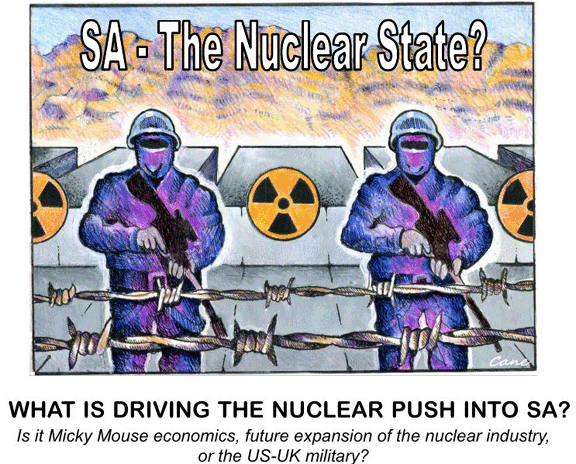
 SOUTH AUSTRALIA’S NUCLEAR MILITARY-INDUSTRIAL COMPLEX: THE GLOBAL CONTEXT, Spirit of Eureka ,Talk by David Palmer at “SA The Nuclear State” forum 03 May 2017 “……..If citizens – the people – whether they are in the Fukushima region of Japan or in Adelaide, South Australia – have a right to speak out on the dangers of the nuclear industry, then who are the elites promoting the nuclear industry? If we look at prominent figures in government the institutional linkages become all too clear. Consider the example of Kevin Scarce, Governor of South Australia until 2014, a Rear Admiral retired from the Royal Australian Navy, current Chancellor of the University of Adelaide, and Deputy Chairman of Seeley International, the largest air conditioning company in Australia that is known for energy-efficiency. Scarce led the Nuclear Fuel Cycle Royal Commission and was the primary author of the report that recommended the South Australian government accept a nuclear waste dump. All the links are there in Scarce’s connections and positions: military, university, corporate, and government.
Furthermore, the Royal Commission did not focus solely on a nuclear waste dump. It considered possible expansion of nuclear industries in the state that encompassed mining, enrichment, and power generation. The Royal Commission report states that “The activity under consideration is the further processing of minerals, and the processing and manufacturing of materials containing radioactive and nuclear substances (but not for, or from, military uses) including conversion, enrichment, fabrication or reprocessing in South Australia.”[3]
But during the time this Royal Commission report was being prepared and finally delivered, Adelaide became the focal point for naval shipbuilding contracts, particularly submarines. Both Labor and Liberal politicians sought to outdo each other in pushing for submarines to be built in Adelaide. They will be diesel powered, but the majority of submarines internationally use nuclear power propulsion. Potential overseas contractors also use designs geared for nuclear power. There are those in Australian naval circles who would like to see these Australian subs with nuclear, not diesel, power. And where will these submarines be used, and with what international interests? We know the answer to that question, as recent events in the Western Pacific have confirmed. The USS Carl Vinson, the nuclear powered air craft carrier, was on exercises in the Indian Ocean in early April with Australia’s HMAS Ballarat, when it was ordered to the Korean peninsula this month in response to the North Korean threat to explode a nuclear bomb.[4] This latest development is just one example of the escalating naval tensions on our side of the Pacific. Crises like this will potentially increase pressure for Australia to build submarines – and possibly other naval vessels – that are nuclear powered.
What does the corporate profile of the “nuclear industry” look like? Continue reading
1 This month


Help Aunty Sue Protect Her Land and Sacred Sites From Destructive Rocket Testing.
.

Australians deserve the truth
about
AUKUS – https://aukuspublicinquiry.com/

PETITION – To: Prime Minister Anthony Albanese and the Australian Labor Government

of the week – Australians for War Powers Reform (AWPR)
To see nuclear-related stories in greater depth and intensity

