NO TO NUCLEAR WASTE DUMP – say women and Labor voters
Women and Labor voters opposed to international nuclear waste dump in South Australia, poll finds Adelaide Now, March 21, 2016 PREMIER Jay Weatherill will need to win the support of women and his own Labor voters if the State Government decides to back the construction of an international nuclear waste storage facility in South Australia.
The results of a new opinion poll show almost 60 per cent of women and most Labor voters are opposed to a global nuclear waste facility being located in the state.
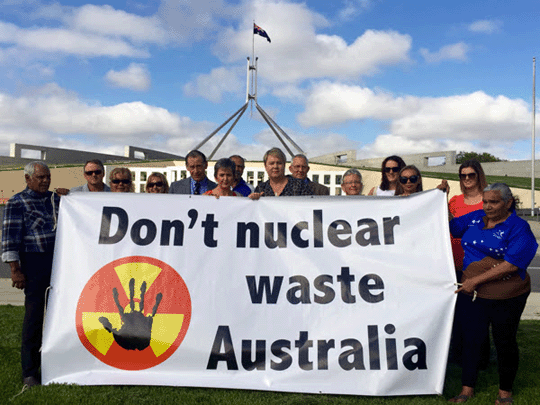
The ReachTEL Poll of 1077 SA residents conducted on March 10 found that 37 per cent of voters supported of voters supported an international nuclear waste dump, 48.5 per cent were opposed and 14 per cent were undecided.
The poll was commissioned by left-wing think tank The Australia Institute, which will tomorrow release a report critical of the international nuclear waste proposal.
Australia Institute executive director Ben Oquist said South Australians were increasingly aware of the risks posed by the project, including the damage it could do to the state’s reputation.
“I think people are increasingly wise to the projects that are jobs-rich, versus those that are expensive, likely to involve a large upfront government subsidy and won’t produce long-term jobs,’’ Mr Oquist said.
Those industries that are jobs-intensive are potentially put at risk by South Australia’s brand being threatened by a global nuclear waste dump.’’
Almost 49 per cent of Liberal, 28 per cent of Labor, 12 per cent of Greens voters backed the proposal.
But 52 per cent of Labor, 38 per cent of Liberal and 71 per cent of Greens were opposed……http://www.adelaidenow.com.au/news/south-australia/women-and-labor-voters-opposed-to-international-nuclear-waste-dump-in-south-australia-poll-finds/news-story/35d4ad38cadbaae4798ca89e91c74f5f
The ethics of burdening future South Australians with nuclear wastes?
A high-level nuclear waste dump for SA What is our moral obligation?

The argument goes: surely SA has a moral obligation to import nuclear waste…
…because we mine uranium?
…because we are more geologically and politically stable than other places?
…because we benefit from x-rays?
If we want this decision to include moral considerations (as it should), we might ask ourselves about the ethics of burdening thousands of generations of future South Australians with the cost and risk of managing highly radioactive waste, when any economic benefits are long gone.
Royal Commission comment period ends but Aboriginal resistance to radioactive dump grows ever stronger
18 Mar 16 Traditional Owners and members of the Aboriginal-led Australian Nuclear Free Alliance (ANFA) have today reaffirmed their opposition to the suggestion that South Australia should host a high level international nuclear waste dump. This announcement comes as the submission period closes for comments on the tentative findings of South Australian Nuclear Fuel Cycle Royal Commission
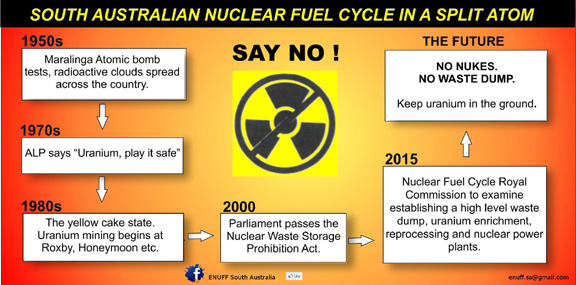
A major recommendation of the Commission to date has been that South Australia could host an international waste storage and disposal facility. This suggestion is strongly rejected by Aboriginal people across the state because of the risks posed to country and culture. Several Aboriginal communities throughout South Australia live with the negative impacts of the nuclear industry through uranium mining and nuclear weapons testing and are committed to resisting any further nuclear proposals.
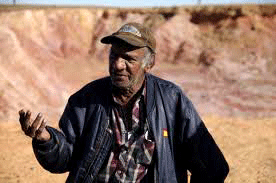 “We have long memories; we remember the atomic weapons tests at Maralinga and Emu Fields and the ongoing denial around the lost lives and health impacts for Aboriginal people. We don’t want any nuclear projects here in South Australia and we won’t become the world’s nuclear waste dump,” said Arabunna elder and Australian Nuclear Free Alliance president Kevin Buzzacott.
Enice Marsh, senior Adnyamathanha woman and Australian Nuclear Free Alliance member said:
“Any kind of radioactive waste dump would put our groundwater at risk. Groundwater is about survival; we don’t want to be faced with another huge risk like this.”
Sue Coleman-Haseldine is a Kokatha-Mula woman and co-chair of the Australian Nuclear Free Alliance. She has recently travelled to Vienna to share her family’s experience with the nuclear industry: “They’ve poisoned us once and there’s no way in the world they’re going to do it again.”
“This problem doesn’t stop at South Australia’s border, there is nowhere that should be designated an international waste dump,” Ms Coleman-Haseldine concluded.
For comment contact: Sue Coleman-Haseldine: 0458 544 593
Kevin Scarce dodges the vital questions of debt & safety from #NuclearCommissionSAust plan
 NuclearCommissionFerret, 18 Mar 16 A meeting was organised by ALP MPs Frances Bedford and Tom Kenyon for their constituents in the north east suburbs of Adelaide. Royal Commissioner Kevin Scarce was the only speaker, there was no balance with a nuclear critic speaker.
Kevin Scarce was asked the question:
” what happens if we accept high level nuclear waste for interim storage, then don’t have enough money when it comes time to build the deep geological dump. We’ll either end up with waste we can’t store to the safest extent possible, or a debt.”
A South Australian Labor MP has the guts to speak out against nuclear waste dump plan
“I don’t want nuclear dump”: Labor MP http://indaily.com.au/news/local/2016/03/18/i-dont-want-nuclear-dump-labor-mp/, Tom Richardson, 18 Mar 16
Jay Weatherill could face a divided party if he forges ahead with a proposal to establish a high level nuclear waste dump in South Australia, with a long-time Labor MP telling InDaily the idea is “quite worrying” – and suggesting several colleagues share the same view.
The tentative findings of Kevin Scarce’s nuclear royal commission handed down last month found an unambiguous economic case to establish a repository, with the Premier already moving to amend the law to facilitate broader debate on the issue.
 But the debate is heating up in the corridors of parliament, with former Labor minister and Ashford MP Steph Key joining Greens MLC Mark Parnell – a vocal opponent of increasing SA’s nuclear involvement – in sponsoring a briefing for interested MPs by a noted critic of the waste dump push.
An email went out to all MPs this week, reading: “Dear colleagues, there’s been so much said about an economic bonanza from building a global nuclear waste facility – but what if the economics don’t stack up?”
“Come and hear from Dr Richard Denniss, Chief Economist, The Australia Institute,” it concluded.
The briefing will be held on Tuesday, after a public briefing by Denniss together with economist and InDaily columnist Richard Blandy, both of whom have argued against the economic case for a waste dump.
“I think it would be fairly well known that I’m an anti-nuclear person,” Key said when contacted by InDaily. “I have been for the last 40 years, and I still am.” She said she was “interested to know what [Denniss and Blandy] have to say about the costings that have been put forward so far”.
“People are saying it could help us economically [but] I don’t actually want to have a dump at all,” she said. “I’m just interested to know whether these billions of dollars cited actually stack up – Mark and I decided we’d try and offer something to people that can come along.”
Key says she believes SA should “store our own waste [and] I do have some sympathy for low level or intermediate level repository”, but she has grave misgivings about a high-level global storage facility.
“I want to know all about it… the study I have done, I think it’s quite worrying,” she said, citing concerns over transportation. “We keep getting things across the sea and then by train, presumably, and truck… what does all that mean? What’s the risk analysis of all that? There’s quite a bit to consider.”
Labor right-winger Tom Kenyon has argued passionately in favour of the repository, but Key – a Left-faction stalwart – says: “I want to have a look at all the facts before I come out and argue in a very public way about this issue.”
“And I want to talk to my colleagues, but I get the impression that quite a few of them have a lot of sympathy for my way of thinking,” she said. “I’ve spoke quite passionately at both convention and state council – and national conference – over the years, so I don’t think anyone would be surprised that I don’t think this is a good idea.
“I just remember Fukushima – five years on and there’s still just people helping with the cleanup, let alone the natural disaster that it was… it just seems like a very big risk to me, and if it doesn’t stack up financially I think people are starting to run out of arguments.”

Greens call on Nuclear Royal Commission to “get real”
 The Greens SA’s submission to the Nuclear Royal Commission’s Tentative Findings rejects the suggestion that an economic bonanza awaits our State if South Australians would only resign ourselves to becoming the world’s nuclear garbage bin.
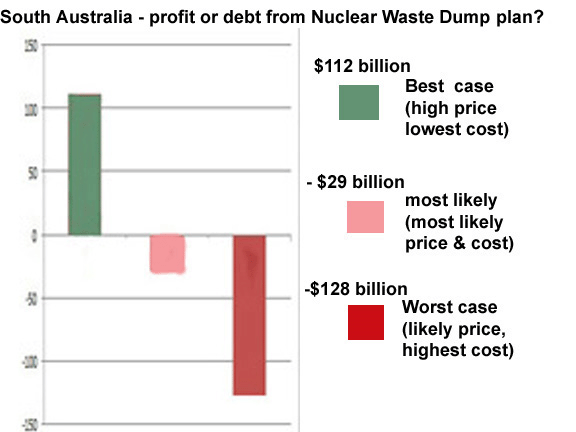
“The Royal Commission has been blinded by imaginary wealth and sucked into believing that a project that has never succeeded anywhere else in the World is South Australia’s for the taking”, said Greens SA Parliamentary Leader, Mark Parnell MLC.
“The most obvious question is being ignored: If this is such a great deal, how come no other country has grabbed it before now?
“The Greens are urging the Royal Commission to “get real” and critically examine the supposed economic benefits alongside the ongoing economic, social, environmental and reputational costs.
“Washing your hands of responsibility for a toxic legacy left to future generations is just immoral.
“The solution to South Australia’s current unemployment problems won’t be solved with mythical jobs that are decades into the future with the creation of toxic liabilities that last hundreds of thousands of year.
On releasing the “Tentative Findings” Report to the media on 15th February 2016, Commissioner Kevin Scarce stated, “The community needs to understand the risks and the benefits.” The Royal Commission’s “Tentative Findings” highlights many purported benefits but is scant on detail when it comes to the profound risks.
According to the Greens’ submission, the “Tentative Findings” suffer from:
1.Unrealistic expectations of the magnitude of the project;
2.Failure to appreciate 6 decades of international failure to solve the nuclear waste problem;
3.Missing costs, unfunded liabilities, missing contingencies and failure to recognise inevitable cost blow-outs
4.Heroic assumptions of other countries’ willingness to pay for SA to take their nuclear waste;
5.Lack of recognition of the potential for irrecoverable sunk costs and unlimited future liabilities;
6.Failure to address reputational damage and impact on other sectors of the economy; and
7.Naïve expectations that South Australia would get to keep all the profits from a nuclear waste dump in our State, without having to share them with other States.
“The Commission’s final report due on 6th May should recommend that the folly of South Australia’s increased involvement in the nuclear industry be abandoned.
“In relation to the other Terms of Reference, increased uranium mining, uranium processing or nuclear power were never really an option for SA and the Royal Commission was an expensive way to tell us what we already knew”, concluded Mark Parnell.
Is there REALLY profit in nuclear waste importing industry?
Conservation Council South Australia 18 Mar 16 A high-level nuclear waste dump for SA
Should we do it for the money?
The Nuclear Royal Commission claims some eye-popping revenue figures to take the world’s high-level nuclear waste.
Labor, Liberal unite to support high-level nuclear waste dump in South Australia
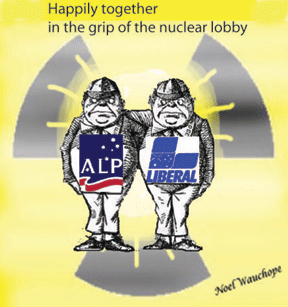 Labor, Liberal unite to support high-level nuclear waste dump in South Australia February 16, 2016 Paul Starick and Daniel Wills The Advertiser UNPRECEDENTED political support is being thrown behind South Australia becoming the global storage facility for high-level nuclear waste in return for a $445 billion bonanza.
Forging a historic united front on a decades-old issue of bitter division, Labor Premier Jay Weatherill and Liberal federal Resources and Energy Minister Josh Frydenberg are encouraging debate on a Royal Commission proposal, unveiled on Tuesday, for SA to store and dispose of hundreds of thousands of tonnes of spent nuclear fuel and waste…….http://www.adelaidenow.com.au/news/south-australia/labor-liberal-unite-to-support-highlevel-nuclear-waste-dump-in-south-australia/news-story/683296ab45e53c73432c66bbe0358e34
South Australia Nuclear Waste Dump Plan – Future Safety Is Unknown!
 A high-level nuclear waste dump for SA Can it be done safely?

The decision to import high level nuclear waste is a forever decision.
 A high-level nuclear waste dump for SA: The big questions
Conservation Council South Australia 18 Mar 16
ENuFF RESPONSE To The Nuclear Fuel Cycle Royal Commission
ENuFF RESPONSE To The Nuclear Fuel Cycle Royal Commission February 2016 TENTATIVE FINDINGS Everybody for a Nuclear Free Future, March 2016
https://drive.google.com/file/d/0BzGxGaq45dRNd2RqT3d0VTVEWjA/view (on original the authors of this response provide source references for their statement)
Noel Wauchope: Response to Tentative Findings of Nuclear Fuel Chain Royal Commission
 Noel Wauchope 16 Mar 16 INTRODUCTION
In view of this waste importation focus by the Commission, I ma here responding to that issue. For simplicity, I have stated passages from the “Tentative Findings in pink.
MANAGEMENT, STORAGE AND DISPOSAL OF NUCLEAR WASTE
STABILITY
The storage and disposal of used nuclear fuel in South Australia is likely to deliver substantial economic benefits to the South Australian community. An integrated storage and disposal facility would be commercially viable and the storage facility could be operational in the late 2020s.
The late 2020s How come Australia could have this nuclear wase facility operational so soon, when other countries have still not satisfactorily completed such a facility over many decades?
The Royal Commission must know that this requires – first of all, overcoming Federal environmental law, and overturning South Australia’s State law against importing nuclear wastes. And that’s only the beginning in overcoming public rejection (1A)
78. For the management of used fuel and intermediate level wastes, South Australia has a unique combination of attributes which offer a safe, long-term capability for the disposal of used fuel.
They include:
a. the underlying Archaean geological structure,
the Gawler Craton, at an appropriate depth for disposal
Earthquake hazard: For either temporary or permanent storage of radioactive wastes, South Australia poses great risks. While the whole State has a small earthquake hazard zone, there are large sections which have an increased earthquake hazard. Particularly in the South of the State (1)
Risk to precious artesian water. While the South of the State has earthquake risks, almost the entire of the rest of the State covers the Great Artesian Basin. (2)
Effectively, this means there is almost no part of South Australia that could safely store radioactive trash for decades, let alone for thousands of years.
I am grateful to Paul Langley, who has set out the problems in relation to the Gawler Craton – “The Royal Commission does not provide a map that defines the area covered by the Gawler Craton. ……There are many maps showing the Gawler Craton and most of them vary radically from one another.”
Langley also drew attention to instability within the Ceduna Sub Basin – “The proposed HLNW geologic repository may be (or may not be) flooded with ground water after completion – as part of the design criteria. I have to ask how such a repository might impact occupants of the Peninsular.”
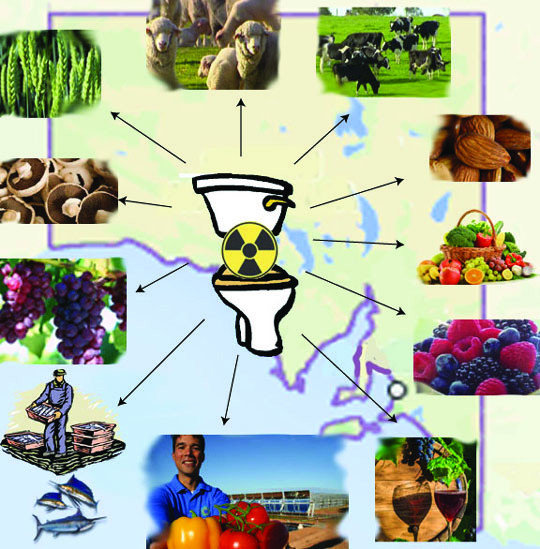
“Agriculture, aquaculture, tourism and mining industries, all reliant on sustainable natural resources, contribute over $2.5 billion to the economy in an average year. Despite low rainfall and low soil fertility, around 45% of SA’s wheat and 20% of SA’s barley harvest come from the Eyre Peninsula. In addition, the region contributes 45% of the state’s seafood harvest. Some 95% of farms are broad acre, of which 85% depend on grain growing alone, or a mix of grain and livestock farming. Given all this, the Eyre Peninsula is extremely vulnerable to a hotter, dryer future.” Source: “Effective Adaptation Policy Making: A case study from the Eyre Peninsula” National Climate Change Adaption Research Facility, athttps://www.nccarf.edu.au/content/case-study-eyre-peninsula https://nuclearexhaust.wordpress.com/2016/03/15/response-to-the-tentative-findings-of-the-sa-nuclear-fuel-cycle-royal-commission/
84. Given the quantities held by countries that are yet to find a solution for the disposal of used fuel, it is reasonable to conclude that there would be an accessible market of sufficient size to make it viable to establish and operate a South Australian repository.85. There is no existing market to ascertain the price a customer may be willing to pay for the permanent disposal of used fuel.
What would the (overseas) holders of radioactive wastes be willing to pay for disposal and storage of radioactive wastes in South Australia?
This question really has no answer. The Commission’s conclusion of total revenue of more than $257 billion, despite all the high-sounding financial statements, sounds like a nice figure just plucked out of the air. At present every country with nuclear facilities is struggling with the unanswered question of what do do with their radioactive trash. Even Finland, which has built a 500 metre deep burial place, will not have enough space for their accumulating radioactive trash. So far, there is no room for Fennovoima’s waste in the Onkalo repository in Olkiluoto. (2)
At this stage there are no proposals for exporting nuclear waste. Royal Commissioner Kevin Scarce, in his recent report on the Commission’s overseas visit, said “We haven’t done the financial study”. When anyone does do the financial study, they will need to factor in the financial costs of insurance, of security for hundreds, thousands, of years, as well as of environmental degradation.
Another factor would be the comparison of the commercial value of renewable energy not pursued, tourist and agricultural opportunities lost as government money went into fostering nuclear schemes rather than South Australia’s more positive activities.
There would be no revenue for at least 30 years – probably longer – until the waste disposal facility were to be up and running. Who pays up for it all in the meantime? Does South Australia have to borrow heavily – and then – what if it all does not eventuate, anyway?
TRANSPORT OF RADIOACTIVE WASTES
I am astonished at the minimalist approach Tentative Findings report towards the transport of radioactive wastes. It’s as if the subject does not matter!
135. During the past 30 years, approximately 11 000 containers of uranium oxide concentrate (UOC) have been exported from Australia. There have been a
number of incidents during the transport of UOC where containers have been knocked or dented. However, given that UOC has low radioactivity and is transported
in sealed drums inside shipping containers, there has never been an accident in Australia resulting in the release of UOC to an extent that has adversely affected
workers, the public or the environment. (They don’t count the Ranger spill in 2014 https://antinuclear.net/2014/10/23/toxic-spill-report-critical-for-ranger-uranium-mine/)
transport packages….
It’s as if the Royal Commission had never heard of the modern facts about climate change – extreme weather events increasing in frequency and severity. (3)
It’s as if the Royal Commission had never heard of the increasing dangers, and increasing sophistication of terrorist attacks.
It’s as if the Royal Commission had never heard of the growing objections of many communities, to having nuclear waste ships pass near them or through their ports. (4)
155. There is no compelling evidence from any international experience that the development of nuclear facilities in South Australia would adversely affect other economic sectors, provided those facilities are operated safely and securely. There is a perception there would be an impact, which would need to be addressed in the process of obtaining community consent for any proposal. In the event of a major nuclear accident, adverse impacts on the tourism, agriculture and
property sectors could potentially be profound.
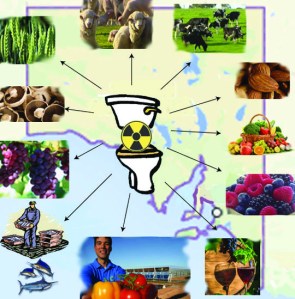
Of course – there’s no evidence at all – as it has never been done before – to set up a nuclear waste importing business to a non nuclear country – particularly in a State such as South Australia, with its renowned wine industry, tourism, fisheries, agriculture, including innovative schemes such as Sundrop Farms
In the past, countries like France accepted the risks of nuclear power, and their other industries thrived. Now, even in France, there is concern about polluting industries. For some time after the Chernobyl nuclear catastrophe, the French wine industry was severely depressed., because the wine growing regions were squarely in the path of the ionising radiation fallout. (5) There is concern in Washington State about the impact of Hanford nuclear waste facility on the wine industry. (6)
SECRECY ISSUE: LAWS AND FINANCIAL ARRANGEMENTS RELATING TO OTHER COUNTRIES
146. There is significant appetite in the private sector investment community to support new Australian infrastructure projects.
The Tentative Findings assume a great financial bonanza to South Australia, but is very vague on how the costs and (assumed) profits would be carved up between South Australia and the countries sending the wastes.
And, I still wonder, if it’s going to be such a bonanza, why is no other country offering to host the global radioactive trash?
Once again, Paul Langley has expressed this question most eloquently:
Nuclear nations all have their own laws regarding nuclear matters. For instance the United States has many laws, including the Atomic Energy Act, as currently amended, associated laws and regulations. It has long been an issue that the US Act prevents full disclosure regarding “special nuclear material” – that is plutonium and uranium as used and produced in a reactor. This matter has long been a concern in the US democratic setting. For instance, see CARDOZO LAW REVIEW, VOL 26, NO 4, MARCH 2005, PP. 1401-8.
The HLNW repository is promoted by the Royal Commission as being South Australian, owned by the government and benefitting the people of SA. To what extent then, in the course of contract negotiations, will the government and people of SA become beholden to the provisions of foreign laws regarding disclosure and other matters in regard a client nation’s HLNW? Will the contracts be commercial in confidence ? Will provisions alien to SA law be invoked in order to comply with contracted obligations? Will such provisions restrict our right to know and our freedom to speak? Will the full nature of the stockpile resident in the HLNW repository be secret in any way? Will the people be able to study each contract? What is an unclassified restricted document, and what happens if an ordinary person figures out it’s contents? (7)
References: Continue reading
A Submission For The Public Good – to #NuclearCommissionSAust
ABOUT SUBMISSIONS 16 Mar 16
Today I take the unusual step of publishing several extracts from one submission. The Royal Commission has allowed very little time for people to send in submissions. So – few are available to me right now.
BUT – Paul Langley of South Australia has prepared a submission. And it is a beauty! Why? Because not only does it pack a punch, but, equally important, Langley provides a wealth of information, facts, figures, and reference sources – https://nuclearexhaust.wordpress.com/2016/03/15/response-to-the-tentative-findings-of-the-sa-nuclear-fuel-cycle-royal-commission/
Sad to mutilate such a strong and lengthy submission, but I have done so on this website. So there are 5 extracts from the submission, on today’s page. If you have time, go to the original. If you don’t have time, at least see what Langley writes about Transport of High Level Nuclear Waste, Gawler Crater, The Law and the Profits, Gaining Public Trust, AN ALTERNATIVE to nuclear industry
Transport of High Level Nuclear Waste: Response to the Tentative Findings of the SA Nuclear Fuel Cycle Royal Commission
Response to the Tentative Findings of the SA Nuclear Fuel Cycle Royal Commission A Submission by Paul Langley Nuclear Exhaust 16 Mar 16 “……Transport of HLNW from around the world to a SA HLNW geologic repository
The Royal Commission apparently assumes that the movements of many hundreds of thousands of tonnes of spent nuclear fuel from many countries around the world to the Gawler Craton will be low risk, no problems and perfectly safe. As contradictory as those stances are. I do not accept that position of default safety. Further I do not accept that the unloading of the HLNW will be perfectly safe. I do not accept that road transport from port to repository site will be perfectly safe, even on a dedicated purpose built road.
I would recommend that Super Freighters laden with the contents of countless reactor cores not sail down the Somali coast nor in the waters to the south of Thailand for fear of pirates. They should avoid man made Islands in the South China Sea. I suppose the ships will be guarded by 6 English policemen each with two revolvers between them. Rather than half the Pacific Fleet they would actually warrant. If they ever get to leave their home ports. What is the Somali coast going to be like in 40 years? Peaceful or short of rad weapons?…….” https://nuclearexhaust.wordpress.com/2016/03/15/response-to-the-tentative-findings-of-the-sa-nuclear-fuel-cycle-royal-commission/
South Australia Nuclear Fuel Chain Royal Commission: About the Gawler Craton and Ceduna sub Basin
Response to the Tentative Findings of the SA Nuclear Fuel Cycle Royal Commission A Submission by Paul Langley Nuclear Exhaust 16 Mar 16 “……….Response to Tentative Finding 74……….
Nuclear adventurism invariably claims to be acting in order to “save the world” from one thing or another.
In my final statement I shall remind the Royal Commission of alternatives to the current proposal. A nuclear dump on Eyre Peninsular or anywhere else will not save this planet from anything, and will impose risk upon populations.
Stability The Royal Commission tentatively finds that the Gawler Craton is stable. The Royal Commission says nothing about the stability of the climate that impacts it and which will impact it in the near future. I choose not to compare SA with lands of snow and glaciers, such as Sweden and Finland. I choose a much more relevant place:
“….even in extremely arid climates such as the Yucca Mountain site, hydrologic interaction is the most prevalent [risk]. It is the primary mechanism of which contamination can occur, and is the most prevalent consequence to other risks discussed…..”
I shall show that the US concern regarding sudden climate change – including extreme rain events – and the impact of this upon arid area HLNW Repositories is much more relevant to Australian scenario than the Swedish and Finnish concerns. …….The risks posed by sudden climate change and increasing extreme weather events include possible flood events on Eyre Peninsular. This is a section of the Gawler Craton that contains no rivers (Source: SA Water Corp). Like Yucca Mountain, Eyre Peninsular appears to be internally drained……..
Contrary to the implications of the written material made available by the Royal Commission, the Swedish and Finnish models do not provide South Australians with a moral precedent or imperative for accepting the nuclear waste generated by the rest of the world. Rather, both nations conform to the principle of clearing up one’s own mess as best one can. Importing the mess of other nations would, it seems to me, be an anathema to both nations. On one hand the Royal Commission implores us to copy Sweden and Finland. On the other hand, both those nations say no in law to what the Royal Commission is proposing and recommending.
However, no doubt, both nations would happily sell their means and methods to South Australians. The cost of this sale has not been made available by the Royal Commission as far as I am aware. No doubt royalties due to Swedish and Finnish patent licenses would apply………
The Swedish nuclear authorities were given from 1977 until 2020 to consider the mandatory HLNW geologic waste dump by the people of Sweden. That’s Forty Three years.
How is it that the people of South Australia have been given only from 2016 to 2020 to consider the same issue? A mere Four years? The people of Sweden were time generous to the nuclear industry. That same industry now attempts to railroad us into a “fast buck for them” solution……
The Royal Commission has not disclosed whether the HLNW geologic repository/dump will be hot or cold. Will it be flooded with ground water as the Swedes intend for theirs?…………
Where is the groundwater coming from if in SA the repository is to be flooded as proposed by the Swedish text quoted above? Where will the ground water subsequently move to from the repository? Is there in fact any basis for an unthinking acceptance of the Swedish solution in South Australia? How wheat and mutton is produced above the deep, geologic Scandinavian nuclear sewers? Do they wish they did not have the problem at all? Yes, but sadly they do have the problem. They may have solved their problem. Is their solution to become our problem? Given we do not share much with them, either in environmental type, chemistry or need………
Tentative Finding 78
parts a – c state: “For the management of used fuel and intermediate level wastes, South Australia has a unique combination of attributes which offer a safe, long-term capability for the disposal of used fuel. They include: the underlying Archaean geological structure, the Gawler Craton, at an appropriate depth for disposal. low levels of seismic activity overall and, in some parts, very low levels relative to elsewhere in the world. an arid environment in many parts of the state.”
The Gawler Craton
The Royal Commission does not provide a map that defines the area covered by the Gawler Craton. ……There are many maps showing the Gawler Craton and most of them vary radically from one another…..
The Royal Commission cannot consider the actual location of the HLNW geologic repository, other than to inform that it will be located within the Gawler Craton. While advocating for the repository, the Royal Commission cannot apparently consider Southern groundwater chemistry as compared to Swedish or Finnish groundwater chemistry or any other technical factor. The only technical data it cites in its tentative findings are promotional statements.
The Gawler Craton appears to be very big. I am familiar with some geologic events of the recent past that indicate not all places located over the Craton are “stable” in the common sense.
I refer to the Bight Basin and in particular to the Ceduna Sub Basin of the Bight Basin.
What are the hydrologic and other dynamics of the Gawler Craton? How well is it understood by modern Geology?
“Owing to sparse outcrop, the geology of the Gawler Craton is relatively poorly understood, and its boundaries are entirely subsurface, being interpreted from total magnetic intensity and gravity data combined with outcrop and drillhole information (Schwarz et al., 2006)”. Source: “Geodynamic Synthesis of the Gawler Craton and Curnamona Province” Edited by N.Kositcin, GEOSCIENCE AUSTRALIA record 2010/27, Australian Government, athttp://minquest.com.au/wp-content/uploads/2015/03/Genesis-of-the-Gawler2.pdf……
There is evidence of instability within the Ceduna Sub Basin……..
The proposed HLNW geologic repository may be (or may not be) flooded with ground water after completion – as part of the design criteria. I have to ask how such a repository might impact occupants of the Peninsular.
“Agriculture, aquaculture, tourism and mining industries, all reliant on sustainable natural resources, contribute over $2.5 billion to the economy in an average year. Despite low rainfall and low soil fertility, around 45% of SA’s wheat and 20% of SA’s barley harvest come from the Eyre Peninsula. In addition, the region contributes 45% of the state’s seafood harvest. Some 95% of farms are broad acre, of which 85% depend on grain growing alone, or a mix of grain and livestock farming. Given all this, the Eyre Peninsula is extremely vulnerable to a hotter, dryer future.” Source: “Effective Adaptation Policy Making: A case study from the Eyre Peninsula” National Climate Change Adaption Research Facility, athttps://www.nccarf.edu.au/content/case-study-eyre-peninsula https://nuclearexhaust.wordpress.com/2016/03/15/response-to-the-tentative-findings-of-the-sa-nuclear-fuel-cycle-royal-commission/
1 This month


Help Aunty Sue Protect Her Land and Sacred Sites From Destructive Rocket Testing.
.

Australians deserve the truth
about
AUKUS – https://aukuspublicinquiry.com/

PETITION – To: Prime Minister Anthony Albanese and the Australian Labor Government

of the week – Australians for War Powers Reform (AWPR)
To see nuclear-related stories in greater depth and intensity

