South Australia’s Environmental Defenders Office (EDO) ‘determined’ not to fold
Environmental Defenders Office NT to stay open; other jurisdictions enter ‘caretaker’ mode following funding cuts 105.7 ABC Darwin By Emilia Terzon “…. It’s a difficult time but we’re determined to stay open. We will not fold. We will stay open. Melissa Ballantyne, principal lawyer at EDO South Australia
In South Australia, the EDO office is preparing to enter caretaker mode on June 30. Melissa Ballantyne, the principal lawyer at EDO SA for nearly 10 years, said the office had no choice but to “downsize services”, but is still determined to find a benefactor or philanthropic funding.
“It’s a difficult time but we’re determined to stay open. We will not fold. We will stay open,” Ms Ballantyne said.
Caretaker mode will see the EDO SA office managed by an employed office coordinator one day a week, and will provide legal advice from volunteer lawyers. “It means we’ll be offering a very basic service in terms of lawyers providing advice,” Ms Ballantyne said.
Ms Ballantyne said EDO SA was the only environmental legal centre of its kind in the state, providing advice on everything from mining on Aboriginal land through to the controversial Olympic Dam expansion in recent years. “Since the funding cuts, it’s been difficult to do much casework,” Ms Ballantyne said. http://www.abc.net.au/news/2015-05-11/edo-nt-to-stay-open-despite-funing-cuts/6558190
Minerals Council of Australia seem to be ignorant of basic economics
 Dennis Matthews, 19 June 15 Support by the Minerals Council of Australia for fossil fuels comes as no surprise, nor does their apparent ignorance of the difference between the Conservation Council of SA (CCSA) and the (Australian) Conservation Foundation (ACF) but it is of concern that they seem to be ignorant of basic economics (The Advertiser, 18/6/15).
Rooftop solar electricity has gone from strength to strength in a classic case of increased demand leading to decreased price. All solar electricity needed was the ability to compete with entrenched fossil fuels. This was done through the Renewable Energy Target , which was an acknowledgement that fossil fuels had pollution derived hidden costs.
The worldwide acknowledgement of these hidden costs is now putting fossil fueled power stations on the endangered list, especially in countries that have “developed” by ignoring the cost of pollution.
Similar advances can be made by addressing other aspects of electricity demand, such as solar hot water or more energy efficient buildings.
Port Augusta the right place for concentrated solar power
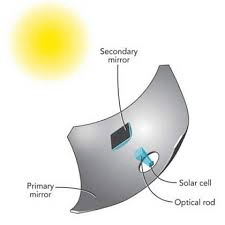 Ingo Weber: After Alinta, here’s a new future for Port Augusta, Adelaide Advertiser, 15 June 15 IN Australia air pollution kills more than double the number of people who die in road deaths. We need to change our dependency on coal, and Port Augusta is the place to start.
There are at least two large international companies currently building concentrated solar thermal power plants (in Spain and the US) keen to build CST right here and now in Port Augusta. We just need political vision.(subscribers only) http://www.adelaidenow.com.au/news/opinion/ingo-weber-port-augusta-ideal-for-a-solar-powered-future/story-fni6unxq-1227400879688
Adelaide’s Advertiser continues to spout pro nuclear advertising articles
 Dennis Matthews, It is indeed pathetic that the pro-nuke lobby keeps repeating the same old one-sided arguments to support their out-dated, dangerous and dirty industry (The Advertiser, 15/6/15). This should be recognised for what it is, the standard tool of the propaganda merchant.
It is equally pathetic that others keep repeating the neurotic claim that opposition to the nuclear industry is some sort of conspiracy to prevent “rational debate” (The Advertiser, 15/6/15), a claim that flies in the face of countless inquiries run by manifestly pro-nuclear governments.
But the most pathetic thing of all is that a reputable newspaper keeps publishing these sorts of unproductive and boring contributions to what is claimed to be an important issue.
Let’s have not only a rational debate but also a debate that encourages the flow of new information not repetitive, mindless, propaganda that appears to be designed to brainwash rather than inform.
South Australia’s Nuclear Royal Commission unfortunately linked with failed nuclear company AREVA
I would like to think that Kevin Scarce’s Royal Commission was fully investigating nuclear industry issues — not just the geewhiz technology that they would be shown in France by AREVA, which is all too cosy with South Australian pro-nuclear politicians and businessmen.
SA’s Nuclear Royal Commission: All too cosy with failed French nuclear giant AREVA? Just how independent is the SA nuclear review and are opponents being side-lined? Independent Australia 12 June 15, Noel Wauchope looks at just who the Royal Commission met on its recent visit to France.
AT ITS South Australian community forums, South Australia’s Nuclear Fuel Cycle Royal Commission head, Kevin Scarce, made a point of the Commission’s independence. He stressed that the Commission would be meeting overseas proponents, and also opponents, of the nuclear industry.
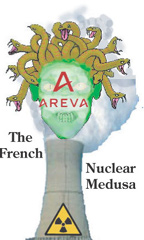 On the Commission’s website, they list the destinations for the Commission’s overseas tour, now about to wind up. I was struck by the amount of time allocated to conferring with the French nuclear energy corporation, AREVA. I had to wonder — in their discussions with AREVA, it would hardly be necessary to talk with nuclear opponents. I wondered how much AREVA would be going to come clean about what really is going on, in France’s nuclear industry.
The AREVA connection with Australia is important. AREVA has an office in Wayville, in Adelaide, and has hosted South Australian parliamentary tours of their nuclear industrial facilities in France. AREVA acquired the Northern Territory Koongarra uranium deposit in 1995, but subsequently, in a David and Goliath battle with Aboriginal traditional owner, Jeffrey Lee, lost this opportunity, as Lee donated his land to Kakadu National Park.
AREVA is in a joint venture with Toro Energy, in uranium exploration in the Northern Territory. The corporation had been exploring for uranium in Queensland’s Karumba and Carpentaria basins since about 2012, but recently pulled out altogether. AREVA will probably be making a submission to the Royal Commission. However, the Commission, in publishing submissions, will not be publishing ones that are deemed “commercially sensitive“.
Without doubt, AREVA has a keen commercial interest in Australia. France’s nuclear industry is somewhat embattled, as its fleet of reactors near the end of their shelf life, and the government is pledged to cut down on nuclear power, and develop renewables. The French nuclear industry (like USA’s) depends for its survival, on selling nuclear technology overseas.
But what of the fortunes of AREVA itself? As the Royal Commission seeks to learn about the commercial viability of the nuclear industry, AREVA is hardly the most reliable authority on that question.
For a start, AREVA now barely exists. Continue reading
South Australia’s great opportunity to transition from coal to 100% renewable energy
Bye bye baseload Our calculations show that SA does not need any baseload power stations, such as coal or nuclear. Indeed, the lack of operational flexibility of coal and nuclear makes them poor partners for high penetrations of variable renewable energy. The SA system has already operated reliably for long periods without its coal-fired stations, as last weekend’s incident demonstrated. Moving fully to renewable energy will deliver environmental, social and economic benefits. The transition would reduce SA’s greenhouse gas emissions, air pollution and associated respiratory diseases. It would cap electricity prices.
SA could create a wide range of new jobs in manufacturing, installation, grid connection, technical support and sales, which could help to compensate for the forthcoming job losses in its coal industry.
As for the nuclear question, the multinational financial analyst Lazard estimates the average costs of subsidized new nuclear energy in the United States in 2017 to be 12.4–13.2 US cents per kilowatt hour (kWh), compared with unsubsidized costs of 3.7–8.1 c/kWh for onshore wind, and 7.2–8.6 c/kWh for large-scale solar PV
 Coal closures give South Australia the chance to go 100% renewable https://theconversation.com/coal-closures-give-south-australia-the-chance-to-go-100-renewable-43182 June 12, 2015 Mark Diesendorf Associate Professor and Deputy Director, Institute of Environmental Studies, UNSW at UNSW Australia South Australia is facing the closure of its Northern and Playford B power stations and Leigh Creek coal mine, after Alinta Energy yesterday announced plans to shut them ahead of schedule. It will cost 438 jobs in the coal-mining and coal-fired electricity industries. But this threat to employment could be transformed into an opportunity for creating many new jobs in renewable energy.
The South Australian electricity system could be operated entirely on scaled-up, commercially available, renewable energy sources. This is the conclusion of my forthcoming report (to be published next week) to the Conservation Council of South Australia. Continue reading
How wind and solar power provided South Australia’s electricity when coal power stopped
the chief qualities of the energy system of the future will not be baseload, but flexibility. This will likely be delivered by the quick-start gas generators that already exist in the system to back up fossil fuels, but also the grid and household-based storage that will be installed in coming years.
 How South Australia coped without any baseload power http://reneweconomy.com.au/2015/how-south-australia-coped-without-any-baseload-power-65138 By Giles Parkinson on 9 June 2015 South Australia’s electricity system was put the test over the long weekend when the state’s only baseload power contributor, the brown coal Northern power station near Augusta, suddenly tripped and stopped providing power.
The incident was caused by a fire that caused several injuries, including one serious injury to a worker still in hospital. This is not the first time that South Australia has been without baseload coal power, of course. Northern was mothballed for nearly a year because of the declining economics of the coal generator. The difference with this event is that it came unannounced.
While declines and increases in the output of wind and solar are quite predictable, sudden outages in baseload fossil fuels are not, which is why the energy system needs a large amount of redundancy to support large centralised generation.
So how did the South Australian energy market cope? Quite well, as it turns out. There was a lot of wind blowing at the time, so it was a while before the Torrens gas plant was needed. Most of the gas came from the Osborne plant.
There was so much wind – more than 1GW through most of the day – that electricity prices dived into negative territory on several occasions during the day, which means that the gas generators were not making any money.
Indeed, for most of the day South Australia had the cheapest wholesale electricity prices in the country. Continue reading
BHP CEO hypes up Olympic Dam uranium mine – but also hedges his bets with a plug for renewables
 BHP says Olympic Dam expansion is ‘game on’ THE AUSTRALIAN Scott Murdoch JUNE 12, 2015 BHP Billiton chief executive Andrew Mackenzie has declared the Olympic Dam expansion is “game on” but admits there are technical and manufacturing hurdles that must be worked out before final approval is given to the giant project…….
The upgraded production targets at Olympic Dam would make it the second-largest copper mine in the world after giving the uranium and gold output an equivalent copper value, and it would be the world’s largest producer of uranium……..
BHP exports uranium to China and Japan for power generation but it would not reveal the value or volume of its annual sales. The miner is expected to make a submission shortly to the Nuclear Fuel Cycle Royal Commission in South Australia on uranium mining……
[But I note that CEO Andrew Mackenzie hedges his bets a bit: -]
“A move to renewable energy (in China) is good for our copper business. Copper is a material that will do well in a world that puts a greater accent on renewable energy. The quicker you can get thermal energy into the form of electrical energy the better in terms of efficiency and the best relatively affordable conductor is copper,” Mr Mackenzie said. “Part of the strength of our portfolio is that we are reasonably flexible as to what path China and other nations choose towards decarbonising their energy…” http://www.theaustralian.com.au/business/mining-energy/bhp-says-olympic-dam-expansion-is-game-on/story-e6frg9df-1227393713719
A French Farce indeed – South Australia’s Nuclear Royal Commission in Paris – talking to AREVA
It would be funny if it were not so serious. Australians hear little about this secretive Royal Commission. But France’s failed nuclear giant AREVA was invited to put in a submission to the Commission.
The SA Royal Commissioner and some support staff will be in Paris this weekend – at the end of a week that saw the French government confirm that they will take apart the nuclear ‘global leader’ AREVA and give some failed pieces to EDF, which subsequently fell by over 6% on the stock market – let’s hope they read the papers.
“Normalising” radioactive trash – Maralinga as tourist attraction
The indigenous people who used to wander these lands called the radioactive plume the “puyu,” or black mist, and still are reluctant to visit despite having fought hard for the land to be returned.
“They deem it as a bad place, what they call ‘mamu,’ like a devil country,” says Mr. Matthews, whose wife is indigenous to the area…….
 Australia’s Newest Tourist Attraction: Nuclear Test Zone At Maralinga, Australia, visitors are given an unusual welcome: Don’t stay too long and never, ever dig. WSJ, By
Maralinga, a deserted former military base in the Outback, has become ground zero for an unusual type of vacation Down Under. In a country best known for its white beaches and coral reefs, Mr. Matthews wants vacationers to wish they were here: on land once used for nuclear-weapons explosions.
Nearly 2,000 warning signs ring the red soil around Maralinga, displaying a Ghostbuster-style graphic prohibiting camping ……
The stark beauty of the hills here, on the edge of the vast Nullarbor Plain where the sun sinks in the same ocher color of the desert, belies its notorious past. Continue reading
South Australia the renewable energy leader- and now with battery storage!
 Plans for Australia’s first non-hydro renewable storage project move forward http://reneweconomy.com.au/2015/plans-for-australias-first-non-hydro-renewable-storage-project-move-forward-52911 By Giles Parkinson on 4 June 2015 The potential site for what will be the first large-scale, non-hydro storage project for renewable energy in Australia has identified three possible sites in South Australia, and received more than 40 different storage proposals and ideas. The project – known as Energy Storage for Commercial Renewable Integration South Australia (ESCRI-SA) – is a ground breaking project for Australia because it will be first and biggest of its type.
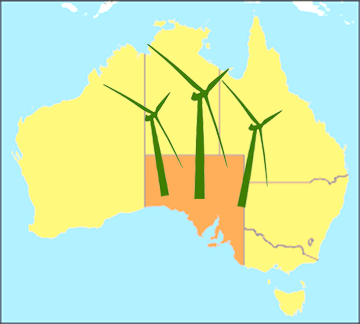 South Australia has already reached 40 per cent generation from variable renewable energy sources such as wind (33 per cent) and solar (7 per cent). It is one of the highest penetrations of variable renewables in modern industrial economies.
Up to now, that share of wind and solar has been relatively easily accommodated, but as this share grow, battery storage will be required as yet more coal-fired generators are retired, and even the need for gas plant diminishes.
The storage will be needed to soak up excess generation (such as wind at night-time or solar during the day) to be stored for use at peak time. It will also be used to provide ancillary services such as frequency – a critical component of the grid. In Germany, battery storage is being used for the same purpose.
Paul Ebert, from Worley Parsons who is leading the project lead funded by the Australian Renewable Energy Agency and with support from AGL Energy, and transmission group ElectraNet says the storage is likely to be located in one of three locations – near Port Lincoln on the Eyre Peninsula, near the Monash sub station on the Yorke Peninsula, or the Dalrymple sub-station in the river land area of the state. Continue reading
The Nuclear Fuel Chain Cost Calculator
 John Mecklin: Introducing the Nuclear Fuel Cycle Cost Calculator http://thebulletin.org/introducing-nuclear-fuel-cycle-cost-calculator8361
… Over the last two years, the Bulletin of the Atomic Scientists and the University of Chicago have created an online tool that will help countries understand the true cost of choosing the reprocessing route—and perhaps also help limit the spread of nuclear reprocessing.

The Nuclear Fuel Cycle Cost Calculator estimates the full cost of electricity produced by three configurations of the nuclear fuel cycle. This calculator is the first generally accessible model to provide a nuanced look at the economic costs of nuclear power, particularly in regard to the reprocessing of spent nuclear fuel. Among many other things, the calculator clearly demonstrates that in most cases, reprocessing results in electricity that is considerably more expensive than other nuclear power, when all costs are added in.
Dr Helen Caldicott dissects the propaganda for South Australia’s Nuclear Chain Royal Commission
This article was posted on Saturday 30 May. I have “upped” it to the top of this page, because it is the clearest and most comprehensive discussion of the very fraught South Australian nuclear fuel chain plan.
Clearly this whole disastrous process is financially beyond the reach of little South Australia. However
Premier Jay Weatherill has been persuaded to establish a flawed royal commission to assess the viability of incorporating the entire nuclear fuel chain in the state.
this is a carcinogenic industry that must be halted immediately in the name of public health. The people advocating a nuclear South Australia have no comprehension of genetics, radiation biology, oncology and medicine. Or they are willing to ignore the risks.
 SA’s short-sighted view of uranium and nuclear options https://www.thesaturdaypaper.com.au/opinion/topic/2015/05/30/sas-short-sighted-view-uranium-and-nuclear-options/14329080001942#.VWjSBtKqpHw Something quite extraordinary is happening in South Australia, the state that initiated the national movement against French atmospheric nuclear tests in 1971-72, and where the movement against uranium mining began in 1975, which ultimately led to a five-year ban by the ACTU on the mining, transport and export of uranium. Forty years later, it is the ultimate irony that the French nuclear industry is interested in becoming involved in South Australian uranium enrichment and nuclear reactors.
 In 2010, the University College London (UCL) established its School of Energy and Resources, Australia, in Adelaide. The school partnered with pro-nuclear and pro-shale gas corporations, including BHP Billiton and Santos. On the surface this may seem harmless enough, but the school and its well-connected backers has had a profound impact on the nuclear debate in South Australia, particularly as the state begins a royal commission into “opportunities and risks” in the “nuclear fuel cycle”.
Professor Stefaan Simons, who is the director of the International Energy Policy Institute and UCL’s  BHP Billiton chairman of energy policy, has been strongly promoting construction of nuclear powered submarines in South Australia, as well as a repository in the state for radioactive “waste streams”. Dr Tim Stone, a businessman and visiting professor to the UCL’s Adelaide campus, was expert chair of the British Office for Nuclear Development and sits on the board of British energy company Horizon Nuclear Power. James Voss, the former managing director of Pangea Resources, the company that originally proposed a nuclear waste dump in Australia in the late 1990s, is also part of the UCL fold, as honorary reader at the International Energy Policy Institute.
Outside of UCL, support has come from the likes of Professor Barry Brook, former professor of climate change at the University of Adelaide, and now professor and chair of environmental sustainability at the University of Tasmania. Brook has vigorously promoted the whole nuclear fuel chain, from uranium mining and enrichment to reactors and storage of radioactive waste in the desert of South Australia. He and Tim Stone have been appointed to the Nuclear Fuel Cycle Royal Commission’s Expert Advisory Committee.
The arguments put for nuclear power are many and specious. As South Australia continues to be seduced by them, it is worth pointing out the flaws that too often go uncorrected. Continue reading
Call to allow clear participation for Royal Commission submissions – Australian Council of Trade Unions (ACTU) Congress
The motion below was passed at Australian Council of Trade Unions (ACTU) Congress yesterday. It was moved by the CEPU (Communications, Electrical and Plumbing Union) and seconded by Unions SA.
Nuclear Fuel Cell Cycle With regards to the Royal Commission into the Nuclear Fuel Cell Cycle currently underway in South Australia, Congress notes with alarm the Commission has decided to require that all public submissions to be typed and sworn under oath in front of a Justice of the Peace before they will be accepted.
Requiring members of the public to take the time and resources to type and swear an oath before they can lodge a submission is an unnecessary and surprising restriction that will serve as a huge barrier to participating in what is supposed to be an open, public, inclusive and democratic process.
To be required to type a submission then swear an oath just to have your say is simply not necessary, and will have a disproportionately large effect on regional and remote communities, a majority of which are Indigenous. Additionally, in many remote communities English is not a first language, so along with the typed and sworn oath requirements means that many Indigenous voices will not be heard in the Royal Commission
The requirements means that if you live in a community that does not have a Justice of the Peace or other authorised witness, you would need to drive (assuming access to car or transport) up to an hour or more to the nearest community that does.
This runs contrary to the spirit of having an open public inquiry and is particularly unacceptable given that it is indigenous communities that will be most impacted should the Commission make recommendations for the establishment of a nuclear waste facility because they will have the facility placed on their land.
Congress calls on the Royal Commission to:
1- Restore and encourage the broadest possible public participation by removing the requirement for public submissions to be sworn under oath.
2- Accept oral and written submissions from members of the public.
3- Ensure that any activities in regional and remote indigenous communities are done in a culturally appropriate manner, including the provision of interpretation services at public meetings and ensuring that written materials are available in local languages.
Examining the nuclear lobby’s hype about “planned construction of reactors
If we had a list of renewable projects that were planned and under construction, it would look like the renewable sector was 1000 per cent of what it actually is. That’s because there are a lot of planned wind farms and even more solar farms.
In fact in interviews of Australian households beyond the 10 per cent who already have solar on their roof (25 per cent in South Australia), more than 75 per cent have a plan to get solar on their roof at some point in time. A similar number believe or are “planning” to get batteries to deliver their solar power as a cheaper alternative to the grid at night.
 So if we put all the planned nuclear reactors that never get built against all the planned solar installs and wind installs around Australia and the rest of the world, the nuclear proposals would be so dwarfed to be completely irrelevant.
 If you’re hearing another one of these countless stories such as those being hawked at the pro-nuclear “Nuclear Fuel Cycle Royal Commission” being held in South Australia, just remember there are people who want their uranium penny stocks to take them from rags to riches or riches to even more riches that are creating most of the hype.
In the west, a second generation nuclear reactor is unacceptable and no third generation reactors have ever successfully been built.
What if we all adopted the nuclear industry’s interpretation of a ‘planned’ project?MATTHEW WRIGHT , HTTP://WWW.BUSINESSSPECTATOR.COM.AU/ARTICLE/2015/5/27/RENEWABLE-ENERGY/WHAT-IF-WE-ALL-ADOPTED-NUCLEAR-INDUSTRYS-INTERPRETATION-PLANNEDIf you search the definitive list of reactors on Wikipedia, you’ll find that reactors are being decommissioned globally at a rate of knots, and many more are set to be decommissioned in the not too distant future. This includes the entire fleet in Germany and a significant portion but unspecified number of reactors in Japan.
If you looked further, you’d find that you could count the total number of reactors built in 2014 and 2015 on just one hand. In that period there was activity predominately in China — with its centralised state control avoiding the scrutiny the technology gets everywhere, outside a lone reactor in Argentina being the exception — but you could hardly get excited as that project was started when first of the Generation Ys were still in nappies in 1981.
So you’ve got a few plants getting built at a much slower pace than planned in China, and a bunch of plants ‘planned’ all over the place. But as is the case with almost all nuclear plans in the last 25 years, they’ve gone nowhere. They are plans (if a dream is a plan), but are not likely to be plants.
So why do we hear about these so called plans over and over? Continue reading
1 This month


Help Aunty Sue Protect Her Land and Sacred Sites From Destructive Rocket Testing.
.

Australians deserve the truth
about
AUKUS – https://aukuspublicinquiry.com/

PETITION – To: Prime Minister Anthony Albanese and the Australian Labor Government

of the week – Australians for War Powers Reform (AWPR)
To see nuclear-related stories in greater depth and intensity

