Nuclear Weapons company gets go-ahead for South Australian uranium mine

 Final environmental OK for Four Mile World Nuclear news, 16 August 2013 The start of operation of the Four Mile uranium mine in South Australia has moved a step closer with final environmental approval. However, the project partners have yet to agree on a development plan.
| r) |
The state Environmental Protection Authority (EPA) has now granted a mining and mineral processing licence for Four Mile. The licence also covers radiation and radioactive waste management plans for the in-situ leach (ISL) mine…..
The Four Mile project is a joint venture between Alliance Resources (25%) and Quasar Resources (75%). The project is managed by Heathgate Resources affiliate Quasar. Both Quasar and Heathgate are subsidiaries of US-based General Atomic Technologies Corp.….
Disputes delay start-up
The start of production from the project has been stymied by legal disputes between Alliance, Quasar and Heathgate. There are on-going Federal Court proceedings by Alliance seeking restitution of its full ownership of the Four Mile deposit due to delays and disagreements.
In May 2012, Alliance said it had agreed to form a strategic alliance with Japanese trading house Itochu Corporation. Under the terms of this, Itochu will have the right to acquire a 14.9% shareholding in Alliance within six months of all litigation being finally determined. Furthermore, within 12 months of that final determination, Itochu will have an option to acquire a further 25.1% shareholding in Alliance.
Four Mile uranium project – Australia’s dirtiest and most dangerous uranium connection
 (Christina Macpherson, originally posted on 4 Nov 2012) Leaving aside its nasty little internal squabbles, Australia’s fifth uranium mine Four Mile uranium project in South Australia is without doubt the most striking example of all that is wrong about Australia’s uranium industry. Well, next door, is Beverley mine – equally bad. But they’re practically the same, in that they are both practically owned by USA’s General Atomics. Neal Blue is the chairman of Quasar Resources, which is affiliated with General Atomics, a major United States weapons and nuclear energy corporation. He is CEO of Heathgate Resources. a 100 per cent-owned subsidiary of General Atomics (GA) which owns Beverley uranium mine. He is Chairman of the Board of Directors for General Atomics
General Atomics has a murky history It develops nuclear technologies including arms manufacture. Especially those Predator drones which kill anybody that the Pentagon thinks is “suspicious” in Iraq and Afghanistan. Neal Blue was one of the designers of Predator. At its uranium processing plant on an Indian reservation in Oklahoma, General Atomics for years covered up radioactive water and gas leaks.
General Atomic has spent $thousands’ lobbying and ferrying of USA politicians to Australia, , and Australian federal and state politicians to USA . In 2000 Heathgate applauded police brutality against environmentalists and local Aboriginal people. An online video clip details this brutality. the police action (in a 2000 media release which is no longer available online). After a 10-year legal case, 10 people were awarded a total of $700,000 damages.
General Atomics flew a group from the US Congress to Australia, accompanied by company executives, to persuade the Federal Government to buy the company’s Predator unmanned aircraft
As well as its interest in unmanned spy planes, General Atomics has employed human spies. In 2008 it was caught hiring a former undercover police officer turned private investigator to infiltrate Australian environment groups and report on their actions.
In 2008 General Atomics and Neal Blue were sued for fraudulently hiking uranium prices and manipulating costs. In the settlement One of General Atomics’s customers, Exelon, received $US41 million from the company. It is estimated Mr Blue made $US200 million by breaking the contracts and selling uranium on the spot market
Heathgate Resources have been promoting the view that low-level radiation is beneficial, and funding the Australian visits of people like Dr Doug Dr Boreham prepared to promote those views.
Heathgate is not required to clean up Four Mile uranium mine. and there is no requirement it decontaminate the Beverley site when mining ceases. Christina Macpherson 25 Oct 12,
Go-ahead for disputed uranium joint venture BY: BARRY FITZGERALD From: The Australian October 25, 2012 THE much-delayed Four Mile uranium project in South Australia – a joint venture between ASX-listed Alliance Resources (25 per cent) and US group Heathgate (75 per cent) – is finally being developed.
South Australia’s renewable energy success, despite planned cutbacks in solar feed-in tariff
SA’s love affair with renewables isn’t just solar-focused; the state also has the largest wind power capacity in the nation. According to the Australian Energy Market Operator, approximately 29% of South Australia’s electricity came from renewable energy sources in 2012.
South Australia Solar Feed In Tariff Countdown http://www.energymatters.com.au/index.php?main_page=news_article&article_id=3872 5 Aug 13, South Australia’s feed in tariff will be slashed for new applications soon. To avoid the inevitable applications rush; households intending going solar may want to make a move now.
South Australia’s current solar feed in tariff for surplus exported electricity is comprised of two parts- a retailer contribution of 9.8c and a 16 cent component paid by SA Power Networks. Continue reading
Plutonium blown up at Maralinga, in secret “Vixen B” tests
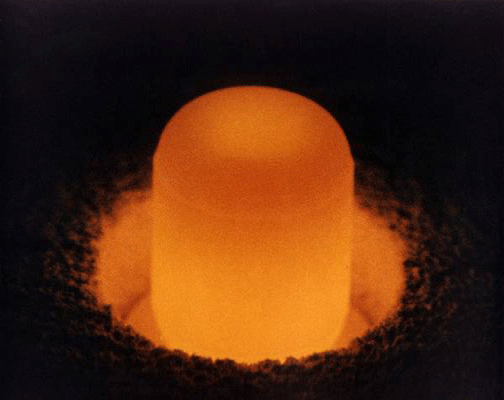 Dig for secrets: the lesson of Maralinga’s Vixen B The Conversation, Liz Tynan, 26 July 13 “……….The tests of far greater consequence were the 12 Vixen B tests, only held at Maralinga These experiments used TNT to blow up simulated nuclear warheads containing a long-lasting form of plutonium.
Vixen B scattered 22.2kg of plutonium-239 around the Maralinga test site known as Taranaki. This form of plutonium has a half-life of over 24,000 years. The extreme persistence of radiation and the threat of cancer posed by inhaling small particles in dust at the site make it especially dangerous.
The Vixen B tests took place amid total secrecy in 1960, 1961 and 1963. Maralinga’s toxic legacy can be summed up in one word: plutonium. When the Maralinga Rehabilitation Technical Advisory Committee (MARTAC) reported in 2002 on efforts to remove contamination from the area it said “Plutonium … was almost entirely the contaminant that determined the scope of the [Maralinga rehabilitation] program.”
The British carried out some clean-up operations after Vixen B and provided a report (by British physicist Noah Pearce) in 1968 that made claims about the level of plutonium contamination at the site. The Pearce report provided the technical basis for the Australian Government to release the UK from any further liability for the Maralinga site.
The technical advisory committee later confirmed that the plutonium contamination at Taranaki was wrong by a factor of 10: “A comparison between the levels reported by the UK at the time (Pearce 1968) and the field results reported by the Australian Radiation Laboratory…(Lokan 1985) demonstrates an underestimate of the plutonium contamination by about an order of magnitude.”……..” http://theconversation.com/dig-for-secrets-the-lesson-of-maralingas-vixen-b-15456
South Australian govt considers council rate charges for wind farms on private properties
 Council rates bid for wind farm turbines on private property http://www.abc.net.au/news/2013-07-19/council-rates-bid-for-wind-farm-turbines-on-private-property/4830326 Jul 19, 2013
Mr Parnell is on the committee and says farmers pay rates on infrastructure such as sheds, but multi-million-dollar wind farms are currently exempt as they are considered to be plant and equipment.
“A big part of the wind farm debate has been how we share the benefits of renewable energy, so one of the things we have to look at is how do we make sure the returns from wind farms are spread through the community?” he said.
“Rates is one way of doing it, community development funds is another way of doing it. “We’ll see at the end of the day which one the committee recommends.”
Radiation leak plans at Olympic Dam uranium mine – 15 years out of date
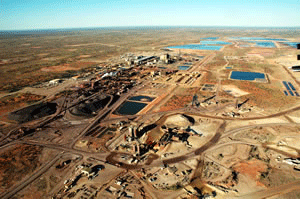 Olympic Dam mine radiation leak plan 15 years out of date news.com.au by: Miles Kemp The Advertiser July 07, 2013 THE radiation plans for Olympic Dam are more than 15 years out of date because of an administrative bungle, the Environment Protection Authority has revealed.The plans are needed because between 2003 and 2012, BHP-Billiton reported 31 radiation leaks at its Olympic Dam mine, totalling more than 3000 cubic metres of material, or the volume of a large hot-air balloon.
Responding to a Freedom of Information application that exposed the problem, the EPA could only find plans from 1997 and 1998 and has stated: “We acknowledge that an update is overdue and action is being taken to address this situation”. Greens MLC Mark Parnell said he sought a copy of the management plan to monitor how BHP-Billiton dealt with radiation leaks to protect workers and the environment.”Workers at Olympic Dam are at risk because the EPA and BHP-Billiton have failed to update their practices for over 15 years,” he said. “What sort of oversight is there by the EPA at Olympic Dam when the basic management plan required under the National Code is ridiculously out of date?”
The EPA searched its records for 10 months before responding that there was no up-to-date plan and it needed a new one. “All these plans should be available in the public realm and not have to be chased using FOI application,” Mr Parnell said.
He said there had been six triggers since 1998 that should have prompted an updated plan, including an expansion in the mine’s capacity.”Between 1998 and 2013, an extraordinary amount of change has occurred in the regulation of radioactive material, with increasing awareness of the risks to workers and the natural environment and advances in processing,” he said…….. http://www.adelaidenow.com.au/national-news/south-australia/olympic-dam-mine-radiation-leak-plan-15-years-out-of-date/story-fnii5yv4-1226675659296#ixzz2YU1PMjCI
Democratic process stops the uranium mining rush into Woomera area
Senate slows deal to give mineral explorers access to Defence’s Woomera testing grounds Adelaide Now, CHRISTOPHER RUSSELL Business Editor June 21, 2013 “…..Laws to keep Defence as the prime user and controller of access to Woomera Prohibited Area but giving certainty to mineral explorers were this week shunted into a Senate committee inquiry after earlier clearing the Lower House with bipartisan support.
The Foreign Affairs, Defence and Trade committee now will seek new public submissions on the pact, which had been negotiated over several years between industry, government and Defence following an inquiry by former public servant Allan Hawke.
The committee is only due to report back on August 20, just weeks before the federal election. That means the reform Bill will lapse and have to await being reintroduced by the next Federal Government……..
Greens MP Adam Bandt said his party was “absolutely opposed to mining uranium” and also had concerns about Aboriginal issues.SA Senator David Fawcett said it was quite appropriate for the Bill to go to a committee inquiry and it should not be rushed.”If it’s not dealt with this week – and clearly it won’t be – it’ll be an issue for whoever forms government after September,” he said.
Senator Fawcett, who came to politics from a military career which included working in Woomera, said the area was crucial to Defence testing.
“Just because we have a State Government and mining lobby who are saying let’s go on with it, I don’t see that – short of a national emergency – we should be circumventing the democratic process,” he said…… http://www.adelaidenow.com.au/business/sa-business-journal/senate-slows-deal-to-give-mineral-explorers-access-to-defence8217s-woomera-testing-grounds/story-e6fredel-1226667870070
Property Council of South Australia’s Nathan Paine,Theo Maras, Chris Burns push for importing nuclear waste
 Christina Macpherson, 15 June 13, In 1980, Senator Jean Melzer warned about Australia becoming “the quarry and waste dump of the world” . The Australian Labor Party soon got rid of her. In 2007 Kevin Rudd came into power as Labor appeared to be opposing a nuclear waste dumping industry in Australia.
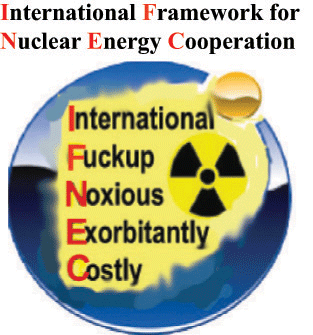
You might think that this nuclear waste importing idea has gone away. But it never did. And Australia has a global agreement that could swing it into action faster than you can swing a cat – the International Framework for Nuclear Energy Cooperation(IFNEC)
You might think that this noxious idea is not getting any support from the Australian public.
If so – you thought wrong.
In South Australia, the Property Council of SA, and several businessmen with more dollars in their eyes, than brains in their heads, are now pushing that same old nuclear barrow.
Here’s how they were reported in Adelaide Now today: “Some also call for the development of a domestic nuclear power sector that Property Council of SA executive director Nathan Paine predicts could turn us into the “Dubai of Asia”….

He said: “You’d almost be able to give every South Australian … when they turn 18, a cheque for $50,000 and a house.”……
, Mr Burns said SA should develop a nuclear sector. He said: “What we’ve got unique resources for in this state are for nuclear energy. We have the resources in the ground; we should be digging it up and processing it. Never sell it, only lease it and bring it back here to bury it. I think that’s the industry for the state.”
SA has 40 per cent of the world’s known uranium reserves. Mr Maras said if the government championed a nuclear industry, business would soon come on board…..
They even want South Australia’s “mums and dads” to invest in developing such ideas in the We’re for Jobs in SA campaign
Labor and Liberal in happy agreement pro uranium mining
 States sign agreement on uranium ABC News, Jun 12, 2013 The New South Wales and South Australian governments have signed an agreement to encourage mining and exploration along the border of the two states.
The memorandum of understanding was signed at a uranium mining conference in Darwin yesterday.
Uranium exploration has only recently been allowed in NSW, while it is already being mined at Honeymoon and Beverley over the border…… “They want to see politicians whether they’re Liberal, Labor or National all working together and we are.”
Mr Hartcher says the agreement does not open the door to uranium mining in NSW….. http://www.abc.net.au/news/2013-06-12/states-sign-agreement-on-uranium/4748452
South Australian wave energy project is progressing
 Port MacDonnell wave energy project ‘on track’ ABD News 12 June 13, Wave energy company Oceanlinx says the construction site of its $7 million Port MacDonnell development is being prepared this week. A 20-square metre offshore concrete unit is expected to be connected
to the power grid by the end of the year and will power 1,000 homes in Port MacDonnell. CEO Ali Baghaei says equipment has started arriving at the site and construction workers have begun setting up.
He says people will soon see the development taking shape….. “We are very much keen to ensure it stays on track and thankfully it has beenon track and I’m very pleased with the progress we have made,” he said. “I must say we have received quite a lot of support from the local communities and I want to thank them all for it.” http://www.abc.net.au/news/2013-06-12/wave-energy-firms-port-macdonnell-project-on-track/4748830
Financial benefits of solar power leading South Australians to make the switch
 Households in South Australia are increasingly turning to solar power to alleviate or even obliterate energy bill woes. National solar energy provider Energy Matters estimates a good quality solar power system installed in Adelaide can return a financial benefit of between $1,502 – $1,711 annually.
South Australian Electricity Prices Biting Hard http://www.energymatters.com.au/index.php?main_page=news_article&article_id=3784, 10 June 13 The last 6 months of 2012 saw a substantial increase in the number of SA households turning to electricity instalment plans and joining electricity retailer hardship programs says the Essential Services Commission of South Australia. Continue reading
The radioactive poisoning of Maralinga
 Historic records of Radiation Monitoring at Australian Nuclear Test Sites, Paul Langley’s Nuclear History Blog 3 June 13“……..RETURN TO MARALINGA, Australia Bomb Test Site On 24 May 1984 a special VIP flight to the RAAF left Adelaide for Maralinga. On board were the Minister of Resources and Energy, Senator Walsh, and the south Australian Premier, John Bannon, accompanied by scientists of the Australian Radiation Laboratory. The tour of the bomb sites took no more than four hours and the politicians learned little more than they already knew from their briefings in Canberra and Adelaide. But the importance of the trip was symbolic. The representatives of the Federal and South Australian Government were there jointly to express their regret that the atomic test series had ever been allowed to take place in Australia and to pledge their support for all investigations into the possible harm done to servicemen, Aborigines and the environment…….
Military and Mining to rule Woomera – an area larger than England

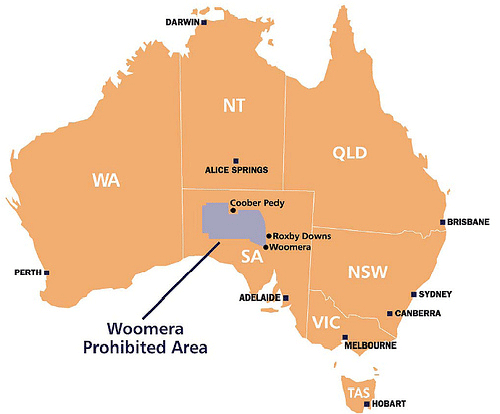
 Australia eases access to world’s biggest weapon range, SMH, 30 May 13 , Australia will ease access restrictions on the world’s largest weapons test range in the remote outback – an area larger than England – to unlock an estimated $35 billion in untapped mineral resources, with legislation for the change unveiled on Thursday.
Australia will ease access restrictions on the world’s largest weapons test range in the remote outback – an area larger than England – to unlock an estimated $35 billion in untapped mineral resources, with legislation for the change unveiled on Thursday.
The Woomera Prohibited Area covers 127,000 square km of mostly barren desert and has been closed to the public since 1947, when it was used for Cold War rocket and nuclear tests by Britain, Australia and the United States.
The sprawling site, which is almost free from electronic signal interference, was also chosen this year as test site for the joint British-French unmanned supersonic stealth drone Taranis, under development by BAE Systems Plc. Defence Minister Stephen Smith told MPs that new legislation would allow miners and some members of the public with reason to be there to share access to the land with the military, to better balance national security and economic concerns………
Parts of Woomera, which hosted British nuclear weapons tests between 1955 and 1963, also lie adjacent to the Olympic Dam site, which BHP Billiton decided not to expand last year as Australia’s mining boom stalled. A small number of mines already exist in the area, including Prominent Hill and Kingsgate Consolidated Ltd’s Challenger gold mine.
Under the new access arrangements, the military would remain in charge of the area, but a permit system would give civilians the right to enter Woomera. As well as miners, indigenous Aboriginal residents can also enter the zone, and environmental or other researchers.The legislation sets up a series of zones, some of which would be zoned red for “continuous defence use” and others which would exclude mining and exploration for between 14 and 70 days a year, in a timeshare arrangement with the military.
“It allows users to make commercial decisions with some assurance as to when they will be required to leave the Area because of defence activity,” Smith said……Smith said the legislation would be passed as a priority before parliament was dissolved for September elections.: http://www.smh.com.au/business/australia-eases-access-to-worlds-biggest-weapon-range-20130530-2ne3a.html#ixzz2Uuz6nLoX
Australian Government’s mock “consultation” about opening Woomera to miners
Government’s “consultation” on mining in Woomera more like a ram raid Australian Greens nuclear policy spokesperson Senator Scott Ludlam. 17 May 2013. The Federal Government made a mockery of public consultation by allowing three working days for initial submissions on opening up the Woomera Prohibited Area to miners, Greens Senator Scott Ludlam said today.
“On Wednesday 8 May Defence Minister Stephen Smith and resources Minister Gary Gray released the draft exposure of legislation to increase access to Woomera Prohibited Area to miners, and three working days later on 13 May the submission period closed. It’s not good enough,” said Senator Ludlam.
 “Lawyers representing the Maralinga people, who in addition to being the Traditional Owners own approximately 40,000sqkm of freehold land in the area, advise that they have not been consulted on this legislation despite approaching the Defence Minister on the issue in July 2011.
“It is a relatively short amendment at nine pages but it is high-impact legislation. This area has an estimated 78 per cent of Australia’s known uranium reserves. The implications are massive.
“After years of review and the production of an 82 page report, we do not want to see a long process brought to an abrupt and shallow end.”
Australian Uranium Association’s Paydirt Conference shortened to one day, in gloomy economic prospects
 PAYDIRT URANIUM CONFERENCE IN ADELAIDE THIS MONDAY Uranium industry boosters will gather this Monday April 29 at the Adelaide Hilton for the annual Paydirt Uranium Conference. This year’s conference has been downgraded to a one-day event, reflecting industry stagnation in the wake of the Fukushima disaster.
Friends of the Earth national nuclear campaigner Dr Jim Green, co-author of a new report exposing the economic myths of the uranium industry, said: “The Australian Uranium Association’s Executive Director Michael Angwin claims that Australia “has enough reserves to be to uranium what Saudi Arabia is to oil”. However Australia’s uranium export revenue in 2011 was 466 times lower than Saudi oil revenue in the same year. Others to draw asinine comparisons between Australian uranium and Saudi oil include former SA politicians Mike Rann and Kevin Foley, and Adelaide-based academics Ian Plimer and Haydon Manning.”
“For decades the uranium industry has promised great economic benefits but it never delivers. Uranium accounted for just 0.29 per cent of Australia’s export revenue in the 10 years from 2002−2011. In the last financial year, uranium revenue was four times lower than Australia’s 20th biggest export earner, eight times lower than Australia’s 10th biggest export earner and 103 times lower than the biggest earner, iron ore. Even milk and cream generate nearly twice as much export revenue as uranium − and can’t be turned into Weapons of Mass Destruction. Uranium mining and exploration accounts for just 0.015% of all jobs in Australia.”
“Last year, BHP Billiton cancelled its planned expansion of Olympic Dam, disbanded its Uranium Division, and sold the Yeelirrie uranium lease in Western Australia for about 11% of the nominal value of the resource. Just months after first production at the Honeymoon mine in north-east SA in September 2011, project partner Mitsui announced its decision to withdraw as it ‘could not foresee sufficient economic return from the project.'”
“An independent inquiry is long overdue to objectively weigh the uranium industry’s economic benefits against its effects on environmental and public health, safety and security, particularly in the shadow of the unfolding Fukushima tragedy − a tragedy directly fuelled by Australian uranium,” Dr Green concluded.
‘Yellowcake Fever: Exposing the Uranium Industry’s Economic Myths’, a report released by the Australian Conservation Foundation last Friday, is posted at:
1 This month

of the week – Australians for War Powers Reform (AWPR)
To see nuclear-related stories in greater depth and intensity
 Antinuclear