Fossil Fuel and Nuclear Industries in lockstep in Australia – theme for April 16
 Despite the global imperative and a strong public movement to reduce greenhouse gas emissions, Australia’s coal, gas and oil industries predict a prosperous future for decades to come.
The nuclear industry proudly touts itself as the solution to climate change. But nothing could be further from the truth. The full nuclear fuel chain emits large amounts of Co2 and other greenhouse emissions. In the coming decades, indirect carbon dioxide emissions from nuclear power plants will increase considerably, because high-grade resources of uranium are exhausted and much more fossil energy will have to be used to mine uranium. In view of this trend, nuclear power plants will no longer have an emissions advantage over modern gas-fired power plants, let alone in comparison to the advantages offered by increased energy efficiency or greater use of renewable energies.
Even when they pretend that nuclear power would cut emissions, the industry itself is well aware that the thousands of reactors needed to have any real impact could not be up and running for many decades – way too late for combatting the global warming process.
That situation suits the fossil fuel industries perfectly. Coal can keep on being mined – “in the meantime”, and nuclear power can take over many decades later, when the coal runs out.
Fossil fuel and nuclear industries are large centralised operations. The much touted Small Modular Nuclear Reactors are supposed to be “decentralised”, but in fact are produced in, and totally dependent on, the same centralised grandiose way as the “conventional” big reactors.
The nuclear industry is very comfortable indeed, with the continuance of dirty fossil fuel industries, aiming for a smooth transition later on, when it can get its dirty industry up and running – meanwhile posing as the world’s saviour from climate chnage.
Nuclear history – theme for January 2016
The start was America’s Manhattan project – developing the atomic bomb. Then came the horror of the atomic bombing of Hiroshima and Nagasaki. Then came – the shock and guilt, and the attempt to turn the nuclear project into something good – “atoms for peace’ “electricity too cheap to meter”.
Of course the costing for “cheap” nuclear energy did not include the health and environmental toll of uranium mining, which, as always, was to be paid by indigenous people. Costing also did not include the virtually eternal toll of the cleaup of radioactive trash. And of course, there would be no accidents, (no Chalk River, Rocky Flats, Windscale, Mayak, Lenin icebreaker, Three Mile Island, Chernobyl, Tomsk, Hanford, Fukushima Daiichi)
Meanwhile, the military-industrial complex continued its production of nuclear weapons. Other countries adopted the “peaceful nuke”, so that they could develop nuclear weapons. The nuclear arms race was underway.

FROM THE ARCHIVES For this month, each week we’ll be posting an item from the past. Lest we forget.
Australian Map of Nuclear Sites, Overview Jim Green Sept 2012 Some of the recurring patterns in Australia’s nuclear history are discussed here under the following headings: children exposed to radiation; racism; struggle; unresolved radioactive contamination issues; deceit; whistleblowers; secrecy; rhetoric versus reality; lessons not learnt; and surveillance, intimidation, and police brutality.
Children exposed to radiation – (at Port Pirie, Rum Jungle, Kalgoorlie, Yeelirie , Hunters Hill, Lucas Heights, and, of course, Maralinga)
Due to the lack of fencing, the contaminated Port Pirie Uranium Treatment Complex site was used as a playground by children for a number of years. The situation was rectified only after a six-year community campaign.
After mining at Rum Jungle in the NT ceased, part of the area was converted to a lake. As a crocodile-free water body in the Darwin region, the site became popular despite the radioactivity. Continue reading
Australia’s renewable energy future – theme for January 2017
Australia has a bright renewable energy future. Indeed a pretty bright renewable energy present, too. Australian households have taken up solar energy in a big way – per head of population, the best in the world.
Wind energy is already a success story, with South Australia leading the way. Initiatives are happening, in utility scale renewable energy, particularly in the Australian Capital Territory.
Along with the ACT, Australia’s cities are choosing renewable energy – Sydney, Melbourne, Perth, , and many other cities are making the solar city change.
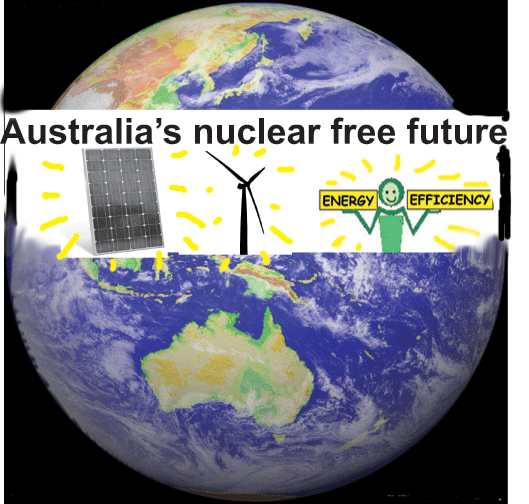
For large scale renewable energy, Australia has lagged behind. The climate policies of Liberal Coalition governments, under PM Tony Abbott, and now PM Malcolm Turnbull have been, and still are, dictated by the fossilfuel/nuclear lobbies.
Yet we still have the Australian Renewable Energy Agency, and the Clean Energy Finance Corporation, supporting initiatives in clean energy. The Turnbull government still plans to axe these, in line with its obligations to its dirty industry funders.
The renewable energy revolution in Australia is being led from “below”, from the people. It’s not to do with “left” or “right” politics. It’s to do with practicalities. Eventually, we will get a government that faces up to the realities of energy sources in the 21st Century .
Moving on to the Post Nuclear World – theme for December 15
The sinister side of the push for “New Nuclear” is that it is a justification for doing nothing about the accumulating toxic wastes and the toxic nuclear weapons and reactors. Such a comfortable temptation – leave this nastiness for our grand and great granchildren to fix.
The present entire reptilean assembly of nuclear industry chiefs and wannabe chiefs, and executives and lobbyists, and the bought politicians and media, will be dead then, having enjoyed their comfortable well-paid lives.
It is up to the ‘alternative’ and ‘social’ media to expose their lies and to highlight the compelling three present day challenges:
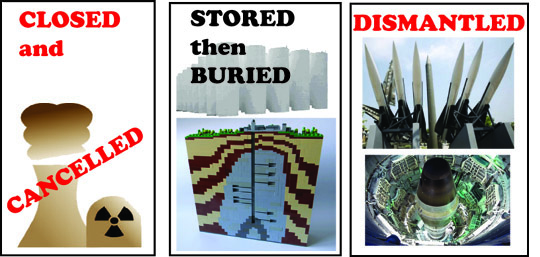
– to close down the global nuclear industry, and especially to expose and prevent the ‘New ‘Nuclear’ deception.
– to deal with the existing masses of radioactive trash – interim above ground storage, then burial near to the site of production – the ‘least worst’ option.
-to dismantle the useless nuclear weapons empire, including the poisonous depleted uranium weapons. (Today’s enemies effectively use much simpler and cheaper weapons)
Australia as Guinea Pig for “New Nuclear” – theme for September 15
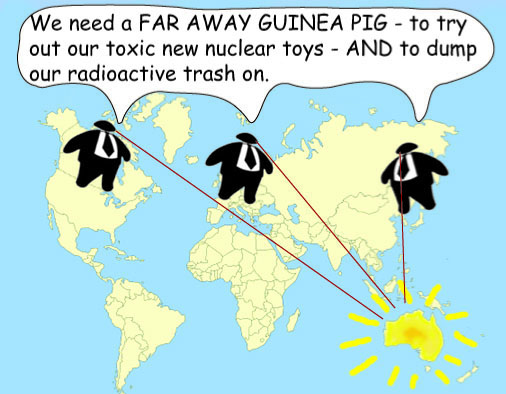
To resuscitate the nuclear industry, its lobbyists must convince the world that they have the solution – to turn radioactive trash into a “valuable resource” – by the new magic “waste eating” Generation IV nuclear reactors.
But those reactors don’t exist. They might be dangerous. They’re astronomically expensive. They will be a terrorist target. And they themselves still leave a smaller amount of highly toxic, long lasting radioactive trash. And that trash is so highly toxic that it requires a large storage space.
But what if – what if – the nuclear industry could convince a far away country that it could make $squillions by importing radioactive trash?
And gee whiz – the nuclear industry would pay up front to set up the new gimmicks (Australia could pay them back later for these).
Australia could be the salvation – of the world’s most toxic, dangerous, and unaffordable industry! Bingo!
Submission Points to Issues Paper 4 – Nuclear Royal Commission
Submissions Issues Paper 4 (Storage and Disposal of Waste) are due by 24 July, 2015
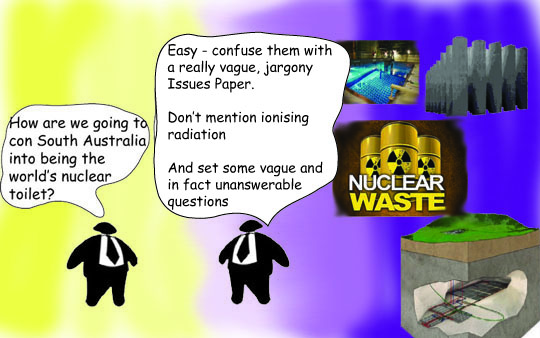
4.1 Are the physical conditions in South Australia, including its geology, suitable for the establishment and operation of facilities to store or dispose of intermediate or high level waste either temporarily or permanently?
Earthquake hazard: For either temporary or permanent storage of radioactive wastes, South Australia poses great risks. While the whole State has a small earthquake hazard zone, there are large sections which have an increased earthquake hazard. Particularly in the South of the State (1)
Risk to precious artesian water. While the South of the State has earthquake risks, almost the entire of the rest of the State covers the Great Artesian Basin. (2)
Effectively, this means there is almost no part of South Australia that could safely store radioactive trash for decades, let alone for thousands of years.
- 3 What would the (overseas) holders of radioactive wastes be willing to pay for disposal and storage of radioactive wastes in South Australia?
This question really has no answer. At present every country with nuclear facilities is struggling with the unanswered question of what do do with their radioactive trash. Even Finland, which has built a 500 metre deep burial place, will not have enough space for their accumulating radioactive trash. So far, there is no room for Fennovoima’s waste in the Onkalo repository in Olkiluoto. (3)
At this stage there are no proposals for exporting nuclear waste. Royal Commissioner Kevin Scarce, in his recent report on the Commission’s overseas visit, said “We haven’t done the financial study”. When anyone does do the financial study, they will need to factor in the financial costs of insurance, of security for hundreds, thousands, of years, as well as of environmental degradation.
Another factor would be the comparison of the commercial value of renewable energy not pursued, tourist and agricultural opportunities lost as government money went into fostering nuclear schemes rather than South Australia’s more positive activities.
4.4 What sorts of mechanisms would need to be established to fund the costs associated with the future storage or disposal of either Australian or international nuclear or radioactive wastes?
A mechanism has been put forward by Oscar Archer. (4) In Archer’s words “it goes like this. Australia establishes the world’s first multinational repository for used fuel – what’s often called nuclear waste” he wants the funding to be provided by “our international partners”, on condition that “This is established on the ironclad commitment [my emphasis] to develop a fleet of integral fast reactors to demonstrate the recycling of the used nuclear fuel” This would be a highly unsatisfactory arrangement. As the nuclear industry now struggles to fund these as yet not developed Generation IV reactors – South Australia would find itself locked in – in a sort of blackmail position, to buying a technology that very likely has no future.
4.5 What are the specific models and case studies that demonstrate the best practice for the establishment, operation and regulation of facilities for the storage or disposal of nuclear or radioactive waste?
The massively expensive 500 metre deep bunker being developed in Finland is so far the only facility that has appears to have relative safety, but that can accomodate only some of Finland’s radioactive trash . Meanwhile in USA, the Waste Isolation Pilot Plant has been as disaster. (5)
4.6 What are the security implications created by the storage or disposal of intermediate or high level waste at a purpose-built facility?
In the short term (i.e a period of decades) the above ground concrete containers are vulnerable to terrorist attack. In the long term , i.e. thousands of years, deep waste reposiitories run risk of climate and seismic events, as well as possible terrorism. They need to to be guarded virtually forever, or else, as they are forgotten, pose risks to future generations.
4.9 Bearing in mind the measures that would need to be taken in design and siting, what environmental risks would the establishment of such facilities present?
Climate change continues to increase risks of extreme weather events, and it is possible that seismic activity, already a risk, would increase.
4.10 What are the risks associated with transportation of nuclear or radioactive wastes for storage or disposal in South Australia?
Extreme weather, transport accidents that would spread ionising radiation , terrorist attack.
4.12 Would the establishment and operation of such facilities give rise to impacts on other sectors of the economy?
In the past, countries like France accepted the risks of nuclear power, and their other industries thrived. Now, even in France, there is concern about polluting industries. For some time after the Chernobyl nuclear catastrophe, the French wine industry was severely depressed., because the wine growing regions were squarely in the path of the ionising radiation fallout. (6) There is concern in Washington State about the impact of Hanford nuclear waste facility on the wine industry. (7)
(1) https://www.sa.gov.au/__data/assets/pdf_file/0005/17168/Earthquake_hazard_zones_SA.pdf
(2) http://www.environment.gov.au/water/environment/great-artesian-basin
(3) http://yle.fi/uutiset/battle_for_nuclear_waste_disposal_site/5097360
(4) http://www.abc.net.au/radio/programitem/pgJrGaLDL7.
(5) 1 6 June 2014, ‘Fire and leaks at the world’s only deep geological waste repository’, Nuclear Monitor #787,www.wiseinternational.org/node/4245 222 27 Nov 2014, ‘New Mexico nuclear waste accident a ‘horrific comedy of errors’ that exposes deeper problems’, The Ecologist,
(6) http://wineeconomist.com/2008/01/26/the-science-of-unintended-consequences/
(7) http://www.thedailybeast.com/articles/2015/03/28/hanford-nuclear-site-could-be-threatening-washington-state-s-best-vineyards.html
Submission Points to Royal Commission Issues Paper 1 EXPLORATION, EXTRACTION AND MILLING
Submissions to this Paper are due by July 24 POINTS TO CONSIDER
They want you to direct your answers to the points they have set out in http://nuclearrc.sa.gov.au/our-reports/exploration-extraction-and-milling/ SO: here are a few ideas:
1.1 and 1.2. (economics of uranium industry) Australia’s uranium production of 5,000 tonnes in 2014 was the lowest for 16 years. The industry generates less than 0.2 per cent of national export revenue and accounts for less than 0.02 per cent of jobs in Australia. (1)
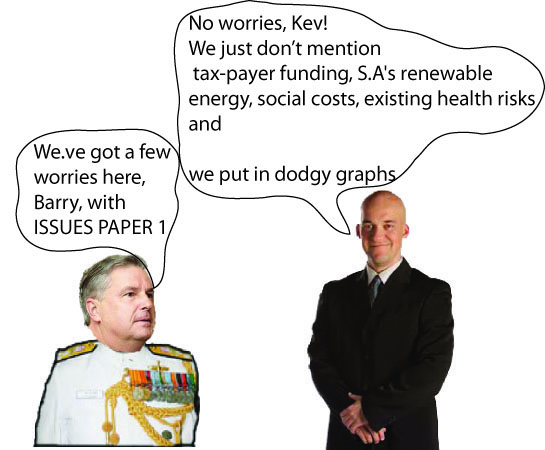
Nowhere in this Issues Paper is information given on Government funding of the nuclear industry either directly in the form of grants and through government supplied services.
1.12 (Uranium enrichment) and 1.7 (Future of uranium market) The 2006 Switkowski Review concluded that “there may be little real opportunity for Australian companies to extend profitably” into enrichment. (2) Conditions are no more conducive to the establishment of an enrichment industry now than they were in 2006. Former World Nuclear Association executive Steve Kidd noted in July 2014 that “the world enrichment market is heavily over-supplied”.(3)
1.8. (health effects) There is a well established link between uranium mining and lung cancer. (4) Exposure to even low-level radiation is a health hazard. That is the position of all relevant expert bodies such as the United Nations Scientific Committee on the Effects of Atomic Radiation. As the the US National Academy of Sciences’ Committee on the Biological Effects of Ionising Radiation states, “the risk of cancer proceeds in a linear fashion at lower doses without a threshold and … the smallest dose has the potential to cause a small increase in risk to humans.”
1.10 (risks) Enrichment plants can produce both low-enriched uranium for reactors and highly-enriched uranium for weapons.
1.13 (effects on other industries). South Australia’s remarkable success in renewable energy, and its reputation for clean agricultural produce would clearly be threatened by further development in the uranium/nuclear industry
(1) http://www.conservationsa.org.au/images/Nuclear_Royal_Commission_issues_summary.pdf
(2) http://www.ansto.gov.au/__data/assets/pdf_file/0005/38975/Umpner_report_2006.pdf
(3) Nuclear Engineering International Magazine, May 2014
(4) http://www.mapw.org.au/files/downloads/Nuclear-power-uranium-mining-&-public-health_MAPW-Factsheet.pdf
#NuclearCommissionSAust Submissions to South Australia’s Nuclear Royal Commission – theme for July 2015
 Theoretically, anyone can make a Submission. Even though they seem to be confining this whole thing to South Australia, those outside South Australia can still make a Submission (- and particularly if you are a company that makes nuclear reactors.)
Closing dates for Submissions
24 July 2015 – Submissions addressing only Issues Paper 1 ((Exploration, Extraction and/or Milling) and Issues Paper 4 (Management, Storage and Disposal of Waste).
3 August 2015 – Submissions addressing Issues Paper 2 (Further Processing and Manufacture) and/or Issues Paper 3 (Electricity Generation).
This closing date also applies to any consolidated submission which addresses all four Issues Papers.
If you go to the Royal Commission’s website http://nuclearrc.sa.gov.au/, you will there find the instructions on how to do the Submission.
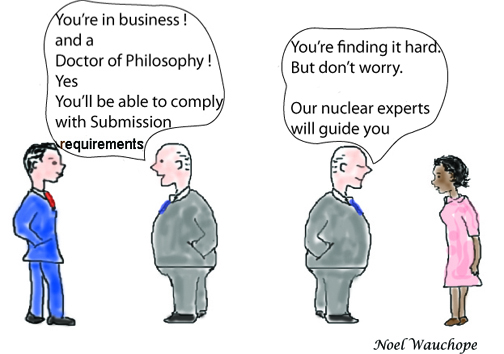
This involves:
- Submissions should be typed with page numbers. Submissions should adopt the numbering of the questions used in the Issues Papers.
- Use their cover form and format.
- Stick to the topics and points as given in their Issues Papers (but you can add other topics as an Appendix) Also in an Appendix you can nominate an expert witness to give evidence at a Hearing.
- Swear an oath before a Commissioner for Affidavits or a Justice of the Peace.
Submissions can be sent by email (submissions@nuclearrc.sa.gov.au) or by directly uploading the submission through its website, Electronic submissions should be in PDF format and be text searchable (OCR). Or in hard copy. by post. Hardcopy submissions can be sent to: Nuclear Fuel Cycle Royal Commission GPO Box 11043 Adelaide SA 5001
The death of the nuclear industry – theme for June 2015
 The world is waking up to the unaffordable costs of the nuclear fuel chain.
Forget health, environment, safety, future generations, weapons proliferation – today’s killer of the nuclear industry is that good old reliable thing – the exorbitant MONEY that is required
Are “developing” countries really buying the nuclear lobby’s advertising drivel? Is China really on a nuclear build spree? Is Australia really going to “embrace” the nuclear fuel chain and become the planet’s nuclear toilet?
The nuclear lobby , like everyone else, knows that the game is over as soon as the next radioactive catastrophe occurs. That’s predicted as50% probability before 2050. It could be this week. That’s a big reason why the nuclear lobby is in such a panic to lock in contracts to buy its toxic products – while the going’s good.
Only tax-payers will fund nuclear facilities, despite the drivel from democracies about private enterprise. Russia, China are more honest about it – the State owns the nuclear companies. And they’re all so keen to export the technology to other countries. Heck! Russia evenpays for them to buy the stuff.
The nuke industry is in trouble – In USA the nuclear industry is a thing of the past. Investors flee Nordic nuclear company Vattenfall. Finland pulls out of building Olkiluoto 4 nuclear reactor. AREVA teeters on bankruptcy.
Nuclear dis- economics: the Hidden Costs – theme for June 2015
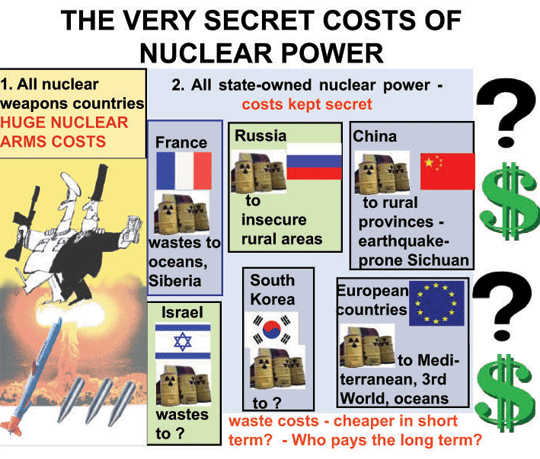
The “front end”, the “central” and the “back end” The nuclear lobby has successfully confined discussion of nuclear power costs to the “central” cost of building nuclear reactors. Even anti-nuclear activists concentrate on this.
But – what about the Hidden Costs? – at the “Front end” and the “Back end”

THE VERY SECRET COSTS OF NUCLEAR POWER
Well it is impossible for anyone to estimate the real costs of nuclear power, as only a narrow range of costs are discussed, even where the nuclear industry is supposedly privately owned.
Gloom in the global nuclear industry – 10 reasons why – theme for May 2015
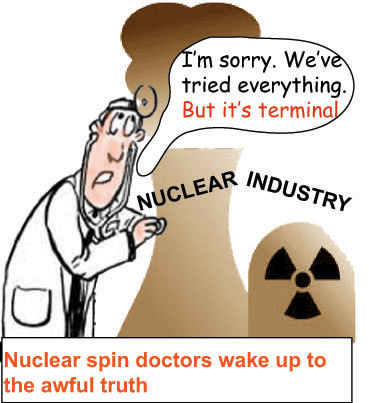 The global nuclear industry is sick, indeed, it is in palliative care. And here are 10 good reasons why:
1. Gloom overlies the nuclear lobby, fear of this question: the next nuclear catastrophe. NotIF it will happen, but WHEN and WHERE?
2. Aging, dangerous nuclear reactors that are too costly to make safe. .
3. “New nuclear” is a joke. The nuclear lobby will boast of so many “planned”, “proposed” reactors. But new ones actually being built? – just two and a half duds.
4 Discord and dissension in the nuclear camp. Nuclear countries cannot afford new reactors, so desperately compete to sell them to other countries.
Meanwhile nuclear companies battle it out to market their particular new gee-whiz nuclear reactor version.
5. Climate change affects nuclear reactors.
6. Nuclear weapons now out-dated. 21st Century conflict is all about smaller, targeted 
weapons, like the USA’s assassination drones. Pride and status are now the only motives for having nuclear weapons.
7. Decline in electricity use
8 Renewable energy, both centralised and small scale, is fast being developed, and widely popular (unlike nuclear).
9. Danger – whatever kind of nuclear facility – there is always the danger of accident or terrorism – they are a target for terrorists.
10 Public opinion. Worldwide – people just don’t like nuclear power.
The global nuclear lobby is in a bigger mess than you realised – theme for May 2015
Take heart – all who seek clean energy – the nuclear industry is in a right mess!
Apart from the chaotic state of nuclear economics, and of security, weapons proliferation, public opposition, desperate marketing, frantic agonising over waste disposal , as well as the drive for public amnesia about Chernobyl and Fukushima – apart from all that – the nuclear lobby are all wrangling among themselves.
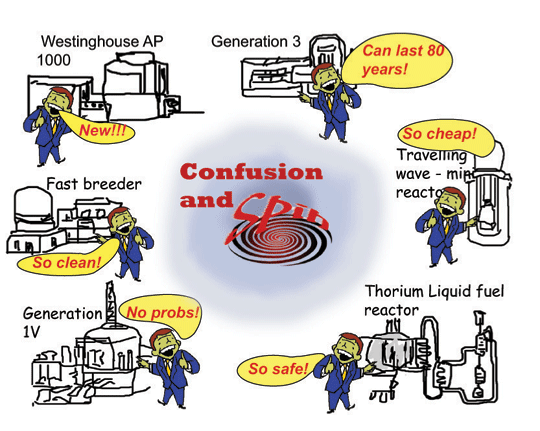
(The Spin graphic within picture is adapted from http://spinoriginal.blogspot.)com.au/ )
There’s an unseemly public frenzy from all the different reactor corporations to market their respective products. This includes marketing the existing old reactors – to continue running them for many decades, despite their deterioration,- because this is much more profitable than getting new ones. And – also – postpones for future generations the massive costs of dealing with the reactors’ radioactive corpses.
Then there’s the drive to sell little reactors, and Thorium reactors – an absolute nightmare of security concerns in these. And of course, the uranium industry won’t like this.
It’s quite likely that in trying to outdo each other, the nuclear industry will kill off itself faster than any anti nuclear campaigns. AREVA is already offering reactors for sale below their cost price.
Australia’s role in the global nuclear industry crisis – – theme for May 2015
The global nuclear industry may pretend otherwise, but it is in crisis. The commercial nuclear industry is an economic disaster. The first and greatest nuclear nation, USA, has learned this. So has France. Britain now undergoes this painful realisation.
As these “old” nuclear countries realise the collapse of their nuclear industry, they turn to marketing nuclear technology overseas, in a desperate effort to make the industry viable. This gets complicated, because the desire for nuclear weapons is a strong motive for buyers – India, Pakistan, Saudi Arabia? – countries that really do not need nuclear power, but like the option of nuclear weapons..
Within the nuclear industry there’s been a division between the interests of the big “conventional” uranium fired nuclear reactors, and the supporters of small nuclear reactors and thorium fuelled reactors.
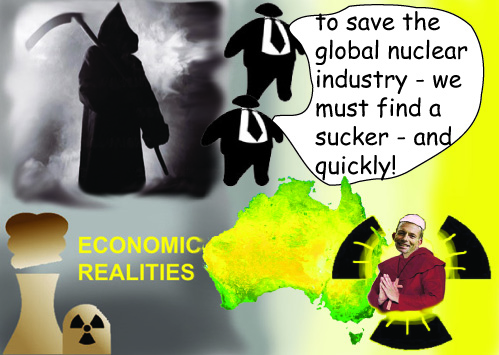
Here’s where Australia comes in. Somewhat culturally isolated, Australia is a sitting duck for a clumsy plan to put all these technologies together, and for the global nuclear salesmen to present a united face, and try to sell the whole lot to Australia.
These nuclear marketers (Canada’s Lavalin, France’s AREVA, USA’s Westinghouse, GE Hitachi) are desperate for Australia to accept this scheme. Afflicted at home by public anxiety about radioactive trash, they really do need to be able to tell their citizens – “Don’t worry – Australia will take the trash – we can keep on making it.”
Essential to design for recycling of rare earths. – theme for April 15
The world is still in the grip of the philosophy of endless growth, endless consumption of material “goods” and energy. Along with that goes the “throwaway mentality.
The result – not just the disappearance of precious resources – water, land , biodiversity – but also the dirty pollution of the ecosphere with wastes. One of the worst is radioactive wastes. (Don’t be caught by the nuclear lobby lie about the’nuclear fuel cycle’ – which is really a chain leading to toxic wastes needing burial)
However, environmentalists must wake up to the fact that nearly all of our advanced technology requires “rare earths” – cerium, 15 lanthanoid elements and one or both of the elements yttrium and scandium. Thorium is often classed with them. Mining these elements results in highly toxic radioactive tailings.
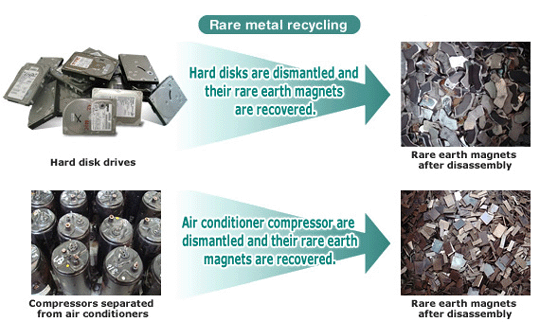
If we’re serious about not creating radioactive wastes disasters, such as the notorious ones in Malaysia and China then the answer must be – DESIGN – designing wind turbines, cell phones, lap-tops etc – in a such a way that the rare metals can be easily retrieved and used again.
“The situation clearly calls for international policy initiatives to minimize the seemingly bizarre situation of spending large amounts of technology, time, energy and money to acquire scarce metals from the mines and then throwing them away after a single use.”
RECYCLING, DESIGN, RARE EARTHS, and the NUCLEAR CHAIN – theme for April 15
FIRST – there is NO “Nuclear Fuel Cycle” – only a toxic Nuclear Fuel Chain 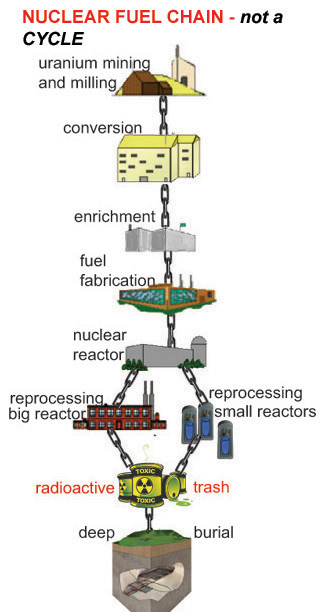
The nuclear lobby is telling one of its finest whoppers – that there really is a “nuclear fuel cycle” – that toxic radioactive wastes can be turned into lucrative nuclear fuel – for a never ending glorious “cycle”
Not true. It is truly a Nuclear Fuel Chain – that the lobby hopes to put around Australians’ necks. The new geewhiz (not yet existing) Liquid Fluoride Thorium Reactors (LFTRs) and Small Modular Nuclear Reactors (SMRs), including the Power Reactor Innovative Small Module (PRISM) – all produce highly toxic wastes that have to be buried. Reprocessing is NOT a “cycle”
SECOND – Rare Earths involve highly radioactive wastes – and require a big switch in DESIGN – so that they can be recycled.
Environmentalists must wake up to this. There must be a paradigm shift from the thinking, (so entrenched in Australia) – from “dig it up – use it – throw it away” – to DESIGN.
The modern technologies that we value – from wind turbines to mobile phones must be redesigned, so that their rare earths can be easily retrieved and re-used.
Otherwise the planet will be further plagued by radioactive wastes from rare earths.

1 This month

of the week – Australians for War Powers Reform (AWPR)
To see nuclear-related stories in greater depth and intensity
 Antinuclear