If anything goes wrong with the nuclear dump, will Kimba be held responsible?
 Kimba for sale Eyre Peninsula Tribune, JAMES SHEPHERDSON, Kimba, 26 July 18
Correct me if I’m wrong, but I have always presumed there to be a general consensus that if one is being paid in any form, one must surely have an item or product for sale.
For instance, if one grows and sells a tonne of grain, one would expect to be paid.
Also, the buyer of that grain expects to receive exactly what they have paid for.
When it comes to the proposed national radioactive waste repository, we may well ask ourselves the question ‘what is this federal government encouraging us to sell?’
Are we selling our future rights to hold the federal government to account should any negative impacts of this facility come to fruition? By receiving payment are we accepting responsibility on behalf of the government?
If this facility were to be here, there is no doubt that if any event led to the government and associated authorities being questioned, we or our descendants will promptly be reminded of the voluntary process and of our willingness to host it.
When financial prosperity becomes such a priority to a point where potential consequences are ignored, one must ask the question, is there anything or anyone not for sale?
Climate change is increasing the risks of heatwaves
 It’s a savage summer in the Northern Hemisphere – and climate change is slashing the odds of more heatwaves https://theconversation.com/its-a-savage-summer-in-the-northern-hemisphere-and-climate-change-is-slashing-the-odds-of-more-heatwaves-100582
In Australia we know about sweltering summer heat. We all remember the images of burned koala paws, collapsing tennis players and, far more seriously, the tragic events of Black Saturday.
Aussies may scoff at Britain’s idea of a heatwave, but this time it’s the real deal and it’s no laughing matter.
Extreme heat has hit locations throughout the Northern Hemisphere, in places as far apart as Montreal, Glasgow, Tokyo and Lapland. In the past few weeks heat records have tumbled in a wide range of places, most notably:
- a new record high temperature for Africa of 51.3℃ in Algeria
- a record high temperature in Japan of 41.1℃ near Tokyo
- a world record hottest overnight minimum of 42.6℃ in Oman.
There have also been major wildfires in northern England, Sweden and, most recently and devastatingly, Greece. The Greek wildfires came off the back of a very dry winter and spring.
What’s behind the widespread extreme heat?
The jet stream, a high-altitude band of air that pushes weather systems around at lower altitudes, has been weaker than normal. It has also been positioned unusually far to the north, particularly over Europe. This has kept the low-pressure systems that often drive wind and rain over northern Europe at bay.
The jet stream has remained locked in roughly the same position over the Atlantic Ocean and northern Europe for the past couple of months. This has meant that the same weather types have remained over the same locations most of the time.
Weather is typically more transient than it has been recently. Even when we do have blocking high-pressure systems associated with high temperatures in northern Europe, they don’t normally linger as long as this.
Is it driven by climate change?
Although climatologists have made great strides in recent years in the field of event attribution – identifying the human climate fingerprint on particular extreme weather events – it is hard to quantify the role of climate change in an event that is still unfolding.
Until the final numbers are in we won’t be able to tell just how much climate change has altered the likelihood or intensity of these particular heat extremes.
Having said that, we can use past analyses of extreme heat events, together with future climate change projections, to infer whether climate change is playing a role in these events.
We also know that increasing numbers of hot temperature records are being set, and that the increased probability of hot temperature records can indeed be attributed to the human influence on the climate.
In Europe especially, there is already a large body of literature that has looked at the role of human-caused climate change in heat extremes. In fact, the very first event attribution study, led by Peter Stott from the UK Met Office, found that human-caused climate change had at least doubled the likelihood of the infamous European heatwave of 2003.
For all manner of heat extremes in Europe and elsewhere, including in Japan, a clear and discernible link with climate change has been made.
Research has also shown that heat extremes similar to those witnessed over the past month or two are expected to become more common as global temperatures continue to climb. The world has so far had around 1℃ of global warming above pre-industrial levels, but at the global warming limits proposed in the Paris climate agreement, hot summers like that of 2003 in central Europe would be a common occurrence.
At 2℃ of global warming, the higher of the two Paris targets, 2003-like hot summers would very likely happen in most years.
Similarly, we know that heat exposure and heat-induced deaths in Europe will increase with global warming, even if we can limit this warming to the levels agreed in Paris.
But summers have always been hot, haven’t they?
For most parts of the world summers have got warmer, and the hottest summer on record is relatively recent – such as 2003 in parts of central Europe and 2010 in much of eastern Europe. One exception is central England, where the hottest summer remains 1976, although it may be challenged this year.
While extreme hot summers and heatwaves did happen in the past, they were less common. One big difference as far as England is concerned is that its extreme 1976 heatwave was a global outlier, whereas this year’s isn’t.
In 1976 northwestern Europe had higher temperature anomalies than almost anywhere else on the globe. In June 2018 the same region was unusually warm, but so was most of the rest of the Northern Hemisphere.
So while the persistent weather patterns are driving much of the extreme heat we’re seeing across the Northern Hemisphere, we know that human-caused climate change is nudging the temperatures up and increasing the odds of new heat extremes.
Heat affecting Finland’s nuclear power
 Warm sea water in Finland reduces power from Loviisa nuclear plant https://www.reuters.com/article/us-finland-nuclear-fortum-oyj/warm-sea-water-in-finland-reduces-power-from-loviisa-nuclear-plant-idUSKBN1KF2CO Lefteris Karagiannopoulos- 26 July 18 OSLO (Reuters) – Finland’s Loviisa power plant, consisting of two reactors with a combined capacity of 1 gigawatt, had to reduce power by 170 megawatts on Wednesday as the sea water that is used to cool the reactors had become too warm, operator Fortum said.
Because of the very warm temperatures the Nordic region is currently experiencing, the sea water that is collected to cool the Loviisa reactors is warmer and the water released is also warmer, at 32 degrees Celsius on Wednesday.
Releasing hot water back to the sea after cooling the reactors could be a hazard and if it exceeds 34 degrees Fortum said the reactors must be shut down due to regulations.
“We decreased power by 170 megawatts for a bit less than two hours. The sea water that cools the reactors was at 24 degrees, which is warmer than usual,” Fortum’s chief of operations in the plant, Timo Eurasto, told Reuters.
Such a rare occurrence may happen again in the next days because of the unusually warm temperatures, he said, adding that there was no danger to people, the plant, or the environment.
“High sea water temperature may indeed reduce the efficiency of the cooling systems of the plant. This is compensated by reducing or shutting down the reactor power,” said Nina Lahtinen, nuclear safety section head at Finland’s regulator STUK.
In Germany traders warned last week that higher temperatures in August may create cooling issues for the country’s reactors, with E.ON subsidiary PreussenElektra cutting output slightly from two units.
Sweden’s nuclear energy regulator SSM, told Reuters on Tuesday that power production at the Forsmark nuclear plant has also been reduced “by a few percentage points” due to cooling issues.
Last time Fortum had to reduce power in its reactors due to warmer-than-usual cooling water was seven years ago, said Loviisa plant’s Eurasto.
Unusually warm and dry weather in the Nordics led temperatures to record highs this summer, affecting water levels at the reservoirs that feed Norway and Sweden with hydropower, causing prices to spike as a result.
Extreme heat causing outages at France’s nuclear power stations
S&P 24th July 2018 , France’s EDF expects nuclear-fired power production at its Bugey and
Saint-Alban power stations to be curtailed “due to extreme temperature forecast,” the utility said Tuesday. On grid operator RTE’s website, EDF said environmental issues are limiting “some” nuclear production availability in the country, starting Saturday. EDF did not give details on the exact impact of the output restrictions. The two nuclear power stations have a combined capacity of over 6 GW. Environmental issues have already resulted in weekend outages at EDF’s Bugey-3 reactor on the river Rhone.
Hot weather conditions previously have led to cooling water restrictions due to raised river temperatures. According to forecaster MeteoFrance, temperatures should remain above seasonal average, or around 2 degrees Celsius above norms over the weekend.
https://www.spglobal.com/platts/en/market-insights/latest-news/electric-power/072418-high-temperatures-to-cut-french-nuclear-production-edf
Facts On How Holtec Spent Nuclear Fuel Canisters Are Substandard And Should Not Be Used, Parked, Or Buried Anywhere – Comment By July 30th, 11:59 PM ET — Mining Awareness +

Comment By Jul 30 2018, at 11:59 PM ET, ID: NRC-2018-0052-0058 on Holtec’s spent nuclear fuel facility in New Mexico: https://www.regulations.gov/docket?D=NRC-2018-0052 Documents here: https://www.nrc.gov/waste/spent-fuel-storage/cis/hi/hi-app-docs.html The Holtec spent fuel casks are huge, as can be seen in the photo below, but only one half (1/2) inch thick. And, yet, Kris Pal Singh’s Holtec spent fuel canister-casks […]
The Holtec spent fuel casks are huge, as can be seen in the photo below, but only one half (1/2) inch thick. And, yet, Kris Pal Singh’s Holtec spent fuel canister-casks lack the continuous monitoring of pressure, temperature and radiation which its thicker German competitor CASTOR has. Holtec’s canisters are welded shut and lack removable lids, so that spent nuclear fuel cannot be checked or removed without destruction of the canister.Welded shut and with no monitoring systems, India born and raised Kris Singh’s Holtec and France’s Areva spent fuel canisters stand in stark contrast to the German CASTOR which have two removable lids and where a “pressure sensor continuously measures pressure in the gap between the primary and secondary lid“, and the “system is wired to [the] Main Dosimetry Control Room“. There is a temperature sensor for continuous surface temperature monitoring, too. See “Operational Experience of Castor 440/84 Casks in Dukovany NPP” by Stanislav Kuba, 14th International Symposium on the Packaging and Paper # 022 Transportation of Radioactive Materials (PATRAM 2004), Berlin, Germany, September 20-24, 2004. http://www.iaea.org/inis/collection/NCLCollectionStore/_Public/37/088/37088667.pdf
As explained, below, not only is Holtec NOT the best standard available, but it fails to follow the requirements of the US Nuclear Waste Technical Review Board – that is, it is substandard (below the NWTRB standard, as well as below any common sense standard).
Olympic Games 2020 threatened by nuclear radiation AND climate change
Climate change is bringing unprecedented heat sweeping Japan right now, and is predicted to continue through August – Japan: Heat spikes to 41.1C near Tokyo as high temps to continue until August
Tokyo 2020 will host the XXXII Olympic Summer Games, Jul 24 – Aug 9.
How safe will the athletes be – competing in this new era of climate change heat?
How safe will anyone be, with the continuing danger of Fukushima’s wrecked nuclear reactors, and Japan’s accumulations of nuclear radioactive trash?
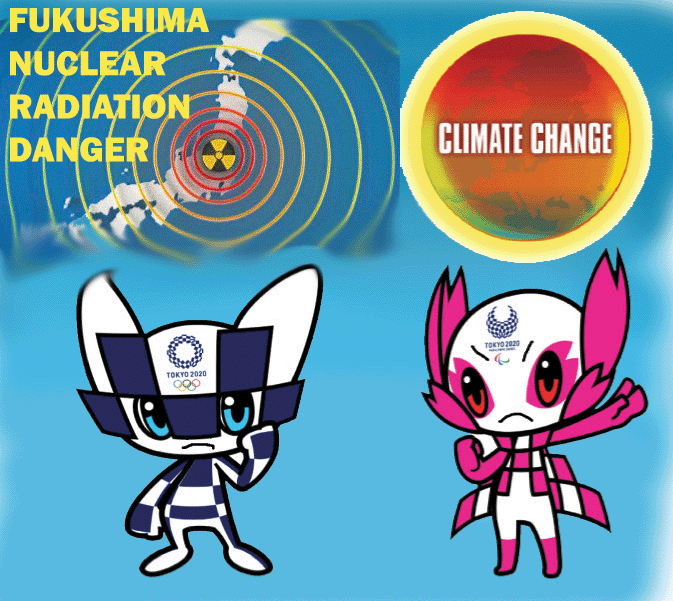
Ironically, Japan would appear to most thinking people to be a most unwise choice for the 2020 Olympics, because of the continuing dangerous situation at Fukushima.
But most people have missed the connection to the military-industrial-corporate-global-nuclear-complex.
It’s a large part of the reason WHY JAPAN WAS CHOSEN – TO PROVE TO THE WORLD THAT FUKUSHIMA DOESN’T MATTER – THAT THE NUCLEAR INDUSTRY IS JUST FINE!
Japan’s fatal heatwave – a climate change warning for 2020 Olympics
The 2020 Olympics will open in 2 years, and the heat is on, https://apnews.com/0a64bd6df7f349879fb5ff7c3b6cafd7 By JIM ARMSTRONG, 24 July 18 Since being awarded the games, which will be the largest ever with 33 sports and 339 events, Tokyo organizers have had to deal with a series of problems ranging from stadium and construction delays , natural disasters and a scandal involving the official logo.
Most of the obstacles have been cleared up, but a deadly heatwave gripping Japan has focused organizerson ways to keep fans and athletes cool when the Olympics begin on July 24, 2020.
Potential for scorching summer conditions has always concerned organizers, with temperatures in central Tokyo often exceeding 35 Celsius (95 Fahrenheit) in July and August, made more difficult because of high humidity.
This summer heatwave has resulted in more than 65 deaths and sent tens of thousands to hospitals. The temperature on Monday reached 41.1 Celsius (106 Fahrenheit), the highest ever recorded in Japan.
Experts have warned the risk of heatstroke in Tokyo has escalated in recent years, while noting the Olympics are expected to take place in conditions when sports activities should normally be halted.
“We are mindful that we do have to prepare for extreme heat,” John Coates, head of the IOC’s coordination commission for the Tokyo Games, told a recent news conference.
The 1964 Games in Tokyo were held in October to avoid the harshest of the heat. That was before the Olympics schedule was influenced by rights-paying broadcasters and sponsors.
Local organizers are doing what they can to help athletes combat the conditions. The marathon and some other outside events will be held early in the morning to avoid extreme heat.
The federal and the Tokyo metropolitan governments are also planning to lay pavements that emit less surface heat and plant taller roadside trees for shade.
“The spectators as well as the athletes have to be taken care of,” Coates said. “The timing of the marathon and road walks will be as early as possible as they have been in previous games to beat the heat.”
Organizers want the games to help showcase Japan’s recovery from the 2011 earthquake and tsunami that took more than 18,000 lives and triggered meltdowns at the Fukushima nuclear power plant.
While reconstruction from the disaster is making steady progress, and work on the new 68,000-seat main stadium in Tokyo is 40 percent complete, more than 70,000 people remain displaced from their communities.
The construction of the main stadium was more than a year behind schedule when it started in December 2016, as earlier plans were scrapped because of spiraling costs and a contentious design.
The Japanese government approved the new 150 billion yen ($1.5 billion) stadium, which is expected to be completed in November of 2019. The previous construction timeline would have allowed the main stadium to host the 2019 Rugby World Cup final on Nov. 2 as a test event, but that idea was scrapped.
Meanwhile, organizers say the other newly-constructed venues are 20 to 40 percent complete.
The torch relay will start March 26, 2020, in Fukushima, an area hit hard by the disaster.
Coates said local organizers are on track with 24 months to go.
“Tokyo 2020 comes a significant step closer to delivering an Olympic Games that will bring Japan and the world together,” he said. “The organizing committee has presented considerable progress … especially as it related to venue and operational readiness.”
Climate change: Greece’s apocalyptic wildfires
Death toll rises from ‘apocalyptic’ Greek fires as blaze ravages resorts, The Sun, News Corp Australia Network, July 25, 2018 AT least 74 people have been killed, 1000 homes have been destroyed and more than 150 victims are injured after two devastating fires ravaged holiday resorts in Greece.
Rolls Royce likely to shut down Small Modular Nuclear Reactor project
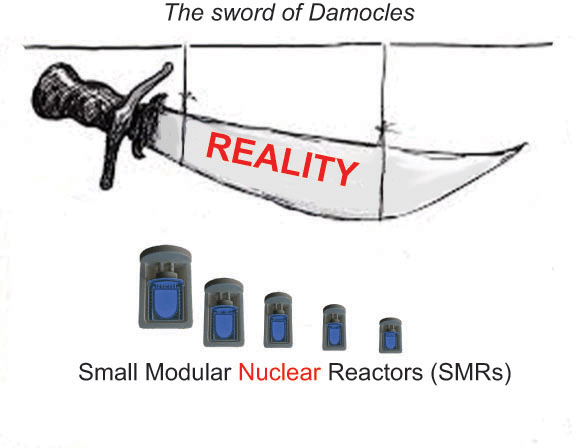 Nucnet 23rd July 2018 , Rolls-Royce is preparing to shut down its project to develop small modularnuclear reactors if the government does not make a long-term commitment to the technology, including financial support, in the coming months, the Financial Times reported. According to the UK-based newspaper, the UK aero-engine maker has scaled back investment significantly, from several millions to simply paying for “a handful of salaries”. Warren East, Rolls-Royce chief executive, told the Financial Times:
However, David Orr, executive vice-president of Rolls-Royce’s SMR programme, said that without comfort from the government on two fronts the project “will not fly. We are coming to crunch time.”
Rolls-Royce is one of several consortia to have bid in a government-sponsored competition launched in 2015 to find the most viable technology for a new generation of SMRs. https://www.nucnet.org/all-the-news/2018/07/23/rolls-royce-planning-to-shut-down-smr-project-without-government-support
USA City Council opposes “temporary” nuclear waste dump, and transport of wastes
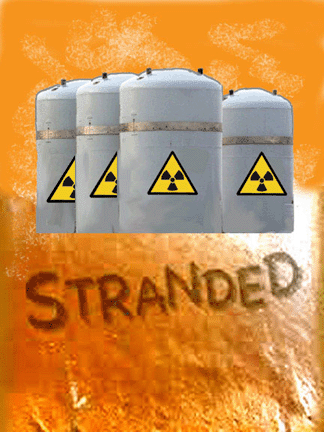
 Las Cruces City Council approves resolution opposing nuclear storage facility https://www.lcsun-news.com/story/news/2018/07/24/las-cruces-city-council-approves-resolution-opposing-nuclear-storage-facility-southeastern-new-mexic/830724002/
Climate change brings wildfires to the Arctic circle
Wildfires have ignited inside the Arctic Circle https://www.vox.com/2018/7/24/17607722/wildfires-sweden-greece-europe-arctic-circle-heat-wave In Sweden and Latvia, and further south in Greece, wildfires are spreading amid a brutal heat wave. By
USA government closed down the research into effects of ionising radiation inpregnancy
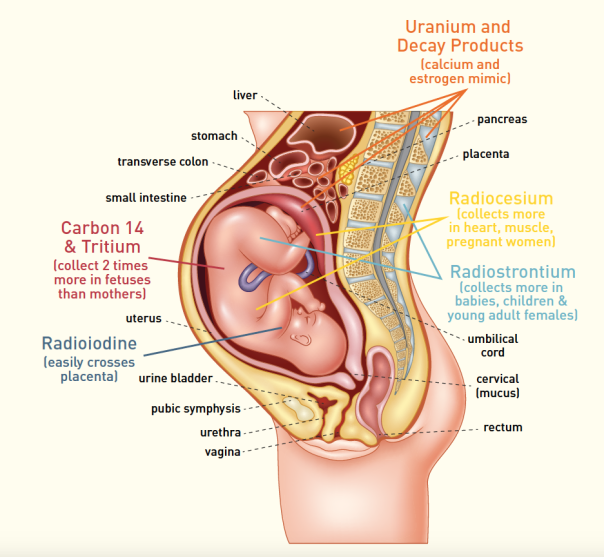
| Does living near a nuclear plant give children cancer? https://beyondnuclearinternational.org/2018/07/23/does-living-near-a-nuclear-plant-give-children-cancer/by beyondnuclearinternational |
US cancer study that would have told us was killed by NRC, By Cindy Folkers
More than 60 studies have shown increases of childhood leukemia around nuclear facilities worldwide. Despite this finding, there has never been independent analysis in the US examining connections between childhood cancer and nuclear facilities. The US Nuclear Regulatory Commission (NRC) had tasked the National Academy of Sciences (NAS) to conduct such a study, but then withdrew funding, claiming publicly that it would be too expensive. Continue reading
Farmers and ranchers across the State of New Mexico rallying against “temporary” nuclear waste dump
 Opposition rallies ahead of public hearing on Holtec site
Nuclear wastes: Hardened On-Site Storage (HOSS) safer than transporting wastes to “temporary” storage
 (Transport dangers) Any mainline rail can be used. The condition of the rails in the U.S. is not good. Think of recent train derailments – as NIRS has often asked, “What if nuclear waste had been aboard?” The irradiated nuclear fuel casks aboard trains bound for Holtec/ELEA, NM, combined with the rail cars, would weigh around 180 tons. These would be among the heaviest loads on the rails, and would risk further damaging them.
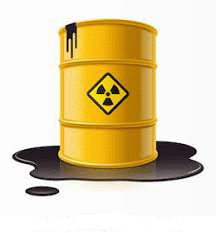 (Waste container contamination) sometimes the exterior of shipping casks are contaminated, sometimes severely so. Above, 49 such incidents of external contamination were documented in the U.S. from 1949-1996. As revealed by Mycle Schneider of WISE-Paris in the mid- to late 1990s, Areva (now called Orano in the U.S., as at the WCS, TX CISF) experienced a very large number of externally contaminated HLRW shipments.
Decommissioning Nuclear Power Plants: What Congress, Federal Agencies and Communites Need to Know Highly Radioactive Irradiated Nuclear Fuel: Need for Hardened On-Site Storage; Risks of Off-Site Transport Kevin Kamps, Radioactive Waste Specialist, Beyond Nuclear , July 16, 2018 https://static1.1.sqspcdn.com/static/f/356082/27949948/1532014874603/7+16+18+Capitol+Hill+Decommissioning+and+HLRW+congressional+briefing+EESI+with+further+note+slides+added.pdf?token=p2q8spOdyd5eCfAnSiIAvb%2FMi2g%3D
‘Nukey Poo’ the Antarctic nuclear reactor was cleaned up properly, thanks to the Antarctic Treaty
Remembering Antarctica’s nuclear past with ‘Nukey Poo’ https://theconversation.com/remembering-antarcticas-nuclear-past-with-nukey-poo-99934 PhD Candidate in Antarctic Representations, University of Tasmania July 23, 2018
We think of Antarctica as a place to protect. It’s “pristine”, “remote” and “untouched”. (Although a recent discovery reveals it’s less isolated from the world than previously thought.)
But it wasn’t always this way. Between 1961 and 1972 McMurdo Station was home to Antarctica’s first and only portable nuclear reactor, known as PM-3A, or “Nukey Poo.” The little-known story of Nukey Poo offers a useful lens through which to examine two ways of valuing the far south: as a place to develop, or a place to protect.
The story of Nukey Poo
By the late 1950s nuclear power was viewed with optimism, as an exciting new solution to both the world’s energy and social problems. The Antarctic Treaty was signed in 1959, designating Antarctica as a place for international scientific cooperation. Both the USA and USSR were original signatories, and both were concerned about the possible use of nuclear weapons in the far south.
The Antarctic Treaty therefore included freedom of inspection of all facilities, and stipulated “any nuclear explosions in Antarctica and the disposal there of radioactive waste material shall be prohibited”.
When Nukey Poo was built by the US Navy it was described by Admiral George Dufek as “a dramatic new era in man’s conquest of the remotest continent.”
While the early explorers set out with flags, pitting their bodies against the elements to claim new territory, nuclear technology represented a modern way for man to triumph over the hostile environment. PM-3A was seen as a trailblazer, and – if all went well – it was planned to be first of many installed in Antarctica.
Dufek also envisaged nuclear energy making possible a wide range of human activities in the far south. His imagined version of “Antarctica in the Year 2000” included nuclear-driven greenhouse crop production, geoengineering of the world’s weather, and mining ventures that helped broker world peace.
While geoengineering in the forms of slowing the melt of glacial ice, solar geoengineering, and marine geoengineering continue to be discussed, mining is prohibited by the 1991 Protocol on Environmental Protection to the Antarctic Treaty. Contemporary visions of Antarctic futures tend to focus on environmental change and reducing human impacts, rather than enhancing the human presence.
Nuclear optimism fades
“Nukey Poo” began producing power for the McMurdo station in 1962, and was refuelled for the first time in 1964. A decade later, the optimism around the plant had faded. The 25-man team required to run the plant was expensive, while concerns over possible chloride stress corrosion emerged after the discovery of wet insulation during a routine inspection. Both costs and environmental impacts conspired to close the plant in September 1972.
This precipitated a major clean up that saw 12,000 tonnes of contaminated rock removed and shipped back to the USA through nuclear-free New Zealand. The clean up pre-dated Antarctica’s modern environmental protection regime by two decades, and required the development of new standards for soil contamination levels.
This elaborate process ensured that the US did not violate the Antarctic Treaty by disposing of nuclear waste on the continent. It also foreshadowed a shift in environmental attitudes away from development and use, towards protection; the removal of so much as one pebble from the Antarctic without requisite permits is now prohibited.
Today, all that physically remains at the site of the PM-3A reactor is a missing hillside and a plaque. Nuclear power is no longer viewed with the optimism of the 1960s, thanks to disasters such as Chernobyl and Fukushima.
The site where Nukey Poo once stood has been designated as a Historic Site and Monument under the Antarctic Treaty System, putting it in the same category as the huts of early explorers such as Mawson and Shackleton.
However, a site with a past of nuclear contamination does not sit well within modern narratives of Antarctica as a place to protect, so this episode in the continent’s history is not often told.
When Admiral Dufek wrote in 1960 “Antarctica will be a fantastic land in the future” he had a very different vision in mind to the Antarctica we see today. Today, the far south is not a place to be improved upon with human innovation, so much as a place to be protected from our influence – including climate change.
The episode of Nukey Poo reveals the modern association between science and the Antarctic environment has not always been so. In demonstrating how Antarctica went from being seen as territory to conquer to a fragile environment, we are reminded that its protection cannot be taken for granted
1 This month
15 April – Zoom –Nuclear Power is Not the Solution
Apr 15, 2026 01:00 AM in Canberra, Melbourne, Sydney

Join the International Physicians for the Prevention of Nuclear War (IPPNW) on Tuesday, April 14th for a timely webinar exploring the risks associated with nuclear power and challenging the myth that it offers a simple, safe, carbon-free solution to the climate crisis

of the week – Australians for War Powers Reform (AWPR)
To see nuclear-related stories in greater depth and intensity
 Antinuclear