 Book review: The Case for Degrowth, Jeremy Williams, The Earthbound Report , 16 Nov 20, “…………. What are the objectives of degrowth? It’s not shrinking the economy for the sake of it. The aim is to get GDP growth out of the driving seat and then steer towards “what really matters: not GDP, but the health and wellbeing of our people and our planet.”
As things currently stand, the drive for growth constantly stands in the way of good ideas. We know that fossil fuels should be left in the ground to avoid dangerous climate change, but growth says dig them up and sell them. We know that rising house prices are driving a wedge between the rich and the poor and the old and the young, but economic growth says don’t you dare intervene. And if it’s not delivering for you, if you’re one of those young people priced out of decent housing, then there’s a solution for you: more growth. It will trickle down to you, apparently, if you’re hard working and eternally patient.
Or there’s the alternative, which is to stop taking growth as the primary measure of progress and get on with delivering what people need. So many political directions open up when GDP growth takes a back seat and we get on with delivering what people need more directly.
Naturally this is an option for developed countries, as Katherine Trebeck and I describe in our book
The Economics of Arrival. Growth has a purpose when it actually does lift people out of poverty, and when it is used to build the infrastructure and the institutions that a healthy society depends on. When it’s just feathering the nests of the already rich, and destroying the living world in the process, it’s time to move on to more qualitative forms of progress.
In fact, downsizing in the rich world may be a key enabler of flourishing elsewhere. “There is no technological or policy fix that can generalize to nine billion people the material standard of living currently enjoyed by a minority at high cost to others.” Instead, “high-consumption nations and people must degrow to free space for low-consumption ones.”
The Case for Degrowth explores these issues in concise terms, and presents five ‘path-breaking’ policies that would forge a new direction:
- A Green New Deal
- universal incomes and services
- policies to reclaim the commons
- shorter working hours
- public finance that supports the first four
Being a short book, it no doubt opens up lots of other questions that the authors don’t cover, though the frequently asked questions at the end captures many of them. Perhaps the one that still sticks out for me is the word ‘degrowth’ itself. In my opinion it doesn’t capture the positivity of a vision for qualitative progress, for improvement rather than enlargement. I know it’s an old debate. We had it when founding the Postgrowth Institute ten years ago, and it doesn’t feel resolved today.
Still, The Case for Degrowth is a brief and straightforward explainer, and a good starting point for anyone who wants to get their head around the degrowth movement and what it wants to acheive.
November 17, 2020
Posted by Christina Macpherson |
General News |
Leave a comment
Questions Remain About ID Nuclear Reactor Project https://www.upr.org/post/questions-remain-about-id-nuclear-reactor-project
By NORTHERN ROCKIES NEWS SERVICE 16 Nov 20, • Questions are being raised about the future of NuScale Power’s Idaho project to bring nuclear energy to cities in the Mountain West.
NuScale‘s small, modular reactor design is the first of its kind to be approved in the United States. The new, compact concept is made up of 12 small reactors and will be located at the Idaho National Laboratory.
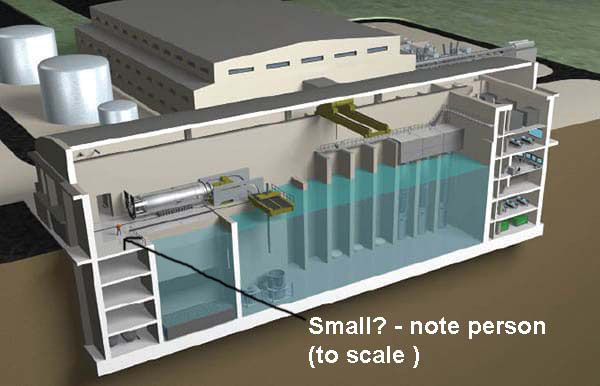
Sarah Fields, program director with the group Uranium Watch, said the Nuclear Regulatory Commission needs to scrutinize the project carefully. In particular, she said she’s concerned about a proposal for fewer people to oversee the project.
“They want to reduce the number of operators, and that’s just to save money,” said Fields. “And the NRC is undergoing a review of that.”.
NuScale said the project needs fewer operators because of its design is simpler and the controls involve more automation. The NRC is reviewing the proposal, which could involve policy changes since the approval process is based on conventional nuclear power plant designs.
The NRC has approved the Design Certification Application for the project in its current form. But Fields said the agency still has to authorize certain aspects of the design.
One NRC engineer has raised questions about dilution of boron water around reactor cores, which could cause a dangerous power surge even if the reactor is shut down. Fields said it could be hard to make modifications once aspects of the design are approved.
“It’s like designing a house,” said Fields. “And once you want to change one thing about the house, then you have to make all different kinds of adjustments. And then, get approvals from that.”
November 17, 2020
Posted by Christina Macpherson |
General News |
Leave a comment

Telegraph 14th Nov 2020 ”………Rolls-Royce, via a relentless lobbying campaign over the past  few years, seems to have convinced the Government that its “mini-nukes” project is a runner. It claims billions are needed from taxpayers to underpin investment in a new production line that will reduce the costs and risks compared with bespoke new reactors such as the £22bn monster at Hinkley Point C.
There are plenty of reasons to be sceptical that even with its nuclear submarine experience, Rolls and its partners can pull it off. The technology is unproven anywhere and – as anti-nuclear campaigners argue – more reactors inevitably mean more potential points of failure. Nuclear power has a poor record of delivering its budgets too…….”
November 16, 2020
Posted by Christina Macpherson |
General News |
Leave a comment
Leading experts opt for 100 per cent renewables and reject nuclear power https://100percentrenewableuk.org/leading-experts-opt-for-100-per-cent-renewables-and-reject-nuclear-power
The undersigned believe that a future based on 100 per cent renewable energy underpinned by traditional and advanced energy efficiency and storage techniques is not only practicable, affordable, but immensely preferable to one that involves nuclear power. Renewable energy offers us a rapid path to net zero carbon transition that, unlike nuclear power, does not involve the need for decommissioning of radioactive plant, nuclear waste or concerns about safety or security threats. With this in mind we regard the prospect of the Government effectively offering unlimited sources of funding to EDF to build Sizewell C nuclear power plant with dismay and urge people to send in their objections to their MPs at this prospect.
- Dr David Toke, Director, 100percentrenewableuk,
also Reader in Energy Politics, University of Aberdeen.
Founder, Director and Trustee, Forum for the Future
Co-Director of the Prince of Wales’s Business & Sustainability Programme
November 16, 2020
Posted by Christina Macpherson |
General News |
Leave a comment
 the Biden-Harris agenda lists small modular reactors under its “game-
 changing technologies.” In a way, that’s correct. Diverting money into small modular reactors will be game-changing. It will put us firmly on the road to climate failure.
The good news is that nuclear power does not play much of a role in the Biden-Harris plan. But the bad news is that, when it comes to nuclear power, the Biden camp has indeed chosen fiction over science.
In Promoting New Nuclear Power, Biden-Harris Back Fiction Over Science, https://www.counterpunch.org/2020/11/13/in-promoting-new-nuclear-power-biden-harris-back-fiction-over-science/ BY LINDA PENTZ GUNTER Although possibly a sad comment on his predecessors, incoming U.S. president, Joe Biden, is offering the most progressive climate policy so far of any who have previously held his position.
As Paul Gipe points out in his recent blog, the Biden-Harris climate plan uses the word “revolution” right in the headline — a bit of a departure from the usual cautious rhetoric of the centrist-controlled Democratic Party.
But ‘revolution’ is proceeded by two words which let us know we are still lingering in conservative ‘safe’ territory. They call it a “clean energy revolution”, which Gipe rightly refers to as “focus-group shopped terminology.” He goes on Continue reading →
November 13, 2020
Posted by Christina Macpherson |
General News |
Leave a comment
NHK World Correspondent, Yoshida Mayu, NHK World Correspondent, 13 Nov 20,
Today is a big, memorable day for us.”
Hiroshima atomic bomb survivor Abe Shizuko was reacting to the October 24 ratification of the United Nations Treaty on the Prohibition of Nuclear Weapons. The accord will take effect in January – although none of the world’s nuclear powers are members.
Nevertheless, hibakusha, which is what the atomic bomb survivors are called in Japan, see the treaty as a victory for their cause. “I take pride in the fact that the decision is a result of the united little voices of individual hibakusha,” says 93-year-old Abe.

On August 6th, 1945, the United States dropped an atomic bomb for the first time in human history. Its target was Hiroshima, where 18-year-old Abe was helping to dismantle buildings to prevent the spread of fires caused by air raids during World War Two. Abe was working just 1.5 kilometers away from ground zero. She suffered severe burns on the right side of her body and face, and has been through 18 surgeries.

“The operations were very painful and difficult. There wasn’t enough anesthetic back in those days, so doctors could not give me supplemental relief even if I started feeling pain. I tolerated the pain through a strong hope to restore my body,” Abe recalls.
The bomb left keloid scars on her face and the right side of her body. In photographs from when she was younger, Abe always looks down, or shows only her left side.
A-bomb survivors call the 10-year period following the world’s first atomic bombing “the blank decade.” That is because people who were injured had little to no medical or financial support. At the same time, they were exposed to severe prejudice and discrimination.
Abe says she was once nicknamed “Red Ogre” because of her scars. “My wound did not heal. My body weakened. I was in poverty. Many people stared at me only just to satisfy their curiosity, because they wanted to know what a hibakusha looked like. They did not feel sympathy for me. They bullied me. The suffering that I went through, and the emotional wound, will never go away.”
In 1956, Abe joined other atomic bomb survivors to form a delegation. They traveled to Tokyo to appeal to the then prime minister and government officials to offer relief for victims, and support their call for the abolition of nuclear weapons. Those efforts led to the establishment of the Japan Confederation of A- and H-Bomb Sufferers Organization.
As the Cold War progressed, the hibakusha became disheartened. Even though they were speaking out about the need to eliminate nuclear weapons, the world was not listening. Nuclear experiments were being carried out repeatedly, and the arms race took off.
“It was really a difficult time for our campaign,” Abe remembers. “We felt as if we were yelling out while trying to survive in rough waves on a dark night.”
Abe carried a grudge against the US, but started to feel a change of heart almost 20 years after the bombing. In 1964, she went to the US and Europe for what was known as the Peace Pilgrimage. It was an opportunity for A-bomb survivors to speak about their personal experiences in front of audiences. Abe stayed at a private home with local hosts in the US, and she was deeply touched by their tender-heartedness.
“They listened attentively to my stories and said to me, ‘It must have been very hard for you. You’ve been through a lot. We’re so sorry for you,'” Abe recalls. “I realized we should never let anyone fall victim to nuclear weapons, regardless of what nationality you are. Americans or anybody.”
The voices of the hibakusha spread to all corners of the world, slowly but steadily.
These days, the average age of hibakusha is more than 83 years old, and there are fewer chances to hear their direct accounts. Some of them, like Taniguchi Sumiteru, played a direct role in the recent ratification of the UN treaty that bans nuclear weapons.
Taniguchi died three years ago, but he put the wheels in motion with a campaign that collected signatures to demand an international convention to ban nuclear weapons. He worked on that until the last moment of his life.
Taniguchi was 16 when he was exposed to the second atomic bomb that the US dropped on Japan. He was working as a postman in Nagasaki. A picture that shows the red burned flesh on his back shocked the world.
He delivered an impassioned speech at the 2010 Nuclear Non-Proliferation Treaty Review Conference at the UN’s New York headquarters: “Please don’t turn your eyes away from me. Please look at me again. I have survived miraculously, but for me, to ‘live’ was to ‘endure the agony’. Bearing the cursed scars of the atomic bomb all over our bodies, we the hibakusha continue to live in pain.”
“For humans to live as humans, not even one nuclear weapon should be allowed to exist on earth. I cannot die in peace until I witness the last nuclear warhead eliminated from this world,” said Taniguchi.
Hibakusha and their supporters gathered at Nagasaki Peace Park shortly after last month’s treaty ratification to share their joy. Among them was Okuma Yuka, a member of an activist group that calls itself “Hiroshima and Nagasaki Peace Messengers”.
Okuma took part in the signature-collecting campaign for the abolition of nuclear weapons after being deeply shocked by the image of a young Taniguchi in the aftermath of the atomic bombing. Her great-grandmother was a hibakusha but didn’t talk much about her experience. The photograph of Taniguchi brought it home to Okuma that suffering had occurred in her own family.

“I believe the Treaty on the Prohibition of Nuclear Weapons is definitely an important step forward,” Okuma says. “I expect that this will become a good opportunity for us to move toward a world that is completely free of nuclear weapons.”
November 13, 2020
Posted by Christina Macpherson |
General News |
Leave a comment

|
Mini-nuclear plants may be an experiment worth exploring, Guardian Nils Pratley 11 Nov 20, Roll-Royce gave an eye-catching pitch but the economics of nuclear power needs further inspection.An energy white paper is in the offing, so consider Rolls-Royce’s pitch for the wonders of small modular reactors (SMRs) a piece of last-minute lobbying. After all, it is clear already that more nuclear, in combination with more offshore wind capacity, is likely to be judged a central way to meet the UK’s targets for cutting carbon emissions.
It’s an eye-catching pitch…
What’s not to like? The clue is in that word “feasibility”. The consortium hasn’t actually built an SMR yet, so claims about lower costs per megawatt hour versus EDF’s at Hinkley are yet to be tested on the ground.
The first few stations would arrive at £2.2bn-£2.5bn, says the consortium, with the price dropping to £1.8bn after the first five. Yes, one can see how costs would fall: automated production lines, with the pieces transported for assembly on site, should yield efficiencies over time.
On the other hand, we also know that nuclear projects never arrive on budget (as EDF could attest). And a key point about mini-nuclear plants, say sceptics, is that they have to be built near to where the energy is used in order to reduce transmission losses. Since a nuclear reactor is few people’s idea of a local community asset, there’s a planning issue…….
The immediate question for government is whether to give a green light for the next stage of development. That would mean legislative support, making sites available and coughing up roughly £2bn of public money. …… https://www.theguardian.com/business/nils-pratley-on-finance/2020/nov/11/mini-nuclear-plants-experiment-economics
|
|
November 12, 2020
Posted by Christina Macpherson |
General News |
Leave a comment

|
Greens call on federal government to abandon nuclear and invest in renewables, November 10, 2020, OTTAWA – Following the recent announcement that the federal government will invest $20 million dollars in Ontario-based Terrestrial Energy to develop its Integral Molten Salt Reactor (IMSR), Green Party MPs have written to Natural Resources Minister Seamus O’Regan and Innovation, Science and Industry Minister Navdeep Bains calling on them to reconsider investments in new and unproven nuclear technology.
Obviously Canada must rapidly reduce its greenhouse gas emissions (GHGs) as required by the Intergovernmental Panel on Climate Change (IPCC),” said Green parliamentary leader Elizabeth May (MP, Saanich Gulf-Islands). “However, choosing to invest in non-commercialized, novel and unproven nuclear technology is fiscally irresponsible and doesn’t move us towards sustainability. It takes us down the wrong path. Small nuclear reactors (SMRs) have no place in any plan to mitigate climate change when cleaner and cheaper alternatives exist.”
A recent Canadian study found that energy from SMRs would cost up to 10 times more than renewable energy. Greens are urging the federal government to assess all energy investments on the same set of metrics based on three key questions:
- For every dollar invested, how many tonnes of GHGs are avoided;
- For every dollar invested, how many jobs are created;
- What is the effective timeline from initial funding to achieving results?
“Using these metrics, nuclear will always finish at the bottom of any hierarchy of energy investments,” said Ms. May. “The winners, every time, will be investments in retrofitting buildings for energy efficiency and investments in renewable energy.”
The 2020 World Nuclear Industry Status Report states that the development of nuclear energy is too slow to address the climate crisis. Nuclear power creates fewer jobs than renewable energy, such as solar, wind, district energy, and geothermal.
“What we need is to be honest with ourselves about the realities of nuclear,” said Jenica Atwin, (MP, Fredericton). “This government continues to parrot industry talking points when what our history and experience with nuclear has shown is that it’s not clean, it’s not cheap and we don’t have the time to waste on this dangerous distraction.”
** Letter to Ministers attached rosie.emery@greenparty.ca
|
|
November 12, 2020
Posted by Christina Macpherson |
General News |
Leave a comment
 NJ Ratepayers Unite to Stop More Nuclear Corporation Bailouts, Energy Monopolies https://www.insidernj.com/press-release/nj-ratepayers-unite-stop-nuclear-corporation-bailouts-energy-monopolies/ November 9, 2020,
Diverse energy users and consumer advocate groups create NJ Ratepayers United
Trenton, N.J. –– As a $300 million annual nuclear subsidy continues to burden New Jersey consumers, a coalition has formed to oppose another proposed major energy policy initiative from PSEG and Exelon that would enable the companies to transform the state’s electricity capacity market and obtain windfall profits.
NJ Ratepayers United (NJRU) is a diverse coalition of New Jersey consumers, business groups, consumer advocates, grassroots organizations and energy providers that have joined forces to stop the proposed Fixed Resource Requirement (FRR). This proposed overhaul would transform how the state procures power, eliminating ratepayer protections and empowering select companies to leverage their market power to further increase electricity costs. Continue reading →
|
|
|
|
|
November 10, 2020
Posted by Christina Macpherson |
General News |
Leave a comment

The nuclear lobby is quite happy with the Biden -Harris win. More on this later, as I try to delve  deeper into a possibly cosy relationship between Kamala Harris and the global nuclear lobby.
Meanwhile, the Atlantic Council writes confidently of the nuclear industry’s plans for future development under the new American administration.
The Atlantic Council, 8 Nov 20, legislation that encourages the rapid deployment of nuclear energy technology represents an area where Democrats and Republicans can continue to work together—as they have over the last four years …….
legislation that encourages the rapid deployment of nuclear energy technology represents an area where Democrats and Republicans can continue to work together—as they have over the last four years……..
Strong bipartisan congressional support for nuclear reactors—both the existing fleet and also the next generation of advanced reactors.
November 9, 2020
Posted by Christina Macpherson |
General News |
Leave a comment
 Joe Biden and Kamala Harris cinch win, Climate Group responds, Mirage News 8 Nov 20,
 The Climate Group congratulates Joe Biden and Kamala Harris on their historic victory, as announced by the New York Times, Associated Press, and BBC.President-elect Biden’s climate and clean energy plan is the most ambitious we’ve seen from a major US presidential nominee. Under his administration and leadership, we are optimistic about the future of US climate action and the opportunity for renewed global collaboration to address the climate crisis.
Amy Davidsen, Executive Director at the Climate Group, said: “Concern for the climate played a major role in the 2020 presidential debates. President-elect Biden’s win shows that Americans expect their president to follow climate science and take the bold and necessary actions to get the US back on track as a leader….. https://www.miragenews.com/joe-biden-and-kamala-harris-cinch-win-climate-group-responds/
November 9, 2020
Posted by Christina Macpherson |
General News |
Leave a comment

A secret military agenda. UK defence policy is driving energy policy – with the public kept in the dark, Beyond Nuclear
By David Thorpe, 8 Nov 20,The UK government has for 15 years persistently backed the need for new nuclear power. Given its many problems, most informed observers can’t understand why. The answer lies in its commitment to being a nuclear military force. Here’s how, and why, anyone opposing nuclear power also needs to oppose its military use.
“All of Britain’s household energy needs supplied by offshore wind by 2030,” proclaimed Prime Minister Boris Johnson at a recent online Conservative Party conference. This means 40 per cent of total UK electricity. Johnson did not say how, but it is likely, if it happens, to be by capacity auctions, as it has been in the recent past.
But this may have been a deliberate distraction: there were two further announcements on energy – both about nuclear power.
16 so-called “small nuclear reactors”
Downing Street told the Financial Times, which it faithfully reported, that it was “considering” £2 billion of taxpayers’ money to support “small nuclear reactors” – up to 16 of them “to help UK meet carbon emissions targets”.
It claimed the first SMR is expected to cost £2.2 billion and be online by 2029.
The government could also commission the first mini power station, giving confidence to suppliers and investors. Any final decision will be subject to the Treasury’s multiyear spending review, due later this year.
The consortium that would build it includes Rolls Royce and the National Nuclear Laboratory.
Support for this SMR technology is expected to form part of Boris Johnson’s “10-point plan for a green industrial revolution” and new Energy White Paper, which are scheduled for release later in the autumn.
Johnson will probably also frame it as his response to the English citizens assembly recommendations– a version of the one demanded by Extinction Rebellion in 2019 – which reported its conclusions last month.
While the new energy plan will also include carbon capture and storage, and using hydrogen as vehicle fuel, it’s the small modular reactors that are eye-popping.
They would be manufactured on production lines in central plants and transported to sites for assembly. Each would operate for up to 60 years, “providing 440MW of electricity per year — enough to power a city the size of Leeds”, Downing Street said, and the Financial Times copied.
The SMR design is alleged to be ready by April next year. The business and energy department has already pledged £18 million (US $23.48 million) towards the consortium’s early-stage plans.
They are not small
The first thing to know about these beasts is that they are not small. 440MW? The plant at Wylfa (Anglesey, north Wales) was 460MW (it’s closed now). 440MW is bigger than all the Magnox type reactors except Wylfa and comparable to an Advanced Gas-cooled Reactor.
Where will they be built? In the town of Derby – the home of Rolls Royce – where, as nuclear consultant Dr. David Lowry points out, the government is already using the budget of the Housing and Communities Department to finance the construction of a new advanced manufacturing centre site.
When asked why this site was not being financed by the business and energy department (BEIS), as you’d expect, a spokesperson responded that it was part of “levelling up regeneration money”.
Or perhaps BEIS did not want its budget used in such a way. Throwing money at such a “risky prospect” betrays “an irrationally cavalier attitude” according to Andrew Stirling, Professor of Science & Technology Policy at the University of Sussex Business School, because an “implausibly short time” is being allowed to produce an untested reactor design.
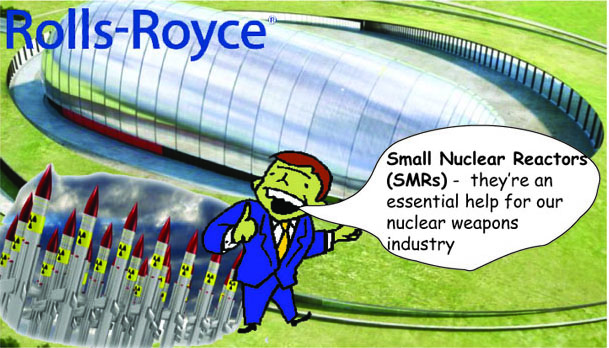
Only if military needs are driving this decision is it explicable, Stirling says. “Even in a worst case scenario, where this massive Rolls Royce production line and supply chain investment is badly delayed (or even a complete failure) with respect to civil reactor production, what will nonetheless have been gained is a tooled-up facility and a national skills infrastructure for producing perhaps two further generations of submarine propulsion reactors, right into the second half of the century.
“And the costs of this will have been borne not by the defence budget, but by consumers and citizens.”
Yes, military needs
UK defence policy is fully committed to military nuclear. The roots of civil nuclear power lay in the Cold War push to develop nuclear weapons. Thus has it ever been since the British public was told nuclear electricity would be “too cheap to meter”.
The legacy of empire and thrust for continued perceived world status are at the core of a post-Brexit mentality. It’s inconceivable to the English political elite that this status could exist without Great Britain being in the nuclear nations club, brandishing the totem of a nuclear deterrent.
“The civil-military link is undisputable and should be openly discussed,” agrees Dr Paul Dorfman at the Energy Institute, University College London.
Andrew Stirling talks of the “tragic relative popularity of (increasingly obsolescent) nuclear weapons”. The coincidental fact that civil nuclear installations are also crumbling provides a serendipitous opportunity for some.
The stores of plutonium in the UK are already overflowing and the military has its own dedicated uranium enrichment logistics.
Any nation’s defence budget in this day and age cannot afford a new generation of nuclear weapons. So it needs to pass the costs onto the energy sector.
“Clearly, the military need to maintain both reactor construction and operation skills and access to fissile materials will remain. I can well see the temptation for Defence Ministers to try to transfer this cost to civilian budgets,” observes Tom Burke, Chairman of think tank E3G.
The threat of nuclear proliferation
The threat of nuclear proliferation is therefore linked to the spread of civil nuclear power worldwide, says Dr David Toke, Reader in Energy Politics, Department of Politics and International Relations at the University of Aberdeen. David Lowry agrees: “India, Pakistan and above all Israel are obvious examples, each of which certainly has built nuclear weapons.”
It’s impossible to separate the tasks of challenging civil nuclear power without also challenging military nuclear interests, Stirling strongly believes. “The massive expense of increasingly ineffective military nuclear systems extend beyond the declared huge budgets. They are also propped up by large hidden subsidies from consumer and taxpayer payments for costly nuclear power.
“Huge hidden military interests will likely continue to keep the civil nuclear monster growing new arms. Until critics reach out and engage the entire thing, we’ll never prevail in either struggle.”
How new plants would be paid for still remains a question. Nuclear power is prohibitively expensive. https://wordpress.com/read/feeds/72759838/posts/3011373103
November 9, 2020
Posted by Christina Macpherson |
General News |
Leave a comment
 A secret military agenda. UK defence policy is driving energy policy – with the public kept in the dark, Beyond Nuclear, By David Thorpe, 8 Nov 20 , ”…………The PR battle for nuclear
There is a PR battle in the UK media for new nuclear – and now there are two sides to it.
Editors seem to favour giving pro-nuclear writers a clear ride and rarely question their baseless claims that nuclear is zero carbon. This is misguided and not based on empirical data, says Dr Lowry.
If the carbon footprint of the full uranium life cycle is considered – from uranium mining, milling, enrichment (which is highly energy intensive), fuel fabrication, irradiation, radioactive waste conditioning, storage, packaging to final disposal – nuclear power’s CO2 emissions are between 10 to 18 times greater than those from renewable energy technologies, according to a recent study by Mark Jacobson, professor of civil and environmental engineering at Stanford University, California.
Another recent peer-reviewed article in Nature Energy shows that nations installing nuclear power don’t have lower carbon emissions, but those installing lots of renewables do. Moreover, investment in new nuclear “crowds out” investment in renewables.
Renewables therefore offer a more rapid and cost-effective means to address net zero targets. The opportunity cost of nuclear is severely negative. The 2019 version of the World Nuclear Industry Status Report comprehensively demolishes any evidence-based arguments on the utility of nuclear to help address climate change.
But that’s not the real argument. It’s military. At the very least, we deserve to be told. https://wordpress.com/read/feeds/72759838/posts/3011373103
David Thorpe is author of books such as Solar Technology and One Planet Cities. He also runs online courses such as Post-Graduate Certificate in One Planet Governance. He is based in the UK. https://wordpress.com/read/feeds/72759838/posts/3011373103
November 9, 2020
Posted by Christina Macpherson |
General News |
Leave a comment







 Antinuclear