Four North county graduates from St Louis who lived near the nuclear waste dump that neighbours Cold-water Creek, started documenting how many of their peers were suffering serious illnesses after two friends were diagnosed with a “one in a million” rare cancer within months of each other. Their research first showed 30 cases, but two months later data they compiled showed 200 cases, then that grew to be 700 cases in a area of 7 square kilometers, some illnesses were,
62 Brain cancers.
27 Leukemia.
26 Lung cancers.
24 Multiple Sclerosis.
15 Lymphoma.
10 Pancreatic cancers.
3 Conjoined twins.
There have also been reports of the children of these peers less than 10 years of age having their thyroids removed.
A professor of statistics at North Western University has crunched the numbers and reported the likely-hood of this number of people having cancers, many which are rare in a clean environment this size is .00000001% which has been said to be a statistical improbability. Will Hawker, Kimba and its neighbouring communities suffer from nuclear waste health issues which can be heightened by the lack of funding outside of Australia’s only High Grade Nuclear waste dump at Lucas Heights, the same installation that has had ongoing accidents on site and off site with transportation of radioactive material. https://www.facebook.com/groups/344452605899556/
After repeated attempts to find a site to bury the UK’s nuclear waste, the last of which ended in 2013 when Cumbria County Council voted to halt the process, the Government are about to restart the search process. Ahead of this launch, the Department for Business, Energy and Industrial Strategy (BEIS) have released a consultation document, Working With Communities.Cumbria Trust has examined the proposal in detail and we have some very serious concerns about this consultation and its implications for areas which volunteer.
BEIS are proposing to open the search process to allow anyone to volunteer, even a member of the public, a farmer or a business. They can do this behind closed doors, with no requirement to make public their expression of interest during the first few months. A process being presented as ‘open and transparent’ appears to fall a long way short.
In stark contrast to the flexible approach by which areas can enter the process, if they later wish to withdraw, they are obliged to follow a much more complex and convoluted procedure in order to be allowed to leave.
However the most alarming aspect of the proposal is that the first and only test of public support does not happen until some 20 years after the process starts. During this time the community will have to endure a programme of borehole drilling and other intrusive investigations lasting a decade or more. The last time this borehole programme happened was in the 1990s with Nirex, and that led Jamie Reed, MP at the time and prominent nuclear advocate, to declare in 2006
“The experience of Nirex endured by my community in the mid-1990s was so wretched that I was minded to entitle this debate fear and loathing”.
He continued
“As long as I have anything to do with it Nirex will never dig another sod of turf in West Cumbria”.
What BEIS are proposing will again potentially expose a community to this experience, and with no mechanism for the public to halt the process. Instead any right of withdrawal rests with a defined Community Partnership. Without regular tests of public support, the Community Partnership appears not to be answerable to the public.
For all the talk of an ‘open and transparent’ process, what BEIS are actually proposing is nothing of the sort, and seems likely to create an early breakdown of public trust. Cumbria Trust has responded to the consultation and would urge our members to read this and consider making their own submissions. The deadline is 19th April and we hope to publish some guidance notes to assist with this within the next few days.
“Transporting nuclear waste is a risky business”. “It is disturbing to discover we are now using an extraairbase in heavily populated areas for a stop-off to transport nuclear waste”. “There is no truly safe way to move this nuclear waste from A to B”.
Top secret flights carrying NUCLEAR WASTE from Britain to US ‘to run until late next year’, Mirror UK, By JIM LAWSON 1 APR 2018
Four US Air Force flights carrying highly enriched uranium from Dounreay power station in the Scottish Highlands are said to have left Wick John O’Groats airport bound for South Carolina. Top secret fights taking nuclear waste between Britain and the US will reportedly continue until late next year.
Four US Air Force flights carrying highly enriched uranium from Dounreay power station in the Scottish Highlands are said to have left Wick John O’Groats airport bound for South Carolina.
Yet authorities have never confirmed any of the deliveries.
Dounreay, the Nuclear Decommissioning Authority, Police Scotland, the Civil Nuclear Constabulary and Wick Airport all refused to comment when asked.
Details of the flights apparently became public when Highland Council informed residents about road closures surrounding the airport – as it is legally obliged to do so. An order published last week was said to be code for “nuclear waste on the move”, suggesting the next consignment could be imminent.
The authority’s notice, published in two local newspapers, said: “The order has been made by reason that the council, as highway authority , is satisfied that traffic on the road should be restricted due to the likelihood of danger to the public.” It adds: “The purpose of the order is to enable abnormal load movements”.
The order will run from yesterday to September 30, 2019 with up to seven more flights expected during the period, it was reported.
A deal to transport highly enriched uranium – the basic building block for making a nuclear bomb – to be flown from Wick to the US was trumpeted by then Prime Minister David Cameron in 2016.
……..Highlands and Islands MSP John Finnie said: “Transporting nuclear waste is a risky business. By using two airports you are doubling the take-offs and landing in this country, which doubles the risk.
“It is disturbing to discover we are now using an extra airbase in heavily populated areas for a stop-off to transport nuclear waste”.
…….. Dr. Richard Dixon, director of Friends of the Earth, said flatly: “There is no truly safe way to move this nuclear waste from A to B”.
A spokesman for the Nuclear Decommissioning Authority said: “Our priority is to comply with the regulations governing the safety and security of nuclear material. Compliance with the regulations includes protecting information about the routes, times, dates and location”.
America’s first climate change refugees are preparing to leave an island that will disappear under the sea in the next few years, Business Insider David Usborne, The Independent, 1 Apr 18
In March, Louisiana state officials announced that everyone living on Isle de Jean Charles will have to leave.
Where there were 22,000 acres in 1955 there are only 320 acres today.
They are one hurricane away from obliteration.
The evacuation is a test-run for countless coastal communities in Louisiana, who must all move as the seas take over the land.
ISLE DE JEAN CHARLES, Louisiana — America comes to an end here. Connected to the marshes and moss-laced bayous of southern Louisiana by two miles of narrow causeway, waters lapping high on each side, Isle de Jean Charles takes you as far into the Gulf of Mexico as you can go without falling in. But the dolour in the salt air is not just about loneliness and separation. It’s about impending demise.
Don’t call it a death sentence – the intention is the opposite – but state officials in late March made the announcement that had been a long time coming. Some on the island, nearly all members of the Biloxi-Chitimacha-Choctaw Indian tribe, met it with relief; others with hostility.
Marking the kick-off of what will be the first climate resettlement of its kind in the entire United States, land had been chosen an hour’s drive to the north for a whole new town to be thrown up. No one will force them exactly, but the intention is clear: to evacuate those still living on the island to the new site, where at present nothing but sugar cane stands, before it is too late.
When that will be depends on whom you ask. But no one disputes that the island is sinking, thanks to a combination of subsidence and rising sea levels.
…… The vanishing of Isle de Jean Charles into the waves of the gulf might take another decade or even five. On the other hand, one more big storm could finally end its viability for human occupation for good, flooding homes beyond repair or cutting through the connecting road.
…….“It’s really a test run,” Mr Forbes, executive director of the Louisiana Office of Community Development, concedes in an interview from his Baton Rouge office. While Americans may have been displaced by environmental change before, notably in Alaska, no single community has been relocated lock, stock and barrel like this. “We are trying to keep the community intact and ensure that it’s economically and socially vibrant and viable. To our knowledge, it’s unique. There are places around the world who are looking at a similar type of thing but nobody in the US has done this.”Which makes residents on Isle de Jean Charles canaries in the mineshaft……..http://www.businessinsider.com/isle-de-jean-charles-climate-change-refugees-2018-4/?r=AU&IR=T
Should Nuclear Energy Be a U.S. National Security Concern?Inside Sources March 29, 2018 by Erin Mundahl Sixty years ago, nuclear power was the energy of the future, promising a nearly limitless supply of clean, cheaper power. That future has yet to arrive. In fact, today, utilities are increasingly transitioning out of nuclear generation, shuttering aging reactors and shelving plans to reinvest in new technology. This is more than just a shift from one fuel to another, says David Gattie, an associate professor of environmental engineering at the University of Georgia. The decline in interest in nuclear energy has significant impacts on America’s national security.
“Nuclear energy is a unique resource because of its unmatched energy density and dual-purpose utility for electric power generation and nuclear weaponry,” Gattie writes in a recently published paper………. Although American scientists began the atomic age, more recently, research and development in nuclear technology, including civilian nuclear, has decreased to a level that threatens American primacy and, by extension, national security….
he U.S. is running the risk of falling behind the rest of the world in terms of nuclear technology, rather than maintaining its position of global leader.
To combat this trend, Gattie advocates specific legislative action to provide fixed support for nuclear research and development. For the purposes of longevity, this would optimally be a legislative, rather than executive action. This space to resurrect research in technologies like molten salt and breeder reactors would signal that the U.S. is committed to the future of nuclear energy. http://www.insidesources.com/nuclear-energy-should-be-a-us-national-security-concern/
Beyond Nuclear 31st March 2018, President Trump has announced that he wants the National Aeronautics and Space Administration (NASA) to “lead an innovative space exploration
program to send American astronauts back to the moon, and eventually
Mars.” But the risks such ventures would entail have scarcely been
touched upon.
For those of us who watched Ron Howard’s nail-biter of a
motion picture, Apollo 13, and for others who remember the real-life drama
as it unfolded in April 1970, collective breaths were held that the
three-man crew would return safely to Earth. They did.
What hardly anyone remembers now — and certainly few knew at the time — was that the
greater catastrophe averted was not just the potential loss of three lives,
tragic though that would have been. There was a lethal cargo on board that,
if the craft had crashed or broken up, might have cost the lives of
thousands and affected generations to come. It is a piece of history so
rarely told that NASA has continued to take the same risk over and over
again, as well as before Apollo 13. And that risk is to send rockets into
space carrying the deadliest substance ever created by humans: plutonium. https://beyondnuclearinternational.org/2018/03/31/the-real-houston-problem/
Oil Price 30th March 2018,The decommissioning of the Fukushima nuclear power plant will cost an
annual US$2 billion (220 billion yen) until 2021, an unnamed source told
the Japan Times. Half of the money will be used to tackle the radioactive
water buildup at the site of the plant and for removing radioactive fuel
from the fuel pools. A small amount of funds will be used to research ways
of retreating melted fuel from the reactors that got damaged during the
2011 tsunami disaster.
The US$6 billion for the three years is only part of
the total estimated cost for taking Fukushima out of operation. The total
decommissioning tally came in at US$75 billion (8 trillion yen), as
estimated by the specially set up Nuclear Damage Compensation and
Decommissioning Facilitation Corp (NDF).
That’s four times more than the initial estimate of the costs around the NPP’s decommissioning. Now theoperator of Fukushima, Tepco, and the NDF are due to submit their financial
plan for the facility to the government for approval by the energy industry
minister. In addition to the US$6 billion allocated for the cleanup, Tepco
will spend another US$1.88 billion (200 billion yen) on preparing to start
extracting the melted fuel from the three damaged reactors. This seems to
be the biggest challenge for the cleanup efforts because of the still high
radiation levels as well as technical difficulties. https://oilprice.com/Latest-Energy-News/World-News/Total-Tally-For-Fukushima-Decommission-Is-75-Billion.html
More Nuclear Power Plant Shutdowns, Bailouts In The Works,WSKG, 1 Apr 18 ByReid FrazierSTATE IMPACT PENNSYLVANIA– Citing market challenges,” electric utility FirstEnergy says it will close three nuclear plants in Ohio and Pennsylvania, while at the same time asking the Department of Energy for immediate help to keep its fleet of coal and nuclear plants open.
The company, which could be near bankruptcy according to a report at cleveland.com, gave regional grid operator PJM interconnection notice that it will deactivate Beaver Valley Power Station and two other plants — Davis-Besse in Oak Harber, Ohio, and Perry Nuclear Power Plant in Perry, Ohio — by 2021.
……. Natural gas and renewable energy have been making up a larger amount of the country’s electric grid, eating into coal and nuclear power on wholesale markets. With that backdrop, FirstEnergy is also asking the Department of Energy to issue an immediate emergency order to PJM Interconnection, the grid operator for mid-Atlantic states, to provide “just and reasonable” compensation to its fleet of aging coal and nuclear power plants in order to keep them open.
“Nuclear and coal-fired generators in PJM have been closing at a rapid rate — putting PJM’s system resiliency at risk — and many more closures have been announced,” the company said, in a letter to Energy Secretary Rick Perry. “PJM has demonstrated little urgency to remedy this problem any time soon — so immediate action by the Secretary is needed to alleviate the present emergency.
…..The order would be similar to one that Perry’s own Department of Energy proposed last year, which would have made ratepayers pay more for energy produced at coal and nuclear plants. In January, the Federal Energy Regulatory Commission rejected the proposal.
Environmental groups were swift to label the plan a “bailout” for the coal industry.
“If Rick Perry and Trump Administration take the bait and actually issue this ill-advised and illegal emergency order, that means they’re happy to let energy bills and pollution skyrocket, just to bail out a handful of rich coal and nuclear executives,” said Mary Anne Hitt, Director of Sierra Club’s Beyond Coal campaign, in a statement.
The oil and gas industry was no less harsh in its criticism……..
In addition to looking for federal assistance, FirstEnergy is asking states for help, too.
SCIENCE It’s a long shot, but Chinese space station could fall to earth here , SMH, By Liam Mannix 30 March 2018
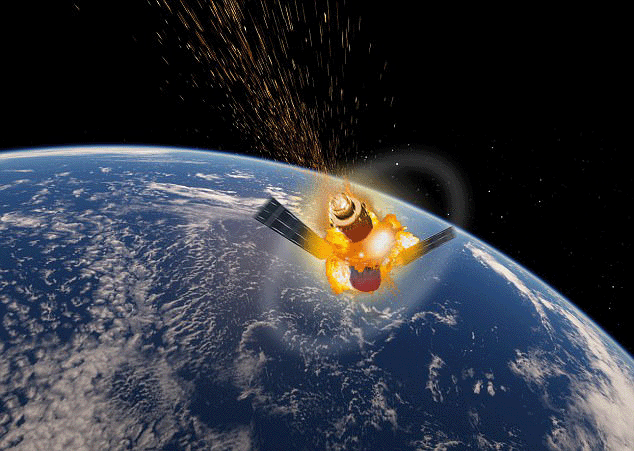
If you get killed by the Chinese space station that’s due to fall out of the sky this weekend you’ll probably be remembered as having had one of the most unlikely deaths on record. Your chances of being hit by Tiangong-1, China’s first space station, are about 10 million times smaller than your yearly chance of being struck by lightning.
But Melburnians would still be advised to watch the skies over the coming days, just in case, with much of Victoria inside a band where there’s a very slightly larger possibility of the debris hitting.
If you die, you would be the first known person ever to be killed by falling space debris. But maybe not the first animal; according to legend, when the remains of the American space station Skylab fell on outback Western Australia in 1979, it killed a rabbit.
“The chances of you being struck by this are essentially zero,” says Associate Professor Alan Duffy, an astronomer at Swinburne University “An individual human is a tiny target relative to the Earth which itself is mostly water and even the land is mostly of sparsely populated regions.”
The station is as big as a bus and weighs several tonnes. Its name means “heavenly palace” in Chinese, but the space station has more in common with Icarus than any castle in the clouds, and is set for a fiery demise.
Estimates vary – some scientists have organised competitions to see who can most accurately predict when the station will hit the atmosphere – but most place its descent to earth in a window between midnight Saturday and early morning Monday.
Precise predictions about when the satellite will re-enter the atmosphere are very hard to make, requiring scientists to factor in the density of the atmosphere as well as the space station’s speed, orientation and physical properties.
Indeed, Tiangong’s re-entry will probably first be spotted by people staring up at the sky – hopefully with camera-phones ready.
The odds are, the space station will burn up in the atmosphere, with what is left falling in the oceans.
……..Satellites are typically “de-orbited” – deliberately dumped out of orbit – over water so they don’t pose a risk to people. But in 2016 China announced it had lost control of Tiangong-1. Since then, the station has been slowly orbiting closer and closer to Earth.
When it reaches a height of about 70 kilometres above the surface, the atmosphere will start to melt the station. It could take up to 20 minutes for the whole station to decompose.
If the space station does de-orbit over Australian skies, get ready for a hell of a lightshow. Burning pieces of the station will likely stay visible for a minute or more, making for great viewing if the day is clear, says Markus Dolensky, technical director at the International Centre for Radio Astronomy Research.
Put together, the Kim-Moon meeting serves more as a prelude to the Trump-Kim summit. And if those talks fail, Harry Kazianis, an Asia security expert at the Center for the National Interest think tank, thinks the chances of war might increase.
“We are putting all of our eggs in the summit basket,” he told me. “This is the ultimate Hail Mary.”
The North Korea nuclear standoff: how we went from “fire and fury” to talks in under a yearVox, “North Korea has 100 percent changed its tactics.” By Alex Ward@AlexWardVoxalex.ward@vox.com
Last year, it seemed like war between the United States and North Korea was a real possibility.
“The United States has great strength and patience, but if it is forced to defend itself or its allies, we will have no choice but to totally destroy North Korea,” President Donald Trumpsaid at the United Nations on September 19, 2017. “Rocket Man is on a suicide mission for himself and for his regime,” he continued, using his favored nickname for North Korean leader Kim Jong Un.
Flash-forward to March 29, 2018, when Pyongyang and Seoul announced that Kim and South Korean President Moon Jae-in will meet face to face in April for talks. It’ll be only the third in-person meeting between the heads of both countries, and the first since 2007. But that’s not all: The Kim-Moon summit will lay the groundwork for an even more historic meeting between Kim and Trump sometime in either May or June, although it remains unscheduled.
How did we get here? How did North Korea and the US go from talk of potential nuclear warto actual, well, talks? Continue reading →
As the nuclear option looks less and less sensible, it becomes harder to explain Whitehall’s enthusiasm. Might it be to do with the military? Guardian, Andy Stirling and Phil Johnstone, 29 Mar 18, Continue reading →
Is China losing interest in nuclear power? China Dialogue Feng Hao 19.03.2018 Slowing demand for electricity and competition from renewables have halted new reactor approvals.Globally, the outlook for new, large nuclear reactors is gloomy, according to the International Energy Agency’s (IEA) World Energy Outlook. A lot of countries have backed away from nuclear power in recent years due to concerns over public safety, cost and the complex challenge of getting plants built.
Steve Dale , 26 Mar 18I think nuclear lobbyists would like people to think that used nuclear fuel is like used chewing gum, that is, less less potent than when it went into the reactor. It’s quite the opposite in regards to toxicity/radioactivity. “Approximately one year after the fuel has been discharged from the reactor, the dose rate is around 1,000,000 mSv/h. This means that a lethal dose, about 5,000 mSv, is received in about 20 seconds. The dose is dominated completely by the contribution from gamma rays. The radiation declines with time, but the dose rate after 40 years, when the spent fuel is to be emplaced in the deep repository, is still as high as 65,000 mSv/h.” That is, 5 minutes for lethal dose. From the following document http://www.iaea.org/…/NCLCo…/_Public/29/015/29015601.pdf
Are the people of Kimba and Hawker aware that their area could be stuck with what is called “Intermediate Level” wastes for hundreds of years – permanently ruining the area’s agricultural and tourism reputation?
Intermediate Level Waste, generated from reprocessing spent fuel rods, is 100K to 100M times more radioactive than granite and can take more than 100 thousand years to return to natural levels.
The only safe disposal of Intermediate and High Level waste requires geologic and social stability for hundreds of thousands of years.
This second article on the unsuitability of nuclear power discusses radioactive waste. Waste disposal assumes there is a place ‘away’, where unwanted things can be discarded. This is a dualistic assumption. Holism recognizes that everything is connected: there is no ‘away’. In nature, everything is recycled, but humans have yet to learn this. Since 1945, more than 80K chemicals have been created and dispersed into our air, water, and soil, 90 percent of them untested for biological toxicity. Bacteria and fungus can break these chemicals into component parts, rendering them non-toxic and available for reintroduction into living systems.
However, radioactive waste is toxic by processes of nuclear physics (not chemistry), and only becomes safe over long periods of time. The life span of radioactive isotopes is measured by the time needed for 50 percent decay, a half-life, which can be tens of thousands of years.
The Nuclear Regulatory Commission (NRC) legislates that nuclear waste be categorized and treated based on level of radioactivity. Very Low Level Waste, twice as radioactive as natural granite, will decay to natural levels within 30 years. This material is disposed of in monitored landfills. Low Level Waste, about 20 times more radioactive than granite, contains isotopes with long half-lives. In the US, this material must be buried in one of four NRC regulated sites.
Intermediate Level Waste, generated from reprocessing spent fuel rods, is 100K to 100M times more radioactive than granite and can take more than 100 thousand years to return to natural levels. High Level Waste, spent fuel rods, is a billion times more radioactive than granite (an exposure of less than 20 seconds is lethal), and remains radioactive for millions of years. The 99 reactors currently operating in the US, have already produced 80,000 tons of High Level Waste. This will double by the time the reactors are decommissioned. These rods are stored in cooling pools, or dry cask storage, within the reactor facilities, but space is limited.
The only safe disposal of Intermediate and High Level waste requires geologic and social stability for hundreds of thousands of years. Globally, there are six research facilities studying the problem but, after 60 years of commercial nuclear power, there are no repositories that accept this type of radioactive waste. Geologic sites might exist with this kind of longevity, but human structures, social and physical, are relatively short lived. The Pandyan Empire in southern India, lasted 2,000 years, and the oldest culture, the Australian Aborigines, dates only 50,000 years. Warning signs about enduring danger are problematic, since language originated about 10,000 years ago.
Yucca Mountain, designated as the High Level depository in the US, was shut down in 2011, after decades of construction and billions in cost, because of unexpected ground water intrusion and political resistance from the State of Nevada. In any event, it is too small to store the waste now in storage, let alone future production, and would require air conditioning for a century. There are no plans for alternative sites, although the Trump administration wants to reopen Yucca for consideration.
“Spent fuel rods” contain 90 percent of the original enriched uranium and fissionable plutonium is produced within the rods, as a result of nuclear reactions. Advocates of nuclear technology and weapons, see this as a potential resource, and want consideration for future access. High Level waste must not be allowed to migrate into the environment for health reasons, and national security demands that this material be kept out of the hands of terrorists. Constructing geologic depositories with possible future access complicates an already difficult design problem.
A nuclear power plant boils water for less than half a century, and leaves a legacy lethal to life for a million years, with the added risk of it falling into the hands of terrorists to produce weapons of mass destruction. Such short-sighted thinking is typical of the dualistic mindset, which seems comfortable sacrificing future generations for the immediate gain of a few. We must be better than that.
Crispin B. Hollinshead is a retired mechanical engineer, a lifelong model maker, woodworker, and philosopher, residing in Mendocino County for over half his adult life, currently living in Ukiah.
Apr 15, 2026 01:00 AM in Canberra, Melbourne, Sydney
Join the International Physicians for the Prevention of Nuclear War (IPPNW) on Tuesday, April 14th for a timely webinar exploring the risks associated with nuclear power and challenging the myth that it offers a simple, safe, carbon-free solution to the climate crisis
21 April Webinar: No Nuclear Weapons in Australia
Start: 2026-04-21 18:00:00 UTC Canberra, Melbourne, Sydney (GMT+10:00)
End: 2026-04-21 19:30:00 UTC Canberra, Melbourne, Sydney (GMT+10:00)
Event Type: Virtual A virtual link will be communicated before the event.













 Antinuclear