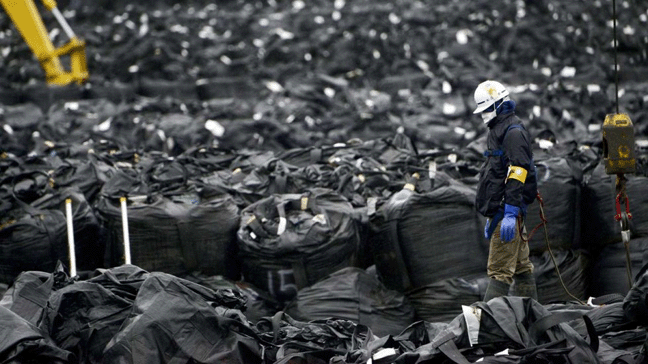
Sworn to secrecy,12 after a superficial safety education drill, they are sent into highly contaminated, hot and wet labyrinthine areas.
Irregular workers’ oral contracts with tehaishi are often illegal or dangerous, and are sometimes imposed on workers through threats or use of force.
Over the past 40 years, poor monitoring and record-keeping has meant that many former nuclear workers who develop leukaemia and other illnesses have been denied government compensation due to their lawyers’ inability to prove the etiological link between their disease and employment.
Informal Labour, Local Citizens and the Tokyo Electric Fukushima Daiichi Nuclear Crisis: Responses to Neoliberal Disaster Management, ANU, Adam Broinowski, 7 Nov 17, “…
Conditions for Informal Labour Employed in Nuclear Power Stations The phenomenon of assembling and recruiting a relatively unskilled labour pool at the cheapest rate possible is typical in nearly all of Japan’s large-scale modern industrial projects in the 20th century. As early as the late 19th century, however, non-criminal homeless men were recruited for such projects, whether forced, coerced or voluntarily from the major day-labourer (hiyatoi rōdōsha 日雇い労働者) sites (yoseba) established in Sanya (Tokyo), Kotobuki (Yokohama), Kamagasaki (Osaka) and Sasashima (Nagoya). In pre–World War II and wartime Japan, yakuzatehaishi (手配師 labour recruiters) operated forced labour camps known as takobeya (たこ部屋 octopus rooms) for Korean and Chinese labourers who had been transported to work mainly in coal mines and on construction sites.6………
The rapid build of nuclear power stations was planned in the 1960s by a consortium of major investment banks, electric utilities and construction companies and/or industry manufacturers (Mitsubishi, Tōshiba, Hitachi, Sumitomo, etc.), and was carried out in the 1970s, with increased momentum in response to the oil crisis of 1974–76. Through an intensive ‘regional development’ program of rural industrialisation from the early 1970s, politically disempowered communities were targeted as potential cheap labour as their environs were designated as sites for nuclear projects by investment capital. In a combination of regulatory capture and economic dependency, utilities moved in to provide employment opportunities to communities while the same communities steadily lost control over their resources and subsistence economies. In the process, they lost political agency as their political representatives often received corporate and state inducements for these projects. As TEPCO owns the electricity distribution system in Fukushima Prefecture, which includes hydroelectric and thermal power stations as well as nuclear, and is a major employer and investor in Fukushima Prefecture,10 it has considerable sway in the political process as well as over electricity bills.
By the early 1980s, irregular workers came to comprise nearly 90 per cent of all nuclear workers.11As nuclear reactors grow increasingly contaminated and corroded by radiation over time, informal labour became fodder for regular maintenance, cleaning, repairing and/or venting and refuelling of these nuclear reactors to reduce exposures to permanent company employees such as scientists and engineers. Continue reading →
On the mediated surface, Fukushima Daiichi has been used to prove to the world that a nuclear disaster of significant scale can be overcome and that people can survive and return to their normal lives. The government has concentrated on proving that it is safe for the Olympics, safe for tourism, safe to consume local produce, and safe to restart nuclear reactors.
The authorities have furnished people with the means by which to normalise sickness and pathologise anxiety to justify the return to nuclear power reliance, while suppressing those who seek to resist it.
And so we return to the basic problem that no nuclear reactor can operate without radiation-exposed labour,
Informal Labour, Local Citizens and the Tokyo Electric Fukushima Daiichi Nuclear Crisis: Responses to Neoliberal Disaster ManagementANU, Adam Broinowski, 8 Nov 17
Nuclear workers are important as sentinels for a broader epidemic of radiation related diseases that may affect the general population.1
The ongoing disaster at the Fukushima Daiichi nuclear power station (FDNPS), operated by Tokyo Electric Power Company (TEPCO), since 11 March 2011 can be recognised as part of a global phenomenon that has been in development over some time. This disaster occurred within a social and political shift that began in the mid-1970s and that became more acute in the early 1990s in Japan with the downturn of economic growth and greater deregulation and financialisation in the global economy. After 40 years of corporate fealty in return for lifetime contracts guaranteed by corporate unions, as tariff protections were lifted further and the workforce was increasingly casualised, those most acutely affected by a weakening welfare regime were irregular day labourers, or what we might call ‘informal labour’. Continue reading →
Climate change will be the border control of the future https://qz.com/1124055/climate-change-will-be-the-border-control-of-the-future/ 9 Nov 17, After 300 years of continuous human settlement, Hurricane Irma destroyed everything on the island of Barbuda andforced the relocationof its more than 1,600 residents, demonstrating that climate-induced migration is no longer a future possibility, but a present-day reality. A week and a half later, Hurricane Maria knocked out power for Puerto Rico’s 3.4 million residents and left much of the island without potable water. Fifteen percent of Puerto Rico’s population is expected to leave the island in the coming year.
Estimates vary, but the consensus is that there will be at least 200 million people displaced by climate change by 2050. In order to address this already unfolding reality, we need to reconsider the relationship between borders and climate change now.
It might seem that borders have no impact on climate change: Hurricanes destroy human settlements in the Philippines and the United States alike. Winds blow dust, pollution, and rains across borders. Sea level rise affects the countries that produced pollution and those that did not. But in reality, environmental change is shaped by borders and sovereignty in several significant ways.
First, there is a strong geographic pattern to where environmental pollution was historically produced and where environmental changes will most severely be felt today. Beginning with the industrial revolution, countries in Europe and North America produced 68% of all emissions, while only accounting for about one-sixth of the world’s population. Nevertheless, the latest Intergovernmental Panel on Climate Change report finds that the countries that have historically polluted the environment will be less negatively affected by climate change. The report identifies sub-Saharan Africa and small island states, like Antigua and Barbuda, as the most vulnerable to climate change because they do not have the resources or infrastructure to adequately adapt to environmental changes.
Second, bounded sovereignty also makes it difficult to create effective international agreements to combat climate change. The sovereign rights of the state are revered by nationalist leaders because they endow them the ability to put the needs of their people above all others. In his UN speech on Sept. 19, US president Donald Trump mentioned some variation of the word sovereignty 21 times. Although some criticize the UN as a form of global government, the charter of the United Nations enshrines the right to absolute sovereignty within borders and UN-sanctioned agreements — including the Paris Agreement — do not infringe on these rights.
In the Paris Agreement, states determine their own contribution, monitor their own progress, and face no consequences if they do not meet the goals they set. As long as local economic factors trump global environmental impacts, climate agreements are bound to fail.
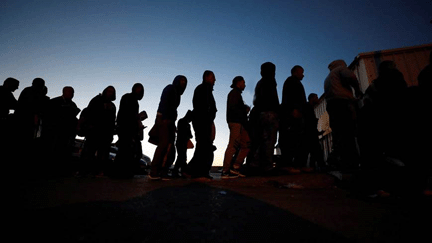
Finally, and perversely, the countries that produced the majority of the emissions that cause climate change are now building walls and securing borders to prevent the movement of people who are displaced by it. As late as the year 2000, there were 15 border walls around the world, but today there are almost 70. Borders and sovereignty mean that countries can decide who has the right to move and can turn away even the most desperate people displaced by climate change.
There have been some early efforts to address the problem of climate induced migration. The Paris Agreement established funds for least developed countries and for adaptation, but these are focused on mitigating risks and rebuilding after disasters. Additionally, Germany and Bangladesh have been leading the Platform on Disaster Displacement, which is an intergovernmental effort to prepare for disasters through prevention and awareness. These meager efforts are well intentioned but do not go nearly far enough.
International institutions are meant to address issues that are not confined to single states but cross political borders. There is already agreement that a few very narrow issues including genocide and state-sponsored terrorism are exempted from the protection of state sovereignty.
The environment and the displacement of people from environmental changes are cross border issues that extend beyond the authority of a single country. In order to realistically address the climate crisis, two more exceptions to absolute state sovereignty are required: the right of people to move from one territory to another and the right of the global community, not individual countries, to regulate the emissions of climate changing pollutants. This does not mean getting rid of sovereignty entirely, but it does mean countries must give up sovereignty over decisions that involve issues that have significant cross-border impacts.
Opening borders and removing sovereignty from environmental decisions will be seen as radical proposals by some. However, the more radical choice is to build walls and ignore climate change, pushing us headlong into a rapidly arriving dystopian future of walled states, violent borders, and hundreds of millions of displaced environmental migrants struggling to survive rising seas, heat waves, and devastating environmental change.
Energy efficiency: the foundation of the climate transition, REneweconomy, By Andrew McCallister on 10 November 2017 I’m preparing for a trip to your fine nation later this month to speak at the National Energy Efficiency Conference in Melbourne, so I’ve been reading up on Australian energy policy debate. It’s been fascinating.
I still have a lot to learn about your energy system, but so far one thing stands out: the discussion in Australia seems overly focused on the transition underway on the supply side of the market.
Don’t get me wrong – the decarbonisation of the world’s energy supply is crucial, and you won’t find a stronger advocate for renewables than me. Way back in the 1990s, I installed many small, remote PV and wind systems with my own two hands, and trained others to do the same.
More recently I ran two of California’s signature renewables programs – the California Solar Initiative and Self-Generation Incentive Program.
However, focusing solely on the move to low carbon generation without pursuing demand side opportunities in an ambitious, systematic way actually makes the transition harder.
Energy efficiency and demand response are just as important to the energy transition as renewables are, as we’ve learnt in California. Today’s technology helps us utilise energy smartly; and indeed the least expensive and cleanest unit of energy is the one not needed at all.
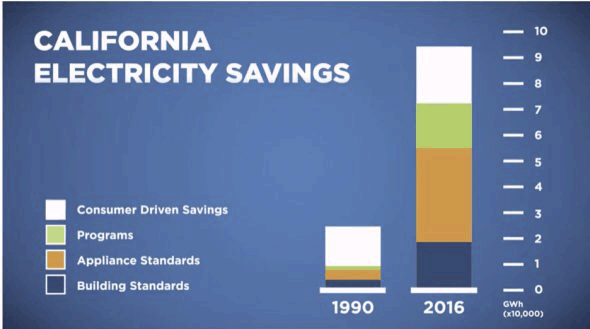
Energy efficiency has been a central contributor to California’s energy mix since the 1970s.∗Efficiency is responsible for an annual reduction in statewide electric consumption of 90 TWh (Figure 1), the equivalent of 30 percent of the state’s current electricity consumption and enough to power around eight million households.
California’s per capita electricity use has remained flat since the mid-1970s, despite a fourfold increase in real economic output, larger homes and the proliferation of consumer appliances and electronics.
Since 2000, the state’s overall carbon emissions are down 8 percent while its economy has grown by 28 percent. California’s deliberate, consistent focus on energy efficiency has played an important role in these successes.
Going forward, the California legislature and Governor Brown have established a goal to double the flow of efficiency savings by 2030. The estimated impacts of this doubling effort are shown in Figure 2. Achieving the goal will see per capita consumption decline around 25 percent by 2030. California’s suite of energy efficiency activities includes:
Building energy efficiency standards. The 2019 Standards update will require residential new construction to have advanced building shells, high-performing water heating and mechanical systems, all-LED lighting and, for the first time, sufficient self-generation (typically PV) to offset all electric load. Incremental costs are shown to be cost-effective.
Appliance efficiency standards. California has explicit authority to develop efficiency standards where national standards do not exist. Recent standards adopted include general service LEDs, computers, and battery chargers. Many appliance standards are currently in development (e.g. industrial fans and blowers, certain compressors and pumps, and room air conditioners)……
Modern energy management complements renewable energy supply
Highly efficient products and practices increasingly bundle with digital communication and control features to support demand-side responsiveness to the momentary needs of the grid. Good design of buildings and industrial processes, together with advanced energy management systems, can provide both beautifully tailored performance for customers and valuable and much-needed grid services that aid seamless incorporation of renewable energy into the supply mix.
Energy efficiency optimises the distribution grid
Energy efficiency frees capacity in the distribution grid, allowing new electric loads to be served with only moderate added investment. That ‘headroom’ will be essential, since California’s clean energy path will include widespread electrification: pervasive adoption of electric vehicles, heat pumps, induction cooking and other electric end use technologies. Electrification brings additional benefits, such as avoiding both investment in new retail gas distribution infrastructure and the risks to health and safety from indoor combustion.
The Flagstaff City Council officially opposed the transportation of uranium ore and other radioactive materials through the city and neighboring communities at its meeting Tuesday night.
The resolution, however, will have no ability to control the route trucks hauling the material will take. At a meeting last month, City Attorney Sterling Solomon and Assistant to the City Manager Caleb Blaschke said the city is preempted from regulating the transportation of uranium ore and all hazardous materials by the U.S. Department of Transportation.
The council voted 6-1 on a resolution stating the city’s opposition to the transportation of uranium ore and reaffirming Flagstaff as a “nuclear free zone.” Councilman Scott Overton was the lone “no” vote on the resolution.
At Tuesday’s meeting, 15 members of the public, including a representative from the Havasupai Tribal Council and state Representative Wenona Benally, spoke. All public speakers voiced their support for the resolution and some asked the council to take the move a step further and craft a legally binding ordinance to stop the transportation of uranium ore through Flagstaff…….
The council also directed the city staff to lobby the federal government to change its policy preempting local control over the material’s transportation.
Members of the public, including many from a group called “Haul No,” filled the council chambers Tuesday evening and erupted into thunderous applause when the resolution passed.
Evans said other towns and cities in northern Arizona look to Flagstaff to set an example as the largest city in northern Arizona.
“I believe the legacy of uranium mining in northern Arizona is unjust,” she said.
The World’s Largest Climate Change Summit Starts Today. Here’s What’s Happening. Huffington Post 6 Nov 17 It is the first annual meeting of the United Nations group since President Donald Trump announced the U.S. would withdraw from the Paris climate deal. Representatives from nearly 200 countries gather at the United Nations’ 23rd climate change conference beginning Monday, an annual effort to tackle global warming and its impacts already inflicting havoc on the planet.
This year, however, the U.N. faces a new challenge: Addressing the phenomenon after U.S. President Donald Trump, leader of the planet’s second-largest greenhouse gas emitter, pledged to do nothing to curb emissions.
The U.N. Framework Convention on Climate Change will deal with that question in Bonn, Germany, from Nov. 6 to Nov. 17 as countries work to firm up their commitments to adapt to a warmer world in line with 2015′s landmark Paris Climate Agreement. Scientists say the world should prevent the planet from warming more than 2 degrees Celsius beyond pre-industrial levels to avoid the worst effects of climate change, a benchmark set by the Paris accord. Meeting the target means dramatic reduction in global emissions, and the Paris pact urges signatories to craft voluntary pledges to do that.
The Trump administration announced last week it would actively promote fossil fuelsduring a presentation at the climate conference, also known as the Conference of the Parties, or COP. Delegates sent by the White House will host a talk titled “The Role of Cleaner and More Efficient Fossil Fuels and Nuclear Power in Climate Mitigation,” which will tout the supposed benefits of coal, natural gas and nuclear power.
A delegation of U.S. negotiators are expected to work in Bonn to help write the rulebook for the Paris agreement, but their presence will be awkward. It’s unclear if negotiators from other countries will be willing to listen to a White House, which, under Trump, would not abide by any rules that emerge.
The summit will feature some U.S. star power, however. Former New York Mayor Michael Bloomberg and billionaire activist Tom Steyer are funding a pavilion to showcase climate action by U.S. cities and businesses. The federal government usually pays the $200,000 or so cost of the showcase, but declined to do so this year.
“The American people and American industry are pretty much all behind doing what the Paris agreement is designed to do, and that is to cut the amount of greenhouse gases going into the atmosphere so we will slow down and maybe even stop climate change, which has the potential to destroy the world,” Bloomberg told The New York Times last month.
Environmental groups and local governments around the U.S. reacted with fury following Trump’s decision to quit the Paris deal, but pledged to do their part to combat his agenda with or without federal support. Other world leaders have vowed to move forward regardless, and in July, every member of the G20, aside from the U.S., unveiled a detailed policy to abide by the Paris pact in a clear rebuke of the White House. …..
North Korea’s underground nuclear test site has turned the surrounding area to wasteland and caused defects among newborn babies, defectors have reported.
About 80 per cent of trees that are planted die at Punggye-riand underground wells have also run dry, according to 21 defectors who used to live in Kilju county, the location of the site.
“I heard from a relative in Kilju that deformed babies were born in hospitals there,” one defector claimed, according to the Chosun Ilbo newspaper. He added that locals were worried about radioactive contamination. “I spoke on the phone with family members I left behind there and they told me that all of the underground wells dried up after the sixth nuclear test,” said another, referring to the regime’s most recent test in September.
Defectors, including one person who claimed to have lived through two nuclear tests in 2006 and 2009, testified that local people were not warned in advance.
“Only family members of soldiers were evacuated to underground shafts. Ordinary people were completely unaware of the tests,” said the defector, who fled North Korea in 2010.
According to another source who has visited Kilju since the sixth nuclear test, residents have been banned from making hospital appointments in the capital, Pyongyang.
Officials also appear to be intent on keeping a lid on accounts from Kilju county, with anyone caught boarding trains with samples of soil, water or leaves reportedly being arrested and sent to prison camps.
Meanwhile, 38 North, a North Korea monitoring site operated out of Johns Hopkins University, Maryland, reported at the weekend that commercial satellite imagery of Punggye-ri had shown significant movements near the West Portal, a yet unused tunnel complex.
It was, however, difficult to determine the exact purpose of the movement of equipment such as mining cards and netting, the report concluded.
For many in the nuclear industry, having watched all their much-touted GW-scale reactors go down the pan, and having had to accept that their long-cherished dream of a new generation of fast-breeder reactors will never materialise, SMRs are almost the last resort.
There are literally dozens of different SMR designs out there, with the USA, Russia, South Korea, China and now the UK bigging up the superiority of their particular whizz-bang design – but there are NO CLIENTS anywhere in the world….. billions of dollars ploughed into one prototype or another, but very little to show for it at the end of the day.
Just as I don’t believe we’ll ever see Hinkley Point finished and generating electricity, nor do I believe that a new generation of SMRs will ever materialise, ensuring that the insane dream of the UK as ‘a vibrant nuclear nation’ will remain just that – an insane dream.
Small Modular Reactors: The Nuclear Industry’s Latest Pipe Dream, http://www.jonathonporritt.com/blog/small-modular-reactors-nuclear-industrys-latest-pipe-dreamJonathon Porritt, 4 Nov 17 You’ve got to hand it to the nuclear industry: they’re one resilient bunch of never-say-die hard-arses! By any standards, 2017 has been an annus horribilis for the industry, with one body blow after another, all around the world. And 2016 wasn’t that much better either.
This is spelled out in almost excruciating detail in this year’s ‘World Nuclear Industry Status Report’ (WNISR), an annual stocktake that dispassionately lays out what’s been happening in the preceding year from technological, engineering, political and financial points of view. Continue reading →
“……University of Johannesburg professor of physics Hartmut Winkler – Winkler has postulated that two powerful lobbies against renewable energy were at work. “One is pro-coal, the other pro-nuclear. This has made the success of the renewable energy projects a target for attacks from interested parties in both,” said Winkler.
“Disrupting the renewable energy sector would ensure that the coal sector remains dominant. And that, over time, it is gradually displaced by nuclear,” he wrote.
Forbes 30th Oct 2017, The UN Environmental Program (UNEP) has rejected the World Nuclear Association’s (WNA) offer to provide financial support to the 8th Annual Sustainable Innovation Forum (SIF).
Described by its chairman as the “largest business-focused side event during the annual Conference Of
Parties” the event is scheduled to take place alongside COP23 in Bonn, Germany. Originally accepted as a gold sponsor and ready to pay the £40,000 ($68,338) fee, the World Nuclear Association was recently notified that its sponsorship had been rescinded upon intervention by the UN Environment Program (UNEP).
Forbes 30th Oct 2017,Fukushima City is 50 miles northeast of the Fukushima-Daiichi Power Plant, so the radiation levels have been lower there than in the restricted areas, now reopening, that are closer to the plant. Hayama was unable to test monkeys in the most-contaminated areas, but even 50 miles from the plant,he has documented effects in monkeys that are associated with radiation.
He compared his findings to monkeys in the same area before 2011 and to a control population of monkeys in Shimokita Peninsula, 500 miles to the north. Hayama’s findings have been published in the peer-reviewed journal Scientific Reports, published by Nature.
Among his findings: Smaller Bodies — Japanese monkeys born in the path of fallout from the Fukushima meltdown weigh less for their height than monkeys born in the same area before the March, 2011 disaster, Hayama said. “We can see that the monkeys born from mothers who were exposed are showing low body weight in relation to their height, so they are smaller,” he said.
Smaller Heads And Brains — The exposed monkeys have smaller bodies overall, and their heads and
brains are smaller still. “We know from the example of Hiroshima and Nagasaki that embryos and fetuses exposed in utero resulted in low birth weight and also in microcephaly, where the brain failed to develop adequately and head size was small, so we are trying to confirm whether this also is happening with the monkeys in Fukushima,” Hayama said.
Over the past half-century, growth in the global economy and carbon pollution have been tied together. When the global economy has been strong, we’ve consumed more energy, which has translated into burning more fossil fuels and releasing more carbon pollution. But over the past four years, economic growth and carbon dioxide emissions have been decoupled. The global economy has continued to grow, while data from the EU Joint Research Centre shows carbon pollution has held fairly steady
China is becoming a global climateleader
China’s shift away from coal to clean energy has been largely responsible for this decoupling. Due to its large population (1.4 billion) – more than four times that of the USA (323 million) and nearly triple the EU (510 million) – and rapid growth in its economy and coal power supply, China has become the world’s largest net carbon polluter (though still less than half America’s per-person carbon emissions, and on par with those of Europeans). But as with the global total, China’s carbon pollution has flattened out since 2013.
That’s especially remarkable because it puts China about 15 years ahead of schedule. In an agreement with President Obama ahead of the Paris international climate negotiations, Chinese President Xi Jingping pledged that China’s carbon emissions would peak by 2030. Republican Party leaders grossly distorted this agreement at the time, with Senate majority leader Mitch McConnell claiming:
As I read the agreement it requires the Chinese to do nothing at all for 16 years while these carbon emissions regulations are creating havoc in my state and around the country
As the chart above [on original] shows, Chinese carbon emissions tripled between 1999 and 2013. To slow that rate of growth to zero as the Chinese economy continues to grow would require a dramatic shift in the country’s energy supply. But that’s exactly what’s happened, with the Chinese government cancelling over 100 planned new coal power plants earlier this year. Chinese coal consumption has in fact fallen since 2013. And China and the EU have pledged to strengthen their efforts to cut carbon pollution.
America isn’t a lost cause
In 2016, American carbon pollution fell to below 1993 levels. The emissions decline began around 2008, which is also when natural gas, solar, and wind energy began rapidly replacing coal in the power grid.
And yet, while these steps can slow the decline in American carbon pollution, the transition from coal to clean energy will nevertheless persist. Coal simply can no longer compete with cheaper, cleaner sources of energy, and the next American president can quickly reverse many of the Trump administration’s anti-climate orders.
The statement comes as a South Korean spy agency renewed fears that the Hermit Kingdom is planning a missile tests, reports Fox News.
North Korea’s state-run Korean Central News Agency said in a statement that the Tuesday report by Japanese broadcaster Asahi TV was “false” and merely “misinformation,” Reuters reported.
It accused the Japanese station of trying to “slander” the rogue regime’s nuclear weapons program.
The Japanese TV station reported on Tuesday that 200 are feared dead after an underground tunnel collapsed at the Punggye-ri test site on October 10.
The workers were in the tunnel during the initial cave-in, the station reported, citing a North Korean source. Another 100 people were crushed when the tunnels gave way on top of rescuers. Continue reading →
Apr 15, 2026 01:00 AM in Canberra, Melbourne, Sydney
Join the International Physicians for the Prevention of Nuclear War (IPPNW) on Tuesday, April 14th for a timely webinar exploring the risks associated with nuclear power and challenging the myth that it offers a simple, safe, carbon-free solution to the climate crisis
21 April Webinar: No Nuclear Weapons in Australia
Start: 2026-04-21 18:00:00 UTC Canberra, Melbourne, Sydney (GMT+10:00)
End: 2026-04-21 19:30:00 UTC Canberra, Melbourne, Sydney (GMT+10:00)
Event Type: Virtual A virtual link will be communicated before the event.














 Antinuclear