Queensland should be the Sunshine State – forget failed nuclear energy !
 Must be kidding on nuclear power https://www.sunshinecoastdaily.com.au/news/must-be-kidding-on-nuclear-power/3224633/ GABRIELLE LUFT, 16th Sep 2017 AH here we go again, the same old lame call for more nuclear power … rarara… So disappointing, Mr Whiteside. (Daily, September 14)
The Dangerous Case of Donald Trump
 “A Duty to Warn” and the Dangerous Case of Donald Trump Renowned psychiatrist says despite “Goldwater Rule,” mental health experts have unique responsibility when someone in power may be dangerous, Common Dreams by Bill Moyers, Robert Jay Lifton , 15 Sept 17
As mental health professionals, these men and women respect the long-standing “Goldwater rule” which inhibits them from diagnosing public figures whom they have not personally examined. At the same time, as explained by Dr. Bandy X Lee, who teaches law and psychiatry at Yale School of Medicine, the rule does not have a countervailing rule that directs what to do when the risk of harm from remaining silent outweighs the damage that could result from speaking about a public figure — “which in this case, could even be the greatest possible harm.” It is an old and difficult moral issue that requires a great exertion of conscience. Their decision: “We respect the rule, we deem it subordinate to the single most important principle that guides our professional conduct: that we hold our responsibility to human life and well-being as paramount.”
Hence, this profound, illuminating and discomforting book undertaken as “a duty to warn.”
The foreword is by one of America’s leading psychohistorians, Robert Jay Lifton. He is renowned for his studies of people under stress — for books such as Death in Life: Survivors of Hiroshima (1967), Home from the War: Vietnam Veterans — Neither Victims nor Executioners (1973), and The Nazi Doctors: Medical Killing and the Psychology of Genocide(1986). The Nazi Doctors was the first in-depth study of how medical professionals rationalized their participation in the Holocaust, from the early stages of the Hitler’s euthanasia project to extermination camps.
The Dangerous Case of Donald Trump will be published Oct. 3 by St. Martin’s Press.
Here is my interview with Robert Jay Lifton — Bill Moyers………
“And that’s what I call malignant normality. What we put forward as self-evident and normal may be deeply dangerous and destructive. I came to that idea in my work on the psychology of Nazi doctors — and I’m not equating anybody with Nazi doctors, but it’s the principle that prevails — and also with American psychologists who became architects of CIA torture during the Iraq War era. These are forms of malignant normality. For example, Donald Trump lies repeatedly. We may come to see a president as liar as normal. He also makes bombastic statements about nuclear weapons, for instance, which can then be seen as somehow normal. In other words, his behavior as president, with all those who defend his behavior in the administration, becomes a norm. We have to contest it, because it is malignantnormality. For the contributors to this book, this means striving to be witnessing professionals, confronting the malignancy and making it known”……..
“the only reality he’s capable of embracing has to do with his own self and the perception by and protection of his own self. And for a president to be so bound in this isolated solipsistic reality could not be more dangerous for the country and for the world. In that sense, he does what psychotics do. Psychotics engage in, or frequently engage in a view of reality based only on the self. He’s not psychotic, but I think ultimately this solipsistic reality will be the source of his removal from the presidency.”………https://www.commondreams.org/views/2017/09/15/duty-warn-and-dangerous-case-donald-trump
Plutonium and reprocessing – a dud technology
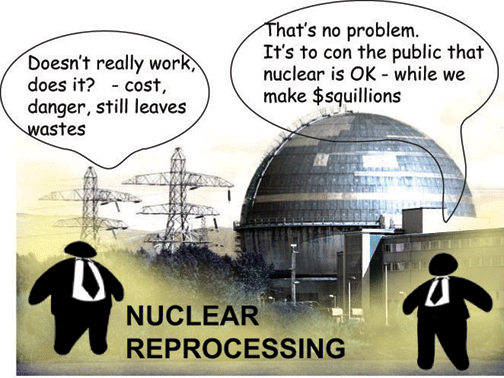 the separation and use of plutonium as a fuel is not economically competitive with simply storing the spent fuel until its radioactive heat generation has declined and a deep underground repository has been constructed for its final disposal. In this “once-through” fuel cycle, the plutonium remains mixed with the radioactive fission products in the intact spent fuel and therefore is relatively inaccessible for use in weapons.
World Nuclear Industry Status Report shows drop in new build projects
 Nuclear newbuild projects at decade low – report http://www.euronews.com/2017/09/12/nuclear-newbuild-projects-at-decade-low-report, By REUTERS, PARIS – The number of nuclear newbuild projects worldwide has dropped to a decade low in the wake of the 2011 Fukushima disaster and due to the rising cost of atomic energy, an industry report showed.
From a high of 15 in 2010, the number of construction starts of nuclear reactors worldwide dropped to 10 in 2013, eight in 2015, three in 2016, and just one in the first half of 2017, according to the World Nuclear Industry Status Report (WNISR).
China, the most active builder of nuclear plants in the past decade, saw its newbuild activity slow from 10 in 2010 to six in 2015 and just two last year. “This may be the end of the Chinese exception,” lead author Mycle Schneider told reporters in Paris.
The 2010 construction peak marked the end of a brief nuclear renaissance when several countries started building reactors again after a nearly 20-year hiatus following the 1986 Chernobyl disaster. Schneider said he would not be surprised to see more nuclear projects under construction being dropped, following the abandonment of a high-profile one in the United States.
After the bankruptcy of reactor builder Westinghouse early this year, two South Carolina utilities in July abandoned the V.C. Summer project for two new Westinghouse reactors, which were 40 percent complete after more than $9 billion had been spent on construction. WNISR data shows that worldwide between 1977 and mid-2017, at least 91 – one in eight – of all nuclear reactor construction sites had been abandoned or suspended in various stages of advancement.
“The nuclear species is going extinct,” Schneider said. The nuclear industry – which has its annual meeting in London this week – says nuclear will keep playing a major role in low-carbon electricity generation and points at major newbuild programmes in China, India, Britain and South Africa. The share of nuclear energy in global electricity production has fallen from a high of 17.5 percent in 1996 to 10.5 percent last year, when nuclear output increased 1.4 percent, WNISR data showed. The United Arab Emirates is expected to start up the first of four South Korea-built reactors next year. Vietnam decided in late 2016 to abandon plans to build its first reactors, citing construction costs and safety concerns. In the first half of 2017, India was the only country to start building a reactor.
Pope Francis urges climate change sceptics to consult scientists
 Pope Francis On Climate Change Denial: ‘Man Is Stupid’ Huff Post, WASHINGTON, 12 Sept 17 — Climate change denials amid catastrophic hurricanes are a reminder that humans are not a particularly smart species, Pope Francis said Sunday while flying over areas in the Caribbean decimated by Hurricane Irma.
A correspondent for Crux Now had a slightly different translation of the pontiff’s comments: “Man is a stupid and hard-headed being who doesn’t see.”
The pope — who has sparred with President Donald Trump on several issues, including climate change — also urged the climate skeptics of the world to consult with a scientist.
Francis warned that “history will judge those decisions,” and that if humans fail to curb climate change we “will go down,” according to reports.
When Trump met with Francis in May, the pope gave the president a copy of his 2015 encyclical on climate change and the environment, “Laudato Si.” In the 184-page document, Francis argues that climate change is inherently a moral and spiritual issue and criticizes local and national governments that refuse to address it. ……http://www.huffingtonpost.com.au/2017/09/11/pope-francis-on-climate-change-denial-man-is-stupid_a_23205254/
11 nuclear power plants lie in the path of Hurricane Irma
What Lies In Irma’s Path, Five Thirty Eight, By Rachael Dottle, Ritchie King and Ella Koeze, what lies in that path? We can’t say for sure, but within the so-called cone of uncertainty for Irma, there are 11 nuclear power plants, hundreds of hospitals and a slew of hazardous waste containment sites that could become sources of environmental contamination. https://fivethirtyeight.com/features/what-lies-in-irmas-path/?ex_cid=538email

Nationals rally against Clean Energy Target plan
Nationals rally against energy plan
The Nationals have fired a warning shot across Malcolm Turnbull’s bow by passing a motion opposing the proposed Clean Energy Target…. (subscribers only)
http://www.afr.com/news/nationals-vote-to-oppose-malcolm-turnbulls-clean-energy-target-20170909-gyeazy
Australian politicians’ mindless backing of Trump
 Australian politicians back Trump’s unhinged nuclear threats, Red Flag, MICK ARMSTRONG, 11 SEPT 17, We are facing the greatest threat of nuclear war since the 1962 Cuban missile crisis: a nuclear war that would make the terrible destruction the US wreaked on the defenceless populations of the Japanese cities of Hiroshima and Nagasaki seem like a kindergarten affair.
What is the response of the Australian government? It has gone out of its way to declare its full-blooded support for a warmongering US president who has promised “fire and fury” against North Korea.
Prime minister Malcolm Turnbull announced he was “absolutely of one mind” with Donald Trump over North Korea after a “very warm” 30 minute phone conversation with the US president on 6 September.
Previously, Turnbull had proclaimed that “we are joined at the hip” with the US.:……
This belligerent rhetoric is simply egging on Trump, who tweeted that the US “is considering, in addition to other options, stopping all trade with any country doing business with North Korea”. If this threat were carried out, it would devastate US trade with China and plunge the world economy into depression, throwing tens of millions of workers across the globe out of their jobs……
Meanwhile, in an attempt to outdo Turnbull’s warmongering, former PM Tony Abbott has called for Australia urgently to consider a missile defence system. If adopted, this proposal would provoke a regional arms race and divert billions of dollars away from vitally needed public services.
Labor’s stance has been virtually indistinguishable from the Liberals’. Bill Shorten said, “Australians should be reassured that on this matter of North Korea and our national security, the politics of Labor and Liberal are working absolutely together……
The Greens reacted angrily to Turnbull’s comments – accusing him of inflaming tensions in the region.
“What we’ve got is two dangerous, paranoid and unhinged world leaders goading each other into a conflict which puts the very survival of each and every person on the planet at risk”, Greens leader Richard Di Natale said. “If there was ever a clearer example of why Australia needs to ditch the US alliance and develop an independent, non-aligned foreign policy, this is it.”……https://redflag.org.au/node/6004
Devastating” Climate Change-Linked Floods Submerge Parts of South Asia
India is one of several South Indian countries to suffer huge floods in the this year’s unprecedented monsoon season.
More than 1,400 are thought to have died across four countries. Many more saw their homes washed away, families split up, and crops on which they depended to survive ruined.
The crisis has had relatively little worldwide coverage, with news organisations more focused on hurricanes on the other side of the world.
But both are linked to changing weather patterns due to climate change that are expected to drive more extreme weather in the years to come.
In India, the poverty-stricken northern state of Bihar was among the worst affected……
weeks after the flood first struck, there has been virtually no Government aid to help victims.
Instead, local charities have been left to deliver emergency supplies.
There were also questions over why there had no been warnings to evacuate or prepare ahead of the floods.
Ashish Ranjan, a volunteer flood relief coordinator, said deaths could have been prevented.
Nuclear power – the least viable alternative to fossil fuels
 Why Nuclear Energy May Not Be Our Best Alternative Option To Fossil Fuel, Forbes, 9 Sept 17 , Michael Barnard, low-carbon innovation analyst, on Quora: “…..Nuclear ….environmentalists aren’t nuclear power’s problem.
Its first problem is that it keeps getting more expensive while alternatives keep getting cheaper. It was in global decline in terms of absolute and relative generation since 2005, with a small uptick last year due to China’s deployment. That’s because it’s expensive compared to alternatives. Until recently it was fiscally challenged by natural gas generation. A handful of years ago it stopped being competitive with onshore wind. Now it’s not cost competitive with utility scale solar. Depending on the forecast, it’s either not competitive with offshore wind today or in the next two years.
Efforts to make nuclear cheaper, like CCS, have failed. The Toshiba Westinghouse AP1000 was supposed to be a standard, easy to build, cheaper option. It’s turned out to be incredibly expensive in reality and Toshiba Westinghouse has entered bankruptcy. A recent US report on next generation fission technologies found that roughly $2 billion had been spent with no progress. Fusion’s best hope is the ITER Tokamak which is expected to go live in prototype with no generation in 2040, meaning that if it works, some commercializable technology might be contributing by 2070.
The second problem is that nuclear is an inflexible form of generation. Some of that is the technology, but regardless of that, the business case requires about 90% capacity factor for nuclear in order to make money due to the extraordinary capital cost of the technology. That’s just the reality. And inflexible generation doesn’t work with intermittent renewables. If you can’t scale the various technologies up and down cost effectively, then there’s a problem. Ontario has been a bellwether in this regard with its surplus baseload generation problems of the past few years. While people tried to blame this on wind energy, what’s really happening is that the nuclear fleet is too big and can’t be turned off, so Ontario has been paying neighbouring jurisdictions to take the excess electricity. California built a lot of pumped storage to give nuclear something to do at night. France built expensive follow-the-load nuclear which basically wastes all of the generated heat without generating electricity. As France’s new President Macron has said, he used to run that ministry and even he doesn’t know how much they spent on nuclear or how much it costs.
The third problem is that nuclear is a geographically limited solution to a global problem. There are only 30 countries with nuclear today and we mostly don’t want to expand that number for reasonable geopolitical concerns related to radioactive material supply chain security, nuclear waste security and expansion of uranium enrichment technologies which happen in many cases to be useful directly for creating nuclear weapon’s grade uranium or masking the purchase of that enrichment technology. Dirty bombs anyone? A new nuclear bomb owning dictator anyone?……
Nuclear power is a 1970’s solution and hasn’t aged well. It hasn’t become cheaper, more flexible or more ubiquitous and it won’t. It’s failing in the marketplace, not due to environmentalists. …… Should we pay much attention to expanding nuclear? No. Why bother wasting breath on something that doesn’t have a business case…….
Renewables are the answer because they are massively scalable, cheap and solving the problems of renewables is easier than solving the problems of nuclear that is down the road.
The big kerfuffle recently about whether we can get to 100% renewables by 2050 or not was very interesting for one reason. Everyone involved agreed we could easily get to 80%. The question was how hard the last 20% would be.
But getting to 80% globally is a huge advance and is much cheaper to achieve than trying to ride the dead horses of nuclear and carbon capture on fossil fuels. We have to find ways to take carbon out of the atmosphere, likely soil carbon capture with global transformation of agricultural approaches, but it can’t be considered a successful part of the solution to get our emissions to zero. https://www.forbes.com/sites/quora/2017/09/09/why-nuclear-energy-may-not-be-our-best-alternative-option-to-fossil-fuel/#25ec6e8375d0
An American story that could be a forecast for an Australian nuclear dump town,perhaps Kimba
“Every house. Every tree. Everything was dug up, shredded and buried in a big hole on top of the hill,” Thompson said. Decades and decades of mining left Uravan contaminated with radioactive chemicals and heavy metals. The EPA declared it a superfund site in the 1980s and ordered the mining company, Umetco, to start clearing away the entire town.
You’d never know the empty picnic area was once a community of about 1000 people. Today, you just see the bottom of a crumbling sandstone river valley
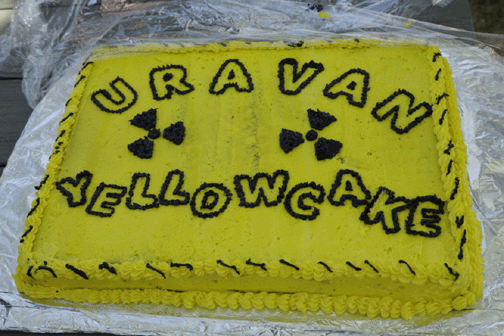
she wants to keep having these annual reunion picnics, where the real star of the show is the desert: an actual yellow cake, with yellow frosting and black radioactive signs on top.
Uravan residents may have lost their town, but not their sense of humor.
Uravan: The Uranium Town That Was http://wyomingpublicmedia.org/post/uravan-uranium-town-was, By DAN BOYCE • SEP 8, 2017 Superfund cleanups are a priority for Scott Pruitt, the administrator of the Environmental Protection Agency. He wants to cut through red tape that has left more than a thousand sites still contaminated with everything from radioactive waste to lead.
He also wants to remove sites that have already been cleaned up from the so-called National Priority List, which has more than 1300 sites. One of those sites is the town of Uravan.
After hours in the dark main room of the Rimrocker Historical Society, Jane Thompson showed off what put this part of Western Colorado on the map. She turned on a geiger counter, which began wildly clicking due to the radioactive yellow rock in a nearby antique jar.
Thompson also helps spearhead an annual picnic some 15 minutes up the road, as she did last weekend. She calls it a reunion picnic at the site of her hometown of Uravan.
“The things that happened here were very important,” Thompson said.
A few dozen people gathered under trees and canopies in the otherwise hot empty field on that late August day. Uravan, a tiny mining company town, provided uranium for nuclear weapons developed during the Manhattan Project.
“Even though the town is gone, we feel like that the history of those people need(s) to be kept,” she said.
Uravan — it is gone. Not just the mill where those yellow rocks were processed into so-called yellowcake uranium ore; everything is gone.
“Every house. Every tree. Everything was dug up, shredded and buried in a big hole on top of the hill,” Thompson said. Decades and decades of mining left Uravan contaminated with radioactive chemicals and heavy metals. The EPA declared it a superfund site in the 1980s and ordered the mining company, Umetco, to start clearing away the entire town.
You’d never know the empty picnic area was once a community of about 1000 people. Today, you just see the bottom of a crumbling sandstone river valley. Larry Cooper, 91, sat in a camping chair, wearing suspenders and breathing with the help of an oxygen tank.
“I didn’t know it was dangerous,” he said. “I didn’t know it would hurt ya.”
He worked in the mills and mines around Uravan, starting in the 1950s. His health suffered.
“I got cancer. I lost half of my lung on the right side,” he said.
Registered Nurse Joanna Godwin said it’s very common for former Uravan workers. She attended the picnic with a non-profit called Nuclear Care Partners. They provide free health care through the Department of Labor for medical issues that can be traced back to the mining of radioactive materials.
“We’ve had people with skin cancers. Pulmonary things are very prevalent. It’s a whole array of things,” she said, referring to conditions in former Uravan employees.
After two decades of cleanup, the EPA declared the remediation of Uravan wrapped up in 2008. But, this empty-field-that-used-to-be-a-town was never taken off the list. The agency says it needs further investigation and study before giving it a clean bill of health.
The Colorado Department of Public Health and Environment recently submitted comments to the EPA, saying the agency’s continued work in Uravan is duplicative, costly and causing delay. That seems to be the kind of thing Administrator Pruitt is looking to streamline.
Still, Jane Thompson doesn’t hold out any hope the Uravan site will ever totally be out of the hands of the federal government.
“Well, I think it will remain forever,” she said.
But, she wants to keep having these annual reunion picnics, where the real star of the show is the desert: an actual yellow cake, with yellow frosting and black radioactive signs on top.
Uravan residents may have lost their town, but not their sense of humor.
Global Treaty to Ban Nuclear Weapons
The 10-page treaty on the prohibition of nuclear weapons will be open for signatures from any UN member state on 20 September during the annual general assembly.
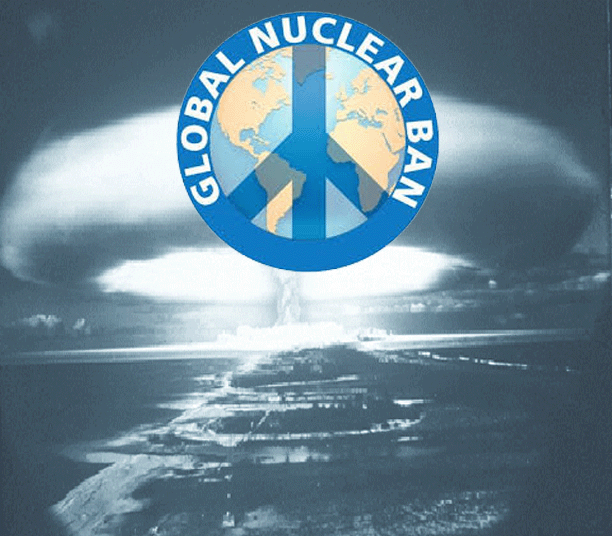
On 7 July, the United Nations adopted the “Nuclear Weapons Treaty” with an overwhelming majority – an epoch-making agreement that prohibits not only the development, experiment, manufacture, possession, and use of nuclear weapons, but also the “threat to use”. Nuclear and chemical weapons, and anti-personnel landmines and cluster bombs were also banned.
The U.N. decided to start negotiations for the treaty after a series of three conferences on the humanitarian consequences of nuclear weapons. It’s been a long and painstaking journey, for people of decency and good faith, from the first conference in Oslo, Norway in March 2013, to the most recent, in July 2017 when the global Treaty was adopted by 122 nations. Now, this month, nations can ratify this Treaty – a positive step in the movement towards a sane world. It is not too late for more countries to join.
Sweden considers nuclear waste, (far more carefully than Finland ever did)
 This is of particular interest to Australia. Our government touts Finland as the great model for acceptance of nuclear waste dump. But in fact, the model adopted by Finland, (by a poorly informed public) was taken from the one refused by Sweden – where a much more informed community used a much more democratic process to study the waste dump issue. See “When haste makes risky waste: Public involvement in radioactive and nuclear waste management in Sweden and Finland” http://bellona.org/…/radioactive-waste…/2016-08-21710
 The Environmental Court’s main licensing hearing about a final repository for spent nuclear fuel in Forsmark – September 5 to October 27 http://www.mkg.se/en/the-environmental-court-s-main-licensing-hearing-about-a-final-repository-for-spent-nuclear-fuel-in#.WbJtaWAl7II.facebook The Environmental Court’s main hearing concerning the Swedish Nuclear Fuel and Waste Management Company SKB’s license application for a final repository for spent nuclear fuel in Forsmark, Sweden, began September 5, at Quality Hotel Nacka in Stockholm. The Swedish Society for Nature Conservation, SSNC, and the Swedish NGO Office for Nuclear Waste Review, MKG, are working together during the main hearing. Follow and get updates during and after the main hearing from the Twitter account of the director of MKG, Johan Swahn, and MKG’s Facebook.
On September 5, the Environmental Court’s main hearing concerning the Swedish Nuclear Fuel and Waste Management Company SKB’s license application for a final repository for spent nuclear fuel in Forsmark, Sweden, began at Quality Hotel Nacka in Stockholm. The main hearing will be in progress for five weeks, between September 5 and October 27. The first two weeks take place in Stockholm. Then, there will be a break for two weeks. The third week will take place in Oskarhamn (were the interim storage Clab is located and were the Waste Company wants to build an encapsulation facility, Clink) and the fourth week will take place in Östhammar (nearby the selected site for the final repository). After another break for one week, the main hearing will be concluded in Stockholm.
The Swedish Society for Nature Conservation, SSNC, and the Swedish NGO Office for Nuclear Waste Review, MKG, are working together during the main hearing. The organisations will bring their statements, which fundamentally are:
-
- The chosen solution for a final repository will not be safe since there is a large risk of the malfunction of the barrier system of copper and clay – the licence application should be denied or rejected!
- There is a large risk that the copper canisters will break down within 1 000 years – a possible scenario is that it might be a contaminated, uninhabitable, forbidden zone in Forsmark!
- The Swedish Radiation Safety Authority, SSM, is aware of the large problems with the license application, but still wants to give an OK to continue towards a Government decision and afterwards ensure that the copper canister will function as intended – this is unaccepted and legal questionable!
- There is an alternative method, the use of very deep boreholes – that might be environmentally safer, entails less risks for human intrusion, and is most likely a less expensive solution for final disposal!
- The nature existing on the suggested site in Forsmark is of high value (there is a number of red-listed species and species protected by the Habitats Directive’s appendix 4) – this, in itself, constitutes a reason to reject the license application!
Follow and get updates during and after the main hearing at the director of MKG’s Twitter (@jswahn) and at MKG:s Facebook (mostly written in Swedish but can be translated directly on the website). Continue reading
Urgent need for women’s participation in climate action decisions

 Too much mansplaining in climate conversations? http://www.nationalobserver.com/2017/09/07/news/too-much-mansplaining-climate-conversations , September 7th 2017 #710 of 711 articles from the Special Report: Race Against Climate Change In the catastrophic 2004 Boxing Day Asian tsunami, four times more women died than men. In the worst affected village, Indonesia’s Kuala Cangkoy, 80 per cent of the victims were female, according to Oxfam International. The number was so disproportionate, reported the humanitarian agency, because men were generally fishing or away from home, and many were able to flee while women at home tried to save children.
It’s an imbalance that disturbs the World Meteorological Organization’s Elena Manaenkova, who addressed the International Panel on Climate Change (IPCC) in Montreal earlier this week.
“Women couldn’t run because of their long clothes and they didn’t know how to swim,” she toldNational Observer in an interview.
The 56th session of the IPCC, which is tasked with providing sound climate science assessments to governments and policy makers, began in Montreal on Wednesday. At a closed-door workshop on Tuesday night however — held between the IPCC and Environment Canada — Manaenkova emphasized the importance of including more women in the world’s response to climate change.
She and a team of other climate experts are urging organizations and governments to recruit for women scientists to help improve sensitivity to gender issues in climate-related policy. Natural disasters, she explained, are just one example of how a warming world can have different impacts on women and men.
Women have to walk further for water
As temperatures rise and droughts become more frequent, for instance, women in some countries who are traditionally tasked with fetching water face more problems, including sexual violence.
According to the United Nations, women in Africa and Asia walk an average of six kilometres to get water but the distance can be much longer with droughts.
The delegate for Kenya, Patricia Nying’uro, has made note of that situation in her own country.
“If there’s a drought, (women) have to find water and in some areas they have to walk really far,” she said in an interview. “Even though everyone feels (climate change), these women feel it a bit more.”
As a senior meteorologist at the Kenyan Meteorological Department, she said whenever there are new seasonal forecasts for rain, they hold information forums and women are particularly interested.
“You will find that’s it’s mainly women who attend, one because they have the time and two, because they’re the most impacted,” she said.
To her, it’s important that more women participate in the climate change conversation because she feels not enough is being done to look at the impact on women.
“Women would be sensitive in general to things that happen to fellow women and the impacts on them,” she said.
In the catastrophic 2004 Boxing Day Asian tsunami, four times more women died than men.
It’s an imbalance that disturbs the World Meteorological Organization’s Elena Manaenkova, who addressed the International Panel on Climate Change (IPCC) in Montreal earlier this week.
“Women couldn’t run because of their long clothes and they didn’t know how to swim,” she toldNational Observer in an interview.
The 56th session of the IPCC, which is tasked with providing sound climate science assessments to governments and policy makers, began in Montreal on Wednesday. At a closed-door workshop on Tuesday night however — held between the IPCC and Environment Canada — Manaenkova emphasized the importance of including more women in the world’s response to climate change.
She and a team of other climate experts are urging organizations and governments to recruit for women scientists to help improve sensitivity to gender issues in climate-related policy. Natural disasters, she explained, are just one example of how a warming world can have different impacts on women and men.
Women have to walk further for water
As temperatures rise and droughts become more frequent, for instance, women in some countries who are traditionally tasked with fetching water face more problems, including sexual violence. According to the United Nations, women in Africa and Asia walk an average of six kilometres to get water but the distance can be much longer with droughts.
The delegate for Kenya, Patricia Nying’uro, has made note of that situation in her own country.
“If there’s a drought, (women) have to find water and in some areas they have to walk really far,” she said in an interview. “Even though everyone feels (climate change), these women feel it a bit more.”
As a senior meteorologist at the Kenyan Meteorological Department, she said whenever there are new seasonal forecasts for rain, they hold information forums and women are particularly interested.
“You will find that’s it’s mainly women who attend, one because they have the time and two, because they’re the most impacted,” she said.
To her, it’s important that more women participate in the climate change conversation because she feels not enough is being done to look at the impact on women.
“Women would be sensitive in general to things that happen to fellow women and the impacts on them,” she said.
IPCC aims to increase female participation
Manaenkova, the climate expert leading the World Meteorological Organization, shares Nying’uro’s position that more women experts need to participate in the conversation. During the gender workshop on Tuesday night, Manaenkova and other leaders working with IPCC gathered to discuss the situation and see how more women scientists could be included in IPCC’s work.
As a major organization assessing climate change to guide scientists and policy makers, the IPCC is trying to be more gender balanced, said Fatima Driouech, who spoke at the evening meeting. She is vice-chair of the IPCC Working Group 1, which deals with the physical science basis of climate change.
The Moroccan scientist is one of 10 women of the IPCC’s 34-member bureau, which includes chairs and vice-chairs of the organization and its working groups and task force. She was also a lead author of the IPCC’s previous climate change assessment report.
“It’s important to include (women) in climate research and in science because there’s a need for different viewpoints, different visions and different ideas,” she said.
According to numbers released at the workshop and confirmed by IPCC, there are more female authors of special reports currently in the works than in previous years. The IPCC is nearly 30 years old, and was first established by the United Nations and the World Meteorological Organization to “provide a scientific basis for governments at all levels to develop climate-related policies.”
Thirty-eight per cent of the 86 authors of the Special Report on Global Warming of 1.5 per cent — scheduled for publication next year — are women, compared with 21.5 per cent of 1,001 authors who participated in the IPCC’s fifth Assessment Report released in 2014. In a subreport of the fifth Assessment Report, all 33 authors from African countries were men.
In two other reports underway that are due in 2019, just under a third of the authors are women. That’s out of 101 authors for a report on climate change and oceans, the Special Report on the Ocean and Cryosphere in a Changing Climate, and 103 authors for the Special Report on Climate Change and Land.
While there’s some global improvement, Driouech said some countries are still struggling to be more gender-balanced: “There are some regions where there’s a little imbalance to fix for everyone’s good.”
For that reason, at the opening of the IPCC session on Wednesday morning, where representatives of member countries were present, Manaenkova mentioned the need for “active debate on the gender sensitivity of the issues” reflected in the IPCC reports.
Despite growing understanding that gender balance can inform better research and decision-making in climate science, she said organizations like the World Meteorological Organization, as well as the IPCC and other UN bodies, have had to put a lot of effort to convince “skeptics” who didn’t understand why more women need to be included. That persuasion effort is still underway.
Countries must nominate more women scientists
At IPCC, she said, some countries do not nominate enough women scientists to be authors.
“In some cases, (IPCC) has to positively discriminate, they prefer a woman to maybe ten men because she was the only one nominated,” she said.
At her own organization, she said they are thinking about enforcing nominations of women. As it stands, female nominations are encouraged and welcomed, rather than enforced.
Manaenkova believes that because IPCC focuses not just on physical climate change, but also socio-economic impacts and adaptation, it is even more important to have input from women. She said it would even be better to have reports with statistics separated by gender.
“(IPCC) says there’s some women nominated who could be lead authors and their competence is very high, and high enough to be coordinating author,” said Manaenkova. “We need to look for these women, find them, and pull them in.”
The IPCC will be in Montreal until Sunday to discuss their reports on the impacts of global warming, and to develop the outline for their main and sixth publication on the topic, which scheduled for release in 2022.
Nuclear weapons ban: need to resolve disagreements about international security
 Disarmament divided: resolving disagreements about
  international security http://thebulletin.org/disarmament-divided-resolving-disagreements-about-international-security11054 5 SEPTEMBER 2017 Jessica Margolis, In the eight weeks since the historic vote to approve a United Nations treaty formally prohibiting nuclear weapons, attention has turned from treaty negotiations to the ban’s future impact. In anticipation of the treaty opening for signature on September 20, both advocates and opponents have been speculating about what comes next. Much of the discussion has focused on ensuring that delegations sign and ratify the treaty, determining how the prohibition will fit into existing nonproliferation regimes, and debating whether nuclear weapon states can or should participate in these next steps. However, little has been said about resolving underlying disagreements regarding international security concerns in the disarmament process. Continue reading
1 This month
Chernobyl: The Lost Tapes – A good documentary on Chernobyl on SBS available On Demand for the next 3 weeks– https://www.sbs.com.au/ondemand/tv-program/chernobyl-the-lost-tapes/2352741955560
15 April – Zoom –Nuclear Power is Not the Solution
Apr 15, 2026 01:00 AM in Canberra, Melbourne, Sydney

Join the International Physicians for the Prevention of Nuclear War (IPPNW) on Tuesday, April 14th for a timely webinar exploring the risks associated with nuclear power and challenging the myth that it offers a simple, safe, carbon-free solution to the climate crisis

21 April Webinar: No Nuclear Weapons in Australia
Start: 2026-04-21 18:00:00 UTC Canberra, Melbourne, Sydney (GMT+10:00)
End: 2026-04-21 19:30:00 UTC Canberra, Melbourne, Sydney (GMT+10:00)
Event Type: Virtual
A virtual link will be communicated before the event.
Host Contact Info: australia@icanw.org

of the week – Australians for War Powers Reform (AWPR)
To see nuclear-related stories in greater depth and intensity
 Antinuclear