| August 29th, 2017 at 10:49 pm ET By ENENews Reuters, Aug 29, 2017 (emphasis added): [W]atchdog groups called for the [South Texas Project nuclear] facility to shut due to Tropical Storm Harvey… The groups expressed concern about workers at the plant and the safety of the general public if Harvey caused an accident at the reactors… When asked if the plant would shut if flooding worsened, [spokesman Buddy Eller] said “We are going to do what’s right from a safety standpoint.”… Eller said 250 “storm crew” workers were running the plant… Personnel from the U.S. Nuclear Regulatory Commission (NRC) are also at the plant, assessing storm conditions. teleSUR, Aug 29, 2017: Groups Warn of Nuclear Accident… In the midst of Tropical Storm Harvey’s drenching onslaught, energy watchdogs are sounding the alarm over the continued operation of two nuclear reactors in East Texas that are running at full capacity despite what they claim is the clear potential for a major disaster… [The nuclear plant] risks being flooded as water pours across the region, threatening the embankment wall shielding the power plant… Beyond Nuclear is one of three groups calling for an immediate shutdown of the twin reactors in case the embankment wall surrounding the plant is breached, which could lead to electrical fires and “cascading events” could result in an accident that threatens major core damage… Some fear the threat of a new Fukushima-style disaster. Common Dreams, Aug 29, 2017: The South Texas Project nuclear power facility in Bay City, Texas could be under extreme threat from historic flood waters, groups warned… energy watchdogs groups are warning of “a credible threat of a severe accident” at two nuclear reactors… [They] are calling for the immediate shutdown of the South Texas Project (STP) which sits behind an embankment they say could be overwhelmed by the raging flood waters and torrential rains… Both the U.S. Nuclear Regulatory Commission and the STP operator have previously recognized a credible threat of a severe accident initiated by a breach of the embankment wall that surrounds the 7,000-acre reactor cooling water reservoir,” said [Beyond Nuclear’s] Paul Gunter… [Harvey] was declared the most intense rain event in U.S. history… [B]reach of the embankment wall surrounding the twin reactors would create “an external flood potentially impacting the electrical supply from the switchyard to the reactor safety systems.” In turn, the water has the potential to “cause high-energy electrical fires and other cascading events initiating a severe accident leading to core damage.” Even worse, they added, “any significant loss of cooling water inventory in the Main Cooling Reservoir would reduce cooling capacity to the still operating reactors that could result in a meltdown.” With the nearby Colorado River already cresting at extremely high levels and flowing at 70 times the normal rate, Karen Hadden, director of SEED Coalition, warned that the continue rainfall might create flooding that could reach the reactors… “Our 911 system is down, no emergency services are available, and yet the nuclear reactors are still running… This is an outrageous and irresponsible decision,” declared [Susan Dancer of the South Texas Association for Responsible Energy]. “This storm and flood is absolutely without precedent even before adding the possibility of a nuclear accident that could further imperil millions of people who are already battling for their lives.” As Harvey hovers over the coastal region, heavy rains are expected to persist for days… Beyond Nuclear, Aug 29, 2017: The NRC and South Texas have refused to provide any public information on the status of the water level within in the reservoir… |
Minerals council just so wrong on the costs and the dangers of nuclear power
Solar, not nuclear, will keep us on the sunny side, Brisbane Times, Bruce Hulbert , 1 Sept 17 Of course the Mineral Council wants to remove legal roadblocks to the establishment of nuclear power plants in Australia (“Mineral body goes green in nuclear push”, September 1). These are, after all, the people who stand to make billions selling uranium for them. Solar power is cheaper, with lower maintenance and materials costs and dramatically less hazardous.
It’s also worth remembering that Australia will always be able to produce much more sunlight than uranium and much more cheaply … unless, of course, a nuclear accident changes that situation.
Peter Nash,We would have to be insane to follow the advice of the Minerals Council. Even since Chernobyl, the worst nuclear disaster in history, using the US definition of an accident (either loss of human life or more than $50,000 damage), there have been more than 50 accidents.
Even ignoring the astronomical cost of building and decommissioning nuclear plants and the still unsolved issue of what to do with the waste, it would seem crazy for Australia to go down the nuclear path when we already have the expertise and superb conditions to exploit renewable energy at a fraction of the cost.
Danger in long transport of irradiated nuclear fuel rods in USA (in Australia, too)
 ARIZONA REFUSES SPENT FUEL FROM SAN ONOFRE; DOCTOR’S GROUP CRITICIZES NUCLEAR WASTE SETTLEMENT PLAN, East County Magazine August 31, 2017 (San Diego) – Finding a safe place to store spent nuclear fuel from the shuttered San Onofre Nuclear Generating Stations is a daunting task. Yesterday, East County Magazine reported on a settlement reached between Citizens Oversight and Southern California Edison that aspires to move the radioactive waste away from the beach at San Onofre over the next couple of decades.
One of the proposed sites is in Arizona. But now officials at Arizona Public Services Company, which operates the Palo Verde Nuclear Generating Station west of Phoenix, say they won’t take California’s nuclear wastes.
Such a move would require approval from the U.S. Nuclear Regulatory Commission, APS says, but APS won’t be asking for that approval to store fuel from a reactor that’s not their own, AZ Central reports.…..
The settlement’s goal is to reduce the risk of a nuclear catastrophe in densely populated California by eliminating nuclear waste storage just 100 feet or so from corrosive sea water in an area at high risk of earthquake and in a tsunami risk zone as well.
 But late yesterday, Physicians for Social Responsibility-Los Angeles warned that the settlement deal “may dramatically increase health and security risks for communities in Southern California and the SouthWestern United States.”
The physicians group concludes that moving the radioactive fuel to a temporary and then permanent storage facility increases risks of a catastrophe through an accident or terrorist attack which could be “devastating,” said Denise Duffield, associate director of the organization. Continue reading
America needs to prepare for the next hurricane

 Preparing for the next Hurricane Harvey,Bulletin of the Atomic Scientists, Dan Drollette Jr , Sept 17, Alice C. Hill is in the business of finding better ways to cope with the catastrophic risks posed by climate change—risks so bad, she says, that “most of us avoid talking about them at the dinner table.” A short list includes ocean acidification, out of control wildfires, long-lasting droughts, record-breaking heat waves that kill crops and humans, the spread of tropical diseases to temperate countries such as the United States, and massive, global-warming assisted hurricanes that cause extensive flooding—which she terms “rain bombs.”
In the aftermath of Hurricane Harvey, her skills have been in great demand.
A former member of the National Security Council and a former Special Assistant to the President, she led the development of a national policy to deal with the effects of climate change on national security—effects that institutions such as the Department of Defense call a “threat multiplier.” Since leaving the White House, Hill has been a research fellow at the Hoover Institution at Stanford University.
In this interview, Hill describes the impacts of Hurricane Harvey, its connections to climate change, and how coastal cities could make themselves more resilient to the increased-intensity storms that climate change is likely to produce. Continue reading
Tony Abbott’s huge tax-payer funded travelmania
 Tony Abbott’s ego as big as Phar Lap’s heart, The Age , Anne Summers, 2 Sept 17 “……Tony Abbott’s ego is the size of Uluru.
It means he doesn’t give a damn, which is why he has become so morbidly fascinating. It’s hard to believe that he’s still there, brazen and bald-faced, badgering us with his weird ideas, occupying too much political space.
His ego is like kryptonite. It protects him from all harm. It means he can disregard all criticism. He can overlook his own contradictions. And have no qualms about touching up taxpayers for his latest exercise in self-gratification……. in an exemplary display of massive ego-enhancement, he is totally unrepentant about taking the taxpayer for a ride.
Last week it was reported that in 2016 Abbott clocked up huge travel and expenses costs jetting round Australia. Rather than be embarrassed about this, he attacked the Liberal Party colleagues who had leaked the information.
My calculations, based on the figures published by the Department of Finance for 2016, show that Mr Abbott spent $79,236.13 on “domestic scheduled fares” and received $37,471 in travel allowances, a total of $116,707.13.
The other five former prime ministers – Julia Gillard, Bob Hawke, John Howard, Paul Keating and Kevin Rudd – between them in 2016 spent a total $73,152.21 on “domestic scheduled fares”.
(For the record, Abbott’s predecessors claimed for domestic travel as follows: Gillard – $22,631.24; Hawke – $13,971.31; Howard – $30,837.91; Keating – $2,149.86; Rudd – $3,662.49.)…..
Mr Abbott’s acquittal for most of those 65 nights away states their purpose as “former prime minister – official business”. This is a new category of employment……..
Exactly what those “official duties” are is not disclosed publicly and it is only when Abbott attends an event that receives media attention that we know what he’s up to.
We don’t know, for instance, what “official duties” required him to be in Melbourne for 11 Monday nights in 2016, including six in a row in May and June…….http://www.theage.com.au/comment/tony-abbotts-ego-as-big-as-phar-laps-heart-20170901-gy8oqn.html
Trumps selects billionaire war profiteers as advisors on war planning
 White House Hires Billionaire War Profiteers To Aid In War Planning, Mint Press News, Blackwater founder Erik Prince and billionaire Stephen Feinberg reportedly “recruited” for war planning. by Jake Johnson July 11th, 2017 [good tweets included on original] Two of President Donald Trump’s closest aides have reportedly solicited advice from two wealthy private military contractors — Erik Prince, founder of Blackwater, and Stephen Feinberg, the billionaire owner of DynCorp International—on how to proceed with the sixteen-year-long war in Afghanistan.
According to the New York Times, White House Chief Strategist Steve Bannon and senior advisor Jared Kushner “recruited” the contractors, who have made a hefty sum from perpetual conflict in the Middle East, “to devise alternatives to the Pentagon’s plan to send thousands of additional troops to Afghanistan.”
Following a meeting with Bannon and Kushner, Prince and Feinberg have “developed proposals to rely on contractors instead of American troops in Afghanistan,” the Times notes.
“The highly unusual meeting dramatizes the divide between Mr. Trump’s generals and his political staff over Afghanistan, the lengths to which his aides will go to give their boss more options for dealing with it and the readiness of this White House to turn to business people for help with diplomatic and military problems,” the Times reports. “But it also raises a host of ethical issues, not least that both men could profit from their recommendations.”
As Common Dreams reported last month, Prince penned an op-ed in the Wall Street Journal in which he recommended a “viceroy approach” in Afghanistan that would rely heavily on private security forces.
Critics characterized Prince’s proposals as tantamount to “colonialism” and argued they exude “sheer 19th-century bloodlust and thirst for empire.”
Following the Times reporting on Monday, commentators denounced the attempt to give credence to the ideas of war profiteers as “lunacy.” http://www.mintpressnews.com/white-house-hires-billionaire-war-profiteers-aid-war-planning/229664/
Most Americans comfortable with the idea of nuclear bombing Iran!

 Americans Are a Little Too Relaxed About Nukes, A majority say they’d be fine with dropping a nuclear weapon on an Iranian city. What? Bloomberg ,By
The survey casts doubt on the power of what experts call the “nuclear taboo,” said Stanford University historian David Holloway, author of “Stalin and the Bomb.” The idea, or hope, behind the concept is that it’s not just luck that humans haven’t dropped any nuclear weapons for 70 years — that there’s a stigma that makes the use of nuclear weapons unthinkable.
But many Americans say it’s quite thinkable. The taboo may be eroding, or it may never have been the protective barrier people thought it was.
The survey’s designers sketched out a hypothetical conflict with Iran — a country without nuclear weapons. Around 60 percent of those polled said that if Iran provoked the U.S. with some non-nuclear aggression, they’d approve of blowing up 2 million Iranian civilians using nuclear weapons rather than sacrificing 20,000 American lives in a ground attack.
“That just means they haven’t thought about it,” said Brian Toon, a professor of atmospheric science at the University of Colorado. They think nuclear weapons are just big bombs that blow up lots of people, he said, without considering the way a nuclear conflict -– even a “small” one involving some 10 percent of the U.S. arsenal — might poison millions of men, women and children. and change the climate enough to starve hundreds of millions.
Today, it’s not Iran but North Korea that’s the focus of concern — with its continued testing of nuclear missiles despite Trump’s threat of “fire and fury.” Serious people are starting to consider the possibility of nuclear conflict. While the North is unlikely to be capable of sending nuclear missiles all the way to the U.S., at least for now, there are plenty of ways casualties could escalate. “There are nuclear reactors all over North Korea,” Toon said. So you might have Fukushima-type contamination all over the country.
Perhaps if people more clearly understood the destruction of human life that would result, the taboo would regain its power. In the early years of the Cold War, the power of nuclear weapons apparently surprised Daniel Ellsberg, a RAND Corporation analyst on loan to the Pentagon for the purpose of nuclear war planning.
“One day in the spring of 1961, soon after my 30th birthday, I was shown how our world would end,” he wrote in 2009. Ellsberg, who is famous for leaking the Pentagon Papers in 1971, has spent recent decades examining the potential for nuclear catastrophe. His latest book, “The Doomsday Machine: Confessions of a Nuclear War Planner,” will be released in December.
The end of the world was described in a highly classified document, Ellsberg recalled. While it didn’t necessarily spell extinction of the human race, it estimated a nuclear war would kill at least 600 million people — or as Ellsberg put it, “a hundred Holocausts.”……https://www.bloomberg.com/view/articles/2017-08-30/americans-are-a-little-too-relaxed-about-nukes
USA’s new nuclear-weapon and missile technologies increase global instability
America’s Risky Nuclear Buildup https://www.nytimes.com/2017/08/31/opinion/america-nuclear-buildup.html, AUG. 31, 2017 “…….Pyongyang’s displays of its nuclear and missile technology are terrifying. But Washington’s development of new nuclear-weapon and missile technologies is also contributing to global instability. American nuclear advances threaten to start a new arms race and change the logic of mutually assured destruction, which has undergirded nuclear stability since the 1950s.
In recent years, the Pentagon has increased the overall offensive power of its nuclear arsenal. Those changes, along with further upgrading, will amount to more destructive power from all three legs of the American nuclear triad: sea, land and air-launched nuclear weapons.
From the sea, a nuclear missile “super fuze” timing element improves the accuracy of submarine-based warheads by allowing for detonation closer to targets. The United States began incorporating this new fuze system into the ballistic-missile submarine fleet in 2009, and some analysts believe the entire submarine force has already been equipped with the technology.
And last week, the Pentagon announced that it had awarded contracts for updated versions of both the ground-based nuclear intercontinental ballistic missile arsenal and the air-launched nuclear-tipped stealth cruise missile, designed to penetrate enemy territory undetected.
According to some nuclear weapons experts, enhancements like the super fuze have increased by up to threefold the destructive capacity of America’s nuclear arsenal. And Andrew C. Weber, a former assistant defense secretary, recently described the upgraded stealth cruise missiles as “a destabilizing system designed for nuclear war fighting,” rather than a necessary addition to the system of nuclear deterrence.
When initially planned during the Obama administration, the upgrades were paired with commitments to nuclear-arms reduction and a policy that narrowed the conditions under which the United States would use its nuclear weapons. The upgrades will continue under President Trump, but there is no sign that they will be accompanied by the kind of limitations on their use advocated by his predecessor.
Washington’s defensive capacity is centered on the deployment of batteries of missile interceptors — most notably the Terminal High Altitude Area Defense and the Aegis systems — and space-based technology to track incoming missiles in real time.
This missile shield is still in the early stages of development and has a mixed record of defending against missile attacks. It is incapable of stopping a full-scale missile barrage and is a long way off from attaining that ability.
But America’s commitment to missile defense, even to systems that have yet to work well, coupled with an aggressive improvement of offensive capacity, is worrisome to other nuclear-armed states, particularly Russia and China.
Both countries have already been working on building more modern nuclear weapons systems. Moscow is playing catch-up with the far superior United States forces, modernizing all three arms of its own nuclear triad. Beijing is upgrading and expanding its own ICBM-equipped nuclear submarine fleet, and seeking to ensure its access to strategic waters.
But we can count on Russia and China to accelerate their nuclear programs in the face of America’s strategy. Former Defense Secretary William J. Perry has argued that the enhanced stealth cruise missile will pressure Russia and China to bolster their systems. And President Vladimir Putin of Russia has cited America’s development of a missile shield as reason to build up his nation’s nuclear strike power.
We should indeed worry about the Kim regime’s nuclear weapons program and its cavalier references to nuclear war. But we should also be concerned by Washington’s expansion of a nuclear war machine under a commander in chief who has publicly questioned longstanding American nuclear policy.
One difference between Mr. Kim and Mr. Trump is that when the United States president threatens to unleash “fire and fury like the world has never seen,” he is actually able to do so. Stuart Rollo is a writer and researcher at the Sydney Democracy Network at the University of Sydney.
One small slip-up could now bring about nuclear war
He also said Australia would be wise to make ourselves less of a target to an angry North Korea.
Speaking privately to the Associated Press, officials in Washington echo the warning that Mr Trump’s now former chief strategist Steve Bannon made in his last media interview before losing his job earlier this month: it is too late for a pre-emptive strike.
There’s no military solution, forget it,” Mr Bannon told the American Prospect in an August 16 interview.
“Until somebody solves the part of the equation that shows me ten million people in Seoul don’t die in the first 30 minutes from conventional weapons, I don’t know what you’re talking about, there’s no military solution here, they got us.”
North Korea nuclear war: Why chances of conflict are higher than ever A FORMER ambassador to South Korea reveals how war could start in North Korea. And all it will take is one tiny slip up. up. news.com.au 31 Aug 17 Debra Killalea @DebKillalea THE risk of conflict breaking out on the Korean Peninsula has never been greater as the margin for error shrinks.
That’s the damning assessment by a former Australian ambassador to South Korea who warned the world was running out of options for dealing with Kim Jong-un.
Speaking to news.com.au, former senior Australian diplomat Mack Williams said the Peninsula has faced crisis points before, including in the 1990s.
He warned this time was different, citing North Korea’s weapons stockpile and an unpredictable US leader as reasons the game has changed. Continue reading
For the third time, a WW2 bomb found close to Hinkley Point nuclear reactor
 Third WWII bomb found in Bristol Channel near Hinkley Point, Guardian 30th Aug 2017 Matthew Weaver Half-mile exclusion zone set up near nuclear plants after third unexploded device discovered in as many weeks
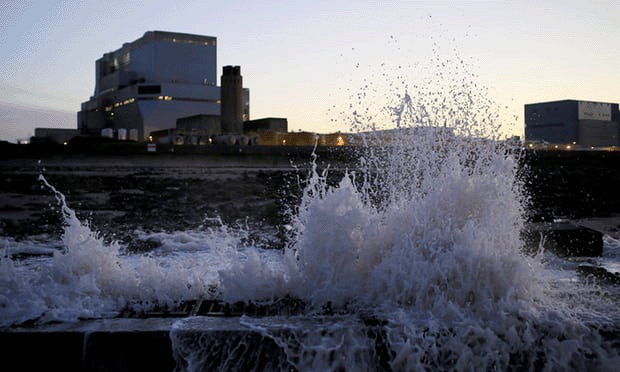
A half-mile (1km) exclusion zone has been set up in the Bristol Channel near the Hinkley Point nuclear power stations after a third unexploded second world war bomb was discovered in as many weeks.
Bomb disposal experts will carry out a controlled explosion on the 250lb (113kg) ordnance on Wednesday, two miles north-west of the power plants. HM Coastguard has set up an exclusion zone around the unexploded device and warned ships to avoid the area.
The bomb was reported in the early hours of Wednesday by a diving team from the Hinkley Point plant. They were clearing the seabed for intake and outtake pipes for cooling water for the reactors on the Hinkley Point C plant.
It is the third suspected second world war bomb to be found in the Bristol Channel in the past three weeks. An EDF source conceded that divers could find more unexploded ordnance before the exercise to clear the area was completed, as the channel was used as a former army training range. The project to clear the seabed is expected to take several more weeks. https://www.theguardian.com/world/2017/aug/30/third-wwii-bomb-bristol-channel-near-hinkley-point-nuclear
Danger of Hurrican Harvey and flooding to South Texas nuclear stations
WARNING: “Credible threat of severe accident at two nuclear reactors” due to Hurricane Harvey — “Clear potential for major disaster” — Plant “could be overwhelmed by raging flood waters” — Officials refuse to provide public with information http://enenews.com/warning-credible-threat-of-severe-accident-at-two-nuclear-reactors-due-to-hurricane-harvey-clear-potential-for-major-disaster-plant-could-be-overwhelmed-by-raging-flood-waters-of
Despite pressure from USA, U.N. nuclear watchdog sees no need to check Iran military sites
U.S. pressure or not, U.N. nuclear watchdog sees no need to check Iran military sites, http://www.reuters.com/article/us-iran-nuclear-inspections-idUSKCN1BB1JC , Francois Murphy, VIENNA , 31 Aug 17, – The United States is pushing U.N. nuclear inspectors to check military sites in Iran to verify it is not breaching its nuclear deal with world powers. But for this to happen, inspectors must believe such checks are necessary and so far they do not, officials say.
Last week, U.S. Ambassador to the United Nations Nikki Haley visited the International Atomic Energy Agency (IAEA), which is scrutinizing compliance with the 2015 agreement, as part of a review of the pact by the administration of President Donald Trump. He has called it “the worst deal ever negotiated”.
After her talks with officials of the U.N. nuclear watchdog, Haley said: “There are… numerous undeclared sites that have not been inspected. That is a problem.” Iran dismissed her demands as “merely a dream”.
The IAEA has the authority to request access to facilities in Iran, including military ones, if there are new and credible indications of banned nuclear activities there, according to officials from the agency and signatories to the deal.
But they said Washington has not provided such indications to back up its pressure on the IAEA to make such a request.
“We’re not going to visit a military site like Parchin just to send a political signal,” an IAEA official said, mentioning a military site often cited by opponents of the deal including Iran’s arch-adversary Israel and many U.S. Republicans. The deal was struck under Trump’s Democratic predecessor Barack Obama.
IAEA Director-General Yukiya Amano frequently describes his Vienna-based agency as a technical rather than a political one, underscoring the need for its work to be based on facts alone.
The accord restricts Iran’s atomic activities with a view to keeping the Islamic Republic a year’s work away from having enough enriched uranium or plutonium for a nuclear bomb, should it pull out of the accord and sprint towards making a weapon.
Adani company’s links to corruption in India
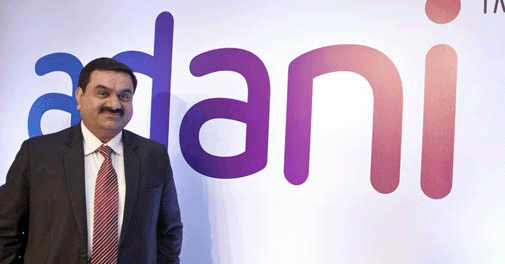 The ‘crony capitalist’: Understanding Adani — an Indian perspective, Independent Australia , 31 August 2017 Freelance Indian journalist Gaurav Tyagi charts the rise of Adani, its finances, its links to corruption and its proposed coal mines in Australia.
The rise of Adani
Adani Group, led by Gautam Adani, has risen phenomenally during the last decade. It is one of the biggest leveraged business house in India. It is very easy for corporate tycoons with proximity to political powers in India to borrow money from state controlled banks. As a result, Adani borrows a lot of capital from India’s state-owned banks.
Government banks in India have a huge problem with bad loans, wherein businessmen borrow huge capital from them but don’t pay it back, resulting in bank’s writing off these sums as non performing assets or bad loans.
Adani is the head of a conglomerate, which is India’s biggest port operator, largest private producer of electricity. The group also has substantial interests in coal mining, civil construction, logistics, international trade, education, real estate, edible oils and food storage.
Contrary to media reports about his humble origins, Gautam Adani comes from a business background. ..
According to Forbes magazine, the 55-year-old Ahmedabad-based businessman had a net worth of US$8 billion (AUD$10 billion) as at 30 August 2017.
Adani’s close links with the Indian Prime Minister
Both hailing from the Indian province of Gujarat, Gautam Adani is one of Indian Prime Minister Narendra Modi’s closest associates. During the campaigning for Indian parliamentary elections in 2014, Modi used Adani’s private aircrafts to fly around Indian for his electoral campaign. During that time, Modi made corruption by the incumbent government a big point in his election speeches…….
Adani’s Misdeeds
The biggest case involving black money (unexplained/untaxed funds) before the establishment of the SIT was that of the Adani Group.
Adani group allegedly took out over Rs (Indian rupees) 5,000 crores (1 crore = 10,000,000, therefore about AUD$1 billion) to tax havens through inflated bills for the import of power equipment from South Korea and China.
As per a senior official of SIT, if the Adani case reaches its logical conclusion the business group will be required to pay a fine of approximately Rs15,000 crores (AUD$3 billion)
He further says it’s a “watertight” case. The trail of documents shows how the Adani group diverted Rs 5,468 crores (AUD$1.1 billion) to Mauritius via Dubai after Modi became Indian Prime-Minister.
The officer heading the Ahmedabad branch was raided by Government agencies. He was accused of possessing disproportionate assets. Nothing, however, was proved against him, despite months of investigation.
The two other senior-most officers, who were looking after this case against Adani were forced out of the agency.
The service tenure of the man holding the Enforcement Directorate (ED) when the case was opened also ended abruptly. The Ahmedabad ED investigators were hot on the trail of Adani at that time……..
Conclusion
Gautam Adani is a crony capitalist. Adani’s phenomenal and rapid rise has solely been due to his proximity with the political powers in India.
Modi, the Indian Prime Minister, ensures that wrongdoings and malpractices of Adani business house go unpunished in India.
In return, Adani finances Modi’s political party, the BJP, through large scale cash donations, in which the majority goes unreported.
Modi is acting like a marketing director of Adani on his foreign trips and trying his best to get lucrative deals for Adani group globally…….
Australians should, therefore, say a firm no to Gautam Adani’s coal project in their country. If Australian politicians do not listen, then the Australian media and citizens need to rise up on serious issue.
Neither Australia nor the world needs more polluting coal plants, when environment friendly, cost effective alternatives are available in abundance.
South Asia – 1200 killed by floods
 As Storm Harvey dominates headlines, floods are devastating South Asia http://metro.co.uk/2017/08/29/as-storm-harvey-dominates-headlines-floods-are-devastating-south-asia-6887164/ {excellent photos] 29 Aug 2017

The heavy rainfall have caused deadly landslides and devastating flooding during the monsoon season – which stretches from June to Spetember.
Shocking images show the true scale of destruction in the continent.
The human toll is steadily rising across India, Nepal and Bangladesh following the latest in a series of deluges since August 10, as the annual monsoon hits the north and east of the region.
The United Nations Office for the Coordination of Humanitarian Affairs says that 41 million people will be affected by the flooding in some way.
An estimated 1,200 people have lost their lives and thousands of homes, schools and hospitals have been completely wiped out. ‘There is the possibility that the situation could deteriorate further as rains continue in some flood-affected areas and flood waters move south,’ the agency said.
The extreme weather has left around a third of Bangladesh submerged underwater.
People left without proper homes or shelter could be at risk from waterborne diseases such as malaria and diarrhoea and the waters are likely to cause food shortages and malnutrition. Bangladesh have deployed thousands of medical teams, whose main priority is survivors without access to water and sanitary facilities.
While in India, helicopters are being used to rescue stranded survivors, who may have climbed to high points during the floods.
Various flood relief camps have been set up to provide food and shelter.
Indian authorities have also revealed that endangered animals have been killed as water overwhelmed wildlife reserves.
We can no longer tolerate climate change denial
In February last year CSIRO announced massive funding cuts to its climate change research division, 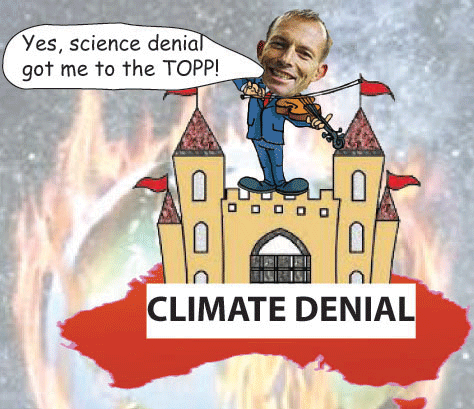 only to partially overturn the decision in the face of sustained national and international criticism. This year the government ended all funding for the National Climate Change Adaptation Research Facility.
As with America’s, Australia’s ongoing failure to deal with climate change carries practical and moral consequence. We cannot significantly cut our greenhouse gas emissions without determined national effort and we cannot engage our diplomatic expertise and might to contribute more to an international solution until we cut our emissions.
We cannot any longer afford to tolerate the scientific myopia exemplified by Mr Trump and Mr Abbott.
http://www.smh.com.au/comment/smh-editorial/we-can-no-longer-tolerate-climate-change-denial-20170829-gy6he6.html EDITORIAL AUGUST 30 2017 The United States Weather Service, normally not an agency prone to colourful language, issued an extraordinary statement on Sunday regarding hurricane Harvey, saying, “This event is unprecedented and all impacts are unknown beyond anything experienced”. It is now predicted the storm could eventually drop over 150 centimetres of rain in some areas, more than any other in the region’s history.
Far from over, it is already clear that Harvey’s impact is catastrophic. Six people are confirmed dead and that number is expected to increase. Cost estimates range up to $US100 billion.
Meanwhile flooding in Bangladesh, India and Nepal during the region’s worst monsoon season in a decade has killed an estimated 1200 people.
Climate scientists are reluctant to attribute any particular weather event to global warming, though in this case the signs are that human behaviour contributed to the formation and severity of the storm and its impact. Continue reading
Dr Jim Green debunks the hype about Generation IV new nukes
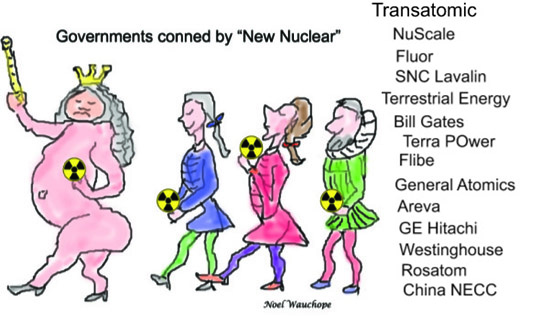 James Hansen’s Generation IV nuclear fallacies and fantasies, REneweconomy, Jim Green, 28 Aug 2017, http://reneweconomy.com.au/james-hansens-generation-iv-nuclear-fallacies-fantasies-70309/
The two young co-founders of nuclear engineering start-up Transatomic Power were embarrassed earlier this year when their claims about their molten salt reactor design were debunked, forcing some major retractions.
The claims of MIT nuclear engineering graduates Leslie Dewan and Mark Massie were trumpeted in MIT’s Technology Review under the headline, ‘What if we could build a nuclear reactor that costs half as much, consumes nuclear waste, and will never melt down?’
MIT physics professor Kord Smith debunked a number of Transatomic’s key claims. Smith says he asked Transatomic to run a test which, he says, confirmed that “their claims were completely untrue.”
Kennedy Maize wrote about Transatomic’s troubles in Power Magazine: “[T]his was another case of technology hubris, an all-to-common malady in energy, where hyperbolic claims are frequent and technology journalists all too credulous.” Pro-nuclear commentator Dan Yurman said that “other start-ups with audacious claims are likely to receive similar levels of scrutiny” and that it “may have the effect of putting other nuclear energy entrepreneurs on notice that they too may get the same enhanced levels of analysis of their claims.”
Well, yes, others making false claims about Generation IV reactor concepts might receive similar levels of scrutiny … or they might not. Arguably the greatest sin of the Transatomic founders was not that they inadvertently made false claims, but that they are young, and in Dewan’s case, female. Ageing men seem to have a free pass to peddle as much misinformation as they like without the public shaming that the Transatomic founders have been subjected to. A case in point is climate scientist James Hansen ‒ you’d struggle to find any critical commentary of his nuclear misinformation outside the environmental and anti-nuclear literature.
Hansen states that 115 new reactor start-ups would be required each year to 2050 to replace fossil fuel electricity generation ‒ a total of about 4,000 reactors. Let’s assume that Generation IV reactors do the heavy lifting, and let’s generously assume that mass production of Generation IV reactors begins in 2030. That would necessitate about 200 reactor start-ups per year from 2030 to 2050 ‒ or four every week. Good luck with that.
Moreover, the assumption that mass production of Generation IV reactors might begin in or around 2030 is unrealistic. A report by a French government authority, the Institute for Radiological Protection and Nuclear Safety, states: “There is still much R&D to be done to develop the Generation IV nuclear reactors, as well as for the fuel cycle and the associated waste management which depends on the system chosen.”
Likewise, a US Government Accountability Office report on the status of small modular reactors (SMRs) and other ‘advanced’ reactor concepts in the US concluded: “Both light water SMRs and advanced reactors face additional challenges related to the time, cost, and uncertainty associated with developing, certifying or licensing, and deploying new reactor technology, with advanced reactor designs generally facing greater challenges than light water SMR designs. It is a multi-decade process …”
An analysis recently published in the peer-reviewed literature found that the US government has wasted billions of dollars on Generation IV R&D with little to show for it. Lead researcher Dr Ahmed Abdulla, from the University of California, said that “despite repeated commitments to non-light water reactors, and substantial investments … (more than $2 billion of public money), no such design is remotely ready for deployment today.”…… http://reneweconomy.com.au/james-hansens-generation-iv-nuclear-fallacies-fantasies-70309/
1 This month


Help Aunty Sue Protect Her Land and Sacred Sites From Destructive Rocket Testing.
.

Australians deserve the truth
about
AUKUS – https://aukuspublicinquiry.com/

PETITION – To: Prime Minister Anthony Albanese and the Australian Labor Government

of the week – Australians for War Powers Reform (AWPR)
To see nuclear-related stories in greater depth and intensity

