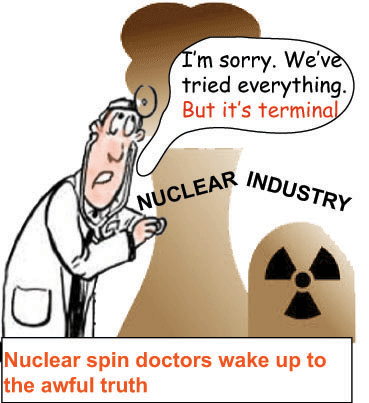
Nuclear – a dying industry
 Paul Waldon, Fight To Stop Nuclear Waste Dump In Flinders Ranges SA, 10 Jan 17 There are over 20 companies trying to produce the best solar paint, they say the product is a reality. I received a email asking if I would like to invest, but poverty stops me.
But I have to ask has anybody ever received requests if they would like to invest in a nuclear waste machine that has a byproduct called electricity.
Nuclear can NOT get investors, it relies on government handouts and other support. Wall Street won’t invest in the game, the Chemical Bank of New York went belly up investing in nuclear, and if you remove the liability cap from nuclear power generation the utilities that operate the reactors won’t want to have anything to do with the businesses, if there was a accident in a NPP IN America the utility will only have to pay about $75 million which is about 1% of what the government will spend.
‘Nuclear is death and it’s a dying industry that can’t be buried and from past history of any offers of compensation by the government is usually gone after the recipients have passed.https://www.facebook.com/groups/344452605899556/
Australia and USA trail behind in renewable energy, as China and India lead
 Interview: U.S., Australia left behind as China, India leads clean energy advancement http://www.china.org.cn/world/Off_the_Wire/2017-01/06/content_40053872.htm, January 6, 2017 While the U.S.-centric world questions renewable energy, China is leading the world in clean-power investment, driving the fledgling industry further and leverage future growth as the sane world looks to transition away from fossil fuels.
China’s domestic investment in renewable energy lifted to 103 billion U.S. dollars in 2015, outbound investment surged 60 percent year-on-year to 32 billion U.S. dollars in 2016, an Institute for Economics and Financial Analysis report showed Friday.
“This is a massive pivot by the Chinese to capitalise on technology control, industry leadership and to take their position global,” the report’s author, IEEFA’s Australasia director of energy finance studies, Tim Buckley told Xinhua.
China wants to “dominate” these industries in a positive way, Buckley said, deploying technology which is now considered the “best in the world” after years of investment.
“Chinese wind turbines are the best in the world, China produces 50-60 percent of the world’s solar modules, they are producing or installing probably half of the world’s dams as we speak,” Buckley said, adding Chinese hydroelectricity engineers are also world leaders.
China’s neighbor India has also showed ambitions on clear energy development.
Its latest national energy plan shows there will be no new coal fired power plants — other than those already under construction — over the next decade, which puts up red flags for Australia’s coal industry and Adani’s recently approved project in Australia’s Galilee Basin.
“When China is moving very very aggressively as a world leader, India is looking to replicate that and accelerate that trend as well and become the low cost manufacturer of this industry transformation, America and Australia risk getting left behind,” Buckley said.
As agreed at the COP21 Paris climate talks in 2015, the countries involved promised to ensure global warming is limited to a two degree Celsius rise through their respective emissions reductions targets. So, investment in new, clean energy technologies is critical.
Western governments such as Australia and the incoming regime of U.S. President-elect Donald Trump however are still championing fossil fuels.
Trump has named former ExxonMobil Corp. chief Rex Tillerson as his nominee for U.S. Secretary of State, while Australia’s ruling lawmakers have backed a 100 billion Australian dollar investment target to expand the local coal industry.
Buckley issued a wake-up-call to the U.S. (and Australia), stating following a mandate to move back to fossil fuels might have some short term opportunity, but it will come at significant cost to jobs, technology and investment in the future.
Buckley says Asia will pivot to renewable energy within the next decade for economic reasons, taking the lowest cost energy source going forward, which is solar.
“It’s technology driven, its policy driven, it’s unstoppable.”
Australia’s state governments are now filling the void from the lack of guidance from federal authorities to meet their self-imposed targets, the reduction in the cost of renewable energy is also making it commercially viable.
“The cost of renewables are dropping in double digit declines in cost per megawatt every year,” Buckley said.
“The cost of solar is now down to 80 or 90 Australian dollars per megawatt hour, the cost of wind is similar, only a year ago it was 30 percent higher.”
Green energy critics however contend the intermittent nature of renewables heightens energy security concerns. Australia’s government blamed the intermittent nature of renewable energy for the state-wide blackout in South Australia on Sept. 28 2016 following a violent storm.
Buckley — like previous statements by former State Grid Corp. chairman Liu Zhenya — said grid stability is not an issue, there is no technical barrier to the use of renewable energy, it just needs investment to prepare for future energy needs. Endit
Tasmania needs to be better prepared for climate change and weather extremes
 Learn fast or pay the cost
 , EDITORIAL, Mercury January 6, 2017 BEYOND the near-universal consensus that climate change is a reality that humans will increasingly have to adapt to, there is a growing realisation that a warming planet will see an increase in the frequency and intensity of weather-related natural disasters.
This is not a revelation for those who are on the frontline of dealing with disaster. The state’s second Natural Disaster Risk Assessment released in September listed bushfires and flooding as the greatest risks to the state. Not far down the list were heatwave and coastal inundation. The available evidence strongly suggests that the likelihood, frequency and severity of these events will increase as climate change becomes more pronounced.
Tasmania is no stranger to the impact of natural disaster. If the ferocity of the bushfires of 1967 are too distant a memory, we need only to think back to the devastation wrought on the Tasman Peninsula in 2013 or the fires which ravaged the state’s wilderness areas at the beginning of last year. Fresh in our memories too are last year’s floods and the terrible toll they took in terms of human life, property damage and economic disruption……..
Just across the Tasman, New Zealand’s superb civil defence preparedness for earthquakes and tsunamis might provide a useful template to improve our own.
Alongside the need to harden our infrastructure (burying critical power, phone and data wires might help for bushfire-price areas for example) getting better at dealing with disasters should become part of our DNA. We need to better integrate charities into the official response. We need to ensure our agencies are sufficiently equipped and trained and we need to make sure residents have the resources they need to be able to cope with disruption to power, water and road infrastructure. And we need to improve responses disasters over the long term — it is not good enough that the effect of last year’s floods are still being keenly felt by some on the land.
The findings of the current inquiry must be heeded. Tasmania simply cannot afford to continue to learn the same lessons time and time again.http://www.themercury.com.au/news/opinion/editorial-learn-fast-or-pay-the-cost/news-story/c88138b52b0dd6087da5066186d87621
Darwin’s hottest year on record
THE Top End sweated through the warmest year on record, according to the Bureau of Meteorology’s Annual Climate Summary for NT… (subscribers only)
http://www.ntnews.com.au/lifestyle/warmest-year-on-record-for-the-top-end/news-story/61ed1e738e8e69586f0a3703579d7c1c
2016 tipped as Australia’s hottest year
Anthropogenic climate change is accelerating, according to the Bureau of Meteorology’s latest annual climate report….. (subscribers only) http://www.theaustralian.com.au/national-affairs/climate/climate-change-on-the-march-as-scientists-tip-2016-as-hottest-year/news-story/8bb55d2bf8f24601f5a4691074d31bd9
Three reasons to STOP Adani
- Sovereignty,
- the Great Barrier Reef
- and our planet http://www.socialism.com/drupal-6.8/organiser-articles/three-reasons-stop-adani-sovereignty-great-barrier-reef-and-our-planet
Alison Thorne | The Organiser: The Australian Voice of Revolutionary Feminism January 2017:“One of the most inspiring speakers I’ve heard recently is Murrawah Maroochy Johnson,
a 20-year-old from the Wangan and Jagalingou people (WJP) of central Queensland.
She spoke passionately about the battle to stop the Carmichael mine on her ancestral lands.
Adani, an India-based multinational, plans to build one of the world’s biggest coal mines in the Galilee Basin, causing environmental devastation and reaping billions of dollars in profit. …“The groundswell of opposition to the project is growing, and the issues at stake —the sovereign rights of the Traditional Owners, – the health of the Great Barrier Reef – and the future of our only planet
—are just too great. …“We need to stop the Carmichael mine, leave the Galilee Basin coal in the ground and create a sustainable energy future based on planning. This means challenging the underpinning logic of the capitalist system. People and environment need to triumph over profit and corruption.”
South Australia’s electricity service needs complete overhaul – work with the community
Dennis Matthews, 1 Jan 17 The latest electricity debacle (The Advertiser 29/12/16) should be a red alert for business leaders in SA.
It is now glaringly obvious that the electricity industry in SA is not up to the task of delivering a safe, secure, affordable and reliable service.
The ridiculously trivial compensation doled out for failure to provide an essential service does nothing to ensure that the failure will not be repeated.
It is time for business leaders to put out-dated ideas behind them, to take off the shackles of 20th century economics and to work with the community in providing energy services that can withstand conditions such as those experienced in the last four months.
Such action is decades overdue.
Adani Corruption Probe: A Responsible Government Would Not Gamble A Billion Dollars
 https://mysunshinecoast.com.au/news/news-display/adani-corruption-probe-a-responsible-government-would-not-gamble-a-billion-dollars,47272 22nd of December 2016:
“The Queensland Greens say it beggars belief that the Federal Coalition and Queensland Labor governments would gamble a billion dollars of taxpayer’s money on Adani, a multinational company
implicated in corruption, tax evasion and ripping off consumers.
Spokesperson and candidate for Mount Coot-tha, Michael Berkman, said:
“”A responsible government would not gamble a billion dollars of taxpayer money on a company
implicated in tax evasion, fraud, corruption and consumer rip-offs.
Adani wants to rip off Queenslanders too, threatening to destroy the Reef and the 70,000 jobs that depend on its health. … “
Climate change denialists a force against clean energy in 2017
 Will 2017 be last stand of clean energy technology deniers?, REneweconomy By Giles Parkinson on 21 December 2016 “……..Two major forces stand opposed in 2017. One is the falling cost of clean energy technology – solar, wind, storage and other smart controls – that is heralding what Alan Finkel calls an “unstoppable” energy transition away from centralised, polluting fossil fuel plants.
Solar now costs less than $30/MWh in many major economies, wind energy is about the same. As Bloomberg recently pointed out, this makes them cheaper than any new generation, and cheaper than much existing generation.
Battery storage costs have fallen 50 per cent in 12 months, and energy experts are freely talking about new energy systems with concepts such as localised and shared energy, zero marginal costs, and even “free energy.” Electric vehicles, inspired by Tesla, are also on the rise with major car makers investing billions in new electric models.
The other major force is political – funded, aided and abetted by the very fossil fuel interests threatened by renewables, storage and EVs. They’ve hit the jack-pot in Washington, and when Donald Trump moves into the White House on January 20, he will be accompanied by a cabinet notable for its collection of climate change deniers, fossil fuel lobbyists and billionaires. And with the Exxon Mobil CEO and chairman as secretary of state.
It is unthinkable, and it is potentially dangerous, but there it is. Clean energy technology will never have faced greater politics headwinds than Trump’s America……
This will have an impact on Australia too. Australia finds itself at the cutting edge of this energy transition, with a huge natural and technological advantage, and even greater motivation (enormous electricity costs and a dirty inefficient grid).
But it also boasts a powerful fossil fuel incumbency. The Trump administration will encourage the climate deniers and vested interests within the ruling Coalition, and there are many.
The Frydenberg Review of climate change policies should be promising, but it has already been hamstrung by Malcolm Turnbull’s subservience to the Far Right.
The only hope will be that the review by chief scientist Alan Finkel will provide some clarity, and may actually be read by the government. Just how long will it take to sink in?……….
Solar and wind costs will continue to fall. In Australia, that could be significant as the backlog in large-scale renewables projects finally breaks: expect to see numerous large-scale solar projects, many of them displacing second tier wind developments.
“Merchant” models will be the vogue for a while, before the big retailers wake up and lock in more projects on contract, particularly as consumers rail against the soaring cost of the “green energy” component of their bill, caused only by the retailers’ own failure to invest.
But it’s not the technology that is the major concern, it is the politics, and the potential for powerful interests to bamboozle politicians and encourage them to make dumb decisions about energy choices – or in the case of the Australian federal government, no decision at all.
The Finkel review will be critical to cut through the myth-making of technology deniers and myth-makers. But it will likely take time to sink in, presuming that anyone in the Coalition actually reads it.
The mainstream media could play a constructive role, but there is not much hope there. They seem completely enthralled by incumbents and completely uninterested in the potential of new technologies.
It is disconcerting enough that most energy market and pricing regulators seem to think that their primary role is to protect the incumbent over the consumer – see the way they protect network revenue, how they demonise renewable incentives as a “transfer of wealth from the generators to the consumers…….. http://reneweconomy.com.au/will-2017-be-last-stand-of-clean-energy-technology-deniers-87502/
Nick Xenopohon slams ‘clueless and incompetent’ energy monitor AEMO
December 13, 2016. Nick Xenophon wants an independent inquiry into the energy market operator…. (subscribers only)
http://www.theaustralian.com.au/business/mining-energy/nick-xenopohon-slams-clueless-and-incompetent-energy-monitor-aemo/news-story/6265dd57cfcc67da87f5f88d39088efc
PM adds to renewable power anxiety
Peter Boyer: Talking Point:
December 13, 2016. Feds take two steps backwards by ruling out carbon price…..(subscribers only)
http://www.themercury.com.au/news/opinion/talking-point-pm-adds-to-renewable-power-anxiety/news-story/6519959f2ff4ff87f0c52acc7949197b
Time that the Sunday Mail moved beyond pro nuclear spruiking
 Dennis Matthews, 12 Dec 16, Sunday Mail’s editorial on new ideas (11/12/16) strikes me as opportunistic and misguided.
After a bankrupt and desperate SA Government spent over $10million of our money in a failed attempt to foist a nuclear dump on SA we still have people who want to go ahead not just with the dump but with the whole nuclear disaster. They want the SA Government to throw good money after bad.
In doing so they not only want to disregard the citizens jury but the heavily pro-nuclear Royal Commission, which found that the only solution was to treat SA like some third world economy, which should be grateful to import the world’s growing stockpiles of nuclear waste. A thing that no other country has done or wants to do including those that have existing nuclear industries.
The pro-nuclear Royal Commission ruled out any other part of the nuclear industry. This includes nuclear submarines, nuclear power and nuclear fuel production.
Time for the Sunday Mail to move on.
Deceptive spin in The Adelaide Advertiser, about electricity problems
| Dennis Matthews, 12 Dec 16, Bright spark Rex Jory has oh-so-cleverly concluded that SA has an electricity supply problem (The Advertiser, 12/12/16). But, like his fellow journalists at sister newspapers The Australian and Sunday Mail, Jory has put 2 and 2 together and got – zilch? Funny about that.
Did the closure of Port Augusta cause the problem? Sorry, in every 2016 electricity crisis there was plenty of surplus generation capacity. Did wind farms cause the problem? Sorry, it was electricity transmission that caused both the SA blackout and the sudden loss of supply from Victoria. Was it reliance on supply from Victoria? Maybe, but then the National Electricity Market (NEM) and inter-connectors between states were set up to smooth out supply-demand problems not exacerbate them. Fix electricity transmission, idle power station, and NEM problems and bingo! Jory and his fellow travelers will have to find some other excuse for pushing their outdated agenda.
|
Prime Minister Turnbull’s lack of priniciple – kowtows to extreme right on climate change
 PM’s kowtowing serves no one, The Age, 11 Dec 16 Generals, it’s said, lose battles by fighting the last war, and it is increasingly clear Malcolm Turnbull is fighting the hard right of the Liberal party like it is still 2009.
Back then, Mr Turnbull lost the Liberal leadership after a revolt by arch conservatives in the party over attempts to introduce a carbon emissions trading scheme. Yet despite having since won back the top job – and then an election – Mr Turnbull appears to have learnt the wrong lesson. He has decided to kowtow to those same hardline forces instead of tackling the reality of climate change.
So it was last week, after Environment Minister Josh Frydenberg flagged the sensible suggestion that the government would consider – not commit, but explore – how an emissions intensity scheme would apply in Australia’s energy markets. This is a type of carbon price that a series of recent reports have considered to meet targets for reducing greenhouse gas emissions. Economic modelling for the Australian Electricity Market Commission suggests such a scheme would save households and businesses up to $15 billion in electricity costs over a decade.
But within 36 hours, after a petulant outburst from hyper-sceptics on the Coalition backbench, Mr Turnbull had abandoned any talk of a carbon intensity scheme. In doing so he not only embarrassed Mr Frydenberg, but again left people wondering: just what, exactly, does Malcolm Turnbull stands for?……..http://www.theage.com.au/comment/the-age-editorial/pms-kowtowing-serves-no-one-20161209-gt7u62.html
Clean energy policies would create tens of thousands more Queensland jobs than Adani
The real jobs boom in Queensland is in clean energy and protecting the 70,000 jobs
that depend on a healthy Great Barrier Reef, not in Adani’s reef-wrecking coal mine.’
https://www.acf.org.au/clean_energy_tens_of_thousands_more_qld_jobs_than_adani 8 December 2016:
“New research shows strong clean energy policies would create 90,000 new jobs across Queensland by 2030
– many tens of thousands more than even the most bullish backers of Adani’s proposed Carmichael coal project say the mine would create.”
1 This month


Help Aunty Sue Protect Her Land and Sacred Sites From Destructive Rocket Testing.
.

Australians deserve the truth
about
AUKUS – https://aukuspublicinquiry.com/

PETITION – To: Prime Minister Anthony Albanese and the Australian Labor Government

of the week – Australians for War Powers Reform (AWPR)
To see nuclear-related stories in greater depth and intensity

