Nations ignore global heating, at their peril
|
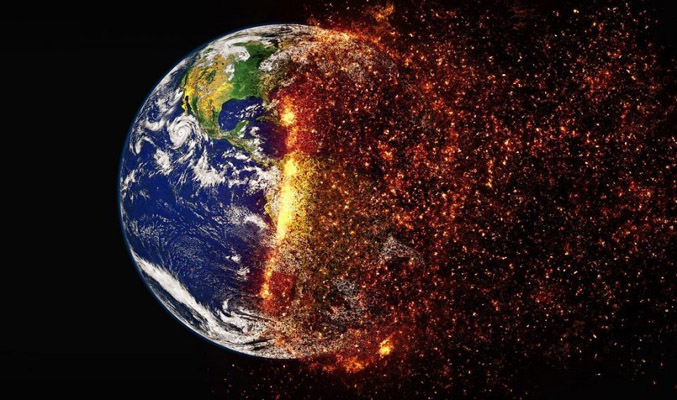
Ignoring Climate Catastrophes, Counter Punch, by ROBERT HUNZIKER NOVEMBER 8, 2019, The planet is coming apart at the seams right before the eyes of scientists at work in remote fringe areas of the North where permafrost crumbles and collapses. It’s abrupt climate change at work in real time, but the governing leaders of the world either don’t care or don’t know. If they did, there would already be a worldwide Climate Marshall Plan to save civilization from early warning signals of utter chaos.“Across 9 million square miles at the top of the planet, climate change is writing a new chapter. Arctic permafrost isn’t thawing gradually, as scientists once predicted. Geologically speaking, it’s thawing almost overnight.” (Source: Arctic Permafrost Is Thawing Fast. That Affects Us All, National Geographic, September 2019 Issue)
After all, collapsing permafrost is the leading edge of cataclysmal global warming as it precedes additional catastrophes that follow one after another, and then another. All of which happen unannounced, known as abrupt climate change events. The modern world’s First Near-Catastrophe, the Ozone Hole (1980s), was luckily avoided 40 years ago, more on this fascinating story later. It was the planet’s closest brush with nearly total extinction ever since the Permian-Triassic event took down 95% of all life 252 million years ago. Meanwhile, the concern is whether cascading permafrost will end up as the world’s Second Near-Catastrophe, meaning it gets attended to, or will it lead to something much worse, as in “catastrophes that follow one after another, and then another?” Cherskiy, Russia, which is home to the Northeast Science Station at 69°N, far above the Arctic Circle, is a year-round base for an international research station that studies Arctic biology and climate change. It is 60 miles inland from the East Siberian Sea (another high risk area in the Arctic). In January of 2018 something unheard of happened at Cherskiy. The topsoil that has maintained frozen permafrost for eons was not refreezing like it had every year for as long as records were kept. Whereas, January in Siberia is normally so brutally cold that human breath can freeze with a “tinkling sound” that locals refer to as “the whisper of stars.” “Three years ago, the temperature in the ground above our permafrost was minus 3 degrees Celsius (-27 degrees Fahrenheit),’ Sergey Zimov (an ecologist) said, ‘Then it was minus 2. Then it was minus one. This year, the temperature was plus 2 degrees,” Ibid. The aforementioned example of abrupt climate change in Siberia is a beckoning out of the North, warning that the past 10,000 years of the Holocene era, earmarked by a Goldilocks Wonder World “not too hot, not too cold,” has ended, as excessive heat tears apart regions of the planet, piece by piece. Thereby sounding the alarm and threatening comfy lifestyles in every country in existence today, but is it a warning signal with a short fuse or a long fuse? Human-generated greenhouse gases have kicked nature into high gear, competing with humanity by emitting tons of methane and carbon dioxide into the atmosphere, even in the winter in Siberia above the Arctic Circle. It’s earth-shattering news that should cause sleepless nights for world leaders, but it doesn’t alarm them. Otherwise, they’d already be taking emergency measures. They’re not! As it happens, world leadership is sacrificing their constituencies on the altar of fossil fuel profits and a brand of capitalism that recklessly consumes everything in site. Therefore emphasizing consequences such as, Alaska’s North Slope has seen temperatures spike 11°F in 30 years as temperatures hit 90°F 240 miles above the Arctic Circle, challenging Florida’s balmy weather. As the Intergovernmental Panel on Climate Change struggles to keep up with ever-faster climate change disaster scenarios that unfold right under their noses, the world’s leadership looks like a herd of deer frozen in headlights. Meanwhile, the risks of excessive global warming, or heat, is not properly understood by the public in the following ‘double-scary’ context:……. https://www.counterpunch.org/2019/11/08/ignoring-climate-catastrophes/?fbclid=IwAR2yyAMaH3W5EXqznrms5qWqG_Uku5YkE0ij8Qu93HvTnMZ6jyS2lff9CsE |
|
In Wyoming, lawmakers objecting to just a pittance for storing nuclear wastes
 Lawmakers right to hold off on nuclear waste bill https://www.powelltribune.com/stories/lawmakers-right-to-hold-off-on-nuclear-waste-bill,22189, November 7, 2019 , By CJ Baker
Offer people enough money and they’ll put up with quite a bit.
So if the State of Wyoming was offered, say, billions of dollars a year, you might find some folks willing to hold their nose and let the federal government store a bit of nuclear waste in an isolated corner of the state.
But with the feds apparently offering relative peanuts to stash their waste in Wyoming, we’re pleased that state lawmakers are backing off the idea.
On Tuesday, the Legislature’s Joint Minerals, Business & Economic Development Committee decided not to sponsor a bill that would have called on the governor’s office to try negotiating a nuclear waste deal with the feds.
Lawmakers started exploring the idea of temporarily storing spent nuclear fuel rods back in July. Things got off on the wrong foot right away, as the Joint Management Council opted to look into the concept using an unannounced vote held by email; the discussion only became public when WyoFile, a nonprofit news service, learned of and wrote about it.
We wrote in this space back in July that, while the lack of transparency was frustrating, the idea was worth exploring. However, the price has to be right. State Sen. Jim Anderson, a Republican from Casper, told WyoFile in July that Wyoming could receive as much as $1 billion a year for storing the country’s nuclear waste. That could go a long way toward relieving some of Wyoming’s budget woes.
But when the Spent Fuel Rods Subcommittee actually heard testimony on the subject in September, federal officials suggested the state might only receive $10 million a year — and a chunk of that would go to local governments, according to reporting by the Casper Star-Tribune.
Further, it was suggested that Wyoming might have a fight on its hands to even get that funding, possibly needing Congress to pass legislation and potentially facing multiple lawsuits.
On top of that, the idea drew nearly unanimous opposition from dozens of members of the public who weighed in at the meeting and via online comments.
“Keep that crap out of my state,” was one representative remark from a Casper resident.
While we believe that nuclear waste could be safely transported to and stored in Wyoming, it’s almost certain that, regardless of whatever precautions are taken and assurances given, many residents will remain wary and fearful of the idea. That means accepting spent fuel rods at a new facility here would require ramrodding legislation through the Wyoming Legislature and Congress over the top of some staunch opposition.
There’s also little question that the move would create some bad PR for Wyoming — the “toxic waste dump” jokes basically write themselves — which is a concern for a state that relies on tourism.
All of that is to say that we were a bit dumbfounded to hear that going to all that trouble would net a mere pittance in revenue.
In an interview with the Casper Star-Tribune last month, Sen. Anderson acknowledged the U.S. Department of Energy hasn’t offered enough cash.
“… if they stick to that $10 million figure, we’re not even going to pursue it,” he said.
However, Anderson suggested to the Star-Tribune that the state could
Nuclear for Newcastle? But the Hunter’s renewable energy programme is underway
The Australia Institute told the inquiry that the main problem with nuclear power is its high cost. It asserts that renewables, demand management and storage can meet Australian energy needs safely…….
In its submission to the inquiry, the People for Nuclear Disarmament said: “Nuclear technology – both nuclear weapons and nuclear reactor technology – tries to do the impossible, to assure perfection where perfection is notoriously unavailable”. …..
In Tamil Nadu, Rooftop Solar could outdo Kudankalam nuclear power plant
|
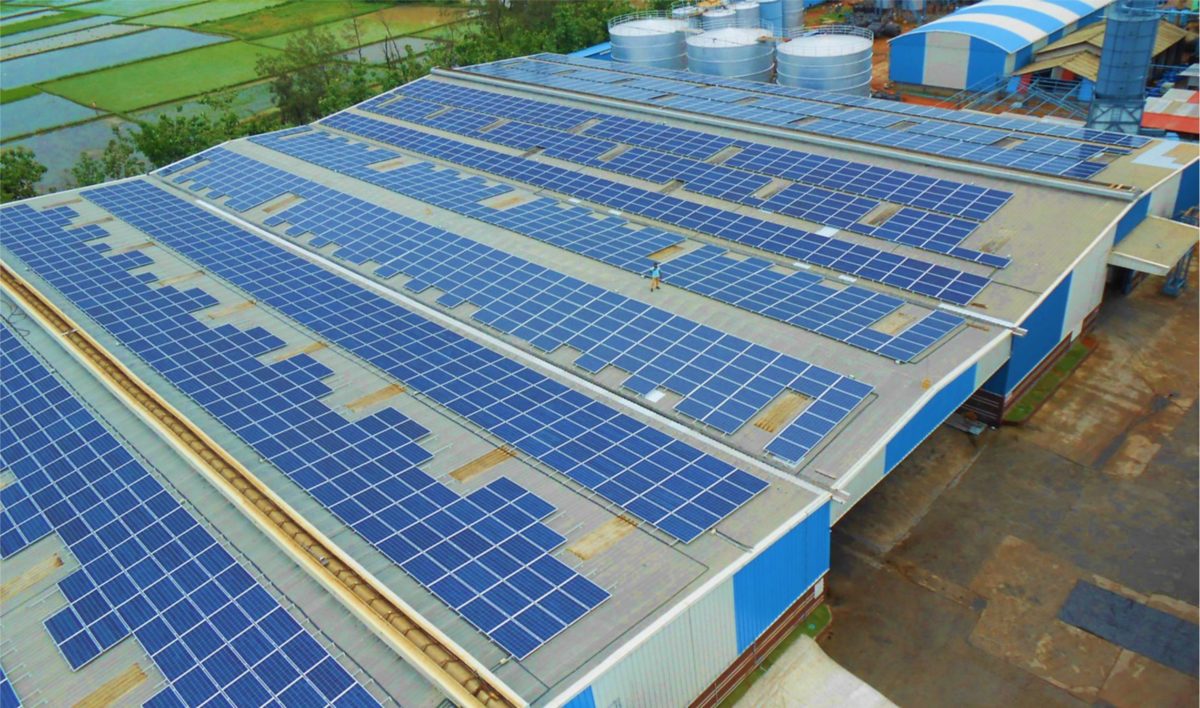
In Tamil Nadu, Rooftop Solar Has the Potential to Outdo Nuclear Power https://thewire.in/energy/tamil-nadu-rooftop-solar-nuclear-power Poonkuzhali 8 Nov 19, Tamil Nadu has said its vision is to have an installed solar powergeneration capacity of 9,000 MW by 2023. In September, India and Russia announced joint plans to set up 20 nuclear power units in the former over the next two decades. India’s nuclear establishment believes that the use of nuclear energy can only be good for the country’s industrial development and prosperity. However, nuclear isn’t the only mode of power generation that can make such a claim. Tamil Nadu is the only state in the country with two nuclear power plants: at Kalpakkam and Kudankulam. The Kalpakkam complex, commissioned by 1986, has four operating units. Two of them are of 235 MW capacity and two of 600 MW capacity. The complex’s gross generation in 2017-2018 was 1,194 MU (at 64% availability; in 2015-2016, with an availability of 97%, it generated 1,861 MU). The Kudankulam power plant is the single largest nuclear power station in India. It has two operational units of 932 MW (net) each. In 2018-2019, with an availability of 33%, it generated 2,797 MU. Tamil Nadu isn’t the sole beneficiary of the power generated by these plants. In 2016, it required 100,319 MU. It received 99,691 MU from various sources, including state, central and private, and renewable and non-renewable. Of this, nuclear power plants supplied 4,999 MU. As it turns out, it’s possible to generate this 4,999 MU from rooftop solar panels alone. On March 31, 2017, Tamil Nadu had the highest installed capacity of grid-connected renewable power (10,562.39 MW), followed by a distant Maharashtra (7,647.60 MW), thanks to wind energy. According to a 2014 book by S. Gandhi, former president of the Electrical Engineers’ Association of the Tamil Nadu Electricity Board, a 1-MW panel in Tamil Nadu produces 1.5 MU per year on average. This conversion accounts for various factors, including that power production happens only during the day and that production efficiency varies according to the season. Extrapolating from the book, to produce 4,999 MU, Tamil Nadu needs an installed capacity of 3,333 MW. A 1-kW solar panel over 1,000 roofs can produce 1 MW, so to produce 3,333 MW, we need to install 1-kW solar panels over 3,333,000 roofs. A 1-kW rooftop panel requires about 100 sq. ft. According to state data, there are 2,392,457 buildings in town panchayats alone. Including the total area of all rooftops in Tamil Nadu’s urban centres, and assuming all roofs will generate 10 W/sq. ft., solar power should be easily able to provide the requisite 3,333 MW. The Government of India and various state governments have consistently presented nuclear power as a safe, sustainable and preferable alternative to coal power. However, while nuclear power plants have very low carbon emissions and have historically caused the fewest fatalities, these advantages are substantially offset by the cost of disposing radioactive waste and an opaque administrative setup in India that has often disprivileged marginalised communities living around power generation complexes. On the other hand, the biggest downsides of solar power generation are that solar panels lower the productivity of the land they’re setup on, and the batteries used to store power contain toxic materials whose extraction and processing has harmed people in other, often poorer, countries. But both issues are quickly resolved in the current example. The question of land productivity doesn’t apply since the panels are to be installed on rooftops. Second, in its solar energy policy published in February 2019, the Tamil Nadu government declared it now has the technology to support grid-connected solar panels on a large scale. This means even domestic solar panels can be connected to the grid, obviating the need for power storage batteries. According to its policy, the state government says its vision is to have an installed solar power generation capacity of 9,000 MW by 2023. As of today, the Tamil Nadu government requires every new building erected in the state to be equipped with a rainwater harvesting system. If lawmakers issue a similar mandate vis-à-vis solar panels, at least for apartment complexes and non-residential buildings, Tamil Nadu could soon be self-sufficient about its energy needs, if not produce a surplus it can sell to its neighbours. Poonkuzhali is a writer and activist based in Chennai. |
|
Farmers fight against nuclear industry plan to take groundwater
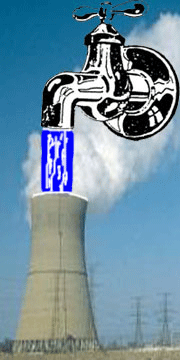 West Valley farmers fight APS attempt to take water for nuclear , RoseLawGroup Reporter, plant https://roselawgroupreporter.com/2019/11/west-valley-farmers-fight-aps-attempt-to-take-water-for-nuclear-plant/ Posted by Staff / November 6, 2019 By Ryan Randazzo | Arizona Republic Arizona Public Service Co. has applied to pump “poor-quality” groundwater from the West Valley that the company says Buckeye farmers are wasting. But the farmers say the water is neither poor nor wasted.
APS wants to take some of the high-saline water from underground and test whether it is cost effective to use at the Palo Verde Nuclear Generating Station about 50 miles west of Phoenix.
Unlike most nuclear facilities that use river or seawater to cool the reactors, Palo Verde uses treated effluent water.
Right now, it gets all of its water from the 91st Avenue Wastewater Treatment Plant. But the cost of that treated effluent water is going to increase over time, so the plant is seeking alternatives.
“If we don’t get some kind of innovative approach to water, 20 or 30 years down the road, the costs would just be prohibitive,” said Jack Cadogan, senior vice president of site operations at Palo Verde for APS. “We’ve always known we would be looking for innovative, cost-effective solutions for water.”…….
Global heating brings radioactive threat from Pentagon’s secret nuclear city
CAMP CENTURY: CLIMATE AND ICE MONITORING
Next Chernobyl? Frozen nuclear city to ‘seep radiation into environment’ as ice melts
A FROZEN underground city could be threatening to seep radioactive materials into the environment as climate change forces the ice to melt. Express UK By CALLUM HOARE Nov 8, 2019
Project Icework was a top secret United States Army programme of the Cold War, aimed at building a network of mobile nuclear missile launch sites below the Greenland ice sheet due to its strategic location near the Soviet Union. To study the feasibility of working under the ice, a highly publicised “cover” project, known as Camp Century, was launched in 1960, but six years later it was cancelled due to unstable conditions. The nuclear reactor was removed before the site was abandoned, but hundreds of tonnes of toxic waste remain buried beneath the ice.
Now, climate change is threatening to expose it, as the ice melts at an alarming rate.
YouTube channel Seeker spoke to William Colgan, who is currently running The Camp Century Climate Monitoring Programme, in the hope of preventing the radioactive material from reaching the surface.
He said in 2018: “The people working at Camp Century did not have an understanding of climate change. “They didn’t have solid records, global climate models, these big data sets so you can see an overview of what’s happening to Earth’s climate.
The moving ice sheet started to destabilise the underground tunnels, prompting the US Army to abort Project Iceworm.
“When Camp Century was decommissioned, only the nuclear reactor was taken out for destructive testing, and the rest of the camp was left in place, and they closed the doors.
“It was abandoned on the assumption that climate wouldn’t change, and it would continue to snow at Camp Century forever and the perpetual snowfall would entomb all of the base infrastructures and eventually bury it.”
The narrator of the series explained why Dr Colgan is so invested in the project.
He said: “The climate has changed and temperatures have reached record highs in the Arctic and Greenland’s ice sheet is melting at an unprecedented rate, which could turn Camp Century’s abandoned waste into a major environmental risk.
So a team of scientists, including William, went back to the site.”
Dr Colgan explained what his team is doing.
He added: “In 2017, the government of Denmark, at the request of the government of Greenland, started the Camp Century Climate Monitoring Programme.
“We set up a bunch of instruments that are erected on the ice sheet surface and then we drill in and we put probes into the ice sheet.
“It keeps a real-time data stream coming from the Camp Century site where we monitor a bunch of things, mainly the temperature of the snow, the temperature of the ice and the air temperature…….https://www.express.co.uk/news/science/1201199/nuclear-warning-cold-war-camp-century-project-iceworm-radiation-climate-change-spt
Drought, climate change Some questions on the incompetence of the Morrison government
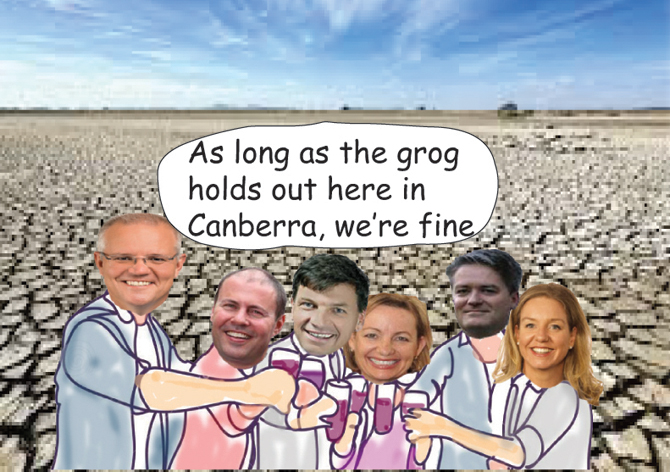 Desert Woman,7 Nov 19 I have a feeling that things may become very interesting quite soon. They have finally been shamed into putting actual money, not words or promises, into the poor old country as 11,000 scientists issue yet another warning in no uncertain terms, and last night we had Greg Mullins telling them there is a fire disaster coming their way. They will learn that all their huffing and puffing has run out of puff as events and angry, frustrated people simply run over them.
Where are all the trucks and water that are going to be required to water towns that have run out? Where are all the fire refugees going to go after there was no water to fight the fires and the nearby towns have also run dry? Where are all the supports going to come from when every state has its own disasters and the USA for example is fighting fires in the winter? And that doesn’t even touch upon the newly impoverished as more crops and small towns fail and epidemics stalk the land. https://independentaustralia.net/politics/politics-display/protesting-and-boycotting-the-morrison-government-way,13287
Deadline looms for New Zealand nuclear veterans and descendants study
The study lead by University of Otago associate professor David McBride will look into the connection between nuclear veterans and their children, who may have been affected by their parents’ exposure to radiation.
So far only 166 people had signed up, according to Mururoa Nuclear Veterans president Gavin Smith.
Mr Smith implored more to join, saying about 500 people went to the Christmas Island and were exposed to nuclear tests in the 1950s and about 500 went to Mururoa during the 1970s.
“Everyone who has a veteran father or grandfather that served there and has maybe deceased or may be living but mentioned nothing of it, I urge them to contact the University of Otago,” he said.
He said the study was crucial because veteran’s children may have been affected by their parents’ exposure to radiation, which could make their offspring more susceptible to conditions like leukaemia and auto-immune diseases.
“Our study is open to all nuclear veterans. If we don’t do it in our generation, it’s going to be an even bigger battle for the next generation.”
The group, which was established in 2013 to press the government to help families with nuclear related illnesses, had 135 members who served at the protest.
Of those, 56 had children or grandchildren with unexplained medical conditions.
Testing would begin next week at the University of Otago, with a timeframe and details on the study yet to be confirmed.
Wyoming Bill to authorize nuclear waste storage talks withdrawn
Members of the Legislature’s Joint Minerals Business and Economic Development Committee agreed to stop work on the bill after its Spent Fuel Rods Subcommittee, formed to examine the issue, met in September.
Sen. Jim Anderson, R-Casper, a chairman of both the committee and subcommittee, told committee members that based on what the subcommittee heard during its meeting, legislative authorization for the state to enter into negotiations over spent nuclear fuel storage is not needed.
“I have prepared a bill as the chairman if the committee to give the governor’s office authority to negotiate with (the federal Department of Energy) on this subject,” he said. “I found out that we really don’t need to give the governor’s office the authority, that they have the authority right now. So at this time, I would like to withdraw that bill from the docket.”
Anderson also told the committee that any negotiations could take five to nine years to complete.
Anderson noted that there are no plans for Gov. Mark Gordon to open negotiations with the Department of Energy about the waste storage.
The idea of storing spent nuclear fuel in Wyoming has surfaced several times over the last three decades and each time, it has generated strong opposition.
Opponents to the plan were on hand for Tuesday and said they were prepared to argue that any rewards from accepting spent nuclear fuel would be outweighed by the risks.
“The biggest issue for me and the state of Nebraska, who says they don’t want a dry cask storage place to get the transportation coming through, it’s the transportation,” said Coleen Whalen, a spokesperson for Wyoming Against Nuclear Dumps. “It’s going to get off on I-80 and I-25 on our teeny little highways“
Whalen said she was pleased the committee killed the bill, but unsure of how the issue would unfold going forward.
“The bill kind of came up quick and the withdrawal of it, I’m glad they are not telling the governor to negotiate, but it could be that they are just moving it out of the public eye,” she said.
Storing nuclear waste is an economic liability for a State, not a benefit
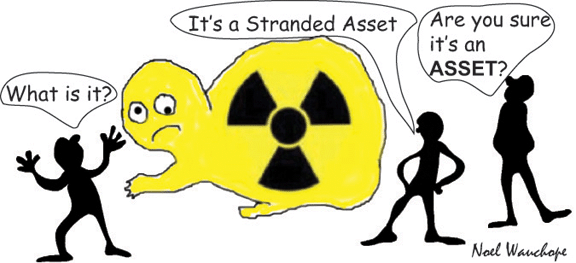
Kessler: Nuclear waste storage provides no benefit for Wyoming, https://trib.com/opinion/columns/kessler-nuclear-waste-storage-provides-no-benefit-for-wyoming/article_4267cc9f-a2f8-54e5-a2d6-7ebe2fe9f9eb.html Star Tribune, 2 Nov 19
There’s no doubt that Wyoming needs to find new revenue sources to fund our schools and state budget, but storing nuclear waste is not the answer. It’s a far-fetched proposal riddled with legal roadblocks. And even if we ignore those roadblocks — along with the many safety and political risks of storing high-level radioactive waste — there’s no real money in it for Wyoming.
For starters, the Nuclear Waste Policy Act, which regulates the storage of spent fuel rods from commercial nuclear reactors, makes available just $5 million per year to states willing to host a “monitored retrievable storage” facility during the construction phase. Once such a facility starts accepting the waste, that amount increases to just $10 million per year. This is a far cry from the $1 billion per year proponents claim Wyoming would see.
That’s assuming such a facility can even legally be constructed. The act also prohibits building a temporary facility until a permanent disposal repository, such as the one proposed for Yucca Mountain in Nevada, starts construction. But licensing work on Yucca Mountain has stalled; Congress hasn’t authorized any funding for it in recent years.
To build a storage facility in Wyoming, we’d have to get Congress to change the law in our favor and give us 100 times the amount of cash authorized in the act. That’s not likely. In the last three years, more than a dozen bills have been introduced in Congress to amend the Nuclear Waste Policy Act and address this topic. They’ve all failed. Nuclear utilities are likely the biggest opponents: Fees collected for the act’s Nuclear Waste Fund are predominantly meant to fund a permanent disposal solution — not something temporary.
But assume we could actually convince Congress to change the law to allow a monitored retrievable storage site here. Then what? Chances are we’d be stuck with those spent fuel rods for good. That’s because there are no legal, political or financial mechanisms to ensure that, once accepted, high-level radioactive waste would ever be removed. Wyoming would likely become the new Yucca Mountain – not a place to hold nuclear waste temporarily, but a de facto permanent disposal site.
The proposal also ignores serious transportation safety concerns. At no time in our nation’s history would so much high-level radioactive waste be on our roads and rails — and traveling such great distances. So far, the federal government has failed to adopt the enhanced transportation safeguards suggested by the Western Governors’ Association, the bipartisan Blue Ribbon Commission on American’s Nuclear Future, the National Academy of Sciences and the Nevada Agency for Nuclear Projects. There is much work to be done ahead of any attempt to safely ship spent fuel rods across the country. As a recent government report concluded: “The transportation of large amounts of spent fuel to an interim storage or permanent disposal location is inherently complex and the planning and implementation may take decades to accomplish.”
“Can we trust the federal government or the assurance of negotiation to protect our citizens’ interests? To do so would disregard the geographical voting power in Congress and 100 years of history and experience… Are we willing to ignore the experience history would provide us for the siren song of promised economic benefits and a policy that is clearly a moving target? As Governor, I am not.”
In Wyoming, we need a vision for our future that embraces the assets that truly make us a place where people want to live, move to and do business: our strong public schools, workforce, wildlife, open spaces, livable communities, agricultural legacy and outdoor way of life. This is what makes Wyoming the envy of many other places. Instead of jeopardizing our heritage and tarnishing our state’s image, we need to protect and build upon these assets. Storing nuclear waste invites regulatory, political, safety and economic diversification risks — while providing Wyoming no real benefits. We urge the Legislature to reject spending any more time or resources on such a misguided idea.
A nuclear war in space would be catastrophic for the human civilisation
Bruce Gagnon ‘War in Space’ interview
Nuclear space war ‘would wipe out humans in days with Earth becoming Hiroshima’
https://www.dailystar.co.uk/news/weird-news/nuclear-space-war-would-wipe-20765135 A fierce critic of the Space Force says the Earth would “burn” and turn into a Hiroshima-style landscape should a nuclear war erupt, By Katy Gill, Video News Reporter, 3 NOV 2019,
A nuclear war in space would be catastrophic for the human civilisation as Earth would transform into a Hiroshima-style landscape with humans being wiped out in a matter of days.
That’s according to Bruce Gagnon, the co-founder and coordinator of the Global Network Against Weapons & Nuclear Power in Space.
US President Donald Trump has repeatedly said he is hoping to create the sixth branch of the US military – the Space Force – in 2020 to, among other things, protect satellites in space from other nations.
There are those that believe new fleets of military craft are already being built, pointing to various UFO sightings across the US in recent months.
But Bruce thinks it could open the doors for a new domain of warfare – with the consequences being devastating.
He explained to Daily Star Online that if a nuclear war erupted above Earth, “everything would burn”.
“The cities are burning, the forests are burning, the planet is burning,” he added.
“There’s no food, you can’t grow anything, everything poison, everything radioactive, we all die.” Bruce spoke of how food production will immediately halt because of the atmosphere burning up and affecting crops.
This will lead crowds of people to raid their local supermarkets.
“How long is that going to last? How long do we have after that?” he asked.
“Probably a few days. Not much longer than that. It’s going to happen fast.Who wants to be alive when the whole world looks like Hiroshima?”
Bruce said after the fire’s smoke and debris floods into the atmosphere it will block the sun.
This would eventually see the Earth freeze because the sun is no longer visible to the planet.
“So the Earth freezes and you have whatever is left after this nuclear war is finished,” he added.
In the past, Bruce told the site that USAF is “creating a new generation of space soldiers by indoctrinating kids“.
Greta Thunberg and Leonardo DiCaprio -climate crusaders together

Greta Thunberg, Leonardo DiCaprio unite in climate crusade, SBS News, 3 Nov 19 The Hollywood star said the pair has made a commitment to support one another in their fight for climate action.
Hollywood A-lister Leonard DiCaprio met Swedish teen activist Greta Thunberg in California, capturing the moment on DiCaprio’s Instagram.
He posted that the pair have joined forces “in hopes of securing a brighter future for our planet”.
DiCaprio, who recently pledged $7 million to preserve the Amazon rainforest yet is widely criticised for his use of private jets, said he was honoured to meet the young climate activist.
“There are few times in human history where voices are amplified at such pivotal moments and in such transformational ways but Greta Thunberg has become a leader of our time,” he wrote on Instagram. …… DiCaprio said he hoped the 16-year-old’s message was a wake-up call to leaders everywhere that “the time for inaction is over”.
“It is because of Greta, and young activists everywhere that I am optimistic about what the future holds,” he wrote on Instagram. HTTPS://WWW.SBS.COM.AU/NEWS/GRETA-THUNBERG-LEONARDO-DICAPRIO-UNITE-IN-CLIMATE-CRUSADE
If Emissions Continue, India Could See 1 Million Heat Deaths a Year
Premature deaths from extreme heat next century could top those from infectious diseases today, A new study predicts there’ll be more than 1 million deaths a year from extreme heat in India by the next century if greenhouse gas emissions continue at their current level.Research by the Climate Impact Lab with the University of Chicago’s Tata Centre for Development projects India’s average annual temperature will rise 4 degrees by 2100.
When broken down by location, 16 of India’s 36 states and union territories will become hotter than Punjab, which is currently the hottest state, with an average annual summer temperature around 90 degrees Fahrenheit (32 degrees Celsius).
As temperatures rise, the number of extremely hot days is expected to rise, as well.
The state of Odisha will see the highest increase, with an average of 48.05 hot days by 2100 compared with 1.62 in 2010. Delhi is projected to experience 22 times as many days with extreme heat, and Haryana is estimated to see 20 times as many days.
The study estimates the combination of hotter summers and more high-heat days will contribute to more than 1.5 million deaths each year by 2100.
The projected death rate is as high as the current death rate from all infectious diseases in India today. Six states—Uttar Pradesh, Bihar, Rajasthan, Andhra Pradesh, Madhya Pradesh and Maharashtra—are expected to contribute to more than half of the excess death rate from rising temperatures.
“Having already seen 2,500 deaths due to a heat wave in 2015, the future is projected to be even more worrying if India—and the world—does not change course to mitigate the harmful effects of climate change,” said Amir Jina of the Climate Impact Lab.
If the world commits to the Paris Agreement and regularly updates its commitments, the study estimates India’s excess death rate from high heat will drop more than 80%.
The study comes as India’s energy use is expected to more than double by 2040, with fossil fuels serving as the main source.
The country’s 5% increase in coal demand last year contributed to a nearly equal percentage in its carbon emissions. India is currently the world’s third-largest carbon emitter (Climatewire, Aug. 14).
Michael Greenstone, faculty director at the Tata Centre and a co-founder of the Climate Impact Lab, said the continued reliance on fossil fuels will harm India in the years to come. The need to balance cheap and reliable energy sources while managing climate risks, he said, is “perhaps the defining challenge of our generation.”
Climate change is exacerbating California’s wildfires
California wildfires: Climate change driving ‘horror and the terror’ of devastating blazes, say scientists
Fires are not new, but their severity is, The Independent, Andrew Buncombe, Seattle @AndrewBuncombe 3 Nov 19,
The words from California’s former governor could barely have been more stark.
“I said it was the new normal a few years ago,’’ says Jerry Brown. “This is serious, but this is only the beginning. This is only a taste of the horror and the terror that will occur in decades.”
As firefighters in California continue to confront a three-week spate of blazes that has reached across the state, attention has also turned to why this year’s wildfires have been so severe. The reason, according to scientists, is climate change.
“It’s warmer weather, more evaporation, and drier conditions. They just burn more,” says Park Williams, a bioclimatologist at Columbia University. The words from California’s former governor could barely have been more stark.
“I said it was the new normal a few years ago,’’ says Jerry Brown. “This is serious, but this is only the beginning. This is only a taste of the horror and the terror that will occur in decades.”
As firefighters in California continue to confront a three-week spate of blazes that has reached across the state, attention has also turned to why this year’s wildfires have been so severe. The reason, according to scientists, is climate change.
“It’s warmer weather, more evaporation, and drier conditions. They just burn more,” says Park Williams, a bioclimatologist at Columbia University. “And we expect this trend to continue. We can’t say if it will happen every year – there are natural variations as well. But we know that when things are drier, a larger area burns.”
Speaking from New York, Williams adds: “We’ve always had the fires. But things are now two or three degrees hotter. That’s enough to make a major difference.”
As Donald Trump continues to refuse to acknowledge the existence of man-made climate change, and as Jay Inslee, the only Democrat running for president on a ticket to address climate change, dropped out of the race this autumn, residents of California and other western states are trying to figure out how to confront the challenge, not just this year but in the years and decades ahead.
The editorial writers at the Los Angeles Times have echoed the words of the former governor, who spoke to Politico, by declaring: “Climate change has set California on fire. Are you paying attention?”
“Nobody can honestly say this is a surprise, given the devastating fires of recent years. Yet it feels surprising all the same. How did things get so bad in California, so quickly,” they write. “The answer is climate change. It is here and our communities are not ready for it.”……..
Michael Mann, a climate expert and professor of Earth sciences at Penn State University, says in the American west climate change has increased the risk of fire weather fivefold and doubled how much land has burned. Wildfire frequency, he says, has quadrupled since the 1980s……..
Asked how such fires could be countered, he replies: “As long as we continue to emit carbon into the atmosphere, and create warmer, drier conditions in California, there is little question that we’ll see a worsening of wildfires.
“The only true solution is to stop burning fossil fuels, generating greenhouse gases, and warming the planet.”
Last year, the world’s leading climate scientists said the world had barely a dozen years to act to make massive changes to global energy infrastructure to limit global warming to moderate levels. “There is no documented historic precedent,” said the United Nations’ Intergovernmental Panel on Climate Change……. https://www.independent.co.uk/news/world/americas/california-wildfire-climate-change-evacuation-santa-ana-winds-devil-diablo-a9181886.html
Marshall Islands may take legal action over radiation leaking from nuclear waste dome
This Concrete Dome Holds A Leaking Toxic Timebomb | Foreign Correspondent
Leaking nuclear waste dome: Marshalls consider legal action https://www.rnz.co.nz/international/pacific-news/402002/leaking-nuclear-waste-dome-marshalls-consider-legal-action
But according to the Marshall Islands Nuclear Commission, more than 99 per cent of the waste has seeped into the atoll’s lagoon.
Commission’s chair Rhea Moss-Christian said the Marshall Islands was exploring legal remedies to obtain compensation from the US government.
“The political environment is always changing. We don’t know what the future brings. But as a nation that is still dealing with the impacts, we can’t afford to sit back and accept that there’s nothing further that can be done.”
The Runit Dome on Enewetak atoll was used to store radioactive materials left over from US nuclear weapons testing during the 1940s and ’50s.
But according to the Marshall Islands Nuclear Commission, more than 99 per cent of the waste has seeped into the atoll’s lagoon.
Commission’s chair Rhea Moss-Christian said the Marshall Islands was exploring legal remedies to obtain compensation from the US government.
“The political environment is always changing. We don’t know what the future brings. But as a nation that is still dealing with the impacts, we can’t afford to sit back and accept that there’s nothing further that can be done.”
The Pacific Islands Forum Chair, Dame Meg Taylor, has called for an independent audit into the Runit Dome. Her UN counterpart, Antonio Guterres, has also raised concerns about the potential radioactive fallout.
The Nuclear Commission is due to start work in November on an impact study of the dome which will take up to three years.
The commission’s report highlighted a number of ongoing impacts of American nuclear weapons testing, including forced migration and high rates of cancer it said had been exacerbated by US refusal of requests for assistance with cancer treatment facilities.
“The absence of cancer care facilities and its link to forced migration are deplorable, and it means that the violence of the testing program continues despite the cessation of weapons testing,” the report said.
It also called for broader support with compensation for victims of nuclear testing, adding that Marshall Islands officials would raise nuclear justice in all official discussions with the US government.
According to the report, a US-funded Nuclear Claims Tribunal ended payments in 2009, leaving more than $US2.2 billion in unpaid compensation.
The Marshall Islands will also request UN agencies conduct its study of radiation levels in nuclear testing sites and their impact on communities.
Establishing a National Nuclear Archive would also be explored, as well as a memorial or monument “commemorate the hundreds of Marshallese who sacrificed their health and homeland for the U.S. nuclear weapons testing program”.
Ms Moss-Christian said the Marshall Islands’ election to the UN Human Rights Council earlier this month provided a new platform for seeking assistance.
“Compensation is definitely a priority for affected communities. There are also other forms of nuclear justice, and some of those areas are where the UN can step in and provide assistance,” she said.
1 This month

of the week – Australians for War Powers Reform (AWPR)
To see nuclear-related stories in greater depth and intensity
 Antinuclear