Once again, Australian government wages nuclear war on Aboriginal people
The plan to turn South Australia into the world’s nuclear waste dump has been met with near-unanimous opposition from Aboriginal people.
The Royal Commission acknowledged strong Aboriginal opposition to its nuclear waste proposal in its final report – but it treats that opposition not as a red light but as an obstacle to be circumvented.
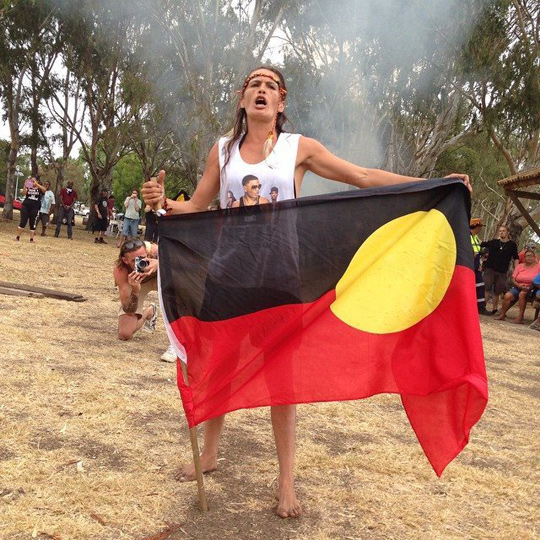

 Radioactive waste and the nuclear war on Australia’s Aboriginal people, Ecologist Jim Green 1st July 2016
Australia’s nuclear industry has a shameful history of ‘radioactive racism’ that dates from the British bomb tests in the 1950s, writes Jim Green. The same attitudes persist today with plans to dump over half a million tonnes of high and intermediate level nuclear waste on Aboriginal land, and open new uranium mines. But now Aboriginal peoples and traditional land owners are fighting back!
Then the government tried to impose a dump on Aboriginal land in the Northern Territory, but that also failed.
Now the government has embarked on its third attempt and once again it is trying to impose a dump on Aboriginal land despite clear opposition from Traditional Owners. The latest proposal is for a dump in the spectacular Flinders Ranges, 400 km north of Adelaide in South Australia, on the land of the Adnyamathanha Traditional Owners.
The government says that no group will have a right of veto, which is coded racism: it means that the dump may go ahead despite the government’s acknowledgement that “almost all Indigenous community members surveyed are strongly opposed to the site continuing.”
The proposed dump site was nominated by former Liberal Party politician Grant Chapman but he has precious little connection to the land. Conversely, the land has been precious to Adnyamathanha Traditional Owners for millennia.
It was like somebody ripped my heart out’
The site is adjacent to the Yappala Indigenous Protected Area (IPA). “The IPA is right on the fence – there’s a waterhole that is shared by both properties”, said Yappala Station resident and Adnyamathanha Traditional Owner Regina McKenzie.
The waterhole – a traditional women’s site and healing place – is one of many archeological and culturally significant sites in the area that Traditional Owners have registered with the South Australian government over the past six years. Two Adnyamathanha associations – Viliwarinha Aboriginal Corporation and the Anggumathanha Camp Law Mob – wrote in November 2015 statement:
“Adnyamathanha land in the Flinders Ranges has been short-listed for a national nuclear waste dump. The land was nominated by former Liberal Party Senator Grant Chapman. Adnyamathanha Traditional Owners weren’t consulted. Even Traditional Owners who live next to the proposed dump site at Yappala Station weren’t consulted. This is an insult.
“The whole area is Adnyamathanha land. It is Arngurla Yarta (spiritual land). The proposed dump site has springs. It also has ancient mound springs. It has countless thousands of Aboriginal artefects. Our ancestors are buried there.
“Hookina creek that runs along the nominated site is a significant women’s site. It is a registered heritage site and must be preserved and protected. We are responsible for this area, the land and animals.
“We don’t want a nuclear waste dump here on our country and worry that if the waste comes here it will harm our environment and muda (our lore, our creation, our everything). We call on the federal government to withdraw the nomination of the site and to show more respect in future.”
Regina McKenzie describes getting the news that the Flinders Ranges site had been chosen from a short-list of six sites across Australia: “We were devastated, it was like somebody had rang us up and told us somebody had passed away. My niece rang me crying … it was like somebody ripped my heart out.”
McKenzie said on ABC television: “Almost every waste dump is near an Aboriginal community. It’s like, yeah, they’re only a bunch of blacks, they’re only a bunch of Abos, so we’ll put it there. Don’t you think that’s a little bit confronting for us when it happens to us all the time? Can’t they just leave my people alone?”
Adnyamathanha Traditional Owner Dr Jillian Marsh said in an April 2016 statement:
“The First Nations people of Australia have been bullied and pushed around, forcibly removed from their families and their country, denied access and the right to care for their own land for over 200 years. Our health and wellbeing compares with third world countries, our people crowd the jails. Nobody wants toxic waste in their back yard, this is true the world over. We stand in solidarity with people across this country and across the globe who want sustainable futures for communities, we will not be moved.”
The battle over the proposed dump site in the Flinders Ranges will probably be resolved over the next 12 months. If the government fails in its third attempt to impose a dump against the wishes of Aboriginal Traditional Owners, we can only assume on past form that a fourth attempt will ensue……
Now Aboriginal people in South Australia face the imposition of a national nuclear waste dump as well as a plan to import 138,000 tonnes of high-level nuclear waste and 390,000 cubic metres of intermediate level waste for storage and disposal as a commercial venture.
The plan is being driven by the South Australian government, which last year established a Royal Commission to provide a fig-leaf of independent supporting advice. The Royal Commissioner is a nuclear advocate and the majority of the members of the Expert Advisory Committee are strident nuclear advocates.
Indeed it seems as if the Royal Commissioner sought out the dopiest nuclear advocates he could find to put on the Expert Advisory Committee: one thinks nuclear power is safer than solar, another thinks that nuclear power doesn’t pose a weapons proliferation risk, and a third was insisting that there was no credible risk of a serious accident at Fukushima even as nuclear meltdown was in full swing.
Announcing the establishment of the Royal Commission in March 2015, South Australian Premier Jay Weatherill said: “We have a specific mandate to consult with Aboriginal communities and there are great sensitivities here. I mean we’ve had the use and abuse of the lands of the Maralinga Tjarutja people by the British when they tested their atomic weapons.”
Yet the South Australian government’s handling of the Royal Commission process systematically disenfranchised Aboriginal people. The truncated timeline for providing feedback on draft Terms of Reference disadvantaged people in remote regions, people with little or no access to email and internet, and people for whom English is a second language. There was no translation of the draft Terms of Reference, and a regional communications and engagement strategy was not developed or implemented.
Aboriginal people repeatedly expressed frustration with the Royal Commission process. One example (of many) is the submission of the Anggumathanha Camp Law Mob (who are also fighting against the plan for a national nuclear waste dump on their land):
“Why we are not satisfied with the way this Royal Commission has been conducted:
Yaiinidlha Udnyu ngawarla wanggaanggu, wanhanga Yura Ngawarla wanggaanggu? – always in English, where’s the Yura Ngawarla (our first language)?
“The issues of engagement are many. To date we have found the process of engagement used by the Royal Commission to be very off putting as it’s been run in a real Udnyu (whitefella) way. Timelines are short, information is hard to access, there is no interpreter service available, and the meetings have been very poorly advertised. …
“A closed and secretive approach makes engagement difficult for the average person on the street, and near impossible for Aboriginal people to participate.”
The plan to turn South Australia into the world’s nuclear waste dump has been met with near-unanimous opposition from Aboriginal people. The Aboriginal Congress of South Australia, comprising people from many Aboriginal groups across the state, endorsed the following resolution at an August 2015 meeting:
“We, as native title representatives of lands and waters of South Australia, stand firmly in opposition to nuclear developments on our country, including all plans to expand uranium mining, and implement nuclear reactors and nuclear waste dumps on our land. … Many of us suffer to this day the devastating effects of the nuclear industry and continue to be subject to it through extensive uranium mining on our lands and country that has been contaminated.
“We view any further expansion of industry as an imposition on our country, our people, our environment, our culture and our history. We also view it as a blatant disregard for our rights under various legislative instruments, including the founding principles of this state.”
The Royal Commission acknowledged strong Aboriginal opposition to its nuclear waste proposal in its final report – but it treats that opposition not as a red light but as an obstacle to be circumvented.http://www.theecologist.org/News/news_analysis/2987853/radioactive_waste_and_the_nuclear_war_on_australias_aboriginal_people.html
Indigenous elder Dr Jillian Marsh – Greens candidate for Grey, South Australia
 Nuclear personal and political for Dr Jillian Marsh http://www.portpirierecorder.com.au/story/3987452/nuclear-issue-personal-and-political-for-marsh/ Politicians more often than not stick religiously to the party line when it
  comes to key policy issues.
But for The Greens’ candidate for Grey, Dr Jillian Marsh, the issue of a proposed nuclear industry in South Australia is not just political – it is personal, too. Dr Marsh is a traditional owner and elder of the Adnyamathanha people.
She endorses The Greens’ nuclear and uranium policy which outlines a future without uranium or nuclear energy production. But she said that her Aboriginal heritage motivated her to take the role as candidate for Grey and fight against the proposed nuclear dump.
“I know this is something I have as an obligation as an Adnyamathanha traditional owner,” Dr Marsh said. “I am required to step up to the mark … to take this on board for the sake of future generations.”
One of the proposed sites for a low to intermediate-level nuclear waste dump at The Wallerberdina station, near Barndioota in the Flinders Ranges, sits on Adnyamathanha land.
Dr Marsh was involved in anti-nuclear protest marches through Port Pirie and Port Augusta recently.She felt the the responsibility as a traditional owner and elder of the Adnyamathanha people to speak out about the federal and state government plans.
“Traditional owners, the Aboriginal people, have really had a gutful of this type of approach to community consultation,” she said. “They are always facing the prospect of their culture and country being damaged, destroyed, abused once again.”
Dr Marsh said that the consultation processes and uncertainty put a lot of pressure on aboriginal communities. “It creates a lot of ill-feeling in the community,” she said. “This type of uncertainty and angst is one of the things contributing to the shorter lifespans faced by our people.”
The translation of Adnyamathanha is “people of the rock” or “people of the rocky country” and Dr Marsh said this sacred cultural connection is under threat. “Our connection to the land is constantly being ransacked by ill-informed policies,” she said.
Indigenous Australians versus the nuclear industry – a story of successes – theme for July 16
The Kungkas wrote in an open letter: “People said that you can’t win against the Government. Just a few women. We just kept talking and telling them to get their ears out of their pockets and listen. We never said we were going to give up. Government has big money to buy their way out but we never gave up.”
In 1963, Aboriginal people of East Arhem Land created ochre-framed bark petitions adorned with the clan designs of all that was threatened by mining – from the snakes to the sand dunes. These petitions against mining paved the way for the Indigenous land rights movement. These were the first traditional documents to be recognised by the Australian Parliament.

In 1966 Vincent Lingiari led the walk-off of Gurindji people from Wave Hill station , leading to l Whitlam’s historic land rights declaration in 1975. The indigenous people’s struggle for their land has never ceased. The focus for this fight for over 40 years was the Tent Embassy, established in Canberra in 1972, to protest against a court decision over mining operations on Aboriginal land.
Without financial resources, but with clear determination, Aboriginal people have fought and won many battles, especially against mining , with protests, and legal action.
On the nuclear front, outstanding victories include the Cape York Olkola people’s three-decade struggle against uranium mining, the Mirrarr people’s success in preventing further uranium mining at Ranger, in Northern Territory, and Jeffrey Lee’s remarkable action in preventing AREVA from further uranium mining in Kakadu National Park
In stopping nuclear waste dump plans for South Australia, in 2004 the battle was led by the Kupa Piti Kungka Tjuta, a council of senior Aboriginal women from northern SA. Aboriginal women led the 7 year battle to prevent nuclear waste dumping at Muckaty, Northern Territory.
I hope that White Australia will gather strength in opposition to the latest onslaught from the nuclear lobby – the nefarious Nuclear Fuel Chain Royal Commission’s plan for South Australia as the global radioactive trash toilet. Very few indigenous people will be taken in by the slick spin and bribery of the nuclear lobby. Those strong, intelligent indigenous people who continue their determined fight, need all the support they can get from the rest of us.
At long last Kenbi Aboriginal land claim is settled
KENBI: settlement at last!
‘As we look to celebrate the 40th anniversary of the Aboriginal Land Rights (Northern Territory) Act,
final settlement has been reached over the Kenbi land claim. In a battle that has been going on for nearly as long as the existence of the Land Rights Act itself, the Kenbi claim has been the focus of numerous court cases and claim hearings, and hostility from a succession of CLP governments.’
Land Rights News | Northern Edition | April 2016 Issue 2 Page 1
https://groups.google.com/forum/#!topic/wgar-news/2AjmlTzThP0 via WGAR News
http://www.nlc.org.au/files/pdfs/LRN_April_2016_web.pdf
Labor and Liberal united in disregard for indigenous people, over nuclear waste dumping
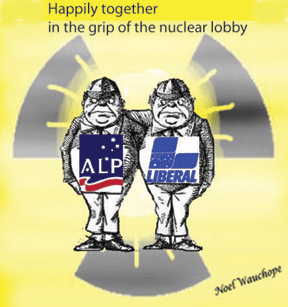 7 shady things Labor & Liberals have in common Progressive Reflection JUNE 1, 2016 CHRIS JENSEN “……..5. Dumping Nuclear waste on Indigenous Australians
Labor and Liberal politicians united earlier this year to profit from turning South Australia into a dumping ground for nuclear waste. But where do you put the most hazardous waste you can think of? Who’s backyard would our political leaders dump a hot radioactive mess in and feel guilt free about it? Who else but Indigenous Australians?.
Fukushima was an unfortunate reminder of how badly nuclear can go wrong, and many countries have since reconsidered nuclear plans. Nuclear is unlikely to ever be the energy of the future it was once thought to be. So why think of poisoning any Australian land with nuclear waste at all?
Because free money!
It’s a dream come true for some Australian politicians – rather than grapple with the politically difficult tasks of ending corporate welfare, or tax loopholes, or paying for essential services the Government could rake in a tidy $6 billion a year for at least 70 years.
All they’d have to do is screw over an indigenous community.
It’s practically business as usual.
And when Labor and Liberal come together to make something happen, they sure can be brazen about their disregard for indigenous people.
Wallerberdina Station near the Flinders Ranges is the only shortlisted site for the nuclear waste dump. Back in November last year, the indigenous community nearby demanded the government reject the proposal.
The dump threatens a local heritage site.
Federal Resources Minister Josh Frydenberg has creatively interpreted their concerns as “a broad level of community support“.
Frydenberg has said that consultation with traditional owners would be undertaken as part of the next phase of the project. That seems nice of him, except that the number of proposed sites for the dump is: 1. Just that site. What do you think the likelihood is the consultation will result in the only site planned being scrapped?
The consultation is there to serve the purpose of pretending to have listened, so that when the site goes ahead and indigenous Australian’s are outraged, they can be patronisingly told they had their chance to have their say………http://www.chrisjensen.info/blog/2016/06/7-shady-things-labor-liberals-agree/
Rum Jungle still polluted 45 years after uranium mine was closed
Rum Jungle uranium mine in NT polluting environment 45 years after closure, ABC Radio The World Today By Sara Everingham Traditional owner Kathy Mills finds every visit to site of the old Rum Jungle uranium mine upsetting.
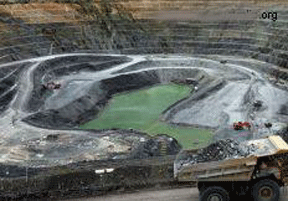
The site, 100 kilometres south of Darwin, is overrun with scrubby weeds, there are two abandoned mining pits, large mounds of waste rock and the water in a diverted channel of the Finniss River is tinged orange and brown from contamination.
But the great-grandmother wants to show people around in the hope it will help her family’s long battle to have the site rehabilitated.
“It has just been lingering on and on and on and many of my people have passed on and I am almost the last man standing in that people who fought for recognition of this land,” she said.
Ms Mills wants the Commonwealth to “hurry up” and rehabilitate the Rum Jungle mine — a Commonwealth-backed venture that produced uranium for the nuclear weapons programs of the US and British governments.
The mine closed 45 years ago but acid and metals are draining into the environment and the site remains off limits to the public including traditional owners.
This month’s federal budget had $11 million for the NT Government to put the finishing touches on a plan for rehabilitation.
Ms Mills said she was running out of time to see Rum Jungle fixed.
Mine took away ‘aspect of land’s importance’
When Rum Jungle was developed traditional owners had no say in it.
One mining pit was dug into a sacred women’s site on the east branch of the Finniss River and the flow of the river was diverted for one kilometre. Ms Mills vividly remembers the anger of one of her older relatives when he saw for the first time how the mine had transformed the land.
“It took away the whole aspect of the importance of that land,” she said.
But in the early 1950s the Commonwealth saw uranium as an opportunity to develop the north.
At the time, Rum Jungle was a major industrial development in northern Australia.
The then prime minister Robert Menzies came to the Top End to open it.
Notorious for environmental problems
When mining finished at Rum Jungle in 1971, no rehabilitation was done and the site became notorious for its environmental problems.
In the early 1980s, the Rum Jungle site could not be handed over to traditional owners as part of the successful Finniss River Land claim in case they became liable for the environmental problems.
The Commonwealth spent $18 million on rehabilitation in the 1980s but some of the work did not last.
At Rum Jungle, scientists from the NT Government are monitoring contamination in the Finniss River…….http://www.abc.net.au/news/2016-05-30/rum-jungle-uranium-mine-in-nt-polluting-environment-45-years-on/7460666
Indigenous advocate recommends both Treaty and constitutional recognition
 Let’s have treaty and constitutional recognition, Indigenous referendum chief says, SMH May 27, 2016 Fergus Hunter
The chief advocate for constitutional recognition of Indigenous people has elevated the possibility of a treaty between Aboriginal people and Australian governments, rejecting the “false” idea the country must choose between the two options.
Tanya Hosch, joint campaign director of Recognise, also expressed optimism that a referendum on constitutional recognition could still happen in 2017 as new polling reaffirms overwhelming support for change.
“We should not be asked to choose … Treaty and constitutional recognition can co-exist. We can work for both. Repeated legal advice makes that clear,” she said.
Polling conducted for Recognise finds 77 per cent of non-Indigenous people and 87 per cent of Indigenous people would vote “yes” for constitutional change if a referendum were held today.
……….Support for a formal treaty or treaties between First Australians and Australian governments has been consistently strong, especially among Indigenous people, and momentum is growing.The Victorian government is in talks with Indigenous communities over the possibility and the National Congress of Australia’s First Peoples says there is a strong preference among its membership for a treaty over constitutional recognition………http://www.smh.com.au/federal-politics/federal-election-2016/lets-have-treaty-and-constitutional-recognition-indigenous-referendum-chief-says-20160526-gp50g9.html
Indigenous owners put Minister Frydenberg on the spot about nuclear waste dump
 Indigenous owners appeal to Minister’s ‘human side’ to shelve proposed nuclear waste site, ABC News By Alex Mann, 27 May 16
Wallerberdina Station part-owner Grant Chapman did not consult the neighbouring Adnyamathahna community before nominating his land as a nuclear waste site. Opposition to the Federal Government’s proposed nuclear waste facility in the Flinders Ranges is heating up, with traditional owners travelling to meet with Federal Resources Minister Josh Frydenberg to demand the Government shelve its plans.
Traditional owner Regina McKenzie said she hoped travelling the more than 1,000 kilometres to Melbourne would appeal to the Minister’s “human side” and get him to change his mind.
“It’s always, every waste dump is near an Aboriginal community,” she told 7.30.
“Don’t you think that’s a bit confronting for us? When it happens to us all the time?”
Ms McKenzie is also a member of Viliwarina Yura, the corporation that was granted the land neighbouring the proposed waste site in 2000. Now she has teamed up with veteran anti-nuclear campaigner Dave Sweeney to take her message across the country.
Mr Sweeney told 7.30 that as the national anti-nuclear campaigner for the Australian Conservation Foundation, and with more than 20 years experience in nuclear issues, he would use his connections, contacts and ability to amplify the story.
“It just feels disturbingly familiar, and disturbingly like we’re replicating past mistakes,” he said.
Mr Frydenberg declined 7.30’s request for an interview but acknowledged in a statement that “legitimate issues have been raised about the Indigenous heritage in the broader area”. As a result, he said the Government would undertake a “comprehensive and independent heritage assessment and further consult with key stakeholders before any final decisions are made”.
But the traditional owners maintain that nowhere would be acceptable.
Local Indigenous owners not consulted
This is just the latest front in a battle around nuclear waste that has raged for decades…….http://www.abc.net.au/news/2016-05-26/local-indigenous-owners-protest-hawker-nuclear-dump/7449124
Campaign to scrap SA nuclear waste dump plans goes national
Campaign to scrap SA nuclear waste dump plans goes national Stephanie Corsetti reported this story on May 25, 2016 MP3 DOWNLOAD http://www.abc.net.au/worldtoday/content/2016/s4468848.htm


The group of Adnyamathanha women are from the Flinders Ranges say it’ll be the first time they’ve made their case directly to the Minister, Josh Frydenberg.
As Stephanie Corsetti reports.
Traditional owner Vivianne McKenzie addressed a town hall meeting in the Melbourne suburb of Northcote last night.
VIVIANNE MCKENZIE: This is what you call the genocide once again of Aboriginal people.
On the land, we are only a minority group in this country. They tell us we’re only three per cent, but I’ll tell you what, by the time we finish this campaign to stop this waste dump, we’ll be at 300 per cent in this country.
(Sound of applause)
STEPHANIE CORSETTI: The Federal Government is looking for what it calls a “willing community” to host a national radioactive waste management facility.
Now the McKenzie’s have travelled across the border to Victoria to send their message to the Federal Government.
VIVIANNE MCKENZIE: This is mental and emotional abuse, on the minds of adults, on children, you see the generational abuse on Aboriginal people.
STEPHANIE CORSETTI: Vivianne’s sister is Regina McKenzie.
REGINA MCKENZIE: If we were to go to a Catholic church or the Vatican and ask them to move or say we want to move the Vatican five miles over and put a waste dump there, that’s the same thing.
It’s our belief system.
STEPHANIE CORSETTI: Last month, the Federal Government said it would accept new nominations for the nuclear waste site after narrowing down the list to the South Australian site near Yappala Station.
The Federal Resources Minister Josh Frydenberg has agreed to meet the McKenzies on Thursday in his Melbourne electorate of Kooyong.
Dr Jim Green from Friends of the Earth is calling for a national campaign against the nuclear plans.
JIM GREEN: There’s unanimous opposition from traditional owners, it’s an extraordinarily beautiful part of the iconic Flinders Ranges, and I really wonder why it was chosen in the first place. And I’m sure they were aware of the possibility that it’s not going to go ahead, and that’s why they’ve opened up nominations from other land holders from around Australia.
STEPHANIE CORSETTI: Dave Sweeney from the Australian Conservation Foundation agrees.
DAVE SWEENEY: It’s a test of our maturity to have a debate about a difficult policy issue, and it’s also a test of how we view and relate with the First Nations people of Australia.
STEPHANIE CORSETTI: The Federal Government says it hasn’t made a final decision and consultation with the Indigenous community is an integral part of the process.
Minister Frydenberg says a heritage assessment will be done with the traditional owners to ensure the area is protected.
ELEANOR HALL: Stephanie Corsetti reporting.
Aboriginal group to take their protest against nuclear waste dump to Resources Minister Josh Frydenberg
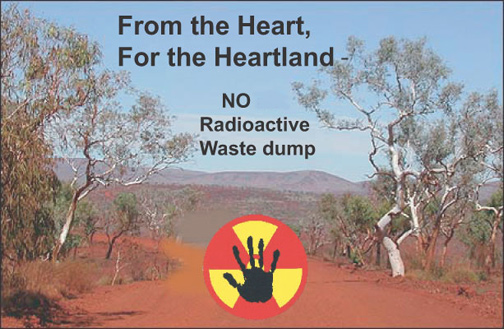 Fears nuclear dump will end their story, MEREDITH BOOTH, THE AUSTRALIAN,MAY 23, 2016 Australia’s first registered Adnyamathanha storyline runs 70km from Hawker to Cotebina Spring through pastoral and indigenous lands between Lake Frome and South Australia’s picturesque northern Flinders Ranges, where it is emerging as a battleline between anti-nuclear activists and the federal government.
Its landmarks, 440km north of Adelaide, tell the origin of Pungka Pudanha spring, where it is said tears falling from a grieving husband merged with the birth waters of his buried pregnant wife — a story that teaches children about family relationships and provides the basis for deeper women’s business.
Custodian and elder Regina McKenzie, a descendant of the king of five clans known as the Adnyamathanha or “people of the rock”, said Pungka Pudanha was the first storyline in Australia to be registered with Aboriginal heritage authorities, in 2012.
But it was now at risk of destruction since pastoral neighbour Wallerberdina Station was named last month as the preferred site for the federal government’s low and intermediate-level nuclear waste dump.
If further technical and environmental testing proves the site suitable, five million litres, or two Olympic-sized swimming pools’ worth, of low radioactive waste will be stored in a warehouse and underground facility.
Ms McKenzie’s worry is mostly for the 25 tonnes of intermediate waste, spent fuel from Sydney’s Lucas Heights reactor returned from reprocessing in France and which requires handlers to wear protective clothing.
She said the Adnyamathanha didn’t want the risk of contamination of groundwaters that fed mound springs on the floodplain where Ms McKenzie brought groups to camp, drink from the spring, and hunt and cook kangaroo in traditional ground ovens and share stories.
“We want to share the culture so we can promote this region to the world,’’ she said.
“Nobody takes the Aboriginal belief systems seriously — it’s our belief system. I just wish that non-Aboriginal people will look and see the richness in our culture.’’
Ms McKenzie and her sister Vivienne, two of 13 children in the McKenzie clan and part of a wider 200 indigenous people in the area, will take their protest, supported by conservation groups, to federal Resources Minister Josh Frydenberg in Melbourne on Wednesday to stop a dump at Wallerberdina………http://www.theaustralian.com.au/national-affairs/indigenous/fears-nuclear-dump-will-end-their-story/news-story/0bf29b3b919547bad0c797ac1b9a4631
Nuclear waste dumping in South Australia – an act of cultural genocide
Nuclear dump protesters warn of ‘cultural genocide’ in South Australia, ABC , 17 May 16 By Claire Campbell Building a nuclear waste dump in South Australia would be “cultural genocide”, an Indigenous Australian says, as a campaign against a potential facility in South Australia ramps up.
Flinders Ranges Adnyamathanha woman Candace Champion was among unions, community groups and traditional landowners who today launched an alliance to protest the dump if it goes ahead.
Nuclear Fuel Cycle Royal Commissioner Kevin Scarce made a recommendation earlier this month that SA build a used-nuclear fuel and intermediate level waste storage facility as an economic opportunity.The State Government has not committed to building a dump and said community engagement would be pivotal before a proposal was considered.
But the alliance believes going ahead with such a facility would ignore Aboriginal rights and put public health, the environment and the state’s finances at risk. It includes the Australian Nursing Midwifery Federation, Conservation Council, Maritime Union of Australia and the Uniting Church.
“This proposal and the proposals of nuclear dumps right around Australia is a threat to Aboriginal culture and society and it is cultural genocide,” Ms Champion said.
“As a young Adnyamathanha woman, I can tell you that my family will be affected by this nuclear dump. It is bringing back a lot of anxiety, a lot of anxiousness and a lot of mental health issues within my family and my community.”
Premier Jay Weatherill in February said it was important that everybody was “afforded an opportunity to have their say” and believed an emotion-charged debate was required.
“In a sense, this is a test of our democracy,” Mr Weatherill said……..http://www.abc.net.au/news/2016-05-16/nuclear-dump-protesters-warn-of-cultural-genocide-in-sa/7419406
International solidarity with indigenous peoples against nuclear waste dumping
 If you’re from the United States, then this whole ordeal should sound somewhat familiar.
According to the Scientific American, “[n]ative tribes across the American West have been and continue to be subjected to significant amounts of radioactive and otherwise hazardous waste as a result of living near nuclear test sites, uranium mines, power plants and toxic waste dumps.”
Take Action!
The final decision for the nuclear dumping site will occur in a year, please act now by signing and sharing this petition urging Australian leaders not to dump nuclear waste near Adnyamathanha territory.
Stop Australia From Committing “Cultural Genocide” and Environmental Injustice http://www.truth-out.org/news/item/36006-stop-australia-from-committing-cultural-genocide-and-environmental-injustice, 14 May 2016 By Jessica Ramos, Care2 | Report Australia is about to make a horrible mistake. The country has (at least, tentatively) earmarked the location of its first nuclear dumping site next to an aboriginal cultural site. And the aboriginal community is speaking out — calling the proposed site “cultural genocide.” Australia is on the path to repeating the United States’ past mistakes and environmental injustices.
Can You Put a Price on Cultural Genocide and Death? Yes, Apparently
The traditional lands at the center of the controversy belong to the Adnyamathanha, also known as the “rock people,” from Flinders Ranges, South Australia. In 2009, the Federal Court of Australia recognized the Adnyamathanha’s native rights over 16,000 square miles of territory. But a nuclear dumping site of low- and intermediate-level nuclear waste (e.g. from medical procedures) endangers their territory and legal rights. Continue reading
Nuclear dump site for a culturally and archaeologically significant area!
Cameco uranium plan faces rocky road
 https://nuclearfree.wordpress.com/media/ , 11 May 16 Traditional Owners from the regions around the proposed Yeelirrie and Kintyre uranium operations in WA have today sent Cameco shareholders and stakeholders a clear message of opposition to any mining plans. The groups have released a joint statement to coincide with Cameco’s Annual General Meeting being held in Saskatoon, Canada.
Both communities have a long history of opposition to uranium mining plans at Yeelirrie and Kintyre, dating back to early uranium exploration in WA during the 1980’s. Both communities have also attracted the support of environment, social justice, union and health organisations and the state Labor and state and federal Greens parties in their fight against uranium mining.
“You can’t reverse what the old people have said before. We’re going to stop it” said Desmond Taylor, Karlamilyi Traditional Owner. “This is my spiritual birthplace, my dreaming place. Warturarra (the proposed Kintyre mine site) became my spiritual home; the bush food there became my totem. To mine there would take away my spirit and the totem, it will destroy the living things around it, that place would become empty.”
The joint statement is going to the Cameco Board, shareholders and major Canadian investors. It conveys the depth of the contest that company will face should it seek to advance uranium mining.
“Our country is special to us” said Kado Muir, a Yeelirrie Traditional Owner and Senate candidate for the National Party. “I’m not anti-mining I am speaking as a Traditional Owner communicating our view that Cameco and uranium mining are not welcome on our country. Uranium is different to other mining, because the risks remain for thousands of years. It is our responsibility to look after the land for future generations. We will continue to challenge the proposal to mine uranium at Yeelirrie.”
Members of the Parnngurr and Martu community will be walking from through the Karlamilyi National Park to the proposed uranium mine at Kintyre from the 4th – 12th of June in protest to Cameco and Mitsubishi’s uranium mine plans. See community interviews here.
The Walkatjurra Rangers and Yeelirrie Traditional Owners will also be walking in protest to the Yeelirrie uranium mine from the 7th of August – 7th September. This will be the sixth annual walk against uranium mining in the region. See community interviews here.
Flinders Aboriginal elders strong in their fight against nuclear waste dumping on their sacred lands
Dumped-on Elders down but not despairing, Eureka Street Michele Madigan | 02 May 2016 “……..Outlining the numerous times that the Traditional Owners had asked the State Minister for the Environment and the Federal Resources Minister Josh Frydenberg to visit the site, she [Enice Marsh, Adnymathanha Elder/Traditional Owner for the Flinders Ranges area of SA.] could only conclude, ‘But all this has come to no avail — it’s all been totally ignored.’
On Friday Frydenberg managed to have it both ways, in what seems to be a now fashionable way to go about such announcements. ‘There is no final decision.’ And yet, there is only one site remaining from what was a ‘self selection’ offer by the original 28 property owners and the shortlisted six.
Frydenberg described the selection process to date as ‘rigorous’. However, as the follow up process will now include ‘technological, safety and environmental assessment’, an obvious question remains about just how ‘rigorous’ it could really have been.
In a repeat of the one of the Kimba owners’ comments some months back, Chapman seems to be quite ill-informed regarding what will actually be deposited on the property, quoting the usual presenting argument used in the former SA campaign of 1998-2004: that the dump will be for medical low-level waste from various hospitals and universities around the country.
No mention as usual that there is no need for this to be stored long term in the first place. No mention of the intermediate level radioactive spent fuel rods which arrived back from France in December, and are presently housed at Lucas Heights. One wonders when such news will be broken to the property owners and the Hawker community.
In contrast, the Adnyamathanha neighbours and other Traditional Owners are completely aware of this and decry the flawed, seemingly unscientific process where one person can offer their land with absolutely no consultation to the neighbours.
Their own Indigenous Protected Area expert research and eyewitness knowledge cites that as well as being a site replete with ‘countless thousands of Aboriginal artifacts and registered cultural heritage sites’, ‘There are frequent yarta ngurra-ngurrandha (earthquakes and tremors). We see the ground move and the hills move; we feel the land move. At least half a dozen times each year.
‘It is flood land. The water comes from the hills and floods the plains, including the proposed dump site. Sometimes there are massive floods, the last one on 20 January 2006.’
In stark contrast to the previous national dump campaign of 1998-2004 which was opposed by the state government, it seems that this time no member of the SA government has come to the defence of the extraordinary Flinders Ranges, a focal point for the tourism industry of South Australia. Wilpena is a famous tourist site of great beauty and heritage, popular with both national and international tourists.
Indeed the SA community next Friday will hear the royal commission’s final recommendation to import high-level radioactive waste into our seemingly politically disposable state — disposable, now, even to our own politicians…….
despair is a temptation but there is also ‘the distressing matter of indifference. Indifference can be lethal.’ And what pain it gives to those like Enice Marsh who care.
But still there is resilience, and still there is hope. Not only are the Adnyamathanha determined to fight on, the five other communities that are now off the shortlist have pledged their solidarity in a continuing fight against ‘this flawed process’.
Who knows the power of such leadership to break the bonds of our own indifference and despair. http://www.eurekastreet.com.au/article.aspx?aeid=47266#.VylNVdJ97Gh
1 This month

of the week – Australians for War Powers Reform (AWPR)
To see nuclear-related stories in greater depth and intensity
 Antinuclear