Tony Abbott repeats his offensive statement on Aborigines, to an international audience
Mr Abbott did not mention the hundreds of Aboriginal nations who made this land home for almost 60,000 years, who managed the vast swathes of country under an extraordinary and complex land management system that incorporated aspects of their spirituality.
He also did not mention that the belief there was nothing in Australia but bush was overturned in the 1992 Mabo High Court decision, which paved the way for the Native Title Act, a weaker form of land rights.
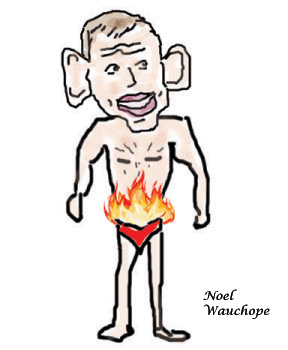 Tony Abbott Says ‘Nothing But Bush’ In Australia Before White Settlement https://newmatilda.com/2014/11/14/tony-abbott-says-%E2%80%98nothing-bush%E2%80%99-australia-white-settlement By Amy McQuire In the presence of British Prime Minister David Cameron, Abbott doubled down on previous remarks about the unsettled nature of Australia before white invasion. Amy McQuire reports.
The self-appointed “Prime Minister for Aboriginal Affairs” Tony Abbott has reiterated the legal fiction of “terra nullius” stating that Australia was “nothing but bush” before British invasion and called pre-colonisation civilisation “extraordinarily basic and raw”.
Mr Abbott made the comments to an international business breakfast in Sydney this morning in an audience that included British Prime Minister David Cameron, who was in town before the G20 summit in Brisbane this weekend. Continue reading
Western Australian Govt’s costly and racist move to get 137 Aboriginal communities off their land
 Cost of closing remote communities greater than tackling issues, Aboriginal leaders say, ABC News, 13 Nov 14 By Nicolas Perpitch and Anna Vidot Aboriginal leaders and advocates are warning the “chaos and dysfunction” caused by closing down remote Indigenous communities will cost the West Australian Government far more than addressing existing issues.
Premier Colin Barnett has acknowledged his decision to shut about half the state’s 274 remote communities will cause distress to the more than 12,000 Aboriginal people living there and cause problems in the towns they move to………
Amnesty International’s indigenous peoples’ rights manager Tammy Solonec said there was no plan to help people evicted from Ooombulgurri integrate into Wyndham or other towns, leaving them “highly traumatised”……..
She said governments needed to support communities rather than shutting them down.
Greens MLC Robin Chapple has gone one step further, accusing the Government of peddling a racially-motivated agenda. “It’s smacks of the assimilation policies over the early 60s,” he said. “It’s horrendous. This is a diabolical, in my view, highly racially motivated agenda.”
The Barnett Government has said it was forced to accept a $90 million payment from the Commonwealth to take over responsibility for the remote communities.http://www.abc.net.au/news/2014-11-13/closing-remote-aboriginal-communities-cause-chaos-leaders-say/5889278
Warren Mundine not trusted by Aboriginal Land Council
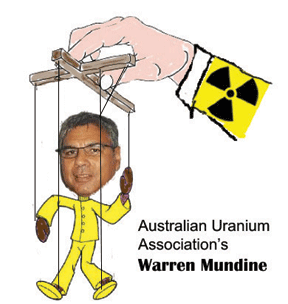 Aboriginal land council shuns Mundine over Wallarah 2 negotiations, Australian Mining10 November, 2014 Ben Hageman Warren Mundine has proven a poor choice to negotiate with local aboriginal groups, who have voiced their distrust in him for dealing with the Wallarah 2 coal mine.
After compensation negotiations with the Darkinjung Aboriginal Land Council broke down this year, Korean government-owned miner Kores hired the chair of the Indigenous Advisory Council to represent the company, SMH reported.
A spokesman for Kores said Mundine had been engaged by the company “to facilitate the resumption of discussions between Darkinjung ALC and Wallarah 2 on a land access agreement.”
However, land council CEO Sean Gordon said the ALC did not want to negotiate through Mundine. “From our end there is distrust in his position as chair of the Indigenous Advisory Council and his general support for the mining industry,” Gordon said……..http://www.miningaustralia.com.au/news/aboriginal-land-council-shuns-mundine-over-wallara
Tanami region of Central Australia – no nuclear wastes, rules Central Land Council
 Central Land Council rules out nuclear dump in Tanami region of Central Australia, ABC News 6 Nov 14 By Xavier La Canna The Central Land Council has ruled out the possibility of a nuclear waste dump being built over a large part of central Australia due to opposition from some traditional owners.
 Traditional owners in the Tanami region were considering nominating land to become a dump, but at a meeting this week delegates heard of opposition to the move from traditional owners and affected communities, the CLC said.
Federal Government Industry Minister Ian Macfarlane has said there has to be unanimous support for the move for a site to be successful.
“The delegates heard that the CLC has received formal correspondence and public statements from the traditional owners and residents of affected communities who are opposed to a nuclear waste dump in the area,” the CLC said.
Given that a nuclear waste dump is forever it’s just not fair to ask people to make this decision without a comprehensive proposal – CLC director David Ross
“Industry Minister Ian Macfarlane’s requirement of a site ‘free from dispute’ cannot therefore be met,” it said. The CLC, a statutory body tasked with a duty to consult traditional owners and other Aboriginal people about any proposals, covers an area of about 776,000 square kilometres, with the Tanami region a sizeable part of that.
The entire Tanami is 178,000 square kilometres.
The CLC also dealt a blow to Federal Government hopes of finding a new site to build a nuclear waste dump, saying the nomination process was unfair and would have seen Aboriginal groups make a decision without enough information.
“The process enshrined in the National Radioactive Waste Management Act 2012 expects traditional owners to volunteer a site without knowing all the information,” a statement from CLC director David Ross read.
“Yet once a site is nominated they cannot change their mind when they find out the full story.
“Given that a nuclear waste dump is forever it’s just not fair to ask people to make this decision without a comprehensive proposal.”……http://www.abc.net.au/news/2014-11-07/nuclear-dump-ruled-out-over-tanami-region-in-central-australia/5875202
For the moment, Aboriginal Land Rights in New South Wales are safe
The NSW Aboriginal Land Council said the Baird Government had withdrawn its controversial Crown Lands Amendment Bill.
“Moving forward we’re happy to talk to the Government, but this Bill was divisive and discriminatory and undermined Land Rights” NSW Aboriginal Land Council Chairman Craig Cromelin said.
“We call on the Government to respectfully deal with Land Rights and start from scratch by genuinely consulting with Aboriginal people before any changes are made to the way Crown Lands in NSW are managed.”………
Cromelin said a community rally held to fight the Bill had helped lead to its withdrawal.
“It means a lot to us to see such a great turnout from mob at such short notice, especially as many people travelled great distances, as well as those who sent letters, emails and tweets to protest against the Bill” he said.
“The rally shows the power of mob uniting for Our Land Council, Our Mob and Our Future.” http://www.probonoaustralia.com.au/news/2014/11/aboriginal-land-rights-safe-now#sthash.0IfywKIB.dpuf
In brief: how Maralinga nuclear bomb caused illness and environmental destruction
Secret Outback nuclear testing site handed back to traditional land owners 50 years after British did HUNDREDS of nuclear tests causing fatal radiation poisoning
- The British nuclear testing site in outback Australia has been returned to its Aboriginal owners
- Seven atomic bombs were detonated on ‘Section 400’ in the 1950s
- There were also about 600 smaller nuclear tests on the area
- The land traditionally belonged to the Maralinga-Tjarutja community
- Britain’s nuclear tests in Australia caused widespread radiation poisoning
- Aborigines and Australian and UK soldiers suffered disease and death
- Radioactive fallout in remote Australia was three time greater than predicted
- Australia spent $100 million cleaning up the traditional lands
- The government held on to the 1782sq km testing range until this week
By CANDACE SUTTON FOR DAILY MAIL AUSTRALIA and AAP, 6 November 2014……………………Hundreds of nuclear trials were carried out. Britain dropped twelve nuclear bombs at Maralinga, and then went on to test nuclear warheads.

Although many Aboriginal people were forcibly removed from their land, more than a thousand were directly affected.
The widespread radioactive fallout of the bombs across the environment, which the local Aboriginal people called ‘puyu’ or ‘black mist’, caused disease and death……..http://www.dailymail.co.uk/news/article-2822906/Secret-nuclear-testing-site-Australian-outback-known-Section-400-finally-handed-Aboriginal-traditional-land-owners-50-years-British-dropped-atomic-bombs-causing-radiation-poisoning-death.html
Aboriginal people really cannot trust the New South Wales Baird Government
The government’s hurried assault on Aboriginal land rights – albeit followed by a hasty retreat – is a deeply unfortunate development, and has badly damaged any trust Aboriginal people can have in the Baird government in treating matters of Aboriginal rights with honesty and integrity.
Aboriginal people must not negotiate with politicians who assault their land rights, Sol Bellear The Guardian 5 Nov 14 The NSW government’s hurried assault on land rights – followed by a hasty retreat – is deeply unfortunate and has damaged any trust Aboriginal people can have in the Baird government The NSW government’s decision earlier this week to abandon legislation aimed at another wave of dispossession of Aboriginal people is welcome. However, the fact that we even got to this point is a matter of grave concern to Aboriginal people across NSW, and the country.
In October, minister for western NSW Kevin Humphries announced his intention to introduce legislation to parliament which extinguished land claims under the NSW Aboriginal Land Rights Act on beaches and coastal reserves. It would have affected have affected more than 600 current Aboriginal land claims around NSW. This is the legilsation which was withdrew on Monday. Continue reading
Scientists and Aboriginal land-managers work together to reduce greenhouse gas emissions
Scientists working together with indigenous land-managers have reduced Australia’s greenhouse gas emissions by half a million tonnes. IMPROVING FIRE MANAGEMENT in the tropical savannah of northern Australia has reduced greenhouse gas emissions by more than 500,000 tonnes over the past year.
By reintroducing traditional fire knowledge and practices, local land managers have benefited through the sale of carbon credits, as well as helping the environment.
“Methane and nitrous oxide emissions from savannah burning represent about three per cent of Australia’s total greenhouse gas emissions,” said the CSIRO’s Dr Garry Cook at the 2014 annual conference of the Ecological Society of Australia in Alice Springs in September.
“Since European settlement, fires in the north have increased in size and severity. This has threatened biodiversity as well as increased greenhouse gas emissions,” he said.
Australia’s tropical savannah landscape is enormous — it covers an area of some 1.9 million square kilometres, or about one quarter of the entire continent. The landscape is mainly forests and woodlands consisting of wide fields of grass with scattered eucalypt trees.
The savannah stretches from Rockhampton on the Queensland coast up to the tip of Cape York and across to the Kimberley region of Western Australia on the Indian Ocean.
Frequent fires are a characteristic of the landscape, and the vast majority are deliberately lit without any authorisation. Tens of thousands of square kilometres burn every year during the northern dry season.
Many local Aboriginal communities have retained their traditional fire knowledge, and these communities hold deep aspirations to fulfil long-held cultural obligations regarding country. Dr Cook said the Commonwealth’s Carbon Farming Initiative provided the impetus to restore traditional fire management practices on aboriginal homelands, combining modern environmental and fire science with traditional mosaic burning practices.
“In order to reduce greenhouse gas emissions under the methodology, land managers need to burn early in the dry season to protect the landscape from the more intense fires that would otherwise occur later in the dry season,” he said.
“Early dry-season fires are generally low in intensity; they trickle through the landscape and burn only some of the fuel, creating a network of burnt firebreaks. These stop the late dry-season fires sweeping through large areas and releasing large amounts of methane and nitrous oxide.
“Most savannahs burn on average once in every two to four years, in the late dry season, and it’s these fires that produce between three and four per cent of Australia’s accountable greenhouse emissions. The methodology helps reduce these emissions by using low-intensity, patchy early dry-season fires to reduce the overall fire frequency and proportion of late dry-season fires, which tend to be much larger and more intense,” Dr Cook said.
The savannah burning methodology for reducing methane and nitrous oxide emissions was developed by a team from CSIRO, the Charles Darwin University’s Centre for Bushfire Research, the Northern Australia Indigenous Land and Sea Management Alliance, and Aboriginal landowners and rangers in northern Australia.
Dr Cook said, “It’s lovely to see science being applied to improve land management in that part of the world: we’re talking very remote country, very limited resources for land management, and very sparse populations. It’s had a great impact.”
Project to document the health effects from atomic bomb testing in South Australia
Uranium the Silent Killer By Hilary Tyler
http://www.pozible.com/project/187985 The story of the project At the ANFA (Australia  Nuclear Free Alliance) meeting in Oct 2014 Indigenous Elders called for documentation of the health effects from the Maralinga and other atomic bomb tests in the 1950’s and 1960’s. See https://ausnukefreealliance.wordpress.com for the meeting statement.
Permission was never sort from the Aboriginal nations.
“Just remember that the fallout at Maralinga affected the whole lot of us. Black, white, brindle; we all breathe the same air, and we’re all being affected in various ways, even though that happened a long time ago. It’s still around.” Sue Coleman-Haseldine (Kokatha Mula – Ceduna)
From 1952 to 1963 atomic testing covered vast areas of South Australia including Maralinga and Emu Fields test sites.
In November 2014 there will be a 3 week road trip to archive the stories of the people from Arabuna, Walitina, Ceduna, and Yalata country to produce film, audio and digital documentaries. We will begin a data base of the families affected, the geographical distributions of fall out and detrimental health repercussions of these unconsented tests.
Nuclear weapons are the most destructive, inhumane and indiscriminate weapons ever created. Both in the scale of the devastation they cause, and in their uniquely persistent, spreading, genetically damaging radioactive fallout, they are unlike any other weapons.
For more information on nuclear weapons, including an article on Yami Lester, one of the survivors of the nuclear tests in South Australia, see http://www.icanw.org/au/
Many Aboriginal people in South Australia still rely on bush foods – plants and animals sourced from land that still is contaminated. The possibility of bioaccumulation is very real. Certainly the stories of early death from cancer, thyroid disease and congenital deformities are continuing.
“I’ve lost a lot of my family members through early death – and a lot of it was through cancer, and I do blame the Maralinga fallout.”
Aunty Martha – Arabana (Lake Eyre) Contact us at: uraniumthesilentkiller@gmail.com

No recognition, no compensation, for Aborigines made sick by Maralinga nuclear bomb tests
Backgrounder: Why was Maralinga used for secret nuclear tests?SBS News 5 Nov 14 “…….
 What happened to the people who lived there?

The nuclear testings lead to widespread dispersion of radioactive material in the local environment. The Anangu Aboriginal people who lived the area called it “puyu” or “black mist”.
UK servicemen, Australian soldiers and civilians, including Indigenous people, were all exposed to radiation. Illnesses reportedly included cancer, blood diseases, eye problems, skin rashes, blindness, vomitting, which are all symptoms of radioactive poisoning.
Between 1953 and 1957, two nuclear devices were detonated at Emu and seven at Maralinga, the Department of Industry reported. According to the Australian Radiationn Protection and Nuclear Safety Agency (ARPANSA) these “major trials” have largely decayed and are “no longer a significant health risk” as these nuclear devices were conducted at higher altitudes (from balloons).
However, the biggest cause of contamination was from “minor trials”, which were weapons development trials that investigated the performance of various components of a nuclear device. Although minor trials didn’t involve nuclear explosions, they did contain radioactive material.
Since contamination remains on or close to the ground surface, there is a significant health risk for locals. Three sites, Taranaki, TM100/101 (TMs), and Wewak remained highly contaminated with plutonium 40 years later……..
Were victims compensated by the British government?
Aboriginal people exposed to British nuclear tests in South Australia during the 1950s are being told they have no hope of compensation. British firm Hickman and Rose had hoped to represent more than 150 civilians, if a huge class action by 1,000 British veterans had succeeded.
But the class action was blocked – the UK Supreme Court ruling that 60 years after the event their claims were too late, the causes of their illnesses apparently unprovable. (Read the full judgment here)
The Australian Greens’ nuclear spokesman Scott Ludlam said the dangers of radiation are well known and it’s unfair to ask Aboriginal people with scant medical records to prove a direct link between exposure to fallout and subsequent sickness.
“The British courts have blocked the application from Defence personnel and Aboriginal people in central Australia by saying you can’t prove those radiations exposures are what caused your illness,” he said. “Now, we know that ionising radiation is harmful for health – we know that for a fact. The right thing for the British Government to do is make an Act of Grace payment to the people who they injured in their nuclear weapons tests.”
In response, UK Defence Personnel Welfare and Veterans Minister of State Mark Francois said: “[The] Ministry of Defence’s position with respect to paying compensation is unchanged. I am sorry to have to send a disappointing reply, but I hope I have explained the reasons for doing so.”……http://www.sbs.com.au/news/article/2014/11/05/backgrounder-why-was-maralinga-used-secret-nuclear-tests
Part of Defence Department’s Woomera Prohibited Area returned to Aborigines
 Defence force releases last Maralinga ancestral lands to traditional owners theguardian.com, Wednesday 5 November 2014
Former weapons testing range at Maralinga in outback South Australia is returned to Maralinga Tjarutja people Traditional owners finally have full access to their homelands at Maralinga after the defence force gave up its weapons testing range on Wednesday. Maralinga, in the South Australian outback, was the site of British atomic bomb testing from 1955 to 1963 and was contaminated by nuclear waste.
The federal government formally acknowledged the excision of an area of the Maralinga Tjarutja lands from the defence department’s Woomera Prohibited Area in a ceremony at Maralinga Village on Wednesday…….http://www.theguardian.com/australia-news/2014/nov/05/defence-force-releases-last-maralinga-ancestral-lands-to-traditional-owners
Maralinga nuclear test site returned to Aborigines, though still some contamination there
 British Nuclear Test Site Returned To Aborigines, Yahoo News UK 5 Nov 14 A former British nuclear test site in the depths of the Australian outback has finally been handed back to its Aboriginal owners after more than half a century.
Codenamed Section 400, the secret Cold War atomic weapons testing base was used in the 1950s and 60s and covered 1,782 square kilometres (688 square miles) of remote South Australia.
Now the Australian Government has formally given the site at Maralinga back to its traditional owners, the Maralinga Tjarutja, who hope to turn it into a tourism attraction.
Maralinga Tjarutja general manager Richard Preece says the community is establishing a business to take visitors round the nuclear test sites.
“We’re going to set up bus tours so people can be taken round by Robin (the local caretaker), who is a walking encyclopaedia of Maralinga,” he told the Australian Broadcasting Corporation.
He added the area still had some contamination but would be safe for visitors if they were escorted………https://uk.news.yahoo.com/british-nuclear-test-returned-aborigines-130655845.html#vPKBkL8
Gurindji Indigenous group travels across Australia to pay repects to Gough Whitlam
Indigenous people pay respects to Whitlam, the prime minister who cared about them November 5, 2014, SMH, Dan Harrison Health and Indigenous Affairs Correspondent “……..this week, some of the Gurindji men and women involved in that fight and their families travelled across the country to Sydney to pay their respects to that jangkarni marlaka (“big important man”), former Prime Minister Gough Whitlam. The group have travelled from Kalkaringi, 800 km south of Darwin, to honour the man who, in August 1975, poured desert soil through the hand of Gurindji stockman Vincent Lingiari to signify the return of more than 3000 square kilometres of Gurindji ancestral land.
“We are mates now,” Lingiari replied.
When news of Whitlam’s death reached Kalkaringi two weeks ago, the community gathered at the spot where the ceremony took place, sharing stories in honour of the man they now refer to respectfully as kulum Whitlam…… http://www.smh.com.au/federal-politics/political-news/indigenous-people-pay-respects-to-whitlam-the-prime-minister-who-cared-about-them-20141104-11guaz.html#ixzz3IJiWV4RE
Plan to smash Aboriginal land rights , from Tony Abbott and Andrew Forrest
Abbott and Forrest’s assault on Indigenous land rights Independent Australia Land Rights News – Northern Edition 31 October 2014, The iconic 1976 Land Rights Act is under attack like never before under the Abbott Government, writes former Fraser Liberal Government Minister for Aboriginal Affairs Ian Viner AO QC (via Northern Land Council – Northern Edition).
WITH the Commonwealth Government’s push for 99-year leases, the Forrest Review’s call for Aboriginal land to be privatised so as to be bought and sold, and attacks upon the Northern Land Council in particular over their defence of traditional ownership and their responsibilities under the Land Rights Act, the iconic 1976 Land Rights Act is under threat like never before.
The whole framework and security of traditional Aboriginal land, protected by theLand Rights Act, is in danger of being subverted by Governments, bureaucracies and people who have no real understanding or sympathy for traditional communal land ownership.
99-year town leases turn traditional ownership upside down.
In reality, they put the Commonwealth back into ownership and control of traditional Aboriginal land like it was before the Land Rights Act was passed as if Aboriginal land had returned to reserve status under Commonwealth control………..
The Forrest Review recommendations make it plain that the objective of Commonwealth land tenure reform policies in the Northern Territory should be to smash traditional ownership by making Aboriginal land “tradeable and fungible” as it says in Chapter 8. History tells us that land grabberswill quickly move in and Aboriginal land will be traded away forever and Aboriginal people left on the fringe once again.
The real objective of Commonwealth policy should be to put the Aboriginal people in control of their own destiny for the next 99 years. Keeping Aboriginal land firmly under Aboriginal control is the only way for that to happen.
Northern Territory Aboriginal people should learn from Maori history in New Zealand………http://www.independentaustralia.net/australia/australia-display/abbott-and-forrests-assault-on-indigenous-land-rights,7052
Nova Peris would be the strong good voice for Labor’s Aboriginal Affairs
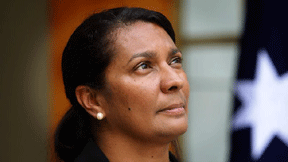
the Senator is the most qualified to represent through the ALP for this nation’s First Peoples. The Andrew Forrest and Professor Marcia Langton authored ‘Creating Parity’ report has been heavily criticised by Senator Peris. The real journey to ‘creating parity’ would have Senator Peris as the Opposition spokesperson on ‘Aboriginal Affairs’.
Nova Peris should be spokesperson for ‘Aboriginal Affairs’ The Stringer by Gerry Georgatos October 26th, 2014 White Australia still grips tightly its control over the nation’s agendas and cultural content despite a multicultural population that it continues to deride and where possible shun. The demography of this nation is not reflected in the parliaments and institutions of the nation. First People are under-represented, multicultural Australia is under-represented. White Australia – Anglo-Celtic-Saxon Australians – populate Government Cabinets, Shadow Cabinets, the party rooms of every political party. The Australian Labor Party had the opportunity to lead the way, but instead choose to let powerbrokers and the influence peddling stand in the way of the big picture message that should have been. Senator Nova Peris, not the Member for Blair’s Shayne Neumann, should be the Shadow Minister for Aboriginal Affairs.
Senator Peris has been effectively a lone voice on First People issues for the Australian Labor Party since she was handpicked by former Prime Minister Julia Gillard as a lead candidate for the Senate from the Northern Territory for the 2013 federal elections. Senator Peris became the first Aboriginal woman into parliament – a double coup for the ALP, but more importantly for the national consciousness, and even more importantly for the continent’s First Peoples.
Mr Neumann has barely uttered a word on the myriad issues affecting First Peoples since he was handed the portfolio by Bill Shorten late last year. Continue reading
1 This month

of the week – Australians for War Powers Reform (AWPR)
To see nuclear-related stories in greater depth and intensity
 Antinuclear