Antinuclear

Australian news, and some related international items

Mirrarr people to lead the Kakadu region’s transition from uranium mining

Kirsten Blair, Community and International Liaison, 15 Aug 19,   Gundjeihmi Aboriginal CorporationToday GAC chairwoman, Toby’s Gangale’s daughter: Valerie Balmoore signed an MOU with the Federal and NT Governments as well as mining company ERA committing all parties to a Mirarr-led post-mining future for Jabiru.

There is still much work to be done on Mirarr country including cleaning up the immense Ranger uranium mine. GAC and others will continue our diligent work in this area – and there are no guarantees the cleanup will be wholly successful – but restoration of country remains the absolute objective.

Mirarr continue to assert their rights as Traditional Owners and lead the way for people and country, this Jabiru story is evidence of a massive shift. The power in these images speaks for itself. Today is deeply hopeful for the Kakadu region and offers an incredible message for all communities resisting unwanted mining projects.

August 15, 2019 Posted by | aboriginal issues, environment, Northern Territory, uranium | Leave a comment

Nuclear waste dump: Barngarla group says indigenous ballots won’t fix its worries over vote discrimination

Nuclear waste dump: Barngarla group says indigenous ballots won’t fix its worries over vote discrimination The Advertiser, 14 Aug 19

An Aboriginal organisation at the centre of a legal battle over a radioactive waste dump site says a ballot for its own community would do little to dampen its discrimination concerns.

An Aboriginal organisation at the centre of a legal battle over the site for a nuclear waste dump says a separate consultation process for indigenous people will do little to dampen its discrimination concerns.

The Barngarla Determination Aboriginal Corporation took Kimba Council to court over its plan to host a community vote to gauge support for a waste storage facility near the Eyre Peninsula town.

The organisation argued the poll was discriminatory because it excluded native title holders who did not live in the area.

After losing the Federal Court challenge in July, the Barngarla has lodged an appeal in the Full Court.

Resources Minister Matthew Canavan has since written to Kimba and Flinders Ranges councils saying he will approach indigenous organisations reaffirming his department’s offer to pay for a poll of their members, providing them with a voice.

But the Barngarla board told The Advertiser such a poll was “designed to exclude our people from having a say on equal footing to the rest of the community”.

“It is very simple to solve this problem – all which needs to happen is to allow our people the right to vote with the rest of the Kimba community rather that segregate us,” the board said.

The organisation said Mr Canavan had not provided a template ballot paper and associated material so the ballot could be run on equal terms. The council and Federal Government had also not agreed to consolidate all the results into one process.

The Barngarla board has written to Indigenous Australians Minister Ken Wyatt asking him to intervene.

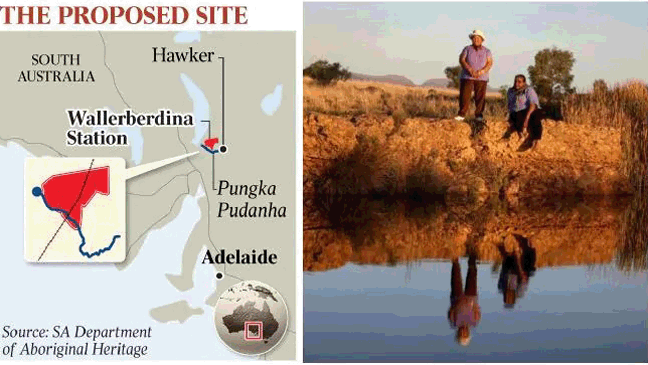
Three SA sites are being considered for the radioactive waste dump – two near Kimba and one at Wallerberdina Station, near Hawker in the Flinders Ranges. It would hold low and intermediate-level waste, primarily from the production of nuclear medicines.

Polls in the Hawker and Kimba communities were due to happen in August 2018 but were stalled after the Barngarla court appeal was flagged.

The Adnyamathanha Traditional Lands Association (ATLA) has also lodged a complaint with the Human Rights Commission.

Meanwhile, Government staff on Tuesday confirmed at a Flinders Ranges-based consultative committee meeting the minimum size of the nuclear site and its surrounding buffer zone would increase from 100ha to 160ha – as claimed by a source close to the project in The Advertiser last month.

The Government says the extra space will allow for features such as a water treatment plant, power infrastructure and road access, depending on the selected site.

Mr Canavan said the Government had “listened carefully” to communities when shaping ballot boundaries.

“At Kimba it extended to the entire local council area, while at Wallerberdina Station it is the local government area plus an approximate 50km radius,” he said.

“Wherever a boundary is defined there will be a number of groups outside that line, but the process gives those people the ability to fully participate by making a submission that will be taken into account in the decision-making process.”

A spokeswoman for Mr Canavan said details of polls among indigenous organisations would be worked out alongside any groups who wanted to participate.

Maurice Blackburn lawyer Nicki Lees, representing ATLA, said the organisation had made it clear it opposed a nuclear waste dump on its traditional land.

“If the Government is considering further consultation on this project, we would consider this in due course,” she said.

“However, it is important that this is a meaningful process, which hasn’t occurred to date.”

Adnyamathanha woman Regina McKenzie has previously told The Advertiser the long-running debate had disrupted her community.

August 15, 2019 Posted by | aboriginal issues, AUSTRALIA - NATIONAL, Federal nuclear waste dump | Leave a comment

Bangarla people call on Minister for Indigenous Australians Ken Wyatt to intervene in support of their vote on nuclear waste dump

On the anniversary of recognition Aboriginal Australians, the Barngarla people have written to Minister for Indigenous Australians Ken Wyatt to ask him to personally intervene and allow them to have a vote on the radioactive waste facility proposed for their land. Read their letter here:
10 August 2019 The Honourable Ken Wyatt AM, MP Minister for Indigenous Australians House of Representatives Parliament House Canberra ACT 2600
Dear Minister Wyatt
On 10 August 1967, some fifty-two years ago today, the Australian Constitution was amended to give effect to the outcome of the 1967 Referendum, allowing Aboriginal People to finally be counted as part of the Australian population.
Prior to this, Aboriginal Australians had no proper legal status in Australia, no stable say in Government, and limited political rights. This was a landmark event in our fight for acknowledgement, equality and reconciliation.
It goes without saying that in the twenty-first century all Australians, no matter their colour, race, gender, or creed, should have the right to vote. However, notwithstanding the heroic struggles of our elders past and present, we now find ourselves again denied the right to vote. In particular, our People, the Barngarla People, have been excluded from the vote on whether there should be a nuclear waste facility on our traditional lands near Kimba, South Australia.
Residents and property owners are allowed to vote—as they should be. The decision will affect all of their rights over their land whether they are for or against the nuclear facility. Similarly, the decision will also affect all of the Barngarla People’s rights over our native title land. The right to live on and care for Country, our ability to use the land, its sense of “home”, and its value to third parties will all be affected for us, like everybody else. We have requested the right to vote—by writing both to the local council and the Commonwealth Government—but we have still been excluded from the ballot.
We write to you on the anniversary of our recognition as Australians to ask you personally to intervene and allow us to have a vote on this issue which will affect us, and all of the generations to come. We ask you to ensure that we do not again live in a country where Aboriginal People are denied the basic human right to vote.
On the anniversary of the 1967 Constitutional amendments, in the spirit of our elders and our ancestors, we ask your Government to ensure that we are included in the Kimba ballot.
Sincerely,
The Barngarla People Barngarla Determination Aboriginal Corporation RNTBC ICN 8603

August 11, 2019 Posted by | aboriginal issues, AUSTRALIA - NATIONAL, Federal nuclear waste dump | Leave a comment

First nations rights and colonising practices by the nuclear industry: An Australian battleground for environmental justice 

PDF of full article available on request (jim.green@foe.org.au)

First nations rights and colonising practices by the nuclear industry: An Australian battleground for environmental justice  Jillian K. Marsh and Jim Green

The Extractive Industries and Society  July 2019

https://www.sciencedirect.com/science/article/pii/S2214790X18302491

Abstract

This paper highlights current events and original research to explore the tensions between First Nations, industry and government in the context of uranium mining and nuclear waste management in Australia. We outline challenges faced by Aboriginal Australians in their role as custodians of the land, and as community leaders. A critical examination of some of the barriers to First Nations empowerment includes government engagement through legislation and practices that have repeatedly resulted in dispossession and disempowerment of Australian Aboriginal Traditional Owners. Laws ostensibly designed to provide rights and protections to Aboriginal people are repeatedly curtailed or overridden to facilitate nuclear projects—in particular radioactive waste repositories and uranium mines. We argue that existing measures provide feeble rights and protections for Aboriginal people as laws have repeatedly produced outcomes that favour government and industry and deny Aboriginal rights to sovereignty. Our research highlights patterns of colonial oppression that transgress human rights, and frames mining and nuclear waste in a way that lacks a decolonisation strategy and are based on industrial violence. Theoretical understandings of Indigenous sovereignty through a decolonising lens will highlight Indigenous standpoints, the continued contestation of Indigenous peoples’ customary land rights, and the limitations of post-colonial environmental justice.

Conclusions

The government and industry approach to environmental and cultural justice sits uneasily with the principle of free prior and informed consent enshrined in the United Nations Declaration on the Rights of Indigenous Peoples. The government approach lacks credibility based on the idea that consultation is somehow an equivalent and acceptable form of a consenting process. Continue reading

July 27, 2019 Posted by | aboriginal issues, AUSTRALIA - NATIONAL | Leave a comment

Federal Court Adani decision: Wangan and Jagalingou’s rights fight will continue


   https://wanganjagalingou.com.au/federal-court-adani-decision-%EF%BB%BFwjs-rights-fight-will-continue/  12 July 2019    ‘Near enough is good enough for Aboriginal rights’ under Native Title Act

Adani ILUA remains tainted, W&J to consider High Court action

Court decision will not silence dissent

THE Wangan and Jagalingou Family Council says today’s decision by the Federal Court dismissing their appeal confirms that when it comes to Aboriginal rights in Australia, “near enough is good enough” under the Native Title Act.

The Council says it will not give up, but instead consider grounds to seek leave to the High Court and work to build public pressure on the Queensland Government to accept their part in dividing their people and ignoring their rights.

The full bench of the Federal Court today dismissed the appeal brought by five W&J appellants against the certification and registration of the Adani ILUA.

The Council noted the decision hinged only on the question of whether the certification and registration of the Adani ILUA were handled according to the legal requirements of the Native Title Act. It did not ‘pull back the veil’ on the contested dealings leading up to and after the Adani meeting more than three years ago.

The Council says no one can draw any conclusion from this decision that those attending the Adani meeting were actually entitled under the laws and customs of Wangan and Jagalingou people to sign away their rights in land for monetary compensation.

Wangan and Jagalingou Council senior spokesperson, Adrian Burragubba said: “Today is NAIDOC. A day of celebration for our community, where we come together to share our culture, and our dreams and aspirations, with our families and friends, brothers and sisters. We join together in strength as First Nations people.

“But this is a day to remember. On ‘black fella day’ the Full Bench of the Federal Court denied us our right to stand up and say ‘that’s our land and we’re not going to give it away’.

“We don’t intend to give up. We will build public pressure on the Queensland Government to accept their part in dividing our people and ignoring our rights.

“In keeping with international law, there has never been any free prior and informed consent when it comes to this ILUA with Adani. A lot of our people were played into position by the Government and Adani and stitched up by a legal process they have no control over.

“We will continue our fight with the support of the Aboriginal and Torres Strait Islander communities, as demonstrated at NAIDOC here in Brisbane today,” he concluded.

Murrawah Johnson, a spokesperson for the Wangan and Jagalingou Council said: “Our Council will continue to pursue all legal and political avenues in opposition to the coal mine and the destruction of Wangan and Jagalingou Country.

“We will review the decision of the Federal Court and take legal advice. We will consider any grounds to seek leave to the High Court. The Adani ILUA has been upheld, as Justice Perry said, “notwithstanding any deficiencies which might have tainted the validity of the certification”.

“With Adani commencing initial works, our focus will shift to exposing the failure of the State Government in issuing the mining leases without an ILUA and without consent.

“Today’s decision does not retrospectively validate the Queensland Government’s abysmal conduct in backing Adani and stepping on our rights.

“We will challenge the issuing of environmental approvals, given without regard to First Nations cultural rights in our land and waters, and the plants and animals that depend upon them.

“We know we have always had a fight on our hands. That fight is not just with Adani, but with the Federal and Queensland Governments. It is shameful that the State delivered mining leases to Adani without an ILUA or our consent, and twice the Federal Government intervened in our cases to ensure Adani’s interests, including in this most recent appeal”, she concluded.

July 20, 2019 Posted by | aboriginal issues, AUSTRALIA - NATIONAL | Leave a comment

How the Mirrar Aboriginal people, helped by environmentalists stopped uranium mining at Jabiluka

Leave it in the ground: stopping the Jabiluka mine, Red Flag Fleur Taylor, 15 July 2019  “…… The election of John Howard in March 1996 marked the end of 13 years of ALP government…..

Australia’s giant mining companies – major backers of the Coalition – got their wish list. Howard immediately abolished Labor’s three mines policy, and the business pages crowed that “25 new uranium mines” were likely and possible. And in October 1997, then environment minister Robert Hill blew the dust off an environmental impact statement from 1979 that said mining at Jabiluka was safe. Approval of the mine quickly followed.

The Jabiluka uranium deposit, just 20 kilometres from the Ranger uranium mine, is one of the richest in the world. The proposal was to build a massively bigger mine than that at Ranger, which would be underground and therefore more dangerous for the workers. It was projected to produce 19 million tonnes of ore over its lifetime, which would be trucked 22 kilometres through World Heritage listed wetlands.

The Liberals hoped to make a point. After all, if you could put a uranium mine in the middle of a national park in the face of Aboriginal opposition, what couldn’t you do?

The fight immediately began. The traditional owners of the area, the Mirarr, were led by senior traditional owner Yvonne Margarula and the CEO of the Gundjeihmi Aboriginal Corporation, Jacqui Katona. They were supported by anti-nuclear campaigners around the country, most notably Dave Sweeney of the Australian Conservation Foundation, as well as a network of activist groups.

The most important objective was to delay construction of the mine, scheduled to begin in 1998. To do this, the Mirarr called on activists to travel to Jabiluka in order to take part in a blockade of the proposed mine site until the onset of the wet season would make construction impossible.

The blockade was immensely successful. Beginning on 23 March 1998, it continued for eight months, attracted 5,000 protesters and led to 600 arrests at various associated direct actions. Yvonne Margarula was one: she was arrested in May for trespass on her own land after she and two other Aboriginal women entered the Ranger mine site.

The blockade also attracted high-profile environmental and anti-nuclear activists such as Peter Garrett and Bob Brown. This helped signal to activists that this was a serious fight. The sheer length of time the blockade lasted created a fantastic opportunity for the campaign in the cities. Activists were constantly returning from Jabiluka with a renewed determination to fight.

The Jabiluka Action Group was key to building an ongoing city-based campaign in Melbourne, and the campaign was strongest there of any city. It held large – often more than 100-strong – weekly meetings, organised endless relays of buses to the blockade and  took the fight to the bosses and corporations that stood to profit from the mine.

We were determined to map the networks of corporate ownership and power behind the mine. But in the late 1990s, when the internet barely existed, this wasn’t as simple as just looking up a company’s corporate structure on its glossy website. It took serious, time consuming research.

A careful tracing of the linkages of the North Ltd board members showed that they were very well connected – and not one but two of them were members and past chairmen of the Business Council of Australia (BCA) – one of Australia’s leading bosses’ organisations. So our June 1998 protest naturally headed to the Business Council of Australia. We occupied their office, and the two groups of anti-uranium protesters, 3,800 kilometres apart, exchanged messages of solidarity, courtesy of the office phones of the BCA.

We were also staggered to learn that the chairman of a company that owned two uranium mines and was Australia’s biggest exporter of hardwood woodchips was also a member of the Parks Victoria board, the national president of Greening Australia and the Victorian Environmental Protection Authority (EPA) board president!

The EPA, and corporate greenwashing in general, thereby became a target for the campaign. Another target was the Royal Society of Victoria, which made the mistake of inviting Sir Gus Nossal, a famous scientist and longstanding booster for the nuclear industry, to give a dinner address. We surrounded its building, and the organisers, somewhat mystified, cancelled the dinner. This action once again made headline news, helping to keep the issue of the Jabiluka mine in people’s minds.

We held regular protests at the headquarters of North Ltd on Melbourne’s St Kilda Road. On the day that Yvonne Margarula was facing court on her trespass charge, a vigil was held overnight. When we heard she had been found guilty, the protest erupted in fury. Cans of red paint – not water-based – materialised, and the corporate facade of North Ltd received an unscheduled refurbishment. The Herald-Sun went berserk.

The leadership of the Mirarr people gave this campaign a different focus from other environmental campaigns of the time. It was fundamentally about land rights, sovereignty and the right of Aboriginal communities to veto destructive developments on their land. In Melbourne, the Gundjeihmi Aboriginal Corporation appointed long-time Aboriginal militant and historian Gary Foley as their representative. Gary worked tirelessly to provoke and educate the many activists who turned up wanting to “support” or “do something” for Aboriginal people.

At a time when “reconciliation” was strongly supported by liberals and much of the left, Foley told us that reconciliation was bullshit. He argued native title (supposedly a key achievement of Keating) was “the most inferior form of land title under British law”, and that the ALP was every bit as racist as One Nation – if not worse. He insisted activists must educate themselves about sovereignty and the struggles happening right here, not just those happening 3,800 kilometres away. The way the Jabiluka Action Group activists approached this challenge was an example of how people’s ideas change. Many came into the campaign primarily as environmental activists, but almost all left as committed fighters for Aboriginal rights.

**********

When the blockade wound down at the onset of the wet season, it was an opportunity to fight on some other fronts. Representatives of the UN World Heritage Committee visited Kakadu in late 1998 and issued a declaration that the World Heritage values of the area were in danger. They called on the government to stop the mine. Yvonne Margarula and Jacqui Katona travelled to Paris to speak to the European Commission about the mine.

John Howard, at the time mired in ministerial scandals and resignations, had called an election for September 1998, and there was hope in some quarters that Labor might win and stop the mine. But Howard scraped back in on only 48.3 percent of the vote, and it was clear that the fight on the ground would have to continue.

In the meantime, an important legal loophole had been identified. North Ltd had failed to secure agreement for the Jabiluka ore to be trucked to the Ranger mine for processing. It turned out the Mirarr did have the right to refuse this, and by exercising this right they would increase the cost of the project by $200 million (the cost of building a new processing plant at Jabiluka). This, combined with the ongoing protests, became a huge problem for the company.

Something we enjoyed doing at the time was monitoring North Ltd’s share price. It started out high when the Liberals took power. But after a year of protest and controversy, it had started to sink. The slump world uranium prices were going through didn’t help. But what the share price correlated to most closely was the major protests – it showed a drop after every single one.

Fund managers everywhere had absorbed the simple message that Jabiluka meant trouble, and early in 1999 this formerly prestigious blue-chip mining stock was described as one of the year’s “dog stocks”. Encouraged by this, the campaign launched its most ambitious action to date – the four-day blockade of North Ltd, from Palm Sunday until Easter Thursday 1999. This was the beginning of the end for the mine. In mid-2000, Rio Tinto bought out the struggling North Ltd. With no appetite for a brawl, the new owners quietly mothballed the Jabiluka project, signing a guarantee with the Mirarr to that effect. The campaign had won.

**********

The Jabiluka campaign was one of those rare things – an outright victory. It was a win not just for the Mirarr people, but for every community threatened by a devastating radioactive mine. And it was a win for humanity as a whole, protected from more of this deadly substance. Our chant – “Hey, North, you’re running out of time! You’re never going to get your Jabiluka mine!” – for once came true.

The victory inspired a neighbouring traditional owner, Jeffrey Lee, single-handedly to challenge the development of the Koongarra uranium deposit, resulting in the cancellation of that entire mining lease. In Melbourne and other cities, the Mirarr resistance inspired sustained and creative campaigning from a wide variety of participants – from vegan Wiccans and revolutionary socialists to doof-doof rave organisers and corporate-philanthropist Women for Mirarr Women. The campaign was chaotic and argumentative, but united by a commitment to challenging corporate power and standing up for Aboriginal sovereignty.

It still serves as an inspiration for anti-nuclear and anti-mining campaigns, such as the brave and determined opposition of the Wangan and Jagalingou traditional owners to the Adani mine. It stands as a great example of how blockades on country can nourish and inspire actions in the cities.  https://redflag.org.au/node/6839


July 18, 2019 Posted by | aboriginal issues, AUSTRALIA - NATIONAL, history, Opposition to nuclear, opposition to nuclear, reference | Leave a comment

Bangarla Aboriginal people’s Statement on court decision regarding ballot on nuclear waste dump site

Barngarla Determination Aboriginal Corporation RNTBC ICN 8603 , 12 July 19,

The Barngarla People have ancient historical connections to the land around Kimba, and we are the determined Native Title Holders for the broader area. The Barngarla hold significant areas of native title in the area, and we are also property owners for the purpose of the Local Government Act. The Barngarla respects the decision of the Federal Court, as the Court has to interpret complicated legislation. However, more generally we consider it sad that in the 21st Century we are required to take legal action to allow us to have the right to vote on the major decision of the day.

From the beginning of this process, the Barngarla have been trying to ensure that their members, the first people for the area, can access the same right to vote as other people in Kimba. This case has been about standing up for the right of Aboriginal people to vote on important issues which affect their rights.
Our lawyers are reviewing the decision. Although Barngarla have only had an opportunity to review the decision in the last two hours, at this stage it appears that the legal issues are now very narrow and we consider that we will likely appeal the decision. However, this decision will be made by the Barngarla Determination Aboriginal Corporation RNTBC after receipt of full and informed legal advice.

July 13, 2019 Posted by | aboriginal issues, Federal nuclear waste dump | Leave a comment

Have the Nukunu Aboriginal people been consulted about proposed Wallerberdina nuclear waste suppository?

On June 21 2019, the Nukunu Native Title Claim achieved Consent Determination. Their traditional country includes Quorn &, according to the Federal Court Map, extends north up to Wallerberdina.

Well within a 50k radius of the proposed national suppository; & also includes much of the Flinders Ranges District Council precinct. Therefore entitled for consultation.

HAVE THE NUKUNU BEEN CONTACTED BY DIIS & INCLUDED WITHIN THE SO-CALLED ‘NRWMF COMMUNITY CONSENT ASSESSMENT PROCESS’? Procedural fairness requires such…..

http://www.nntt.gov.au/searchRegApps/NativeTitleRegisters/Pages/RNTC_details.aspx?NNTT_Fileno=SC1996%2F005

ENuFF[SA]  Office Admin   https://www.facebook.com/sanuclearfree/

July 8, 2019 Posted by | aboriginal issues, AUSTRALIA - NATIONAL, Federal nuclear waste dump | Leave a comment

The health toll of Australia’s uranium nuclear industry – theme for June19

Well -they carefully haven’t kept health records, have they?

OCCUPATIONAL HEALTH AND SAFETY, Parliament of Australia 

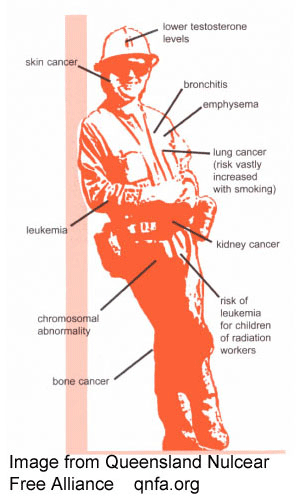
4.1 The perception that uranium mining has not led to ill health effects in workers has been created through the lack of comprehensive studies on worker health and the failure of Governments to establish a national registry for health workers. …..

Uranium mining, however, presents unique risks over other mining operations. Because of the presence of radioactive elements, uranium miners are at risk not only of immediate health problems, but of delayed fatal effects such as cancer. There is also the potential for radiation exposure to lead to illness and defects in the offspring of uranium miners

RADIATION EXPOSURE FOR URANIUM MINERS.  The potentially serious effects of radiation on workers has been shown by previous mines in Australia. Evidence was given to the Committee that 40% of underground workers at the Radium Hill mine in South Australia have died of lung cancer [12]. Even with more recent mining operations it was clear that worker health and safety was not given the priority it deserves. On a trip to the closed Narbarlek mine, the Committee saw worker health records and files left scattered on the floor of an abandoned administrative building. When the Committee visited WMC’s Olympic Dam mine, it saw workers who were not wearing the Thermoluminescent Dial (TLD) badges which register their exposure to radiation.   https://www.aph.gov.au/Parliamentary_Business/Committees/Senate/Former_Committees/uranium/report/d05#10

Kirsten Johnson
kirstjohn@aapt.net.au  I have a father, uncle and two aunts who all worked at Rum Jungle in the 1960’s. My father and uncle passed away in their 60’s due to lung cancer. My aunt in her 60’s due to breast cancer and my other aunt who is still with us today has also had breast cancer. Surely this cannot be a coincidence and I would like to know if there is information with regards to the health impact that the Rum Jungle uranium mine has had on past workers.

Janet Dickinson nee Litchfield
dickinsonjanet@hotmail.com  – I am Kirsten Johnson’s aunt, and sister to Judy, Peter and Kevin Litchfield who passed away with cancer. all having worked at Rum Jungle in the 50’s. My father in law also passed away in 1979, aged 70 from lung cancer, he worked at Rum Jungle for 20 years from 1958. I have just recently been diagnosed with inoperable lung cancer.

Health effects on Aboriginal people near Ranger uranium mine. 

….Since 1981, three years after mining began, at least 120 ‘mishaps’ and ‘occurrences’ — leakages, spillages of contaminated water, and breaches of regulations — have occurred. The Office of the Supervising Scientist has consistently claimed no harm to either the environment or human health — a claim difficult to substantiate. Since completion of the AIATSIS social impact monitoring report in 1984, there has been no monitoring of the social and physical impact on Aboriginal health and well-being, and no agency has specifically investigated the impacts on Aboriginal health.

Exploratory research undertaken in 2005 and 2006 has found a significant overall increase in the incidence of cancer among Aboriginal people in the Kakadu region — some ninety per cent greater than would be expected. We could not determine possible effects on maternal and child health because data on congenital malformations and stillbirths were not available. …. https://aiatsis.gov.au/sites/default/files/products/discussion_paper/dp20-aborigines-uranium-monitoring-health-hazards_0.pdf

June 8, 2019 Posted by | aboriginal issues, Christina themes, health, Northern Territory | Leave a comment

COURT STATEMENT: WANGAN & JAGALINGOU COUNCIL – on the Adani coal project and Aboriginal rights

May 30, 2019 Posted by | aboriginal issues, AUSTRALIA - NATIONAL | Leave a comment

The harm done to indigenous people, through uranium mining – and it’s happening again

Uranium mines harm Indigenous people – so why have we approved a new one?     https://theconversation.com/uranium-mines-harm-indigenous-people-so-why-have-we-approved-a-new-one-116262   The Conversation, 1 May 19, In the 1970s, when the Ranger mine opened, the Mirarr people felt largely powerless in negotiations between mining companies and the federal government.

Last week, the Tjiwarl experienced similar disempowerment. Yet both communities are recognised by the government as traditional owners.

Unsurprisingly, Australia is yet to sign the Treaty on the Prohibition of Nuclear Weapons, continuing the persistently toxic legacy of Australia’s nuclear industry.May 1, 2019   Last week the federal government approved the Yeelirrie uraniam mine in Western Australia in the face of vigorous protest from traditional owners.

This Canadian-owned uranium mine is the newest instalment in Australia’s long tradition of ignoring the dignity and welfare of Aboriginal communities in the pursuit of nuclear fuel.

For decades, Australia’s desert regions have experienced uranium prospecting, mining, waste dumping and nuclear weapons testing. Settler-colonial perceptions that these lands were “uninhabited” led to widespread environmental degradation at the hands of the nuclear industry.

As early as 1906, South Australia’s Radium Hill was mined for radium. Amateur prospectors mined haphazardly, damaging Ngadjuri and Wilyakali lands. And an estimated 100,000 tonnes of toxic mine residue(tailings) remain at Radium Hill with the potential to leach radioactive material into the environment.

Uranium mines across Australia have similar legacies, with decades of activism from the Mirarr people against the Ranger and Jabiluka mine sites in Kakadu National Park.

In the 36 years since it began operating, the Ranger mine has produced over 125,000 tonnes of uranium and experienced more than 200 accidents. In 2013, a reported one million litres of contaminated materialspilt into the surrounding environment.

Aboriginal communities remain at a disproportionate risk because large uranium deposits exist in lands deemed sacred and significant, while the testing and dumping of nuclear material is rarely undertaken in areas inhabited by settlers.

The federal government’s ambivalence toward these impacts has most recently culminated in their decision to give Cameco the go-ahead for the Yeelirrle uranium mine, a blow to the traditional owners of Tjiwarl country.

Native title fails to protect traditional owners from the mining industry

The Tjiwarl people have fought the Yeelirrie mine alongside the Conservation Council of WA for more than two years. They now must grapple with the government’s decision to ignore their resistance.

And in 2017, the International Campaign to Abolish Nuclear Weapons (ICAN) negotiated with the United Nations to create a treaty banning nuclear weapons. The treaty, adopted on July 7, 2017, recognised the disproportionate impact nuclear material has on Indigenous communities around the world. It includes the mining and milling of uranium.

The treaty warns that parties should be:

mindful of the unacceptable suffering of and harm caused to the victims of the use of nuclear weapons (hibakusha), as well as of those affected by the testing of nuclear weapons, [and recognise] the disproportionate impact of nuclear-weapon activities on indigenous peoples.

Nuclear weapons sourced from Aboriginal lands

The toxic legacy of uranium mining is not isolated to the contamination of ecosystems.

Radium Hill provided uranium for weapons for the United Kingdom and United States, including the nuclear weapons tested at Maralinga and Emu Field in the 1950s and 1960s.

These weapons spread radioactive contamination and dispossessed Aboriginal communities in and around the Anangu Pitjantjatjara Yankunytjatjara (APY) lands.

Uranium from the Ranger mine in Northern Territory found its way into the Fukushima Reactor, a reality that plagues the Mirrar people. In 2011, traditional owner Yvonne Margarula expressed her sorrow for those affected by the Fukushima meltdown:

it is likely that the radiation problems at Fukushima are, at least in part, fuelled by uranium derived from our traditional lands. This makes us feel very sad.

These legacies are felt acutely by those who continue to struggle with the lack of protection from native title and other government policies apparently designed to prevent the exploitation of Aboriginal communities by various industries.

In the 1970s, when the Ranger mine opened, the Mirarr people felt largely powerless in negotiations between mining companies and the federal government.

Last week, the Tjiwarl experienced similar disempowerment. Yet both communities are recognised by the government as traditional owners.

Unsurprisingly, Australia is yet to sign the Treaty on the Prohibition of Nuclear Weapons, continuing the persistently toxic legacy of Australia’s nuclear industry.

May 2, 2019 Posted by | aboriginal issues, AUSTRALIA - NATIONAL | Leave a comment

British exhibition on nuclear testing glosses over the impact on Aboriginal people

Cold War exhibition tries to airbrush Britain’s dark history of nuclear testing, The Conversation, Sue Rabbitt Roff, Researcher, Social History/Tutor in Medical Education, University of Dundee, May 2, 2019  A new exhibition about the Cold War recently opened at the UK National Archives at Kew in south-west London. Protect and Survive: Britain’s Cold War Revealed seeks to tell the story of how the years of high nuclear tensions affected the UK, from spy paranoia to civil defence posters to communications at the heart of government. …..

an extremely important facet of Britain’s Cold War has been almost entirely airbrushed from the story. There is barely anything in the exhibition about the 45 atomic and nuclear weapons detonations carried out by the British: 12 in Australia from 1952-57, nine in the central Pacific in 1957-58, and a further 24 alongside the Americans in the Nevada desert until as recently as 1991. The effects on the health of all this testing on indigenous people and some 22,000 British servicemen who were sent as observers is still being researched.
The Cold War exhibition includes three photos showing the atmospheric effect of the 1952 detonation off the Montebello Islands off north-western Australia. There is one additional picture of the hydrogen bomb that was exploded near Christmas Island in May 1957, the first of the central Pacific series, which persuaded the US to resume nuclear collaboration with the UK. And that’s about it. Worse, the exhibition includes a map of the global impact of the nuclear era in which the test locations in Australia are obscured by lettering – not least Maralinga, an important Aboriginal area in which seven detonations took place.

Files under review

My understanding is that decisions about the content of the exhibition were finalised late last year. Interestingly, this was around the same time as the Nuclear Decommissioning Authority, the public body with ultimate responsibility for the UK’s nuclear legacy withdrew recordsfrom the National Archives relating to 1950s nuclear weapons tests that had been declassified decades ago, pending a “security review” by the Ministry of Defence and Atomic Weapons Establishment. Specialists in this field have long complained about the many files concerning British testing that have remained secret, which makes the withdrawal of declassified files all the more unsettling………

Remembrance, The omissions at the London Cold War exhibition are a reminder about the UK’s low-key approach to its weapons testing history. The story doesn’t only need to be properly told at this exhibition, it needs a permanent public space. Yet no existing museum dedicated to Britain’s wars is interested in giving it house room – not even the records and memorabilia of all the military personnel sent to observe the tests. A number of years ago I was quietly told while walking down a corridor in one major institution not to offer it my own records because “they will end up in the skip”.

My years working in this field indicate to me that successive governments seem to want the story of British nuclear testing to die off naturally. But surely, at the very least, the point of the National Archives is to preserve the records to ensure that it is never allowed to be forgotten. https://theconversation.com/cold-war-exhibition-tries-to-airbrush-britains-dark-history-of-nuclear-testing-116237

May 2, 2019 Posted by | aboriginal issues, AUSTRALIA - NATIONAL, history, politics international, weapons and war | Leave a comment

Traditional owners fight Adani coal project, – fear destruction of their sacred wetlands

May 2, 2019 Posted by | aboriginal issues, AUSTRALIA - NATIONAL, environment | Leave a comment

UK nuclear testing in Australia – Trident anniversary – no cause for celebration.

Trident celebrations ignore Aboriginal victims of British nuclear weapons testing, Green Left, Linda Pearson, April 26, 2019 Issue 1218, Scotland   

THE Royal Navy’s plan to hold a “national services of thanksgiving” at Westminster Abbey to mark 50 years of Britain’s submarine-based nuclear weapons has provoked condemnation from senior clergy and peace campaigners.

Campaign for Nuclear Disarmament (CND) General Secretary Kate Hudson said the plan is “morally repugnant” and the organisation is urging supporters to convey their opposition to Defence Secretary, Gavin Williamson. Two Bishops and more than 20 priests have called on Westminster Abbey to cancel the service, which is set to take place on May 3……

The rhetoric of “deterrence” and “defence” is routinely invoked by nuclear-armed states to obscure the horrifying truth about nuclear weapons and justify national security doctrines that rely on them. Nuclear weapons are unique in their destructive power; “designed to indiscriminately kill and destroy thousands of innocent civilians”, as the Bishop of Colchester told The Times last week. This reality was recognised by most of the world’s countries, which voted to ban nuclear weapons in 2017.

Britain’s nuclear weapons program has already destroyed the lives of countless innocent civilians. More than 1200 Indigenous Australians were exposed to radiation during British nuclear weapons testing in the 1950s and 1960s, while many others were displaced. The effects continue to be experienced by their families today. Some are now calling on the British government to apologise for the testing, instead of celebrating Trident.

Nuclear testing in Australia

Britain conducted 12 major nuclear weapons tests in Australia at the Montebello Islands, and at Emu Field and Maralinga in South Australia.

After securing the agreement of the Australian government, the British established a permanent test site at Maralinga in 1955. Seven major and several hundred “minor” tests were carried out there, releasing 100kg of radioactive materials into the surrounding area.

The British and Australian governments of the day demonstrated a callous disregard for the lives of Aboriginal people that is characteristic of the settler-colonial mindset. Permission to conduct the testing was not sought from Aboriginal landowners and the Australian government decided they should not be informed of the risks.

When an Australian scientist asked British authorities about the potential danger to local Aboriginal people, the response was that “a dying race couldn’t influence the defence of Western civilisation”.

Many Aboriginal people were forcibly removed from their land prior to the tests, destroying their way of life. Others experienced serious health issues as a result of their exposure to radiation.

Yankunytjatjara man Yami Lester went blind after a “black mist” from the explosions enveloped his country. Others experienced skin rashes, diarrhea and vomiting. Today, Aboriginal communities in the area experience high rates of diseases associated with the effects of radiation poisoning.

Yami Lester’s daughter, Karina Lester, and her family played a crucial role in the International Campaign to Abolish Nuclear Weapons (ICAN). They collected and shared stories from the survivors of nuclear weapons testing that were instrumental in convincing 122 states that the only safe way to deal with nuclear weapons is to eliminate them.

ICAN won the Nobel Peace Prize for its efforts to bring about the 2017 United Nations Treaty on the Prohibition of Nuclear Weapons. The historic treaty recognises “the disproportionate impact of nuclear-weapon activities on Indigenous peoples”. The British and Australian governments boycotted the UN negotiations, however, and have ruled out signing the treaty.

No cause for celebration

Karina Lester said “survivors of the British Nuclear Tests carried out on Australian soil in the 1950’s and 1960’s in South Australia’s outback are still haunted. The Indigenous communities still suffer with high numbers of deaths, cancers, respiratory illnesses and autoimmune disease.”

Several attempts to clean up the Maralinga site have been made by British and Australian governments, thanks to the campaigning of survivors like Yami Lester, but contamination at the site remains. In 1995, Aboriginal peoples received just £7.5 million for the loss and contamination of their land. Only £110,000 has been paid to five Aboriginal people to compensate for their exposure to radiation. A class action was blocked by Britain’s Supreme Court in 2013.

Karina Lester said that the affected communities “have had no apology for the wrongdoings on our traditional lands to this day. As the British Government celebrates 50 years with nuclear weapons, Australia’s Indigenous communities in South Australia wear the scars.”

Instead of celebrating, Lester said, “we Indigenous South Australians urge the British government to own up and apologise for your actions…………”https://www.greenleft.org.au/content/trident-celebrations-ignore-aboriginal-victims-british-nuclear-weapons-testing

April 27, 2019 Posted by | aboriginal issues, AUSTRALIA - NATIONAL, weapons and war | Leave a comment

Traditional Owners fighting Adani coal mine mount fresh legal challenge   

 https://www.sbs.com.au/nitv/article/2019/04/10/traditional-owners-fighting-adani-coal-mine-mount-fresh-legal-challenge?fbclid=IwAR2CDn6KvmYhrD2yfZ2-Hz7sGtKr0MRWbA5fDQFVvr1S-3Oxk_OOd509qyk   Adani gained federal government approval for its controversial mine project but could be stopped by a courtroom confrontation from Traditional Owners.  By Ella Archibald-Binge, 10 Apr 19

Source: 

NITV News

Traditional Owners opposed to the Carmichael mine will mount a legal challenge in the federal court next month to overturn Adani’s crucial agreement with Indigenous landholders.

The mining company’s groundwater management plan was approved this week by Federal Environment Melissa Price and before construction can begin the Queensland government needs to sign off on environmental approvals.

However, if successful, next month’s court hearing could have severe ramifications.

A handful of Wangan and Jagalingou (W&J) native title claimants are seeking to invalidate Adani’s Indigenous Land Use Agreement (ILUA), which is required for the mining company to build key infrastructure.

Some W&J native title claimants support the mine but those who oppose it say the ILUA is a “sham”.

Their claims were dismissed in a court hearing last year and the group will now appeal that verdict to the full bench of the federal court.

‘An act of war on our people’

Adrian Burragubba, one of the anti-Adani claimants, said he felt confident ahead of the hearing.

“That full bench federal court has allowed us to argue at least ten points – all we need is one of those points to get up in that argument and that ILUA will then become null and void,” he told NITV News.

“You can’t start building a mine until you get that ILUA, so nobody wants to talk about it because it’s the main thing that’s holding up the mine.”

Mr Burragubba  also criticised the federal government’s decision to approve Adani’s groundwater management plan, claiming the project would destroy ancient springs.

“Water is part of our dreaming as First Nations people,” he said.

“This will fracture our ties with our ancestors and will essentially be an act of war on our people.”

Environmental approval ‘reeks of political interference’

Meanwhile, Queensland Environment Minister Leeanne Enoch said she would not be rushing the remaining approvals.

“I will not be bullied and I will not allow the regulator to be bullied,” the Labor MP said.

“The federal minister’s decision yesterday to approve Adani’s [groundwater management plan] reeks of political interference, and in many ways puts into question the integrity of her decision-making process.”

Adani Australia CEO Lucas Dow said the approval followed 18 months of environmental evaluation by CSIRO and Geoscience Australia.

“The measures outlined in the plans will ensure groundwater at the mine, and the ecosystems that depend on it, are protected,” he said in a statement.

April 11, 2019 Posted by | aboriginal issues, AUSTRALIA - NATIONAL, climate change - global warming | Leave a comment