Turnbull’s powerful taskforce to promote the coal industry
 Push for coal-fired power Malcolm Turnbull has formed a new, powerful cabinet committee to oversee national energy policy.
Turnbull taskforce to push coal-fired power for north The Australian February 4, 2017 DENNIS SHANAHAN Political Editor Canberra MICHAEL OWEN, Malcolm Turnbull has formed a new, powerful cabinet committee to oversee national energy policy as the government proposes to use some of the $5 billion Northern Australia Fund to help build a new, commercially viable coal-fired power station in northern Queensland……
As parliament resumes next week the Prime Minister is putting energy security and lower power prices at the heart of the Coalition’s policy and political campaign with the new cabinet sub-committee — including Mr Turnbull, Barnaby Joyce, Julie Bishop, Scott Morrison, Mathias Cormann, Josh Frydenberg, Matt Canavan and Arthur Sinodinos — starting to co-ordinate and develop a national energy policy…….
Mr Turnbull and the Treasurer have flagged using funds from the Clean Energy Development Fund for modern coal-powered generators the government has convinced the $100 billion Asia Infrastructure Investment Bank to lend for coal-fired electricity generation in Asia. Senator Canavan, the Minister for Northern Australia, yesterday suggested the government help fund a coal-fired power station in the Galilee Basin in Queensland……
“We back clean-coal options in the north and I want to make clear that we will back investment in clean coal through our $5bn Northern Australia Infrastructure Facility. We set up that facility to build infrastructure in the north, to build specific infrastructure like power stations,” Senator Canavan said….
The minister said Mr Turnbull had announced that the “Australian government would look at encouraging the development of a clean coal-fired power station in Australia”. “This will be a clear difference between us and the Labor Party. We support coal…….. http://www.theaustralian.com.au/business/mining-energy/turnbull-taskforce-to-push-coalfired-power-for-north/news-story/e15cbb9f03c1922f909780ccbffd41cb
Turnbull govt wants to use Clean Energy Finance Corporation to finance new coal power stations
“The stranded asset risks of investing in new coal-fired power plants are clear to almost all,” Buckley said. “At some point a carbon tax or ETS is inevitable and would need to be priced in.”
Buckley said if that happened, the CEFC could well be stranded with any loan it’s given to coal power stations.
How Malcolm Turnbull could ignore the facts and fund the myth of ‘clean’ coal, Guardian, Michael Slezak 2 Feb 17 The Coalition could use the Clean Energy Finance Corporation to finance new coal power stations but it wouldn’t be cheaper than renewables Just a few months ago, the idea that a new coal power station would ever be built in Australia seemed laughable. Banks, energy companies and even the Turnbull government seemed to accept the inevitable decline of the coal industry.
But, since then, the Turnbull government has been furiously talking up the idea of “clean” coal. And while no bank is likely to finance the building of a new coal-fired power station here, Turnbull and his ministers have been indicating the government might themselves fund them.
There’s been a lot of spin in this debate, so here are some facts……..
The Clean Energy Finance Corporation cannot currently fund coal (but the government could change the rules) Continue reading
The nuclear industry- economic disaster for Australia – theme for February 2016

Any economic argument for the nuclear industry was blown out of the water by the absolute discrediting of South Australia’s shonky Nuclear Royal Commission (NFCRC)’s push for importing nuclear wastes.
Australia’s nuclear lobby knew that the industry is not healthy, nor safe, nor clean, and is a disaster for the Aboriginal people. But, they didn’t care – saying that importing nuclear waste would make $billions. All thorough economic research said otherwise. Far from saving South Australia’s struggling economy, expanding the nuclear industry would most likely bring that State to bankruptcy.
Now the nuclear lobbyists are at it again – touting “new nukes” – small thorium nuclear reactors, (which would require importing enriched uranium or plutonium to get them working.) Even the pro nuclear NFCRC concluded that these would not be economic for South Australia.
 The push for “new nukes” is driven partly by the vanity of a few would-be-famous young men, partly by the nuclear enthusiasts within the defence lobby, and partly by the general desperation of the global nuclear industry to make it look as if they’re succeeding.
Whichever way it is, South Australia will be the loser if nuclear lobbyists win. South Australia has the opportunity to lead in 21st Century renewable energy technologies. With no help from the climate-denying, anti-renewables, Turnbull government, South Australia is up against it.
The uranium market is in continual gloom. Any expansion of the nuclear industry in Australia is a recipe for economic disaster – and a ludicrous contrast to Australia’s wonderful opportunities in renewable energy and clean agriculture.
Utility scale investment marks the surge in wind and solar power in Australia
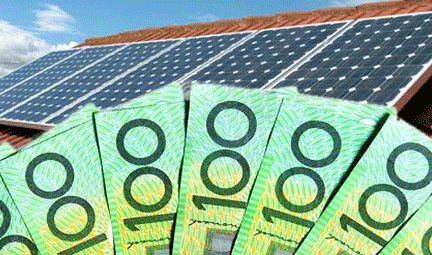 Wind, solar investment surge “the start of bigger
  things to come” REneweconomy By Jonathan Gifford on 18 January 2017 The strong growth in large scale renewable project financing in Australia in 2016 could be just the beginning of a major wave of investment.
This is the prognosis of Bloomberg New Energy Finance associate Leonard Quong, who adds that if key policy settings remain in place the $2.5 billion in annual large scale project investment required for Australia to meet its Renewable Energy Target could be achieved through to 2020.
“We have seen a new sense of momentum and energy in the market,” Quong told RenewEconomy, speaking of the latter stages of 2016. “If some of the fundamentals looking forward are to be believed, this is the start of bigger things to come.”
Quong explains that the stage is set for a large number of utility scale wind and solar PV projects to attract financing and get off the ground in 2017.
This is due in a large part to the “paralysis” the large scale renewable market experienced in 2014 and 2015, itself brought on by the Abbott Government’s Renewable Energy Target (RET) review. This paralysis is the primary cause of the large scale generation certificates (LGCs) shortfall likely to eventuate in 2018.
The BNEF analyst notes that the RET reduction agreed to by the major political parties, a position advocated by the Clean Energy Council aimed at breaking the paralyzing deadlock, laid the groundwork behind the recent growth in project financing.
The significant factor being that as it was achieved in a bipartisan fashion, investors gained confidence that the policy will be in place over the mid-to- long term.
As to whether Australia can achieve the reduced RET, Quong is quietly optimistic…….
A major trend set to emerge strongly in 2017, according to BNEF analysis, is the rise of utility scale solar. While wind project investments far exceeded utility scale solar in Australia in 2016, rapid price declines and solar PV’s inherent advantages in terms of project execution should see large scale solar take off.
“Given the shortfall in certificates now expected to happen in 2018, it gives quite an incentive for investors to look at solar,” says Quong. “With the shorter build times, potentially shorter development times, and with certificate prices now above $80/MWh, it certainly makes it quite attractive.” ……http://reneweconomy.com.au/wind-solar-investment-surge-start-bigger-things-come-57167/
Australian Capital Territory prepares for role as clean energy hub and exporter of renewable technology
Funding boost for renewable sector to prepare ACT for green future http://www.canberratimes.com.au/act-news/funding-boost-for-renewable-sector-to-prepare-act-for-green-future-20170110-gtp8vm.html Clare Sibthorp 11 Jan 17
The ACT government hopes a funding boost to the local renewable sector will take the territory one step closer to a green future.
Two new grant programs launched by Climate Change and Sustainability Minister Shane Rattenbury aim to shape the ACT as an export-oriented hub for renewable energy innovation and investment.
The new Direct Grants Stream will provide grants of more than $30,000 to businesses developing renewable technologies.
The Innovation Connect Renewables Stream will feed extra cash into the ACT government’s existing Innovation Connect grants program, allocating $120,000 to the development of innovative products and services in the renewable sector in 2017.
Mr Rattenbury said the programs would be financed from the $12 million industry-funded Renewable Energy Innovation Fund.
He said the ACT was on track to be fully powered by renewables by 2020. “The grants announced today are designed to grow the renewable energy industry, help organisations take the next step in commercialising their technology and reduce deployment costs of renewable energy and energy storage,” he said.
Jobs growth in the ACT renewable energy sector in the past six years was 12 times faster than the national average, a report into the territory government’s action on climate change revealed.
The Minister’s Report into Climate Change and Greenhouse Gas Reduction also showed the rate of job growth in the ACT’s renewables sector was six times higher than any other state and territory, as the government invested $12 million into a renewable energy industry development strategy.
W.A. govt approves Toro Energy’s Wiluna uranium mine, as uranium prices continue to decrease
 Toro Energy’s Wiluna uranium mine in Goldfields gets green light from WA Government, ABC News, By Jarrod Lucas, 9 Jan 17, Western Australia’s first uranium mine is a step closer after the state’s Environment Minister Albert Jacob granted approval for a project at Wiluna in the northern Goldfields.
The owners of the proposed mine, Toro Energy, still need the green light from Federal Environment Minister Josh Frydenberg.
Toro told the stock market on Monday afternoon it hoped federal approval would be granted by March…..
, uranium miners rushing to get approvals in place before March’s state election were thwarted in their bid for a hat-trick when Canadian giant Cameco’s proposed Yeelirrie mine was knocked back on environmental grounds last year……
Drop in Australian uranium production predicted
Uranium prices remain near historic lows, depressed since the 2011 Japanese tsunami sent the Fukushima plant into multiple meltdowns.
The Department of Industry, Innovation and Science today released its Resources and Energy Quarterly which forecast Australian uranium production to decrease by 6.8 per cent this financial year to 7,141 tonnes……http://www.abc.net.au/news/2017-01-09/toro-energy-wiluna-uranium-mine-approved-by-wa-government/8171398
The Australian tax-payer is the sole investor in Adani’s coal export plans.
Aside from the culture, environment and cost, is Adani a good investment?, The Age, Julien Vincent , 13 Dec 16,
The Australian public is the sole investor in Adani’s coal export plans.
Adani is an Indian conglomerate that wants to build the largest thermal coal mine in Australia, a rail line of almost 400 kilometres connecting it to the coast, and a coal export terminal in the Great Barrier Reef World Heritage Area. The coal would be shipped out through the reef, giving it a perfect view of the bleaching and mortality that has been decimating our valuable natural icon recently before being burned in power stations overseas, only to further contribute to climate change and ocean acidification, considered the greatest long-term risks to the reef.
Given that the reef sustains 60,000 jobs and provides $6 billion per year of economic benefit to Australia, investors may want to consider conflicts of interest before moving ahead.
Some other niggling environmental risks investors might want to consider is the drainage of 12 billion litres per year of water from the Great Artesian Basin and the impacts of coal dust on people’s health along the transport corridor, along with particulate matter from the power stations as the coal is burned.

We’d also want to be content with supporting a mine that has not received free, prior and informed consent from traditional owners, potentially making this a major human rights issue.
But enough of the existential threats posed to culture, people, sites of natural World Heritage and the climate.
Let’s look at the numbers. Last week’s proposal by the Australian government of a $1 billion loan from the Northern Australia Infrastructure Fund means as investors we need to understand the business case.
First of all, don’t be put off by Adani’s corporate debt, which is two-and-a-half times the size of the company. Or the fact that Adani’s share price is down 20 per cent this year. This loan would actually be going to Adani’s private family company, based in Singapore and ultimately owned by Atulya Resources in the Cayman Islands, where we can be sure the money will be totally secure.
The mine will supply new coal power stations in India, whose power minister said yesterday would not be required until 2022, and who wants to get India off imported coal within the next few years. The power will only cost twice that of new renewable energy, and so an exciting market has been identified among those living in energy poverty.
Should the India option fail, the coal could be sold onto the seaborne market, which has declined by 10 per cent in recent years, Goldman Sachs, Deutsche Bank, Bernstein and others declaring it in structural decline.
Conditions like these have frightened off a few more faint-hearted commentators, such as the Queensland Treasury under the Newman government, which described the project as unbankable. Or Wood Mackenzie, which still considers the project as having a negative net present value.
Should the India option fail, the coal could be sold onto the seaborne market, which has declined by 10 per cent in recent years, Goldman Sachs, Deutsche Bank, Bernstein and others declaring it in structural decline.
Conditions like these have frightened off a few more faint-hearted commentators, such as the Queensland Treasury under the Newman government, which described the project as unbankable. Or Wood Mackenzie, which still considers the project as having a negative net present value…….
It’s clear that our investment is going to make a major difference. But will it be enough? $1 billion is a huge lifeline but depending on what assumptions you make about the scale of the project or who you’re prepared to believe, this project is going to cost anywhere from $7 billion to $21 billion……http://www.theage.com.au/business/mining-and-resources/aside-from-the-culture-environment-and-cost-is-adani-a-good-investment-20161213-gta0nq.html
Australian Capital Territory (ACT) – jobs growth with renewable energy
 Renewable jobs grow as ACT drives down emissions from government operations by 17 per cent in three years, Canberra Times, Katie Burgess, 13 Dec 16, Jobs growth in the ACT renewable energy sector in the past six years was 12 times faster than the national average, a report into the territory government’s action on climate change has revealed.
The Minister’s Report into Climate Change and Greenhouse Gas Reduction also showed the rate of job growth in the ACT’s renewables sector was six times higher than any other state and territory, as the government invested $12 million into a renewable energy industry development strategy.
Ahead of the COAG Energy Council meeting on Wednesday, climate change minister Shane Rattenbury said he would push other states and territories to take up their own renewable energy targets.
“We must not allow the federal government’s inaction to limit what we can achieve at a state and territory level. The ACT is a great example of what subnational governments can achieve. We are on track to meet our 100 per cent renewable electricity target by 2020 and to become Australia’s first zero emission jurisdiction by 2050,” Mr Rattenbury said.
Emissions from government operations have fallen 17 per cent since 2012-2013, the report also revealed. The ACT government is aiming to be carbon neutral in its own operations by 2020……http://www.canberratimes.com.au/environment/climate-change/renewable-jobs-grow-as-act-drives-down-emissions-from-government-operations-by-17-per-cent-in-three-years-20161213-gta1ha.html
Australia’s electricity industry strongly calls for a carbon price, and switch to clean energy
Electricity industry pushes for carbon price to aid transition to clean energy system http://www.abc.net.au/news/2016-12-08/electricity-industry-push-for-a-carbon-price/8104642 By political reporter Naomi Woodley Australia’s electricity industry has issued a strongly worded plea to federal and state governments to quickly decide on ways to transform Australia’s ageing energy grid.
In a joint statement released ahead of tomorrow’s Council of Australian Governments meeting, the groups representing generators, distributors and retailers say a national, market-based carbon price is the best option to make the transition to a cleaner energy system.
The Australian Energy Council and Energy Networks Australia said without change, customers face higher prices and an increasingly unstable electricity supply. Continue reading
Not justified, not financially viable – Adani’s huge coal mine project
Adani’s mega mine neither financially viable nor justified, says energy analyst, ABC News, By Casey Briggs, 8 Dec 16, Adani’s mega coal mine in north Queensland is neither “financially viable nor strategically required” an energy commentator claims.
The mining giant will begin construction on its $22 billion Carmichael coal mine in the Galilee basin in central Queensland next year.
This week, Adani announced the mine’s regional headquarters will be in Townsville, and the State Government is promoting an “ironclad” handshake deal with the company to source workers from regional Queensland.
Despite the announcements, energy analyst Tim Buckley from the anti-coal think tank The Institute for Energy Economics and Financial Analysis (IEEFA) said there is still doubt over whether the mine is even viable.
“All of my financial analysis over the last four years says the mine is neither financially viable nor strategically required or justified,” Mr Buckley said.
“Financial closure is going to be a major obstacle, I have absolutely no doubt.”
“As the company has admitted, they have not been talking to any financial institutions about this project”
Federal government should study India first
A number of Australian and international banks have reportedly ruled out financing the mine. Adani has also applied for public financing for a $1 billion rail link from the Commonwealth Government, but it’s unclear if the loan will be granted.
Mr Buckley said the Indian Government’s plans to reduce and potentially end coal imports threatens the justification for the project. “[The Australian Government should] go and study what’s happening in India … before they give a billion dollars in taxpayer subsidy to a foreign billionaire who made an investment decision at the height of the coal boom in 2011 and hasn’t progressed the project for six years,” said Mr Buckley.
At the Paris climate summit in November 2015 India’s prime minister Narendra Modi declared that in the 21st century “the world must turn to the sun to power the future”…….http://www.abc.net.au/news/2016-12-08/adani-mega-mine-neither-viable-nor-required-says-analyst/8100906
Australian uranium mining companies going down the gurgler?
 Writing on the wall for Paladin Energy Ltd, The Motley Fool, Mike King – December 1, 2016 Uranium miner Paladin Energy Ltd (ASX: PDN) faces the prospect of being unable to repay US$212 million due in April 2017 and being forced into liquidation.
The troubled company has seen its share price slump more than 65% this year alone. The planned sale of 24% of its Langer Heinrich Mine (LHM) to CNNC Overseas Uranium Holdings (COUH) for US$175 million appears unlikely to complete before the end of 2016. Now Paladin has been forced to consider other ‘contingencies’ to repay the 2017 convertible bonds.
Not only that but Paladin also needs to raise working capital as it struggles to generate positive cash flow with uranium prices trading under US$20 per pound – the lowest prices in more than 12 years. As Paladin admits, that’s a level that no producer in the world can sustainably break even, and most producers are experiencing negative cash flows.
That’s a long way away from Paladin’s all-in cash expenditure of extracting uranium of US$38.75 per pound (lb). Even the company’s C1 cash costs of US$25.88/lb are well above the spot price of uranium. Paladin is forecasting all-in costs of around US$30/lb for the 2017 financial year, but it’s clear that even at that level, the company is going backwards.
Energy Resources of Australia Limited (ASX: ERA), majority owned by Rio Tinto Limited(ASX: RIO) faces a similar prospect to Paladin and is likely to shut up shop in 2021, once it has finished processing stockpiles at its Ranger uranium mine.
The problem for uranium miners around the world is that since the Fukushima nuclear incident in 2011, uranium prices have steadily fallen from above US$60/lb to its current price under US$20/lb……
Paladin faces the prospect of sinking into administration unless it can find a white knight willing to take a minority stake in its mine – or make an outright bid for the whole company.
That appears highly unlikely. http://www.fool.com.au/2016/12/01/writing-on-the-wall-for-paladin-energy-ltd/
Toro Energy, uranium miner, CEO Vanessa Guthrie chucks away the poisoned uranium chalice
 Toro Energy rings in the changes at the top as Dr Vanessa Guthrie departs http://www.proactiveinvestors.com.au/companies/news/169921/toro-energy-rings-in-the-changes-at-the-top-as-dr-vanessa-guthrie-departs-169921.html
Australian solar power technology sold to China, by CSIRO
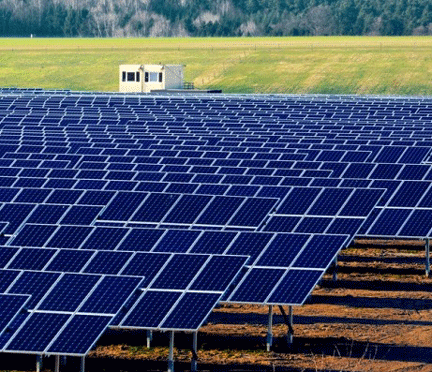 CSIRO sells concentrated solar power technology to China, The Age, Marcus Strom , 28 Nov 16 The CSIRO on Tuesday will sign a technology licensing agreement with a Chinese solar company that could reap millions of dollars in royalties for the national science and industry organisation. The deal with Beijing-based Thermal Focus will allow the company to bid for business in the burgeoning Chinese market for concentrated solar power using Australian-designed technology.
China aims to build infrastructure that produces 1.4 gigawatts of concentrated solar power by 2018, increasing this to 5GW by 2020.
“To put that into perspective, Australia has 50GW capacity in all its power stations,” said Wes Stein, CSIRO’s chief energy research scientist. John Grimes, of the Australian Solar Council, said: “This is a significant commercial opportunity, perhaps worth hundreds of millions.” CSIRO chief executive Larry Marshall said: “This partnership takes our climate mitigation focus to a global stage.”
Minister for Industry, Innovation and Science Greg Hunt said: “Australia is a leader in clean energy technology and this partnership is an important step in realising this advantage.”
The partnership will be signed at the Asia-Pacific Solar Research Conference at the Australian National University. Phil Hearne
Concentrated solar power, or solar thermal, uses mirrors to focus the sun’s energy into a collector. At collected temperatures of 560 degrees, that energy is then stored in molten nitrate salts in large thermal tanks. This can then generate superheated steam to drive turbines for electricity generation for weeks.
CSIRO’s patented technology uses smaller mirrors of about five square metres, known as heliostats, and field-control software to direct the solar energy. The technology was pioneered at the CSIRO’s energy centre in Newcastle. The solar thermal team has grown to more than 30 scientists and engineers.
Mr Stein said: “The big difference with photovoltaic cells is that our technology has storage embedded at a lower cost than batteries.”
A CSIRO spokesman said the licensing agreement covered a technology transfer payment with recurring royalties for the number of heliostats installed……
John Grimes at the Australian Solar Council said: “CSP with storage is the missing link in China’s renewable energy market.” Mr Grimes said what gave this deal credibility was that the Chinese had delivered on their plans in renewables. “Already China has installed 120GW of solar photovoltaic cells,” he said. “It really is a world leader in this field.” Its commitment was partly due to a combination of environmental concerns, cost effectiveness and air-quality pressures in cities, Mr Grimes said.
There are no commercial plants operating concentrated solar thermal technology in Australia. He said this was because government leadership in Australia had been lacking.
However, there are some companies working towards this: Vast Solar, SolarReserve and SolarStor, which is backed by former Liberal leader John Hewson.
SolarStor plans to build a concentrated thermal plant near Port Augusta, South Australia, as does US firm SolarReserve.
The solar deal comes a day after an interim report by a Senate committee recommended all Australian coal mines close by 2030.
The retirement of coal-fired power stations report committee is chaired by Greens senator Larissa Waters. Its final report will be handed down on February 1. http://www.theage.com.au/technology/sci-tech/csiro-sells-concentrated-solar-power-technology-to-china-20161128-gsz8gh.html
BHP Billiton living in la la land on uranium: mining giant faces difficult questions at its Annual General Meeting
 16th November 2016 Company Directors of BHP Billiton will face some difficult questions tomorrow at the mining giants Annual General Meeting in Brisbane. The operator of the Olympic Dam uranium mine in South Australia’s north has been receiving much attention over the past year after the tailings dam collapse at its jointly owned Samarco iron ore mine in Brazil in November 2015, causing what’s been described as the worst environmental disaster in Brazil’s history.
Anti-nuclear and social justice campaigner Adam Sharah is one of several delegates attending the meeting to challenge company directors on matters including the Samarco disaster and issues surrounding the Olympic Dam mine. Mr Sharah will question company directors about BHP Billiton’s position regarding nuclear regulation in Australia, new expansion plans for Olympic Dam, and plans to increase the height of the tailings dams at the mine.
In its submission to the recent South Australian Royal Commission into the Nuclear Fuel Cycle, BHP Billiton recommended that nuclear actions should not be regulated under the federal Environment Protection and Biodiversity Conservation Act, the key piece of legislation for environmental protection in Australia, on the basis that uranium is just like any other mineral. The company claims that “there is no scientific basis for uranium mining to be defined as a Matter of Environmental Significance…”[1]
“BHP Billiton is in la la land if they still believe that uranium is just like any other metal – no other metal has such an enormous range of international treaties – uranium is fundamentally risky, and BHP Billiton should act accordingly,” said leading Environmental Engineering academic, Dr Gavin Mudd.
“What would have been the impact of the tailings dam collapse in Brazil if the tailings were radioactive?” asks Adam Sharah. “Uranium and the tailings produced by uranium mining are unique both in their health and long term environmental impacts.”
“In the wake of the tailings dam collapse in Brazil, there are concerns here in Australia about reports that BHP Billiton are seeking approval to increase the height of their tailings dams at the Olympic Dam mine,” continued Mr Sharah. “It is important that the company clarify this for the Australian public, Aboriginal custodians of the area, and its shareholders.”
Mr Sharah will also seek clarification on the progress of the company’s plans for an on-site heap leach trial at Olympic Dam as part of a cheaper expansion plan, after it shelved it’s grand expansion plans in 2012.
“It is always a concern when corporations start seeking cheaper, cost-cutting alternatives,” said Nectaria Calan, of BHP Billiton Watch. “These concerns are magnified by the fact that federal approval of the heap leach trial did not require any environmental assessment even though heap leach mining is not a method currently used on-site at the Olympic Dam mine.”
“Yet despite by-passing environmental assessment for the trial, and despite the legal privileges and exemptions BHP Billiton enjoy under the Indenture Act, which only applies to the Olympic Dam mine, the company is still lobbying through forums such as the Nuclear Fuel Cycle Royal Commission to reduce regulation further. This type of regulatory race to the bottom, characteristic of third world nations competing for foreign capital, will only make disasters like Brazils more common.”
BHP Billiton’s AGM will be held on Thursday 17th November, 11 am, Brisbane Convention and Exhibition Centre
Jobs in a clean energy future
http://apo.org.au/resource/jobs-clean-energy-future
25 October 2016 Download file
By committing to the Paris Agreement, the world recognised the need to work together to keep global warming well below 2 degrees. Around the world, other governments are embracing the opportunities of transitioning to a clean energy future. But at home, Australia’s pollution continues to rise and Australia remains as one of the biggest per capita polluters in the world. There is still no coherent national plan to transition Australia to a net zero emissions economy.
Jobs in a clean energy future updates our 2010 collaboration Creating Jobs – Cutting Pollution and demonstrates, yet again, that creating a brighter future for the Australian community and our environment go hand in hand.
This report presents a clear choice. If Australia continues with business as usual, pollution will continue to rise and the health of the people and our natural world will continue to deteriorate. If the government acts now and implements policies under a strong action scenario we can create one million more jobs by 2040. People and nature will be better off and the places we love will thrive. If we increase public transport and clean energy Australia’s cities, towns and regions will be more liveable, smarter and healthier places to live. By embracing these opportunities Australia can be a world leader and create jobs and industries that are at the forefront of the transition.
1 This month
15 April – Zoom –Nuclear Power is Not the Solution
Apr 15, 2026 01:00 AM in Canberra, Melbourne, Sydney

Join the International Physicians for the Prevention of Nuclear War (IPPNW) on Tuesday, April 14th for a timely webinar exploring the risks associated with nuclear power and challenging the myth that it offers a simple, safe, carbon-free solution to the climate crisis

of the week – Australians for War Powers Reform (AWPR)
To see nuclear-related stories in greater depth and intensity
 Antinuclear