Fall in quarterly production for uranium miner ERA
 ERA’s Sept quarter production falls, NT NewsAAP OCTOBER 13, 2015 THE Rio Tinto-owned company that recently shelved a major uranium mine expansion has reported a fall in quarterly production.
ENERGY Resources of Australia produced 457 tonnes of uranium oxide in the September quarter, down 19 per cent on the same quarter last year.
- Production was up 17 per cent on the June quarter, when output was impacted by a mill shutdown to carry out maintenance.All ore milled in the September quarter was taken from existing stockpiles, and no exploration expenditure was incurred during the quarter.ERA lost half its board in June after deciding a proposed new underground mine at Ranger in the Northern Territory will not proceed to a final feasibility study due to a sluggish uranium market.
 Rio Tinto has pulled its support for any expansion, but ERA continues to seek to extend its authority to operate Ranger in order to re-visit the expansion at some stage.
The company’s total evaluation expenditure for the September quarter dropped to $1 million, from $3 million in the June quarter, due to “close out activities” of its Ranger pre-feasibility study……..http://www.ntnews.com.au/business/era-sept-quarter-production-down-19-pct/story-fnjbnvte-1227567072625
Unable to sell them at home, Westinghouse trying to flog uneconomic nuclear reactors to Australia
 Westinghouse eyes Australian nuclear potential, links with local suppliers, SMH October 8, 15, Angela Macdonald-Smith and Jenny Wiggins Nuclear technology giant Westinghouse sees the retirement of old coal-fired power plants in Australia as an opportunity for nuclear power and is positioning itself early to inform the political and public debate.
In Sydney to announce a tie-up with three local suppliers, Westinghouse chief executive Danny Roderick said the Japanese-owned company “wants to make sure that the facts are out there” on the safety of new-generation nuclear reactors.
He said that convincing the 8 per cent of the Australian public that is undecided about nuclear power would create “an overwhelming majority of people in Australia that would support a nuclear new-build”.
The company, part of Toshiba Corporation, already has strong links with uranium suppliers in Australia, and sees the latest step as “a very logical fit” to build on those and explore local manufacturing capacity for a new reactor……….
Public perception still an issue
Nuclear power made “a lot of sense” for Australia, Mr Chilcote added. “Look at what brown coal and the associated emissions are doing on the environment. There’s a lot less waste out of nuclear, the hardest part is overcoming the public perception.”
The option of nuclear power for Australia is being examined within a South Australian royal commission, with findings due next year. Meanwhile, the federal government’s greenhouse gas reduction targets, of 26 to 28 per cent cuts from 2005 levels by 2030, and the anticipated retirement of ageing coal-fired generators have also set the scene for discussion.
“In the next decade you have several very large coal plants that are going to need to be retired, and you’re going to have to choose to build something to replace those,” Mr Roderick said.
“If you’re going to talk about carbon reduction and greenhouse gas reductions you’re going to have to bring nuclear into the mix.”
Mr Roderick’s discussions this week included federal Environment Minister Greg Hunt, Port Adelaide member Mark Butler and senior officials from the offices of the Prime Minister and Cabinet, and Resources Minister Josh Frydenberg.
He has been pointing out that Westinghouse’s AP1000 nuclear plant uses “passive” technology that doesn’t require electricity to be able to safely shut itself down, averting a Fukushima-like situation. This type of plant is under construction in the US and is set to be used in the UK, China and India……….. http://www.smh.com.au/business/energy/westinghouse-eyes-australian-nuclear-potential-links-with-local-suppliers-20151008-gk427h.html#ixzz3o0cN6nkW
Western Australian Wiluna uranium project in the doldrums for the forseeable future
WA’s first uranium mine likely to be delayed as Toro Energy puts Wiluna on hold WESTERN Australia’s first new uranium mine is likely to be delayed due to the ongoing downturn in demand and prices, Perth Now, 1 Oct 15
Toro Energy has put its Wiluna uranium project on hold as it waits for market conditions to improve. The company began drilling at the project in 2014 and had expected to start operations in 2017.
“We will get to build Wiluna when we get the price that makes Wiluna economic. We are not seeing that price today,” managing director Vanessa Guthrie told AAP.
Wiluna, 960 kilometres northeast of Perth, is the first new uranium mine in WA to receive federal  government approval since the lifting of a ban on uranium mining in 2008.
The project will require prices between $60 and $70 a pound to make money, Dr Guthrie said.
Long term uranium prices currently hover around $45 per pound, almost half the levels of five years ago. Prices are expected to dip further because of large stockpiles……..
Global uranium production has stalled in the past two years as depressed uranium prices have curtailed exploration activities and the opening of new mines……http://www.perthnow.com.au/business/was-first-uranium-mine-likely-to-be-delayed-as-toro-energy-puts-wiluna-on-hold/story-fnhocr4x-1227552733503
Report shows opportunity for clean energy jobs worth $370 bn
Australian clean energy jobs could be worth $370 bn in 10 years http://reneweconomy.com.au/2015/australian-clean-energy-jobs-could-be-worth-370bn-in-10-years-39526 By Sophie Vorrath on 29 September 2015 Australia’s renewable energy industry could generate $370 billion worth of jobs over the next 10 years using current technology, a new report has found. The report, released on Tuesday by Beyond Zero Emissions, aims to illustrate how Australia can transition from coal-fired power to renewables, shifting the economy along with it.
“Our research with Melbourne University into energy generation in Australia shows that we can create $370 billion of green energy jobs with current technology, instead of using coal-fired power stations,” said Beyond Zero Emissions CEO Stephen Bygrave.

When you add to this smart homes and buildings, as well as low-carbon land use, high speed rail and electric vehicle options, the green jobs climb towards $1 trillion dollars in value, Dr Bygrave says.
The report’s findings coincide with a new policy proposal from the Greens that calls for a levy to be imposed on coal mining companies to help pay for the transition away from fossil fuels, including for the rehabilitation of retired mines and retraining workers for clean energy jobs.
BZE is also set to launch a new book on October 2, at the Smart Future Cities Conference showing how easily existing Australian homes can be retrofitted to eliminate electricity and gas bills – a follow-up to its Zero Carbon Australia Buildings Plan, that was researched over 3 years.
“The Buildings Plan showed that all residential and commercial buildings in Australia could be converted to generate as much energy as they consumed, creating $270 billion of green jobs in the construction industry,” Bygrave said.
“The new book, The Energy Freedom Home, shows how every home can produce more energy than it consumes. And with rising electricity and gas prices and falling rooftop solar prices, Australian households can affordably revolutionise the way they power their homes.
“Our research shows that millions of ordinary Australian homes can be transformed to be high performing, comfortable and cheaper to run. The transformation is easy since 1.4 million homes already have rooftop solar.”
To illustrate their theory, BZE along with the University of Newcastle have retrofitted a brick veneer family home in North Lambton, Newcastle, that was originally built in 2000.
The retrofits, which began in 2009 and are based on the guidelines provided by the Energy Freedom Home program now save the household $1,200 a year on power bills, with credits during the year. By 2013 the house was transformed into a comfortable, passive solar house, generating more energy from the PV system in the year than it uses.
“We removed the gas systems for health, safety and cost reasons, and have found we use less energy now than when we had both electricity and gas,” said the house’s owner, who monitors it for energy, water, temperature and humidity.
As part of the Smart Future Cities conference, the home in North Lambton will be open on 10am and at 10:30am on Saturday 3rd October for free limited tours.
Climate hypocrites – survey findings on Rio Tinto, Business Council of Australia
 Rio Tinto, Business Council of Australia among ‘climate hypocrites’, survey says SMH, September 16, 2015 Peter Hannam Environment Editor, The Sydney Morning Herald BHP Billiton, Rio Tinto and the Business Council of Australia are among the world’s largest companies and industry groups holding back action on climate change, according to a new survey.
The research, based on methodology developed by the US-based Union of Concerned Scientists and applied by UK-based non-profit group InfluenceMap, found 45 per cent of the 100 biggest industrial companies were “climate hypocrites” that obstruct action on global warming. Some 95 per cent of the delaying firms were also members of trade associations that demonstrated “the same obstructionist behaviour”.
BHP Billiton was rated a “D”, keeping it just outside the lower 45 per cent of companies that were ranked as “hypocrites”.
“More and more, we’re seeing companies rely on their trade groups to do their dirty work of lobbying against comprehensive climate policies,” Gretchen Goldman, lead analyst at the Union of Concerned Scientists, said. “It is unacceptable that companies can obstruct climate action in this way without any accountability.”
Google topped the list of best performers, along with Unilever and Cisco Systems, each of which received a “B” rating for their relatively positive involvement on tackling greenhouse gas emissions and backing laws that supported such action.
Unilever, which has consumer brands including Dove and Flora, gained kudos for “strongly” supporting the introduction of a carbon tax in Australia in 2012.
The Abbott government scrapped the policy two years later and newly installed Prime Minister Malcolm Turnbull indicated in his first speech after toppling Tony Abbott that he would stick to the replacement direct action policy to pay polluters to curb emissions.
BHP Billiton, which has coal and oil interests, received its “D” for having a “low level but negative engagement on climate regulation”, including supporting the repeal of the carbon price. “The company appears to be supportive of [greenhouse gas] intensive energy sources, supporting continued use of coal,” the survey said.
BHP also lost marks for its membership of the International Association of Oil and Gas Producers and the Business Council of Australia (BCA), “both of which appear to be opposing climate policy”, the report argued. http://www.smh.com.au/environment/climate-change/rio-tinto-business-council-of-australia-among-climate-hypocrites-survey-says-20150915-gjn3rz.html#ixzz3m2HDgRjw
Uranium deal with India is bad for Australian business
 Australia-India nuclear deal http://www.lowyinterpreter.org/post/2015/09/14/Reader-riposte-Australia-India-nuclear-deal.aspx
Besides its collateral damage to Australia’s security, commercial and diplomatic interests, the soon-to-be ratifiedAustralia-India nuclear cooperation agreement notably fails to meet its objectives.
The aim was to give a green light to Australian uranium exports to India. Two objectives were to be served, one commercial, the other diplomatic. A vast new market was to be opened for Australian uranium exporters and India was to be convinced Australia was a reliable partner, worthy of a closer relationship.
Instead, as has been exposed in the Joint Parliamentary Committee, the Australian side gave away so much in the course of the negotiations on safeguards against nuclear proliferation and left open such loopholes for Australian uranium to end up in bombs or otherwise help their manufacture, that this proposed treaty does not do what Australia’s 23 existing nuclear safeguards treaties do.
Unlike them, it does not give Australian exporters legally watertight guarantees that the trade will be subject to effective controls against misuse of the uranium in ways Australian companies neither want nor could afford. So many deficiencies in the proposed treaty have been exposed it amounts at best, not to a greenlight but to a blinking yellow one. Not ‘all is guaranteed safe’ but ‘proceed carefully at your own peril’. And JSCOT’s main recommendation is a red light: no uranium exports to be permitted for the foreseeable future.
How Australian companies will respond and what risks they will be prepared to take remains to be seen, but no responsible government would have placed them in this situation.
The Indian Government has every reason to feel it too has been dudded. Instead of a reliable supply, there is a big element of precariousness. As for a demonstration of the Australian Government’s trustworthiness as a close partner, the contrary impression is conveyed of a bumbling inability to manage our own end of the deal.
Global investment bank UBS approves Labor’s proposed 50 per cent renewable energy target
 Australia’s Energiewende: UBS on why 50% renewable target is good, REneweconomy, By Giles Parkinson on 14 September 2015 Global investment bank UBS has conducted the first in-depth analysis of Labor’s proposed 50 per cent renewable energy target for Australia by 2030, concluding that it will require around $80 billion in investment, but much of this would need to be spent anyway.
In various scenarios outlined in the report, UBS says that up to 20GW of wind energy will need to be built by 2030, and 26GW of solar (both rooftop and large-scale), along with around $10 billion in grid costs. Around $4.8 billion is expected to be spent on battery storage by networks, and nearly $3 billion by households.
But it says this much of this will come from private investment, mostly from listed companies. And much of it needs to be factored in because it would be spent anyway to replace ageing coal and gas plants. And, UBS notes, all polls point to the popularity of renewable energy.
“A big part of the above cost will be incurred in one way or another as most of the thermal fleet in Australia is old and will need replacing.”
The intervention of UBS comes at a critical time, with the Canning by-election ……….
UBS says that the current target aims for around 7GW of wind and 6GW of solar, but it is not working anyway, because the policy certainty is not there – an issue we explore in this story, If wind energy is this cheap, why aren’t wind farms being built?………
Indeed, UBS suggests that a reverse auction process might be the best way to meet a Labor 50 per cent target – the same system adopted with great success in the ACT, and now by Germany and Texas and elsewhere (South Africa, UAE and Brazil also come to mind).
“Renewable energy suppliers and financiers want revenue certainty,” UBS analyst David Leitch writes.
“Thermal suppliers want to be able to plan their future with confidence. We think capacity auctions meet both of these goals.”
How would this work?
Leitch says legislation could set a quantity of renewable capacity to be added to each year. For instance, a 50 per cent by 2030 target requires around 70TWh of new renewables to be delivered over the 13 years from 2018 to 2030. That’s around 5TWh per year…………http://reneweconomy.com.au/2015/australias-energiewende-ubs-on-why-50-renewable-target-is-good-76557
Rosatom now selling uneconomic Honeymoon uranium project in South Australia
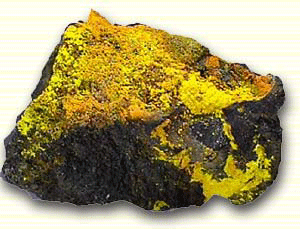 Rosatom sells Honeymoon uranium mine in South Australia, SMH September 1, 2015 Simon Evans Russia’s state-owned nuclear energy company Rosatom has finally lost patience with the Honeymoon uranium project in northern South Australia and is selling it off to an ASX-listed minnow called Boss Resources.
Honeymoon is one of the five Australian uranium mines in Australia, four of which are located in South Australia, but it has been in mothballs for the past two years because of the plunge in uranium prices which made it uneconomic to continue mining from the site.
The Honeymoon mine is located about 75 kilometres north west of the town of Broken Hill and has been through a series of changes in ownership, the last being a buyout of the Canadian firm Uranium One by the Russian state-owned nuclear company Rosatom. This gave Rosatom ownership of Honeymoon.
Boss Resources chairman Evan Cranston told Fairfax Media on Tuesday that one of the big attractions was the 2600 square kilometre tenement package which came with the project…….
The complex buyout by Boss involves several components including a $2.4 million cash payment, a $200,000 “site access” fee and several milestone payments into the future if the mine does go into production again. http://www.smh.com.au/business/rosatom-sells-honeymoon-uranium-mine-in-south-australia-20150901-gjci9k.html#ixzz3kWS1eIJQ
Australian uranium company Paladin mothballing uneconomic project in Labrador, Canada
Aurora Energy suspending uranium exploration in Labrador, CBC News Company cites low prices for decision to mothball Labrador operation Sep 01, 2015 Aurora Energy has announced it is suspending uranium exploration in Labrador and is blaming lower commodity prices for the decision.
Ches Andersen, Aurora’s vice-president of Labrador affairs, said since there’s no mining underway, the parent company will mothball the Labrador operation…..
Aurora is a member of the Paladin Energy Ltd. Group of Companies, based in Australia.
Lifting of moratorium
The issue of uranium mining in Labrador has been a divisive one.
The Nunatsiavut government narrowly passed a controversial bill to put a moratorium on exploration in place in April 2008. The decision to lift the moratorium was made unanimously late in 2011….http://www.cbc.ca/news/canada/newfoundland-labrador/aurora-energy-suspending-uranium-exploration-in-labrador-1.3209939
Enova Energy New South Wales community organisation starts new renewable energy provider

The directors said in the prospective that the “nimble and collaborative locally based social enterprise model” used by Enova could be replicated and scaled across like-minded communities in Australia.
The share offer closes on September 25.
Northern Rivers community seeks $4m in energy IPO http://www.theage.com.au/business/energy/northern-rivers-community-seeks-4m-in-energy-ipo-20150828-gja99q.html#ixzz3kLbExZM1 August 30, 2015 Angela Macdonald-Smith A community-owned organisation in north-eastern NSW is set to take on the big guns in electricity supply through a $4 million initial public offering to fund a renewable energy retailing and solar company it hopes will stimulate local renewable energy projects across the country.
Enova Energy, chaired by consultant and former NSW state librarian Alison Crook, is aiming to capture customers in the Northern Rivers region, where retailing major Origin Energy dominates the market.
Ms Crook said Enova was not aspiring to be a major competitor of Origin but sought mainly to provide a customer for small wind farms, hydropower and bio-energy projects that were not large enough to be of any interest to major retailers as a green power provider.
“We see this as a game-changer to get community renewable energy really going in Australia,” Continue reading
South Australian Premier critical of BHP as the company cuts even more jobs
“Our strategy has always been about the diversification of the South Australian economy and I think that we’ve been working on many fronts. Whether it’s education, health industries, tourism, defence … this is an economy of many moving parts,” Mr Weatherill said.
SA Premier Jay Weatherill refuses to explain BHP Billiton’s ‘bad news’ after jobs cut announcement 891 ABC Adelaide , 11 Aug 15,
Mr Weatherill said the company needed to “front the media” after its announcement this week that jobs would go at the mine, including those of technicians, scientists, engineers and supervisors.
It follows on from the loss of 230 positions in South Australia earlier this year.
Mr Weatherill defended the Government’s record on embracing the mining industry and BHP’s expansion plans for the mine. Continue reading
Uranium mining experts have faith, despite the gloomy situation for the nuclear industry
One of the major risks for the uranium industry is the rapid advancement of the renewable power sector, particularly in battery technology.
“We have been waiting for the Japanese nuclear power fleet to be turned back on. We had an expectation for the past two summers that it would be turned back on and that hasn’t come to pass, and that remains the biggest question for uranium prices..”
Australia is well placed to cash in on uranium boom, say mining experts The Age, August 6, 2015 Peter Ker If uranium demand were to ever boom like iron ore, Australia would make a packet. But renewables and community attitudes threaten that. If uranium demand were ever to boom in the way iron ore has over the past decade, Australia would be well placed to cash in.
With the world’s largest known uranium resource and enough mining to be the world’s third biggest producer of the nuclear fuel, Australia is already a significant player in the global uranium industry.
But that industry remains relatively small compared with the likes of gold, copper and coal, and it has endured a severe downturn over the past four years………..
dramatically reduced demand for uranium and prices have been badly depressed ever since. The benchmark price has spent the past couple of years between $US25 a pound and $US40 a pound, and uranium was fetching $US35 a pound last week.
The weak prices have forced many marginal mines around the world to close which, combined with older mines reaching the end of their working lives, has reduced the number of operating uranium mines in Australian in recent years.
Uranium is now being produced at just three Australian sites: BHP Billiton’s Olympic Dam mine in South Australia, the Rio Tinto-dominated Ranger lease in the Northern Territory, and the Four Mile mine in South Australia, run by Quasar and Alliance Resources.
Mining at Ranger has stopped and the company is gradually working through the remaining stockpiles, while Olympic Dam is focused on copper and treats uranium as a byproduct.
Two others in South Australia (Russian miner Uranium One’s Honeymoon mine and US company General Atomics’ Beverley mine) closed down during 2013 and 2014 because weak uranium prices made them unviable.
But weak prices do not only hurt the mines that are already in production; they also deter companies from pushing ahead with the next generation of uranium mines, as at Ranger last month when plans for a underground expansion were abandoned.
Other Australian uranium deposits, such as the ones Toro Energy is developing in Western Australia, seem unlikely to be mined unless uranium prices significantly recover. Continue reading
Uranium miner ERA losses slump, yet again
 ERA’s loss widens to $255m, Yahoo 7 Finance, 1 Aug 15 Uranium miner Energy Resources of Australia has slumped to a $255 million half year loss after shelving a major mine expansion in challenging conditions.
The Rio Tinto-controlled miner will not pay a half year dividend and said the uranium market remained challenging as an oversupply kept prices week……Half of the company’s board quit last month after ERA decided its proposed new underground mine at Ranger the Northern Territory would not proceed to a final feasibility study due to a sluggish uranium market.
Controlling shareholder Rio Tinto then pulled its support for any expansion of the mine, despite ERA saying it would seek to extend its authority to operate Ranger in order to re-visit the expansion at some stage.
ERA’s net loss in the six months to June 30 is significantly larger than the $127 million loss incurred in the same period of 2014, due mainly to a $197 million writedown related to the mine decision……https://au.finance.yahoo.com/news/eras-loss-widens-255m-051004998.html
Australian uranium company Paladin desperate to stay alive – cuts salaries
Paladin Energy cuts management salaries in break-even bid, THE AUSTRALIAN,BUSINESS SPECTATOR JULY 30, 2015 Michael RodMichael Roddan Troubled Australian uranium miner Paladin Energy has slashed the pay of its chief executive by 20 per cent as part of a string of cost cutting measures across the business designed to get the firm to a cash flow break-even point by the end of the year.
Paladin (PDN) said today it had materially lowered its break-even level for the 2016 financial year, on a cashflow basis, off the back of capital expenditure reductions, and cutting of corporate and debt costs….
Previous to this, the salary of the managing director had been reduced by 35 per cent and board fees cut by 10 per cent.
…Mr Borshoff also gave himself a 20 per cent pay cut as part of the restructure, along with a 10 per cent salary cut for management and staff and further 20 per cent reduction in fees payable to Paladin’s chairman and non-executive directors……..
Uranium is currently being traded at $US36 a pound, The market has been soft for some time, with the uranium spot price hovering around or under $US40 for the last two years, well below its peak of $US130 a pound in 2007.
Paladin shares have also taken a pounding since the commodity’s peak, falling from $10.44 in 2007 to their current level at 22.5c……..
Industry under attack, as Tony Abbott hacks into Clean Energy Finance Corporation
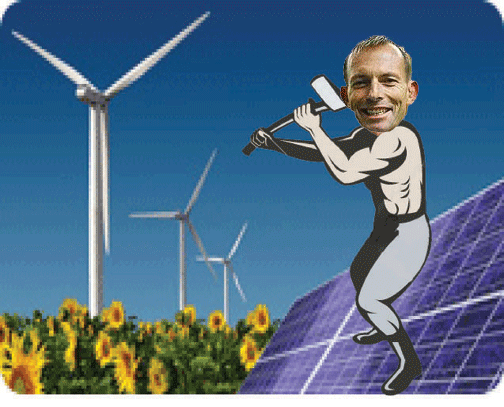 Australia Renewable Energy Gets Hacked & Attacked, Clean Technica July 21st, 2015 by Steve Hanley Originally published on Solar Love.
Australia is bathed in sunlight like few other places on earth. It, among all countries, has the highest potential to generate all the electricity it needs from renewable sources, principally the sun and wind.
But the prime minister doesn’t care about clean, renewable energy in Australia. All he cares about is doing the bidding of the wealthy coal owners who bought and paid for his election win in 2013. Since he took office, Australia’s investment in clean energy projects has fallen 70%, according to Bloomberg New Energy Finance.
Government Says No to Solar Investment
Now Abbott has issued instructions to the Clean Energy Finance Corporation (CEFC) prohibiting it from investing in wind farms or small-scale solar projects. Opposition leaders and solar energy supporters say the government directive prohibiting CEFC from investing in rooftop solar will cripple the industry and further diminish Australia’s chances of transitioning to a clean energy economy.
“I don’t agree with the prime minister that if you just don’t have any government support for the future of renewable energy, that the renewable energy will just miraculously grow and increase in Australia,” opposition leader Bill Shorten told the Australian Broadcasting Corporation. He said that striking wind farms and rooftop solar from the CEFC will mean that “the only thing the CEFC can invest in is flying saucers.”
The Role of the Clean Energy Finance Corporation
1 This month
7 April – WEBINAR – Australia and the Doomsday Clock – Preventing nuclear war through NoFirstUse and other policies
Online | Tuesday April 7, 4:00-5:30pm, Australian Eastern Time / 8:00-9:30am Central Europe Time
– Access the registration link
15 April – Zoom –Nuclear Power is Not the Solution
Apr 15, 2026 01:00 AM in Canberra, Melbourne, Sydney

Join the International Physicians for the Prevention of Nuclear War (IPPNW) on Tuesday, April 14th for a timely webinar exploring the risks associated with nuclear power and challenging the myth that it offers a simple, safe, carbon-free solution to the climate crisis

of the week – Australians for War Powers Reform (AWPR)
To see nuclear-related stories in greater depth and intensity
 Antinuclear