Paladin Uranium’s debts require it to sell off assets
Paladin Energy under pressure to flog assets The Australian, BY: ROSS KELLY Wall Street Journal April 26, 2012 PALADIN Energy still needs to offload assets to meet looming debt payments and funding requirements, according to Citigroup, which has nominated two of the uranium miner’s non-producing assets in Australia and Canada as possible candidates for divestment……“If the cash squeeze became very acute on Paladin the company could also look to
sell an interest in a producing asset,” Citigroup says.
Electricity price rise from carbon tax – less than expected
 Carbon tax to raise electricity prices less than expected http://www.independentaustralia.net/2012/business/consumers/carbon-tax-impact-on-electricity-prices-less-than-expected/ 19 April, 2012 12:01 am The effect of the carbon price on retail electricity will be lower than predicted and vary considerably by region, a new University of Queensland study has projected.
The most accurate estimate to date for the impact of the carbon price on retail electricity prices reveals the burden will vary considerably, depending on a household’s location.
Tasmanians, with a relatively low carbon footprint, are set to gain significantly from the carbon price once tax and pension changes are factored in, while Queenslanders – heavily dependent on coal to generate electricity – will wear the biggest increase in power prices, according to economic models run on “supercomputers” at The University of Queensland. Continue reading
BHP’s Olympic Dam mine expansion might not go ahead anyway

Acting chief executive of the South Australian Chamber of Mines and Energy Nigel Long said the state’s mining industry was not solely reliant on the expansion of Olympic Dam because there were other “exciting opportunities” ahead,
“The decision to press the pause button is a decision to be made by the BHP board, but we see a very good future for other projects in South Australia regardless…..
The BHP board will be considering whether to approve the project at a time when cost pressures in Australian mining are rising and profit margins are contracting.
BHP has Olympic hurdles to overcome, Financial Review 17 APR 2012 The South Australian government says it is not inclined to grant BHP Billiton an extension on an approvals expiring in December that cover the $US20 billion expansion of the Olympic Dam mine at this stage. Jamie Freed and Lucille Keen
“They’d need a ministerial exemption to continue those approvals,” the state’s Minister for Natural Resources Tom Koutsantonis told ABC Radio South Australia yester day. “Thus far I’ve seen nothing that would incline me to grant an exten sion.”
His comments followed a report in The Australian Financial Review on Saturday that BHP was weighing whether to hit the pause button on the project amid a weaker outlook for commodities, industry-wide cost inflation, added government imposts and pressure from shareholders to return more cash.
BHP’s largest shareholder, Black- Rock, has lowered its stake in the miner’s Australian arm from 5.7 percent to 4.99 per cent over the past six months, according to US regulatory filings. “BlackRock are realising BHP are going to press the button on Olympic Dam so they are getting out,” Continue reading
Don’t worry: radiation’s OK: nuclear is cleaner than wind or solar energy – says uranium industry’s Michael Angwin
 Facts ‘needed to end radiation fear’, Herald Sun April 19, 2012 AUSTRALIANS would fear radiation less if they better understood the science behind it, a uranium advocacy group says.
A misinformed fear of radiation, from disasters like Chernobyl and Fukushima, drives public perception about uranium, the Australian Uranium Association (AUA) says…
.. AUA CEO Michael Angwin says radiation is a safe natural phenomena that need not be feared…… “You do see people who will become physically ill due to just the fear of the unknown.” He said he saw people sick with worry in Japan last year following the major earthquake and feared radioactive disaster at the Fukushima
nuclear plant….
 Mr Angwin said while Fukushima had been a set-back for the image of uranium it remained a clean-energy option for the future. “Emissions from nuclear energy are very low, about the same as wind and in many cases less than a number of the solar technologies,” “For the same amount of electricity produced, the emissions from the nuclear industry are very low.”….http://www.heraldsun.com.au/ipad/facts-needed-to-end-radiation-fear-expert/story-fn6bfkm6-1226331893359
Expert panel reviews the Clean Energy Finance Corporation
the panel has recognised the significance and the potential for new technologies to transform Australia’s energy system and ensure it remains competitive with other countries.
Now, however, just watch the Opposition attack it, along with the usual suspects among the established energy generators and emitters. The key themes of this report – investment for long-term gains over short term costs, the “external” benefits which are overlooked by banks and statutory authorities, and the issue of future competitiveness – will no doubt be lost in the shouting.
 Ten things you should know about the CEFC REneweconomy, By Giles Parkinson 17 April 2012 The long-awaited “experts review” into the proposed $10 billion Clean Energy Finance Corporation has been delivered to – and accepted by – the federal government.
The CEFC is seen as one of the most critical elements of the Clean Energy Future package by large parts of the clean energy industry, particularly those trying to introduce new technologies. It will certainly be one of the political hot potatoes going into the next election. The federal Government says it intends to introduce legislation into the Budget sittings of parliament which begin in May. The Opposition calls it a “slush fund.”
Here are some highlights from review by the team led by Reserve Bankboard member Jillian Broadbent, and supported by funds manager David Paradice and former banker Ian Moore. Continue reading
Australian Government set to launch Clean Energy Finance Corporation (CEFC)
$10b fund for renewable energy firms http://www.perthnow.com.au/business/b-fund-for-renewable-energy-firms/story-e6frg2r3-1226330084361 AAP April 17, 2012 COMPANIES involved in renewable energy will soon be able to tap into a $10 billion federal pool. The Gillard government released today an independent review into the Clean Energy Finance Corporation (CEFC), which is due to start operating from July 2013.
The government accepted all recommendations made by the review.
The CEFC will provide $10 billion worth of financing to companies involved in renewable energy, low-emissions and energy efficiency technology. The review was led by Reserve Bank of Australia board member Jillian Broadbent.
The CEFC will encourage private investment and help overcome capital market barriers for cleaner energy technologies, the government said in a statement today.
The fund will apply “commercial rigor” to its investment decisions to make sure companies have a positive rate of return and are able to repay the loans.
Australian uranium miner Paladin – shares down again
 Paladin misses targets, shares drop, Peter Ker April 16, 2012 Shares in Paladin Energy are sliding lower this
morning, after the uranium miner revealed it had missed production targets yet again and had been forced to reduce its annual production targets.
Uranium production at Paladin’s flagship Langer Heinrich mine was 10 per cent below the company’s target during the first three months of2012, while its secondary mine also missed its production targets.
The missed targets, combined with concerns over Paladin’s debt, was pushing shares were down by 3 cents to 1.77 shortly after 11am…. Many analysts are concerned about Paladin’s debt levels, and the company is looking to sell minority stakes in its non-producing assets as a way to boost cashflow.
Concerns over the debt situation prompted Patersons Securities to downgrade Paladin to a sell earlier this month.
http://www.brisbanetimes.com.au/business/paladin-misses-targets-shares-drop-20120416-1x2od.html#ixzz1sQlkNcbp
Uranium spot price ‘dead for months’, despite lobby propaganda
 18 April 12, Yesterday 9 news reported on the uranium spot price’s continuing dismal slide : –
“Last week a mere three transactions occurred in the global spot uranium market, totalling 500,000lbs, industry consultant TradeTech reports. TradeTech’s spot price indicator remains unchanged at US$51.25/lb. Year to date trading has seen 8.2mlbs of U3O8 equivalent change hands compared to 18.4mlbs in the same period last year. ….
the spot uranium market has been pretty “dead” for the past several months….. Australian-listed Paladin Energy has been following a bumpy road to becoming one of the world’s more significant uranium producers as it deals with the usual pitfalls of project development and expansion and deals with them in Namibia. Aside from production issues, Paladin is suffering from cashflow tightness as development costs rise in the face of weak post-Fukushima uranium pricing”
ERA talking about closure costs for Ranger uranium mine (have they budgeted enough?)
Era adds A$251m to Ranger closure plan By: Esmarie Swanepoel, Mining Weekly, 11th April 2012 PERTH – The CEO of uranium miner Energy Resources of Australia (Era), Rob Atkinson on Wednesday told shareholders that the company had increased the provision for the closure of its Ranger mine, in the Northern Territory, from A$314-million to A$565-million, following a desktop review.
At the company’s annual general meeting, Atkinson said that the miner would continue investigating its closure plan during the remainder of 2012…… He noted that the revised plan would support a review of the rehabilitation cost estimate, later this year.
Gloomy uranium prices. Ranger mine likely to quietly shut down
 Spot Uranium Grafting, 9 News Finance, 13 April 12, “………Activity in general remains sluggish, and while two transactions were reported last week in the term market they were both pretty small by term market standards…
..Energy Resources of Australia managed a 5% price increase over the quarter but remains in the 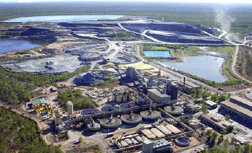 balance. The company has elected to spend $120m to explore the underground potential at its premier Ranger mine in the northern territory, known as the Ranger Deeps project.
If ERA decides the Deeps is not a commercially viable proposition, Ranger is destined to quietly shut down. Merrills suggests known reserves are unlikely to last beyond this year and stockpiles would be gone in 3-4 years.
Meanwhile, Merrills has ceased coverage of Extract Resources post takeover and its impending de-listing this week.
The broker has also taken the opportunity to review its uranium price forecasts to account for weaker Japanese demand now apparent one year after Fukushima. The analysts’ 2012 spot price forecast falls to US$56.25/lb from US$58.50/lb and 2013 to US$67.50/lb from US$70.00/lb. Merrills’ long term price drops to US$63.00/lb from US$65.00/lb. …
http://finance.ninemsn.com.au/newscolumnists/greg/8449091/spot-uranium-grafting
Energy Resources of Australia – no decision on new uranium mining until 2014
ERA to wait two years on new uranium, Northern Territory News, ALISON BEVEGE | April 12th, 2012 A DECISION won’t be made on mining an estimated 34,000 tonnes of uranium at a new Territory resource until 2014, uranium miner Energy Resources of Australia has said.
Shareholders caught a ray of hope at ERA’s annual general meeting at SkyCity Casino yesterday after a gloomy 2011 where the company lost $154 million and halted dividends….. The company will begin extensive mapping of the new find this year with construction to begin on a $120 million exploration decline on May 1.
Mr Atkinson said no decision on mining it would be considered for two years. “2014 is to be the year of decisions,” he said….. http://www.ntnews.com.au/article/2012/04/12/298551_ntnews.html
ERA’s Ranger uranium mine should be closed down – Australian Conservation Foundation
Meanwhile, the Australian Conservation Foundation is calling for all Ranger operations to end. Foundation spokesman Dave Sweeney says there are severe environmental risks associated with the mine.
“Over the course of the history of ERA’s operations, we have seen over 150 publicly documented leaks, spills, accidents and breaches,” he said. “Some of them have been small but some of them have been severe.”
ERA flags future for Ranger uranium despite loss http://www.abc.net.au/news/2012-04-11/ranger-uranium-era-agm/3943640 By Phoebe Stewart, April 11, 2012 Operations at the Ranger facility were closed for five months last year because of extremely wet weather. One of the world’s biggest uranium miners is forecasting a strong future despite reporting a big loss last year. Continue reading
Australia’s uranium promoters working hard against the reality of falling profits
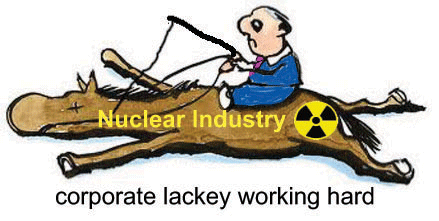 Uranium bulls have spent much of the past 12 months arguing there is a serious disconnect between the way the sharemarket and short-term investors view the outlook for uranium and the way long-term industry players (the CGNPCs and Rios of the world, for example) see it.
No sweeteners for yellowcake players, The West, Kate Emery April 11, 2012, A little over a year after the Fukushima nuclear disaster and despite endlessly positive outlook statements from the uranium industry, the fact remains it’s a still a tough time to be in the yellowcake business. Continue reading
Decline in Ranger uranium mine’s production, profit and morale – time to close it down
ERA tightens 2012 guidance, Colin Jacoby , 10 April 2012 …The uranium miner Energy Resources of Australia reported production of 612 tonnes of uranium oxide for the March quarter, down 41% from its December 2011 quarter production of 1030t.. The company was dogged by high rainfall at Ranger and access to high-grade ore was restricted due to the water level in the pit.
With ERA unable to access the high-grade ore located at the bottom of the pit, the ore milled during the quarter was sourced from stockpiled material. … the company said 2012 production remained highly dependent on the level of rainfall for the remainder of the year.
Kakadu uranium miner faces growing criticism. ACF, 11 April 12, Mining at the troubled Ranger uranium operation in Kakadu has been described as dirty, dangerous and desperate by the Environment Centre NT and the Australian Conservation Foundation. The groups have used Energy Resources of Australia annual meeting today in Darwin to re-affirm their concerns about uranium mining inside the World Heritage listed Kakadu National Park.
 ”ERA’s open cut mine has seen over 150 leaks, spills and breaches; radioactive exposure to workers; mismanagement of water and a mine shutdown that resulted in a $150 million dollar loss last year. The mine continues to pose ongoing environmental risk to Kakadu and the creation of more unwanted and poorly managed radioactive waste,” said Environment Centre NT campaigner Cat Beaton.
“Much of that waste is stored in an overloaded tailings dam that continues to leak over 100,000 litres of contaminated water a day.” Continued Ms Beaton.
In recent years ERA’s controversial Ranger mine has been plagued by declining production, morale and profit, with operations severely impacted by severe weather events. The company is attempting to reverse this decline by moving away from open cut mining in favour of underground mining.
“ERA’s fortunes are in systemic decline and will not be turned around by a tunnel to nowhere,” said ACF nuclear campaigner Dave Sweeney. “In the shadow of Fukushima – which we know was fuelled by Australian uranium – we need an open assessment of the costs and consequences of the uranium trade, not piecemeal approvals of short term projects that generate long term risks and problems”. “Uranium mining is unclean and unsafe, and this industry remains contaminating and contested”. Concluded Mr. Sweeney.
Australian Nuclear Science and Technology Organisation competed unfairly against private company
 Nuclear agency ‘breached competition rules’, ABC News, By business editor Peter Ryan April 05, 2012 Australia’s government-owned nuclear and scientific agency been has criticised for using its public ownership to win a contract to supply nuclear medicine to hospitals in New South Wales.
A report by the Productivity Commission has found that the Australian Nuclear Science and Technology Organisation (ANSTO) breached some rules on competitive advantage when it beat a small private company, Cyclopharm Limited, in the multi-million dollar tender last year. Continue reading
1 This month

of the week – Australians for War Powers Reform (AWPR)
To see nuclear-related stories in greater depth and intensity
 Antinuclear