Net zero emissions target for Australia could launch $63bn investment boom
|
Net zero emissions target for Australia could launch $63bn investment boom, Guardian, Lisa Cox, 12 Oct 20,
Modelling shows moving towards a net zero emissions economy would unlock financial prospects in sectors including renewables and manufacturing Australia could unlock an investment boom of $63bn over the next five years if it aligns its climate policies with a target of net zero emissions by 2050, according to new economic modelling. The analysis, by the Investor Group on Climate Change (IGCC), finds the investment opportunity created by an orderly transition to a net zero emissions economy would reach hundreds of billions of dollars by 2050 across sectors including renewable energy, manufacturing, carbon sequestration and transport. However, if the country keeps to its current targets and climate policies, investment worth $43bn would be lost over the next five years, growing to $250bn by 2050. The Investor Group on Climate Change represents investors in Australia and New Zealand who are focused on the effect of the climate crisis on the financial value of investments. Among its membership are institutional investors with funds under management worth more than $2 trillion. The organisation commissioned the consultancy Energetics to examine the domestic investment opportunities that would arise from an orderly transition to net zero emissions by 2050. The report finds a net zero scenario would unlock $63bn in investment over the next five years, including $15bn in manufacturing, $6bn in transport infrastructure such as charging stations, and $3bn in domestic green hydrogen production, as companies and governments moved towards the stronger emissions goal. ………. “What it shows is that the investment opportunities extend well beyond just the renewables industry,” said Erwin Jackson, the IGCC’s director of policy. “Renewables are the backbone of the transition but there are massive opportunities in other sectors such as manufacturing, restoring the land, and electrification of transport.” The report, which targets governments, companies, investors and financial regulators, says its estimates are conservative because they do not factor in the export potential of industries such as clean hydrogen. It argues that if governments set stable policy, and companies and investors collaborate to align their decisions with the goals of the Paris agreement, then billions of dollars over the short and long term could support the jobs and wealth of millions of Australians, particularly in regional areas. The Morrison government has refused to commit Australia to a net zero emissions target and has focused its climate policy on a new technology roadmap covering hydrogen, energy storage, “low carbon” steel and aluminium, carbon capture and storage, and soil carbon……… John Connor, the chief executive of the Carbon Market Institute, said the reality Australia faced was its economy was running “below capacity and it needs a new direction”. He said clean technologies like renewable energy and transport represented significant opportunities for Australia in a post-carbon world and the country’s vast land mass, with landscapes in need of regeneration, gave it a competitive advantage in carbon sequestration. “We can either coast off the cliff into the hothouse of economic and climate disaster, or we can turn a corner towards an orderly transition and the opportunities that are there,” Connor said. https://www.theguardian.com/australia-news/2020/oct/12/net-zero-emissions-target-for-australia-could-launch-63bn-investment-boom |
|
China’s dramatic plan for switch to renewables – a warning to Australia’s fossil-fuel economy
 China just stunned the world with its step-up on climate action – and the implications for Australia may be huge, The Conversation, October 8, 2020, Hao Tan, Associate professor, University of Newcastle, Elizabeth Thurbon, Scientia Fellow and Associate Professor in International Relations / International Political Economy, UNSW, John Mathews, Professor Emeritus, Macquarie Business School, Macquarie University, Sung-Young Kim, Senior Lecturer in International Relations, Discipline of Politics & International Relations, Macquarie School of Social Sciences, Macquarie University China just stunned the world with its step-up on climate action – and the implications for Australia may be huge, The Conversation, October 8, 2020, Hao Tan, Associate professor, University of Newcastle, Elizabeth Thurbon, Scientia Fellow and Associate Professor in International Relations / International Political Economy, UNSW, John Mathews, Professor Emeritus, Macquarie Business School, Macquarie University, Sung-Young Kim, Senior Lecturer in International Relations, Discipline of Politics & International Relations, Macquarie School of Social Sciences, Macquarie University
|
|
Australia now the worst OECD country for climate change action
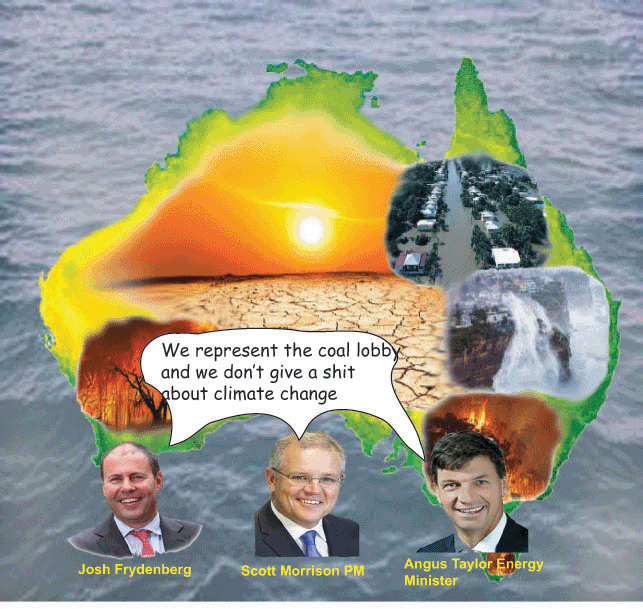 Back of the pack: Australia now the worst OECD country for climate change action, The New Daily, Cait Kelly, 7 Oct 20, Australia has become the worst-performing of all OECD countries when it comes to climate change, and will soon become a global pariah unless federal policies change fast, experts warn.It comes as UK Prime Minister Boris Johnson became the first democratic leader to outline a green-centred plan for rebuilding the country and creating jobs when the coronavirus crisis ends.
One of Australia’s leading experts in climate change, Professor Will Steffen said the UK’s announcement has left Australia in the dust.
“The UK is the first country to put forward a concrete plan but other OECD counties, particularly the Nordic ones – Denmark, Norway and Sweden – already have advanced plans,” he told The New Daily.
“We and the United States are stumbling around while most European countries are trying to get it done.”
He said depending on how the US election plays out, Australia could soon become an outlier.
We’re pretty much alone now and who knows how the US is going to go,” Professor Steffen said. If the election changes the government, you’ll see much more action on climate change. They’ve got great wind resources. They’ve got enormous tech capability. If they get the politics right, they could change fast.
We have enormous renewable sources, but we’re being held back by politics.”
The stark warning we have fallen behind the pack comes as new analysis from WWF reveals that in terms of committing to stimulus spending on renewables, Australia lags even further behind.
We are currently spending five times less than the conservative UK government and 10 times less than South Korea – a major trading partner……….
The government has focused Australia’s economic recovery from COVID-19 on fossil fuels, namely gas. ……. https://thenewdaily.com.au/news/national/2020/10/07/australia-climate-change-oecd/
Morrison government again fails on climate ation, snubs renewable energy
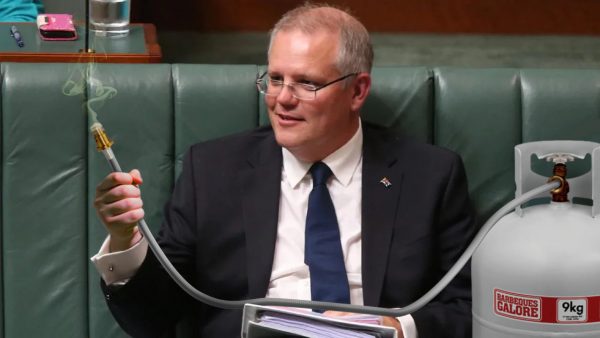
But investment in renewable energy was largely shunned. Notably, the government allocated just A$5 million for electric vehicles. It confirmed funding for the Australian Renewable Energy Agency (ARENA) for another decade, but the money is far less than what’s needed.
The COVID-19 pandemic has seen the Morrison government abandon long-held dogma on debt and deficits. However, the federal budget shows when it comes to climate and energy, the government is singing from the same old songbook.
A techno-fix
The budget doubled down on the Morrison government’s rhetoric of “technology, not taxes”, by choosing preferred technologies for investment.
This “picking winners” approach would have some chance of addressing climate change if it were based on a comprehensive analysis of the best path to zero emissions. But instead, the government has largely made offerings at the altars of technologies worshipped by the conservative side of politics.
The government will spend an as-yet undisclosed sum, possibly A$11 million, to refurbish the Vales Point coal-fired power station. The commitment to this coal infrastructure, co-owned by prominent Liberal party donor Trevor St Baker, is a disgraceful misuse of public money. It will also do little to halt the steady decline of coal-fired power generation.
As previously announced, the government will spend A$52.9 million to support the gas industry, which Frydenberg says will lower prices and support more manufacturing jobs. It includes money for gas infrastructure planning and to open up five gas basins, starting with Beetaloo Basin in the Northern Territory.
The budget confirms A$50 million for carbon capture and storage (CCS) to fund projects to cut emissions from industry. But proving the viability of large-scale CCS projects is extremely difficult, as experience in the United States and Canada has shown. In this context, allocating just A$50 million to get the technology off the ground is simply laughable.
History suggests the spending offers little return on investment. Research by the Australia Institute in 2017 revealed federal governments have spent A$1.3 billion in taxpayers’ money on CCS projects, with very little to show for it.
Renewables snubbed
Meanwhile, last night’s budget largely shunned investment in renewable energy.
The budget confirmed A$1.4 billion in ARENA funding for a further ten years, including a pretty paltry A$223.9 million over the next four years. Separately, the government will also seek to pass legislation to change ARENA’s investment mandate, enabling it to fund gas and carbon capture projects.
The government has allocated a tiny A$5 million towards electric vehicle development, including money towards a manufacturing facility in South Australia. It’s good to see electric vehicles on the government’s radar. But the commitment is dwarfed by investment overseas, including a reported US$300 billion set aside by global car makers over the next decade to bring electric vehicles to mass production.
The measly spending on clean energy technology does not make economic sense. The renewable energy sector is standing by to slash emissions and deliver lower energy prices – if only the right policy environment existed.
The budget was also an opportunity for the government to ditch its irrational opposition to carbon pricing. Recent research has comprehensively shown carbon pricing slows growth in greenhouse gas emissions.
Vehement carbon pricing critics, such as conservatives Tony Abbott, Craig Kelly and Barnaby Joyce, are now either discredited or out of parliament altogether. And scores of countries around the world have implemented some form of price on carbon.
A global outlier
Most obviously, the budget was an opportunity to commit to net-zero emissions by 2050, as many developed countries have done.
The Morrison government has already used dodgy accounting tricks to meet Australia’s Paris Agreement commitment – reducing emissions by 26% on 2005 levels. The absence of a net-zero target suggests the government intends to allow emissions to grow indefinitely after 2030.
This approach is out of step with many of Australia’s international peers. Democratic presidential candidate Joe Biden, now the clear favourite to win the US election in November, is campaigning on what has been described as “the most aggressive climate platform” ever put forward by a presidential nominee.
China’s zero emissions target is contrasted with Australia’s inaction on global heating
China’s escalation is also set to have implications for Australia’s diplomatic position in the Pacific, where it has been attempting to manage China’s rising influence among some of its closest neighbours.
“From both sides of Parliament Australian politicians aren’t understanding it, they approach climate change like it’s just another issue for our Pacific counterparts. What Australian politicians 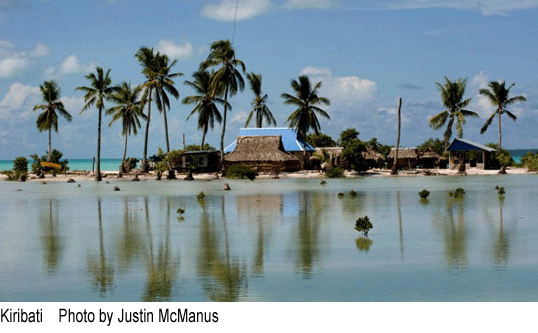 do often miss is this issue is personal,” said Professor Bamsey.
“It concerns Pacific politicians when they get out of bed, they can see the changes to the future of their country when they look out the window.”
China’s zero emissions target puts Australia on notice, The Age, By Eryk Bagshaw and Mike Foley, September 30, 2020 — Australia’s former top climate diplomat has warned China’s net-zero emissions target will leave Australia behind, threatening future trade deals and its influence in the Pacific as the Morrison government becomes wedged between the US and China on climate action.
Howard Bamsey, who was Australia’s special envoy on climate change during the Rudd government, said the announcement from President Xi Jinping last week had turned the politics of emissions reduction into a sharp economic and diplomatic issue.
Professor Bamsey, who was also Australia’s ambassador for the environment under the Howard government, said the new policy “pulls the rug out from under the argument” that Australia’s domestic climate goals do not need to accelerate because China was yet to increase its ambitions.
“It’s clear now China is accepting a leadership role,” he said. “Xi made the announcement. That carries all the weight of the state and party.”
The coronavirus has forced this year’s United Nations Glasgow Climate Change Conference to be rescheduled to November 2021, turning Australia’s international emissions obligations into a major election flashpoint. The earliest month a federal election can be held is August 2021 and voters are expected to go to the polls by the end of next year.
China, which is simultaneously the world’s largest polluter and biggest producer of renewable energy, pledged to go carbon neutral by 2060 at the UN General Assembly last week………… Continue reading
Forget the lobbying. It’s the spin that wins on climate, report finds
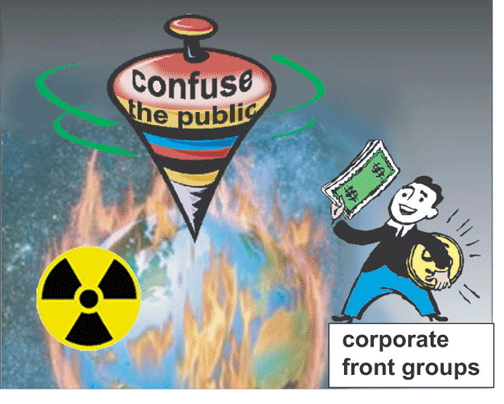 When it comes to impacting Australia’s climate wars, little can stand up to the fossil fuel industry’s public spin. GEORGIA WILKINS, SEP 24, 2020
These tactics focus on influencing public opinion and the broader political agenda rather than direct engagement with policymakers.
InfluenceMap, which is funded by environmental and investor groups, says the Minerals Council of Australia had the biggest negative influence on Australian climate-related….(subscribers only) https://www.crikey.com.au/2020/09/24/forget-the-lobbying-its-the-spin-that-wins-on-climate-report-finds/
Farmers have called out the federal government’s climate change low emissions policy as selling out an industry for profit
Farmers have called out the federal government’s climate change low emissions policy as selling out an industry for profit.Farmers for Climate Action slam Australian Government’s technology investment roadmap, Examiner, Caitlin Jarvis, 25 Sept 20
Federal Energy Minister Angus Taylor unveiled the draft technology investment roadmap this week, with steps towards low emissions.
Tasmanian farmer Brett Hall, who runs a beef property at Bronte Park, near Miena, said climate change was evident every day on his farm.
He said low emissions targets were an excellent first step, but it was a matter of too little, too late, and time was running out.
“Climate change is evident to us working on the land, but we need to see stronger initiatives because the evidence is there to suggest that we have not done enough so far and we’re past that point,” he said……… https://www.examiner.com.au/story/6938510/why-farmers-are-angry-about-low-emissions-roadmap/?cs=95
Australian scientists censored on speaking about climate change

 Censored: Australian scientists say suppression of environment research is getting worse
Survey finds that many researchers are banned from speaking about their work or have had their research altered to downplay risks. Nature , Dyani Lewis, 22 Sept 20, Environmental scientists in Australia say that they are under increasing pressure from their employers to downplay research findings or avoid communicating them at all. More than half of the respondents to an online survey thought that constraints on speaking publicly on issues such as threatened species, urban development, mining, logging and climate change had become worse in recent years1.
The findings, published this month in Conservation Letters, reflect how politicized debates about environmental policy in Australia have become, says Saul Cunningham, an environmental scientist at the Australian National University in Canberra. “We need our publicly funded institutions to be more vocal in defending the importance of an independent voice based on research,” he says.
Australian scientists aren’t the only ones who have reported interference in science or pressure — particularly from government employers — to downplay research findings. Scientists in the United States, Canada and Brazil have also
Scale of the problem
Two hundred and twenty scientists in Australia responded to the survey, which was organized by the Ecological Society of Australia and ran from October 2018 until February 2019. Some of the respondents worked in government; others worked in universities or in industry, such as environmental consultancies or non-governmental organizations.
The results show that government and industry scientists experienced greater constraints from their employers than did university staff. Among government employees, about half were prohibited from speaking publicly about their research, compared with 38% employed in industry and 9% of university staff. Three-quarters of those surveyed also reported self-censoring their work (see ‘Scientists silenced’)……….
One-third of government respondents and 30% of industry employees also reported that their employers or managers had modified their work to downplay or mislead the public on the environmental impacts of activities such as logging and mining. ………. https://www.nature.com/articles/d41586-020-02669-8
Medical groups are urging Greg Hunt to include climate change in 10-year health strategy
SBS, 22 Sept 20
A national preventative health strategy is useless if it doesn’t address the risks of climate change, experts have told the responsible minister.
Numerous health groups from across the country have signed a joint statement to Health Minister Greg Hunt calling for climate change to be a key part of the national preventative health strategy.
The strategy is currently being developed, with public feedback on its consultation paper open until the end of the month.
Scott Morrison transfers his love affair with coal, to gas
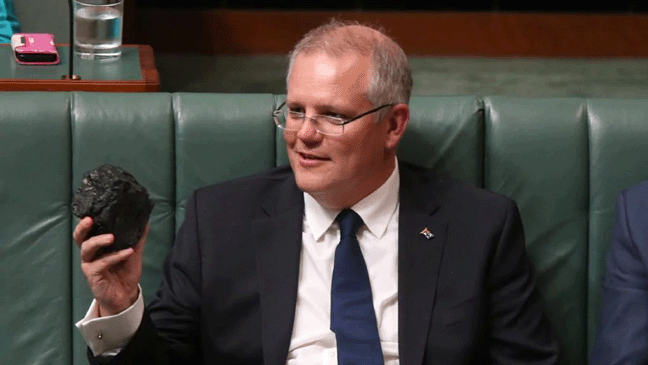
Our coal-fondling PM switches his prop to gas, but is anything really different? Jacqueline Maley, Columnist and senior journalist, The Age, 20 Sept 290 In February 2017, Scott Morrison walked into Parliament to perform a piece of coal-centred theatre that became one of the defining moments of his political career. “Mr Speaker, this is coal,” he pronounced, brandishing a black lump. “Don’t be afraid, don’t be scared. It won’t hurt you!”
As was pointed out at the time, the coal must have been lacquered – touching raw coal covers you in black dust. Morrison didn’t want to get his hands dirty. He just wanted to score a political point.
His speech was not about the benefits of coal so much as it was a gleeful attempt to wedge Labor over the electability problem it had, and still has – the insoluble tension between its heavy industry-reliant, blue-collar voter base, and its urban voters, who want meaningful climate action.
No one feels this tension more than Opposition Leader Anthony Albanese, who is old-Labor in his sensibilities, but whose inner-Sydney electorate is under siege from the Greens…………
It was always the Coalition, of course, that had the ideological attachment to coal as an energy source. The Nationals, in particular, appear to be moving away from representing farmers to supporting what is buried in the earth beneath their crops.
It is Labor that has always had the political problem with coal. It needed to convince its blue-collar base it cared about jobs and electricity prices, while also being serious about emissions reduction. But Labor is also the only side of politics that has ever been effective on emissions reduction, instituting in 2012 the only sensible mechanism to bring emissions down – a carbon price and emissions trading scheme.
It worked, in the short time it was operational, before being abolished by Tony Abbott, elected in a 2013 landslide to do exactly that.
The energy prop has changed now, with Morrison this week announcing he wants a “gas-led recovery” for the post-COVID-19 future. He is backing slowly away from coal.
In a speech in the Hunter Valley – a carefully chosen location given its significance in Labor’s own climate wars – he said there was “no credible energy transition plan for an economy like Australia that does not involve the greater use of gas”.
Details of his plan were scant. It is a plan for a plan. Morrison issued an ultimatum to electricity companies, saying if the industry did not back “dispatchable” electricity generation by next year, taxpayer money would be used to build a gas-fired power plant in the Hunter Valley, replacing the near-defunct Liddell coal plant at Muswellbrook………
Most Australians are too stressed by contemporary events, and fatigued by the climate wars, to follow the detail, which is complex. But Morrison will be able to use his “gas-led recovery” rhetoric to hedge.
His government no longer has to fight a rearguard action in defence of coal, an energy source that markets have firmly turned away from, and which public opinion is swaying against. But his party can still keep its distance from the renewable energy sources to which it seems to nurse an ideological objection. It remains to be seen if the plan will work to reduce emissions, or ensure low electricity prices.
Meanwhile, business continues to move ahead faster than the government. On Friday, BlackRock, the world’s largest investor, with $US7.32 trillion in assets under management, released a report showing that more than 1000 global companies and other organisations had signed up to the Task Force on Climate-related Financial Disclosure standards.
………Morrison’s plan for a plan will stand in for an energy policy, for now, from a government that has thoroughly betrayed the electorate on this issue for the seven years it has been in power. In that time, the earth has warmed further, and Australia has had a good taste of what is yet to come in terms of climate devastation. https://www.theage.com.au/politics/federal/our-coal-fondling-pm-switches-his-prop-to-gas-but-is-anything-really-different-20200918-p55ww9.html
Scott Morrison turns to socialism, with his new religion, not coal, but “gas-led recovery”
 It’s a small church that sings the gas gospel, Canberra Times, Michelle Grattan, 18 Sep 20,
If Labor were threatening to build a power station, the Liberals would likely be screaming “socialists”.
As for a Coalition government contemplating such a thing – well, to say the obvious, it hardly fits with the Liberals’ stated free-market, private-enterprise philosophy. But hey, neither does the hyper-Keynesian support package to cushion the economy through the pandemic.
The gas power plant is another matter, and it will be fascinating to see how the debate plays out if the threat turns into reality.
The threat is part of the go-with-gas policy unveiled by Scott Morrison this week, spruiked as driving a “gas-fired” recovery, especially for manufacturing. This sounds suspiciously like a three-word slogan that promises more than it is likely to deliver.
But Morrison has signed up to the church of gas, whose pastors include Nev Power, chairman of the Prime Minister’s COVID-19 commission, and Andrew Liveris, the head of its (now defunct) manufacturing taskforce, which delivered a pro-gas report.
Much of the gas plan is broad and aspirational at this stage. But the threat is specific enough.
Morrison said the electricity sector must lock in by April investments to deliver 1000MW of new dispatchable energy to replace the Liddell coal-fired power station before it closes in 2023. Or else. The government-owned Snowy Hydro was working on options, he said.
Going back to Malcolm Turnbull’s time, the government conducted – and lost – a bitter battle with AGL over the planned Liddell closure. It exerted maximum pressure on the company to extend the life of the station, or alternatively to sell it, but to no avail.
The gas policy, especially the threat, hasn’t gone down well – with the energy sector or environmentalists. And it’s come under criticism from experts and even from within Coalition ranks.
The Australian Energy Council, representing investors and generators, warned the spectre of a government gas generator could put off private investors.
Environmentalists are against gas anyway, whoever produces it, because it is a fossil fuel and therefore has emissions, albeit not as bad as coal.
The Nationals’ Matt Canavan, who not so long ago was resources minister, says if a new power station is to be built in the Hunter region it should be coal-fired.
And the director of the Grattan Institute’s energy program, Tony Wood, says the government’s claim that 1000MW of new dispatchable capacity is needed isn’t supported by the advice from its own Liddell taskforce.
More generally, Wood argues the idea of a gas-led recovery is “a mirage”.
He says east-coast gas prices are unlikely to fall to very low levels and anyway, even very low prices would not stimulate major economic activity. “Investing in more gas infrastructure in the face of climate change looks more like a herd of stampeding white elephants” is Wood’s blunt assessment…….
Critics don’t like the proposed expansion of the remit of the Australian Renewable Energy Agency and the Clean Energy Finance Corporation beyond supporting renewables. https://www.canberratimes.com.au/story/6931688/its-a-small-church-that-sings-the-gas-gospel/?cs=14230
Australia’s mainstream media dutifully parrots out Government spin about gas
|
Gas Gush: the toadies of mainstream media trot out government’s fossil fuel fracking campaign https://www.michaelwest.com.au/gas-gush-the-toadies-of-mainstream-media-trot-out-governments-fossil-fuel-fracking-campaign/
 by Michael West | Sep 15, 2020 Gas fracking and a new fossil fuel power plant got a big leg-up today as News Corp, Nine Entertainment, ABC News and Guardian Australia faithfully splashed with the latest government gas plan on their front pages today. by Michael West | Sep 15, 2020 Gas fracking and a new fossil fuel power plant got a big leg-up today as News Corp, Nine Entertainment, ABC News and Guardian Australia faithfully splashed with the latest government gas plan on their front pages today.
This is not journalism. This is stenography. This is not balanced reporting. This is reporting a government press release one day early. Australia’s captive mainstream media all splashed with the same story this morning, the Morrison Government’s fossil fuel public relations campaign. The Age, the Sydney Morning Herald, The Guardian, The Australian, the Australian Financial Review. They all featured the same story on gas. Now, breakfast TV and morning radio will be left to follow it up, unquestioning, now that it’s been “in the papers”. The gas propaganda blitz did not feature the critical facts that gas is almost as polluting as coal, that fracking the Beetaloo Basin, the Galilee Basin and the North Bowen Basin will destroy water systems and endanger wildlife and farmland. Neither did this media blitz, orchestrated by expert media manipulators in the offices of government, and keenly assisted by the gas lobby, mention that the gas multinationals which stand to benefit from this campaign have been acting as a cartel, ratcheting up gas prices at a cost to all Australians and siphoning profits offshore to tax havens. Neither did the slavishly toadying coverage in the corporate media mention how much the companies Shell, BHP, Exxon, Origin and Santos and their proxies pay political parties in donations. No, the journalists and their editors simply gush the Government’s line. “Scott Morrison will announce”, “The Government will announce”. There was, and still is, no detail, nothing official from the Government but its toadies in the mainstream media have recorded the story faithfully. They are paving the way for the Government to spend billions in taxpayer money on a new gas power plant and pipelines – for a pipeline industry controlled by Chinese and Singaporean multinationals who don’t pay tax. The only difference between the big black headlines in The Age and the SMH were the words “in NSW”. “Morrison to back construction of new gas-fired power station in NSW,” touted the SMH. The team of press secretaries in the office of Prime Minister and Cabinet – a team brimming with fossil fuel advocates – could not have asked for great loyalty and dedication to the cause. “Scott Morrison is prepared to forcefully intervene in the energy market by building a new gas-fired power station in the Hunter Valley in NSW if need be, and underwriting the construction of gas pipelines to feed a new national trading hub,” wrote the AFR‘s Canberra correspondent Phil Coorey. Although there is still no press release from the Prime Minister, and nothing official from the office of Energy Minister Angus Taylor either, the AFR had four stories on the big gas plan. “The prime minister will say the government intends to pursue 13 measures,” wrote Katherine Murphy in The Guardian. How did she know that? How did they all know it? They got “the drop”. The drop is industry parlance for a leak from government which is a favour. The political operative engineers the drop to the select journalist and the select journalist is expected, in return, to deliver favourable coverage. Morning TV and radio will follow up on cue. By this afternoon, the Government’s media campaign will have dominated the 24-hour media cycle. The actual details of the plan may be released this afternoon. Late morning perhaps. By then, independent journalists and the non-spoon-fed media may become privy to the detail and report the news properly. “Power up or we build gas plant: Morrison,” is the headline in The Australian. It is accompanied by a flattering “comment piece” by Murdoch media’s top correspondent in Canberra, Simon Benson: “Morrison move to energise industry.” Already, Australia is up there with Qatar as the world’s biggest exporter of gas. Australians pay among the highest prices in the world for gas too. This is no accident. This is a failure of government and media. The corporations that dominate the gas cartel have got the better of government, completely dominated the governments state and federal in fact. They have dominated the media too. Their advertising, their slick lobbying, craven editorial management. Australia’s politicians and media have failed the people. |
|
In tropical areas, increasing heat and humidity will make life almost unbearable
These impacts will be stronger in the seasonally wet tropics (such as the Northern Territory of Australia), where more extreme warming is expected than in the equatorial zone.
Predictions for Darwin, in northern Australia, suggest an increase in days with temperatures above 35℃ from 11 days a year in 2015 to an average of 43 days under the mid-range emission scenario (IPCC’s RCP4.5 scenario) by 2030 and an average of 111 (range 54-211) days by 2090. Under the higher emission scenario (IPCC’s RCP8.5), an average of 265 days above 35℃ could be reached by 2090.
|
Climate explained: will the tropics eventually become uninhabitable? https://theconversation.com/climate-explained-will-the-tropics-eventually-become-uninhabitable-145174 James Shulmeister, Professor, School of Earth and Environmental Sciences, University of Canterbury 16 Sept 20, What is the impact of temperature increases in the tropics? How likely is it that regions along the Equator will be uninhabitable due to high wet bulb temperatures such as 35℃ and more in places like Singapore? Do we have models that suggest how likely this is and at what time frames?More than 3.3 billion people live in the tropics, representing about 40% of the world’s population. Despite some areas of affluence, such as Singapore, the tropics are also home to about 85% of the world’s poorest people and are therefore particularly susceptible to the impacts of climate change.
The tropics are expected to experience rising temperatures and changes to rainfall, and the question is whether this could make this region uninhabitable. How would this happen? Heat stressHumans regulate their body temperature in warm conditions through sweating. The sweat evaporates and cools the skin. But if conditions are humid, sweating and evaporation are much less effective. Humans can survive and function in quite high temperatures if humidity is low, but as humidity increases our ability to function decreases rapidly. This effect is measured by a heat stress index which shows the apparent temperature you feel under different relative humidity conditions. From a human health point of view, the wet bulb temperature is critical. This is the temperature a thermometer covered in a wet cloth would measure, and it reflects the maximum amount of cooling that can be achieved by evaporation. High wet bulb temperatures are more problematic to human health than high absolute temperatures. Wet bulb temperatures above 35℃ are life-threatening because they cause hyperthermia, which means the body cannot cool down and the internal body temperature exceeds 40℃. Climate modelling predictions used by the Intergovernmental Panel on Climate Change (IPCC) for the period from 2080-2100 suggest warming in the tropics of about 1.6℃ under mid-range emissions scenarios and up to 3.3℃ under high emissions scenarios, with error margins of about 0.5℃ on both predictions. Continue reading |
‘Gas-led recovery’ may actually deter energy investment: Experts
|
‘Gas-led recovery’ may actually deter energy investment: Experts, The New Daily, Josh Butler, 16 SEp 20, Climate change and clean energy campaigners were left dismayed at the
federal government’s plans to spearhead a “gas-led recovery” from COVID-19, saying it will be ineffective and damage the prospects of meeting international emissions reduction commitments. Independent MP Zali Steggall claimed the Prime Minister’s announcement was “blackmailing private companies”, while even energy companies said the announcement – however well meaning –could actually lead to further uncertainty and less investment in the market. On Tuesday, PM Scott Morrison announced plans to lean heavily on the gas sector in the nation’s recovery from the pandemic, talking up the fuel’s potential to lower power prices and shore up reliability in the electricity grid. He also flagged the possibility of the commonwealth helping foot the cost for a new gas-fired power station in NSW, if the soon-to-be-closed Liddell plant is not replaced. But climate experts and clean energy campaigners are up in arms over the plan, which they say will be far more expensive and far worse for the environment than renewables. ….. Mr Bourne, a former regional president with BP Australasia, said gas was better for the environment than coal – but only marginally, when emissions linked to its extraction, production and transmission were factored in. “It’s not that much better than coal,” he said. The Australian Energy Council, representing major investors in power generation, said the government’s announcement may actually create more uncertainty and less investment in the sector – saying “even discussions and threats of intervention act as a deterrent”…… Labor’s shadow energy minister Mark Butler slammed gas as “the most expensive way to build new energy”……… https://thenewdaily.com.au/news/2020/09/15/gas-led-recovery-climate/ |
|
A legal win for Adani, against climate activist Ben Pennings
 Adani granted injunction to stop activist Ben Pennings using ‘confidential material’ABC 11 Sept 20, Mining giant Adani has been granted an injunction ordering an activist to stop using “confidential material” it claims is frustrating the development of its mine and rail network in the Galilee Basin.
Key points:
- The legal action is against Brisbane activist Ben Pennings
- Mr Pennings is accused of demanding contractors to cease working with Adani
- Justice Martin found the “Stop Adani” movement had caused at least three contractors to withdraw
Adani launched legal action in the Supreme Court in Brisbane against activist Ben Pennings, claiming he had continually demanded contractors who had agreements with the mining company to terminate or withdraw from negotiations.
Adani also argued Mr Pennings would encourage others to provide confidential information to an ongoing campaign —The Galilee Blockade — concerning plans and operations at the site.
Today’s order comes after Adani twice failed to secure a search order to seize evidence from Mr Penning’s home.
Activist accused of ‘intimidation and conspiracy’
Outside court, Mr Pennings said he would respect the court’s injunction but was “very concerned” about ongoing civil action in which Adani accused Mr Pennings of a “breach of confidence, inducing breach of contract, intimidation and conspiracy”.
“I have a family at home, kids, a kid with a disability,” Mr Pennings said.
“If Adani is successful with their civil action, I’ll have to sell my house, and that’s really difficult for my family, but Adani seem determined to hurt me.
“I don’t believe I should have to sell my suburban family home in Aspley to make an Indian multi-billionaire even richer.
“The ‘Stop Adani’ movement is massive. I’m just one passionate person. They really can’t sue all of us.”………. https://www.abc.net.au/news/2020-09-11/adani-granted-court-injunction-ben-pennings-galilee-basin/12654486
1 This month

of the week – Australians for War Powers Reform (AWPR)
To see nuclear-related stories in greater depth and intensity
 Antinuclear