Australia’s nearly 2 $trillion costs by 2050 – if we continue climate change inaction
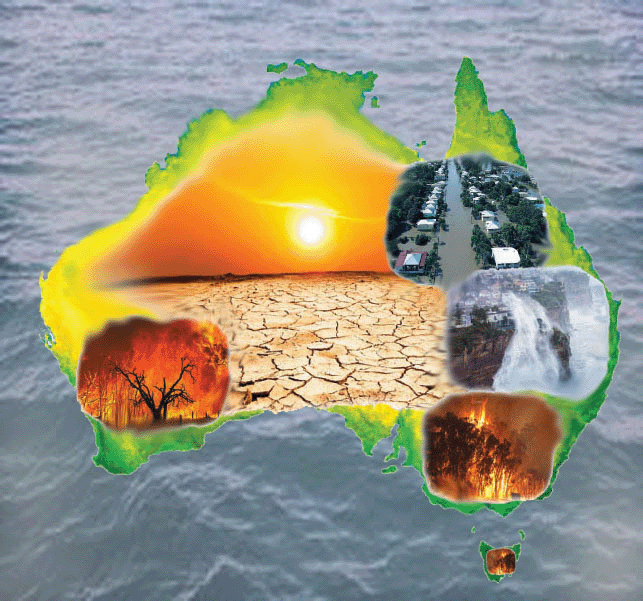 Trillions up in smoke: The staggering economic cost of climate change inaction, New Daily, Ben Silvester, 8 Sept 20, Over the next 30 years, increasing economic damages from climate change will cost the Australian economy at least $1.89 trillion – or roughly 4 per cent of projected GDP each year – if current emissions policies are maintained.New research from the University of Melbourne reveals annual economic damages by 2038 will be comparable to the current estimated annual cost of COVID-19 in Australia. Trillions up in smoke: The staggering economic cost of climate change inaction, New Daily, Ben Silvester, 8 Sept 20, Over the next 30 years, increasing economic damages from climate change will cost the Australian economy at least $1.89 trillion – or roughly 4 per cent of projected GDP each year – if current emissions policies are maintained.New research from the University of Melbourne reveals annual economic damages by 2038 will be comparable to the current estimated annual cost of COVID-19 in Australia.
There have been many attempts at estimating the economic cost of climate change, but the researchers said this is the most detailed and globally comprehensive to date. The modelling covers 139 countries in four potential warming scenarios from now to 2100. The projections draw on a modelling framework in the journal Earth’s Future in 2018 and have been continually updated through adding data points for bushfires and other ecological events. “There is no model in the world that is nearly this computationally large,” said lead researcher Professor Tom Kompas of the university’s school of biosciences. “It’s as much as 10 times larger than standard basic models.” The detail built into the projections allowed researchers to drill down and discover how each country will be affected by rising temperatures at particular points in the coming century. Previous models could only provide average damages across large regions or the world as a whole…………. If this trajectory is maintained, the research found that the economic cost of climate change for Australia alone will total at least $1.89 trillion by 2050 and exceed $100 billion in annual damages by 2038. Professor Kompas described the impact of the coronavirus pandemic as “devastating”, but he said it also puts the huge economic threat of climate change into context. “By 2038, on average projections, climate change may well be dealing a COVID-sized blow to the Australian economy every year … [it] will imply more job losses, unemployment and deeper cuts in GDP. And those damages will continue to increase disproportionately year after year,” Professor Kompas said. Much of the economic damage will be from rising sea levels wreaking havoc on property, infrastructure and agriculture along the coast. It is calculated that damages of more than $992 billion over the next three decades, or more than $30 billion a year, on average, from sea level rise and storm surge alone. The modelling also predicts productivity losses of $261 billion as rising temperatures make it harder for certain crops to grow and for outdoor labourers to work, while losses in biodiversity total $277 billion with thousands of species at risk of extinction. “Many of these damages ramp up over time,” Professor Kompas said. But he said Australia is already getting a taste of what’s around the corner, the past “Black Summer” bushfires being an example. The researchers tallied up the damage to property, infrastructure and agriculture caused by the recent bushfires, assessing the cost at $48 billion. And with research suggesting Australia will have two more “megafires” before the end of the decade, Professor Kompas calculates that by 2050 bushfires will have cost the economy about $360 billion. The $1.89 trillion cost to the economy in the next 30 years is almost certainly an underestimate, he said. His research does not yet account for damage to Australia’s major environmental assets, pollution from burning fossil fuels, tourism losses and natural disasters other than bushfires……. https://thenewdaily.com.au/news/national/2020/09/10/economic-cost-climate-change/ |
|
Scott Morrison will be praying for a Trump win: they see eye-to-eye on doing nothing about climate change


|
Scott Morrison is yearning for a Donald Trump victory The PM will be praying for a Republican win in the US to back up his inaction on climate and the Paris Agreement. The Age, Kevin Rudd 8 Sept 20, A year out from Barack Obama’s election in 2008, John Howard made a stunning admission that he thought Americans should be praying for a Republican victory. Ideologically this was unremarkable. But the fact Howard said so publicly was because he knew just how uncomfortable an Obama victory would be for him given his refusal to withdraw our troops from Iraq.Fast forward more than a decade, and Scott Morrison – even in the era of Donald Trump – will also be yearning desperately for a Republican victory come November. But this time it is the conservative recalcitrance on a very different issue that risks Australia being isolated on the world stage: climate change.
And as the next summer approaches, Australians will be reminded afresh of how climate change, and its impact on our country and economy, has not gone away. Former vice-president Joe Biden has put at the centre of his campaign a historic plan to fight climate change both at home and abroad. On his first day in office, he has promised to return the US to the Paris Agreement. And he recently unveiled an unprecedented $2 trillion green investment plan, including the complete decarbonisation of the domestic electricity system by 2035. By contrast, Morrison remains hell-bent on Australia doing its best to disrupt global momentum to tackle the climate crisis and burying our head in the sand when it comes to embracing the new economic opportunities that come with effective climate change action. As a result, if Biden is elected this November, we will be on track for a collision course with our American ally in a number of areas. First, Morrison remains recklessly determined on being able to carry over so-called “credits” from the overachievement of our 2020 Kyoto target to help it meet its already lacklustre 2030 target under the new Paris regime. No other government in the world is digging their heels in like this. None. It is nothing more than an accounting trick to allow Australia to do less. Perhaps the greatest irony is that this “overachievement” was also in large part because of the mitigation actions of our government. That aside, these carbon credits also do nothing for the atmosphere. At worst, using them beyond 2020 could be considered illegal and only opens the back door for other countries to also do less by following Morrison’s lead.
This will come to a head at the next UN climate talks in Glasgow next year. While Australia has thus far been able to dig in against objections by most of the rest of the world, a Biden victory would only strengthen the hand of the UK hosts to simply ride over the top of any further Australian intransigence. Morrison would be foolhardy to believe that Boris Johnson’s government will burn its political capital at home and abroad to defend the indefensible Australian position. Second, unlike 114 countries around the world, Morrison remains hell-bent on ignoring the central promise of Paris: that all governments increase their 2030 targets by the time they get to Glasgow. That’s because even if all those commitments were fully implemented, it would only give the planet one-third of what is necessary to keep average temperature increases within 1.5 degrees by 2100, as the Paris Agreement requires. This is why governments agreed to increase their ambition every five years as technologies improved, costs lowered and political momentum built……… Under Trump, Morrison has been able to get one giant leave pass for doing nothing on climate. But under Biden, he’ll be seen as nothing more than the climate change free-loader that he is. As he will by the rest of the world. And our economy will be punished as a result. https://www.theage.com.au/world/north-america/scott-morrison-is-yearning-for-a-donald-trump-victory-20200906-p55sxe.html |
|
Endless summers, endless wildfires,

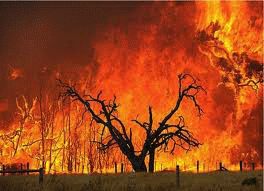
Endless summers, endless wildfires, South Wind 8 September 2020,
If leaders can’t get their heads around the wildfire-climate link, we had better prepare for many more nasty summers “…………. Now, everything is merged into one, and greatly enlarged. In my youth the places I recall having summer fires were Australia, the western United States, and odd outbreaks in Latin America, Africa and Mediterranean countries. Now we hear of fires erupting in other northern lands, as far north as the shores of the Arctic Ocean.
Looking back at this year so far we could be forgiven for thinking the whole world is ablaze. Almost as soon as wildfires are extinguished on one continent they seem to be breaking out afresh on another one.
2020 began with Australia’s record-breaking Black Summer fires destroying millions of hectares of forest and capturing global attention. Within a couple of months fires had broken out in Ukraine, threatening the abandoned Chernobyl nuclear plant.
A month later, smouldering peat that had been primed by years of drying and warming began to spark vegetation fires in Siberia that would eventually number over 600, emitting more carbon in two months than any preceding year and producing a smoke cloud spanning an area bigger than Europe.
The Siberian fires were still burning in mid-August when forests in California erupted into flames, more than a month earlier than the start of a “normal” season in that part of the world and less than two years after its previous record-breaking year.
At the end of a relatively quiet Californian fire season, in 2019-20 Australia got the benefit of that state’s large water-bombing aircraft, one of which crashed in the Australian Alps killing its US crew. Now, with California suffering similar devastation, we are battling to respond to its desperate appeal for reciprocal help.
Add to all those the perennial fires accompanying rainforest clearing in Southeast Asia and Brazil. The Amazon Basin situation is dire. August-September is the land-clearers’ peak burning period, and this year, with legal constraints all but destroyed under president Jair Bolsonaro, the area burnt and smoke generated looks like being even worse than what triggered last year’s global alarm.
Last week saw release of the interim report of the inquiry into Australia’s natural disaster management, led by former air force chief Mark Binskin, which was set up by the Morrison government after the Black Summer fires.
As the Black Summer fires showed, the report said, “bushfire behaviour has become more extreme and less predictable. Catastrophic fire conditions may become more common, rendering traditional bushfire prediction models and firefighting techniques less effective.”
No close observer of climate change would be surprised by the coronavirus pandemic’s global progress and the response to it of many political and vested interests. Those interests might wish it were otherwise, but this contagion operates without any reference to the things they hold dear.
Climate change, too, doesn’t recognise human boundaries. We set it off, and by failing to curb carbon emissions, we ensured its impact would continue to grow. Yet Australian governments, ignoring dire warnings from disaster experts, continue to behave as if it doesn’t exist.
This summer may see something of a reprieve. Weather authorities anticipate a wettish spring for eastern Australia. A moist understory is less likely to kindle fire from dry lightning, which has plagued recent fire management in both hemispheres.
But hoping for good weather doesn’t replace what the experts keep saying: a fire plan that doesn’t acknowledge the overwhelming influence of climate change is no plan at all. If partisan politics and vested interests prevent us acting on this, we’d better get ready for many more summers from hell. http://southwind.com.au/2020/09/08/endless-summers-endless-wildfires/
Joe Biden if president will push allies like Australia to do more on climate, adviser says
Joe Biden if president will push allies like Australia to do more on climate, adviser says
Jake Sullivan says the former vice-president, if elected, won’t ‘pull any punches’ on what is a global problem. Guardian Daniel Hurst @danielhurstbne, Mon 7 Sep 2020
Joe Biden will not pull any punches with allies including Australia in seeking to build international momentum for stronger action on the climate crisis, an adviser to the US presidential candidate has said.
If elected in November, Biden will hold heavy emitters such as China accountable for doing more “but he’s also going to push our friends to do more as well”, according to Jake Sullivan, who was the national security adviser to Biden when he was vice-president and is now in the candidate’s inner circle……..
While Australia’s prime minister, Scott Morrison, is likely to welcome the pledge of US coordination with allies on regional security issues, there may be unease in government ranks about the potential for tough conversations about Australia’s climate policies.
The Coalition government has resisted calls to embrace a target of net-zero emissions by 2050 and it proposes to use Kyoto carryover credits to meet Australia’s 2030 emission reductions pledge. Some Coalition backbenchers still openly dispute climate science.
Sullivan said climate change would be a big priority for Biden, both in domestic policy – with climate and clean energy issues placed at the heart of his economic recovery visions – and in foreign policy, where he would do more than just reverse Donald Trump’s decision to abandon the Paris agreement.
He has said right out of the gate, we’re not just rejoining Paris – we are going to rally the nations of the world to get everyone to up their game, to elevate their ambition, to do more,” Sullivan told the Lowy Institute. ………. https://www.theguardian.com/us-news/2020/sep/07/joe-biden-if-president-will-push-allies-like-australia-to-do-more-on-climate-adviser-says
PARLIAMENT COVERS UP AUSTRALIA’S TRUE CARBON FOOTPRINT
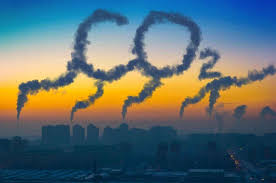 Parliament Covers Up Australia’s True Carbon Footprint, ByTasmanian Times, August 31, 2020 The House Standing Committee on the Environment and Energy today tabled its report on Andrew Wilkie MP’s National Greenhouse and Energy Reporting Amendment (Transparency in Carbon Emissions Accounting) Bill 2020 in Federal Parliament.
“Regrettably the Committee has voted to cover up Australia’s shameful role as one of the world’s biggest contributors to climate change,” Mr Wilkie said. “But the reasoning behind its recommendation for Parliament not to pass this Bill doesn’t stack up.”
Mr Wilkie’s Bill would require the Federal Government to include scope 3 emissions in reports of Australia’s carbon emissions, boosting transparency and accountability. Scope 3 emissions are the potential emissions contained in the gas and coal mined in Australia, which is then exported overseas. The Bill allows Australia to track its impact as one of the largest exporters of fossil fuels in the world, giving the public access to information about Australia’s role in very significantly contributing to global greenhouse gas emissions.
“Australia must have a clear picture of its contributions to global greenhouse gas emissions,” Mr Wilkie said. “This is essential as the world tries to limit warming to 1.5 degrees and halt catastrophic climate change. Keeping track of Australia’s scope 3 emissions is not double counting but gives a true picture of our responsibility for climate change around the globe.
The Committee can hardly argue that tracking scope 3 emissions is ‘too hard’ when the Department of Industry, Science, Energy and Resources has not even conducted an assessment of compliance costs. For goodness sake, the Committee acknowledges that more than a quarter of ASX200 companies already voluntarily report their scope 3 emissions.
“Further, the fact that this kind of tracking is not required by the Paris Agreement is beside the point. The Australian Government should be open and transparent for the sake of the community, rather than claiming that Australia can do little to influence climate change. The truth is that when the carbon in fossil fuel exports is taken into account, Australia accounts for about 5 per cent of the global total for fossil fuels.”
The full House Standing Committee on the Environment and Energy report can be found here.
2. ANALYSIS OF THE BILL………… HTTPS://TASMANIANTIMES.COM/2020/08/PARLIAMENT-COVERS-UP-AUSTRALIAS-TRUE-CARBON-FOOTPRINT/
Book: The Carbon Club -Tony Abbott and the ‘people’s revolt’ against Gillard’s climate policy
 Tony Abbott and the ‘people’s revolt’ against Gillard’s climate policy
In her new book ‘The Carbon Club’ Marian Wilkinson exposes the truth behind Australia’s inaction on climate change. Crikey, MARGOT SAVILLE, AUG 28, 2020
For several years, award-winning journalist Marian Wilkinson has been investigating the relationship between climate-sceptic politicians, business leaders and their allies. For her latest book The Carbon Club, she has conducted scores of interviews with players on both sides in order to expose the truth behind Australia’s inaction on climate change.
Bernardi teamed up with young libertarian Tim Andrews, who had trained with the Koch Brothers’ internship in the US.
“The two helped create the ‘people’s revolt’ against the climate policy, using the power of social media and the tactics of the Tea Party movement that was gaining ground in the US Republican party.
“One of the driving ideas behind the campaign was to exploit the anger and disaffection among ordinary voters towards politicians,” Wilkinson writes. …..
The “people’s revolt” against Gillard and the emissions trading scheme passed by Kevin Rudd would fundamentally fracture conservative politics in Australia, fostering splinter parties and deepening divisions in the Liberals, Wilkinson writes.
“It would destroy any chance of uniting the major political parties to face the enormous challenge of climate change.”………
Marian Wilkinson will discuss her new book at a Crikey Talks event for Inside Access members next month. Visit our Inside Access page to upgrade https://www.crikey.com.au/2020/08/28/book-review-carbon-club/
Adani quietly rebranding Abbot Point terminal as company hit with $107m damages bill
 Adani quietly rebranding Abbot Point terminal as company hit with $107m damages bill
Exclusive: Queensland supreme court says company engaged in ‘unconscionable conduct’, Guardian Ben Smee @BenSmee, Fri 28 Aug 2020 Adani has quietly begun planning to rebrand its Abbot Point coal terminal – removing all reference to Adani in its company name and branding – as financiers continue to abandon the business and a Queensland court orders it to pay $106.8m in damages.
The Queensland supreme court this week ordered Adani to pay four terminal users damages for “unconscionable conduct” in a judgement that was scathing of Adani’s actions to advantage its own financial interests over other coal companies.
In the 93-page decision, the supreme court justice Jean Dalton said Adani’s ports business “attempted to disguise its behaviour in complex transactions”, engaged in conduct outside the boundaries of normal commercial behaviour, and “pleaded matters which were false”.
Name change planned as more investors pull out
Guardian Australia can reveal that Adani reserved two new company names with the Australian Securities and Investments Commission on 18 August – eight days before the court judgement. The Asic documents flag its intention to rebrand Adani Abbot Point Terminal and its holding company as the “North Queensland Export Terminal”.
In July, an Adani employee registered the web domain www.nqxt.com.au on behalf of Adani Abbot Point Operations, a separate company that manages the operations of the export terminal.
Climate campaigners say the move appears to be Adani “changing what has obviously become a toxic brand” amid its ongoing difficulties refinancing the port’s debts.
The Guardian can also reveal two additional Korean investors have, under pressure from climate activists, said they will dump their investments in Adani’s port, which has total debts of $1.5bn.
In recent days, Korean Investment Securities and Industrial Bank of Korea have written to activist groups confirming they will not offer further finance to the port, which would export coal from Adani’s controversial Carmichael coalmine………. https://www.theguardian.com/environment/2020/aug/28/adani-quietly-rebranding-abbot-point-terminal-as-company-hit-with-107m-damages-bill
Gas is not a transition fuel to a safe climate. That ship has sailed
Gas is not a transition fuel to a safe climate. That ship has sailed, https://www.theage.com.au/environment/climate-change/gas-is-not-a-transition-fuel-to-a-safe-climate-that-ship-has-sailed-20200826-p55pec.html, Penny Sackett, 27 Aug 20
Australia’s chief scientist from 2008 to 2011 If gas-fired electricity emissions can be lower than that from coal-fired plants, should Australia expand its fossil gas industry as a means of combating climate change? The answer is a clear no if we want to avoid the worst climate change outcomes.
Science has repeatedly demonstrated that the most important action to limit global warming to well below 2 degrees is to begin to reduce all fossil fuel consumption – coal, yes, but oil and gas too – in this decade.
The primary difficulty is the large mismatch between what is required to meet that stated climate goal of the Paris Agreement and what nations have actually pledged to do. Worse still, the current policies of many countries, Australia included, would increase their national production of fossil fuels, increasing emissions above their own weak pledges.
This so-called “production gap” is the subject of a recent multi-institutional, multi-national report led by the Swedish Environment Institute. Its analysis shows that governments are planning to produce about 50 per cent more fossil fuels by 2030 than would be consistent with a 2-degree pathway and 120 per cent more than would be consistent with a 1.5-degree pathway. This means that plans for fossil fuel development or extension that are already on the table must be shelved to hold warming to the Paris target range.
Consistent with other research, the report demonstrates that to have a 66 per cent chance of holding warming to well below 2 degrees, coal, oil and gas production must all decline significantly in the next decade. That is why increasing gas development to displace coal is no longer a viable approach to maintaining a reasonably safe climate.
Over the past 30 years, coal-to-gas “fuel-switching” has played a role in reducing emissions in the United States and Britain. However, the latest information from the US Energy Information Administration shows that the US energy grid has decreased its emissions from a shift to non-fossil fuel sources by almost as much as a shift to gas. Despite the shale boom, non-carbon energy sources have now overtaken any other single source of fossil fuel in supplying energy to the US grid.
In Britain, renewables played a large role in reducing emissions in the electricity grid. Between 2006 and 2016, the renewables share of electricity production rose from 2 per cent to 25 per cent, even excluding large hydro. While the 1990’s “dash for gas” was responsible for the largest cumulative amount of avoided greenhouse emissions in Britain since 1990, the situation is different now. In 2017, the transition to renewable energy was the largest driver in its electricity sector’s emission reductions. In second place was lower electricity demand (think what we could do with energy efficiency in Australia), while coal-to-gas switching came in third.
The world we live in has already changed dramatically with global average temperatures now 1.1 degrees above pre-industrial levels. Cyclones and storm surges are more intense. Droughts are more damaging. Fire seasons are longer and bushfires more fierce. Billions of animals died in last year’s Australian bushfires alone. Entire species are becoming extinct at rates far above normal. The point of no return may have already passed for Arctic sea ice – in 15 years, globes in schoolrooms may show white ice at only one pole.
At 2 degrees of warming, heatwaves would be even more severe and more deadly to humans, animals and agriculture. Sydney and Melbourne would need to brace for 50-degree days. The fire weather that produced Australia’s Black Summer would become at least four times more likely, the amount of water available to feed dams and rivers in NSW would be reduced by 30 per cent from what was typical mid last century, and coral reefs around the world would almost certainly be eliminated.
We have all the tools to avoid that future of 2 degrees of warming. What has been lacking is coherent, science-based action that does not add yet more fuel to the climate fire. Today, when the enormous human, economic and ecological costs of even 1.1 degrees of warming are so clear, when prices of renewable energy have plummeted, and several non-fossil energy storage options are available, gas is not a transition fuel to a safe climate. That ship has sailed.
Planned and rapid coal-to-renewables switching is now the responsible path. Gas will have a role in the near term, certainly, but the science is clear. The role of gas needs to be a significantly declining one, not a growing one, if we are to avoid the worst of climate change so that Australia’s future is safe, sustainable and competitively modern.
Penny Sackett was Australia’s chief scientist between 2008 and 2011. She is an honorary professor at the Climate Change Institute, Australian National University.
Nearly 90% of young Australians want real action on climate change
|
Young people send strong climate message, Pro Bono Maggie Coggan | 24 August
“We see the world in a different light. Politicians need to start listening to us and taking action,” a youth leader says.
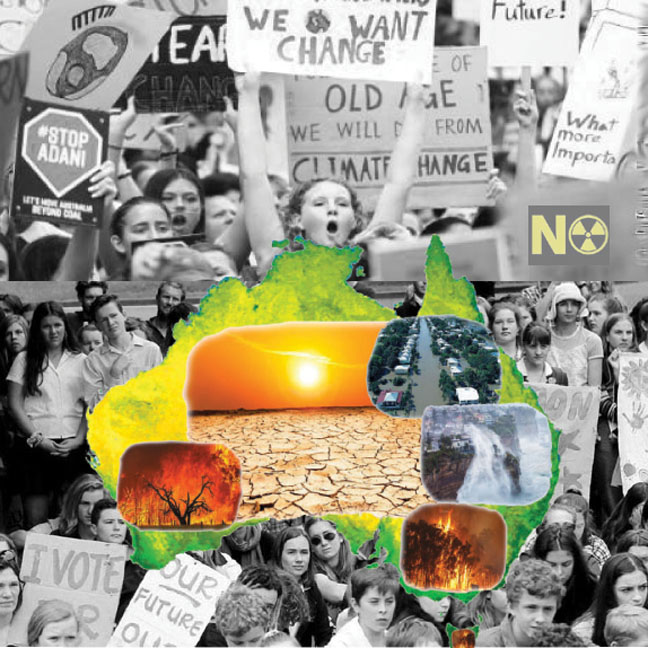
Nearly 90 per cent of young people say they feel unprepared for future climate disasters and want politicians to give them a bigger voice on climate change, a new report finds. Conducted in the wake of the catastrophic summer bushfire season, the new Australian Institute for Disaster Resilience and World Vision Australia research found that despite hazards such as bushfires, floods, drought and tropical cyclones posing a greater threat, young people said they were more likely to learn about earthquakes at school. This left 88 per cent of survey respondents feeling unprepared and unable to protect themselves and their communities, even though nearly two-thirds (64 per cent) had experienced at least three events such as bushfires, heatwaves and drought in the past three years. “We anticipate that we will experience personal impacts from natural hazards in the future, whether we are living in capital cities, regional centres, or rural areas,” respondents said. “The 2020 bushfires demonstrated that you need not live in the bush to be affected by a bushfire. We are experiencing these persistent worries while having to contend with life, school, growing up and everything else that comes with being a young person in Australia.” It is the most comprehensive consultation of children and young people on climate change, disasters, and disaster-resilience in the country, with 1,500 people participating in the online survey, supported by UNICEF Australia, Plan International, Save the Children, Oaktree and Australian Red Cross. Young people concerned, but not heard ………… A full copy of the report can be found here. https://probonoaustralia.com.au/news/2020/08/young-people-send-strong-climate-message/ |
|
Gas is not transition energy we were promised, new research suggests
Gas is not transition energy we were promised, new research suggests, SMH, By Nick O’Malley, August 24, 2020 — The good news about natural gas is that when it is burnt it creates between 40 and 50 per cent less carbon dioxide than coal would to create the same amount of energy.This is why it has been embraced by some climate activists and governments as a useful energy source to replace coal and oil while renewable energy technologies catch up with global energy demand.
But the good news ends there, and there is a lot more to the story.
Before it is burnt natural gas is mostly made up of methane, and methane is estimated to be about 28 times more potent a greenhouse gas than carbon dioxide over a 100-year period.
Over a 20-year period – about the time scientists believe we have to try to prevent the worst impacts of global warming – it is up to 80 times more potent at warming the planet than carbon dioxide.
The United States’ Environmental Protection Agency estimates that for every cubic metre of methane extracted by the US oil and gas industry, 1.4 per cent escapes into the atmosphere as so-called fugitive emissions.
But more recent research suggests this estimate is drastically low, and that, in fact, the industry in the US is leaking 13 million metric tonnes of methane a year, or 2.3 per cent.
It is not yet clear how much fugitive methane is released by the Australian gas industry, but new technologies now allow scientists to accurately measure it and the data is expected to be published in the coming months.
The US Environmental Defence Fund estimated that, in America, if just 3 per cent of methane escapes, gas is no cleaner an energy source than coal……. https://www.smh.com.au/environment/climate-change/gas-is-not-transition-energy-we-were-promised-new-research-suggests-20200824-p55ovg.html
Antarctica – global heating and nuclear issues – theme for September 20
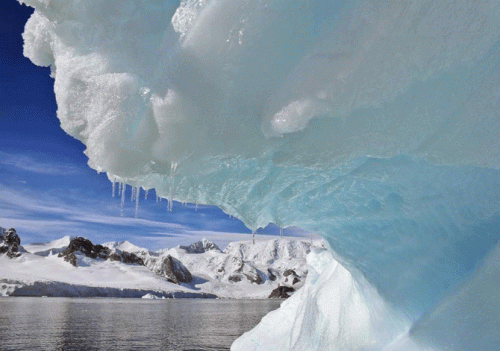
Antarctica is not in the news as much as the Arctic is, But global heating is affecting Antarctica too, and Antarctica has its nuclear issues.
Antarctica has made headlines several times this year due to extremely warmer than usual temperatures. It has been steadily heating up for decades. Antarctic ice shelves have lost nearly 4 trillion metric tons of ice since the mid-1990s, scientists say. Ocean water is melting them from the bottom up, causing them to lose mass faster than they can refreeze. As ice shelves melt, they become thinner, weaker and more likely to break. When this happens, they can unleash streams of ice from the glaciers behind them, raising global sea levels. Antarctica is also losing ice from melting ice sheets, and chunks of ice falling from glaciers.
Less studied than the Arctic region, Antarctic is now being investigated by Australian researchers, using robots to gather data from difficult to reach underwater areas. Satellite monitoring confirms the shelves’ melting trend.
Nuclear issues. From 6,000 nautical miles away, uranium mining in Australia is polluting the Antarctic. After 1945 atomic bomb testing sent radioactive pollution to the South Pole, as well as to everywhere else on the planet.
USA operated a small nuclear power plant at Antarctica’s McMurdo Sound. It was known as “nukey poo” because of its frequent radioactive leaks. It had 438 malfunctions – nearly 56 a year – in its operational lifetime, including leaking water surrounding the reactor and hairline cracks in the reactor lining. The emissions of low level waste water where in direct contravention of the Antarctic Treaty, which bans military operations as well as radioactive waste in Antarctica. After the reactor was closed down, the US shipped 7700 cubic metres of radioactive contaminated rock and dirt to California. Many USA naval workers there developed cancers.
Today, small nuclear reactors similar to this one, are being touted for remote areas in Australia and other countries. The history of this one in Antarctica, and 7 others elsewhere, was one of malfunctions, and closing down within a few years. This does not augur well for the small nuclear reactors being promoted today.
Adam Bandt urges another Labor-Greens coalition for climate action
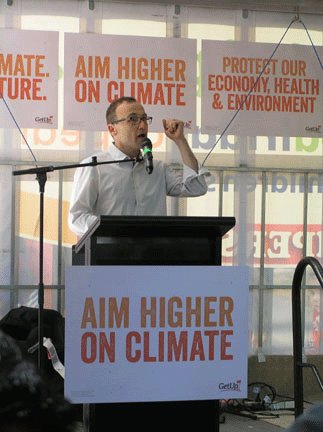 Adam Bandt urges another Labor-Greens coalition for climate action, https://www.theage.com.au/politics/federal/adam-bandt-urges-another-labor-greens-coalition-for-climate-action-20200820-p55nrc.html, By Rob Harris, August 21, 2020 —Greens leader Adam Bandt will mark 10 years since his party signed a deal to prop up the Gillard government by flagging he would be willing to again form a power-sharing deal with Labor to combat climate change.The Melbourne MP will use his address to the Greens National Conference on Saturday to urge Labor leader Anthony Albanese to commit to acting on carbon pollution by again entering into progressive pact
Labor is currently locked in a fierce internal battle over its support for coal and gas production as it wrestles with three successive election losses and poor results at the polls last year in resource-rich regional Queensland seats.
Veteran frontbencher Joel Fitzgibbon warned on Thursday his party could soon split in two, arguing it is struggling to be “all things to all people” across its inner city and regional voter bases.
Mr Bandt will tell his party faithful that it was only with the Greens holding the balance of power in both the House of Representatives and the Senate which led to “world leading climate action with a price on carbon”.
“In recent Australian history, there is one indisputable fact. The only time that climate pollution meaningfully dropped is when the Greens shared power,” Mr Bandt says in a draft copy of the speech.
“When the Greens, Labor and independents worked cooperatively and shared power like we did in 2010, we got a lot done.
As Liberal and Labor rush once more to give tax cuts to millionaires while embracing coal and gas, it is clear that Greens sharing power is the pathway to change.
Mr Bandt will also use the speech to say the climate deal reached with the Gillard government was stronger and more effective in reducing carbon emissions than the Rudd government’s scheme it blocked in the Senate.
Warning of a federal election within 12 months, Mr Bandt will say the path to climate policy progress was to put the Greens into shared power through a hung parliament.
Mr Bandt said the carbon tax legislation by Labor in 2010 with the backing of the Greens was “well-designed” and it reduced pollution for the first time in Australian industrial era history.
He will promise to “hammer” a straightforward message between now and the next election that the “only way to get real change is to vote for it and give the Greens shared power”.
“Many look longingly to New Zealand, where Jacinda Ardern leads a progressive multi-party government with Greens support, and wonder if it could happen here,” he will say.
Mr Albanese on Thursday said Labor had continually evolved and a modern party with “any self-respect” would be attempting to mitigate the effects of climate change.
In a rebuke to Mr Fitzgibbon, he said the issue of climate change was not a matter of geography because “wherever people live, they’re impacted by climate change”.
“Were about also holding the government to account. Putting forward an alternative agenda for the nation,” he said.
Torres Strait Islanders claim climate change affects their human rights – Australia govt tries to stifle their claim
Australia asks UN to dismiss Torres Strait Islanders’ claim climate change affects their human rights
Complaint argues Morrison government has failed to take adequate action on emissions or adaptation measures, Guardian, Katharine Murphy Political editor 14 Aug 20 The Morrison government has asked the human rights committee of the United Nations to dismiss a landmark claim by a group of Torres Strait Islanders from low-lying islands off the northern coast of Australia that climate change is having an impact on their human rights, according to lawyers for the complainants.
The complaint, lodged just over 12 months ago, argued the Morrison government had failed to take adequate action to reduce emissions or pursue proper adaptation measures on the islands and, as a consequence, had failed fundamental human rights obligations to Torres Strait Islander people.
But the lead lawyer for the case, Sophie Marjanac, says the Coalition has rejected arguments from the islanders, telling the UN the case should be dismissed “because it concerns future risks, rather than impacts being felt now, and is therefore inadmissible”.
Marjanac said lawyers for the commonwealth had told the committee because Australia is not the main or only contributor to global warming, climate change action is not its legal responsibility under human rights law.
“The government’s lawyers also rejected arguments that climate impacts were being felt today, and that effects constituting a human rights violation are yet to be suffered”.
A spokesman for the attorney general, Christian Porter, said submissions to the human rights committee were not publicly available……
Lawyers for the islanders have alleged that the catastrophic nature of the predicted future impacts of climate change on the Torres Strait Islands, including the total submergence of ancestral homelands, is a sufficiently severe impact as to constitute a violation of the rights to culture, family and life.
The challenges associated with sea level rise in the Torres Strait have been well documented. A report from the Climate Council on the risks associated with coastal flooding notes that Torres Strait Island communities are extremely low-lying and are thus among the most vulnerable in Australia to the impacts of climate change.
The report concludes the shallowness of the strait “exacerbates storm surges and when such surges coincide with very high tides, extreme sea levels result”. It cites sea level data collected by satellite from one location in the Torres Strait between 1993 and 2010 that indicated a rise of 6 mm per annum, “more than twice the global average”,
Although the report notes this was a single dataset, low-lying islands in the Pacific – and Torres Strait islands such as Masig and Boigu – are likely to be at the forefront of forced displacement. Some forecasts have predicted up to 150 million people could be forcibly displaced by climate change by 2040 – larger than the record number of people already forced from their homes globally.
The non-profit group ClientEarth is supporting the complaint. A spokesman for the group said: “It is shameful that Indigenous communities on Australia’s climate frontline are being told that the risk of climate change to their human rights is merely a future hypothetical issue, when scientists are clear these impacts will happen in coming decades”.
“Climate change risk is foreseeable and only preventable through immediate action in the present. States like Australia have legal duties to protect the human rights of their citizens”. https://www.theguardian.com/australia-news/2020/aug/14/australia-asks-un-to-dismiss-torres-strait-islanders-claim-climate-change-affects-their-human-rights
$6.6 trillion in annual GDP at risk as Asian climate warms – McKinsey Global Institute
|
McKinsey sees $6.6 trillion in annual GDP at risk as Asian climate warms, https://www.smh.com.au/business/markets/mckinsey-sees-6-6-trillion-in-annual-gdp-at-risk-as-asian-climate-warms-20200813-p55ley.html By Bloomberg News, August 14, 2020 Lethal heatwaves, droughts, floods and typhoons will become more common in Asia-Pacific, which faces more severe potential impacts from climate change than many parts of the world, McKinsey & Co. researchers warn.Asia is particularly at risk because it has such a high number of poor people, who tend to rely more on outdoor work, living in areas most vulnerable to extreme increases in heat and humidity, McKinsey Global Institute said in a new report published on Thursday. By 2050, the loss of that labor could cost the region as much as $US4.7 trillion ($6.6 trillion) a year in GDP, about two-thirds of the global total at risk.
The report underscores the economic risks of delaying investments that mitigate or adapt to climate change. The potential for widespread damage is similar to the region’s experience during the current pandemic, according to McKinsey. What we have seen is that countries, cities and people can take resolute actions and if we do take these actions and sustain them, we can cooperate globally and see positive outcomes,” said Oliver Tonby, McKinsey’s Asia chairman, who co-authored the report. The projections are based on a scenario in which the world fails to cut greenhouse gas emissions and Asia warms by 2 degrees Celsius. They show that by 2050, between 500 million and 700 million people living in places like India, Bangladesh and Pakistan could experience heatwaves that exceed the survivability threshold. The loss of outdoor labour during those times could shave off 7 per cent to 13 per cent off GDP in those three countries, resulting in losses of $US2.8 trillion to $US4.7 trillion across the whole of Asia on average per year, according to the report. Extreme precipitation events could rise three- or four-fold by 2050 in parts of Japan, China, South Korea and Indonesia, according to McKinsey. Increased riverine flooding could cause $US1.2 trillion in damage in Asia, about 75 per cent of the global impact. Conversely, as the earth warms, parts of southwestern Australia could spend more than 80 per cent of a decade in drought conditions by 2050 and regions of China could experience droughts 40 per cent to 60 per cent of the time. Climate change will also increase the likelihood of severe typhoon strikes from the Philippines and Vietnam to Northeast Asia. It will also create winners and losers, increasing surface water supply in parts of northern India and China while depleting reservoirs in Australia.
To face the business risks, Tonby said companies need to assess their exposure and take it into consideration when making plans. A significant opportunity lies in infrastructure development in Asia as the region is still rapidly urbanising. |
Australian government using COVID recovery strategy to bolster its mates in gas industry
There have been recent media reports that the commission advising the Morrison government on its COVID recovery strategy has recommended that taxpayers provide massive support to build gas and fuel infrastructure.
However, Australia is possibly suffering something of a “resource curse”, as capital markets increasingly won’t invest in – nor insure – new coal and gas projects.
With the world seeking to accelerate the transition to low-carbon economies and societies, this would see the Australian people being asked to invest in old-world industries and technologies, rather than new, emerging industries. Or in assisting some key industries that have been severely damaged by COVID-19 to reset.
It is not unfair to claim that Australia has never really had an effective industry policy.
Sure, we have often ridden on the backs of sheep and minerals booms, and enjoyed them while they lasted…….
The current special interest push for gas and fuel infrastructure defies common sense, is directly against our national interests.
It is to the detriment of other major export/employment sectors – such as education (especially universities) and international tourism – that have been severely impacted by the COVID-19 pandemic but are not being supported by government assistance.
Coal and gas are facing declining global demand; they are hardly “infant industries” the longer-term future of which could justify investment to assist them to grow up.
These projects just wouldn’t stack up as feasible, when full account is taken of their economic/commercial, social, and environmental costs and benefits.
Investors are also reassessing their climate risks and moving out of climate exposed investments, forcing many of the big oil, gas and coal companies to make significant write downs of the values of their assets.
By comparison, investments in renewable energy (including recognising its significant potential as an export, especially to Asia), as well as in the transition business opportunities as transport is decarbonised, in regenerative agriculture, and in a host of bioenergy/circular economy projects dealing with waste and fuel security will probably stack up on such a cost/benefit assessment…..
The tragedy is that the Morrison government gives priority to its mates. ….
Today, it’s more the mining industries and banks – and now the specific influence of some on the COVID Commission with gas and related interests.
It’s time for our government to think beyond the square, and in our national interest.
John Hewson is a professor at the Crawford School of Public Policy, ANU, and a former Liberal opposition leader. https://www.canberratimes.com.au/story/6877063/how-australia-is-suffering-a-resource-curse/?cs=14246
1 This month

of the week – Australians for War Powers Reform (AWPR)
To see nuclear-related stories in greater depth and intensity
 Antinuclear