While we focus on coronavirus, the planet is still heating
 All eyes are on coronavirus… but what about the planet? With COVID-19 all anyone is talking about at the moment, we take a look at where that leaves the environment, Pro Bono Australia, 14th April 2020 Maggie Coggan As many countries shut their borders, impose heavy-duty lock down laws, and scramble to deal with the financial and social implications of coronavirus, the climate crisis has shifted out of focus.
But environmental advocates warn that just because attention is elsewhere it doesn’t mean the environment isn’t suffering, or that action to mitigate the impacts of climate change should come to a grinding halt.
The crisis is still happening
At the end of March, the Great Barrier Reef experienced its third major bleaching event in the last five years.
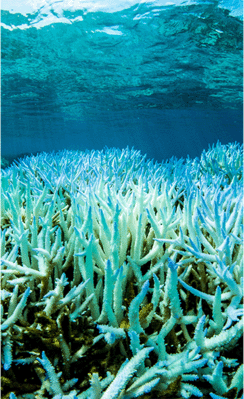 The Great Barrier Reef Marine Park Authority confirmed soon after that the bleaching was caused by warming waters associated with climate change.
Nathaniel Pelle, a senior Greenpeace campaigner, told Pro Bono News that while the reef could recover, it needed drastic emission reductions globally and in Australia.
He said something that wouldn’t help was the fossil fuel industry actively trying to weaken environmental protections, attracting corporate subsidies from government stimulus packages and forging ahead with mining projects.
“We’ve seen the petroleum exploration licence fees suspended in South Australia and a lot of oil and gas companies calling for assistance as well,” Pelle said.
“Controversial coal and gas projects like the Metropolitan mine, the Vicary Coal Mine, the Glendale mine, and the Narrabri Mine are continuing apace, even while communities don’t have the opportunity to participate, while expert witnesses aren’t necessarily going to be available and scientific investigation is impossible.”
The Victorian Premier Daniel Andrews, also recently came under fire for lifting the ban on onshore gas exploration in mid-March, a move environment groups warned could lead to worse bushfires and droughts.
Gavan McFadzean, the Australian Conservation Foundation climate change program manager, also said it was critical that a close eye was kept on the fossil fuel industry.
“These are times often when the fossil fuel sector may attempt to entrench its longevity as an economic powerhouse,” McFadzean told Pro Bono News.
“They have been ramping up their political donations federally in recent years and have the kind of political access that could shape economic reform as we come out of this crisis.”
He added that the postponement of climate talks such as the United Nations Intergovernmental Panel on Climate Change and the Cop26 in Glasgow meant that global targets and action would have to hold off until at least 2021.
He said while it was understandable the events were postponed, it was critical that once the virus was under control climate action once again took centre stage.
“The Cop26 event was going to be the most important conference since Paris in 2016… it was the conference where countries were going to be setting targets,” McFadzean said.
“It’s going to be really important that climate issues return to the national stage as COVID-19 gets under control, because climate change is also a central threat to society and the global economy as we know it.”
Emissions are going down – But not for long …….
Pelle said that if Australia and the rest of the world emerged from the crisis looking towards the energy solutions of the 21st century then the globe could see a recovery that worked for everyone.
“We could see a recovery that works for communities, that works for people, that makes people’s lives better and tackles the climate crisis at the same time, instead of a deliberate economic contraction and disruption to everyone’s lives,” he said.
A chance to start again
McFadzean said while the COVID-19 crisis was far from over, it was a good time to start imagining what a different kind of economy and climate future might look like if things were done differently.
“This means positioning ourselves to be an exporter of renewable energy to the world as we strive to make our future energy needs from low emission sources, recover our transport sector and move towards lower emissions vehicles, stronger pollution standards and electric vehicles,” he said………
https://probonoaustralia.com.au/news/2020/04/all-eyes-are-on-coronavirus-but-what-about-the-planet/
Coronavirus action: Australia’s moment to change course for a clean environment, slowing global heating

 Climate scientists say coronavirus could be Australia’s golden opportunity, https://www.sbs.com.au/news/climate-scientists-say-coronavirus-could-be-australia-s-golden-opportunity Climate experts say the way Australia chooses to rebuild its economy after the COVID-19 pandemic will seal its climate change fate. BY CLAUDIA FARHART, 10 Apr 20,
Australian climate scientists are urging the government to recognise the similarities between the COVID-19 pandemic and climate change, arguing they could be the key to stopping global warming.
Professor Matthew England from the University of New South Wales’ Climate Change Research Centre said acting early, listening to expert advice and adaptation were the keys to solving both crises.
While the coronavirus is posing a serious risk to millions of lives right now, Mr England said climate change will threaten even more lives over the next five decades.
“We’ve seen all around the world that the nations ignoring the best advice of their scientists are suffering the most, and climate change is no different,” he told SBS News.
“We have expert reports that have been tabled for the last three or four decades, but many nations are ignoring those, so I think that COVID-19 provides a wake up call for what happens if you do ignore the best scientific advice.”
Revealing the possibilities
Emissions around the globe are already dropping significantly as the world stays home and production grinds to a halt, with China already recording a 25 per cent drop in emissions in the first quarter of 2020.
Photographs of smog-free Los Angeles skies, crystal clean canals in Venice and clear views of the snow-capped Himalayas from India have circulated online, showing visible improvements.
While these significant improvements in air and water quality are showing people around the globe what is possible when emissions are reduced, Mr England said it is not time to celebrate yet.
Instead, he says Australia needs to recognise the opportunity COVID-19 presents to rebuild in a more environmentally friendly way.
“This is going to be a major stall in the global economy, but out of this pandemic we’re certainly going to see a huge economic boom and it’s going to be a real chance to make that boom a low-carbon boom,” he said.
“To solve climate change, we actually need large scale innovation and the huge economic boom that is poised to happen out of this pandemic.”
‘Fight or flight’
While COVID-19 has already killed at least 90,000 people, the World Health Organisation has warned that climate change will kill as many as 250,000 people per year by 2030.
Professor Mark Howden of the Climate Change Institute said governments’ differing approaches to the two crises was as simple as how our brains are wired.
“The coronavirus is appealing to our hindbrain, our fight or flight responses, rather than our forebrain, our planning and strategic responses,” he told SBS News.
“Humans are much more attuned to responding to the short-term rather than the long-term.”
While Mr Howden is expecting to see a drop in Australian carbon emissions of roughly five per cent due to COVID-19, he said this will not be the first time such a drop has occurred.
Australia’s emissions saw a similar drop during the global financial crisis of 2009, but were back to their normal levels within two years.
“This is simply because we’re much less active economically, and emissions are fairly closely tied to GDP, so the big challenge will be what happens after the coronavirus,” he said.
However, unlike during the GFC, Mr Howden said coronavirus has now given governments the proof that a health crisis can be halted by an all-in effort.
“Coronavirus has meant that governments have ditched often long-held ideologies and been forced into very pragmatic responses,” he said.
“I think climate change actually needs that – it needs to move away from ideological positions into responses which are informed by the evidence, the science.”
SBS News contacted the Department of Industry, Innovation and Science for comment but did not receive a response.
Climate threat underlies the pandemic emergency
 Beneath the virus lurks a bigger emergency, but the world is distracted from the climate threat, SMH, Bob Carr 2 Apr 20, What did our battered old planet do to bring this run of wretchedly bad luck? Just before the 2008 Wall Street disaster, Washington was about to force emitters to pay for the privilege of dumping carbon waste in the upper atmosphere. Congress approved a cap and trade scheme so its economy could trade its way to a low carbon future. In a similar spirit the Rudd government was legislating its own carbon trading model. Beneath the virus lurks a bigger emergency, but the world is distracted from the climate threat, SMH, Bob Carr 2 Apr 20, What did our battered old planet do to bring this run of wretchedly bad luck? Just before the 2008 Wall Street disaster, Washington was about to force emitters to pay for the privilege of dumping carbon waste in the upper atmosphere. Congress approved a cap and trade scheme so its economy could trade its way to a low carbon future. In a similar spirit the Rudd government was legislating its own carbon trading model.
Then the financial crisis knocked everyone sideways. The carbon lobby in both countries was able to talk job losses and higher taxes. The propaganda was a pushover. Legislation died in the US and Australian senates. And the world kept warming.
Last month the temperature on the Antarctic peninsular hit 65 degrees Fahrenheit, beating all previous records. For the globe, 2019 was the second hottest year on record, and the hottest without the contribution of a big El Nino. The coming decade may be our last chance to contain the chaos driven by humankind’s craziest experiment: the idea that carbon can be stored in the thin filigree of air around the planet. The Paris Agreement provides a road map and the falling price of renewables a market impulse. …. In the middle of the coronavirus crisis, The Sydney Morning Herald and The Age, to their credit, still find space to record the conclusion of leading reef scientist, Terry Hughes, that there is a third major bleaching of the Great Barrier Reef now under way. This follows the bleachings of 2016 and 2017. This is every bit a climate event as were the mega fires over Christmas. Yet the irrevocable loss of healthy coral may not galvanise the way fires did….. Meanwhile, the pandemic emergency may kill off the Glasgow conference on climate planned for November. The UN event is aimed at averting runaway climate change by keeping the temperature rise to 1.5 degrees. …… if the breaking up of permafrost in the Arctic circle assumes an extra ferocity. That would release plumes of methane, 30 times more lethal at trapping heat than carbon, but on a scale to blow apart every calibration of how fast climate is shifting. For Australia, Black Swan climate events could include a cyclone beyond what we have seen before, hitting the Queensland coast. Experts say there is still enough unburnt bush to give us a fire season as bad as the last, even next season – if we suffer the same malevolent mix of heat, low humidity and strong wind…… Beneath news of virus and slump there simmers an even bigger story. The planet keeps warming. And there’s no guarantee the rate may not pick up alarmingly. ……https://www.smh.com.au/environment/climate-change/beneath-the-virus-lurks-a-bigger-emergency-but-the-world-is-distracted-from-the-climate-threat-20200328-p54et4.html |
|
Tax-payers funded Matt Canavan’s expensive trip to attend coalmine opening
The former resources minister used the occasion to give a speech attacking ‘self-indulgent’ environmentalists, Guardian, Christopher Knaus, Wed 25 Mar 2020
The former resources minister Matt Canavan billed taxpayers for a $5,390 charter flight to travel 150km to attend the opening of a coalmine, where he gave a speech attacking “self-indulgent” environmental activists.
Canavan took the private charter flight from Mackay to Colinsville, a three-hour drive, so he could get to the opening of the $1.76bn Byerwen mine in north Queensland.
At the opening, Canavan gave a speech attacking what he described as “hypocritical, self-indulgent activists” holding back the dreamers of the mining industry…….
The most recent parliamentary expense reports, released last week, show Canavan later billed taxpayers for the $5,390 charter flight ….. The expense was listed as “unscheduled travel” by the independent parliamentary expenses authority and the finance department…….
The expense is roughly the same as that incurred by the former Liberal MP Bronwyn Bishop, who chartered a $5,227 helicopter for a return trip from Melbourne to a golf course near Geelong for a Liberal party function.
Canavan quit as minister last month to support Barnaby Joyce’s bid to return to the leadership position. He has described himself as running on an “unashamedly pro-coal” platform.
 The Guardian previously reported that Canavan had omitted two properties worth more than $1m from his current declaration of interests to parliament. He declared “nil” interests in real estate despite owning two houses in Yeppoon, Queensland and Macquarie in Canberra.
Canavan said he was not required to declare the interests to the 46th parliament because they’d been declared to the previous parliament, an argument that conflicts with official advice. https://www.theguardian.com/australia-news/2020/mar/25/matt-canavan-billed-taxpayers-5390-for-charter-flight-to-attend-coalmine-opening
Carbon capture and storage (CCS) is a silly scheme
The carbon capture con, Online Opinion, By Viv Forbes 19 March 2020
Carbon capture and storage (CCS) tops the list of silly schemes to reduce man-made global warming. The idea is to capture carbon dioxide from power stations and cement plants, separate it, compress it, pump it long distances and force it underground, hoping it will never escape………
The quantities of gases that CCS would need to handle are enormous and capital and operating costs will be horrendous. For every tonne of coal burnt in a power station, about 11 tonnes of gases are exhausted – 7.5 tonnes of nitrogen from the air used to burn the coal, plus 2.5 tonnes of CO2 and one tonne of water vapour from the coal combustion process….., CCS also requires energy to produce and fabricate steel and erect gas storages, pumps and pipelines and to drill disposal wells. This will chew up more coal resources and produce yet more carbon dioxide, for zero benefit.
But the real problems are at the burial site – how to create secure space for the CO2 gas.
There is no vacuum occurring naturally anywhere on earth – every bit of space is occupied by solids, liquids or gases. Underground disposal of CO2 requires it to be pumped AGAINST the pressure of whatever fills the pore space of the rock formation now – either natural gases or liquids. These pressures can be substantial, especially after more gas is pumped in.
The natural gases in rock formations are commonly air, CO2, CH4 (methane) or rarely, H2S (rotten egg gas). The liquids are commonly salty water, sometimes fresh water or very rarely, liquid hydrocarbons.
Pumping out air is costly; pumping natural CO2 out to make room for man-made CO2 is pointless; and releasing rotten egg gas or salty water on the surface would create a real problem, ……
Then there is the dangerous risk of a surface outburst or leakage from a pressurised reservoir of CO2. The atmosphere contains 0.04% CO2 which is beneficial for all life. But a CCS reservoir would contain +90% of this heavier-than-air gas – a lethal, suffocating concentration for nearby animal life if it escaped. ….
NSW Environment Minister Matt Kean contradicts the Coalition party line – wants climate action and NO nuclear
 It’s time to win climate wars, Kean says https://www.canberratimes.com.au/story/6674567/its-time-to-win-climate-wars-kean-says/?cs=14231, Jodie Stephens, 11 Mar 20, It’s time to win climate wars, Kean says https://www.canberratimes.com.au/story/6674567/its-time-to-win-climate-wars-kean-says/?cs=14231, Jodie Stephens, 11 Mar 20,
Outspoken NSW Environment Minister Matt Kean says it’s time to “win the climate wars” and for the political right to show better leadership on the issue. In the wake of a devastating bushfire season, Mr Kean wants an end to “futile arguments” about whether climate change exists. He told an Affinity Intercultural Foundation event on Wednesday people had weaponised climate change for too long and to the country’s detriment.
He stressed reducing emissions didn’t need to come at the expense of the economy. “That’s something that has been absent from the debate for a long time. The economics have changed dramatically,” Mr Kean said at the Sydney event. “Right now, it presents an enormous economic opportunity for our nation that’d be too good to miss.” Mr Kean said renewables backed up by pumped hydro offered the cheapest way to deliver electricity, adding, “It’s not nuclear, it’s not coal, it’s not gas.” He said the global push to reduce emissions would require trillions of dollars of investment in low-emissions technology and he wanted a big slice of that money coming into NSW. “There’s no country on the planet better placed to take advantage of a low-carbon world than Australia,” he said. “We’ve got masses of land, we’ve got some of the best wind and solar sources anywhere on the planet.” Criticised earlier this year for linking bushfires to climate change, Mr Kean said at the time federal cabinet ministers wanted stronger action. Prime Minister Scott Morrison responded by claiming most of his colleagues didn’t know who Mr Kean was and that he “doesn’t know what he’s talking about”. Mr Kean on Wednesday said he was glad he raised the issue because it demonstrated “that the sensible people in this discussion need to stand up”. “The centre of Australian politics has vacated the field when it comes to climate change for too long,” he said. He said the right of Australian politics hadn’t been showing the leadership they should have for a long time. “It’s time for that to change. “As someone on the right of Australian politics, the reason I’m there is because I believe in the power of markets. I’m a capitalist.” Mr Kean told the event he intended to win the nuclear debate, after Deputy Premier John Barilaro said the Nationals would support a bill to repeal state bans on uranium mining and nuclear facilities. “For the people arguing for nuclear, you’re actually arguing for more expensive electricity which is less safe and dirtier. I don’t think that’s a good argument,” he said. |
|
Global heating is intensifying a rare natural phenomenon that brings severe drought to Australia.
A rare natural phenomenon brings severe drought to Australia. Climate change is making it more common, The Conversation, Nicky Wright, Research Fellow, Australian National University, Bethany Ellis, PhD Candidate, Australian National University, Nerilie Abram, Professor; ARC Future Fellow; Chief Investigator for the ARC Centre of Excellence for Climate Extremes, Australian National University, March 10, 2020
Weather-wise, 2019 was a crazy way to end a decade. Fires spread through much of southeast Australia, fuelled by dry vegetation from the ongoing drought and fanned by hot, windy fire weather.
On the other side of the Indian Ocean, torrential rainfall and flooding devastated parts of eastern Africa. Communities there now face a locust plague and food shortages.
These intense events can partly be blamed on the extreme positive Indian Ocean Dipole, a climate phenomenon that unfolded in the second half of 2019.
The Indian Ocean Dipole refers to the difference in sea surface temperature on either side of the Indian Ocean, which alters rainfall patterns in Australia and other nations in the region. The dipole is a lesser-known relative of the Pacific Ocean’s El Niño.
In research published today in Nature, we reconstructed Indian Ocean Dipole variability over the last millennium. We found “extreme positive” Indian Ocean Dipole events like last year’s are historically very rare, but becoming more common due to human-caused climate change. This is big news for a planet already struggling to contain global warming.
So what does this new side-effect of climate change mean for the future?
The Indian Ocean brings drought and flooding rain
First, let’s explore what a “positive” and “negative” Indian Ocean Dipole means.
During a “positive” Indian Ocean Dipole event, waters in the eastern Indian Ocean become cooler than normal, while waters in the western Indian Ocean become warmer than normal.
Warmer water causes rising warm, moist air, bringing intense rainfall and flooding to east Africa. At the same time, atmospheric moisture is reduced over the cool waters of the eastern Indian Ocean. This turns off one of Australia’s important rainfall sources.
In fact, over the past century, positive Indian Ocean Dipoles have led to the worst droughts and bushfires in southeast Australia.
The Indian Ocean Dipole also has a negative phase, which is important to bring drought-breaking rain to Australia. But the positive phase is much stronger and has more intense climate impacts.
We’ve experienced extreme positive Indian Ocean Dipole events before. Reliable instrumental records of the phenomenon began in 1958, and since then a string of very strong positive Indian Ocean Dipoles have occurred in 1961, 1994, 1997 and now 2019.
But this instrumental record is very short, and it’s tainted by the external influence of climate change.
This means it’s impossible to tell from instrumental records alone how extreme Indian Ocean Dipoles can be, and whether human-caused climate change is influencing the phenomenon.
Diving into the past with corals
To uncover just how the Indian Ocean Dipole has changed, we looked back through the last millennium using natural records: “cores” taken from nine coral skeletons (one modern, eight fossilised)……….
positive Indian Ocean Dipole events have been occurring more often in recent decades, and becoming more intense…….
climate change is causing the western side of the Indian Ocean to warm faster than in the east, making it easier for positive Indian Ocean Dipole events to establish.
In other words, drought-causing positive Indian Ocean Dipole events will become more frequent as our climate continues to warm. In fact, climate model projections indicate extreme positive Indian Ocean Dipole events will occur three times more often this century than last, if high greenhouse gas emissions continue.
This means events like last year will almost certainly unfold again soon, and we’re upping the odds of even worse events that, through the fossil coral data, we now know are possible.
Knowing we haven’t yet seen the worst of the Indian Ocean Dipole is important in planning for future climate risks. Future extremes from the Indian Ocean will act on top of long-term warming, giving a double-whammy effect to their impacts in Australia, like the record-breaking heat and drought of 2019.
But perhaps most importantly, rapidly cutting greenhouse gas emissions will limit how often positive Indian Ocean Dipole events occur in future.https://theconversation.com/a-rare-natural-phenomenon-brings-severe-drought-to-australia-climate-change-is-making-it-more-common-133058
Christiana Figueres- “Australia, you’re not ‘meeting and beating’ your emissions targets”

Be honest Australia, you’re not ‘meeting and beating’ your emissions targets https://www.smh.com.au/environment/climate-change/be-honest-australia-you-re-not-meeting-and-beating-your-emissions-targets-20200307-p547u1.html 8 Mar 20, Optimistic. Prosperous. A country of rare beauty, blessed with abundant natural resources. Australia has all the “golden eggs” needed to position itself as a global leader, to help its Asia-Pacific region leapfrog to a new energy future, and to guarantee Australian prosperity in the process.
Watching this summer’s unprecedented firestorms, I was heartbroken by the sheer scale of the human and ecological tragedy. “This must be the tipping point on climate politics in Australia,” I said to myself. “Surely now the politicians will join hands and forge a bipartisan plan for a better future.”
Instead, the climate wars have returned, driven by a handful of deniers afraid to let go of longstanding vested interests, and given air by powerful media sympathisers and a Prime Minister unwilling to fully embrace the science and stare them down.
For Australia, the choice between danger and opportunity is clear, and that choice must be made now. Since the 2008 Stern Review, the world has known that the cost of not acting is much greater than the cost of our current path. And since the 2008 Garnaut Review, Australians have known that without stronger action, droughts and bushfires would become more frequent and intense, and “observable by 2020”. It is time to move on from denial, delusion and delay towards preparedness, productivity and prosperity.
The following three steps will put Australia on track to the future we must create.
First, be honest about where Australia is at. Your country is much more than 1.3 per cent of the global climate problem. Carbon emissions from Australia’s use and export of fossil fuels account for about 5 per cent of the global fossil fuel footprint. With exports included, Australians have the biggest per capita carbon footprint in the world.
Australia is not “meeting and beating” its emissions targets. Emissions have increased in every calendar year since 2014. The government’s own projections say Australia will reduce emissions by only 16 per cent by 2030, not the 26 to 28 per cent it promised in Paris, nor the 50 per cent required by science to limit warming to 1.5 degrees. Kyoto “carryover” can’t be used to make up the gap. The Paris Agreement doesn’t allow it. To suggest otherwise is at best an attempt to paper over Australia’s lagging efforts; and at worst, a legally baseless ploy that encourages cheating and holds back development of the next phase of carbon markets.
A highly vulnerable Australia cannot address climate change on its own, but its heel dragging leaves it without the international credibility to drive a stronger global response. The Australian government must look seriously at how to really meet and beat its 2030 target, and ask other major emitters to join it in an alliance for higher ambition at the COP26 climate summit in Glasgow this November.
Second, Australia needs a bipartisan, long-term vision for decarbonisation. Rattled by the bushfires and growing evidence of climate-related risks and stresses, Australia’s biggest corporations – including Rio Tinto, Qantas, Telstra and BHP – have announced support for a national net zero target for 2050. For them, legislating this target is important to finally end the climate wars, and provide the necessary certainty to underpin investment in the transition.
All states and territories have 2050 net zero targets, as do 73 other nations, including Britain and Canada. British Prime Minister Boris Johnson would welcome Australia joining these ranks ahead of the COP26, and giving consideration to the British model of using an independent expert body to advise government on five-yearly carbon budgets en route to net zero by 2050. Independent MP Zali Steggall’s private members’ bill does exactly that.
Third, Australia must embrace net zero by 2050 as a central pillar of its economic plan for the future. The plan must prioritise the policies, industries and technologies that are scientifically aligned with the 1.5 degree temperature limit, and retire those that are not, albeit with gratitude for the service provided in the past.
Despite a booming renewables industry, coal still accounts for around 60 per cent of Australia’s energy mix. But the technology is tired and unreliable in the summer, highly polluting, and no longer price competitive with solar and wind, firmed up by big batteries or pumped hydro. There is no place for governments signed up to the Paris Agreement to provide subsidies for dying coal. We must instead invest in the future.
These ground-breaking projects are just three examples of how Australia can lead and prosper. With political honesty and vision, ambitious targets, and a stubborn commitment to innovation, Australia stands ready to assume its rightful place as a clean energy superpower of the world. With the right choices, the future is bright.
Christiana Figueres is the former UN climate chief who oversaw the negotiation of the 2015 Paris Agreement, and is convenor of the Mission 2020 climate campaign. She is co-author of The Future We Choose and is visiting Australia this week.
Why don’t we treat the climate crisis with the same urgency as coronavirus?
 Why don’t we treat the climate crisis with the same urgency as coronavirus? Owen Jones Guardian, 6 Mar 2020 No Cobra meetings, no sombre speeches from No 10, yet the consequences of runaway global heating are catastrophic, It is a global emergency that has already killed on a mass scale and threatens to send millions more to early graves. As its effects spread, it could destabilise entire economies and overwhelm poorer countries lacking resources and infrastructure. But this is the climate crisis, not the coronavirus. Governments are not assembling emergency national plans and you’re not getting push notifications transmitted to your phone breathlessly alerting you to dramatic twists and developments from South Korea to Italy.More than 3,000 people have succumbed to coronavirus yet, according to the World Health Organization, air pollution alone – just one aspect of our central planetary crisis – kills seven million people every year. There have been no Cobra meetings for the climate crisis, no sombre prime ministerial statements detailing the emergency action being taken to reassure the public. In time, we’ll overcome any coronavirus pandemic. With the climate crisis, we are already out of time, and are now left mitigating the inevitably disastrous consequences hurtling towards us. While coronavirus is understandably treated as an imminent danger, the climate crisis is still presented as an abstraction whose consequences are decades away. Unlike an illness, it is harder to visualise how climate breakdown will affect us each as individuals. Perhaps when unprecedented wildfires engulfed parts of the Arctic last summer there could have been an urgent conversation about how the climate crisis was fuelling extreme weather, yet there wasn’t. In 2018, more than 60 million people suffered the consequences of extreme weather and climate change, including more than 1,600 who perished in Europe, Japan and the US because of heatwaves and wildfires. Mozambique, Malawi and Zimbabwe were devastated by cyclone Idai, while hurricanes Florence and Michael inflicted $24bn (£18.7bn) worth of damage on the US economy, according to the World Meteorological Organization.As the recent Yorkshire floods illustrate, extreme weather – with its terrible human and economic costs – is ever more a fact of British life. Antarctic ice is melting more than six times faster than it was four decades ago and Greenland’s ice sheet four times faster than previously thought. According to the UN, we have 10 years to prevent a 1.5C rise above pre-industrial temperature but, whatever happens, we will suffer.
Pandemics and the climate crisis may go hand in hand, too: research suggests that changing weather patterns may drive species to higher altitudes, potentially putting them in contact with diseases for which they have little immunity. “It’s strange when people see the climate crisis as being in the future, compared to coronavirus, which we’re facing now,” says Friends of the Earth’s co-executive director, Miriam Turner. “It might be something that feels far away when sitting in an office in central London, but the emergency footing of the climate crisis is being felt by hundreds of millions already.”
Imagine, then, that we felt the same sense of emergency about the climate crisis as we do about coronavirus. What action would we take? ….. https://www.theguardian.com/commentisfree/2020/mar/05/governments-coronavirus-urgent-climate-crisis
Morrison to cancel Australia’s participation in the Energy Transition Hub
 Morrison government to stop funding international collaboration on shift to zero emissions. The five-year Australian-German initiative to transition to new energy and low emissions was due to end in 2022, Guardian , Adam Morton Environment editor @adamlmorton Fri 6 Mar 2020 The Morrison government has told researchers at two of Australia’s leading universities it will break a commitment to fund an international collaboration into what is required to shift to a zero emissions future. Morrison government to stop funding international collaboration on shift to zero emissions. The five-year Australian-German initiative to transition to new energy and low emissions was due to end in 2022, Guardian , Adam Morton Environment editor @adamlmorton Fri 6 Mar 2020 The Morrison government has told researchers at two of Australia’s leading universities it will break a commitment to fund an international collaboration into what is required to shift to a zero emissions future.
The Australian-German Energy Transition Hub was announced in 2017 by then prime minister Malcolm Turnbull and German chancellor Angela Merkel as a collaboration that would “help the technical, economic and social transition to new energy systems and a low emissions economy”. Based at the University of Melbourne, the Australian National University and three German institutions, it was to receive $4m over five years from the Department of Foreign Affairs and Trade as part of an eventual full cross-country funding of $20m. But in an email to staff on Friday afternoon, hub managers said the department had told them the government had decided it would “not follow through on its original commitment to fund the hub until 2022”. Government funding for the hub will end in June. Guardian Australia has been told there is $1.75m unpaid from the original agreement. Some researchers said the decision made little sense given the hub’s work included areas of government interest, particularly the development of a clean hydrogen industry. Other hub projects focus on energy storage, energy system modelling, plans for a just transition to clean energy and integrating solar energy into the grid……..https://www.theguardian.com/environment/2020/mar/06/morrison-government-to-stop-funding-20m-international-collaboration-on-shift-to-zero-emissions |
|
|
Cosy little cocktail party for Liberal and Labor MPs, with coal industry bigwigs
Climate campaigners condemn ‘insidious’ cocktail party for MPs and coal industry
Parliament House event represents an effort to undermine climate action, environmental group 350 Australia says, Guardian, Christopher Knaus @knauscWed 4 Mar 2020 Environmental campaigners say a cocktail night involving the fossil fuel industry and federal politicians represents an “insidious” lobbying effort to undermine climate action.
The pro-coal Liberal MP Craig Kelly and Labor’s Joel Fitzgibbon hosted a cocktail event at Parliament House to discuss carbon capture and storage with industry leaders on Wednesday night.
An invite seen by the Guardian was sent out by Kelly and Fitzgibbon, who chair the parliamentary friends of resources, together with representatives of Santos and the carbon capture body CO2CRC. The event is described as a “cocktail event to mark the inaugural meeting of the CO2CRC Carbon Capture and Storage Policy Forum”.
That forum features companies such as BHP, Chevron, Coal21, ENI, Exxon, the Global Carbon Capture and Storage Institute, JPower, Shell and Woodside.
The invite says the forum aims to “work with governments, industry and other stakeholders” to create “suitable policy settings and a regulatory framework to accelerate the development and deployment of CCS technology in Australia”…..
Environment group 350 Australia says the event shows the need to “crack down on the undue influence of lobby groups on our democracy”.
The 350 Australia chief executive, Lucy Manne, said the event was an “insidious effort by the fossil fuel lobby to undermine action on the climate crisis”.
Manne said carbon capture and storage had proven a “pipe dream of the coal and gas lobby” and diverted millions away from proven renewables…..
“It’s outrageous that instead of working out how to rapidly transition to the renewable energy future the vast majority of Australians and businesses want, our elected representatives will tonight be sipping cocktails with the coal lobby and discussing how to extend the life of dirty coal-burning power stations.”
Such lobbying is generally hidden from the public unless revealed by the media. The Fitzgibbon-Kelly cocktail event was reported in News Corp papers.
It does not appear in any of the transparency measures governing lobbying. Federal ministers are also not required to disclose who they have met with, unlike in states like Queensland and New South Wales. ……https://www.theguardian.com/australia-news/2020/mar/04/climate-campaigners-condemn-insidious-cocktail-party-for-mps-and-coal-industry
Greens leader Adam Bandt introduces climate emergency Bill
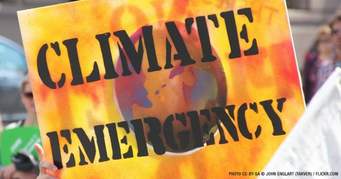 ‘People are angry and anxious’: Adam Bandt introduces climate emergency
 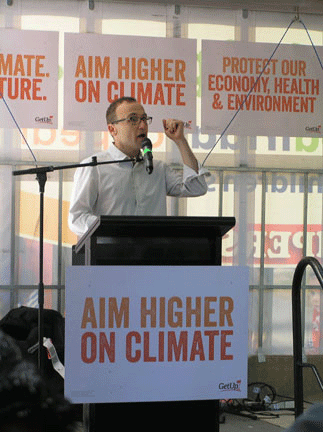 bill, https://www.sbs.com.au/news/people-are-angry-and-anxious-adam-bandt-introduces-climate-emergency-bill Greens leader Adam Bandt has introduced a bill to formally declare a climate emergency and set up a ‘war cabinet’ to tackle the crisis.
Greens leader Adam Bandt has painted a post-apocalyptic future for Australia unless the government declares a climate emergency.
Mr Bandt told parliament on Monday that “environmental collapse was here” as he introduced his bill to formally declare the crisis.
“It is not scaremongering, it is hard physics and we have just had a taste of it over the last summer,” he said.
He said northern Australia would be inhospitable for parts of the year, one-in-six native species would be extinct, mosquito-borne diseases will travel south and the country’s river systems will see more algal blooms that lead to mass fish kills in the Murray-Darling.
Under the bill, the government would be required to set up a “war cabinet” to tackle the crisis, government agencies would refer to the declaration of a climate emergency when developing policy and table annual reports on how they were meeting their obligations.
Mr Bandt’s bill was seconded by independent MP Zali Steggall, who knocked off former Liberal prime minister Tony Abbott for the NSW seat of Warringah at the last election.
“There is no doubt we are in the midst of a climate emergency,” Ms Steggall said.
We have a duty to Australian people … it is time for us all to be accountable.”
A climate emergency motion moved in October fell four votes short.
So-called ‘Ethical’ super funds invest in coal, oil, gas
‘Ethical’ super funds invest in coal, oil, gas, SMH, Charlotte Grieve, March 3, 2020 Sustainable investment options offered by two major industry superannuation groups and wealth giant AMP have millions invested in the fossil fuel industry, despite pledging to apply strict screening based on environmental, social and governance standards.
AustralianSuper’s “socially aware investment option” claims it does not invest in Australian or international companies that directly own fossil fuels while disclosures of its portfolio holdings show it has at least $39 million invested in more than 20 global coal, oil and gas projects. These include Marathon Petroleum Corp, Indian thermal coal plant Adhunik Power and Natural Resources and oil, gas and chemicals company, WorleyParsons.
Latest figures show the fund has more than $2.4 billion invested on behalf of 38,000 members, less than 2 per cent of the $172 billion superannuation giant’s total membership pool.
After conducting a survey of members’ interests, the top investment concern for those wanting an ethical alternative was exposure to coal and other fossil fuels. The socially aware option pledges to screen out companies that own reserves of fossil fuels or uranium, regardless of the size of its ownership.
This screen is not applied to private equity, which makes up 4 per cent of total investments and the fund’s fact-sheet explains it can still invest in companies that provide services to, buy, process or sell products from or invest in the excluded companies.
The fund has a stake in 24 companies that either produce fossil fuels or rely on their production. These include: thermal coal producer Westmoreland Mining that in December announced a six-year coal supply agreement in middle America; $9.6 million in Halliburton, one of the world’s largest providers of drilling and production services for oil, gas and coal companies; and $9.6 million in Marathon Petroleum, the largest refining company in America that produces more than 3 million barrels of crude oil per day.
Other oil and gas companies AustralianSuper’s sustainable fund bankrolls include Fieldwood Energy, a company that claims to be one of the largest producers of oil and gas in the Gulf of Mexico, Perth-based Northern Oil and Gas and Ajax Resources, recently acquired by Texas oil and gas company, Diamondback.
AustralianSuper declined to answer questions about its screening process or if it had plans to create a fund that applies a hard screen to the fossil fuel industry.
Similarly, the 2019 portfolio holdings for $54 billion Hostplus’s sustainable investment option launched in March 2017 includes at least eight oil and gas companies, including Oil Search, Santos and Woodside Petroleum.
Hostplus was contacted for comment.
However, AMP invests in at least nine oil and gas companies, including Oil Search, Woodside Petroleum and Santos……. https://www.smh.com.au/business/banking-and-finance/ethical-super-funds-invest-in-coal-oil-gas-20200228-p545ja.html
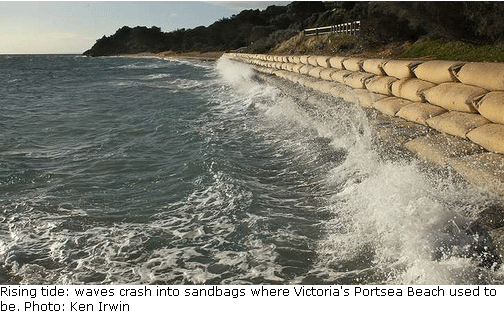
Australia’s disappearing beaches, as global heating causes sea level rise
|
Thousands of kilometres of Australia’s beaches at risk from rising seas, SMH, By Peter Hannam, March 3, 2020 More than 12,000 kilometres of Australia’s sandy beaches are threatened by coastal erosion by the end of the century, with greater losses predicted if greenhouse gas emissions remain high.The projections, made by European researchers and published in Nature Climate Change on Tuesday, used satellite data that tracked shoreline change from 1984 to 2015. They found a “substantial proportion” of the world’s sandy coastline is already eroded, a trend that could worsen as climate change pushes up sea levels.
Under a “moderate” effort to curb emissions – with carbon pollution peaking at 2040 and then declining – at least 12,324 kilometres of Australia’s sandy coast will be threatened with erosion by 2100. That tally is the most of any nation, and would amount to about 40 per cent of the country’s sandy beaches. Should greenhouse gas emissions continue to rise through the century – the so-called 8.5 Representative Concentration Pathway – Australia’s sandy coastline at risk increases to 15,439 kilometres, the paper said. “You have a long coastline and part of the coast is very mildly sloping” and is therefore susceptible to erosion, said Michalis Vousdoukas, a coastal oceanographer at the European Commission and the paper’s lead author. “Melbourne is worse than Sydney,” Dr Vousdoukas told the Herald and The Age, adding Brisbane and Adelaide’s beaches fell between the two in terms of vulnerability to erosion. The researchers said global sea levels had been increasing “at an accelerated rate during the past 25 years and will continue to do so with climate change”. So far, most of the increase had come from the thermal expansion of warmer water but, by mid-century or so, the increase in sea levels would likely come more from melting ice sheets, Dr Vousdoukas said……..https://www.smh.com.au/environment/climate-change/thousands-of-kilometres-of-australia-s-beaches-at-risk-from-rising-seas-20200302-p5463p.html |
|
|
#ScottyFromMarketing a ‘predatory’ centrist on climate policy with no plans for meaningful emissions reduction
|
Wayne Swan Morrison a ‘predatory’ centrist on climate policy with no plans for meaningful emissions reduction, says Swan Labor president says party must work against PM’s PR strategy and get on with ‘solving the bloody problem’, Katharine Murphy Political editor, Sun 1 Mar 2020
Labor federal president Wayne Swan says Morrison does not have a serious climate policy ‘but as you would expect from a marketing guy, [he has] a clearly articulated PR strategy to use climate as a wedge. Labor’s federal president Wayne Swan will accuse Scott Morrison of engaging in “predatory centrism” on climate policy by styling himself as the pragmatist between the extremes of climate emergencies and denialism, when the government has no intention of driving meaningful emissions reduction. In a speech to be delivered on Sunday, Swan will argue Labor will only win the decade-long climate wars if it approaches the challenge with “pragmatic policy and ruthless organisation”. According to speech notes, Swan will say Labor needs to articulate a roadmap for the domestic coal powered industry “which manages its decline”……. https://www.theguardian.com/world/2020/mar/01/morrison-a-predatory-centrist-on-climate-policy-with-no-plans-for-meaningful-emissions-reduction-says-swan |
|
1 This month

of the week – Australians for War Powers Reform (AWPR)
To see nuclear-related stories in greater depth and intensity
 Antinuclear