Fact checking Angus Taylor: does Australia have a climate change record to be proud of?
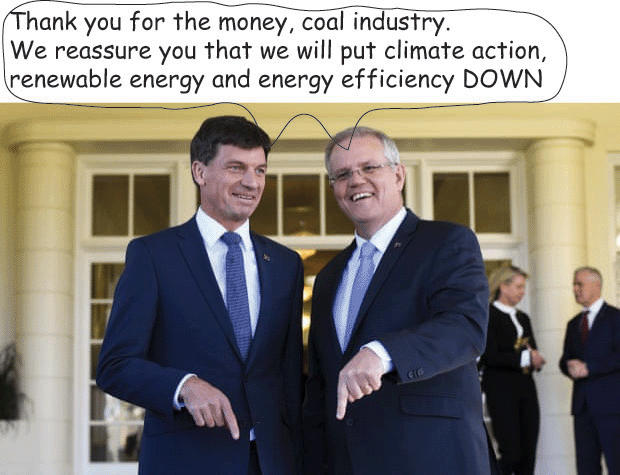
On a day of extraordinary bushfires the energy minister argued that the country has ‘strong targets, clear plans and an enviable track record’ on reducing emissions. Is he right? Guardian, Graham Readfearn
Angus Taylor spoke at the COP25 climate summit in Madrid. The energy minister says Australia has an enviable record on climate change – the Guardian fact checks his claims.
Australians should be proud of the country’s achievements on climate change, energy minister Angus Taylor has argued in a newspaper column that claims “quiet Australians” don’t accept the “shrill cries” of the government’s climate critics.
The column, published in The Australian, makes a series of claims about Australia’s emissions and how they compare to other countries, as well as highlighting exports such as LNG that are “dramatically reducing emissions” in other countries.
So is Australia really a paragon of climate virtue – cutting emissions at home while helping the world to cut emissions?
As is always the case when it comes to climate and energy policy, there is much to check and understand in Taylor’s article.
Prof Frank Jotzo, director of the Centre for Climate and Energy Policy at the ANU Crawford School of Public Policy, told Guardian Australia: “I would characterise [Taylor’s article] as a selective use of statistics that make Australia’s emissions trajectory look good, when in reality it does not look good at all.”
Tiny footprint?
Taylor writes that Australia is “responsible for only 1.3 per cent of global emissions, so we can’t single-handedly have a meaningful impact without the co-operation of the largest emitters such as China and the US.”
In the context of global emissions, there is much that Australia can, and does, do that has a meaningful impact.
The 1.3% figure does not account for Australia’s contribution to global emissions from the fossil fuels we dig up and export.
If this exported coal and gas was accounted for, one analysis suggests Australia would be responsible for almost 5% of the global carbon footprint from fossil fuel burning.
When countries report their emissions to the United Nations Framework Convention on Climate Change, they only report emissions occurring inside their borders, so it could be argued that using this larger number is unfair.
But the problem is that elsewhere in Taylor’s article, he says Australia’s exporting of LNG is helping countries cut emissions.
Jotzo says: “If we are going to talk about impacts on global emissions of Australia’s energy exports, then we need to consider all fuels, including coal. Any exporting of coal will result in higher global emissions because it increases the availability and lowers the price of coal, and encourages the use of coal.”
While Taylor admits that LNG processing in Australia has pushed domestic emissions higher, he claims that “our LNG exports are dramatically reducing emissions in customer countries such as Japan, South Korea and China — the equivalent of up to 30 per cent of our emissions each year”.
He says the “lion’s share” of the exports will actually replace gas from other sources, rather than displacing coal generation. There is also a risk, he says, that increasing LNG exports also encourages countries to build more gas infrastructure, making it harder to move away from the fossil fuel.
He adds: “It is not clear that the availability of Australian LNG decreases emissions internationally.”
Easy target
“Australia meets and beats its emission-reductions targets, every time,” writes Taylor. “We beat our first Kyoto targets by 128 million tonnes. We expect to beat our 2020 targets by 411 million tonnes.”
The key reason why Australia has easily beaten its targets, is that they were very low to begin with.
Australia’s first Kyoto target allowed it to increase emissions by 8% between 1990 and 2010. The second target period required a 5% cut below 2000 levels by 2020.
Much of Australia’s cuts to emissions in recent decades, says Jotzo, has been achieved through drops in land clearing, rather than reductions in other parts of the economy the government could have influence over.
Australia wants to use some 411 million tonnes of CO2 “credits” amassed over the Kyoto periods against future targets under the separate Paris agreement, even though it admits it is probably the only country looking to use these “carryover credits”.
Using carryover credits would cut the amount of emissions reductions Australia would need to find to meet its Paris target by about a half.
At the latest UN climate talks in Madrid, Australia came under harsh criticism from more than 100 countries for its desire to use the credits, which some analysts say is a proposal with no legal basis.
Proud and quiet Aussies?
According to Taylor, “Australia has strong targets, clear plans, an enviable track record” on climate change, and Australians should be proud of it.
But when overseas groups look at Australia’s record compared to the rest of the world, the assessments come out differently.
An analysis by Climate Action Tracker says Australia’s Paris targets are “insufficient” and inconsistent with the Paris goal of keeping global warming well below 2C.
Australia has been placed consistently towards the bottom in the annual Climate Change Policy Index analysis of the world’s top 57 emitting nations.
The most recent analysis ranked Australia as the sixth worst country on climate change overall.
Jotzo, who attended the Madrid climate talks as an observer, said: “Australia was highly regarded at the talks for its technical competence, and it always has. But Australia is not highly regarded at all for its policies or for its efforts to water down effective ambition of the Paris agreement.”
Jotzo adds: “They are flabbergasted that Australia is digging in to its stance of getting an easier deal when it would so obviously be in its national interest to encourage strong global action.” https://www.theguardian.com/australia-news/2019/dec/31/fact-checking-angus-taylor-does-australia-have-a-climate-change-record-to-be-proud-of
Apocalypse now the time to accept climate change
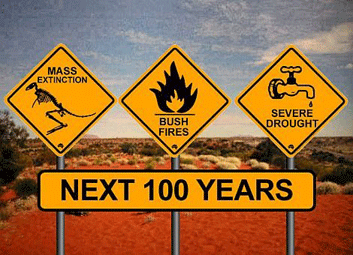 Apocalypse now the time to accept climate change, SMH, 2 Jan 2020, What will it take for Scott Morrison to face up to reality? During his New Year’s speech when referring to the bushfires, he said “We have faced these disasters before and we have prevailed, we have overcome” (”Tragedy shows the need for climate leadership”, January 1).We have never faced any disaster as destructive as the current season of fires. The PM is incapable of expressing any comment that could to the slightest degree be considered as an admission that climate change is real. – Tony Lyons, Lithgow Apocalypse now the time to accept climate change, SMH, 2 Jan 2020, What will it take for Scott Morrison to face up to reality? During his New Year’s speech when referring to the bushfires, he said “We have faced these disasters before and we have prevailed, we have overcome” (”Tragedy shows the need for climate leadership”, January 1).We have never faced any disaster as destructive as the current season of fires. The PM is incapable of expressing any comment that could to the slightest degree be considered as an admission that climate change is real. – Tony Lyons, Lithgow
The PM’s appeal to the Australian spirit in this bushfire crisis rings hollow because Australia feels insecure in the face of this unprecedented ”invasion” by the terrifying forces of climate change. For more than a decade the Coalition has never presented a policy designed to protect the Australian way of life from the anger of a wounded environment. We, the Australian people, elected this government knowing that climate change was decidedly not a priority. And so Wednesday’s front page of the Herald looks like it is describing an all-out invasion. Our national security is at risk. – Michael Kennedy, West Pymble We have a PM who helped end the possibility of a decent carbon tax, who brought a lump of coal into Parliament and smirked at its harmlessness, who constantly assures us that with our minimal efforts towards mitigating climate change are world leading, who refused at least twice to meet fire chiefs and other experts to discuss their concerns for the current summer, who thinks school children, whose future is the most effected, should not demonstrate and should not be alarmed by talk of climate change, who had to be dragged to offer compensation to the RFS volunteers. Is it then any wonder that we are enduring the summer that we are? I wonder how relaxed and comfortable children are with the headlines on New Year’s Day. – Brenton McGeachie, Queanbeyan West Our PM urges us to celebrate and his Energy Minister says we should be proud of our efforts on climate change. I can’t celebrate our “amazing country” when so much of what makes it amazing is gone. Forests have been destroyed, koalas killed en masse and too many people have died. I feel nothing but shame for our paltry efforts on climate change, let alone the part we played in sabotaging the recent UN climate talks in Madrid. Our government is recklessly indifferent to the apocalypse engulfing eastern Australia and to the existential threat faced by its people. How out of touch is that? – Bronwyn Scott, Croydon ……. https://www.smh.com.au/national/nsw/apocalypse-now-the-time-to-accept-climate-change-20200101-p53o0v.html |
|
Climate patterns behind Australia’s bushfires, heat and drought set to improve
Climate patterns behind Australia’s bushfires, heat and drought set to improve Bureau of Meteorology says two climate patterns behind the dangerous fire conditions have shifted towards neutral.Guardian, Graham Readfearn @readfearn, Wed 1 Jan 2020 Two climate patterns that have been influencing Australia’s ongoing drought, deadly bushfire weather and record-breaking heat have shifted towards neutral, according to the Bureau of Meteorology.
The changes should reduce the chances of hot winds from the west that have been adding to the extreme risk of bushfires in the south-east.
But Dr Andrew Watkins, the head of long-range forecasts at the bureau, told Guardian Australia the damage caused by the two patterns – the positive phase of the Indian Ocean Dipole (IOD) and a negative Southern Annular Mode (SAM) – would likely remain for several months……. https://www.theguardian.com/australia-news/2020/jan/01/climate-patterns-behind-australias-bushfires-heat-and-drought-set-to-improve
Australia’s unprecedented bushfires, and the role of global heating
|
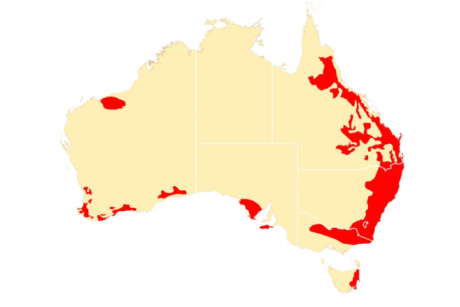
Yes, Australia has always had bushfires: but 2019 is like nothing we’ve seen before. Record low rainfall has contributed to a continent-scale emergency that has burned through more than 5m hectares and alarmed scientists, doctors and firefighters, Guardian, Adam Morton Environment editor @adamlmorton, Wed 25 Dec 2019 As the area burned across Australia this fire season pushes beyond five million hectares, an area larger than many countries, stories of destruction have become depressingly familiar.
At the time of writing, nine people have been killed. Balmoral, in the New South Wales southern highlands, is the latest community affected in a state where up to 1,000 homes have been destroyed. A third of the vineyard area and dozens of homes were razed in the Adelaide Hills. It is too early for a thorough examination of the impact on wildlife, including the many threatened species in the fires’ path. Does this qualify as unprecedented? Plenty of experts say yes, but not all politicians and newspaper columnists are convinced. Last week the acting prime minister, Michael McCormack, assured the nation that “we’ve had these smoke hazes before. We’ve had bushfires before.” After returning from Hawaii, Scott Morrison, acknowledged the fires were severe, but also adopted a familiar line: Australia has always had bushfires. That’s true. But a key question is whether it has always had bushfires like this. Who says the bushfires are unprecedented?The firefighting agency in the state worst affected, for starters.
The NSW Rural Fire Service says the scale of what has burned in that state is unprecedented at this point of the fire season. By Monday, 3.41 million hectares had burned. “To put it in perspective, in the past few years we have had a total area burned for the whole season of about 280,000 hectares,” RFS spokeswoman Angela Burford said. A slightly larger area burned across the 1974 calendar year, but those fires were of an entirely different nature: fuelled by above-average rainfall, it burned through mostly remote outback grasslands in the state’s far west. By comparison, this year’s fires are further east, where people live, and have been fuelled by a vast bank of dry fuel following the country’s record-breaking drought. Soil moisture is at historic lows in some areas, and rainfall in the first eight months of the year was the lowest on record in the northern tablelands and Queensland’s southern downs. What do scientists say?David Bowman, director of The Fire Centre at the University of Tasmania, says the most striking thing about this fire season is the continent-scale nature of the threat. The damage in each state is explained here. “The geographic range, and the fact it is occurring all at once, is what makes it unprecedented,” Bowman says. “There has never been a situation where there has been a fire from southern Queensland, right through NSW, into Gippsland, in the Adelaide Hills, near Perth and on the east coast of Tasmania.” He says one of the less explored issues, though it has begun to receive some attention in recent days, is the economic impact of having prolonged fires that affect so many Australians. “You can’t properly run an economy when you get a third to a half of the population affected by smoke, and the media completely focused on fires,” he says. “I’m not quite certain why anybody would want to be claiming fires have been like this before. It’s concerning as it is a barrier to adaptation. To deal with these sort of fires the first step is to acknowledge the scale of the problem.” ……. What role does climate change play?The explanation should be familiar by now: greenhouse gas emissions do not cause bushfires, but they play a demonstrated role in increasing average and particularly extreme temperatures and contribute to the extraordinarily dry conditions afflicting eastern Australia.
Scientists cite the near absolute lack of moisture in the landscape as a key reason the fires have been so severe. Multiple studies, here and overseas, have found the climate crisis is lengthening the fire season. In the past, the season started in spring in NSW before moving south to Victoria, South Australia and Tasmania in the new year. Just as Australia’s fire season is more overlapping with that in California, making resource-sharing more difficult, it is also running simultaneously across the country……. https://www.theguardian.com/australia-news/2019/dec/25/factcheck-why-australias-monster-2019-bushfires-are-unprecedented |
|
Evacuation of thousands as Victoria’s bushfires merge
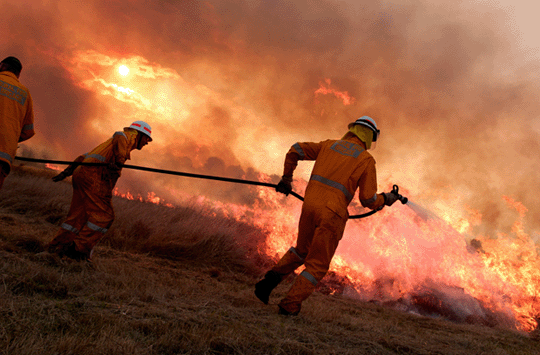 LIVE: Victorian fires merge, thousands told to leave as fire danger worsens, 9 News, By Olivana Smith Lathouris • Producer Dec 30, 2019 With temperatures set to soar, around 30,000 residents and holiday-makers have been urged to evacuate in Victoria’s far east as fires rip through East Gippsland.
– Firefighters expecting bushfire conditions in NSW to deteriorate with high temperatures and strong winds forecast in the lead-up to New Year’s Eve.
– Sydney’s NYE fireworks display is expected to go ahead but a final decision will be made later today…… https://www.9news.com.au/national/bushfires-near-me-live-coverage-victoria-nsw-residents-evacuated-ahead-of-catastrophic-fire-conditions/d2fd78c3-c1b4-46f9-adb7-ba2cf6d6a3b8
Horror bushfire conditions for Australia’s New Year’s Eve
 Horror conditions predicted for NYE as mercury rises. news.com.au 30 Dec 19
Australians have been told to brace for catastrophic conditions as the heatwave continues, with the bushfire danger peaking on New Year’s.
Australians are in for a horror New Year’s Eve as a fresh heatwave engulfs at least three states, with temperatures expected to soar well past the 40C mark.
The NSW Rural Fire Service says about 2000 firefighters are preparing for peak bushfire conditions on Tuesday, warning travellers to monitor the fire situation before they leave home.
Massive fires continue to rage across NSW, with 85 fires burning statewide — 36 of which remain out of control.
Persistent, large bushfires at Gospers Mountain northwest of Sydney, Green Wattle Creek southwest of Sydney and the Shoalhaven area continue to burn, with authorities admitting only rain will put them out….
The Bureau of Meteorology has predicted the extreme heat will peak on the final day of the year, sparking fears of a last-minute cancellation of Sydney’s Harbour’s $6.5m pyrotechnics display. …..
But the City of Sydney confirmed this morning the fireworks would go ahead, despite the heightened bushfire risk…..
VICTORIANS WARNED TO FLEE
Meanwhile residents in Victoria’s far east have been warned to flee as an out-of-control blaze rages amid worsening fire conditions.
People in Goongerah and Martins Creek have been told to evacuate as a bushfire burning easterly towards their communities is still not under control today. ….. https://www.news.com.au/national/horror-conditions-predicted-for-nye-as-mercury-rises/news-story/b8db8480d57d6c9d72404caf5ffa6c52
South Australia facing hightened bushfire conditions, as blazes continue
 ‘Elevated fire conditions’ to hit South Australia on Monday as firefighters continue to battle blazes ABC, 29 Dec 19Key points: ‘Elevated fire conditions’ to hit South Australia on Monday as firefighters continue to battle blazes ABC, 29 Dec 19Key points:
Extreme temperatures, damaging winds and severe thunderstorms are expected to grip much of South Australia on Monday, prompting a “severe to extreme” fire rating for most of the state. The conditions have prompted the Country Fire Service (CFS) to warn those in bushfire-prone areas to remain vigilant and make decisions early about staying or leaving their property. It comes as the CFS continues to battle blazes at Cudlee Creek, in the Adelaide Hills and at Duncan, on Kangaroo Island, which both remain at advice level….. A catastrophic fire danger rating has been flagged for Adelaide, Mid North and the Yorke Peninsula, while extreme danger is predicted at Murraylands and the Lower South-East districts. A severe fire danger rating is also in place for the rest of the state, which includes the Adelaide Metropolitan, Flinders, Riverland, Kangaroo Island, the West Coast, Lower and Eastern Eyre Peninsulas and the Upper South East……. Weather to bring ‘elevated fire conditions’Bureau of Meteorology (BOM) forecaster Bonnie Haselgrove said very hot conditions were expected on Monday with very hot and dry north to north-westerly winds…… Outside of South Australia, Swan Hill in Victoria is expected to reach 43C on Monday, and Menindee in New South Wales is also forecast for 43C. As for metropolitan areas, Parramatta in Western Sydney is expected to reach 38C on Monday; Melbourne is forecast to reach 43C; and the northern Adelaide suburb of Elizabeth could reach 41C. Canberra is expected to hit 39C on Monday and Tasmanians will not be spared from the heat either with Hobart predicted to hit 40C.https://www.abc.net.au/news/2019-12-29/elevated-fire-conditions-to-hit-sa-on-monday-as-fires-burn/11831200 |
|
|
‘Climate Emergency’ – the phrase that elicits anger and outrage
 ‘You have utterly no clue’: why ‘climate emergency’ is Australia’s ultimate outrage trigger At any level of Australian government, there is little so divisive as suggesting that a climate emergency be declared, Guardian Ben Smee @BenSmee, Mon 30 Dec 2019 Earlier this year, Trudi Beck, a general practitioner from Wagga Wagga, wrote to councillors across New South Wales urging them to acknowledge the climate crisis and declare a local emergency.
Some responses were positive. Others less so.
Mark Hall, a Lachlan shire councillor and Baptist pastor, told Beck: “Stick to medicine – you have utterly no clue about climate science. Your email intrusion is truly not welcome.”
In Australia, as ever when it comes to climate policy, the process has been polarising and frustrating.
The leaders of one town might have recognised the climate crisis and committed to developing adaptation measures to help the community deal with the impacts of global heating. The next town over might have decided that climate change has nothing to do with local government business such as carting rubbish or fixing potholes.
“We went from talking about the climate emergency, to now all of a sudden we’re living in it,” says Sarah Mollard, a general practitioner from the coastal NSW town of Port Macquarie.
“It was incredibly unsettling to experience the sky going from blue to red in the space of a few hours. It’s extraordinarily unsettling to be in your home and see smoke haze in your home. This is my home, this is my safe space, and I can’t keep my children safe in it.”
A few months ago, Mollard and other community members began to lobby for the Port Macquarie council to declare a climate emergency. In September, a relatively benign council motion to develop a “climate change action plan” was deadlocked at four-all. The mayor’s casting vote shelved the idea indefinitely…….
Newcastle, the home of the world’s largest coal export port, has declared an emergency and has a policy to work towards a just transition. The Wollongong City c-ouncil – which along with Newcastle was for decades an industrial and steelmaking hub – has also recognised the climate crisis.
In Queensland, where climate politics is most fraught amid a rush to support coal exports, only the Noosa council has declared an emergency. It also set a zero net emissions target by 2026…….
Conservative Wagga Wagga, home of the deputy prime minister, Michael McCormack, earlier this year declared a climate emergency. A few weeks later, after an increasingly nasty debate, councillors rescinded that declaration.
Outraged councillors would later demand the mayor, Greg Conkey, drive an electric vehicle to Sydney and back. He did and has said the journey was a success.
Beck had been instrumental in building local support in Wagga Wagga, and in July, while the city was locked in debate about the declaration, she contacted other council areas soliciting support…….
So far, 84 jurisdictions in Australia covering about a quarter of the population – mostly cities and local government areas – have declared a climate emergency. The first elected body in the world to act, Darebin council in Victoria, is credited with starting a movement that is now supported by governments representing 800 million people worldwide, including the European Union and Bangladesh. https://www.theguardian.com/australia-news/2019/dec/30/you-have-utterly-no-clue-why-climate-emergency-is-australias-ultimate-outrage-trigger
New Year heat wave threatens Australia with more bushfires
Sat 28 Dec 2019
However, none were above advice level after more than 1,500 firefighters in the field took advantage of milder conditions over the Christmas week to strengthen containment lines and prepare for a forthcoming heatwave and high fire danger.
The Currowan fire on the south coast and the Green Wattle Creek fire in the southern highlands are among those still out of control, according to the NSW Rural Fire Service (RFS), but the Gospers Mountain “megafire” and the nearby Grose Valley fire, to the north-west and west of Sydney, are listed as being controlled……
The prime minister, Scott Morrison, faced widespread criticism after going on a family holiday to Hawaii in the midst of the bushfire crisis without publicly announcing it, and with his office reportedly telling journalists he was not in Hawaii.
Morrison returned early last week, apologising for going away. He continued to face criticism for his government’s failure to develop a credible climate change policy.
At least nine people, including two firefighters, have been killed in fires this season – eight of them in NSW.
Almost 1,000 homes are estimated to have been destroyed in the NSW bushfire crisis, according to the most recent impact assessment from the RFS, published on Christmas Eve.
Another 68 facilities and 2,048 “outbuildings” were also confirmed destroyed.
More than 7,800 homes have been saved by firefighters……
At least three fires remain burning in South Australia at advice level, including two on Kangaroo Island, at Bunbury, and at Cudlee Creek where there have been flare-ups in recent days. https://www.theguardian.com/australia-news/2019/dec/28/australian-bushfires-out-of-control-as-heatwave-expected-to-peak-on-new-years-eve
Call to Prime Minister Scott Morrison – Time to stop pretending that you have a climate policy
 Prime minister, you need a credible climate policy. It’s too dangerous to keep pretending you have one, https://www.theguardian.com/australia-news/2019/dec/22/prime-minister-its-too-dangerous-to-keep-pretending-you-need-a-credible-climate-policy Lenore Taylor Scott Morrison’s press conference on the Australian fires was just more talking points and spin. The country needs more than words Prime minister, you need a credible climate policy. It’s too dangerous to keep pretending you have one, https://www.theguardian.com/australia-news/2019/dec/22/prime-minister-its-too-dangerous-to-keep-pretending-you-need-a-credible-climate-policy Lenore Taylor Scott Morrison’s press conference on the Australian fires was just more talking points and spin. The country needs more than words
@lenoretaylor, Sun 22 Dec 2019
Scott Morrison says this is not a time for division, or partisanship, or point scoring. He says we should unite in response to the current crisis. That’s certainly true. We have been. But prime minister, this is also time to stop pretending. Talking about Australia’s woefully inadequate climate policy at this time is not partisan, it is essential. And, with respect, the same same old talking points you rolled out on your return from Hawaii just don’t cut it any more. As you acknowledged, we are facing Christmas with dread. The immediate losses – of loved people, homes, safety, breathable air, passable highways upon which to drive to holiday, blue summer sky – those are deeply unsettling and sad. But the realisation that this is how Christmas may often be for our children, not carefree like the long summers we remember, but orange-skyed, fearful, choking and desperate – that is dreadful in the truest sense of the word. As you said, we are all grateful for the firefighters’ selfless efforts, but you’re right, we need to ask whether we can really expect this from them year after year, and those questions become more urgent if we face up to the fact that this is now the way things are going to be more often. You ignored the desperate, and as it turns out prescient, warnings from the former fire and emergency chiefs in the lead-up to this season. Your acting prime minister, just this weekend, again dismissed those experts because they had been funded by the Climate Council. Surely it is now time to put those political talking points aside and start to listen. We know global heating is fuelling this unprecedented fire emergency; we’ve been warned this would happen for decades. We know it is also contributing to the drought. Not directly causing, but certainly exacerbating. Surely it is time for your government to face these facts, instead of reciting Dorothea Mackellar or diverting blame to self-combusting manure or falsely claiming “greens” are somehow to blame by preventing hazard reduction burning. They haven’t, just for the record, and those former fire chiefs you refused to meet actually had some advice about hazard reduction burns, had you chosen to listen. That requires something more than just agreeing there is a link between global heating and fires, as you now have done. This isn’t about an adjustment to your language, it requires an adjustment to your policy, it requires a credible policy, the kind of policy we know could benefit us economically, that business is begging you to enact so that they can invest. And we know that would mean we could fight for effective international action rather than continue to act as a hindrance. We know we can’t solve the heating that is exacerbating this crisis on our own, so please don’t insult our intelligence again with that “1.3% of global emissions” argument like you did at the start of this fire season. Given the consequences we are suffering, we should be doing everything we can, and we know that we are not. You’ve just kept pretending. We’ve watched your Coalition immobilised by its climate denialist faction for more than a decade, destroying repeated political efforts to do something. We watched it dispense with Malcolm Turnbull as prime minister to avoid implementing a policy that was supported by industry and green groups alike. We watched you, prime minister, hold up a coal-industry supplied lump-of-coal prop in the parliament and urge us all not to fear it, but then go to the election with a policy that was little more than a sham, enough to appease the electorate’s concerns but with fine print that didn’t promise to do anything much to reduce domestic emissions, and that didn’t offer any explanation of how you would do the things you did promise, like reduce vehicle emissions. We’ve watched our domestic emissions continue to rise, or flatline because of the terrible impact of the drought, according to the latest accounts. We’ve watched Angus Taylor act against reaching an agreement at the most recent climate talks in Madrid, by insisting – against howls of international protest – that Australia be allowed to continue using an accounting trick to meet our emission reduction obligations. Days later, there he was again, interviewed against the orange backdrop of his own burning electorate, still mouthing the same discredited talking points about Australia “meeting and beating” its emission reduction target by the use of that loophole. You just used the same line yourself. It’s too close now, too terrifyingly dangerous and loud in the fire regions, too unendurably long in the regions parched by drought, to keep pretending like this. We need to know how you’re going to transition our economy. We understand that’s a complicated long-term process, so don’t treat us like idiots, as your deputy did on Saturday with the straw-man argument that those concerned about climate change are asking for all coalmining to cease tomorrow and risking the lights going out. Katharine Murphy spelled out your political choices in her final column for the year –you could once again try to damp down our fears and hope the backlash from this summer of fires will ease when the skies do eventually clear, or you could change policy course. On your return from holidays you seemed to choose the former, which is a tragedy, because there really is no more time to waste. We are past the point where the absence of credible policy can be papered over with talking points and spin. Your predecessor knows it, your former departmental head knows it, business, unions and farmers know it, scientists and environmentalists have known it for decades. You asked us all to be kind to one another, and we certainly should be. One kind thing you could do now is to finally stop pretending.
|
|
Australian bushfire crisis deepens with record breaking temperatures
Calla Wahlquist (now), Amy Corderoy and Naaman Zhou (earlier), Fri 20 Dec 2019
Melbourne was shrouded in smoke, catastrophic fire warnings issued for parts of New South Wales on Saturday and in South Australia one person died and eight have been injured.
- New South Wales is bracing for catastrophic bushfire conditions on Saturday. A catastrophic warning has been issued for Greater Sydney, Illawarra/Shoalhaven, and Southern Ranges — all areas where fires are currently burning. The Greater Hunter, ACT and Central Ranges will have extreme conditions.
- RFS deputy commissioner Rob Rogers said it would be a “miracle” if more houses were not lost in NSW tomorrow.
- Fire chiefs in NSW, SA and Victoria have all emphasised that they may not be able to get a warning to people, and they cannot guarantee they will be able to get a firetruck to everyone affected by bushfires. The recommendation, across the country, is to leave early. “Early” means before the fire approaches — not after the embers have begun falling.
- People in NSW have been told to put off travel tomorrow because the Princes Highway, Western Highway, Hume Highway and other major arterial roads could be cut.
Scott Morrison’s brand damaged by silly cover-up of his Hawaii holiday
 Prime Minister Scott Morrison pulls pin on Hawaii family holiday, but the damage is already done, ABC , By political editor Andrew Probyn , 20 Dec 19, Australia’s marketing expert Prime Minister has just had his first major product recall.Scott Morrison’s brand has been damaged, as he wings his way back to Australia from Hawaii, a trifle shop-soiled and humiliated.
And all because Morrison and his office thought they could engineer silence on a family holiday.
As so often in politics, it’s the cover-up that gets you.
No-one begrudges the fellow going on holiday with his wife and lovely girls who have probably seen less of their dad this year than any in their short lives.
And he’s undoubtedly knackered from a hectic year in which he pulled off a miracle election win…….
There was no official public note issued of his absence and when one Press Gallery journalist inquired with the Deputy Prime Minister’s office as to whether Michael McCormack was Acting PM, the journalist was referred back to the PM’s Office.
And when a couple of journos asked the PMO to confirm the boss was in Hawaii, they were told this was incorrect.
Here’s a tip for the PM’s minders: don’t compound a fudge with a fib……
Morrison is actually lucky more pressure hasn’t been appliedMorrison can be grateful that Anthony Albanese has been very measured this week. Albanese has visited members of the Rural Fire Service, making breakfast for volunteers, but has constrained his commentary……
It is now very clear that the Coalition must recalibrate its climate and energy policies.
Amid the smoke haze, the community horror and angst, this is a point of real clarity.
Morrison’s attempt last week to reassure Sydneysiders concerned by the incessant bushfire haze, by asserting he’d seen it all before, didn’t cut it. Nor does it now…..https://www.abc.net.au/news/2019-12-20/andrew-probyn-analysis-scott-morrison-hawaii-holiday/11817356
Students’climate protest outside Scott Morrison’s residence. Greens MP arrested
‘Time politicians did something’: Greens MP among arrested at Kirribilli climate rally, Students rallied outside Scott Morrison’s Sydney prime ministerial residence to demand action on climate change. SBS News, BY TYRON BUTSON, 20 Dec 19, NSW Greens MP David Shoebridge was among 10 people arrested by police outside Sydney’s Kirribilli House as they demanded the prime minister take action on climate change.
Demonstrators rallied outside Prime Minister Scott Morrison’s official Sydney residence on Thursday, protesting the PM’s overseas holidays as unprecedented bushfires burn across the state.
Some protesters had vowed to camp out on site until the PM returned from holidays until they were confronted by police on Thursday afternoon.
Mr Shoebridge, a NSW Upper House Greens MP, was among those protesters charged with failing to move on. He took aim at Mr Morrison, saying it was high time politicians left parliament to join the community demanding climate action.
Mr Shoebridge, who alleges he was trying to comply with police directives to move on when he was arrested, will face Manly Local Court on 16 January. ….
Some of the demonstrates were clad in Hawaiian shirts, while others carried placards asking “ScoMo where the bloody hell are ya?” and “When do our firefighters get a holiday?”…. HTTPS://WWW.SBS.COM.AU/NEWS/TIME-POLITICIANS-DID-SOMETHING-GREENS-MP-AMONG-ARRESTED-AT-KIRRIBILLI-CLIMATE-RALLY
Australia just had its hottest day on record
It’s official: Tuesday was ‘Australia’s hottest day on record’, SBS, 18 Dec 19, Preliminary results show Tuesday was Australia’s hottest day on record. Tuesday was the hottest day on record with an average across the country of 40.9 degrees Celsius, preliminary results show.
The Bureau of Meteorology said the average temperature beat the previous record of 40.3 degrees Celsius recorded on 7 January 2013.
Southern and central Australia sweltered as temperatures reached eight to 16 degrees above average.
Tuesday’s record could soon be eclipsed though – with temperatures expected to exceed 40 in parts of Australia until the end of the week.
Adelaide is facing a four-day heatwave, with an expected peak of 44 degrees Celsius on Friday.
Victoria is also predicted to record its hottest December day on Friday if northwest towns such as Mildura and Swan Hill reach a forecast 47 degrees Celsius. ….. https://www.sbs.com.au/news/it-s-official-tuesday-was-australia-s-hottest-day-on-record
Ominous forecast for Australia’s bushfire dangers
- The bushfire outlook from August warned of above-normal bushfire conditions for most of the east coast this summer, as well as parts of all states and the ACT
- Monday’s update expands the above-normal region further north in Queensland, across to northern Victoria and further along the Tasmanian coast
- Experts say the only thing that would change this outlook would be widespread rainfall, which is not likely this summer
The outlook was already bad, with above-normal fire potential for most of the east coast.We’re already dealing with a fire season for the record books — crews exhausted, millions of hectares burnt, scores of houses destroyed — but an update of the danger ahead paints an even more ominous picture.
Where is above normal?
Above-normal fire danger is expected for most of the east coast, eastern Tasmania, northern Victoria, Kangaroo Island and the Eyre Peninsula in South Australia, parts of south-west Western Australia and a patch up north.
But that doesn’t mean everywhere else is in the clear — for many areas of southern Australia, dangerous fires in summer are normal…..
Keep up to date with warnings from your local fire authority, ABC Radio and ABC Emergency on Facebook.
Australia, you have been warned. https://mobile.abc.net.au/news/2019-12-16/bushfire-outlook-update-makes-for-more-grim-reading/11802452
1 This month

of the week – Australians for War Powers Reform (AWPR)
To see nuclear-related stories in greater depth and intensity
 Antinuclear