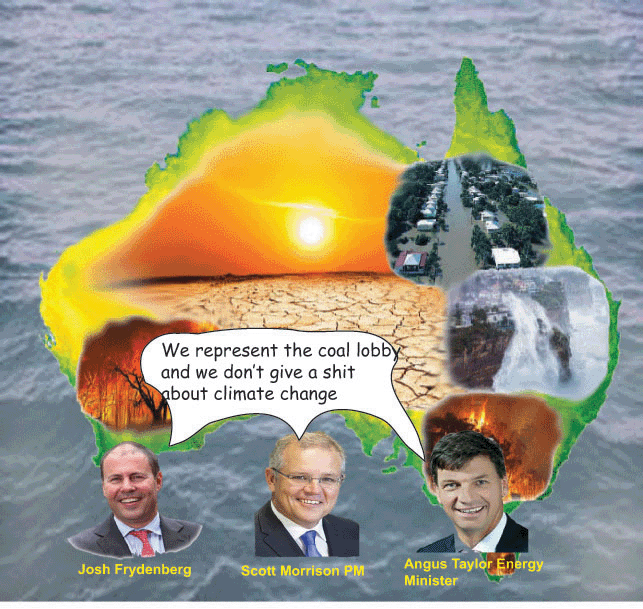
Coal lobby wields power over Australian govt, like the National Rifle Association does in USA
 While Australia burns, the world watches our credibility go up in smoke, The New Daily, Damien Cave 14 Nov 19, When a mass shooting shattered Australia in 1996, the country banned automatic weapons.In its first years of independence, it enacted a living-wage law.
Stable retirement savings, national health care, affordable university education – Australia solved all these issues decades ago.
But climate change is Australia’s labyrinth without an exit, where its pragmatism disappears. The bushfires that continued raging on Wednesday along the country’s eastern coast have revealed that the politics of climate in Australia resist even the severe pressure that comes from natural disaster.
Instead of common-sense debate, there are culture war insults.
The deputy prime minister calls people who care about climate change “raving inner-city lunatics”. Another top official suggests that supporting the Greens party can be fatal.
And while the government is working to meet the immediate need – fighting fires, delivering assistance – citizens are left asking why more wasn’t done earlier as they demand solutions.
“We still don’t have an energy policy, we don’t have effective climate policy – it’s really very depressing,” said Susan Harris Rimmer, an associate professor at Griffith Law School. ……
in Australia, where coal is king and water is scarce, the country’s citizens have spent the week simmering with fear, shame and alarm……..
Even as the country’s emissions continue to soar, it’s been hard to reach a political consensus on energy and climate change policy because of Australia’s mining history and a powerful lobby for one product: Coal.
“Coal is our NRA,” said Dr Harris Rimmer, referring to the National Rifle Association, which has stymied changes to gun laws in the US even as mass shootings have become shockingly common.
“They have total control over Parliament.”……
For conservatives in particular, extraction of natural resources in rural areas is a stand-in for values worth fighting for against condescending urban elites.
Just a few days before the fires, for example, Prime Minister Scott Morrison told a mining group that new laws were needed to crack down on climate activists and progressives who “want to tell you where to live, what job you can have, what you can say and what you can think”.
“Climate change has become a proxy for something else,” said Robyn Eckersley, a climate politics expert at the University of Melbourne…….
Mr Morrison, who in the past has made it clear that Australia’s economic prosperity comes first, has repeatedly argued in recent days that now is not the time to discuss climate policy or politics.
Photographed hugging fire victims, he has sought to focus on emotional and financial support.
Joëlle Gergis, a climate scientist and author, said that “it wastes the opportunity to explain to the Australian public what we’re seeing in climate extremes”……. https://thenewdaily.com.au/news/2019/11/14/while-australia-burns-the-world-watches-our-credibility-go-up-in-smoke/
Fire chief says Australia fires could be out of control for months
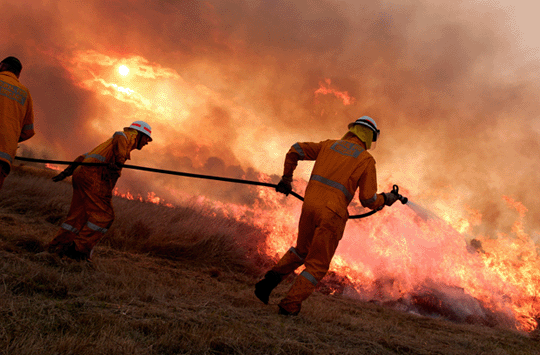 Australia fires could be out of control for months, says fire chief
Concern grows over wind changes and high temperatures forecast for later this week, Guardian, Ben Doherty in Sydney @bendohertycorro
Wed 13 Nov 2019 It could be months before eastern Australia has more than a million hectares of bushfires under control, the New South Wales fire chief has warned, as the country faces one of its worst bushfire outbreaks.After relief that no further lives were lost on Tuesday, concern was growing over unpredictable winds worsening fires in the neighbouring state of Queensland on Wednesday, with much hotter temperatures also predicted for the Sydney area in the coming days.
Gusty winds changing direction are predicted to fan flames in new directions and widen “catastrophic” fire fronts in Queensland and northern NSW, where more than 100 fires – one more than 150,000 hectares (370,000 acres) in size – are burning.
Forecasters warned that “dry lightning” strikes could ignite new blazes, with fires worsening when hotter temperatures arrive over the weekend. Temperatures in Queensland are currently up to 8C higher than average.
Shane Fitzsimmons, the commissioner of the NSW rural fire services, said: “The real challenge is we have an enormous amount of country that is still alight. They won’t have this out for days, weeks, months. Unfortunately the forecast is nothing but above-average temperatures and below-average rainfall over the next few months and we’ve still got summer around the corner.”
The current fires in NSW cover four times the land area that burned during the whole of 2018, according to Fitzsimmons. There are also fires in Western Australia, South Australia and the Northern Territory.
While the extent of the bushfires is less than those in New South Wales in 1974-75 , which destroyed 4.5m hectares (11m acres), forecasters and fire chiefs are concerned that so many fires are already under way before high summer………
Bushfires are a regular occurrence during Australian summers, but the intensity of this year’s fires, and how early in the season they have arrived, have unleashed an acute political debate over the impact of climate change in exacerbating Australia’s fire vulnerability.
The prime minister, Scott Morrison, whose conservative coalition government has been consistently criticised over its support for coal-mining and power plants, inaction on climate change, and Australia’s rising carbon emissions, has refused to answers questions on climate change worsening fires………
In one of the largest peacetime mobilisations of Australian forces, the defence minister, Linda Reynolds, is preparing to send army, navy and air force reserve forces – the equivalent of the UK’s Army Reserve – into the fire zone to assist with evacuations and logistics.
The military intervention might even include an unprecedented compulsory call-up of reserve forces, such is the scale of the fire damage. https://www.theguardian.com/australia-news/2019/nov/12/australia-fires-rage-out-of-control-catastrophic-day
23 fire and emergency services leaders from across Australia demand government action on climate change
 Ex-fire chiefs demand government find ‘urgent response’ to climate change, SBS, 14 Nov 19, A coalition of 23 fire and emergency services leaders from across Australia is demanding government action to cut emissions amid devastating bushfires. Ex-fire chiefs demand government find ‘urgent response’ to climate change, SBS, 14 Nov 19, A coalition of 23 fire and emergency services leaders from across Australia is demanding government action to cut emissions amid devastating bushfires.
Former fire chiefs from across Australia are calling on the federal government to act now against the “urgent threat” of climate change as bushfires devastate parts of the country. A coalition of 23 fire and emergency services leaders from every state and territory are insisting harder-to-control fires have broken out earlier-than-normal across New South Wales and Queensland because of global warming. The Emergency Leaders for Climate Action group is pressing for an urgent plan to phase out fossil fuels such as coal, oil, and gas, which they argue are “the root cause” of the problem…….. Former fire chiefs from across Australia are calling on the federal government to act now against the “urgent threat” of climate change as bushfires devastate parts of the country. A coalition of 23 fire and emergency services leaders from every state and territory are insisting harder-to-control fires have broken out earlier-than-normal across New South Wales and Queensland because of global warming. The Emergency Leaders for Climate Action group is pressing for an urgent plan to phase out fossil fuels such as coal, oil, and gas, which they argue are “the root cause” of the problem.https://www.sbs.com.au/news/ex-fire-chiefs-demand-government-find-urgent-response-to-climate-change |
|
Scientists refute Barnaby Joyce’s claim that sun’s magnetic fields cause bushfires
The former deputy prime minister told Sky News he accepted that the climate crisis was making Australia hotter and drier.
Barnaby Joyce’s claim that changes to the sun’s magnetic fields were linked to the bushfires burning out of control across NSW have been rubbished by climate scientists.
The former deputy prime minister told Sky News he accepted that the climate crisis was making Australia hotter and drier….. “There’s just the the oscillation of the seasons. There’s a change in the magnetic field of the sun.”
Associate Professor Nerilie Abram, a climate researcher at the ARC Centre of Excellence for Climate Extremes, called his comments “ludicrous and grossly ill-informed”.
Dr Abram said she was unaware of any study suggesting changes to the sun’s magnetic field could increase Australia’s bushfire risk.
“I don’t know of any scientific study that says that,” she said.
Dr Abram said changes to the sun’s magnetic fields had a tiny effect on the Earth’s climate.
“They are not causing climate change……
Associate Professor Pete Strutton, from the Institute for Marine and Antarctic Studies at the University of Tasmania, said it was difficult to analyse Mr Joyce’s claim because it was so bizarre.
“I don’t even know what he means. We know what causes climate change,” he said. “What exactly would the magnetic fields influence? I can’t even … Are they influencing the amount of solar radiation reaching the Earth? It is hard to respond to because it is so wacky.” https://www.brisbanetimes.com.au/national/barnaby-joyce-says-sun-s-magnetic-fields-cause-bushfires-science-says-20191112-p539xb.html
Global heating: Australians must rethink planning for bushfires
Whatever the successes and failures in this crisis, it is likely that we will have to rethink the way we plan and prepare for wildfires in a hotter, drier and more flammable world.
Drought and climate change were the kindling, and now the east coast is ablaze, The Conversation, Ross Bradstock, Professor, Centre for Environmental Risk Management of Bushfires, University of Wollongong, Rachael Helene Nolan, Postdoctoral research fellow, Western Sydney University, November 11, 2019
Last week saw an unprecedented outbreak of large, intense fires stretching from the mid-north coast of New South Wales into central Queensland.
The most tragic losses are concentrated in northern NSW, where 970,000 hectares have been burned, three people have died, and at least 150 homes have been destroyed…….
What is unprecedented is the size and number of fires rather than the seasonal timing.
forests and shrublands can rapidly accumulate bushfire fuels such as leaf litter, twigs and grasses. The unprecedented drought across much of Australia has created exceptional dryness, including high-altitude areas and places like gullies, water courses, swamps and steep south-facing slopes that are normally too wet to burn.
Thus, the North Coast and northern ranges of NSW as well as much of southern and central Queensland have been primed for major fires. A continuous swathe of critically dry fuels across these diverse landscapes existed well before last week, as shown by damaging fires in September and October.
More people in harm’s way
Many parts of the NSW north coast, southern Queensland and adjacent hinterlands have seen population growth around major towns and cities, as people look for pleasant coastal and rural homes away from the capital cities.
These unprecedented fires are an indication that a much-feared future under climate change may have arrived earlier than predicted. The week ahead will present high-stakes new challenges.
The most heavily populated region of the nation is now at critically dry levels of fuel moisture, below those at the time of the disastrous Christmas fires of 2001 and 2013. Climate change has been predicted to strongly increase the chance of large fires across this region. The conditions for Tuesday are a real and more extreme manifestation of these longstanding predictions.
Whatever the successes and failures in this crisis, it is likely that we will have to rethink the way we plan and prepare for wildfires in a hotter, drier and more flammable world. https://theconversation.com/drought-and-climate-change-were-the-kindling-and-now-the-east-coast-is-ablaze-126750
G20 Report shows Australia is among the worst on climate policy
Brown to Green report highlights Australia’s poor response on deforestation, transport, energy supply and carbon pricing, Graham Readfearn @readfearn Mon 11 Nov 2019 Australia’s response to climate change is one of the worst in the G20 with a lack of policy, reliance on fossil fuels and rising emissions leaving the country exposed “economically, politically and environmentally”, according to a new international report.
Australia’s progress to meeting its already “unambitious” Paris climate targets was third worst, fossil fuel energy was on the rise and policies to tackle high transport emissions and deforestation were also among the worst across the G20 countries.
The Brown to Green report, now in its fifth year, takes stock of the performance of G20 countries on climate change adaptation and mitigation across key sectors, and in the finance sector.
The chief executive of Climate Analytics, Bill Hare, an Australian co-author of the report, told Guardian Australia: “Australia is behind [on] climate action in nearly every dimension. Australia’s emissions are increasing and there’s virtually no policy in place to reduce them.”
Some 14 non-governmental groups, thinktanks and research institutes compile the report, funded by the World Bank, the US-based ClimateWorks Foundation and Germany’s environment ministry.
Across the G20, the report said, limiting global heating to 1.5C would cut negative impacts by 70%, compared with allowing global temperatures to rise by 3C. Currently, extreme weather events were costing G20 countries about US$142bn annually.
While the report doesn’t provide an overall ranking, Australia appears consistently among the worst performers in the report’s analysis.
India and Australia were the only two G20 countries that had not introduced, or were not considering, policies to price greenhouse gas emissions, the report said.
Only South Korea and Canada were further away than Australia from meeting the pledges that formed their Paris climate commitments.
On deforestation, the report said Australia was the only developed country that was a “deforestation hotspot”, but had no policies to tackle it.
Australia was ranked third worst for transport emissions per capita, and the report found “Australia, in particular, lacking significant policy” in the transport sector. Per capita emissions from aviation were 53 times higher than India’s.
Australia, along with Russia, had no policies to move away from petrol-powered cars, no policies to decarbonise the heavy-duty vehicle sector and no policies to shift people onto public transport, the report said.
Referring to the current Liberal-led Coalition government, Hare said this was the same political party that had repealed climate legislation, such as the carbon pricing mechanism, and “since then has done all it can to undermine any level of action”.
Australia, along with the US and Saudi Arabia, had high emissions from the building sector. Australia had no building codes covering renovation of older buildings.
All this lack of action, Hare said, was leaving Australia and its people exposed on climate change “economically, politically and environmentally”.
Hare told Guardian Australia: “The leadership of the country is effectively telling lies about their performance, and contradicting their own government’s information.
“The country is led by politicians who in one way or another deny either the science or are de facto denying it, and actively and wilfully opposing or obstructing climate policies.”
He said the country’s position was in contrast with its opportunities in renewable energy, which it had not exploited as fully as it could.
“Australia has one of the best solar energy potential and wind potential in general of any of the G20 countries,” he said.
“Australia is not transforming its energy system and is focused on building coal and gas, and has not paid any attention to the need to transition to a zero-carbon economy.” Referring to the current Liberal-led Coalition government, Hare said this was the same political party that had repealed climate legislation, such as the carbon pricing mechanism, and “since then has done all it can to undermine any level of action”.
He said the country’s position was in contrast with its opportunities in renewable energy, which it had not exploited as fully as it could.
“Australia has one of the best solar energy potential and wind potential in general of any of the G20 countries,” he said.
“Australia is not transforming its energy system and is focused on building coal and gas, and has not paid any attention to the need to transition to a zero-carbon economy.”
The Brown to Green report, now in its fifth year, takes stock of the performance of G20 countries on climate change adaptation and mitigation across key sectors, and in the finance sector
Sydney Morning Herald up to date coverage of New South Wales bushfires
New South Wales braces for unprecedented fire danger | ABC News
Message from the Editor: Our bushfire coverage, SMH, By Lisa Davies,
“Catastrophic” is not a word used flippantly. The highest possible level of bushfire danger across NSW has led the Premier Gladys Berejiklian to declare a State of Emergency for the first time in six years.
As a result, the Herald will provide open access to our coverage – meaning that for the duration of this crisis, bushfire stories will be free for all readers…..
the conditions forecast for Sydney, the Hunter region, the Blue Mountains and Central Coast have worsened – similar to those experienced in Victoria on Black Saturday, which saw 173 people killed and thousands of homes lost.
Rural Fire Services Commissioner Shane Fitzsimmons said the predictions were unprecedented for the greater Sydney area.
“We could not find a time in history … where we saw indices reaching what we now know are catastrophic levels here in the Greater Sydney environment,” he said. “We are talking about something we haven’t experienced before in Sydney in the Greater Sydney environment.”
Education Minister Sarah Mitchell has announced 300 schools will be closed and expects the number to rise.
So what does a “catastrophic” fire emergency mean?
It means high winds and extreme heat can cause embers from existing fires to travel more than 20 kilometres ahead of the main firefront, Mr Fitzsimmons explained……..
We will be updating readers live via our blog and at smh.com.au……. https://www.smh.com.au/national/nsw/message-from-the-editor-our-bushfire-coverage-20191111-p539k7.html
Sydney and surroundings – “Catastrophic” fire warning.

How near to Lucas Heights nuclear facility are the fires?
| Catastrophic’ fire warning a first for Sydney RFS raises Sydney fire warning to ‘catastrophic’, SMH Helen Pitt, Lisa Visentin, Laura Chung and Lucy Cormack, November 10, 2019 |
| Catastrophic fire danger is forecast for Sydney and its surrounds on Tuesday for the first time, as a statewide total fire ban is enforced today to help contain more than 60 fires across the state. |
| It’s the first time the NSW Rural Fire Service has issued the maximum level of warning for the city since the introduction of the “catastrophic” alert in 2009 in the wake of the Victorian Black Saturday blazes. |
| Yet both the Prime Minister Scott Morrison and NSW Premier Gladys Berejiklian have refused to be drawn on the contribution of climate change to the fires which have so far killed three, injured at least 35 and destroyed more than 150 homes. |
| The Sydney region is now drier than before the 2001 Black Christmas fires, as authorities warn more “lives and homes” will be at risk when the mercury soars to 37-38C tomorrow……. https://www.smh.com.au/national/rfs-raises-sydney-fire-warning-to-catastrophic-20191110-p5397q.html?list_name=40_smh_newsalert&promote_channel=edmail&utm_campaign=smh-am-newsletter&utm_content=TOP_STORIES&utm_medium=email&utm_source=newsletter&utm_ter |
Australian Greens criticise Morrison government on bushfires and climate change
 Greens ramp up climate war as fires burn, Herald Sun, Colin Brinsden, Australian Associated Press, November 10, 2019 Greens Leader Richard Di Natale says while he is saddened by the loss of life from bushfires in NSW and Queensland, “thoughts and sympathies are not enough”. Greens ramp up climate war as fires burn, Herald Sun, Colin Brinsden, Australian Associated Press, November 10, 2019 Greens Leader Richard Di Natale says while he is saddened by the loss of life from bushfires in NSW and Queensland, “thoughts and sympathies are not enough”.
Dr Di Natale said for decades it has been known that burning climate changing fossil fuels would lead to more frequent and intense bushfires. “Yet with Queensland and New South Wales burning, the Coalition government refuses to acknowledge this scientific reality and instead wants to use taxpayer dollars to fund new coal-fired power stations.” he said in a statement on Sunday. “Every politician, lobbyist, pundit and journalist who has fought to block serious action on climate change bears responsibility for the increasing risk from a heating planet that is producing these deadly bushfires.” His climate change spokesman Adam Bandt made similar comments on Saturday, drawing a scathing attack from Deputy Prime Minister and Nationals Leader Michael McCormack, saying it was “despicable”…..https://www.heraldsun.com.au/news/breaking-news/greens-ramp-up-climate-war-as-fires-burn/news-story/42fad0f6e7a70492e1fa259514deba10 |
|
|
Climate reality needs more than thoughts and prayers
|
It has an eerily similar ring to it: “Thoughts and prayers”. Australians rightly mock this platitude when it’s rolled out by politicians after a mass shooting in the US, but now our own Prime Minister saw fit to present this meaningless line for victims of the bushfires on the mainland. Like how the US does nothing to end their deadly problem, our government also appears determined to cover its ears to the stark reality now facing us: Australia is drier than ever, hotter than ever, and less prepared than ever. This is no fault of our fire services. In fact, it appears to be in spite of our fire services. Former NSW fires chief Greg Mullins and 22 other former emergency chiefs were refused an urgent meeting with the PM multiple times this year, and NSW frontline firefighting has been slashed in the eternal quest for a surplus. In Tasmania, the TFS is well aware of the risks. In Launceston this year, their State Conference was titled “Not the Norm”: because the changing climate is putting humanity in a completely unpredictable position where every year is worse than the last. There is no “norm” anymore – as evidenced by the last fire season. Did we learn anything from that fire season? It waits to be seen, but a failure to enact all recommendations from a review into those fires would be reckless. Yet while Australia faces unprecedented fires (and this is not the only “unprecedented” weather event of recent times, with floods, drought and ocean heatwaves increasing in severity year on year), politicians continue to mislead on carbon emissions, or use rubbery accounting tricks to meet our emissions targets. Yet while Australia faces unprecedented fires (and this is not the only “unprecedented” weather event of recent times, with floods, drought and ocean heatwaves increasing in severity year on year), politicians continue to mislead on carbon emissions, or use rubbery accounting tricks to meet our emissions targets. And the similarities don’t end there.
|
|

Climate dispute between Scott Morrison and the Greens
Climate dispute breaks out as Scott Morrison visits bushfire-hit areas, SBS 11 Nov , “……war of words has broken out about the link between climate change and the unprecedented bushfire emergency that has hit NSW and Queensland.BY CLAUDIA FARHART Deputy Prime Minister Michael McCormack has lashed out at Greens MP Adam Bandt over “stupid and callous” comments linking the government’s inaction on climate change and bushfires that have claimed three lives in New South Wales.
On Saturday, Mr Bandt tweeted that “words and concern are not enough … the Prime Minister does not have the climate emergency under control”.
Bandt tweeted: I’m deeply saddened by the loss of life. Hearts go out to all affected & to brave firefighters. But words & concern are not enough. The PM does not have the climate emergency under control. Unless we lead a global effort to quit coal & cut pollution, more lives will be lost……
Prime Minister Scott Morrison and NSW Premier Gladys Berijiklian dodged more questions about climate change as they visited fire-hit areas in northern NSW on Sunday.
Mr Morrison was heckled by a climate change protester during a briefing from firefighters.
“Climate change is real, can’t you see,” the protester yelled, before being escorted out of the building. HTTPS://WWW.SBS.COM.AU/NEWS/CLIMATE-DISPUTE-BREAKS-OUT-AS-SCOTT-MORRISON-VISITS-BUSHFIRE-HIT-AREAS
Massive bushfires in New South Wales are NOT “part of a normal cycle” – fire-fighting expert.
This is not normal: what’s different about the NSW mega fires, SMH, By Greg Mullins, November 11, 2019 —I write this piece reluctantly, because there are still possible fire victims unaccounted for; people have lost loved ones; and hundreds of families have lost their homes. My heart goes out to them. I don’t want to detract in any way from the vital safety messages that our fire commissioners and Premier will be making about Tuesday’s fire potential.
In the past I’ve have heard some federal politicians dodge the question of the influence of climate change on extreme weather and fires by saying, “It’s terrible that this matter is being raised while the fires are still burning.” But if not now, then when?
“Unprecedented” is a word that we are hearing a lot: from fire chiefs, politicians, and the weather bureau. I have just returned from California where I spoke to fire chiefs still battling unseasonal fires. The same word, “unprecedented”, came up.
Unprecedented dryness; reductions in long-term rainfall; low humidity; high temperatures; wind velocities; fire danger indices; fire spread and ferocity; instances of pyro-convective fires (fire storms – making their own weather); early starts and late finishes to bushfire seasons. An established long-term trend driven by a warming, drying climate. The numbers don’t lie, and the science is clear.
If anyone tells you, “This is part of a normal cycle” or “We’ve had fires like this before”, smile politely and walk away, because they don’t know what they’re talking about..… https://www.smh.com.au/national/this-is-not-normal-what-s-different-about-the-nsw-mega-fires-20191110-p5395e.html
Scott Morrison wants to shut down moderate climate action group, Market Forces, BECAUSE IT’s TOO EFFECTIVE
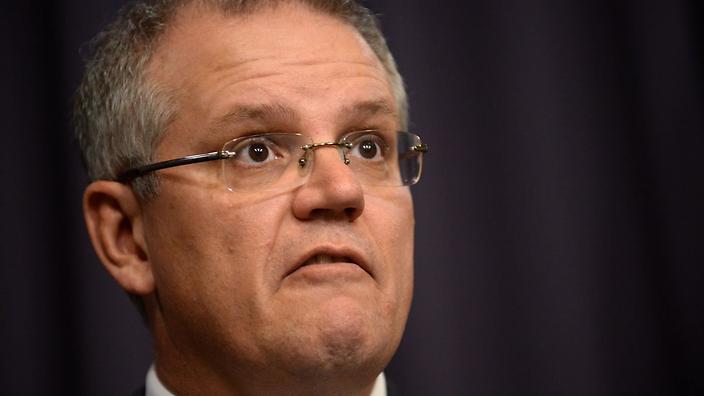 Inside Market Forces, the small climate group Scott Morrison wants to put out of business, From humble beginnings, Market Forces is now in the crosshairs of the Coalition’s war on environmental boycotts, Guardian, Adam Morton Environment editor @adamlmortonMon 11 Nov 2019 When Market Forces, a small climate activist group, was singled out as the target of the government’s push to stop environmental campaigns that advocate boycotts of fossil-fuel companies, its leader was briefly taken aback but not disappointed.
“You know you’re doing something right when the Morrison government tries to bring you down,” Julien Vincent, the group’s executive director and founder, says from its base in Melbourne. “It’s unpleasant, but it’s only happening because we are getting results.”
From Vincent’s perspective, those results include the Commonwealth Bank and insurers QBE, Suncorp and IAG pledging they would soon no longer work with or underwrite developments that use thermal coal, and the group’s part in the campaign that frustrated attempts by Indian company Adani to find investors for its proposed Carmichael coalmine.
In terms of winning the government’s attention, it is likely the results also included a recent profile in the Australian Financial Review, the newspaper of the business community. Under the headline “How activists pushed CBA out of coal in five years”, it talked up Market Forces’s successes and methods, including a deal-making meeting with the bank’s chairwoman, Catherine Livingstone.
Coincidentally or not, the attorney general, Christian Porter, last week nominated Market Forces as a poster child “radical activist group” trying to impose its will on companies through coordinated harassment and threats of boycotts. Porter said it was “simply not OK” that mining and resources businesses were being targeted on ideological grounds by activists that wished them financial harm.
It followed Scott Morrison telling the Queensland Resources Council that activists who campaigned for secondary boycotts against miners and small businesses that work with resources companies potentially posed a “more insidious threat” to jobs and the economy than street protests……
With the details in the wind, Morrison’s push has led to some confusion among Coalition MPs about what is proposed and how it will avoid impinging on freedom of expression, though none spoke publicly. The Business Council of Australia has backed the prime minister; legal academics have warned changes to reduce the influence of environmental campaigns could breach the constitution.
Environmental and civil liberty groups noted the apparent hypocrisy in the government floating a secondary boycott ban given Canavan had urged his constituents to stop doing business with Westpac after it ruled out financing the Adani mine …… https://www.theguardian.com/environment/2019/nov/11/inside-market-forces-the-small-climate-group-scott-morrison-wants-to-put-out-of-business
Australia’s out of control bushfires (all along the region where the nuclear lobby wants to put reactors!)
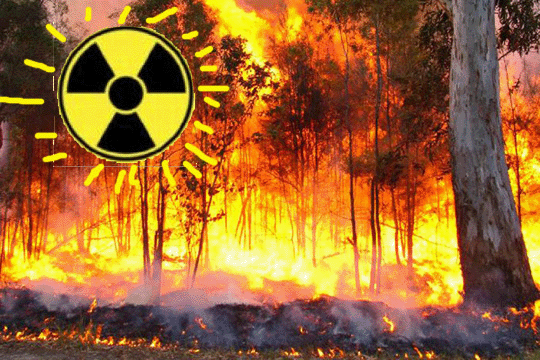 ‘Uncharted territory’: Dozens of out of control bushfires burn across New South Wales and Queensland, https://www.sbs.com.au/news/uncharted-territory-dozens-of-out-of-control-bushfires-burn-across-new-south-wales-and-queensland Hot, windy conditions are wreaking havoc across New South Wales and Queensland.
Australian firefighters warned they were in “uncharted territory” as they struggled to contain dozens of out-of-control bushfires across the east of the country on Friday.
Around a hundred blazes pockmarked the New South Wales and Queensland countryside, around 19 of them dangerous and uncontained.
“We have never seen this many fires concurrently at emergency warning level,” New South Wales Rural Fire Service Commissioner Shane Fitzsimmons told the ABC. “We are in uncharted territory.”The RFS said on Friday afternoon it received multiple reports of people being trapped in their homes at several locations.
Homes have also been destroyed, the RFS added.
A mayor on New South Wales’ mid-north coast said on Friday the bushfires ripping through the region were “horrifying and horrendous beasts”.
MidCoast Council mayor David West said a fire near Forster threatened a council building on Thursday night.
“It was literally a wall of yellow, horrible, beastly, tormenting flames,” the mayor said.
The mayor was particularly concerned about an out-of-control fire burning near Hillville south of Taree.
Strong public demand for climate action, but Australian government determined to punish climate protesters,
An increasingly outraged public is demanding action in a nation intimately linked to coal mining. The government has responded by threatening a new law to punish protesters. NYT, By Damien Cave and Livia Albeck-Ripka, Nov. 6, 2019 SYDNEY, Australia — One climate activist halted train service by chaining himself to the tracks. Others have glued themselves to busy roads, causing gridlock. And just last week, protesters locked arms to stop people from entering a mining conference before being forcibly dispersed by police officers with pepper spray.
A surge of climate activism is flooding Australia as the country falls behind on its promise to reduce emissions — effectively ignoring the Paris Agreement the Trump administration just abandoned. Prime Minister Scott Morrison has responded with a threat that’s alarmed scientists and free speech advocates, arguing that the government should outlaw “indulgent and selfish” efforts by environmental groups to rattle businesses with rallies and boycotts. “The right to protest does not mean there is an unlimited license to disrupt people’s lives,” Mr. Morrison said, adding, “I am very concerned about this new form of progressivism.”
Australia’s “climate wars,” once confined to election campaigns, are now spilling into the streets with some of the biggest protests the country has ever seen. An increasingly outraged public is demanding action while the conservative national government refuses to budge, relying on the police to squelch dissent……..
Coal-loving politicians
Two years ago, when Mr. Morrison was Australia’s treasurer, he stood up in the House of Representatives with a hunk of black coal in his hand.
“Don’t be afraid. Don’t be scared,” he said. “It won’t hurt you.”
His shiny prop had been shellacked to keep his hands clean, but the point he made then is one he and his governing coalition stand by: Coal is good……Now, Australia is the world’s largest coal exporter. It is also a major exporter of natural gas, making for a resource-driven country that is
“rich, dumb and getting dumber,” according to one recent headline summarizing the findings of a Harvard study that ranked Australia’s economy 93rd in complexity, behind Kazakhstan, Uganda and Senegal. The mingling of mining interests with national interests is perpetuated through a revolving door: lawmakers frequently work for the coal industry after leaving office. And for some, defending coal has come to be equated with defending the country.Even the opposition center-left Labor Party is hooked, pushing for emissions cuts while continuing to support more coal mining……
An increasingly angry public
Poll after poll shows growing concern about climate change among Australians of all ages and political persuasions.In September, a survey by the Australia Institute found that 81 percent of Australians believe climate change will result in more droughts and flooding (up from 78 percent in 2018). Two out of three Australians agreed that the government should plan for an orderly phaseout of coal, while 64 percent said Australia should aim for net-zero emissions by 2050.
And researchers continue to sound the alarm. A paper co-written by an Australian scientist and signed by 11,000 other experts warned on Wednesday of a clear “climate emergency.”……
The so-called climate strike in September, part of a global effort led by children, was the largest mass demonstration in Australian history.
It was quickly followed last month by the Extinction Rebellion protests, and then came last week’s anti-mining protests in Melbourne….. Over 10 days of protests in London, the police arrested more than 1,700 Extinction Rebellion protesters.
Australia aims to go further. A law passed last year allows the military to break up protests. The Labor government in Queensland is fast-tracking a law to add new fines for protesters who use locking devices to prevent their removal……. Reduced coal mining would not hurt the economy as much as people think.
According to the Australia Institute poll from last month, Australians believe coal mining accounts for 12.5 percent of Australia’s economic output and employs 9.3 percent of its work force. “In reality,” the report says, “coal mining employs only 0.4 percent of workers in Australia and is 2.2 percent of Australia’s G.D.P.” Of the roughly 238,000 jobs that mining provides in Australia, only around 50,000 are tied to coal, according to government figures.
“The government relies on ignorance,” Professor Eckersley said. “It’s a very toxic politics.”
Portrayals of extreme activism are also exaggerated. The vast majority of protesters demanding climate action are not radical disrupters. They are more like Jemima Grimmer, 13, who asked adults to “respect our futures” at the Sydney climate strike in September, or Vivian Malo, an Aboriginal woman attending last week’s protest in Melbourne, where she said the experience of being pepper-sprayed felt like chemotherapy “on the outside.” Here in a country rapidly losing its laid-back image, the future of Australia’s climate battles could be seen in her bloodshot eyes as she stood near a line of stone-faced police officers, describing their use of force as “scary.”
“The insatiable drive for resource extraction,” she said. “It’s out of control.” https://www.nytimes.com/2019/11/06/world/australia/australia-climate-protests-coal.html
1 This month

of the week – Australians for War Powers Reform (AWPR)
To see nuclear-related stories in greater depth and intensity
 Antinuclear