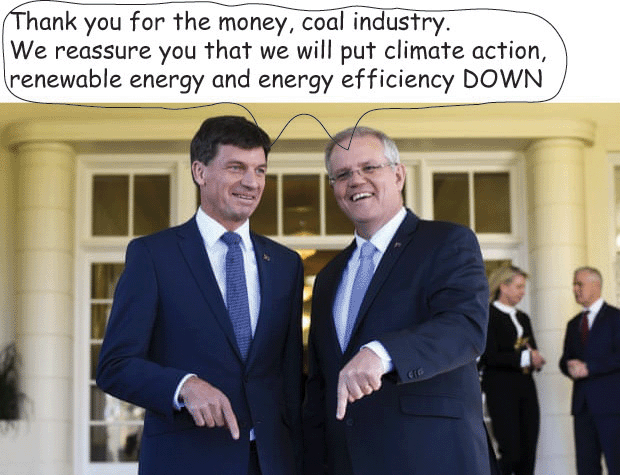
Australian Prime Minister Morrison’s attitude to Pacific Islanders – “Take the Money and Shut Up about Climate Change”
 Take the money and shut up’: Ex-Tuvalu PM slams Morrison’s climate bargaining, The Pacific nation of Tuvalu is one of the world’s most vulnerable countries to the effects of climate change. SBS News has spoken to its former leader about Australia’s ‘lack of climate action’. Take the money and shut up’: Ex-Tuvalu PM slams Morrison’s climate bargaining, The Pacific nation of Tuvalu is one of the world’s most vulnerable countries to the effects of climate change. SBS News has spoken to its former leader about Australia’s ‘lack of climate action’.
SBS 23 OCT 19
BY NICK BAKER
Former Tuvalu Prime Minister Enele Sopoaga has accused the Morrison government of trying to buy the silence of Pacific Island leaders who are vocal about climate change. Mr Sopoaga, who has been a fierce advocate on climate change action, told SBS News on Wednesday that Prime Minister Scott Morrison’s climate policies were “un-Pacific” and that Australia was letting down the region. Earlier this year, Australia said it will steer $500 million of existing aid towards the Pacific to help the region cope with climate change. But Mr Sopoaga said some Pacific leaders felt like they were being told to “take the money and shut up”. “Putting this money on the table – $500 million – and then expecting Pacific Island countries like Tuvalu to say ‘OK, we’ll stop talking about climate change’, it’s not on … This is completely irresponsible.” He said greater action on climate change back in Australia was more important than Pacific aid. “Any amount of money that is coming with the Step-Up [Pacific aid program] cannot be seen as an excuse for no action at a domestic level to cut down on greenhouse emissions.”…….. HTTPS://WWW.SBS.COM.AU/NEWS/TAKE-THE-MONEY-AND-SHUT-UP-EX-TUVALU-PM-SLAMS-MORRISON-S-CLIMATE-BARGAINING
|
|
|
Scott Morrison on the drought (“Climate” is a dirty word)
 Scott Morrison says drought the Coalition’s ‘first call’ – but makes no mention of climate
Prime minister suggests Coalition may commit to extra funding relief in Liberal party federal council speech, Ben Doherty, @bendohertycorro, Sat 19 Oct 2019 The Guardian
Scott Morrison has indicated the federal government might be prepared to commit extra relief funding to drought-stricken communities, reaffirming the drought is the government’s top priority.
In a triumphal speech to the Liberal party’s federal council in Canberra on Saturday, Morrison again said the drought was “the most pressing and biggest call on our budget”.
“It is the first cab off the rank, the first thing we sit together and say, ‘Once we have done everything we can in this area, then we can consider other priorities’…….
The prime minister did not mention the climate crisis while detailing the government’s three-phase drought response package thus far: the farm household allowance for eligible farming families; the drought communities program dedicating $100m to councils affected by the drought; and long-term drought resilience plans, including money for new dams and the drought future fund. ………
The government has been criticised by Labor for moving too slowly on the drought. Accusing the government of “six years of inaction”, Labor’s Joel Fitzgibbon has called for a bipartisan drought war cabinet to be established.
“What began as crisis for our farmers fast moved to a crisis for our rural townships, which are literally running out of water,” he said. “And I fear that we now are fast approaching a threat to our food security … We need to sit the major parties down together and to start making some pretty significant decisions.”
The drought response has also been questioned by some councils, including Moyne shire in south-west Victoria, which was given $1m despite not being in drought and whose mayor said he wanted to refuse it……. https://www.theguardian.com/australia-news/2019/oct/19/scott-morrison-says-drought-the-coalitions-first-call-but-makes-no-mention-of-climate
Barkindji people have title to Darling River area – but their river is dying, killed by drought, and whiteys’mismanagement
Indigenous community say they’ve lost their culture to water mismanagement, SBS, This is the final part in a series of reports from communities along NSW’s Darling River that have been impacted by water mismanagement and drought. BY ANEETA BHOLE 18 Oct 19, An Aboriginal community in rural NSW fears their culture may be lost, as dry conditions and low river flows threaten the future of the Darling River.
The Barkindji people have lived, hunted and passed down their oral history on the banks of the Darling for more than 40,000 years.
Now the river is drying up due to over-extraction by irrigation upstream and drought.
The community’s fears surfaced at a recent corroboree in the small town of Wilcannia, which was once a thriving Murray-Darling River port.
The Yaama Ngunna Barka corroboree had been travelling to towns along the river from Walgett to Menindee. The corroboree have been travelling to towns in outback New South Wales in a bid to raise awareness about the plight of the Darling river.
‘Dead water’
Lilliana Bennett can still recall her grandmother talking about taking the family down the riverbank to fish and hunt for goanna. The river was a place of safety and community for her family.
“It’s a place they go to relax, to tell stories,” she told SBS News.
“For me, it’s been really devastating, I mean we went down and camped by the river where there’s still a bit of water around and it just doesn’t have the same feeling, it’s dead water.”…….
With water levels at an all-time low and the drought continuing to ravage the region, native animals have also started to disappear from the river banks. Many with spiritual significance. …….
The Barkindji community fought for Native Title of the land – covering 128,000 square kilometres — from Wentworth at the Victorian border to near Wanaaring in the state’s north-west, including Broken Hill, Wilcannia, Menindee, Pooncarie and Dareton.
They started the claim in 1997 and won two decades later, but many have said without water flowing in the river they feel robbed. …….
Case for change
Last month, the National Resources Commission (NRC) released an independent report looking into the water-sharing plan of the Barwon-Darling River system.
The system takes in the the Barwon River, from upstream of Mungindi at the confluence of the Macintyre and Weir rivers, to where the Barwon meets the Culgoa River.
At this point the river channel becomes the Darling River and the Barwon–Darling system extends downstream to the Menindee Lakes.
It found that provisions that allow increased access to low flows resulted in poor ecological and social outcomes downstream of Bourke, including the town of Wilcannia where part of the Barkindji community live.
The NRC has made 17 recommendations, including one which has called for stricter regulation of when irrigators, including cotton farmers, can pump water from the river………. HTTPS://WWW.SBS.COM.AU/NEWS/INDIGENOUS-COMMUNITY-SAY-THEY-VE-LOST-THEIR-CULTURE-TO-WATER-MISMANAGEMENT
Morrison government’s drought policy mess
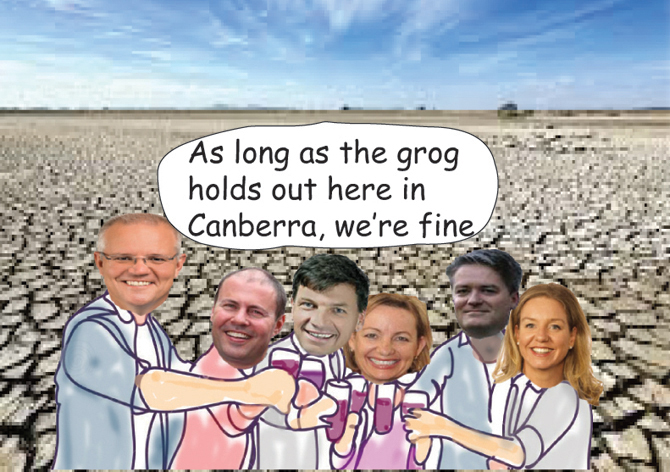 Has drought policy become a casualty of the federal-state blame game? ABC The Conversation By Michelle Grattan 18 Oct 19, Government sources insist shock jock Alan Jones didn’t drive Thursday’s announcement of a cash payment to drought-stricken farmers about to be turfed off their household support because they’d reached the four-year time limit.They say the measure — giving up to $13,000 to a couple and $7,500 to individuals at a cost of $12.8 million this financial year — had been in Cabinet’s expenditure review committee process for some time.
But the National Farmers Federation says it wasn’t given any notice, which seems odd since Drought Minister David Littleproud is constantly referencing the NFF.
Regardless of the sequencing, Mr Jones’ extraordinarily angry and emotional performance on Tuesday, haranguing Mr Morrison on radio, breaking down on TV, and warning of dire political consequences if the Government didn’t do something, certainly concentrated the Prime Minister’s mind.
As one official puts it, Mr Morrison is “attuned to the zeitgeist”.
Described more prosaically, the PM is highly sensitive to public opinion, and he judges that in metropolitan areas as well as the regions, people want more action — and then more still — to help those brought to their knees.
Can drought policy deliver better outcomes?
When he became PM, Mr Morrison was immediately anxious to own the issue of the drought. He referred to it in his news conference the day he was elected leader, saying it was “the first thing I need to turn attention to”, and was quickly off to a drought-affected area.
Now he is feeling the full cost — political as well as financial — of that ownership, as he’s confronted with pressure on all sides.
NFF president Fiona Simson continues to say she doesn’t think the Government has a drought policy…….
A sign of weakness?
Also, the Government has no credible reason for keeping under wraps the report it commissioned from Stephen Day, who was its drought coordinator, which would provide some useful overview.
Thursday’s announcement of the cash payment was messy: Mr Morrison trumpeted it on radio at the same time as the Nationals unveiled it at a press conference.
The Coalition’s handling looks ad hoc and reactive……..
Also, the Government has no credible reason for keeping under wraps the report it commissioned from Stephen Day, who was its drought coordinator, which would provide some useful overview.
Thursday’s announcement of the cash payment was messy: Mr Morrison trumpeted it on radio at the same time as the Nationals unveiled it at a press conference……. https://www.abc.net.au/news/2019-10-18/drought-gives-scott-morrison-a-harsh-political-lesson/11614698
Australia’s climate crisis: destruction of forests
An epidemic of land clearing is sabotaging efforts to address climate change. Farming communities are bitterly divided over the issue – but it also has global consequences
Roger Fitzgerald’s family has been farming near Moree since 1925. But these days he feels under siege on his own farm. His 1,700-hectare property, 50km north of the town, is now surrounded by the operations of the sprawling agribusiness Beefwood Farms, which has been steadily buying up land in New South Wales to expand its operations.
The old easement to Fitzgerald’s cottage across the sprawling Beefwood property has been planted over with crops. His letterbox has mysteriously disappeared on several occasions, making it hard for visitors to spot the entrance to his farm. But it is the extent of land clearing by his neighbour, Beefwood’s owner, Gerardus Kurstjens, that has upset him the most.
Fitzgerald says the microclimate of the nearby Welbon plains has moved a kilometre further on to his property since losing a tree line on Kurstjens’ property that once sheltered his land.
Pockets of remaining vegetation have been ripped from the grey soil to expand cultivation and square up paddocks – and the first Fitzgerald knows of it is when the bulldozers arrive.
“There is something seriously not right about the extent of land clearing in my little part of the world,” he says.
Think of land clearing like a rezoning in the city. Land cleared for cropping west of Moree sells for $2,500 a hectare whereas grazing land will sell for between $700 and $1000 a hectare. East of Moree most of the prime land has already been converted to crops and sells for $6,800 a hectare, three times the value of grazing land.
Clearing vegetation has the potential to add millions to a property’s value, as well as yielding high returns in a good year.
That alone is enough for farmers to risk up to $1m in fines for illegally clearing, according to one former NSW Office of Environment and Heritage compliance officer, who asked not to be named.
But while land clearing might benefit individual farmers in the short term, the loss of native vegetation comes with enormous costs for the rest of us.
“Land clearance and degradation is one of the greatest crises facing Australia and the world,” says Bill Hare, the chief executive and senior scientist with Berlin-based Climate Analytics. “It undermines the basis for food production, is causing species loss and ecological decline, destroys climate resilience, degrades water resources and reverses carbon storage on the land.”
Pollution from land clearing is projected by the federal government to remain at about 46m tonnes of carbon dioxide a year to 2030, roughly equivalent to emissions from three large coal-fired power plants. The rate at which we are clearing land in Australia is almost immediately wiping out gains being made under tax-payer funded schemes to address climate change.
Australia is among the 11 worst countries when it comes to deforestation, according to the World Wildlife Fund.
Queensland, with its vast swathes of untouched land on Cape York, has the highest clearing rate, but NSW is rapidly becoming a hotspot – and there is less to lose, with only 9% of the state’s vegetation in its original state.
What is becoming clear is that successive NSW governments have failed to explain the science behind preserving native vegetation – both in relation to climate change and protecting the landscape and endangered species – to farmers and the public.
Instead, land clearing laws in the state have been successively weakened, first by Labor and then more comprehensively by the Coalition, with the introduction of amendments to the Local Land Services Act in August 2017.
“NSW’s native vegetation laws were [once] based on the principle that broad-scale land clearing would not be permitted and clearing could only proceed if it could be shown to maintain or improve environmental outcomes,” says Rachel Walmsley, a solicitor at the NSW Environmental Defenders Office.
“The new act brought in a new approach with the twin stated objectives of arresting the current decline in the state’s biodiversity while also facilitating sustainable agricultural development.”
But while farmers are mostly happy with the new rules, environmentalists say they have ushered in an environmental disaster because they allow farmers to self-assess whether clearing is permissible.
The old act also protected paddock trees; the amended act has made it much easier to get rid of them.
Critics say farmers have been given the green light to clear.
“I have sat in meetings where arguments have been put that driving a tractor around a tree is a significant cost in diesel for farmers,” Walmsley says.
“There’s no valuation of the ecosystem services these trees provide: clean water, clean air, healthy soils and hosting pollinators. There’s no dollar value put on vegetation.”………
The facts are unequivocal. NSW is losing vegetation at an alarming rate………………… https://www.theguardian.com/environment/ng-interactive/2019/oct/17/stripped-bare-australias-hidden-climate-crisis
Severe fire danger for northern New South Wales
|
Plenty more bush to burn’: Severe fire danger for northern NSW, SMH. By Josh Dye, October 16, 2019 A total fire ban has been declared for six regions in the state’s north and north-east on Thursday as firefighters brace for “severe” fire conditions.The NSW Rural Fire Service is warning residents to be vigilant with “hot and windy” weather putting firefighters on high alert. There’s plenty more bush out there to burn,” an RFS spokesman said.
“Winds are likely to average 40km/h from the north to north-west with gusts up to 70km/h.” Temperatures are forecast to reach up to 35 degrees in parts of the state’s north on Thursday, including near Casino where two bushfires burnt out of control last week. Two people died, 64 homes were destroyed and more than 122,000 hectares were scorched in the fires. Firefighters are also worried about the possibility of extra fires being ignited from lightning strikes with possible storms on the radar……. https://www.smh.com.au/environment/weather/plenty-more-bush-to-burn-severe-fire-danger-for-northern-nsw-20191016-p531bt.html |
|
|
Northern Territory Aboriginals call out for climate action as mangroves dieback with heat
 NT traditional owners urge climate change policy makers to witness mangrove devastation ABC News, By Jane Bardon 14 Oct 19, Traditional owners are devastated by the lack of recovery at the site of Australia’s worst recorded mangrove dieback and are calling for action to limit climate change threats.
Key points:
- Scientists have said the severity of the mangrove dieback is on a par with Great Barrier Reef bleaching
- The Top End is experiencing sea level rise at two to three times global averages
- The CSIRO is warning the world is not on track to halt sea level rise
Traditional owner Patsy Evans had hoped there would be signs of recovery at the site of the mangrove dieback, in the Gulf of Carpentaria.
But during a recent visit to the area for the first time since 2015, when she and her husband alerted the Northern Territory Government to the extent of the damage, she was devastated by the scene.
She said she wanted policy makers to see how climate change was affecting the land near her home on the Limmen River, 750 kilometres south of Darwin.
“Go out and see what’s happening, be aware and look at it, and don’t make decisions where you are,” she said.
The mangroves were once nurseries for the mud crab, barramundi and prawn fisheries, but now consist mainly of dead trees and dusty earth.
The few live seedlings coming through are exposed, and vulnerable to damage from the fallen dead trees……
On par with Great Barrier Reef bleaching
“We can’t see any other driver of the dieback other than the extreme climatic envelope has shifted,” Charles Darwin University professor Lindsay Hutley said.
Dr Hutley said the extent and duration of the dieback was on a par with the severity of Great Barrier Reef bleaching………
Polar icecap melting underestimated
The CSIRO has mapped the average sea level rise of the Top End at between six and 13 millimetres a year — two to three times the rate off southern Australia and the global average……… https://www.abc.net.au/news/2019-10-14/climate-change-mangrove-traditional-owners-call-for-action/11598238
Weather experts predict more heat and fire risk coming, though fewer cyclones

|
Australia could see fewer cyclones, but more heat and fire risk in coming months The Conversation, Jonathan Pollock, Climatologist, Australian Bureau of Meteorology, Andrew B. Watkins, Head of Long-range Forecasts, Australian Bureau of Meteorology, Catherine Ganter Senior Climatologist, Australian Bureau of Meteorology. Paul Gregoryn, BOM, Australian Bureau of Meteorology, October 14, 2019
Northern Australia is likely to see fewer cyclones than usual this season, but hot, dry weather will increase the risk of fire and heatwaves across eastern and southern Australia.
The Bureau of Meteorology today released its forecast for the tropical cyclone season, which officially runs from November 1 to April 30.Also published today is the October to April Severe Weather Outlook, which examines the risk of other weather extremes like flooding, heatwaves and bushfires. Warmer oceans means more cyclones On average, 11 tropical cyclones form each season in the Australian region. Around four of those cross the coast. The total number each season is roughly related to how much cooler or warmer than average the tropical oceans near Australia are during the cyclone season……..
when ENSO is neutral, there is little push towards above or below average numbers of cyclones. Temperatures in the tropical Pacific Ocean have been ENSO-neutral since April and are likely to stay neutral until at least February 2020. However, some tropical patterns are El Niño-like, including higher-than-average air pressure at Darwin. This may be related to the current record-strong positive Indian Ocean Dipole – another of Australia’s major climate drivers – and the cooler waters surrounding northern Australia. The neutral ENSO phase alongside higher-than-average air pressure over northern Australia means we expect fewer-than-average tropical cyclones in the Australian region this season. The bureau’s Tropical Cyclone Season Outlook model predicts a 65% chance of fewer-than-average cyclones………. Other severe weatherWhile cyclones are one of the key concerns during the coming months, the summer months also bring the threat of several other forms of severe weather, including bushfires, heatwaves and flooding rain. With dry soils inland, and hence little moisture available to cool the air, and a forecast for clear skies and warmer days, there is an increased chance that heat will build up over central Australia during the spring and summer months. This increases the chance of heatwaves across eastern and southern Australia when that hot air is drawn towards the coast by passing weather systems.
Likewise, the dry landscape and the chance of extreme heat also raise the risk of more bushfires throughout similar parts of Australia, especially on windy days. And with fewer natural firebreaks such as full rivers and streams, even greater care is needed in some areas. Widespread floods are less likely this season……..https://theconversation.com/australia-could-see-fewer-cyclones-but-more-heat-and-fire-risk-in-coming-months-125139 |
|
Climate change – heat -drought – more mass fish deaths to come
The communities preparing for more devastating mass fish deaths in rural NSW, In the first in a series of reports from communities along the Darling River, SBS News meets those who have been impacted by water mismanagement and drought., BY ANEETA BHOLE 14 Oct 19, Rural New South Wales communities are bracing for another ecological disaster, despite efforts to save local fish populations.
More than a million fish died in December 2018 and January this year along the Darling River at Menindee, which was once home to 60 different fish species.
Local fisherman Graeme McCrabb still recalls the stench that saturated the town following what has been called Australia’s largest fish kill on record……….
Disconnected river system
A lack of fresh flows down the river, combined with the drought, are exacerbating the disaster.
“There’s six kilometres of dry riverbed and think when you’re looking at that everyday it’s really confronting,” he said.
“It’s a stark reminder of just how dire the situation is.”…………
Loss of culture
Barkindji man Michael ‘Smacka’ Whyman, lives upstream in Wilcannia.
He said the state of the water system is devastating to his community, the Barkindji people, or ‘Darling River folk’.
“I’d like to see the government stop draining or rivers our national waterways we’re living in the longest river in Australia and they’ve killed,” he said.
“The environmental damage alone is bloody massive.”
In September, an independent review by the state’s Natural Resources Commission found that the Barwon-Darling river system is an ‘ecosystem in crisis’.
The review found: “The weight of scientific evidence is clear: while reduced inflows due to drought, upstream extraction, and climate change are all impacting the flows in the Barwon- Darling, the Plan provisions that allow increased access to low flows have resulted in poor ecological and social outcomes downstream of Bourke.”……….
https://www.sbs.com.au/news/the-communities-preparing-for-more-devastating-mass-fish-deaths-in-rural-nsw
The role of climate change in Australia’s early bushfire season
Climate change partly to blame for early bushfire 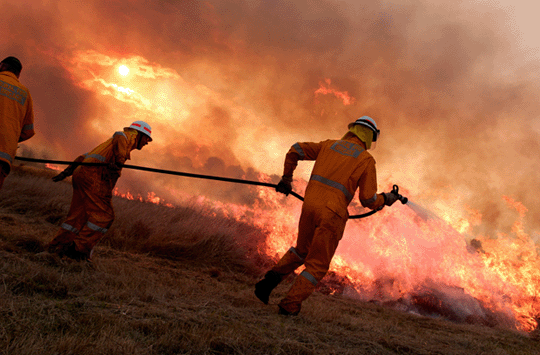 season, New analysis confirms the relationship between climate drivers such as El Niño, climate change and the Australian bushfire season, Guardian, Chris Lucas and Sarah Harris for The Conversation, 11 Oct 19
Summer might be more than six weeks away but out-of-control bushfires have already torn across parts of eastern Australia in recent days, killing two people, destroying homes and threatening more lives.
By Wednesday afternoon up to 30 homes were feared lost or badly damaged by bushfires burning in northern New South Wales. About 40 fires burned across the state.
This did not surprise meteorologists and fire agencies. Record-breaking heat and windy conditions were forecast for parts of NSW and Queensland this week, prompting severe fire danger ratings.
We’re often told the Australian bushfire season is starting earlier. This year it began in September on the eastern seaboard. Last year and in 2013 significant spring fires hit NSW and in 2015 they affected much of the nation’s southeast.
But what lies behind this phenomenon? We examined seasonal fire weather history for 44 years at 39 weather stations to find the answer.
This analysis is the most comprehensive ever conducted in Australia. It confirms the strength of the relationship between climate drivers such as El Niño, climate change and the Australian bushfire season. It also demonstrates that a few milder bushfire seasons do not mean climate change isn’t happening.
Hot, dry, windy conditions spell fire trouble
The prerequisites for a severe bushfire season are high temperatures, low humidity, and strong winds that coincide with long periods of low rainfall.
These weather ingredients are used to calculate an area’s fire danger rating, using the forest fire danger index. The index produces a score reflecting the severity of fire weather on a given day, where zero represents minimal anger, 50 represents conditions where a fire ban may be issued, and 100 is potentially catastrophic………
Climate change is a culprit too
The changed conditions have led to an average increase in severe seasonal bushfire weather across Australia, especially in southern parts of the continent. The increased severity affects all seasons but in particular spring, which means that, on average, the bushfire season is starting earlier.
Pulling it all together
Our research has made clear that climate modes bring large and rapid swings to the fire weather, while human-induced climate change gradually increases background fire weather conditions. The trend generally means an earlier start to the bushfire seasons than in the past.
Similarly, a few milder bushfire seasons among a string of record high seasons do not mean that climate change should be dismissed.
- Chris Lucas is a senior research scientist at the Australian Bureau of Meteorology and Sarah Harris is manager research and development at the Country Fire Authority.https://www.theguardian.com/australia-news/2019/oct/11/climate-change-partly-to-blame-for-early-bushfire-season
Climate protest in Perth: arrests in Sydney, Brisbane – Melbourne?
|
Dozens arrested on east coast as Extinction Rebellion protests begin https://thewest.com.au/news/environment/dozens-arrested-on-east-coast-as-extinction-rebellion-protests-begin-ng-b881345425z
Geoff Parry, 7NEWS ,Monday, 7 October 2019 Dozens of people have been arrested at climate change rallies on the east coast of Australia.
Protests organised by the group Extinction Rebellion have been held in most capital cities, including Perth. About 100 “climate protectors” started at Elizabeth Quay and walked through the city, eventually finishing at Yagan Square. As promised by the organisers disruption was kept to a minimum and no arrests. In Sydney about 30 people were arrested by police, including some elderly demonstrators and school-age children. Hundreds of them blocked a major street near Central Station forcing police to remove some of them. Several handcuffed themselves to a water tank to frustrate police. In Brisbane several people were detained by police as several hundred marked through the centre of the city. They stopped at a number of intersections along the way deliberately blocking traffic for long periods. In Melbourne a big climate change rally is getting underway this afternoon with organisers predicting there will be arrests. Here in Perth they described today’s rally as an introduction to a week or protests and promised this is just the beginning.We feel the disruption is justified, warranted and actually long overdue,” Extinction Rebellion spokeswoman Jesse Noakes said. “Unfortunately there is major major disruption coming whether we like it or not.” They say their big protest day will be Friday. |
|
Arrests in the global climate rebellion
Protesters chained themselves to vehicles and other structures and lay down in the middle of streets in defiance of police across Europe and parts of Asia, Africa and North America.
Protesters chained themselves to vehicles and other structures and lay down in the middle of streets in defiance of police across Europe and parts of Asia, Africa and North America.
Police had made 217 arrests by 17:15 pm (1615 GMT).
“Getting arrested sends a message to the government that otherwise law-abiding citizens are desperate,” IT consultant Oshik Romem, from Israel but working in Britain for 19 years, told AFP while sitting on a road outside parliament.
‘Running out of time’
Hundreds of Australians joined a sit-in on a busy inner Sydney road before being dragged away by the police. Thirty people were later charged.
“We have tried petitions, lobbying and marches, and now time is running out,” Australian activist Jane Morton said.
Australia’s conservative government has resisted adopting new environmental standards and backed lucrative coal exports.
Protests occurred in 60 cities around the world, including New Delhi, Cape Town, Paris, Vienna, Madrid and Toronto.
At New York’s Battery Park, some 200 demonstrators took part in a “funeral march” to Wall Street, where protesters threw fake blood over the financial district’s famous bronze statue of a bull.
“We need imagery like this in order to get people’s attention,” 29-year-old James Comiskey told AFP, as he carried a cardboard coffin in the procession.
‘Burn capitalism!’
The movement is partially credited with pushing the UK government in June to become the first in the Europe Union to commit itself to a net-zero target for harmful emissions by 2050.
Extinction Rebellion is demanding governments reach that target by 2025, as well as holding “citizens assemblies” to decide on policies to achieve that aim.
The parliament in Norway, not an EU member, in June adopted a target of 2030.
There has been less movement in other parts of Europe or the most impacted cities of Asia.
And not everyone out on the streets was impressed with the campaign.
“They’re taking it out on everyday people trying to go about their business. They should go after big people,” London taxi driver Dave Chandler told AFP.
Extinction Rebellion counters that emergencies like the one heating up the climate demands action from everyone across the world.
Hundreds barricaded themselves inside a Paris shopping center for hours over the weekend. Groups unfurled banners with slogans such as “Burn capitalism, not petrol” above Paris restaurants and fashion boutiques.
And hundreds brought blankets and sleeping bags to one of the main roundabouts in central Berlin which police expect to be shut down for many days.
Extinction Rebellion’s tactics in Australia prompted senior conservative politicians to call for protesters’ welfare payments to be cut.
Sydney assistant police commissioner Mick Willing accused protesters of putting themselves and others at risk, warning that such disruptive protests in the future would “not be tolerated”.
David Glynne Jones on the unwisdom of nuclear power for Australia in a heating climate
 Inquiry into the prerequisites for nuclear energy in Australia Submission 249 David Glynne Jones
…………4. Australia’s fresh water supplies are already under extreme pressure to meet 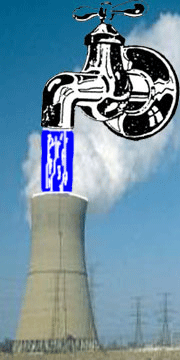 existing and future environmental flow, agricultural, urban and industrial requirements, and the use of very large quantities of fresh water for the cooling of nuclear power stations is unlikely to be either viable or acceptable.
- Consequently the only likely viable option will be to use seawater cooling, requiring nuclear power stations to be located close to the coastline, and with significant environmental impacts on affected coastal waters resulting from water heating and very large water flows.
- By comparison, solar photovoltaic and wind turbine generating systems do not require the use of any significant water resources for cooling……..
Energy affordability and reliability
 Recent European experience has shown that nuclear power generation is not reliable during extreme heatwave conditions, with nuclear power stations being required to operate at reduced power levels or shutdown completely.
- Given that the future climate outlook for Australia is longer hotter heatwaves during the summer, this must be given serious consideration in any decision to adopt nuclear power generation in Australia.
- There is no evidence that nuclear power generation using either LMR or SMR technology can compete with other emerging 21st century electricity generation technologies, which are evolving at an increasingly high rate and have gained broad market investor confidence.
- The AEMO/CSIRO GenCost 2018 report projects capital and operating costs for both LMR and SMR technology at uncompetitive levels for the foreseeable future.
- There is no evidence of market investor appetite for nuclear power generation investment in the absence of government subvention.
- The UK SMR program has a NOAK target of GBP 60/MWh (~ AUD 110/MWh), but this cannot be demonstrated until a significant number of reactors haved been built and operated for a significant period. The FOAK target is GBP 75/MWh (~ AUD 140/MWh).
-
- The report found that “Investing in a nuclear power plant is uneconomical. This This
holds for all plausible ranges of specific investment costs, weighted average cost of
capital, and wholesale electricity prices”.-
 Economic feasibility
 - A recent report published by the German Institute for Economic Research (known as DIW Berlin) reviewed the development of 674 nuclear power plants built since 1951, finding that none of the plants was built using ‘private capital under competitive conditions’. A full copy of the report is available at https://www.diw.de/documents/publikationen/73/diw_01.c.670581.de/dwr-19-30-
1.pdf. holds for all plausible ranges of specific investment costs, weighted average cost of capital, and wholesale electricity prices”.
-
-
- It would be sensible for the Committee to seek input from the energy investment
- It is highly unlikely that the commercial insurance industry would ever be prepared
- The cost of firmed renewable-generated electricity is already as low as AUD
- For a proposed Australian nuclear power generation industry capacity of 20 GWeThe report found that the expected economic loss for a 1000 MWe (1 GWe) nuclear power station would be in the range of Euro 1.5-8.9 billion – approximately AUD 2.4-14.4 billion).this would translate to a future economic loss in the range of approximately AUD50-300 billion………..
10.The biggest risk for potential market investors in nuclear power generation is the future uncertainty created by competing technologies, given that there is currently no operational evidence that nuclear power generation can ever compete directly with other electricity generation technologies. 70/MWh (https://reneweconomy.com.au/stunning-low-costs-inspire-alinta-to-rampup-renewables-push-flag-early-coal-exit-82836/), and is likely to reduce further over the next two decades.
 12.Australia has a superabundance of solar energy resources – the largest of any nation state in the world. At current solar energy conversion efficiencies Australia has the potential to produce 30% of the world’s current electricity demand from just 1% of its land area (by comparison agriculture uses 53% of Australia’s land area).
13.The increasing technological and commercial viability of long distance HVDC transmission means that Australia will be able to export highly competitive low cost renewably generated electricity directly to the Asian market. to underwrite the risks of catastrophic failure, and consequently this will need to be underwritten by government (ie taxpayers), as is currently the case in other countries with nuclear power industries. and insurance industries.
- The cost of firmed renewable-generated electricity is already as low as AUD
- It is highly unlikely that the commercial insurance industry would ever be prepared
- It would be sensible for the Committee to seek input from the energy investment
- The report found that “Investing in a nuclear power plant is uneconomical. This This

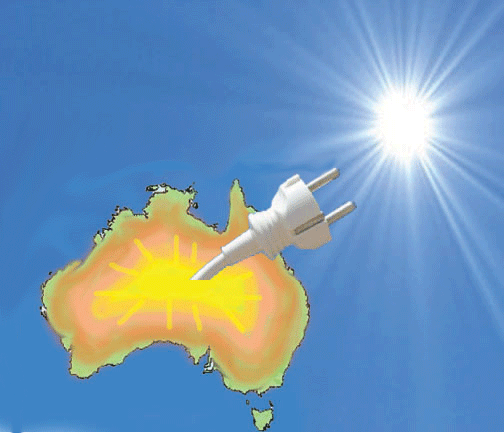
Australia’s drought disaster a political disaster too, for its climate-sceptic Morrison govt?
Inadequate drought preparation may prove to be political disaster too, Brisbane Times, Tony Walker 4 Oct 19
Panicky. That’s a word to describe the Morrison government’s response to a national drought emergency. Lack of rain, arid conditions, scorching winds and higher temperatures are contributing to an evolving disaster against the background of a contentious climate change debate.
This is a challenge that will become increasingly difficult for the governments, federal and state, to ignore as water supplies run down in New South Wales towns such as Dubbo and Queensland towns such as Stanthorpe. Risks of bushfire will be further elevated.Judging by Bureau of Meteorology forecasts, drought over much of eastern Australia is set to surpass all others in living memory going back to the beginning of record keeping. In other words, things may get a lot worse before they get better. What is left unspoken by government officials and farm representatives is this aridity will prove to be the new normal. Let’s repeat these words in capitals: NATIONAL DROUGHT EMERGENCY.
It might also be observed that no less than a drought emergency, this is a POLITICAL EMERGENCY for the Morrison government. Governmental responses, both federal and state, to a catastrophic dry across central and northern New South Wales and southern Queensland have been unfocused, according to farm representatives. Tony Mahar, chief executive of the National Farmers’ Federation, the peak body for Australian farmers, awards federal and state governments a “fail” when it comes to developing a national drought strategy to deal with emergencies. “No government, red or blue, has successfully nailed drought policy,” Mahar tells me.
Government inattention may well reflect agriculture’s diminishing share of the national economy at just three per cent of Gross Domestic Product. On the other hand, 1.6 million jobs reside in the complete agricultural supply chain. Prime Minister Scott Morrison’s dash – on his return to Australia from a state visit to the United States – to Dalby in the heart of drought-stricken southern Queensland to announce a $100-million relief package as part of an overall $7-billion allocation reflects government political concerns.
Morrison himself would not need reminding that the 2001-2010 millennium drought contributed to John Howard’s undoing, given he was perceived – rightly or wrongly – to be indifferent to climate change. At least six Coalition seats are at risk in the face of seething local anger over water mismanagement, or no management at all. In all of this, what tends to be overlooked is that the government has a wafer-thin majority of one after the Speaker is excluded……….
Finally, the latest Bureau of Meteorology bulletin provides little encouragement to believe that drought conditions will ease in the short term. The BOM reports the lowest rainfall on record extending from the Great Dividing Range as far as Dubbo and Walgett in central NSW. This is a huge swathe of the country under some of the most extreme drought conditions in the history of white settlement. Only the peak of the terrible 1900-02 “Federation Drought” was worse.
This is bad enough but meteorologists at the BOM are also reporting that a phenomenon known as sudden strategic warming above the South Pole risks contributing to a further deepening of the drought. The SSW effect would cause warmer westerly winds to track north, intensifying drought conditions in southern Queensland and northern New South Wales. If those forecasts prove correct, distinctions between a natural disaster and a national emergency will certainly become moot. Regardless, in a cloudless sky, these weather conditions will constitute an accelerating political emergency. https://www.brisbanetimes.com.au/national/governments-scandalously-little-drought-preparation-is-accelerating-disaster-20191004-p52xmv.html
With temperatures heading for 40C, New South Wales and Queensland at bushfire risk
 Large swathes of NSW at bushfires risk as temperatures set to reach 40Cm
 Bourke and Brewarrina brace for 40C day as dust storms set to sweep western parts of state, Guardian, Australian Associated Press, Sun 6 Oct 2019 The Bureau of Meteorology says an unseasonal heatwave hitting western and north-western New South Wales could demolish October heat records and place large swathes of the state at bushfire risk.While Sydney’s top temperature was expected to reach a mild 23C on Sunday, Bourke and Brewarrina braced for their first 40C day since March.
Wilcannia, Cobar and Dubbo were also set to exceed 37C while dust was forecast for most parts west of Griffith and Bourke.
The BoM warned the fire danger rating in almost every NSW/ACT region was high or very high for Sunday, prompted by heat, high winds and low humidity.
By early afternoon, no bushfires were rated higher than “advice” alert level.
Meteorologist Jake Phillips said the bureau was particularly concerned by conditions to the west of the Great Dividing Range. “It’s quite unusual to see temperatures this warm,” Phillips said.
“In large areas of the state we’re seeing daytime temperatures between 8C and 12C above average for this time of the year, and in some places more.
“As we move into tomorrow, it’s quite likely we will see some places getting pretty close to or maybe breaking October records, the most likely areas being the northern tablelands and north-west slopes.”
Very high fire danger was forecast in ACT and 10 NSW regions: greater Hunter, central ranges, southern ranges, Monaro alpine, lower central west plains, upper central west plains, far western, New England, northern slopes and north western. On Sunday afternoon none were yet subject to total fire bans.
All other regions except eastern Riverina had a high fire danger rating…..
The BoM said Queensland was also set to scorch through another heatwave this week, with hot, dry and windy conditions increasing fire danger, particularly in the south-east….. https://www.theguardian.com/australia-news/2019/oct/06/bushfire-danger-soars-as-parts-of-nsw-forecast-to-reach-40c
1 This month

of the week – Australians for War Powers Reform (AWPR)
To see nuclear-related stories in greater depth and intensity
 Antinuclear