Climate change the essential factor in planning about droughts
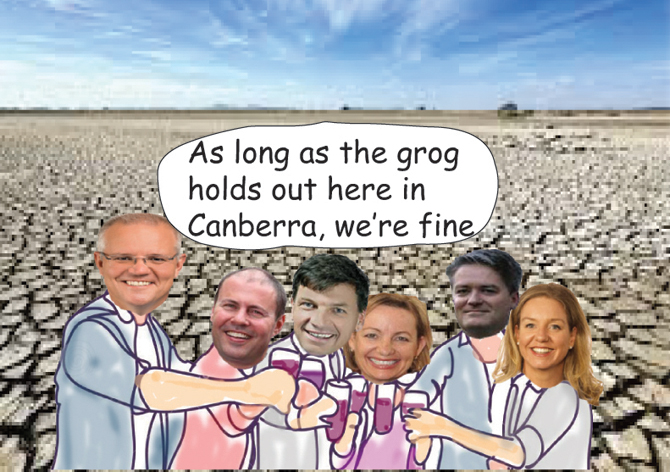
Drought plan must factor in climate change, https://www.smh.com.au/ business/small-business/drought-plan-must-factor-in-climate-change-20191003-p52xfn.html Lisa Davies, 4 Oct 19, As country towns across the inland run out of drinking water, the federal government has started to show its concern for farmers affected by the drought.
Prime Minister Scott Morrison went to Dalby in Queensland last week to announce a $100 million drought package and Treasurer Josh Frydenberg has taken time off his day job for a three-day tour of NSW and Queensland.
On one hand, country people will be comforted that the government is paying attention to their plight. On the other, they will ask whether another parade of politicians putting on moleskins and fronting a press pack in the dust will make any difference.
As country towns across the inland run out of drinking water, the federal government has started to show its concern for farmers affected by the drought.
Prime Minister Scott Morrison went to Dalby in Queensland last week to announce a $100 million drought package and Treasurer Josh Frydenberg has taken time off his day job for a three-day tour of NSW and Queensland.
On one hand, country people will be comforted that the government is paying attention to their plight. On the other, they will ask whether another parade of politicians putting on moleskins and fronting a press pack in the dust will make any difference.
Everyone says the government needs to do something but for now the government’s basic approach is to dribble out more money and hope that it rains.
That is probably all that can be done in a crisis.
But it is not the whole answer. It ignores the crucial issue of what to do if the scientists are right and droughts are becoming longer and more frequent.
This question should not be conflated with the equally important issue of whether Australia should have a stronger climate change policy.
Deeper cuts in Australia’s carbon emissions are needed to help slow the rise in global temperatures but it will not solve the farmers’ problems overnight. Scientists say droughts will get worse for decades.
The Herald backs drought assistance to help farmers cope but it should be fair and efficient and it should be designed to encourage farmers to adjust to the new climate conditions.
In fact, the Productivity Commission says a lot of money is already being spent. Sheep, cattle and grain farmers in 2017-18 received about $1.3 billion in state and federal government subsidies. Those farmers now receive 5.8 per cent of their income as subsidies from the government, compared with just 3.7 per cent five years ago, a higher rate of subsidy than any industry sector.
Farmers also receive lots of other indirect help such as state subsidies on freight for fodder as well as generous household payments worth up to $37,000 per couple, far more than age pensioners or single parents.
Yet many people who receive drought relief are not poor. The latest drought package has allowed people with assets up to $5 million to apply.
Mr Morrison says this is not welfare but it is still taxpayers’ money and it should be spent prudently.
Sometimes it seems it is not. The government was left red-faced this week when it emerged that Moyne Shire in western Victoria that got $1 million under Mr Morrison’s announcement was not actually affected by the drought. Equally, it appears that former “drought envoy” Barnaby Joyce was was not required to produce a report to justify his salary and expenses.
Farmers groups sometimes call for more dams as a panacea. But it is often hard to produce a long-term business case for them. Fans of dams also often ignore the risk that they will reduce water flows to surrounding farms and the environment.
Unfortunately, even with the best government plan, climate change will reshape Australia’s rural society.
Some farmers will adjust their methods and succeed. Some will decide to sell up their farms to big businesses and do something else. Governments should help those in need but rural Australia must accept that the times are changing
Black swans – the bushfires of the future are already here.
Australia is not prepared to fight the bushfires of the future, experts warn, Background Briefing Oct 5 19, An investigation by Background Briefing, ABC Regional and Landline The bushfires of the future are already here. They burn earlier in the season, and more ferociously, and can interact with extreme weather events to create fires we don’t know how to fight.
Key points
- The national aerial firefighting centre, which two years ago flagged the need for an $11m funding boost, still has not received a decision from the Federal Government
- The Government has not guaranteed funding for the only national body researching the future of bushfires
- Twenty-three emergency services experts calling on the Government to consider the threat of climate change in fire planning have not received a response
This year, the bushfire season began with the worst September in recorded history, with 55 homes destroyed.
The Australian winter was only just in the rear-view mirror when 130 bushfires ripped through southern Queensland and northern NSW in one day.
Australia’s former chief scientist, Ian Chubb, said it was clear the climate was changing.
“It’s not just some passing phase that it didn’t rain this decade,” he said. “The implications of that for fire are pretty obvious.”
Former New South Wales fire and rescue commissioner and Climate Council member Greg Mullins said unprecedented conditions could give rise to so-called Black Swan fire events.
“We’re going to have fires that I can’t comprehend, and I’ve been in the game for nearly half a century,” he said.
A Black Swan is something without precedent and thought to be impossible, until it happens.
When it comes to bushfires, these Black Swans happen as our environment changes, creating conditions firefighters have never seen before.
Emergency experts and senior scientists have told a joint ABC investigation that a comprehensive national plan is needed to tackle the fires of the future, and they are concerned about the lack of financial commitment from the Federal Government for resources and research.
“This is a national issue that all people in Australia, regardless of whether they are left or right, have a right to expect that we will face up to challenges that are ahead,” Professor Chubb said.
Inside a Black Swan fire event
When an unprecedented heatwave swept New South Wales in 2017, it set the conditions for a Black Swan fire event.
The Sir Ivan fire began east of Dunedoo and would burn through 55,000 hectares……….
Australia: NSW fires out of control and the temperatures nears 50C
The blaze was unlike anything the NSW RFS had ever dealt with, according to Commissioner Shane Fitzsimmons.
“It was unprecedented in New South Wales,” he said……..https://www.abc.net.au/news/2019-10-04/the-bushfires-of-the-future-are-here-black-swan/11559930
Sir David Attenborough slammed the Australian government’s response to climate change
|
David Attenborough says Australian government ‘doesn’t give a damn’ about rest of the world, Telegraph, UK, Giovanni Torre, perth 24 SEPTEMBER 2019 While the United Kingdom has reduced its carbon emissions over the past 12 Sir David said the current Australian government had departed from the Sir David noted that Mr Morrison brought a lump of coal into one of “If you weren’t opening a coal mine okay I would agree, it’s a joke. But you Sir David noted that Mr Morrison had campaigned for re-election on a Speaking from Chicago, Mr Morrison defended his government’s record on
|
Scott Morrison on climate change: he just doesn’t “get it
 Morrison’s condescending response to kids and climate https://independentaustralia.net/politics/politics-display/morrison,13153 By Graeme McLeay | 29 September 2019 The best you can say about Prime Minister Scott Morrison is that he doesn’t get it.He and his conservative colleagues in the Coalition do not understand the science of climate change despite what our own scientists are telling them. The only way to explain his behaviour otherwise is to believe that he is deliberately setting out to deceive us.
First, there was the visit with U.S. President Donald Trump. No one would argue that good relations with the United States are not positive for Australia but his closeness to Trump tells us something about his mindset.
Trump is the President who vowed to revive coal, opened up federal parklands to oil and gas, attempted to reverse Obama’s plan to limit coal pollution and California’s vehicle pollution laws, decimated the U.S. Environmental Protection Agency, and withdrew from the Paris Agreement.
At least, French President Emmanuel Macron when visiting Trump raised climate change with him as Morrison surely would have if he understood the science.
Then it gets worse. Morrison continues his sojourn in the U.S. visiting an Australian owned cardboard factory while leaving Foreign Minister Marise Payne to attend the UN Climate Conference.
Had he himself gone he might have learned what the IPCC had to say: that in the last five years climate change has accelerated, a matter of some importance to Australia you might think, given the evidence from our own scientists. They tell us heat waves will increase, sea levels will rise, perennial droughts and a more severe bushfire seas. Continue reading
Pacific Island nations urge action on climate change at UN
Scott Morrison and Donald Trump happily together against climate change action

|
Scott Morrison’s decision to spurn the UN climate summit for a Trump rally speaks volumes, https://thenewdaily.com.au/news/world/2019/09/23/scott-morrison-donald-trump-climate/ Prime Minister Scott Morrison has enthusiastically shared the stage at a Trump rally in the US swing state of Ohio rather than attend the United Nations Climate Action Summit in New York.The rally was organised around the opening of Australian cardboard box billionaire Anthony Pratt’s new recycling factory in the regional town of Wapakoneta.
Its timing is probably no coincidence either, as President Donald Trump, like the Prime Minister, was not invited to speak in New York and didn’t want to go anyway. The Special Representative of the UN Secretary-General Antonio Guterres, Rachel Kyte, said: “He (Mr Guterres) wanted people to come with plans, not speeches.” Those plans had to be about doing more to reduce emissions and combat climate change than had already been promised. Mr Guterres, backed by the latest scientific assessments, is concerned by the fact that what nations promised at the Paris Climate Summit four years ago will fall disastrously short of what is needed to avert a catastrophic rise in global temperatures by 2050. Simply put, if a nation had nothing new to say, it was not welcome to make it to the podium. Our Foreign Minister Marise Payne is reduced to bystander status. At the Ohio Rally, Trump told 1500 cheering supporters that Scott Morrison was supposed to lose the last election, but “he blew ’em away”. And added that the PM did that because “he believes the same things I believe”. Incredibly, given the fact that some 300,000 people rallied for climate change action around Australia – and millions more did the same around the world – climate change wasn’t mentioned during the leaders’ Oval Office love in. “No it didn’t come up” was Morrison’s terse reply to reporters. Even though since achieving the top job, Mr Morrison has said he believes the climate science and is “taking action”, that is not how he is perceived by the American media. CBS Radio commentator Michael Williams, in a live cross from Washington to The Sunday Project, said the two men get on because they both like “free trade and closed borders”. And more to the point, “both are big on climate scepticism”. Williams, like other foreign commentators, hasn’t caught up with the Prime Minister’s rhetorical pivot. Or maybe, like the UN Secretary-General, is judging him on his government’s weak commitments. Though Energy Minister Angus Taylor insists “we are taking strong action and we need to”. Mr Taylor says Australia is overachieving in reaching the commitments we have made. Never mind that a special exemption was given to Australia at Kyoto to keep emitting on the promise to do better later. Our emissions, on the government’s own figures, are continuing to rise. Mr Taylor, like his Prime Minister, has no plans on how to achieve our net zero emissions target by 2050 other than yet-to-be invented technology. Fuel reserve failureIt’s becoming the MO of this government – as they say in police speak of the modus operandi or the usual way suspects commit their crimes – to claim success while failing to really deliver. Another worrying example is its failure to deliver its commitment to the international world-standard minimum of 90 days of fuel reserves. Now in its seventh year, the best the government has done is two to three weeks of fuel reserves. The attack last week on the Saudi oil refinery complex and the disruption this caused could be just a foretaste of the dangers ahead. Mr Taylor claims we are close to 90 days because he is including “stocks on water”. Not even his colleague, Resources Minister Matt Canavan, believes that. He told Sky TV on the weekend “we’ve got roughly on average about 40 days” of reserves. Nero famously fiddled while Rome burned. Pity he seems to be a role model for our leaders in Canberra. Paul Bongiorno AM is a veteran of the Canberra Press Gallery, with 40 years’ experience covering Australian politics |
|
Australian schoolgirl attends United Nations Youth Climate Summit.
 Australian climate striker Harriet O’Shea Carre takes fight to New York https://www.abc.net.au/news/2019-09-23/australian-climate-striker-15-takes-fight-to-new-york/11539354, By Kirsten Robb 23 Sept 19, Every Friday night, 15-year-old Harriet O’Shea Carre can be found hanging upside down from an aerial hoop in an old train shed in Castlemaine, Victoria.
She is one of the founding members of the School Strike For Climate (SS4C) movement in Australia. Ms O’Shea Carre has just taken her fight all the way to New York City, where she was invited to attend Saturday’s United Nations Youth Climate Summit.
Around the world on Friday, millions of students — including Ms O’Shea Carre — and their supporters skipped school and work to attend what was touted as the biggest climate protest in world history.
Organisers estimated around 4 million people in more than 163 countries turned out, including an estimated 300,000 Australians.
It was in October last year that the “Castlemaine Three” — Ms O’Shea Carre and her friends Milou Albrecht and Callum Neilson-Bridgefoot — started the Australian SS4C movement in the town of Castlemaine, 120 kilometres north-west of Melbourne.
The teens stumbled across an article about Swedish teenager Greta Thunberg, who has been credited with beginning the global student climate movement.
“Milou read an article about Greta Thunberg when she was pretty much solo striking,” Ms O’Shea Carre said.
“She was really excited about it and she came to me on the school bus and was like, ‘Harriet, there’s this awesome article I read about this girl who’s doing this school strike.'”
After penning an impassioned letter to the editor of a Melbourne newspaper, the three teenagers and about two dozen classmates took the train from Castlemaine to Bendigo to protest outside the offices of their federal members of parliament, MP Lisa Chesters and Senator Bridget McKenzie.
The Castlemaine strikers then decided to hold a global SS4C on November 30. When their rally went viral, Prime Minister Scott Morrison famously called for “more learning in schools and less activism in schools”.
David Carre, Ms O’Shea Carre’s father, says the Prime Minister could not have helped more to galvanise the youth.
“It was probably the best thing he could have said in terms of mobilising these young people.
“To be so dismissive of them, and to suggest that they’re trying to get away with wagging school, that is just quite offensive.”
More than 10,000 went on strike on November 30. Another was held in March 2019, with 1.5 million striking around the world.
“We’re at a point in time where it’s an emergency, and we’re not seeing any action from our leaders,” Ms O’Shea Carre said.
“And if the people who are leading us aren’t doing any leadership, then I will.”
Ms O’Shea Carre was invited to attend the first United Nations Youth Climate Summit in New York City alongside Ms Thunberg.
While her parents and friends marched from Castlemaine to Melbourne, Ms O’Shea Carre joined the rally through the streets of Manhattan.
“It’s so inspiring to be here,” she told 7.30 from New York.
“There are so many people, I’m really excited to be involved in it.”
Ms O’Shea Carre says the group will keep striking until they get action.
“We’re not going to stop because there’s no point in having an education on a dead planet, and at this stage, that’s what we’re headed for.
“We’re going to keep going and keep fighting because we’re not going to let our future go away.”
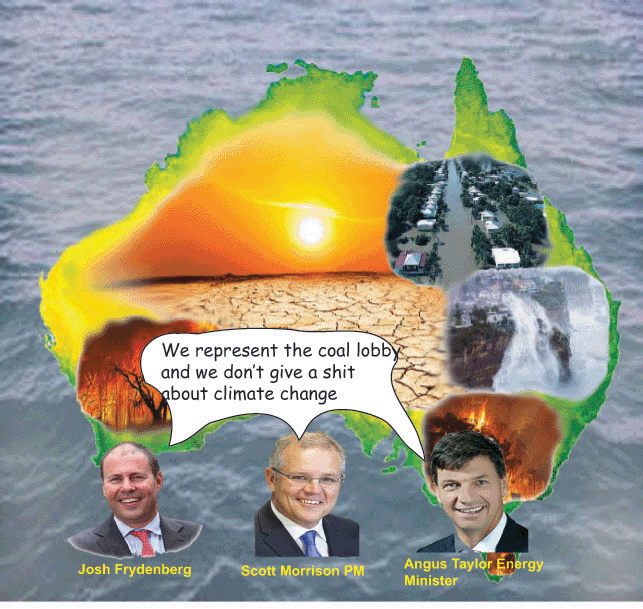
Coal’s servant, P.M. Morrison makes Australia an international pariah at UN Climate Summit
|
PM accused of ‘trashing’ Australia’s reputation by spruiking coal ahead of UN summit, SMH, By Dana McCauley September 22, 2019 Environmentalists are accusing Scott Morrison of “trashing” Australia’s international reputation, as official documents reveal the broad scale of his government’s efforts to significantly increase coal exports at a time of mass protests calling for action on climate change.
As delegates of the United Nations climate change summit – which Mr Morrison has snubbed – prepare to discuss emission reduction efforts this week, briefing notes obtained under Freedom of Information laws detail the emphasis placed on coal in the government’s diplomatic relations.
Departmental briefing notes provided to Resources Minister Matt Canavan ahead of his official visit to Singapore and India last month canvass the potential to expand Australia’s coal exports into Bangladesh – a nation that is among the most vulnerable to the effects of global warning. The government is seeking to grow its coal exports in overseas markets as it looks to buttress the economic fallout from a deteriorating relationship with China. Australian Conservation Foundation climate change campaigner Christian Slattery said Australia was “trashing its international reputation because of its addiction to polluting coal”. “As major importers of Australian coal move to transition to cleaner forms of energy, the Morrison government is doing the coal industry’s bidding, trying to secure new markets,” Mr Slattery said. “Burning coal is the number-one cause of climate damage. Unless we stop digging up and burning coal the planet will suffer unmanageable damage from more extreme fires, droughts, storms and coral bleaching that will harm hundreds of millions of people.” The briefing note to Senator Canavan, released in redacted form to the ACF, said that with “a significant expansion of coal-fired power in Bangladesh expected in the near future”, there were opportunities for Australia “to establish a new export market for thermal coal”…….. Foreign Minister Marise Payne will front the UN climate change summit this week, but will not address delegates – as Australia is among a group of coal-supporting economies singled out as not getting a spot on the list of 63 speakers. Mr Morrison’s snub comes despite him being in the United States on an official visit…….. ACF’s Mr Slattery said the government “seems intent on selling a 20th century technology to a 21st century world and doing a great deal more climate damage while they are at it”. “Australia’s reported blocking by the UN Secretary-General from speaking at the special climate summit in New York is nothing short of an international embarrassment for a wealthy and developed country that prides itself on being a good international citizen,” he said. https://www.smh.com.au/politics/federal/pm-accused-of-trashing-australia-s-reputation-by-spruiking-coal-ahead-of-un-summit-20190922-p52tr1.html |
|
Australian children, and adults who care, march in their hundreds of thousands, for Action on Climate Change
 While our revered Prime Minister was sucking up to USA’s revered President, and totally ignoring the climate issue, hundreds of thousands of Australian citizens were rallying for action on climate change. I was there, in Melbourne, and I’ve never seen anything like it. I’ve been there in big rallies, 100,000 and more- but this was the biggest ever!
And so many children. It is their future, that we are talking about!!

|
Global climate strike : Australian school students march to protest climate change https://www.smh.com.au/national/global-climate-strike-live-australian-school-students-march-in-protest-of-climate-change-20190920-p52t70.htm By Jenny Noyes and Natassia Chrysanthos September 20, 2019 — That’s a wrap for Australia’s climate strikes It’s been a huge day for more than 300,000 Australian school and university students, families and workers who took to the streets of their cities and towns to protest climate change inaction. Organisers described the turnout as the biggest nationwide since 500,000 people protested against the Iraq war in 2003. Similar school strikes in March and November last year drew 40,000 and 15,000 people. Police commended the large crowds for displaying good behaviour at the peaceful protests. The rallies produced some powerful images, particularly in Sydney and Melbourne where the crowds were especially large – so check out our gallery to the right for all the best photos. [on original] |
|
Australian Labor Party standing firm on its climate policies
 Labor’s climate policies are ‘unshakeable’ despite election loss, Mark Butler says
Shadow climate minister says he believes Scott Morrison may shift on issue during the coming term, Guardian, Katharine Murphy Political editor @murpharoo, 21 Sep 2019 Mark Butler wants to make one thing clear: the shadow minister for climate change and energy is not for turning. It wasn’t a mistake to pursue an ambitious climate policy in the 2019 election and “we are not going to change our position to get to a level of profound irresponsibility [on policy], like the government”, he tells Guardian Australia’s politics podcast.
“Our position on climate is unshakeable.”……..
he also thinks it is possible Scott Morrison will shift on climate during the coming term, particularly if the Australian community remains vocal on the issue, and business also continues to demand policy certainty to allow it to deal with carbon risk. He says for people who want practical climate action, as opposed to rhetoric, bipartisanship remains “the holy grail”.
Butler says Morrison is not Malcolm Turnbull on climate, and not Tony Abbott, but somewhere in the middle. He suspects the prime minister has no “deep beliefs” on the issue, but that could enable him to pivot to a more plausible policy position in the event he makes a judgment that climate change is harming the electoral prospects of the Coalition. Perhaps Morrison, he says, can take “some baby steps to break down the culture war”.
…….. Butler says all the survey evidence he has seen indicates Australian voters are alarmed by the lack of policy action on climate change, and the issue rates second behind concerns about cost of living pressure. He says he is “utterly convinced” that public opinion in favour of action is “broad, deep and growing”.
Politicians, he says, need to be particularly aware that young people are hugely motivated on climate change. Butler has teenaged children and meets regularly with young activists.
“If we get to 2030 with the level of inertia we’ve had over the last decade, then we have profoundly let down our children and grandchildren”. https://www.theguardian.com/australia-news/2019/sep/21/labors-climate-policies-are-unshakeable-despite-election-loss-mark-butler-says?fbclid=IwAR0EPtILqei1clnBN_uRzHHflc-m2HBdcrvmQ3E9SUt0A3JkunlqKVc08Sk
Revealed: Josh Frydenberg was behind the strange Environment Department decision to block wind turbines on Lord Howe Island.
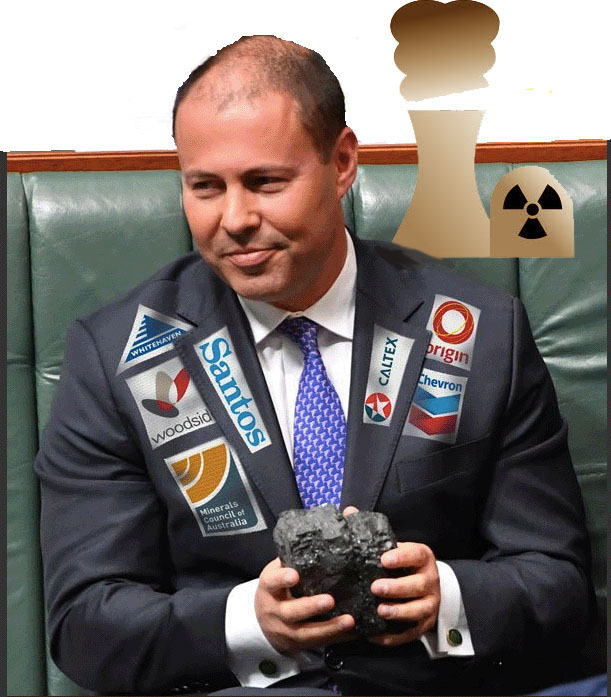 Josh Frydenberg overruled department to block Lord Howe Island wind turbines, FOI documents reveal former environment minister took action despite support from islanders, Guardian, Anne Davies, 18 Sept 19 The former environment minister Josh Frydenberg went against the advice of his departmental experts when he blocked two wind turbines on Lord Howe Island in 2017, consigning the world heritage-listed island to relying on diesel fuel for the bulk of its electricity. Josh Frydenberg overruled department to block Lord Howe Island wind turbines, FOI documents reveal former environment minister took action despite support from islanders, Guardian, Anne Davies, 18 Sept 19 The former environment minister Josh Frydenberg went against the advice of his departmental experts when he blocked two wind turbines on Lord Howe Island in 2017, consigning the world heritage-listed island to relying on diesel fuel for the bulk of its electricity.A freedom of information request by the Guardian has uncovered that the minister took the unusual action of blocking the project under the Environmental Protection and Biodiversity Conservation Act, deeming it “unacceptable”…… Projects are rarely ruled “unacceptable” under federal environmental laws but are often approved with modifications or strict conditions. For instance, the Adani coal project’s groundwater plan was approved in 2019 with conditions; the Abbot Point coal terminal was judged not to have unacceptable impacts on the Great Barrier Reef; and the Watermark coal project near Tamworth was waved through in 2015. But two medium-sized wind turbines on Lord Howe Island proved a bridge too far for Frydenberg as environment minister. Now the Guardian can reveal that his decision was taken despite the advice of his own department, strong support from the majority of residents on Lord Howe Island, the governing board of the island, and even another federal government agency – the Australian Renewable Energy Agency – which had offered $4.6m in funding towards the renewable energy project. The department’s natural heritage section 23 November 2016 advice was that “the proposed action is unlikely to significantly impact the Island Group’s world heritage values” and that moving the island away from reliance on weekly deliveries of diesel would help secure its Unesco world heritage status……… The case raises questions about political influence in environmental decision making. “Former environment minister Josh Frydenberg’s rejection of the Lord Howe Island windfarm is inconsistent with many other environmental approvals where there was strong departmental advice about unavoidable risks to internationally protected places and wildlife,” Basha Stasak, the Australian Conservation Foundation’s nature campaign manager, said.
“For example, Frydenberg ignored clear departmental advice urging a rejection of the Toondah Harbour property development because it would destroy part of an internationally protected wetland. “These inconsistencies go to the heart of the environmental law reform Australia needs. We need strong laws and decisions made under them by an independent national Environment Protection Authority,” she said…….. Lord Howe Island resident Craig Thompson – “Sustainable clean energy for a world heritage site like Lord Howe should be mandatory. We should be setting an example to the whole world, not being held back by a minister’s political ideology or personal opinion.” …….. Lord Howe Island is now exploring what can be done with solar and batteries to meet the island’s needs. New South Wales spends $750,000 a year on shipping diesel to the island to provide power for its 350 residents. https://www.theguardian.com/australia-news/2019/sep/18/josh-frydenberg-overruled-department-to-block-lord-howe-island-wind-turbines |
|
Climate change already damaging Australia’s ecosystems
|
Australia’s ecosystems ‘already suffering from climate change’ https://www.sbs.com.au/news/australia-s-ecosystems-already-suffering-from-climate-change 18 Sept 19, Warming temperatures are threatening Australian wildlife with the iconic Kakadu National Park also in danger of rising sea levels, a report has found.Australian wildlife is under threat and forests that don’t normally burn are being devastated by fire, with ecosystems already suffering from climate change, a new report suggests.
The Climate Council report found sensitive vegetation that’s never been subject to fires before is burning, ringtail possums and flying foxes are dying from heatwaves and river catchments are losing mangroves due to underwater heatwaves. “In Queensland we are seeing bushfires burning into rainforests that have basically never had bushfires before,” report author Lesley Hughes told AAP. Professor Hughes warned that climate change is not a future problem but a problem that needs to be addressed now.
“What we are seeing is devastating impacts that have occurred with about one degree of warming,” she said. “It’s not just rising average temperatures, just having one or two really hot days can wipe out a whole species.”
The council found sea levels in northern Australia are rising about twice the global average, which is threatening wetlands in the Northern Territory’s iconic Kakadu National Park. Rising temperatures are also threatening the endangered Carnaby’s black cockatoo, which is found in southwestern Australia, because it is very susceptible to heat stress.
The warming weather also puts at risk green turtles, with the report finding 99 per cent of the animals hatching in the northern Great Barrier Reef are female. “When the temperature is over 29C green turtles will hatch into females … the future impacts on the population are devastating,” Prof Hughes said. The council called on the federal government to take a bolder approach to conservation to ensure Australia’s ecosystems are resilient to the increasing extreme weather experienced across the nation.
“Australia has long been regarded as one of the most vulnerable developed countries to the impacts of climate change,” Prof Hughes said. “The government is frankly not dealing with the situation at all.”
The council criticised Australia’s conservation record, with the nation having one of the highest rates of species extinctions. “Australia is home to more than a million species of plants and animals yet our track record on conservation is woeful; climate change is making it even harder to protect them,” chief councillor Tim Flannery said in a statement.
|
|
National Party disdains report from Farmers for Climate Action
 Nationals MPs snub launch of farming group’s climate change report https://www.theguardian.com/environment/2019/sep/16/nationals-mps-snub-launch-of-farming-groups-climate-change-report
Australia’s agricultural production will fall and food insecurity will rise without a climate strategy, report warns, Sarah Martin Chief political correspondent 16 Sept 19, Nationals MPs have snubbed a farmers’ group launching a major climate change report that warns the Australian agricultural sector faces “significant threats to viability” without a new national climate strategy.
The report, launched by the Farmers for Climate Action group at Parliament House on Monday, warns that agricultural production will fall, farm profits will decline and food insecurity will increase if the government does not come up with a cohesive national strategy on climate change and agriculture.
Lucinda Corrigan, the chair of Farmers for Climate Action, said she had wanted Nationals MPs to attend the event, saying she believed cross-party support was needed given the challenge facing producers.
“It would have been great if they had been there because they need to take this seriously,” Corrigan said.
“Because being green is actually our agenda, it’s actually a conservative agenda, being a conservationist is a conservative agenda, it is not a green agenda, it has been taken from us and we actually want it back.”
She also said Nationals MPs should consider the concerns within the agricultural sector about climate change separately to the issues affecting the energy sector. Continue reading
Australian Capital Territory leads the nation in the climate emergency
Canberra acts ‘first’ in the climate emergency, Canberra Times, Penny D Sackett , 16 Sept 19, On Monday, the ACT government released its Climate Change Strategy 2019-2025, just a few months after declaring a climate emergency in May, the first Australian state or territory to do so. The document contains several more Australian “firsts,” reflecting the government’s desire to lead climate action. Is this new strategy needed, and what does it mean for Canberrans?
Previous ACT climate strategy documents are out-of-date for three reasons: science, economics, and new legislated emissions targets.
Second, the rapid advance in new technologies such as battery storage and electric vehicles means that a wider variety of solutions is now economically viable, presenting new opportunities for local investment and job growth. Furthermore, because the monetary and human costs of inaction are so enormous, substantial near-term climate action is responsible both economically and socially.
Finally, the ACT government has recently brought forward its commitment to zero net emissions from 2050 to 2045, and put in place science-based interim emission targets for 2025, 2030, and 2040 to guide the way. These legislated targets, based on advice from the ACT Climate Change Council and in line with global carbon budget responsibilities to hold warming below 2 degrees celsius, are not only an Australian first for states and territories, but world-leading. A new plan is needed to realise the 2025 target of reducing ACT emissions by at least 50 per cent compared to 1990 levels, whilst collecting data that will be vital in meeting the next target in 2030.
So what does the plan hold in store for Canberra and Canberrans?
The starting point of the new strategy is the assumption that the ACT will effectively be powered by 100 per cent renewable electricity in 2020 – an expectation that will likely be met due to the territory’s previous investment in large scale solar and wind generation. Achieving that goal will result in a 40 per cent reduction of emissions from 1990 levels. The additional reduction required to meet the 2025 target will need to come primarily from the transport and gas sectors. After 2020, ACT transport emissions (which overwhelmingly come from private vehicles) will account for 60 per cent of Canberra’s emissions, with gas for heating and cooking making up another 20 per cent or so.
Substantial reduction in emissions from transport and gas use can only be achieved through a change in the choices made by Canberrans, at our work and businesses, and in our homes. Those low-emissions choices must be enabled and supported by government policies and regulations.
The new ACT climate strategy contains several realistic, forward-looking actions that begin to provide the magnitude of support and vision required in these sectors, and many are “firsts” among Australian states and territories. Among these are: ensuring that all new schools and government buildings are all-electric and appropriate for the changing climate; a commitment to maintain 100 per cent renewable electricity supply into the future; and a fossil-fuel-free bus fleet by 2040. …….https://www.canberratimes.com.au/story/6389173/canberra-acts-first-in-the-climate-emergency/?cs=14246
Climate crisis confronts Morrison
Climate crisis confronts Morrison https://www.theguardian.com/australia-news/2019/sep/16/environmental-groups-warn-against-push-for-nuclear-power-in-australia– Paul Karp@Paul_Karp16 Sep 2019
When parliament resumes on Monday Scott Morrison will play host to Fijian prime minister Frank Bainimarama.
Defence, labour mobility, trade, investment, illegal fishing and climate change are all on the agenda for the bilateral meeting. Bainimarama was heavily critical of Morrison at the Pacific Islands forum, saying the Australian PM had insulted and alienated Pacific leaders over his failure to back stronger emissions targets.
The climate crisis will also be forced back onto the agenda by the member for Warringah, Zali Steggall, who will bring a motion, seconded by independent MP Helen Haines, calling on the government to decarbonise the economy by 2050 to reduce the health impact and linking it to extreme weather events.
Earlier in September the Australian Medical Association formally declared climate change a health emergency; Steggall’s call will be backed by peak health bodies pointing to heat related illnesses, respiratory diseases and hypoallergenic conditions caused by global heating.
Australia is in the grip of early-spring fires in New South Wales and Queensland and a drought that could see parts of NSW run out of water as early as November.
Steggall said the “unprecedented fires” and the “shocking drought” are “events causing terrible health impacts which are going to get more severe as the world continues to warm”. https://www.theguardian.com/australia-news/2019/sep/16/environmental-groups-warn-against-push-for-nuclear-power-in-australia
1 This month

of the week – Australians for War Powers Reform (AWPR)
To see nuclear-related stories in greater depth and intensity
 Antinuclear