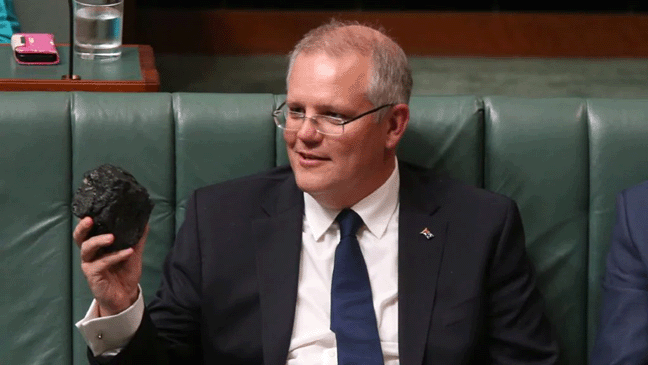
Australia losing credibility with Pacific nations, as Morrison supports coal, not climate action
|
Australia’s climate change stance damaging relationship with Pacific islands, former Kiribati president warns, ABC News, By political reporter Matthew Doran , 19 Aug 19. Pacific nations may view Australia as the “worst of two evils” when compared to China, after it undermined a deal on climate change, according to the former president of one of the region’s smallest nations.
Key points:
Prime Minister Scott Morrison and the Coalition have been broadly criticised for forcing leaders at last week’s Pacific Islands Forum (PIF) in Tuvalu to water down language on cutting carbon emissions and phasing out the use of coal. China’s rising influence in the Pacific is of concern to Australia, which has “stepped up” its presence in the region through aid and development funding. But Anote Tong, who from 2003 to 2016 served as president of Kiribati — a series of islands atolls in the Pacific which is home to more than 100,000 people — said the renewed interest from Canberra could be dismissed, as island nations expressed their disgust at the nation’s lack of leadership on climate change. “It’s really about the lesser of the two evils, I guess,” he told RN Breakfast…. https://www.abc.net.au/news/2019-08-19/australia-climate-change-inaction-damaging-pacific-relationship/11426390 |
|
Climate change is altering ocean waves, as well as causing sea level rise

|
Climate change may change the way ocean waves impact 50% of the world’s coastlines The Conversation, Principal Research Scientist, Oceans and Atmosphere, CSIRO, Kernot Professor of Engineering, University of Melbourne, PhD Candidate, Griffith University, Professor, Kyoto University, August 20, 2019 The rise in sea levels is not the only way climate change will affect the coasts. Our research, published today in Nature Climate Change, found a warming planet will also alter ocean waves along more than 50% of the world’s coastlines.
If the climate warms by more than 2℃ beyond pre-industrial levels, southern Australia is likely to see longer, more southerly waves that could alter the stability of the coastline. Scientists look at the way waves have shaped our coasts – forming beaches, spits, lagoons and sea caves – to work out how the coast looked in the past. This is our guide to understanding past sea levels. But often this research assumes that while sea levels might change, wave conditions have stayed the same. This same assumption is used when considering how climate change will influence future coastlines – future sea-level rise is considered, but the effect of future change on waves, which shape the coastline, is overlooked. Changing wavesWaves are generated by surface winds. Our changing climate will drive changes in wind patterns around the globe (and in turn alter rain patterns, for example by changing El Niño and La Niña patterns). Similarly, these changes in winds will alter global ocean wave conditions. Further to these “weather-driven” changes in waves, sea level rise can change how waves travel from deep to shallow water, as can other changes in coastal depths, such as affected reef systems. Recent research analysed 33 years of wind and wave records from satellite measurements, and found average wind speeds have risen by 1.5 metres per second, and wave heights are up by 30cm – an 8% and 5% increase, respectively, over this relatively short historical record. These changes were most pronounced in the Southern Ocean, which is important as waves generated in the Southern Ocean travel into all ocean basins as long swells, as far north as the latitude of San Francisco. Sea level rise is only half the story.…. https://theconversation.com/climate-change-may-change-the-way-ocean-waves-impact-50-of-the-worlds-coastlines-121239 |
South Australian students plan more climate action -“No jobs on a dead planet”
Tom Webster and Guthrow Taylor Johnson are among 12 student protesters skipping school between 9am and 3pm on Friday each week with no intention of stopping in the near future.
The weekly strikes follow mass school walkouts across the globe earlier this year, including in South Australia.
On March 15, thousands of high school and university students swarmed King William Street demanding politicians take a firmer stance on climate change.
During the event, Adelaide School 4 Climate spokesperson Doha Khan called on her peers to boycott Friday classes until the Federal election.
lthough the election came and went, Taylor Johnson said the group wouldn’t stop protesting until their key demands were met.
“We want no more new fossil fuel projects in Australia,” he said.
“Starting with saying no to Adani, which is going to be the biggest coal mine in the Southern Hemisphere if the government allows them to build it.
“We also want 100 per cent renewables by 2030 and we want a just transition for workers in fossil fuel industries for them to go into renewables.”
The South Australian climate strikes are part of an international movement led by 16-year-old Swedish climate activist Greta Thunberg.
In 2018, Thunberg spent every school day sitting outside of Sweden’s parliament protesting the country’s inaction on climate change. Thunberg later reduced her strikes to every Friday, kicking off a movement of Friday school protests.
A wave of school and university strikes demanding more progressive climate policy has since erupted across the globe.
Last Friday, the National Union of Students led university students in Australian capital cities in striking against climate change.
Webster said while many of their fellow weekly protesters were attending the strike he and Taylor Johnson – who are both still in high school – felt it was important to continue their parliamentary protest as well.
Taylor Johnson said the pair planned to join the next major climate strike, to be held on September 20, and hoped to see his peers there.
“Right now, in Australia, [there’s] a lot of climate deniers. So, it’s up to Australia to both lead the way in climate policies and set an example to other countries,” Taylor Johnson said.
A Seaton High School year 11 student, Taylor Johnson said he originally struggled to find a balance between his studies, social life and activism but has managed to navigate the three successfully…. https://indaily.com.au/news/2019/08/16/no-jobs-on-a-dead-planet-the-sa-students-who-wont-give-up-on-the-climate-change-strike/
Nuclear’s disadvantages – greenhouse gases and costs
Michele Madigan, Advertiser, August 19, Re‘Nuclear Benefits’ (Advertiser 31/7/19), according to the 2006 Switkowski Report, nuclear power emits three times more greenhouse gases than wind power. In these drought years, Australians may prefer other uses for the 35 to 65 million litres per day that reactors typically consume. It’s a long wait – 15 years or more to develop nuclear power in Australia.
The nuclear power industry survives only because of huge taxpayer subsidies an estimated A$40 billion for Hinkley Point’s two reactors in the UK. Finally, the awkward matter of very possible accidents with Chernobyl and Fukushima being only more recent and catastrophic examples: modern technology notwithstanding. No surprise then that insurance companies do not insure against the risk of nuclear accidents. Given the inconvenient facts, nuclear power mightn’t seem such a good idea after all.
NUCLEAR POWER ‒ NO SOLUTION TO CLIMATE CHANGE
 Friends of the Earth Australia Statement August 2019 http://www.nuclear.foe.org.au
- Introduction 2. Nuclear Power Would Inhibit the Development of More Effective Solutions 3. The Nuclear Power Industry is in Crisis 4. Small Modular Reactors 5. Nuclear Weapons Proliferation and Nuclear Winter 6. A Slow Response to an Urgent Problem 7. Climate Change & Nuclear Hazards: ‘You need to solve global warming for nuclear plants to survive.’ 8. Nuclear Racism 9. Nuclear Waste 10. More Information
- Introduction
Support for nuclear power in Australia has nothing to do with energy policy – it is instead an aspect of the ‘culture wars‘ driven by conservative ideologues (examples include current and former politicians Clive Palmer, Tony Abbott, Cory Bernardi, Barnaby Joyce, Mark Latham, Jim Molan, Craig Kelly, Eric Abetz, and David Leyonhjelm; and media shock-jocks such as Alan Jones, Andrew Bolt and Peta Credlin). With few exceptions, those promoting nuclear power in Australia also support coal, they oppose renewables, they attack environmentalists, they deny climate change science, and they have little knowledge of energy issues and options. The Minerals Council of Australia – which has close connections with the Coalition parties – is another prominent supporter of both coal and nuclear power.
In January 2019, the Climate Council, comprising Australia’s leading climate scientists and other policy experts, issued a policy statement concluding that nuclear power plants “are not appropriate for Australia – and probably never will be”. The statement continued: “Nuclear power stations are highly controversial, can’t be built under existing law in any Australian state or territory, are a more expensive source of power than renewable energy, and present significant challenges in terms of the storage and transport of nuclear waste, and use of water”.
Friends of the Earth Australia agrees with the Climate Council. Proposals to introduce nuclear power to Australia are misguided and should be rejected for the reasons discussed below (and others not discussed here, including the risk of catastrophic accidents).
- Nuclear Power Would Inhibit the Development of More Effective Solutions
Renewable power generation is far cheaper than nuclear power. Lazard’s November 2018 report on levelised costs of electricity found that wind power (US$29‒56 per megawatt-hour) and utility-scale solar (US$36‒46 / MWh) are approximately four times cheaper than nuclear power (US$112‒189 / MWh).
A December 2018 report by the CSIRO and the Australian Energy Market Operator concluded that “solar and wind generation technologies are currently the lowest-cost ways to generate electricity for Australia, compared to any other new-build technology.”
Thus the pursuit of nuclear power would inhibit the necessary rapid development of solutions that are cheaper, safer, more environmentally benign, and enjoy far greater public support. A 2015 IPSOS poll found
that support among Australians for solar power (78‒87%) and wind power (72%) is far higher than support for coal (23%) and nuclear (26%).
Renewables and storage technology can provide a far greater contribution to power supply and to climate change abatement compared to an equivalent investment in nuclear power. Peter Farley, a fellow of the Australian Institution of Engineers, wrote in January 2019: “As for nuclear the 2,200 MW Plant Vogtle [in the US] is costing US$25 billion plus financing costs, insurance and long term waste storage. For the full cost of US$30 billion, we could build 7,000 MW of wind, 7,000 MW of tracking solar, 10,000 MW of rooftop solar, 5,000MW of pumped hydro and 5,000 MW of batteries. That is why nuclear is irrelevant in Australia.”
Dr. Ziggy Switkowski ‒ who led the Howard government’s review of nuclear power in 2006 ‒ noted in 2018 that “the window for gigawatt-scale nuclear has closed”, that nuclear power is no longer cheaper than renewables and that costs are continuing to shift in favour of renewables.
Globally, renewable electricity generation has doubled over the past decade and costs have declined sharply. Renewables account for 26.5% of global electricity generation. Conversely, nuclear costs have increased four- fold since 2006 and nuclear power’s share of global electricity generation has fallen from its 1996 peak of 17.6% to its current share of 10%.
As with renewables, energy efficiency and conservation measures are far cheaper and less problematic than nuclear power. A University of Cambridge study concluded that 73% of global energy use could be saved by energy efficiency and conservation measures. Yet Australia’s energy efficiency policies and performance are among the worst in the developed world.
- The Nuclear Power Industry is in Crisis
The nuclear industry is in crisis with lobbyists repeatedly acknowledging nuclear power’s “rapidly accelerating crisis”, a “crisis that threatens the death of nuclear energy in the West” and “the crisis that the nuclear industry is presently facing in developed countries”, while noting that “the industry is on life support in the United States and other developed economies” and engaging each other in heated arguments about what if anything can be salvaged from the “ashes of today’s dying industry”.
It makes no sense for Australia to be introducing nuclear power at a time when the industry is in crisis and when a growing number of countries are phasing out nuclear power (including Germany, Switzerland, Spain, Belgium, Taiwan and South Korea).
The 2006 Switkowski report estimated the cost of electricity from new reactors at A$40–65 / MWh. Current estimates are four times greater at A$165‒278 / MWh. In 2009, Dr. Switkowski said that a 1,000 MW power reactor in Australia would cost A$4‒6 billion. Again, that is about one-quarter of all the real-world experience over the past decade in western Europe and north America, with cost estimates of reactors under construction ranging from A$17‒24 billion (while a reactor project in South Carolina was abandoned after the expenditure of at least A$13.3 billion).
Thanks to legislation banning nuclear power, Australia has avoided the catastrophic cost overruns and crises that have plagued every recent reactor project in western Europe and north America. Cheaper Chinese or Russian nuclear reactors would not be accepted in Australia for a multitude of reasons (cybersecurity, corruption, repression, safety, etc.). South Korea has been suggested as a potential supplier, but South Korea is slowly phasing out nuclear power, it has little experience with its APR1400 reactor design, and South Korea’s ‘nuclear mafia‘ is as corrupt and dangerous as the ‘nuclear village‘ in Japan which was responsible for the Fukushima disaster.
- Small Modular Reactors
The Minerals Council of Australia claims that small modular reactors (SMRs) are “leading the way in cost”. In fact, power from SMRs will almost certainly be more expensive than power from large reactors because of diseconomies of scale. The cost of the small number of SMRs under construction is exorbitant. Both the private sector and governments have been unwilling to invest in SMRs because of their poor prospects. The December 2018 report by the CSIRO and the Australian Energy Market Operator found that even if the cost of power from SMRs halved, it would still be more expensive than wind or solar power with storage costs included (two hours of battery storage or six hours of pumped hydro storage).
The prevailing scepticism is evident in a 2017 Lloyd’s Register report based on the insights of almost 600 professionals and experts from utilities, distributors, operators and equipment manufacturers. They predict that SMRs have a “low likelihood of eventual take-up, and will have a minimal impact when they do arrive”.
No SMRs are operating and about half of the small number under construction have nothing to do with climate change abatement – on the contrary, they are designed to facilitate access to fossil fuel resources in the Arctic, the South China Sea and elsewhere. Worse still, there are disturbing connections between SMRs, nuclear weapons proliferation and militarism more generally.
- Nuclear Weapons Proliferation and Nuclear Winter
“On top of the perennial challenges of global poverty and injustice, the two biggest threats facing human civilisation in the 21st century are climate change and nuclear war. It would be absurd to respond to one by increasing the risks of the other. Yet that is what nuclear power does.” ‒ Australian
Nuclear power programs have provided cover for numerous covert weapons programs and an expansion of nuclear power would exacerbate the problem. After decades of deceit and denial, a growing number of nuclear industry bodies and lobbyists now openly acknowledge and even celebrate the connections between nuclear power and weapons. They argue that troubled nuclear power programs should be further subsidised such that they can continue to underpin and support weapons programs.
For example, US nuclear lobbyist Michael Shellenberger previously denied power–weapons connections but now argues that “having a weapons option is often the most important factor in a state pursuing peaceful nuclear energy”, that “at least 20 nations sought nuclear power at least in part to give themselves the option of creating a nuclear weapon”, and that “in seeking to deny the connection between nuclear power and nuclear weapons, the nuclear community today finds itself in the increasingly untenable position of having to deny these real world connections.”
Former US Vice President Al Gore has neatly summarised the problem: “For eight years in the White House, every weapons-proliferation problem we dealt with was connected to a civilian reactor program. And if we ever got to the point where we wanted to use nuclear reactors to back out a lot of coal … then we’d have to put them in so many places we’d run that proliferation risk right off the reasonability scale.”
Running the proliferation risk off the reasonability scale brings the debate back to climate change. Nuclear warfare − even a limited, regional nuclear war involving a tiny fraction of the global arsenal − has the potential to cause catastrophic climate change. The problem is explained by Alan Robock in The Bulletin of the Atomic Scientists: “[W]e now understand that the atmospheric effects of a nuclear war would last for at least a decade − more than proving the nuclear winter theory of the 1980s correct. By our calculations, a regional nuclear war between India and Pakistan using less than 0.3% of the current global arsenal would produce climate change unprecedented in recorded human history and global ozone depletion equal in size to the current hole in the ozone, only spread out globally.”
Nuclear plants are also vulnerable to security threats such as conventional military attacks (and cyber-attacks such as Israel’s Stuxnet attack on Iran’s enrichment plant), and the theft and smuggling of nuclear materials. Examples of military strikes on nuclear plants include the destruction of research reactors in Iraq by Israel and the US; Iran’s attempts to strike nuclear facilities in Iraq during the 1980−88 war (and vice versa); Iraq’s attempted strikes on Israel’s nuclear facilities; and Israel’s bombing of a suspected nuclear reactor site in Syria in 2007.
6. A Slow Response to an Urgent Problem
Expanding nuclear power is impractical as a short-term response to climate change. An analysis by Australian economist Prof. John Quiggin concludes that it would be “virtually impossible” to get a nuclear power reactor operating in Australia by 2040.
More time would elapse before nuclear power has generated as much as energy as was expended in the construction of the reactor. A University of Sydney report states: “The energy payback time of nuclear energy is around 6.5 years for light water reactors, and 7 years for heavy water reactors, ranging within 5.6–14.1 years, and 6.4–12.4 years, respectively.”
Taking into account planning and approvals, construction, and the energy payback time, it would be a quarter of a century or more before nuclear power could even begin to reduce greenhouse emissions in Australia … and then only assuming that nuclear power displaced fossil fuels.
- Climate Change & Nuclear Hazards: ‘You need to solve global warming for nuclear plants to survive.’
“I’ve heard many nuclear proponents say that nuclear power is part of the solution to global warming. It needs to be reversed: You need to solve global warming for nuclear plants to survive.” ‒ Nuclear engineer David Lochbaum.
Nuclear power plants are vulnerable to threats which are being exacerbated by climate change. These include dwindling and warming water sources, sea-level rise, storm damage, drought, and jelly-fish swarms.
At the lower end of the risk spectrum, there are countless examples of nuclear plants operating at reduced power or being temporarily shut down due to water shortages or increased water temperature during heatwaves (which can adversely affect reactor cooling and/or cause fish deaths and other problems associated with the dumping of waste heat in water sources). In the US, for example, unusually hot temperatures in 2018 forced nuclear plant operators to reduce reactor power output more than 30 times.
At the upper end of the risk spectrum, climate-related threats pose serious risks such as storms cutting off grid power, leaving nuclear plants reliant on generators for reactor cooling.
‘Water wars’ will become increasingly common with climate change − disputes over the allocation of increasingly scarce water resources between power generation, agriculture and other uses. Nuclear power reactors consume massive amounts of cooling water − typically 36.3 to 65.4 million litres per reactor per day. The World Resources Institute noted last year that 47% of the world’s thermal power plant capacity ‒ mostly coal, natural gas and nuclear ‒ are located in highly water-stressed areas.
By contrast, the REN21 Renewables 2015: Global Status Report states: “Although renewable energy systems are also vulnerable to climate change, they have unique qualities that make them suitable both for reinforcing the resilience of the wider energy infrastructure and for ensuring the provision of energy services under changing climatic conditions. System modularity, distributed deployment, and local availability and diversity of fuel sources − central components of energy system resilience − are key characteristics of most renewable energy systems.”
- Nuclear RacismTo give one example (among many), the National Radioactive Waste Management Act dispossesses and disempowers Traditional Owners in every way imaginable:
- The nomination of a site for a radioactive waste dump is valid even if Aboriginal owners were not consulted and did not give consent.
- The Act has sections which nullify State or Territory laws that protect archaeological or heritage values, including those which relate to Indigenous traditions.
The nuclear industry has a shameful history of dispossessing and disempowering Aboriginal people and communities, and polluting their land and water, dating from the British bomb tests in the 1950s. The same attitudes prevail today in relation to the uranium industry and planned nuclear waste dumps and the problems would be magnified if Australia developed nuclear power.
The Act curtails the application of Commonwealth laws including the Aboriginal and Torres Strait Islander Heritage Protection Act 1984 and the Native Title Act 1993 in the important site-selection stage.
- The Native Title Act 1993 is expressly overridden in relation to land acquisition for a radioactive waste dump.
9. Nuclear Waste
Decades-long efforts to establish a repository and store for Australia’s low-and intermediate-level nuclear waste continue to flounder and are currently subject to legal and Human Rights Commission complaints and challenges, initiated by Traditional Owners of two targeted sites in South Australia. Establishing a repository for high-level nuclear waste from a nuclear power program would be far more challenging as Federal Resources Minister Matt Canavan has noted.
Globally, countries operating nuclear power plants are struggling to manage nuclear waste and no country has a repository for the disposal of high-level nuclear waste. The United States has a deep underground repository for long-lived intermediate-level waste, called the Waste Isolation Pilot Plant (WIPP). However the repository was closed from 2014‒17 following a chemical explosion in an underground waste barrel. Costs associated with the accident are estimated at over A$2.9 billion.
Safety standards fell away sharply within the first decade of operation of the WIPP repository ‒ a sobering reminder of the challenge of safely managing nuclear waste for millennia.
- More Information
- Climate Council, 2019, ‘Nuclear Power Stations are Not Appropriate for Australia – and Probably Never Will Be‘
- WISE Nuclear Monitor, 25 June 2016, ‘Nuclear power: No solution to climate change‘
- Friends of the Earth Australia nuclear power online resources
Jacinda Adearn and Scott Morrison – the contrast over attitudes to climate change
Speaking at the Pacific Islands Forum, she has urged for greater action on climate change and made a thinly veiled criticism of Australia’s defence of its rising greenhouse gas emissions.
We will continue to say that New Zealand will do its bit and we have an expectation that everyone else will as well,” she told reporters.
“Australia has to answer to the Pacific, that is a matter for them.”
Ms Ardern noted New Zealand contributes a small amount to global emissions but said that wasn’t an excuse not to act.
“If we all took the perspective that if you’re small it doesn’t matter, we wouldn’t see change.”
This is in stark contrast to Energy Minister Angus Taylor, who has used Australia’s small global contribution when defending rises in domestic emissions.
The New Zealand leader also sided with Pacific nations by saying anything more than a 1.5-degree rise in global temperatures would have a catastrophic effect.
Negotiations on the wording of the final communique are ongoing, with smaller nations calling for a phase-out of coal, no new coal mines and for Australia to not use carryover credits to reach emissions goals……
Although regional security issues are bubbling under the surface, Pacific leaders are dedicated to focusing on climate change, which is threatening their survival. …..
Minister for the Pacific Alex Hawke, who now has the prime minister by his side, earlier admitted Australia was trying to remove mention of phasing out of coal in the final communique.
He described it as a “red line issue” for Australian negotiators.
Mr Morrison has delved right into the forum, holding bilateral meetings on Wednesday with Ms Ardern as well as Vanuatu leader Charlot Salwai, Cook Islands Prime Minister Henry Puna and Tuvalu’s Enele Sopoaga.
Mr Sopoaga has not held back on his strong language against Australia, saying its aid for the region was no excuse not to reduce emissions or open new coal mines.
The Pacific leaders will spend Thursday together at a leaders’ retreat. https://www.sbs.com.au/news/australia-has-to-answer-to-the-pacific-ardern-weighs-in-on-climate-change-responsibilities
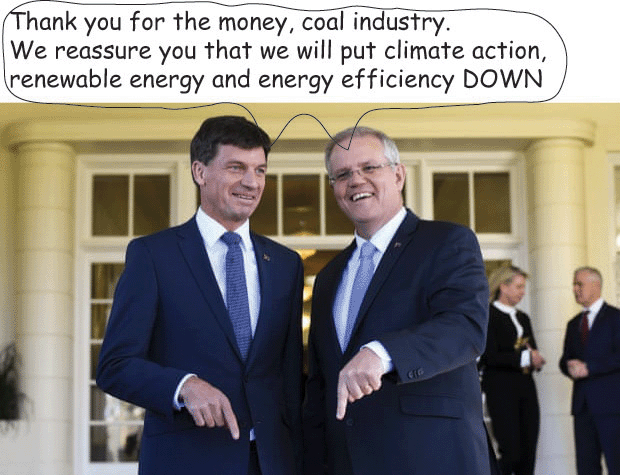
Australia’s Emissions Reduction Minister Angus Taylor makes light of UN’s urgent climate warning
 Australian government brushes off UN’s urgent climate warning, SBS News 9 Aug 19 Humanity faces increasingly painful trade-offs between food security and rising temperatures within decades unless emissions are curbed and unsustainable farming and deforestation halted, according to a landmark climate assessment.
The federal emissions reduction minister has defended Australia’s land management practices after a new United Nations climate change report called for changes in the way the world produces and consumes food.
The UN’s Intergovernmental Panel on Climate Change warned efforts to limit global warming while feeding a booming population could be wrecked without swift and sweeping changes to how we use the land we live off.
The report on land use and climate change highlighted the need to protect remaining tropical forests as a bulkhead against future warming. It offered a sobering take on the hope that reforestation and bio-fuel schemes alone can offset mankind’s environmental damage, underlining that reducing emissions will be central to averting disaster.
“Land is a source of emissions as well as a sink,” IPCC chair Hoesung Lee told AFP.
“Obviously you want to reduce emissions from land as much as possible. But that has a lot to do with what’s happening to the other side of the equation: greenhouse gas emissions, mainly from the energy sector.”
But Emissions Reduction Minister Angus Taylor said Australia is already absorbing emissions from land management. “This is a very, very important success story in Australia. Farmers, in particular, haven’t been given the credit they deserve for the role, the enormous role, they’ve played on this front,” he told ABC News on Friday.
But the minister brushed off concerns about the role meat-heavy diets play in climate change, suggesting the report was “forcing” people to become vegan……..
Land is intimately linked to climate. With its forests, plants, and soil it sucks up and stores around one-third of all man-made emissions. Intensive exploitation of these resources also produces huge amounts of planet-warming CO2, methane and nitrous oxide, while agriculture guzzles up 70 percent of Earth’s freshwater supply.
National Farmers Federation president Fiona Simson said the food warning should send “a shiver down your spine”…….
As the global population balloons towards 10 billion by mid-century, how land is managed by governments, industry and farmers will play a key role in limiting or accelerating the worst excesses of climate change.
Farmers for Climate Action want the federal government to implement a national strategy on climate change and agriculture, and to speed up the transition to clean energy.
“With NSW marking one year since it was 100 per cent drought-declared … and farmers across the country hurting from droughts, heatwaves and other extreme weather events, it is clear that climate change is already hurting Australian agriculture,” the group said in a statement……https://www.sbs.com.au/news/australian-government-brushes-off-un-s-urgent-climate-warning
Australia’s one great river system – Murray-Darling Basin Plan ‘untenable’ – corrupt?
|
Murray-Darling Basin Plan ‘untenable’ says NSW, as Inspector-General says more corruption wouldn’t surprise https://www.abc.net.au/news/2019-08-05/murray-darling-basin-plan-untenable-says-nsw/11382396
Key points:
|
Water shortage hitting Queensland town Stanthorpe
|
Day zero approaches for Stanthorpe as locals face prospect of levy to cover cost of trucked-in water https://www.abc.net.au/news/2019-08-05/stanthorpe-drought-bites-as-town-runs-out-of-water/11381886, ABC Southern Qld , By Elly Bradfield Locals describe it as the “worst drought in living memory” but things are about to go from bad to worse in the southern Queensland town of Stanthorpe, with the town water supply weeks away from drying up.
Key points:
If there is no rain by the end of spring, the council has estimated it will have to truck 45 loads water per day, costing up to $2 million a month, to supply the town. The Queensland Government has refused to be drawn on whether it will contribute, but the council said it would be forced charge ratepayers a levy if governments did not step in. Families strugglingBusiness has doubled at the laundromat, but owner Chris Reedy said that was a bitter pill to swallow with the community struggling.
“They struggle to put food on the table, let alone come and do washing for hygiene,” he said. “I feel depressed to see people in that state … especially families and young kids. “I’ve been helping out a bit with free loads to try to help out where I can.” He described spirits in the town as “at an all-time low” and raised concerns about people’s mental health. Without water you can’t make concreteTraditionally the winter period was concreter Lachlan Carnell’s busiest time, but with most farmers cash strapped, work has dried up and he has been forced to tell staff to “take whatever [work] they can get”. Without water you cannot mix concrete, so everyone’s a bit stressed at the moment,” he said. “The plant will have to start trucking in water, which is going to stress us the contractors and the clients because obviously the concrete is going to go up in price.
Levy threat causes fearAt the motel, owner Michael Jensen raised concerns about the impact of a water levy on the already struggling town. “I think it could have been handled a lot better because there’s a lot of people out there now that are very scared of what’s ahead of us,” he said. “We have an ageing population and a lot of those older people, including my parents for example, just have to try to find that extra money if it does come to that situation.” Mr Jensen broke down when he described the impact of the drought on his community. “If we don’t get water in the next three to six months I fear for the actual community,” he said. “It’s tough; tough for everyone especially the farmers.” ‘Not just farmers who struggle’Secretary of the Stanthorpe and Granite Belt Chamber of Commerce Amanda Harrold said the levy would be “the last straw” for many people. “It goes all the way through the town through families, the retail, the shopping centres, all the way to the school, to the hospital — what services will be kept if we have a dwindling community?” she said. “It’s not just the farmers who struggle in a drought. “This community cannot bear the cost of this, there just won’t be the money.” She said business was already down 20 to 50 per cent. “We are lucky that some tourists are coming to town, but with tourists comes the water usage, so it’s a really hard balancing act.” With the $84 million Emu Swamp Dam now fully funded, there is some hope for locals that the region can be protected from future droughts. But the Bureau of Meteorology has warned the town is unlikely to receive the soaking rain needed in the coming months. |
|
Andrew Bolt’s media attack on Greta Thunberg – Greta’s answer
|
Teen activist Greta Thunberg hits back at ‘deeply disturbed’ jibe from Andrew Bolt, SBS News, 2 Aug 19 Sixteen-year-old Greta Thunberg has responded to an op-ed written by columnist Andrew Bolt which describes the teenager as ‘deeply disturbed’.
Teen climate activist Greta Thunberg has derided criticism levied at her by conservative commentator Andrew Bolt. Her response follows an opinion piece by the News Corp columnist, labelling the 16-year-old a ‘deeply disturbed’ messiah. In a tweet, Greta returned fire, saying “hate and conspiracy campaigns” around climate change had prompted her strident advocacy action. “I am indeed ‘deeply disturbed’ about the fact that these hate and conspiracy campaigns are allowed to go on,” she tweeted.
“Just because we children communicate and act on the science. Where are the adults?” The Swedish activist’s School Strike for Climate initiative has sparked a worldwide movement calling for greater government action on climate change. She has been nominated for a Nobel peace prize for her campaigning, which has emphasised the need for urgent human action against global warming. But in his opinion piece, Mr Bolt questioned why so many are listening to her “climate panic”. “No teenager is more freakishly influential than Greta Thunberg,” Mr Bolt wrote in his op-ed…… Mr Bolt targeted this unwillingness to “compromise” in his opinion piece. “This allows followers who are tormented with doubt and burden of freedom to relax into her totalitarian certainty,” Mr Bolt wrote. “What is so fascinating about this Thunberg cult is not just that she’s believed so fervently even though she’s wrong.”….. He said it was troubling to him that this “wrong” view was being accepted. …….https://www.sbs.com.au/news/teen-activist-greta-thunberg-hits-back-at-deeply-disturbed-jibe-from-andrew-bolt |
|
|
Drought-stricken NSW braces for an early bushfire season with not enough water to take them on
Drought-stricken NSW braces for an early bushfire season with not enough water to take them on ABC New England By Jennifer Ingall 2 Aug 19, Firefighters in parched New South Wales face the unenviable predicament of preparing for the impending fire season in a state where 98 per cent is in drought or short on water.
Key points:
- Firefighters brace for a hot summer with depleted water resources
- BOM’s August to October climate outlook suggests a drier than average three months for large parts of Australia
- RFS assures farmers it will replace water used to fight fires
“When you’ve got a drought like that, particularly in bush areas, the fuel is so dry it doesn’t take a lot to get it to burn and burn hot,” acting Rural Fire Service (RFS) deputy commissioner Rob Rogers said.
August was traditionally a cool but windy month, but add to that the dry fuel load and it could be a recipe for disaster.
“So you’ve got the dry fuel and the strong winds — if you add a high temperature, and if we don’t get an easing of the drought through rainfall, then that’s quite concerning going into summer proper,” he said.
Resources already depleted
In the state’s north, the community of Tenterfield does not have enough water to supply the townsfolk, let alone an allocation of the precious resource to fight fires.
The drought has left the town supply with less than 200 days of water, requiring the Tenterfield Council to take the drastic measure of bringing in a temporary desalination plant.
In February this year, the region depleted a lot of its water resources fighting fires.
The RFS pulled water from private dams and even household tanks which then had to be replenished……. https://www.abc.net.au/news/2019-08-01/nsw-braces-for-early-bushfires-season-and-lack-of-water/11371540
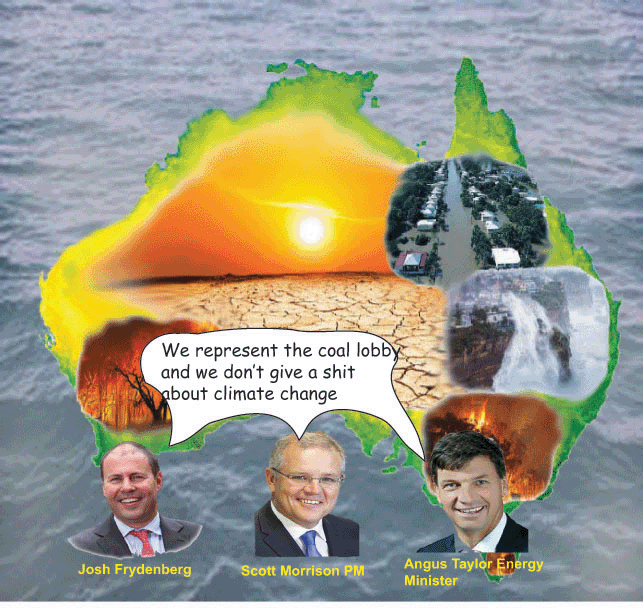
Australia’s government, lackey of the coal industry, in denial over climate change
|
While others face climate reality, our government denies the undeniable, SMH, John Hewson, Columnist and former Liberal opposition leader, 1 Aug 19, despair at just how long our Australian government can continue to deny the undeniable. It seems the new Morrison government has learned nothing, doesn’t want to learn anything, just wants to kick the climate emergency further down the road, hoping nothing of consequence happens on its watch.It is fundamental to us meeting our global obligations as the largest exporter of fossil fuels in the world, with poor and worsening biodiversity, and in the clear interests of our future generations, that we make the transition to a low-carbon society by the middle of this century.
It should have been particularly instructive that Britain, a nation that led the industrial revolution fuelling its economy with coal, and has weathered the Thatcher era tensions with the coal mining industry, has recently announced its plan for a complete exit from coal and declared that there is, indeed, a “climate emergency”. Similarly, the Germans have announced a commitment to stop using coal by the mid-2030s, and even the likes of China and India are moving much faster than expected to reduce their reliance on fossil fuels. At the very least, our government should have heard and responded to the din of cries for action: from the 60 to 80 per cent of respondents to various surveys; from big business, including conspicuously large fossil fuel miners such as BHP, Rio, Glencore, and Woodside; and from the Reserve Bank of Australia, the Australian Prudential Regulation Authority, the Australian Securities and Investments Commission and the Australian Competition and Consumer Commission. No! The tin-eared Coalition has preferred silly stunts such brandishing a lump of coal in Parliament, claiming unjustified electoral mandates to mine more coal and build a new coal-fired power plant in North Queensland, even though there is no net demand for electricity in that region (when more than 80 global banks wouldn’t finance it nor insurers insure it, and where renewable alternatives are much cheaper). It has also ignored the potential of carbon farming in agriculture and scare-mongered over the inevitable transition to electric vehicles. While Australia dithers, others face reality. In November, the Federal Reserve Bank of San Francisco will host what is believed to be its first research conference focused on climate change, acknowledging the systemic risks to the soundness of the US banking system. In April, with global insurers shouldering $160 billion in climate-related losses from last year alone, a group that included 30 central banks – Australia’s included – called for measures to spur green finance. In May, the Bank of England issued climate risk guidance to help insurers and re-insurers assess the financial risks posed by climate threats such as heatwaves, floods and storms. ……https://www.smh.com.au/environment/climate-change/while-others-face-climate-reality-our-government-denies-the-undeniable-20190731-p52cdl.html |
|
(Officially no climate change in Australia) but Queensland towns are running out of water
 Queensland towns face million-dollar water-carting bills if rain stays away, Brisbane Times, By Tony Moore
More than 65 per cent of Queensland, including Ipswich, Lockyer Valley and Scenic Rim councils on Brisbane’s doorstep, is drought-declared.
The worst case is Stanthorpe, one of Queensland’s premier tourism and wine regions, in the Southern Downs Regional Council area.
Southern Downs mayor Tracy Dobie said Stanthorpe was on track to run out of water by Christmas, leaving ratepayers with a hefty bill to cart water from Warwick. “We are estimating something between half a million dollars to a million dollars per month just to cart water,” she said.
“That is a sizeable chunk for a regional council with 19,000 ratepayers and an annual budget of $70 million.”
Warwick would run out of water by December 2020 if it did not receive significant rainfall over summer, Cr Dobie said.
“The Warwick situation is worse than Stanthorpe,” she said.
“The only way we can do it, if it doesn’t rain, is establishing new bores and pumping.” In the Toowoomba Regional Council area, water is being carted to Cecil Downs, while water has also been carted to Hodgson Vale, Cambooya and Clifton as bores run dry.
Ipswich and Lockyer Valley councils are close to carting water to some regional areas, but at this stage are meeting water demand from dam supplies.
There are as yet no water restrictions on south-east Queensland homes.
Over the Great Dividing Range, regions face extreme water restrictions.
Stanthorpe and Warwick residents already face “extreme-level” water restrictions of 120 litres per person a day, the same as Brisbane during the drought of 2008. Cr Dobie said the cost of carting water was significant for smaller councils.
“We have these councils west of the Great Dividing Range and in New South Wales that have really small rate bases and don’t have the money to build their own infrastructure,” she said.
(Officially no climate change in Australia) but Norther Territory towns are running out ofvwater
NT rural residents face spending thousands to truck in water if  bores run dry, ABC News, By Sowaibah Hanifie 29 July 19, With groundwater levels critically low and the wet season yet to begin, some rural Northern Territory residents fear they may have to pay thousands of dollars to truck in water for their homes.
Many bores connected to the Berry Springs and Howard Springs groundwater systems have been flagged as critical and could run dry as soon as October due to the driest Territory wet season in decades.
Eddie and Sheryl Kendall’s Berry Springs bamboo business could collapse if their bore runs dry.
“The plants, we’d just have to let them die,” Mrs Kendall said.
“That wouldn’t be very good, but if you have to do it, you have to do it.”
Mr Kendall said while their bore was not critically low yet, they were being conservative with their water use, meaning their plants were not getting the water they needed to thrive.
In the community of Southport, Progress Association president Barry Whalan said he would be forced to pay $400 per week if his community, which has a critically low bore, ran dry before the wet season in December……..
Humpty Doo resident Shannon Griffiths is living near the site of a proposed $2 billion, 4,000-property development in Noonamah Ridge, which would be completed over 30 years.
Mr Griffiths said while he understood the Government wanted to increase the Territory’s population, he was concerned more rural development would put his groundwater at risk.
“How are they going to monitor people running their bores or irrigating their yards at night, which a lot of people do,” he said…..
https://www.abc.net.au/news/2019-07-29/rural-water-bores-running-dry-northern-territory/11354680
Papua New Guinea Prime Minister urges Australia to help island nations threatened by climate change
|
Australia must help protect Pacific from climate change, PNG prime minister says , Guardian,
James Marape says Australia, with New Zealand and PNG, has a moral obligation to listen to the voices of smaller island nations. Australia has a responsibility to protect the Pacific region from the impacts of climate change, PNG’s newly appointed prime minister has said. James Marape told the Guardian Australia had “a moral responsibility … to the upkeep of the planet”, particularly given the extreme effect it was having on smaller Pacific nations. “I don’t intend to speak from Canberra’s perspective, they have their own policy mindset, but as human beings I know they will respond to the moral obligation that is prevalent amidst us, that we are environmentally sensitive to the needs of others.” He said the voices of smaller island nations must be listened to. “As big countries in the Pacific – Papua New Guinea, Australia, New Zealand – we have a sense of responsibility to the smaller island countries, because displacement of these smaller communities will first and foremost be our neighbourhood responsibility,” Marape said………https://www.theguardian.com/world/2019/jul/27/australia-must-help-protect-pacific-from-climate-change-png-prime-minister-says |
|
1 This month
15 April – Zoom –Nuclear Power is Not the Solution
Apr 15, 2026 01:00 AM in Canberra, Melbourne, Sydney

Join the International Physicians for the Prevention of Nuclear War (IPPNW) on Tuesday, April 14th for a timely webinar exploring the risks associated with nuclear power and challenging the myth that it offers a simple, safe, carbon-free solution to the climate crisis

of the week – Australians for War Powers Reform (AWPR)
To see nuclear-related stories in greater depth and intensity
 Antinuclear