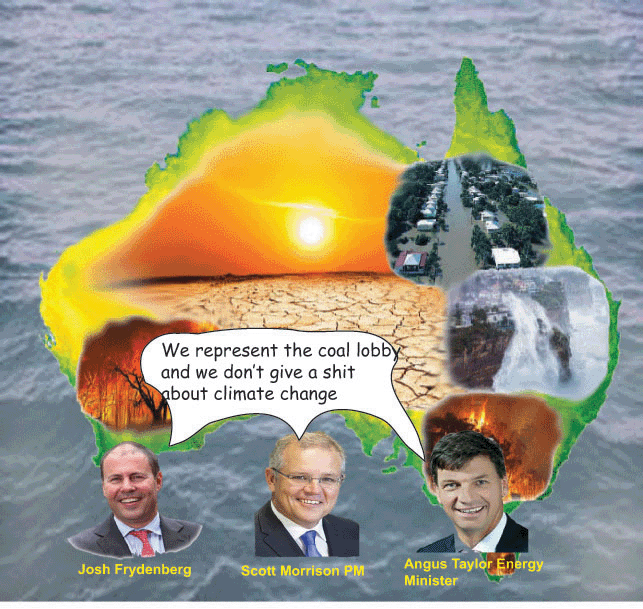
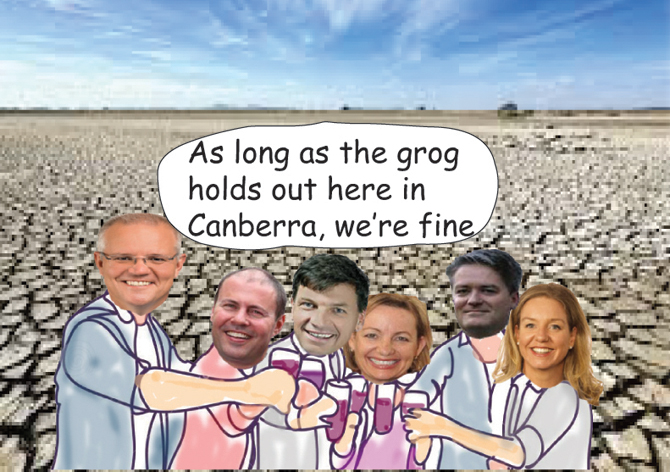
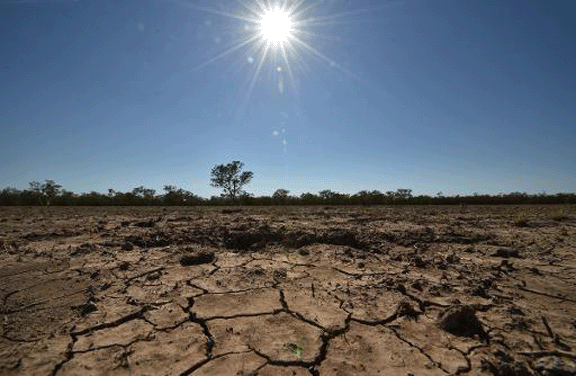
Drought-stricken NSW braces for an early bushfire season with not enough water to take them on ABC New England By Jennifer Ingall 2 Aug 19, Firefighters in parched New South Wales face the unenviable predicament of preparing for the impending fire season in a state where 98 per cent is in drought or short on water.
Key points:
- Firefighters brace for a hot summer with depleted water resources
- BOM’s August to October climate outlook suggests a drier than average three months for large parts of Australia
- RFS assures farmers it will replace water used to fight fires
“When you’ve got a drought like that, particularly in bush areas, the fuel is so dry it doesn’t take a lot to get it to burn and burn hot,” acting Rural Fire Service (RFS) deputy commissioner Rob Rogers said.
August was traditionally a cool but windy month, but add to that the dry fuel load and it could be a recipe for disaster.
“So you’ve got the dry fuel and the strong winds — if you add a high temperature, and if we don’t get an easing of the drought through rainfall, then that’s quite concerning going into summer proper,” he said.
Resources already depleted
In the state’s north, the community of Tenterfield does not have enough water to supply the townsfolk, let alone an allocation of the precious resource to fight fires.
The drought has left the town supply with less than 200 days of water, requiring the Tenterfield Council to take the drastic measure of bringing in a temporary desalination plant.
In February this year, the region depleted a lot of its water resources fighting fires.
The RFS pulled water from private dams and even household tanks which then had to be replenished……. https://www.abc.net.au/news/2019-08-01/nsw-braces-for-early-bushfires-season-and-lack-of-water/11371540
August 3, 2019
Posted by Christina Macpherson |
climate change - global warming, New South Wales |
Leave a comment

|
While others face climate reality, our government denies the undeniable, SMH, John Hewson, Columnist and former Liberal opposition leader, 1 Aug 19, despair at just how long our Australian government can continue to deny the undeniable. It seems the new Morrison government has learned nothing, doesn’t want to learn anything, just wants to kick the climate emergency further down the road, hoping nothing of consequence happens on its watch.It is fundamental to us meeting our global obligations as the largest exporter of fossil fuels in the world, with poor and worsening biodiversity, and in the clear interests of our future generations, that we make the transition to a low-carbon society by the middle of this century.
It should have been particularly instructive that Britain, a nation that led the industrial revolution fuelling its economy with coal, and has weathered the Thatcher era tensions with the coal mining industry, has recently announced its plan for a complete exit from coal and declared that there is, indeed, a “climate emergency”. Similarly, the Germans have announced a commitment to stop using coal by the mid-2030s, and even the likes of China and India are moving much faster than expected to reduce their reliance on fossil fuels.
At the very least, our government should have heard and responded to the din of cries for action: from the 60 to 80 per cent of respondents to various surveys; from big business, including conspicuously large fossil fuel miners such as BHP, Rio, Glencore, and Woodside; and from the Reserve Bank of Australia, the Australian Prudential Regulation Authority, the Australian Securities and Investments Commission and the Australian Competition and Consumer Commission.
No! The tin-eared Coalition has preferred silly stunts such brandishing a lump of coal in Parliament, claiming unjustified electoral mandates to mine more coal and build a new coal-fired power plant in North Queensland, even though there is no net demand for electricity in that region (when more than 80 global banks wouldn’t finance it nor insurers insure it, and where renewable alternatives are much cheaper). It has also ignored the potential of carbon farming in agriculture and scare-mongered over the inevitable transition to electric vehicles.
While Australia dithers, others face reality. In November, the Federal Reserve Bank of San Francisco will host what is believed to be its first research conference focused on climate change, acknowledging the systemic risks to the soundness of the US banking system. In April, with global insurers shouldering $160 billion in climate-related losses from last year alone, a group that included 30 central banks – Australia’s included – called for measures to spur green finance. In May, the Bank of England issued climate risk guidance to help insurers and re-insurers assess the financial risks posed by climate threats such as heatwaves, floods and storms. ……https://www.smh.com.au/environment/climate-change/while-others-face-climate-reality-our-government-denies-the-undeniable-20190731-p52cdl.html
|
|
August 1, 2019
Posted by Christina Macpherson |
AUSTRALIA - NATIONAL, climate change - global warming, politics |
Leave a comment
 Queensland towns face million-dollar water-carting bills if rain stays away, Brisbane Times, By Tony Moore
July 29, 2019 Six regional Queensland towns, including the large centres of Stanthorpe and Warwick, have either begun or will soon begin carting drinking water as the state’s drought worsens.
More than 65 per cent of Queensland, including Ipswich, Lockyer Valley and Scenic Rim councils on Brisbane’s doorstep, is drought-declared.
The worst case is Stanthorpe, one of Queensland’s premier tourism and wine regions, in the Southern Downs Regional Council area.
Southern Downs mayor Tracy Dobie said Stanthorpe was on track to run out of water by Christmas, leaving ratepayers with a hefty bill to cart water from Warwick. “We are estimating something between half a million dollars to a million dollars per month just to cart water,” she said.
“That is a sizeable chunk for a regional council with 19,000 ratepayers and an annual budget of $70 million.”
Warwick would run out of water by December 2020 if it did not receive significant rainfall over summer, Cr Dobie said.
“The Warwick situation is worse than Stanthorpe,” she said.
“We can truck water [to Stanthorpe] from Warwick because there is only 5000 customers, however there are 15,000 people in Warwick and we can’t truck [that much] water.
“The only way we can do it, if it doesn’t rain, is establishing new bores and pumping.” In the Toowoomba Regional Council area, water is being carted to Cecil Downs, while water has also been carted to Hodgson Vale, Cambooya and Clifton as bores run dry.
Ipswich and Lockyer Valley councils are close to carting water to some regional areas, but at this stage are meeting water demand from dam supplies.
There are as yet no water restrictions on south-east Queensland homes.
Over the Great Dividing Range, regions face extreme water restrictions.
Stanthorpe and Warwick residents already face “extreme-level” water restrictions of 120 litres per person a day, the same as Brisbane during the drought of 2008. Cr Dobie said the cost of carting water was significant for smaller councils.
“We have these councils west of the Great Dividing Range and in New South Wales that have really small rate bases and don’t have the money to build their own infrastructure,” she said.
July 30, 2019
Posted by Christina Macpherson |
climate change - global warming, Queensland |
Leave a comment
NT rural residents face spending thousands to truck in water if  bores run dry, ABC News, By Sowaibah Hanifie 29 July 19, With groundwater levels critically low and the wet season yet to begin, some rural Northern Territory residents fear they may have to pay thousands of dollars to truck in water for their homes.
Many bores connected to the Berry Springs and Howard Springs groundwater systems have been flagged as critical and could run dry as soon as October due to the driest Territory wet season in decades.
Eddie and Sheryl Kendall’s Berry Springs bamboo business could collapse if their bore runs dry.
“The plants, we’d just have to let them die,” Mrs Kendall said.
“That wouldn’t be very good, but if you have to do it, you have to do it.”
Mr Kendall said while their bore was not critically low yet, they were being conservative with their water use, meaning their plants were not getting the water they needed to thrive.
In the community of Southport, Progress Association president Barry Whalan said he would be forced to pay $400 per week if his community, which has a critically low bore, ran dry before the wet season in December……..
Humpty Doo resident Shannon Griffiths is living near the site of a proposed $2 billion, 4,000-property development in Noonamah Ridge, which would be completed over 30 years.
Mr Griffiths said while he understood the Government wanted to increase the Territory’s population, he was concerned more rural development would put his groundwater at risk.
“How are they going to monitor people running their bores or irrigating their yards at night, which a lot of people do,” he said…..
https://www.abc.net.au/news/2019-07-29/rural-water-bores-running-dry-northern-territory/11354680
July 30, 2019
Posted by Christina Macpherson |
climate change - global warming, Northern Territory |
Leave a comment
|
James Marape says Australia, with New Zealand and PNG, has a moral obligation to listen to the voices of smaller island nations. Australia has a responsibility to protect the Pacific region from the impacts of climate change, PNG’s newly appointed prime minister has said.
James Marape told the Guardian Australia had “a moral responsibility … to the upkeep of the planet”, particularly given the extreme effect it was having on smaller Pacific nations.
“I don’t intend to speak from Canberra’s perspective, they have their own policy mindset, but as human beings I know they will respond to the moral obligation that is prevalent amidst us, that we are environmentally sensitive to the needs of others.”
He said the voices of smaller island nations must be listened to. “As big countries in the Pacific – Papua New Guinea, Australia, New Zealand – we have a sense of responsibility to the smaller island countries, because displacement of these smaller communities will first and foremost be our neighbourhood responsibility,” Marape said………https://www.theguardian.com/world/2019/jul/27/australia-must-help-protect-pacific-from-climate-change-png-prime-minister-says
|
|
July 29, 2019
Posted by Christina Macpherson |
AUSTRALIA - NATIONAL, climate change - global warming, politics international |
Leave a comment
 Why this south-east Queensland council declared a ‘climate emergency’ https://www.brisbanetimes.com.au/national/queensland/why-this-south-east-queensland-council-declared-a-climate-emergency-20190724-p52acd.html, By Tony Wellington, July 27, 2019
Frustrated by stagnant policy at the federal level, Australian communities are looking elsewhere for responses to climate change.
Businesses, communities and, increasingly, local governments are stepping up to the plate.
Noosa council declared a climate emergency to send a strong message, according to the mayor.
As the closest tier of government to the people, it’s our responsibility to listen to the concerns of residents, and they are demanding a healthy and resilient future for their children and grandchildren.
The concerns of our communities are not being heard by the national decision-makers. Local governments have no choice but to act as climate advocates for their communities and thus take matters into their own hands.
That’s why we in Noosa shire have set ourselves a target of net-zero carbon emissions by 2026 – and our community has jumped on board.
Our modelling shows that, if action is not taken to significantly reduce global greenhouse gas emissions, a much larger proportion of our residential and commercial properties will be within the storm tide inundation zone in the year 2100.
In other words, with a projected sea-level rise of 0.8 metres and intensifying weather events, many properties could be flooded in a significant storm or else subject to coastal erosion. We need to plan for this now, not wait until it’s too late.
Noosa recently became the first Queensland council to declare a climate emergency, joining 847 other government jurisdictions across the world who have already done so. We want to send a strong message to higher levels of government that this is the most serious issue facing humankind.
Noosa council is rolling out solar panels and battery storage, adopting a wide range of energy efficiency measures and tackling methane emissions from our landfill. And we are working with our community to reduce emissions at the business and household level. Of course, there is much more to be done. But we’re not alone.
We’re just one of many councils across the country who are rising to the challenge of climate change. From the Huon Valley in Tasmania to Port Douglas in northern Queensland, councils are working together through alliances such as the Cities Power Partnership.
We need to learn from each other and share our knowledge because we’re all in this together. Every local government wants to see sustainable, healthy communities that thrive in the future. And, like it or not, the future is renewable energy. Tony Wellington is the Mayor of Noosa Shire Council
July 29, 2019
Posted by Christina Macpherson |
climate change - global warming, Queensland, solar |
Leave a comment
Adani’s Carmichael coal mine surviving on lifeline from Indian parent company, ABC 23 July 19
Key points:
- The company responsible for the Carmichael coal mine has current liabilities of more than $1.8b versus current assets of less than $30m
- The auditors signed off on the company being a “going concern” because of a 12-month guarantee from the Indian parent firm
- Accounting expert Sandra van der Laan says “effectively on paper they are insolvent. I wouldn’t be trading with them”………
She examines a diagram of Adani’s Australian structure: a labyrinth of trusts interposed between private companies and Indian stock market-listed companies with ties to, and in some cases ownership in, tax havens stretching from Singapore to Mauritius, on to the Cayman Islands and the British Virgin Islands.
The more immediate concern is Adani Mining Pty Ltd, the Australian-registered company which is the proponent of the Carmichael coal mine in the Galilee Basin.
Adani Mining recently provided ASIC with its financial accounts to March 31.
As a private company, the subsidiary is only required to release reduced financial statements with limited detail — but enough to raise red flags for Professor van der Laan and other critics.
The accounts show the owners have contributed less than $9 million in equity to the business and total liabilities exceed total assets by more than half a billion dollars.
Current assets of less than $30 million are swamped by current liabilities, due over the next 12 months, of more than $1.8 billion.
“Adani Mining is in a very fragile, even perilous, financial position,” Professor van der Laan observes.
“The gap between the current assets and liabilities is what’s really concerning………
‘They will never pay any material corporate tax in Australia’
Adani is now going it alone and “self-funding” the Carmichael mine after failing to secure loans from banks or government wealth funds.
Although the mine has been scaled down to an initial 10 million tonnes a year output, rather than the mega-mine of 60 million tonnes a year it has approval for, the price tag for building it and an accompanying railway will still be a multi-billion-dollar sum.
Even for a man as rich as family patriarch Gautam Adani, it is no small ask.
But in the tangled web that is the Adani Group, there are ways.
Adani’s ports business is the most profitable part of the empire, headed by the Bombay stock exchange-listed company Adani Ports SEZ.
It is currently raising more than $1 billion in debt on global markets.
Critics are suspicious that Adani may channel the money through its opaque corporate structure and use the money to fund the Queensland coal mine that no bank was willing to finance………
Whether or not concerns about the solvency of various Adani companies or funding for the Carmichael mine are well-founded, the promise of a company tax bonanza from the Queensland mine seems destined to remain unfulfilled, according to Tim Buckley.
Already, accumulated losses mean that, if the mine is built, Adani Mining won’t pay company tax for many years in Australia and may never do so — like the Abbot Point Coal Terminal, which has paid little to no company tax under the ownership of Adani.
“They have carry forward losses that mean the first $1.5 billion of profit are corporate tax free,” says Mr Buckley.
July 25, 2019
Posted by Christina Macpherson |
AUSTRALIA - NATIONAL, climate change - global warming |
Leave a comment
|
We are now in a place we’ve never been before https://southwind.com.au/, 
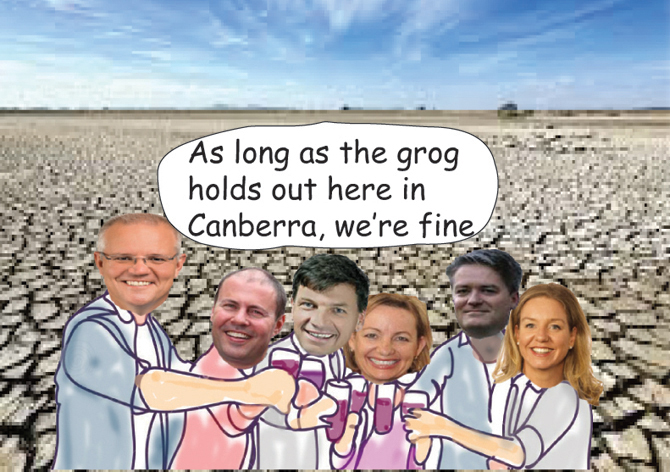
23 July 2019 by Peter Boyer Australia’s big dry is now its worst drought on record. Which is pretty much the way it is everywhere. Following a lead from our state and federal governments, today I’m going to avoid the delicate matter of future climate. Instead I’ll focus on what’s happening around us now.
Weather records tell us that June in Australia was 0.26C warmer than average and 31 per cent drier. The first half of 2019 produced the continent’s second warmest and seventh driest conditions in 120 years of records.
In those six months the Murray-Darling Basin had about half its normal rainfall. Basin residents might have coped with this in normal times, but these are not normal times. Dry, warm, high-evaporation weather since January 2017 has left them with conditions they’ve not seen before.
Now it’s official. Rainfall records reveal that today’s Murray-Darling experience is Australia’s worst drought on record – more severe than the Federation, the World War II, the Millennium or any other drought in our recorded history.
Bureau of Meteorology climatologist David Jones told a BOM seminar last week that proxy evidence indicates Australia hasn’t been as dry as this for two or three million years, long before humans existed. This puts the current state of our weather in a completely new place.
Numerous NSW and southern Queensland towns now have emergency water restrictions in place. Many towns in upper Darling catchments calculate their water storage as a few months at most. In Tenterfield they’re pumping already-depleted groundwater to try to keep storage levels stable.
Water is now being carted to the small town of Guyra, 150 km away, but for Tenterfield that’s not an option – at least not a sustainable one. Its businesses and 4000 residents would need 1400 B-double truckloads a month, or nearly 50 each day, to sustain even minimal water use.
The list of towns threatened with losing their water supply is growing, including Warwick and Stanthorpe in Queensland. The larger centres of Tamworth, Armidale, Orange and Dubbo are lining up to join them if good rain doesn’t come this year. The Bureau is not hopeful of that happening.
Running out of water is a nightmare for any community. Cape Town almost ran out a year ago and is still in a tenuous position. In much-larger Chennai on India’s southeast coast, where it hasn’t rained for six months, the situation is dire. Monsoon rain is not expected for another month or two.
This city of 10 million people consumes over 500 million litres a day. The provincial government is now using trains to transport water every day from a half-full storage over 300 km away, but if the city were to run out completely that supply would have to increase 50-fold. That won’t happen.
Early monsoonal downpours in India’s Assam along with Nepal and Bangladesh have brought the opposite problem: too much water, displacing millions of people and killing over 100. Not far away in the high Himalayas, the rate of glacier melt has been found to have doubled in less than 20 years to more than eight billion tonnes a year. A scientific assessment published in June is a very bad omen for downstream communities depending on glacial meltwater.
Meanwhile America’s Pacific north-west is preparing for another nasty fire season. A scientific wildfire survey has just informed Californians, after their worst season ever last year, that the state’s summer fires have increased five-fold since the 1970s, with rising temperature the key cause.
Wildfire anxiety has spread northward, to the dark, dank forests of British Columbia. The Canadian province’s wildfire service has warned that abnormally high fire conditions will be experienced in coastal regions including Vancouver Island at least till the end of summer.
This comes after several summers of intense wildfires up and down the Canadian west coast, mostly started by lightning strikes. They have been especially devastating in new-growth forests, where less genetic diversity and lower tree density allows higher moisture loss.
Things are hotting up in the far north. Alert, a Canadian military base on Ellesmere Island in the high Arctic, normally has a daytime maximum around 7C in July, but it’s currently experiencing an unprecedented heatwave that has seen temperatures climb above 20C.
Canada’s chief climatologist, David Phillips, says this heatwave is just the latest indicator of what will be a long, hot Arctic summer. The main trigger, say scientists, was a dramatic loss of Arctic sea ice over the past decade that allowed the ocean to absorb much more heat from the sun.
Smoke has become a regular contributor to Arctic weather, and this year is no exception. These are not forest fires so much as peat fires. The dried-out tundra itself is now burning in Alaska and across wide Siberian expanses, sending choking black smoke into the air.
Among the many things I’ve left out are Darwin’s groundwater crisis, depleted Great Barrier Reef coral, Europe’s unprecedented June heat, vanishing Antarctic sea ice, chronic drought in Africa and the Americas and floods in Asia, Africa and Latin America. Did I mention climate change?
VICTIM of a chronic decline in government support, Hobart’s venerable environment and sustainability body, Sustainable Living Tasmania, has been forced to close its doors after nearly 50 years of quiet achievement. It will continue as a volunteer-run organisation with no office
|
|
July 23, 2019
Posted by Christina Macpherson |
AUSTRALIA - NATIONAL, climate change - global warming, politics |
Leave a comment

 Adani protest: French journalists arrested while filming anti-coal activities, Guardian
Journalists charged with trespassing after filming Frontline Action on Coal activists include Hugo Clément, Ben Smee@BenSmee, Mon 22 Jul 2019 Four journalists working for the public television network France 2 have been charged with trespassing for filming a protest near the Abbot Point coal terminal, in north Queensland, targeting the operations of the Adani group.
July 23, 2019
Posted by Christina Macpherson |
AUSTRALIA - NATIONAL, civil liberties, climate change - global warming, media |
Leave a comment
 Greens seek ‘climate emergency’ this year, SBS News 20 July 19
The Australian Greens are focusing on climate change and the need to transition to renewable energy at its annual conference in Adelaide. The Australian Greens are demanding the country declare a “climate emergency” while calling for a royal commission into the Murray-Darling Basin plan.
Aside from those core messages at the party’s annual conference, Greens leader Richard Di Natale also had a crack at the Labor Party for capitulating on the Morrison government’s personal income tax cuts.
And he urged Australia to forge an independent, non-aligned foreign policy rather being tied to a “dangerous and unhinged” US President in Donald Trump.
It’s now clearer than ever that the Greens are the real opposition,” Senator Di Natale declared at the Greens national conference in Adelaide on Saturday in response to the actions of Labor since the May election.
“We don’t believe one thing before an election and another thing after it.”
Addressing reporters after his speech, Senator Di Natale said a key focus for the conference will be the transition from coal and fossil fuels to renewable energy.
“There needs to be a transition that brings tens of thousands of new jobs and that looks after people so that we are better off as a result of making this transition,” he said.
“Unless you accept that there is a serous problem you’re not going to come up with the solutions that are necessary to deal with it.”
Greens federal spokesman on climate change, Adam Bandt said he hopes to bring a motion to have the parliament declare a climate emergency before the end of the year.
He said the UK, France and Canada have already made such declarations, as has the ACT government. Labor and the crossbench also took climate change policies to the election.
“We think there is a really good chance in having the parliament unanimously declare a climate change emergency before the end of the year,” Mr Bandt told reporters……. https://www.sbs.com.au/news/greens-seek-climate-emergency-this-year
July 22, 2019
Posted by Christina Macpherson |
AUSTRALIA - NATIONAL, climate change - global warming, politics |
Leave a comment
|
 Large Man Looking At Co-Worker With A Magnifying Glass — Image by © Images.com/Corbis Young climate activists ‘most at risk’ of being spied on by AFP, New Daily, Cait Kelly, Reporter, 16 July 19
Children and young adults who go to protests are the most likely Australians to have their phones tracked and monitored by police, a prominent security analyst has warned in a submission to an inquiry cybersecurity laws.Dr Stanley Shanapinda of La Trobe University said that politically minded youth are “the most at risk” of having their digital footprint watched by the AFP.
“They’re the most at risk because of their social media habits, they’re a lot more vocal. As a community they’re the most likely to be targeted,” he told The New Daily.
Under the metadata laws passed in 2015 the Australian Federal Police force (AFP) has the power to view the metadata of citizens who are deemed as a risk to national security, up to two years old without a warrant.
Dr Shanapinda argues that both Liberal and National politicians have highlighted young climate change activists, Adani protestors and The Greens as threats.
“Senior members of the government have labelled the protest actions of the young people and the Greens … as threats to national security and the national economic interests, openly in national media,” he said.
During the federal election, Prime Minister Scott Morrison warned that The Greens are a greater political threat to national and economic security than Clive Palmer or Pauline Hanson.
Dr Shanapinda said that these concerns over Greens policies, and young protestors could open the door to party members and activists having their metadata watched.
“Opposing the Adani coal mine and protesting against it, on climate change on ideological bases, may therefore legally be categorised by the government as posing a threat to national security, if the government wanted to, because of its economic and job creation value,” Dr Shanapinda said.
Protestors having their phones used against them has become an increasing issue around the globe…… https://thenewdaily.com.au/news/2019/07/16/metadata-activists-climate/
|
|
July 18, 2019
Posted by Christina Macpherson |
AUSTRALIA - NATIONAL, civil liberties, climate change - global warming |
Leave a comment
|
 Adani demands names of CSIRO scientists reviewing groundwater plans https://www.abc.net.au/news/2019-07-16/adani-requests-names-of-csiro-scientists/11308616 Adani demands names of CSIRO scientists reviewing groundwater plans https://www.abc.net.au/news/2019-07-16/adani-requests-names-of-csiro-scientists/11308616
Exclusive by Josh Robertson Adani demanded the names of all federal agency scientists reviewing its contentious groundwater plans so it could check if they were “anti-coal” activists, emails obtained under freedom of information show.
Key points:
- Emails show Adani gave the federal environment department five days to provide the names of people from the CSIRO and Geoscience Australia involved in the review
- Adani says it wrote to the department to request “assurance that individuals involved in any review processes were independent”
- CSIRO’s Sam Popovski says “our scientists just want to get on and do their best job … without their social media being tracked”
The revelation has alarmed CSIRO staff representatives, who said it indicated Adani had “a deliberate strategy” to pressure scientists by searching for personal information it could use to try to “discredit their work”.
Emails obtained under freedom of information by environmental group Lock The Gate show Adani gave the federal environment department five days to provide “a list of each person from the CSIRO and Geoscience Australia involved in the review”.
“Adani simply wants to know who is involved in the review to provide it with peace of mind that it is being treated fairly and that the review will not be hijacked by activists with a political, as opposed to scientific, agenda,” the company told the department on January 25.
A department spokeswoman said it “consulted with CSIRO and Geoscience Australia about Adani’s request” but did not provide the names “as the advice on the plans was received from CSIRO and Geoscience Australia, rather than individuals within those agencies”.
Days before the demand, in a January 21 newspaper article Adani had questioned the independence of a scientist leading a Queensland review into the company’s bird conservation plan because he tweeted from a climate rally nine months earlier.
The ABC revealed in February that Adani last year hired a law firm, AJ & Co, that had drafted a commercial proposal called “Taking the Gloves Off”, in which it vowed to act as the company’s “trained attack dog”.
It proposed a “war” strategy including that Adani “not settle for government department’s dragging out decisions — use the legal system to pressure decision makers”.
|
|
July 16, 2019
Posted by Christina Macpherson |
AUSTRALIA - NATIONAL, civil liberties, climate change - global warming |
Leave a comment
Defence lacks ‘overarching strategy’ to deal with climate change conflict, internal notes warn By Mark Willacy, ABC Investigations and Freedom of Information Editor Michael McKinnon, 14 July 19, Australia’s military has warned of a possible influx of climate refugees and an increased potential for conflict because of the effects of climate change.
Key points:
- A briefing note warns there is no “overarching strategy” to address climate change risks
- The Indo-Pacific region is projected to experience prolonged droughts and increased flooding from rising sea-levels
- Defence admits that their operations could be impacted by ocean acidification and extreme weather
Internal Australian Defence Force (ADF) briefing notes from last year, obtained by the ABC under Freedom of Information, also predict the military may be forced to increase patrols in Australia’s northern waters to deal with “sea-borne migration” sparked by rising sea levels in the Indo-Pacific.
One document warns that climate change could “exacerbate the potential for conflict” and contribute to “state fragility and the undermining of economic development in our immediate region”.
Former Defence Force chief Chris Barrie said Australia would be seen as the “land of opportunity” for many people affected by climate change………..
Climate change ‘may directly impact’ Defence operations
The ADF has refused to release documents relating to the impact of sea level rises and flooding on defence training areas, telling the ABC that it is not in the national interest.
“Release of this information could reasonably be expected to cause damage to the ability of the Defence Force to remain an effective force as well as potentially providing an avenue through which foreign incursions could significantly impact our critical infrastructure,” it said.
But one briefing note warns that the Indo-Pacific region is projected to experience challenges such as prolonged droughts and increased flooding from increased sea levels.
“Sea level rise, ocean acidification, increase in extreme temperatures and a forecast increase in intensity of bushfires and extreme weather events may directly impact Defence capabilities, personnel and equipment,” it read.
The ADF has already identified climate change as a challenge to Australia’s future security.
Its 2016 Defence White Paper predicted that Australia may be called on to conduct more humanitarian and disaster relief operations.
The internal notes obtained under freedom of information go further in warning about climate change risks.
“Further, an increase in illegal foreign fishing or sea-borne migration to Australia because of climate change effects may increase demands for Australian Defence Force patrols in Australia’s north waters,” the briefing note said.
 Admiral Barrie said Australia was “wide open” for climate refugees, using Bangladesh as an example — its border with India is already being heavily patrolled by the Indian military.
“Bangladesh — a very populated country — runs out of fresh water and also has problems with sea level rise. Where will all the Bangladeshis go?” he said.
‘Impacts are unavoidable’
The briefing documents include a report assessing the impact of sea level rises and flooding on “selected defence training areas and ranges”.
The report, by global infrastructure consultancy Aecom, says the “warming of the climate system is unequivocal…atmospheric concentrations of carbon dioxide, methane and nitrous oxide have increased to levels unprecedented in at least the last 800,000 years”.
It states that the warming of Australia’s mean air temperature could “reach 0.6 degrees Celsius to 5.1C depending on the emission scenarios”.
The report cites such impacts as increased flooding, coastal erosion, bushfires and heatwaves.
“Even with considerable reductions in global greenhouse gas emissions, the inertia of the global climatic system means that many of these impacts are unavoidable.”
Last year defence chiefs told the Senate’s Foreign Affairs, Defence and Trade committee that rising sea levels and coastal erosion could damage military bases “in the short to medium term”.
The committee’s report warned that “climate change may also eventually contribute to greater irregular migration pressure in vulnerable countries to Australia’s north, potentially becoming a substantial security threat to Australia”…….. https://www.abc.net.au/news/2019-07-15/defence-lacks-overarching-strategy-for-climate-change-conflict/11304954
July 15, 2019
Posted by Christina Macpherson |
AUSTRALIA - NATIONAL, climate change - global warming |
Leave a comment

Country towns close to reaching ‘day zero’, as water supplies dry up in the drought, ABC News, By National Regional Affairs reporter Lucy Barbour 14 July 19, Across New South Wales and Queensland’s southern downs, country towns are approaching their own ‘day zero’, as water supplies dry up in the drought.
Ten towns, including major centres, are considered to be at high risk of running out within six months, if it doesn’t rain and if water infrastructure isn’t improved.
Councils are rushing to put emergency measures in place, but more than a decade since the end of the millennium drought, water security is still almost non-existent for many rural communities……….
Bigger centres like Tamworth and Orange, and potentially Dubbo and Armidale, plus smaller towns like Cobar, Narromine and Nyngan are all considered to be at “high risk” of running out within six months if things do not change.
Across the border in Queensland, water shortages are biting hard in towns like Stanthorpe and Warwick, which are inching towards emergency restrictions.
Southern Downs Shire Mayor Tracy Dobie says water may have to be carted from Warwick to Stanthorpe in December, and she fears ratepayers may have to foot the bill.
“We could be looking at anything from $500,000 to $1.5 million per month, to transport the water, depending on how far we have to truck it from,” she says.
Trucks are already a big part of the landscape in southern Queensland and northern New South Wales, carting livestock between saleyards and abattoirs.
But water restrictions are making those journeys longer, more expensive and messier, because councils have closed the wash stations drivers use to clean excrement from their vehicles……… https://www.abc.net.au/news/2019-07-14/day-zero-approaching-as-towns-run-out-of-water/11271430
July 15, 2019
Posted by Christina Macpherson |
AUSTRALIA - NATIONAL, climate change - global warming, environment |
Leave a comment

Our Future || Caring for planet is a moral responsibility https://www.canberratimes.com.au/story/6244511/caring-for-planet-is-a-moral-responsibility/?cs=14246 Thea Ormerod, 30 June 19
I am a grandmother with eight grandchildren. Sometimes I lie awake at night worrying about how our changing climate is going to affect their future.
Seeing those little faces looking up at you, I feel we’re betraying the trust of these future generations by not taking care of this beautiful planet.
I attend the church of Our Lady of Fatima at Kingsgrove.
And while I pray for the Earth’s future, I also know that we must stand and act together. Our leaders must be persuaded to take moral responsibility. That’s why last week the organisation I’m involved with, the Australian Religious Response to Climate Change, released an open letter to the Prime Minister asking him to make the climate the No.1 priority.
It was signed by 153 religious leaders from across the spectrum, many of them in very senior roles.
Climate change and the burning of fossil fuels is a moral issue. Saving the world is a spiritual matter. I don’t interpret spiritual as “other worldly”.
Spirituality for me is about being responsible and reasonable, which shows in healthy relationships.
You see the fruits in laughter, peace and kindness towards each other. In his time on earth, Jesus himself was less interested in rules and who was or wasn’t praying.
He was interested in who was caring about people, especially people who are suffering.
Today, the people who have been hit hardest by climate change are mostly in developing countries, and they’ve done nothing to contribute to the problem.
Those suffering most in Australia are largely people in rural and regional areas. They are on the frontline of droughts, bushfires, intense heat and flooding, left grieving for lost herds and ruined crops.
But people in these areas are being sold short by politicians who are not planning for a more sustainable future, which includes an orderly transition away from the mining and burning of fossil fuels.
Many other nations are making big commitments to reduce emissions but Australia is out of step.
Our elected representatives may think politics is not about religion or spirituality. But it is about morality and caring about people.
June 30, 2019
Posted by Christina Macpherson |
AUSTRALIA - NATIONAL, climate change - global warming, religion and ethics |
Leave a comment