Australia’s religious leaders call on Prime Minister Scott Morrison to act on climate change
‘For the sake of generations to come’: Faith leaders unite on climate change https://www.sbs.com.au/news/for-the-sake-of-generations-to-come-faith-leaders-unite-on-climate-change 26 June 19, More than 150 religious leaders have issued an open letter to Prime Minister Scott Morrison, urging him to show moral leadership on the issue of climate change.
Faith leaders from across the religious divide have gathered in Sydney to call on Prime Minister Scott Morrison to show moral leadership on climate change.
The joint press conference kicked off with Rabbi Johnathan Keren-Black blowing a ram’s horn to symbolise raising the alarm.
Environmental Advisor for the Council of Progressive Rabbis, Rabbi Keren-Black said the world is facing a “climate emergency”.
Judaism believes that we have a responsibility to be caretakers for God’s world, and we’re not doing a very good job of it at the moment.”
More than 150 religious leaders – including the heads of the Uniting Church in Australia, the Federation of Australian Buddhist Councils, Muslims Australia and the National Council of Churches – on Tuesday issued an open letter to Mr Morrison.
The letter calls on the Prime Minister to make addressing climate change his number one priority.
Australian Religious Response to Climate Change (ARRCC) President Thea Ormerod described climate change as a moral issue that needs to be urgently addressed.
“We have an urgent challenge which we all share, a moral challenge. It’s not just a political issue or an economic issue, it’s also a moral issue and all of us are standing together with one voice today,” she said.
Under the banner of Australian Religious Response to Climate Change, the group is calling for a stop to new coal and gas projects, stopping Adani’s controversial coal mine in central Queensland and moving to 100 per cent renewable energy by the year 2030.
Despite the differences in our faith, we all regard addressing the climate emergency as our shared moral challenge. We stand together for our common home, the Earth,” the letter says.
“Will you and your Government have the courage to agree to this simple threefold agenda? We pray that you will.”
Loreto Sister Libby Rogerson said there is a sacred responsibility to care for the earth and all living beings.
“We are concerned for the poorest and most vulnerable, and it is the poorest and most vulnerable of people and nations that are affected by Climate Change,” she said.
Federation of Australian Budhist Councils Spokesperson Gawaine Powell Davies also attended the press conference, and said climate change is driven by “human foolishness”.
“We have a very sharp analysis of human foolishness which has led us to put greed and short-term benefit ahead of the long-term interests of ourselves and our children, and our grandchildren,” Mr Powell Davies said.
The Grand Mufti of Australia, Ibrahim Abu Mohammed, along with senior Rabbis, bishops and theologians have also signed the letter.
Australia a top G20 leader in subsidising the coal industry
 Australia leads the G20 nations’ pack in aid for coal-fired power, SMH Peter Hannam, June 25, 2019 Subsidies for coal-fired power production almost tripled in the three years to 2016-17 among G20 nations, with Australia providing among the largest support, an international study has found.The report by UK think tank, the Overseas Development Institute, found aid for such power stations soared from US$17.2 billion ($24.7 billion) in 2013-14 to $US47 billion in the most recent year. It’s in contrast to pledges made by the 20 biggest economies in 2009 to phase out subsidies to reduce the risks of climate change……
The highest amounts of total support to coal consumption were identified in Indonesia at US$2.3 billion per year, Italy and Australia, both about US$870 million, the US at US$708 million, and the UK with US$682 million, it reported.
“These tens of billions of dollars a year of G20 support to coal are not just locking in the high-carbon
economy and leading to stranded assets, they are also a missed opportunity to support a clean energy transition and to achieve other sustainable development objectives,” the study said……
‘Ecological crisis’
Jamie Hanson, head of campaigns at Greenpeace Australia Pacific, said Australia was in an “ecological crisis driven by climate change”.
“Coal is the primary cause of the climate damage that is causing extinctions all over the country, drought and fire that has torched ancient rainforests, and that has killed half the Great Barrier Reef in the last five years,” he said.
“Climate-destroying government handouts to the coal industry defy all logic – especially now, when we know that clean renewable energy is the cheapest form of new power.”
Separately, Australia’s climate ambassador Patrick Suckling has argued at a United Nations conference in Bonn, Germany that the country’s carbon reduction efforts were “having a positive effect”. https://www.smh.com.au/environment/climate-change/g20-nations-aid-for-coal-fired-power-triples-in-three-years-report-20190625-p5213r.html
Australian States taking the lead on energy policy, as renewable energy generates more Queensland jobs than coal does,
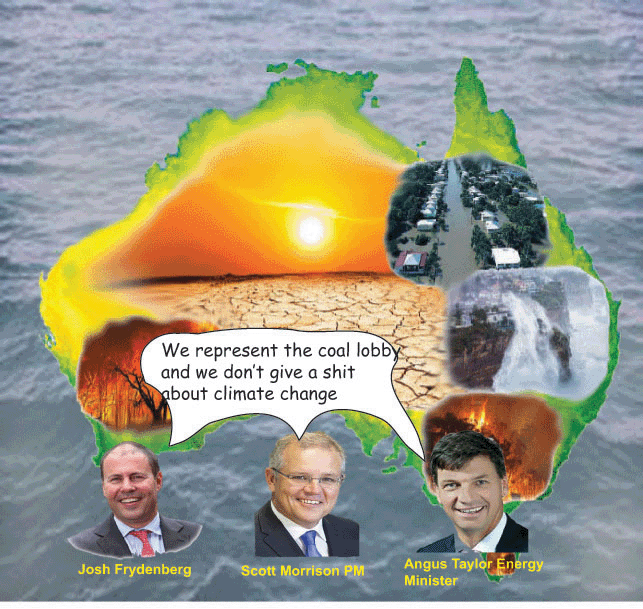
It’s ironic, perhaps, that in an election cycle where a number of regional Queenslanders voted for the promise of blue-collar jobs, backing the party that backed the Adani coal project, renewables generated more than 13,000 actual jobs in construction, with a lot of that activity in north Queensland.
Liberal states in talks to revive Turnbull’s dumped energy policy In Canberra, a month on from Scott Morrison’s election victory, there is talk of feasibility studies for a new Queensland coal plant, and a nascent nuclear debate. But if we shift our vantage point to Adelaide, Australia’s near-term energy outlook looks very different.
Dan Van Holst Pellekaan, the Liberal energy minister, is talking about South Australia hitting 100% net renewables by the 2030s. When asked to explain what that means, he tells Guardian Australia “producing more renewable energy in South Australia than we need for our own consumption and exporting the surplus”.
There is no talk of coal, apart from the inevitability of its displacement.
The South Australian renewables export plan relies on a new interconnector with New South Wales. Van Holst Pellekaan says if the proposed interconnector is approved, there are opportunities to construct large-scale solar and wind farms in the north-east of the state, on pastoral land, adjacent to the transmission equipment. “Then we start to displace coal in NSW,” he says. “It’s not just about a bit of renewable energy making a difference … that’s where you start to get a really big win on emissions reduction.”
But pushing ahead with that kind of progress is much easier if there’s a national framework driving the transition. Post-election, Van Holst Pellekaan wants Canberra back at the table being collaborative, implementing a coherent energy policy.
What the South Australian doesn’t say, but is obvious to people who know how the Coag energy council works, is the states can force this issue if they choose to.
If they can agree among themselves about what needs to happen, they can create a framework setting out the rules of the road even if the commonwealth resists.
Liberal states drive energy policy reboot Continue reading
Climate change bringing sea-level rise to Victoria’s low-lying towns and suburbs
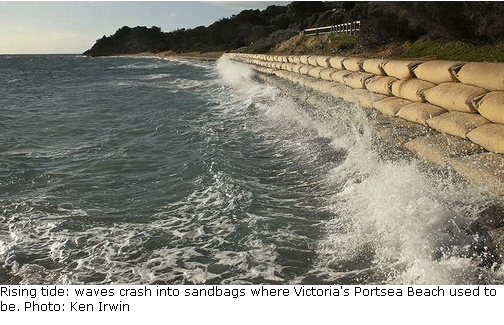 Rising sea, erosion to wreak havoc in low-lying suburbs: report, The Age , By Benjamin Preiss and Adam Carey
Other places at risk include areas around Queenscliff and Barwon Heads on the Bellarine Peninsula; the south-west Victorian towns of Port Fairy and Portland; and Tooradin, Lang Lang and Seaspray in the state’s south-east.
A report tabled in Victoria’s Parliament last week examines the myriad threats to the state’s fragile coastline, painting an alarming picture of damage to the environment and suburban Melbourne if no action is taken.
The Victorian Environmental Assessment Council report cites a 20-centimetre sea-level rise by 2040 and between 40 centimetres and one metre by century’s end.
Sea-level rise will lead to more frequent inundation of low-lying areas, loss of coastal habitat, cliff, beach and foreshore erosion,” the report says.
“Climate change will also put pressure on ageing coastal infrastructure and ultimately impact on feasibility of living in or developing some coastal locations.”
Increasing storm intensity, coupled with rising seas, will cause extensive erosion of the Victorian coastline by 2040, the report says.
“The most extensive area vulnerable to erosion by 2040 is the Gippsland coast,” it says. “Other coasts at risk include west of Portland, beaches in Port Phillip Bay between Mordialloc and Frankston, and the coast between Cape Paterson and Cape Liptrap in South Gippsland.”
Sydney City Council. Mayor Clover Moore to declare city climate emergency
Sydney Lord Mayor Clover Moore said Australia’s largest city needed to step up and show global leadership, especially given the failure of “successive federal governments (which) have shamefully presided over a climate disaster”.
Liberal Sydney Councillor, Craig Chung, one of two Liberal councillors who plan to oppose the motion, told The Australian while he supported action on climate change, he strongly objected to Ms Moore’s “hysterical, catastrophising” message.
“Language like climate emergency, climate catastrophe and extinction rebellion do nothing to further reasoned and rational debate,” Mr Chung said.
“If we learned one thing from the May 18 (federal) election, polarised fear mongering is not what the community want. The electorate expects us to take action, debate clearly and rationally about solutions, stop weaponising language and to deliver measurable and tangible outcomes for all Australians.”
Mr Chung said he would be proposing an amended version of the lord mayoral motion, stripped of all its “hysterical elements”.
Ms Moore said the nation was now experiencing such extreme weather “91 of the hottest places on Earth were in Australia”.
She said heatwaves across the country were now five times more likely, and “even more alarming — they start earlier, become hotter and last longer”.
“Seventy per cent of the world’s emissions are generated from cities, so the action city governments take is absolutely critical,” Ms Moore said.
Ms Moore has asked Council to call on the Federal Government to respond urgently to the emergency, by reintroducing a price on carbon to meet the Paris Agreement emissions reduction targets, and establishing a Just Transition Authority to ensure Australians employed in fossil fuel industries find appropriate alternate employment.
“Successive federal governments have shamefully presided over a climate disaster, and now we are at a critical juncture — we face a climate emergency,” she said.
“Australia’s greenhouse gas emissions have increased for four consecutive years. It is clear that the current Federal Government’s policies are simply not working and I call on council to declare a climate emergency, step up our efforts to hold the Federal Government to account. “With 96 per cent of NSW still drought affected, our farmers and rural communities are being decimated by drought, suffering from water shortages and extended bush fire seasons, witnessing unprecedented fish kills and the death of once mighty river systems.”
The Lord Mayor, outlining the City of Sydney’s action on climate change since 2008, committed to accelerate work in the development of its strategic plan till 2050.
“We set a goal to reduce our emissions by 70 per cent by 2030, and — following the Paris Climate Agreement in 2015 — we set a more ambitious goal to reach net zero emissions by 2050”, she said.
“We became Australia’s first carbon neutral council in 2007, and as of June 2017, we’d reduced emissions in our own operations by 25 per cent. By 2020, we will be powered by 100 per cent renewable energy, allowing us to meet our 2030 target by 2024 — six years early.”
According to the International Climate Emergency Forum, over 600 jurisdictions in 13 countries have now declared a climate emergency. The Climate Emergency Declaration campaign in Australia is supported by over 50 climate action groups, including the International Climate Emergency Forum, Extinction Rebellion, and Greenpeace Australia.
Environmental groups are now considering a legal challenge To Queensland’s approval of Adani mine
Queensland approval of Adani plan ‘unlawful’, say environment groups Activists consider legal challenge, saying rules related to source aquifer have been compromised, Guardian, Ben Smee@BenSmee 23 Jun 2019
The Queensland environment department may have acted “unlawfully” when it approved of Adani’s groundwater plan, in the process backing down on a longstanding requirement that the miner provide definitive proof about the source of an ancient desert spring.
Environmental groups are now considering a legal challenge to the approval, partly because the state’s Department of Environment and Science (DES) appeared to negotiate a last-minute compromise with Adani rather than applying strict conditions.
The DES insisted on Friday that it had not changed its position when granting approval for Adani’s groundwater dependent ecosystems management plan – the final hurdle that will allow the company to begin construction of the Carmichael coalmine.
But documents obtained by Guardian Australia, and an email sent by a DES spokesman on 9 April, indicate that the department softened its interpretation of a key requirement in the politically charged weeks before clearing the proposal.
The email of 9 April says the department believed the CSIRO and Geoscience Australia had highlighted “uncertainties” about whether Adani had identified the source aquifer of the Doongmabulla Springs complex.
“Based on the CSIRO and Geoscience Australia report, it would appear that a number of uncertainties remain, including whether the (groundwater plan) definitively identifies the source aquifers of the Doongmabulla Springs Complex, which has always been a requirement for state approval,” the email says.
Four days after the federal election, the Queensland premier, Annastacia Palaszczuk, insisted on a timeframe for DES to make a decision about the groundwater plan. When the clock ran out on 13 June, Adani’s plan was approved, and DES had subtly changed its language.
It said Adani had “sufficiently” identified the “main source aquifer”. The miner’s conditions require it to identify the “source aquifer(s)”……. https://www.theguardian.com/business/2019/jun/23/queensland-approval-of-adani-plan-unlawful-say-environment-groups
Extinction Rebellion activists occupy four Australian cities protesting Adani,
Extinction Rebellion activists occupy four Australian cities protesting Adani, Protesters are ramping up anti-Adani demonstrations – tonight taking over four major CBDs – as works on the controversial mine get underway.
SBS BY CHARLOTTE LAM
The Carmichael Coal Mine received its final environmental approvals to begin work on the central Queensland project, after nearly a decade of opposition and debate.
Queensland’s Environment Department last week approved the mine’s groundwater management plan, ultimately giving it the final go-ahead.
Around 60 people have begun construction activity that includes work on the mine access road……https://www.sbs.com.au/news/extinction-rebellion-activists-occupy-four-australian-cities-protesting-adani
Queensland can expect catastrophic heat waves (but then coal is more important than climate, isn’t it?)

|
The ‘catastrophic’ effect of increasing heatwaves on Queensland, https://www.brisbanetimes.com.au/national/queensland/the-catastrophic-effect-of-increasing-heatwaves-on-queensland-20190616-p51yaf.html Stuart Layt, June 17, 2019 Queensland’s emergency services are planning for more catastrophic weather events – including 30-day heatwaves and 43-degree peak temperatures – as the effects of climate change turn up the heat on regional parts of the state.
The state government commissioned the Queensland State Heatwave Risk Assessment 2019 following the extended heatwave over much of the state in late 2018, which culminated in “catastrophic” fire conditions. “Over the last few summers we have experienced record-breaking heatwaves and seen how their impacts are intensified when they coincide with another natural disaster,” Health Minister Steven Miles said in his foreword to the report. “We only need to look to the October 2018 bushfires, or the February 2019 North Queensland flooding, to see how heatwaves can cause further distress during times of crisis.” The summer of 2018-19 was the hottest on record for Australia. The report, made public this month and running over 100 pages, comprehensively lays out the various impacts the predicted increases to the length and severity of heatwaves would have on Queensland. It was developed using long-term climate modelling provided by the climate science division of the Department of Environment and Science, and is intended to be used by emergency services and related agencies to develop disaster management plans. The state is staring down the barrel of sweating through 15 per cent of the year in heatwave conditions by 2090, up from 3 per cent in 2018, as well as an increase in the duration of individual heatwaves from four days to nearly 30. The average temperature of heatwaves is predicted to rise from 32.5 degrees to 36 degrees, and the average temperature of the peak of the heatwaves will rise from 34 degrees to 43 degrees.
That extra heat is expected to have a range of effects on everything from people’s personal health and the environment to the multiple industries which would be affected, potentially costing the state billions of dollars. The expected effect on individual Queenslanders is “major to catastrophic”, with increased mortality rates among older people and those with pre-existing conditions. That would have a flow-on effect for hospital and health services, which would be under increasing pressure under this scenario. The report notes heatwaves already result in lost productivity to industry across Australia to the value of $8.8 billion, a figure expected to increase accordingly as heatwaves get longer and hotter. Heatwaves over a certain temperature also bring concerns about the effect on infrastructure, in particular the power grid being overloaded, as well as interruption to transport systems. Livestock is also set to be adversely affected by sustained periods of extreme heat, along with crops. The report offers a range of suggestions to mitigate the effects of heatwaves, while specifically not dealing with the underlying effects of climate change. It recommends electricity providers put measures in place to reduce network demand during periods of system stress, and for future infrastructure projects to take extreme heatwaves into account for their design and planning. It also urges industries to develop clear policies for managing workers’ health and safety during extreme heatwaves and more generally across the warmer months of the year. Between 1900 and 2011, extreme heat was the cause of death for at least 4555 people across Australia, more than the number of deaths attributed to all other forms of natural disaster combined. |
|
Australian government’s own data shows that its greenhouse gas emissions policy is failing
 Australia’s Emissions Reduction Fund is failing to deliver, government data shows, ABC News Australia’s Emissions Reduction Fund is failing to deliver, government data shows, ABC News
Key points:
The Emissions Reduction Fund also appears to be failing in its mission to lower emissions, Government data shows. In 2014, the Abbott government allocated $2.55 billion to the newly established Emissions Reduction Fund, mostly to pay polluters to emit less greenhouse gas. The Morrison Government has extended the program with an additional $2 billion and rebranded it the Climate Solutions Fund. Twice a year, the Clean Energy Regulator holds reverse auctions, where companies bid to win the emissions reduction work. The cheapest good-quality bids win and are awarded Emissions Reduction Fund contracts. Those contracts are for a range of projects, including planting trees, stopping tree-clearing and installing energy efficient appliances. Data shows flatlining of emissions reductionThe ABC examined figures from 10 different datasets published by the Government’s Clean Energy Regulator — a series of auction results published in separate PDFs, as well as two spreadsheets containing information about the status of Emissions Reduction Fund contracts and projects…….. https://www.abc.net.au/news/2019-06-17/australian-emissions-reduction-fund-data-analysis/11164476 |
|
‘Stop-Adani’ protest to go global: Brown
Protesters will gather outside the Indian high commission in Canberra on Saturday as the campaign to stop Adani’s Carmichael mine continues.
Queensland’s environment department on Thursday signed off on the company’s plan to manage groundwater on and around its Galilee Basin mine site – the final approval the company needs to begin construction.
Former Australian Greens leader Bob Brown is expected to join the peaceful demonstration to “highlight the Adani company’s appalling record of environmental destruction and corruption overseas”. A vigil is also expected to be held outside India’s consulate general in Sydney.
Adani mining project: Court asks Australian govt to look into public concerns
Adani mining project: Court asks Australian govt to look into public concerns https://www.nationalheraldindia.com/international/adani-mining-project-court-asks-australian-govt-to-look-into-public-concerns 14 June 19
A local court in Australia has asked Federal Govt to listen to public grievances on Adani’s North Galilee Water Scheme. It spells fresh trouble for Adanis and their billion dollar coal mining project
In what is being interpreted as fresh trouble for the Adanis in Australia, who are on way to set up USD 16 billion dollar coal mining project in the Queensland state, a local court has asked the Federal Government to listen to public grievances on Adani’s North Galilee Water Scheme.
The Australian Conservation Foundation (ACF), which had filed a case the Federal Government has said that the latter has conceded public grievances on the Adani’s water scheme were ignored.
ACF said, “This is a massive outcome for the broader community, who raised grave concerns about the effect this project would have on Australia’s precious water resources”, adding, “In conceding the case, the Federal Environment Minister has admitted the Federal Government failed to consider all of the thousands of valid public submissions about if and how Adani’s project should be assessed, in direct breach of the Environment Protection and Biodiversity Conservation Act 1999.”
According to ACF, “Those people were denied their right to a voice in this process. This win will ensure their voice is heard. Now the Government will need to go back to the drawing board and open up assessment of the project for public comment again. It’s a big moment in the Adani story, and it couldn’t have happened without the bold vision of ACF in launching the case, backed by the hard work and expertise of the legal team.”
It continued, “This win is a humiliating outcome for the Federal Government over its assessment of Adani’s North Galilee Water Scheme – the plan to pump up to 12.5 billion litres of water a year from the Suttor River to the company’s Carmichael mine site. Thousands of Australians made valid public comments on Adani’s North Galilee Water Scheme referral, many concerned about the project’s impact on our precious water resources during a time of extreme drought.”
According to ACF, “The Federal Environment Minister has now admitted her delegate did not consider these comments, as required by law. In fact, she has admitted that her Department lost an unknown number of public comments made over the controversial project. This botched process points to a worrying lack of oversight in core assessment procedures designed to protect Australia’s precious water resources.”
It insisted in a statement, “The Federal Environment Minister did not concede our client’s initial argument in the case, which was that the ‘water trigger’ should have applied to the Scheme. The ‘water trigger’ is a measure that ensures any action which has a significant impact on water resources and involves a large coal mining development requires a more rigorous assessment under the EPBC Act.”
It added, “The community is still no closer to having an answer on why the ‘water trigger’ should not have applied to the North Galilee Water Scheme – a project which will take billions of litres of water a year from Central Queensland to service a coal mine. The Australian people have a right to know the impact big projects like this have on their precious water resources.”
Pick out the anti-environment statements in Sussan Ley’s spiel!
 Sussan Ley: I’ll be an environmentalist as minister, Guardian 14 June 19,
 The new environment minister, Sussan Ley, has declared herself an “environmentalist”, saying she is prepared to fight for the environment around the cabinet table even when colleagues disagree with her.
Ley, who welcomed the Queensland government’s decision on Thursday to give the green light to the Adani coalmine, told Guardian Australia she wanted to see more action on recycling, threatened species and biodiversity protection, and a greater focus on individual action to achieve a better environment.
But in the lead-up to a 10-yearly review of the country’s Environment Protection and Biodiversity Conservation Act, Ley has also flagged that she wants approval times for major projects cut, has left the door open to lifting the country’s ban on nuclear power, and has questioned whether land clearing is responsible for species loss.
The former health minister, who was returned to cabinet by Scott Morrison after she quit over an expenses scandal in 2017, said she saw the role as an advocacy position……
Ley welcomed the review of the EPBC Act, due in the second half of this year, saying the country’s current environmental laws were “unnecessarily arduous, complex and not productive”.
….. Along with the approvals process, a clutch of Coalition MPs have indicated they will use the EPBC Act review to have Australia’s nuclear ban removed, a push that is being backed by the Minerals Council of Australia and industry groups.
Ley said the question of nuclear power in Australia was one “where you have to listen to all of the voices” but said she was open to the review considering a removal of the ban.
“To be honest, I am not strongly for or against nuclear power. I think there are good arguments for it, and there are good arguments against it.
“From the perspective of the environment it is important that it is considered, so I am not going to lead that discussion at any point of the review process. Plenty of other people will.”
Ley also made clear her views on the threat to biodiversity after a UN report warned that a million species across the world faced extinction. The minister said she was “concerned” about the problem, but questioned whether land clearing was to blame.
The Australian Conservation Foundation has estimated that there has been a loss of more than 7.4m hectares of threatened species habitat since the EPBC Act was introduced in 1999, with Australia singled out for its high rates of deforestation.
“Biodiversity and … our level of loss of species is of great concern to me,” she said.
“I really believe that the biggest threat to our threatened species is probably feral cats. Loss of habitat isn’t just land clearing, if it is land clearing at all, loss of habitat is often the wrong type of vegetation and that is often introduced weeds……
I do want my approach to the portfolio to be about what you can do, whether it be reducing plastic waste, whether it be about joining a local volunteer group, whether it be about agitating for better weeds and pest management in national parks that are near you, where you live – these are practical things that people can do and they do make a difference.”
On climate change, Ley said she was “interested” in the emissions reduction task of government which is included with the energy portfolio, under Angus Taylor, rather than environment, and said she believed the Coalition’s climate solutions fund is “where we need to be”.
“I am not going to discuss the emissions policy, that is Angus Taylor’s to discuss,”……..
Having argued during the campaign for the compliance and operational parts of the Murray-Darling Basin Authority to be split, Ley also said she would use her new role to push for changes being demanded by irrigators……..perhaps we need to work harder on that balance between environmental water and agriculture.” https://www.theguardian.com/australia-news/2019/jun/14/sussan-ley-ill-be-an-environmentalist-as-minister
Nearly a billion people facing high exposure to climate change effects, Global Peace Index finds
 Nearly a billion people facing high exposure to climate change effects, Global Peace Index finds, ABC, Nearly a billion people facing high exposure to climate change effects, Global Peace Index finds, ABC,
Nearly a billion people are facing climate change hazards globally, with the Asia-Pacific region housing twice as many people living in areas with high exposure than all other regions combined, a new report has revealed. Key points:
In the annual Global Peace Index released on Wednesday, the Institute for Economics and Peace (IEP) said an estimated 971 million people — including more than 2.4 million Australians — live in areas with high or very high exposure to climate hazards including cyclones, floods, bushfires, desertification and rising sea levels. The top nine countries facing the highest risk of climate hazards were all Asian nations with the Philippines topping the list, followed by Japan, Bangladesh, Myanmar and China. IEP founder and executive chairman Steve Killelea told the ABC that many of the countries in the Asia-Pacific region also have weaker coping capacities for natural disasters.
In Australia, the main risks come from hurricanes and cyclones in the north, rising sea levels in the south and east, as well as drought and desertification which is already affecting thousands of farmers, he said. Climate hazards exacerbate conflict and migrationThe report — which ranks 163 countries by measuring internal safety and security, militarisation and ongoing conflict — included climate change risks for the first time this year to evaluate links between climate hazards and violence. It found climate pressures can adversely impact resource availability and affect population dynamics, which can impact socioeconomic and political stability. ……. https://www.abc.net.au/news/2019-06-12/climate-change-hazards-global-peace-index-report/11198144 |
|
Time’s up for Australia’s ignorant ‘old school’ climate denialists
 Why old-school climate denial has had its day, The Conversation, Associate professor in astronomy, Monash University, June 13, 2019 The Coalition has been re-elected to government, and after six years in office it has not created any effective policies for reducing greenhouse emissions. Does that mean the Australian climate change debate is stuck in 2013? Not exactly.While Australia still lacks effective climate change policies, the debate has definitely shifted. It’s particularly noticeable to scientists, like myself, who were very active participants in the Australian climate debate just a few years ago. Why old-school climate denial has had its day, The Conversation, Associate professor in astronomy, Monash University, June 13, 2019 The Coalition has been re-elected to government, and after six years in office it has not created any effective policies for reducing greenhouse emissions. Does that mean the Australian climate change debate is stuck in 2013? Not exactly.While Australia still lacks effective climate change policies, the debate has definitely shifted. It’s particularly noticeable to scientists, like myself, who were very active participants in the Australian climate debate just a few years ago.
The debate has moved away from the basic science, and on to the economic and political ramifications. And if advocates for reducing greenhouse emissions don’t fully recognise this, they risk shooting themselves in the foot. The old denialsOld-school climate change denial, be it denial that warming is taking place or that humans are responsible for that warming, featured prominently in Australian politics a decade ago. In 2009 Tony Abbott, then a Liberal frontbencher jockeying for the party leadership, told ABC’s 7.30 Report:
The theory and evidence base for human-induced climate change is vast and growing. In contrast, the counterarguments were so sloppy that there were many targets for scientists to shoot at.
Climate “sceptics” have always been very keen on cherrypicking data. They would make a big fuss about some unusually cold days, or alleged discrepancies at a handful of weather stations, while ignoring broader trends. They made claims of data manipulation that, if true, would entail a global conspiracy, despite the availability of code and data. Incorrect predictions of imminent global cooling were made on the basis of rudimentary analyses rather than sophisticated models. Cycles were invoked, in a manner reminiscent of epicycles and stock market “chartism” – but doodling with spreadsheets cannot defeat carbon dioxide. That was the state of climate “scepticism” a decade ago, and frankly that’s where it remains in 2019. It’s old, tired, and increasingly irrelevant as the impact of climate change becomes clearer. PartisansClimate “scepticism” was always underpinned by politics rather than science, and that’s clearer now than it was a decade ago. Several Australian climate contrarians describe themselves as libertarians – falling to the right of mainstream Australian politics. David Archibald is a climate sceptic, but is now better known as candidate for the Australian Liberty Alliance, One Nation and (finally) Fraser Anning’s Conservative National Party. The climate change denying Galileo Movement’s claim to be to be non-partisan was always suspect – and now doubly so with its former project leader, Malcolm Roberts, representing One Nation in the Senate. Given this, it isn’t surprising that relatively few Australians reject the science of climate change. Just 11% of Australians believe recent global warming is natural, and only 4% believe “there’s no such thing as climate change”.
Old-school climate change denial isn’t just unfounded, it’s also unpopular. Before last month’s federal election, Abbott bet a cafe patron in his electorate A$100 that “the climate will not change in ten years”. It reminded me of similar bets made and lost over the past decade. We don’t know whether Abbott will end up paying out on the bet – but we do know he lost his seat……
there are economic arguments against new coalmines and new mines may not deliver the number of jobs promised. Australian power companies, unlike government backbenchers and Clive Palmer, have little enthusiasm for new coal-fired power stations. But the fact remains that these economic issues are largely outside the domain of scientists. Debates about climate policy remain heated, despite the scientific basics being widely accepted. Concerns about economic costs and jobs must be addressed, even if those concerns are built on flawed assumptions and promises that may be not kept. We also cannot forget that climate change is already here, impacting agriculture in particular. Science should inform and underpin arguments, but economics and politics are now the principal battlegrounds in the Australian climate debate. https://theconversation.com/why-old-school-climate-denial-has-had-its-day-117752
|
|
|
Ditch the jobs v environment slogan and get on with doing both
 Brisbane Times, By Jeff Angel, June 11, 2019 — ……… In a little publicised study released this year, the NSW Innovation and Productivity Council assessed the environmental goods and services sector. The activities involved include delivering waste, water and energy management; and biodiversity, landscape and climate services. It found the number of jobs generated as 152,000 larger than the total number of jobs in agriculture and mining combined. Importantly a significant number were in regional areas and the vast majority of businesses, small to medium size. With a 6 per cent growth rate, the environmental goods and services sector was already contributing $43.9 billion a year across the economy.
So, protecting the environment is not a job destroyer. It’s the opposite. But what has caused this positive situation?
Another is the NSW Energy Savings Scheme, where electricity retailers are required to meet escalating targets helping business, industry and households save energy (and have lower bills). The Council notes the government law created a competitive market to deliver energy savings at least cost, resulting in NSW now leading the world in the wide-scale adoption of efficient lighting.
A more recent development has been “return and earn” providing refunds on drink bottles and cans. Originally decried by major beverage companies as a tax on consumers that would cost jobs – the evidence is that more than 500 new jobs have been created. None have been reported lost. The state’s Pricing Regulator has also found minimal cost impact; and when you return your drink container for the 10 cent refund, you are saving on the purchase price.
This does not mean that these jobs are replacing employment in the extractive industries, but rather at a macro level there is a social and economic benefit. The issue confronting policy makers is transition as one industry declines and another grows. Some skills are transferable but more deliberate assistance programs are needed. …..
It’s not a choice between jobs and the environment, but how to transition in a way that manages inevitable dislocation and also prevents ongoing, damaging and serious environmental impacts on present and future generations. This is the challenge for the new federal and NSW ministers for the environment and industry.
We know there are many jobs in the green economy – NSW has shown this. Income and job creating services that protect the climate will grow if government allows it. Establishing a local reprocessing industry for our recycling is also essential. Asia has rejected our kerbside recyclate and we can’t just dump or incinerate it here. On the optimistic side, we have a new federal Minister for Waste Reduction in the environment portfolio, the first in Australia’s history; and state ministers are grappling with how to embrace the circular economy where resources are not wasted. Let’s dispense with the slogan of jobs v the environment and get on with doing both.
Jeff Angel is the director of the Total Environment Centre. https://www.brisbanetimes.com.au/national/ditch-the-jobs-v-environment-slogan-and-get-on-with-doing-both-20190610-p51w8n.html
1 This month.

Australians deserve the truth
about
AUKUS – https://aukuspublicinquiry.com/

PETITION – To: Prime Minister Anthony Albanese and the Australian Labor Government

of the week – Australians for War Powers Reform (AWPR)
To see nuclear-related stories in greater depth and intensity
 Antinuclear