
New Report Suggests ‘High Likelihood of Human Civilization Coming to an End’ in 2050 https://www.vice.com/en_us/article/597kpd/new-report-suggests-high-likelihood-of-human-civilization-coming-to-an-end-in-2050 3 June 19
The climate change analysis was written by a former fossil fuel executive and backed by the former chief of Australia’s military. A harrowing scenario analysis of how human civilization might collapse in coming decades due to climate change has been endorsed by a former Australian defense chief and senior royal navy commander.
The analysis, published by the Breakthrough National Centre for Climate Restoration, a think-tank in Melbourne, Australia, describes climate change as “a near- to mid-term existential threat to human civilization” and sets out a plausible scenario of where business-as-usual could lead over the next 30 years.
On our current trajectory, the report warns, “planetary and human systems [are] reaching a ‘point of no return’ by mid-century, in which the prospect of a largely uninhabitable Earth leads to the breakdown of nations and the international order.”
The only way to avoid the risks of this scenario is what the report describes as “akin in scale to the World War II emergency mobilization”—but this time focused on rapidly building out a zero-emissions industrial system to set in train the restoration of a safe climate.
The scenario warns that our current trajectory will likely lock in at least 3 degrees Celsius (C) of global heating, which in turn could trigger further amplifying feedbacks unleashing further warming. This would drive the accelerating collapse of key ecosystems “including coral reef systems, the Amazon rainforest and in the Arctic.”
The results would be devastating. Some one billion people would be forced to attempt to relocate from unlivable conditions, and two billion would face scarcity of water supplies. Agriculture would collapse in the sub-tropics, and food production would suffer dramatically worldwide. The internal cohesion of nation-states like the US and China would unravel.
Even for 2°C of warming, more than a billion people may need to be relocated and in high-end scenarios, the scale of destruction is beyond our capacity to model with a high likelihood of human civilization coming to an end,” the report notes.
The new policy briefing is written by David Spratt, Breakthrough’s research director and Ian Dunlop, a former senior executive of Royal Dutch Shell who previously chaired the Australian Coal Association.
In the briefing’s foreword, retired Admiral Chris Barrie—Chief of the Australian Defence Force from 1998 to 2002 and former Deputy Chief of the Australian Navy—commends the paper for laying “bare the unvarnished truth about the desperate situation humans, and our planet, are in, painting a disturbing picture of the real possibility that human life on Earth may be on the way to extinction, in the most horrible way.”
Barrie now works for the Climate Change Institute at Australian National University, Canberra.
Spratt told Motherboard that a key reason the risks are not understood is that “much knowledge produced for policymakers is too conservative. Because the risks are now existential, a new approach to climate and security risk assessment is required using scenario analysis.”
Last October, Motherboard reported on scientific evidence that the UN’s summary report for government policymakers on climate change—whose findings were widely recognized as “devastating”—were in fact too optimistic.
While the Breakthrough scenario sets out some of the more ‘high end’ risk possibilities, it is often not possible to meaningfully quantify their probabilities. As a result, the authors emphasize that conventional risk approaches tend to downplay worst-case scenarios despite their plausibility.
Spratt and Dunlop’s 2050 scenario illustrates how easy it could be to end up in an accelerating runaway climate scenario which would lead to a largely uninhabitable planet within just a few decades.
“A high-end 2050 scenario finds a world in social breakdown and outright chaos,” said Spratt. “But a short window of opportunity exists for an emergency, global mobilization of resources, in which the logistical and planning experiences of the national security sector could play a valuable role.”
June 4, 2019
Posted by Christina Macpherson |
AUSTRALIA - NATIONAL, climate change - global warming |
Leave a comment
|
Federal election 2019: Clive Palmer unveils new coal-fired power station plan in Qld marginal seat, ABC,
By Jemima Burt 8 May 2019 Clive Palmer’s coal company Waratah Coal has announced plans to build a coal-fired power station in central Queensland….
Climate change makes plan dangerous: Australia InstituteWaratah Coal is the largest tenement holder in the Galilee Basin, which sits in the electorate of Capricornia, one of the most marginal seats of the 2019 election.
And today’s announcement comes amid Mr Palmer’s federal election campaign…..
Climate change is the biggest threat to wellbeing and to industries in this region.
“If we build new coal-fired power stations and pump more greenhouse gases into the atmosphere then that’s going to make it worse.” The Australia Institute (AI) predicts that by 2070 there will be 35-day heatwaves and a 50 per cent reduction in rainfall in Capricornia due to climate change.
AI spokesman Mark Ogge said in light of the report, Mr Palmer’s announcement was dangerous.
“It’s just crazy at this point in time when we’re facing a huge threat from climate change,” Mr Ogge said.
“Climate change is the biggest threat to wellbeing and to industries in this region…… https://www.abc.net.au/news/2019-05-08/clive-palmer-new-coal-mine-plan-waratah-coal-central-queensland/11092102
|
|
June 3, 2019
Posted by Christina Macpherson |
climate change - global warming, Queensland |
Leave a comment
 the most fundamental problem may lie within the Adani group itself. The A$2 billion required from the project will ultimately come, in large measure, from chairman Gautam Adani’s own pocket.Adani Group founder Gautam Adani. Wikimedia,
With an estimated wealth of A$7 billion, he can certainly afford to pay if he chooses to. But it would represent a huge bet on the long-term future of coal-fired electricity, at very bad odds.
|
Explaining Adani: why would a billionaire persist with a mine that will probably lose money? http://theconversation.com/explaining-adani-why-would-a-billionaire-persist-with-a-mine-that-will-probably-lose-money-117682?utm_medium=email&utm_campaign=Latest%20from%20The%20Conversation%20for%20June%203%202019%20-%201325612392&utm_content=Latest%20from%20The%20Conversation%20for%20June%203%202019%20-%201325612392+CID_41d453460eeb0abec7025e8daebe0960&utm_source=campaign_monitor&utm_term=Explaining%20Adani%20why%20would%20a%20billionaire%20persist%20with%20a%20mine%20that%20will%20probably%20lose%20money
June 3, 2019 The road to Adani. There are more hurdles to overcome, and Gautam Adani might have to put up his own money. AAP By mid-June, if everything goes as expected, Adani Australia will receive the final environmental approvals for its proposed Carmichael coal mine and rail line development.Newspaper reports based on briefings from Adani suggest that, once the approvals are in place, the company could begin digging “ within days”.
On Friday the Queensland government approved Adani’s plan to protect a rare bird, apparently leaving it with just final regulatory hurdle: approval for its plan to manage groundwater.
Its billboards in Brisbane read: “We can start tomorrow if we get the nod today”.
But several big obstacles remain. Even after governments are out of the way, it will have to deal with markets and companies that aren’t keen on the project.
Obstacles aplenty
First up, there’s the problem of access to Aurizon’s rail line. Adani originally planned to build its own 388km railway from the Galilee Basin to its coal terminal at Abbot Point.
However, in the scaled-down version of the project announced last year, Adani plans to build only 200km of track, before connecting to the existing Goonyella line owned by the rail freight company Aurizon.
That requires an agreement of access pricing and conditions. Aurizon is legally obliged to negotiate with Adani, but has shown itself to be in no hurry to reach a deal.
Then there’s insurance. Faced with rejection by every major bank in the world, Adani announced it would fund the project from its own resources. But now insurers, including nearly all the big European firms and Australia’s own QBE, are saying the same sort of thing as the financiers.
Without insurance the project can’t proceed, and the pool of potential insurers is shrinking all the time.
Not particularly financial
But the most fundamental problem may lie within the Adani group itself. The A$2 billion required from the project will ultimately come, in large measure, from chairman Gautam Adani’s own pocket.Adani Group founder Gautam Adani. Wikimedia, CC BY
With an estimated wealth of A$7 billion, he can certainly afford to pay if he chooses to. But it would represent a huge bet on the long-term future of coal-fired electricity, at very bad odds.
In my analysis of the original Carmichael mine proposal in 2017 I concluded that the profit from operating the coal mine would be around A$15 per tonne.
A recent analysis of the revised project by David Fickling for Bloomberg yielded a marginally more favorable estimate of US$16 per tonne, or US$160 million a year for the initial output of 10 million tonnes a year.
That’s an 8% rate of return on $US2 billion, before considering overheads and depreciation.
It’d need a long life…
Such an investment could only be profitable on the basis of a mine with a long life and substantial potential for future expansion. How likely is that? When the start of construction was re-announced last November, it was suggested the coal might be shipped by 2021. With six months’ delay, and the insurance problem noted already, 2022 seems like the earliest possible date.
But by that time, the current construction pipeline for coal-fired plants in India will have been worked through, and very few new ones will be being commissioned. A mere 8 gigawatts of new coal-fired power was commissioned in 2017-18, partly offset by 3.6GW of coal-fired power stations that closed down.
The Indian government has stated that no new coal plants will be needed after 2022, or 2027 at the latest.
…which it might not get
In these circumstances, newly opened coal mines will be able to sell coal only if they can displace existing suppliers. This suggests prices will have to fall to a level sufficient to ensure further closures of existing mines. Such a fall would erode or eliminate Adani’s already thin margins.
By 2030, with the project still in its relatively early stages, most developed countries will have stopped using coal-fired power. The others will be moving fast in that direction. So far under President Trump, the United States has closed 50 coal-fired power stations, and will almost certainly never build another.
The only glimmer of hope for coal has been in less developed countries in Asia. But over the course of this year, even these hopes have dimmed. Major banks in Japan and Singapore have withdrawn from funding new coal projects, following the lead of the global banks based in Europe and the US.
Read more: If the Adani mine gets built, it will be thanks to politicians, on two continents
That leaves South Korea and China as potential sources of funding. Korea is already phasing out coal-fired power domestically and its banks are being pressured to divest globally. The option of relying solely on China is problematic to say the least.
To sum up, unless current trends change dramatically, the economic life of the Carmichael mine is unlikely to be more than a decade – nowhere near enough to recover a A$2 billion investment.
The only glimmer of hope for coal has been in less developed countries in Asia. But over the course of this year, even these hopes have dimmed. Major banks in Japan and Singapore have withdrawn from funding new coal projects, following the lead of the global banks based in Europe and the US.
|
|
June 3, 2019
Posted by Christina Macpherson |
AUSTRALIA - NATIONAL, climate change - global warming |
Leave a comment
|
  Brace for impact – climate change litigation is fast approaching https://www.canberratimes.com.au/story/6184421/brace-for-impact-climate-change-litigation-is-fast-approaching/?cs=14246, Arthur Marusevich , 30 May,19 Brace for impact – climate change litigation is fast approaching https://www.canberratimes.com.au/story/6184421/brace-for-impact-climate-change-litigation-is-fast-approaching/?cs=14246, Arthur Marusevich , 30 May,19
Since the late 1990s, Australian politics on climate change has been divisive. Although Australia signed the Kyoto Protocol in 1998, it did not ratify it until 2007. Then, in 2011, the Clean Energy Act purporting to reduce greenhouse emissions was passed, only to be repealed in 2014.
In 2016, Australia ratified the Paris Agreement and the Doha Amendment to the Kyoto Protocol; however, any serious action on climate change remains to be seen.
At the same time, some states and territories also have emissions reduction targets. The uncoordinated approach is a problem for at least two important reasons.
First, climate change is an ever-increasing phenomenon, with tremendous impact on corporate, social and political discourse. Any meaningful legal framework to govern climate change requires the development of a legal consensus at the federal level, in line with international commitments.
Second, there is a rising wave of climate change-related litigation globally which is headed for Australia. Climate change litigation 2.0 (targeting companies) and climate change litigation 3.0 (targeting governments) will sink Australia, unless drastic measures are implemented.
Under the current legal regime, company directors may only be liable if found to be in breach of their duty of care or for failing to address a foreseeable risk. However, guidance from case law suggests that it is difficult to establish that the actions or omissions of a particular entity or director caused or contributed harm to be suffered by another. With the arrival of climate change litigation 2.0, this will all change.
For one, litigation 2.0 will force companies to assess and report on the risks of climate change and potentially set out plans for mitigating those risks. The recent tide of comments from the Australian Securities and Investments Commission, the Australian Prudential Regulatory Authority and the Reserve Bank of Australia are a testament to this.
Companies and their directors could soon face liability (including personal liability) if they fail to assess and address risks relating to climate change. Investors, shareholders and even communities will be able to recover losses and seek damages from companies and their directors, auditors and advisors, for failing to assess and mitigate risks.
As major climate change attribution studies emerge to assist in tracing particular weather events with greenhouse gasses, causation will be easier to establish. It is likely that in the future, courts will rely on such studies to conclude that a particular entity has contributed, at least in some proportion, to a particular harm.
It would be interesting to see how companies and directors brace for impact as climate change litigation 2.0 approaches.
Although unprecedented and unheard of in Australia, climate change litigation 3.0 will be the next phase. It will allow Australians to bring action against the government for failing to mitigate risks.
Claims of this nature around the world are already proving to be quite successful. The Urgenda litigation in the Netherlands is the leading example. In that case, a Dutch NGO argued that the Netherlands Government had breached its duty of care to the Dutch people by failing to mitigate the risks of climate change and reducing greenhouse gases. The remedy ordered by the court was that the Netherlands Government reduce emissions by at least 25 per cent by the end of 2020.
Similarly, the Juliana case brought against the US government argued that current policies fail to satisfy their obligations to hold certain essential resources on trust for all US citizens. The case is currently awaiting a determination as to whether it will go to trial.
We can only ignore it for so long – in the coming years, we are destined to see a rise in climate change litigation in Australia. While this may be welcome news for practitioners, it is not so much for companies and governments, who need to re-examine their approach to assessing and mitigating climate change risks now. If not, litigation 2.0 and 3.0 will do it for them.
- Arthur Marusevich is a lawyer and writer. He is an advocate for legal reform and social justice.
|
|
May 30, 2019
Posted by Christina Macpherson |
AUSTRALIA - NATIONAL, business, climate change - global warming, legal |
Leave a comment
|
Rising seas threaten Australia’s major airports – and it may be happening faster than we think, The Conversation, Thomas Mortlock, Senior Risk Scientist, Risk Frontiers, Adjunct Fellow, Macquarie University, Andrew Gissing, General Manager, Risk Frontiers, Adjunct Fellow, Macquarie University, Ian Goodwin, Associate Professor, Macquarie University, Mingzhu Wang, Senior Geospatial Scientist, Risk Frontiers, Adjunct Fellow, Macquarie University, May 28, 2019 Most major airports in Australia are located on reclaimed swamps, sitting only a few metres above the present day sea level. And the risk of sea level rise from climate change poses a greater threat to our airports than we’re prepared for.
In fact, some of the top climate scientists now believe global sea-level rise of over two metres by 2100 is likely under our current trajectory of high carbon emissions.
This makes Cairns (less than 3m above sea level), Sydney and Brisbane (under 4m), and Townsville and Hobart (both around under 5m) airports among the most vulnerable.
In the US, the National Oceanic and Atmospheric Administration (NOAA) has recommended that global mean sea level rise of up to 2.7 metres this century should be considered in planning for coastal infrastructure.
This is two to three times greater than the upper limit of recommended sea level rise projections applied in Australia.
But generally, the amount of sea level rise we can expect over the coming century is deeply uncertain. This is because ice sheet retreat rates from global warming are unpredictable……..
The Intergovernmental Panel on Climate Change (IPCC) puts sea level rise projections for Australia somewhere between 50 to 90 centimetres by 2090, relative to the average sea level measured between 1986 to 2005. But the emerging science indicates this may now be an underestimate.
Some studies suggest if substantive glacial basins of the West Antarctic Ice Sheet were to collapse, it could contribute at least a further two metres to global sea levels.
Most Australian airports have conducted risk assessments for the IPCC projections.
In fact, there is no state-level policy that considers extreme sea level rise for the most critical infrastructure, even though it is possible sea levels could exceed those recommended by the IPCC within the coming century…….. http://theconversation.com/rising-seas-threaten-australias-major-airports-and-it-may-be-happening-faster-than-we-think-115374
|
|
May 30, 2019
Posted by Christina Macpherson |
AUSTRALIA - NATIONAL, climate change - global warming |
Leave a comment
 Labor divided on climate policy after ‘absolute carnage’ at the election, Brisbane Times ,
  By Nicole Hasham, Eryk Bagshaw and Dana McCauley, May 25, 2019
Shadow climate change minister Mark Butler says Labor’s calamitous election loss is no reason to walk away from tough emissions cuts, as a senior party figure described the result of its climate strategy in Queensland as “absolute carnage”.
Labor failed to win office in what was billed as the climate change election, despite having a much bolder policy than the Coalition on cutting greenhouse gas pollution.
May 25, 2019
Posted by Christina Macpherson |
AUSTRALIA - NATIONAL, climate change - global warming, politics |
Leave a comment
Climate change protesters flood Melbourne’s CBD, block traffic in call to action, More than a thousand people have marched through Melbourne’s CBD and staged a mock “die-in” for climate change. ABC
Key points:
- Activists marched through the city and staged a “die-in” at Bourke and Swanston streets
- Organiser Extinction Rebellion called for a Citizens’ Assembly on “climate and ecological justice”
- The protest disrupted tram schedules in the city during the march
The protest started with speeches at the Victorian Parliament, then marchers moved through the city to the corner of Bourke and Swanston streets where they staged a “die-in”.
A number of protesters dropped to the ground to lie down in the intersection before moving on to Carlton Gardens.
Protesters young and old chanted “this is our future, there is no plan B” and “what do we want — action, when do we want it — now”.
One of the protest organisers, Extinction Rebellion Victoria, called for governments to set up a “Citizens’ Assembly on climate and ecological justice” to lead environmental policy.
Extinction Rebellion organised a series of protests in London last month which caused major disruptions……. https://www.abc.net.au/news/2019-05-24/climate-protesters-flood-melbournes-cbd/11145648
May 25, 2019
Posted by Christina Macpherson |
climate change - global warming, Victoria |
Leave a comment
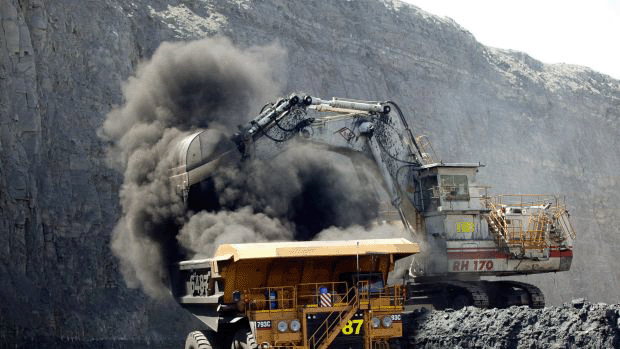
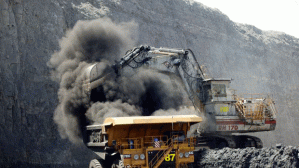 While the Morrison government, including Resources Minister Matt Canavan, have been quick to seize on pro-Adani sentiment, especially in regional Queensland, after the election trouncing Labor too will likely review its stance on the mine.
Joel Fitzgibbon, Labor’s agriculture spokesman, on Monday warned that the party’s emphasis on climate change over coal jobs cost it heavily, including a 10 per cent swing in his own seat in the Hunter.
But the fight is not likely to go away.
As little as 1 per cent of the Great Barrier Reef will remain if global temperatures rise 2 degrees above pre-industrial levels, and we are halfway there, the UN reported earlier this month in a landmark report on global biodiversity.
And the climate risks aren’t restricted to the reef. The Reserve Bank’s deputy governor, Guy Debelle, has warned that climate change could cause financial shocks if companies didn’t take the risks seriously in their planning.
By risks, he was meaning everything from reputational damage to the damages from bushfires and cyclones, events worsened by climate change. It’s for reasons such as this that major lenders QBE, Japanese trading companies and China’s State Development and Investment Corporation have all reduced their investment exposure to coal.
Are anti-mine activists about to give up?
The Stop Adani campaign says it’s not going to give up its national efforts.
“We’re not going to let that basin be mined,” a spokesperson for the movement said.
Stop Adani’s local organisations have increased to 190 across the country and these groups won’t be put off by the election outcome.
“These kinds of moments are when movements grow,” the spokesperson said. “Nothing has changed about the science nor what’s at stake.”
What’s next for the coal mine that helped to return Morrison to power? https://www.smh.com.au/environment/conservation/what-s-next-for-the-coal-mine-that-helped-to-return-morrison-to-power-20190520-p51p7j.html
It’s been a byword for division but, post-election, moves are speeding up to approve Adani’s Carmichael coal mine in Queensland. How did we get here and what’s next? By Peter Hannam Adani’s proposed mine in Queensland has long been a lightning rod for division over coal-mining and climate change in Australia. It is also being named as a big reason for Labor’s lost seats in Queensland amid the Morrison government’s upset re-election.Now Queensland’s Premier says everyone’s “had a gutful” of the issue – and she wants it sorted out.
“I am expecting a definite timeframe by Friday,” Premier Palaszczuk said on May 22.
So what’s next for this controversial project and what are the implications of it finally going ahead?
May 23, 2019
Posted by Christina Macpherson |
AUSTRALIA - NATIONAL, climate change - global warming, politics |
Leave a comment

 Any impact on the underground aquifers that feed into the Great Artesian Basin would not only be devastating for the environment, but also for all the communities that rely on its water resources.
The original groundwater model submitted by Adani was not “suitable to ensure the outcomes sought by the EPBC Act conditions are met”
|
With the LNP returned to power, is there anything left in Adani’s way? The Conversation, Samantha Hepburn
Director of the Centre for Energy and Natural Resources Law, Deakin Law School, Deakin University, 22 May 19, After months of “start” and “stop” Adani campaigning, the coalmine is poised to go ahead following the surprise success of the Coalition government at the federal election.So is anything still stopping the coalmine from being built?Australia has a federal system of government, but states own coal. This means the Queensland Labor government is responsible for issuing the Adani mining licence……
what has “delayed” the state government so far is its legal duty to make sure the coalmine has an effective plan to manage matters of environmental significance.
Before the election, the federal government already approved two controversial environmental plans – the groundwater management planand the finch management plan. The only thing left now is for the Queensland Labor government to give its nod of approval.
Not ‘delay tactics’, but a legal duty Continue reading →
|
May 23, 2019
Posted by Christina Macpherson |
AUSTRALIA - NATIONAL, climate change - global warming, politics |
Leave a comment
|
Climate change litigation to continue, with focus on CSR, https://www.lawyersweekly.com.au/biglaw/25692-climate-change-litigation-to-continue-with-focus-on-csr
23 MAY 2019 By: Jerome Doraisamy
Australian courts will consider the risks of climate change to be foreseeable, thereby creating further responsibilities for companies and directors, according to one BigLaw firm.
Ashurst partner James Clarke said that several proceedings have already commenced in Australia with regard to climate change disclosures and company management. This trend, he said, is expected to continue.
“While there is an increasing understanding about associated obligations and liabilities, there remains a lack of detailed guidance for companies and directors in how to appropriately respond,” he said.
“Australian courts will most likely consider that climate change risks are foreseeable, and that directors who fail to consider those risks may be liable for breaching their duties of care and diligence. At the same time, key regulators have increasingly strengthened their statements in relation to climate change risks.”
One wave of climate change litigation focuses on corporate decision making and disclosures, and the role of directors in those contexts, Mr Clarke continued.
“A separate wave presents a different risk and that is the litigation directed at challenging, on climate change-related grounds, government approvals associated with development of a project, typically relating to fossil fuel projects or projects with high carbon emissions.”
His fellow partners, John Briggs and Jeff Lynn, added that even though the re-election of the Morrison Government means that “significant new legal transitional risks” may not yet emerge at a federal level, it is still expected that individual states and territories may play an increased role in renewable energy and emissions reduction requirements.
“Companies and their directors must monitor these developments and ensure that their practices meet the increasingly well understood obligations,” the pair said.
Climate change can have significant implications for the obligations of companies and their directors, they added, “even when it does not pose any direct physical risk to business activities”.
“Companies and their directors are expected to consider and understand climate change risks, and ensure they are disclosed and, where appropriate, mitigated.”
“Australian regulators including ASIC and APRA are increasingly attuned to these obligations, and have been vocal in their focus and awareness of climate change and associated liability. However, regulators are not the only ones seeking to ensure that companies and their directors consider and respond to climate risks – climate change litigation is a growing global trend,” they concluded.
jerome.doraisamy@momentummedia.com.au
|
|
May 23, 2019
Posted by Christina Macpherson |
AUSTRALIA - NATIONAL, climate change - global warming, legal |
Leave a comment
 Environment Minister Price under pressure to front the public, https://www.smh.com.au/federal-election-2019/environment-minister-price-under-pressure-to-front-public-after-campaign-20190520-p51pak.html ,By Nicole Hasham, May 20, 2019 Australia has failed to deliver a major report to the United Nations on its progress in halting the extinction crisis as pressure mounts on Environment Minister Melissa Price to front the public over highly controversial election-eve decisions.Ms Price’s absence from the federal election campaign became a national curiosity. She refused scores of media interview requests, ignored challenges from her political rivals for public debates and did not appear at government announcements relating to her portfolio.
This prompted suggestions she was avoiding scrutiny of controversial approvals she granted just before the election, such as groundwater plans for the divisive Adani coal project and a contentious uranium mine in her home state of Western Australia.
Prime Minister Scott Morrison has indicated Ms Price will be re-appointed to the portfolio in his next cabinet.
The Department of the Environment and Energy, which Ms Price oversees, was due last December to present Australia’s sixth national report to the United Nations Convention on Biological Diversity.
The report would outline the government’s progress on conservation measures and in meeting the objectives of the convention, to which Australia is a party. However, it has not been delivered.
Australia has one of the world’s worst extinction records. The global crisis was highlighted in a shocking United Nations report this month that warned 1 million species on Earth were headed for extinction within decades.
The Morrison government has also failed to deliver an official plan to protect the nation’s animals and plants. A draft version of the plan, Australia‘s Strategy for Nature 2018-2030, was panned last year as a “global embarrassment” for its brevity and lack of specific targets.
Ms Price’s office did not respond to this publication’s questions or interview request.
Mr Morrison was grilled over the United Nations extinction report and appeared to stumble in his response, referring to government measures that do not exist.
Two days out from the election, Ms Price and Resources Minister Matt Canavan announced an independent audit of energy giant Equinor’s plans to drill for oil in the Great Australian Bight, in response to deep concerns in South Australian coastal electorates.
Should Ms Price continue in the environment portfolio, she faces a number of persistent questions, including how Australia will meet its Paris climate targets if the government’s plans to use carryover carbon credits from the Kyoto period are deemed outside the rules.
In a statement, the department said it was working on the report to the UN Convention on Biological Diversity and that this involved “an extensive co-ordination and consolidation process”. The department hopes to finalise the report this year.
The separate national biodiversity strategy was being revised and required agreement from state and federal environment ministers, it said.
Greens environment spokesperson Senator Sarah Hanson-Young said Mr Morrison “must dump Melissa Price from the ministry … The climate and our environment can’t afford another term with Melissa Price as environment minister”.
May 21, 2019
Posted by Christina Macpherson |
AUSTRALIA - NATIONAL, climate change - global warming, environment, politics |
Leave a comment
 Coal industry urges re-elected Morrison government to build new coal plants, Guardian, Ben Smee @BenSmee 20 May 2019
The Coal Council calls on Labor to reverse many of its climate policies after strong election swings against it, The coal industry has begun lobbying the re-elected Morrison government to support hardline positions, including building new coal-fired power stations and weakening approvals processes for new mines.
The Coal Council of Australia released a statement on Sunday welcoming the election result, praising the Coalition for supporting coal, and calling on Labor to reverse many of its climate-focused policies towards the fossil fuel…….
Despite the election result, coal will likely remain a vexing issue where policies designed to win regional votes could also cost support in inner-city electorates. Research by the Queensland Resources Council, leaked to the Australia Institute in the days before the election, shows the sector is “nearing crisis” and that coal has created a negative perception.
May 21, 2019
Posted by Christina Macpherson |
AUSTRALIA - NATIONAL, climate change - global warming, politics |
Leave a comment
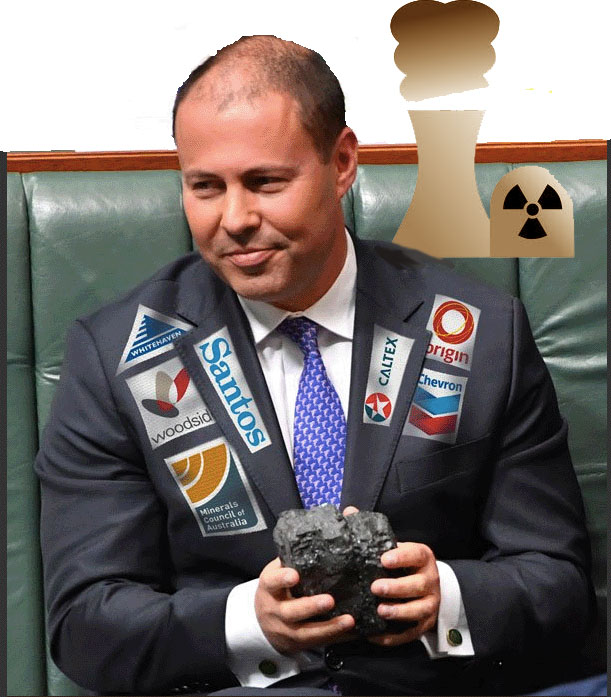
Our plan is very clear’: No climate revamp for re-elected Coalition, Australians should not expect any change to the  Liberal-National government’s climate change policies after their federal election win. SBS, 20 May19
Treasurer Josh Frydenberg has hosed down any suggestion that the Coalition will be going back to the drawing board on climate change after the government’s come-from-behind election win.
“Our plan is very clear and it’s the plan that we took to the Australian people,” he told ABC’s Insiders on Sunday. Treasurer Josh Frydenberg has hosed down any suggestion that the Coalition will be going back to the drawing board on climate change after the government’s come-from-behind election win.
“Our plan is very clear and it’s the plan that we took to the Australian people,” he told ABC’s Insiders on Sunday.
Mr Frydenberg was among Coalition members who faced a swing against them on Saturday, in the face of challenges from independent or Green candidates campaigning largely on climate change.
Former prime minister Tony Abbott lost his seat to Independent Zali Steggallfor whom climate change was pivotal.
As the results rolled in, outgoing MP Julie Bishop said the Coalition must reassess its position on climate change and possibly revisit former prime minister Malcolm Turnbull’s signature energy policy.
“It will have to end the uncertainty and the National Energy Guarantee was the closest thing we had to a bipartisan position.” …..
Labor frontbencher Tanya Plibersek hopes the government finally grapples with climate and energy with a policy aimed at bringing down pollution, reducing power prices and boosting investment in renewables.
“How is this government going to manage that when they are still so broken inside with climate change deniers on one side and people who at least accept the science on the other side, but 14 different energy policies?” https://www.sbs.com.au/news/our-plan-is-very-clear-no-climate-revamp-for-re-elected-coalition
May 20, 2019
Posted by Christina Macpherson |
AUSTRALIA - NATIONAL, climate change - global warming, election 2019 |
Leave a comment
|
After the climate election: shellshocked green groups remain resolute, Guardian, Paul Karp 20 May 19,
Environmentalists reject suggestions tactics such as the Stop Adani convoy cost Labor the election The environmental movement drew first blood on election night by helping independent Zali Steggall oust Tony Abbott but, in the end, the Coalition – which rated a miserable 4% on the Australian Conservation Foundation’sclimate change scorecard – won.After the unexpected result environmentalists have questioned whether their campaign tactics need revision or whether the progressive side of politics was let down by other factors.The Australian Conservation Foundation chief executive, Kelly O’Shanassy, told Guardian Australia climate “was definitely a top issue in the election … but it didn’t convert to votes in all the places it needed to”……..
in Queensland, Nationals MPs including Michelle Landry and George Christensen are prepared to heap the blame – or more accurately, the credit for the conservatives’ strong vote in central Queensland – on campaigns like Stop Adani and particularly the convoy organised by the Bob Brown Foundation. ……
in Queensland, Nationals MPs including Michelle Landry and George Christensen are prepared to heap the blame – or more accurately, the credit for the conservatives’ strong vote in central Queensland – on campaigns like Stop Adani and particularly the convoy organised by the Bob Brown Foundation. ……..
GetUp’s exit polling found climate change was the voters’ top issue in Warringah, where Tony Abbott lost to Zali Steggall, in Josh Frydenberg’s seat of Kooyong and in Menzies.
Independents including Steggall and Helen Haines in Indi and the Centre Alliance’s Rebekha Sharkie in Mayo all want a better climate policy and there were swings to Labor in inner-city Melbourne.
Paul Oosting, the national director of GetUp, said “the leading climate denier Tony Abbott was unseated”. “It’s clear the Coalition aren’t meeting the public’s expectations and need to change their approach or face more Warringahs.”
Schneiders said it would be “unwise for the prime minister not to recognise his government is very vulnerable on the environment”. The Coalition may feel “they’ve had a happy day now – but the job just gets harder again as soon as they get sworn in”. “It’s a tactical win – the problem hasn’t gone away.”
O’Shanassy said concern about climate change “goes across political lines”. During door-knocking in the electorate of Chisholm, eight out of 10 voters committed to consider the climate, including Liberal voters.
So while the Liberal party retained most of its blue-ribbon seats, like Higgins and Kooyong, O’Shanassy said there is “rising concern from Liberal voters” that the party will need to take seriously – in the same way the state election drubbing in Victoria sparked a flurry of environmental policy announcements from Scott Morrison.
“There’s no doubt the Morrison government needs to deal with climate and energy – and they won’t be able to continue to put it in the too-hard basket.”…… https://www.theguardian.com/australia-news/2019/may/20/after-the-climate-election-shellshocked-green-groups-remain-resolute
|
|
May 20, 2019
Posted by Christina Macpherson |
AUSTRALIA - NATIONAL, climate change - global warming, election 2019 |
Leave a comment
 SBS 20 May 19, New independent MP Helen Haines says she doesn’t intend to operate in a bloc with other crossbenchers, saying she runs her own race in Indi., The Victorian seat of Indi’s likely new independent MP Helen Haines says she doesn’t intend to operate as a bloc with fellow crossbenchers, but expects they’ll work together on issues such as climate change.
Ms Haines looks set to take the seat that was previously held by independent Cathy McGowan, winning almost 52 per cent of the vote so far after preferences.
It would make her the first independent to succeed another independent in a seat……..
“I’m not operating as a bloc with the other independents. I very much run my own race in Indi,” she said.
“There’s no doubt, though, that we do see eye-to-eye on action on climate. I think climate is the one that we will be collaborating very closely on the crossbench.”……. https://www.sbs.com.au/news/crossbenchers-put-climate-on-agenda
May 20, 2019
Posted by Christina Macpherson |
AUSTRALIA - NATIONAL, climate change - global warming, election 2019 |
Leave a comment









 Antinuclear