Dutton to ditch Paris Agreement: analysis reveals nuclear impact on emissions

SMH By Mike Foley. June 9, 2024
The opposition’s nuclear energy plans would force Australia to fall massively short of the nation’s emissions target and generate more than 2 billion tonnes of extra greenhouse gas by 2050, breaking Australia’s commitment to the Paris Agreement. New analysis revealed the emissions blowout following Opposition Leader Peter Dutton’s declaration he would ditch Australia’s legally binding climate target to cut emissions 43 per cent from 2005 levels by 2030.Dutton told The Australian on Saturday that the government’s renewable goal was unattainable and “there’s no sense in signing up to targets you don’t have any prospect of achieving”, and pledged only to meet a goal of net zero emissions by 2050.
Solutions for Climate Australia calculated the extra emissions that would be generated by coal and gas plants while waiting for the first nuclear plants to be built, which CSIRO reported last month could not be achieved until 2040 at the earliest.
Dutton has said the Coalition would boost the role of gas power to fill gaps in the energy grid until his reactors are built, and would ensure coal plants are not shut before their energy supply is replaced.
This increased reliance on fossil fuels would generate 2.3 billion tonnes more greenhouse emissions compared to the Albanese government’s climate policy. That’s more than five years’ worth of Australia’s annual emissions, which were 433 million tonnes in 2023.
Dutton’s declaration will reignite the climate wars and ensure the next federal election, due by May, is a referendum on climate policy after Prime Minister Anthony Albanese last week vowed his government will campaign on this issue every day.
The opposition’s plan would break from the terms of the Paris Agreement, which demands its members increase their emissions goal every five years, with the Albanese government committed to set a 2035 target by February.
It is also at odds with findings of the Intergovernmental Panel on Climate Change – the United Nations’ expert science body – that fossil fuels must be rapidly phased out to meet the Paris Agreement, which the Abbott government signed Australia up to in 2015.
The Paris Agreement commits nations to contributing to action that limits global warming to under 2 degrees – and as close to 1.5 degrees as possible – to avoid the worst damage.
Climate scientists say reaching net zero emissions by 2050 is not enough to achieve this goal, and countries must start reducing emissions rapidly now to have any hope of limiting warming to below 2 degrees, rather than waiting until later decades to deliver deep reductions in greenhouse gases.
Currently, 194 nations are signatories to this deal, including all developed nations and Australia’s major trade and security partners – the US, UK, Japan, Korea, China and India.
Dutton’s rejection of Australia’s 2030 goal will place Australia outside the bounds of the Paris Agreement.
“They’re walking away from the Paris Agreement … saying that Australia will join Libya, Yemen and Iran outside the Paris Accord,” said Climate Change and Energy Minister Chris Bowen.
The Investor Group on Climate Change, representing institutional investors with total funds under management of more than $30 trillion, said Dutton’s policy threatened to derail the clean energy transition.
“Back-flipping on these commitments and withdrawing from the Paris Agreement would corrode investor confidence at a time when Australia is competing for funding for new technologies and clean industries, local jobs and training opportunities,” said the group’s policy director Erwin Jackson………………………………..
“Our analysis shows the federal Coalition’s plan for nuclear reactors would see Australia throw its commitment to limit global heating to 1.5 degrees out the window,” said Solutions for Climate Australia campaigner Elly Baxter……………………………..
The modelling assumes, based on comments from senior figures including Nationals Leader David Littleproud, that a Coalition government would halt construction of large-scale wind and solar farms and continue to roll out rooftop solar panels for homes.
When asked if the opposition still wanted to pause the rollout of renewables, O’Brien said details of the policy would be released in due course. https://www.smh.com.au/politics/federal/dutton-to-ditch-paris-agreement-analysis-reveals-nuclear-impact-on-emissions-20240604-p5jj8s.html
Peter Dutton proposes decades of delay on climate: Federal Liberals still with no climate plan
June 8, 2024: The AIM Network, https://theaimn.com/peter-dutton-proposes-decades-of-delay-on-climate-federal-liberals-still-with-no-climate-plan/
National climate group Solutions for Climate Australia expressed extreme disappointment and concern at the Opposition Leader Peter Dutton proposing further decades of delay in tackling climate change, despite increasing climate disasters.
This follows a statement by Peter Dutton today, in an interview with The Australian, that the Federal Liberal Party wants to reject current targets and plans to reduce Australia’s climate pollution this decade.
“It is a tragedy that the Federal Liberal Party has no plan to stop the increasing climate disasters which are directly killing Australians, and damaging communities, agriculture and businesses across the country, and globally,” said Dr Barry Traill, Director of Solutions for Climate Australia.
“We need decisive action on climate pollution this decade to protect farmers, our food supply, businesses and trade. From uninsurable houses, to declining crop yields, to direct threats to life and property, we are all now being hurt by climate disasters.
“Australians voted decisively for action on climate in the 2022 election. Mr Dutton’s weak, do-nothing approach on climate is out of step with the electorate. The community showed it expects all political parties to adopt strong, science-based targets to reduce pollution.”
“The federal Coalition has not heeded the message of the nation on climate. They must do better.”
Dutton’s nuclear policy a disaster for Australia
Climate Council Media Release, 8 June 24 https://theaimn.com/duttons-nuclear-policy-a-disaster-for-australia/
Responding to reports today that Opposition Leader Peter Dutton would rip up Australia’s 2030 climate targets if elected, Climate Council CEO Amanda McKenzie said:
“Dutton’s climate policy is a disaster, and the consequence for Australians would be more extreme heat, fires and floods. Instead of ripping up Australia’s 2030 climate targets, Peter Dutton must listen to the communities already ravaged by worsening climate disasters.
“There are 195 countries signed up to the Paris Agreement. Opting out would make Australia a global laughing stock.
“The Liberals haven’t learned the lesson Australians gave them at the last election: this is more of the same from the party who already gave us a decade of denial and delay on climate.”
Head of Policy and Advocacy Dr Jennifer Rayner said: “Peter Dutton is now promising Australians more climate pollution and a more dangerous future for our kids.
“This is the make-or-break decade to slash climate pollution by accelerating Australia’s move to clean energy. This is what it takes to keep our kids safe from escalating climate change and set Australia up for our next era of prosperity.
“Australia is already making great progress, with 40 percent of the power in our main national grid coming from clean energy, and one in three households having solar on their roof. Doing a massive u-turn on this momentum makes no sense when we can accelerate it instead.”
Experts unite to condemn Coalition nuclear policy meltdown.
Climate Media Centre
Energy and health experts as well as affected regional and global communities have condemned reports today of the Coalition’s energy policy which includes large nuclear reactors to be sited on mothballed coal-fired power stations across regional Australia, as well as a plan to rip up Australia’s commitments to the Paris Agreement.
The CSIRO’s recent GenCost report showed that renewable energy remains the fastest, safest and lowest-cost energy option is what we’re already building. Clean energy like solar and wind already makes up 40% of our national electricity grid, and one in three households have installed solar panels. Staying this course is the most responsible path toward slashing emissions this decade to avoid the worst impacts of climate change.
Andrew Bray, National Director, RE-Alliance – “The Federal Coalition’s energy policy is a false solution to Australia’s emission reduction commitments – the shift to a clean energy supply is already under way, with the latest data showing almost 40% of Australia’s electricity generation came from renewable energy sources in 2023.
“Policies relying on non-existent small modular reactor (SMR) nuclear technologies and large-scale nuclear plants that take decades to build would commit Australia to a polluting and unreliable fossil fuel powered system for the next 20 years. Our current trajectory will see these ageing plants close progressively over the next ten years.
“Renewable energy is here right now. Australians are increasingly using a cleaner and cheaper electricity supply, which we need to minimise the increasing impacts of climate change. Regional communities can greatly benefit from the rollout of renewable energy infrastructure – provided governments and industry are committed to sustained and significant investment in community engagement.
“We need to stick to the plan but shift our focus to ensure regional communities get the benefits they deserve from the roll-out.”
IEEFA Australia CEO, Amandine Denis Ryan, said: “The research by IEEFA’s nuclear experts calls into question whether nuclear makes financial sense for Australia, for a multitude of reasons – timing, cost, compatibility with renewables and liability issues to cite just a few.”
“Our research shows that nuclear reactors – both small modular reactors (SMRs) and gigawatt-scale reactors – in comparable countries have consistently taken longer and have been more expensive to build than expected. With over 50 years experience in this space, our analysts have researched nuclear projects around the world. For a country like Australia, starting from scratch, we expect that nuclear power reactors would not reach commercial operation before the 2040s, would come at a high cost, and require substantial government support.
“Nuclear plants in Australia cannot be built in time to replace Australia’s fleet of coal power stations, more than 90% of which are expected to retire in the next 10 years. Our research aligns with CSIRO and the regulators’ assessment that it would take at least 15 years to first production. The few existing SMRs in operation took over 12 years to build, despite original construction schedules of three to four years. Large reactors have a history of long delays, with most recent projects taking nine years or more from the first concrete pour, which in turn can only take place after years of planning, contracting and pre-construction works. This is in addition to the time required to develop the regulatory regime.
 Experts unite to condemn Coalition nuclear policy meltdownClimate Media CentreEnergy and health experts as well as affected regional and global communities have condemned reports today of the Coalition’s energy policy which includes large nuclear reactors to be sited on mothballed coal-fired power stations across regional Australia, as well as a plan to rip up Australia’s commitments to the Paris Agreement. Experts unite to condemn Coalition nuclear policy meltdownClimate Media CentreEnergy and health experts as well as affected regional and global communities have condemned reports today of the Coalition’s energy policy which includes large nuclear reactors to be sited on mothballed coal-fired power stations across regional Australia, as well as a plan to rip up Australia’s commitments to the Paris Agreement.The CSIRO’s recent GenCost report showed that renewable energy remains the fastest, safest and lowest-cost energy option is what we’re already building. Clean energy like solar and wind already makes up 40% of our national electricity grid, and one in three households have installed solar panels. Staying this course is the most responsible path toward slashing emissions this decade to avoid the worst impacts of climate change. To arrange interviews, please contact:Danielle Veldre +61 408972997 dan.veldre@climatemediacentre.org.auEmily Watkins +61 420622408 emily.watkins@climatemediacentre.org.au Andrew Bray, National Director, RE-AllianceAndrew has been working with regional communities hosting large scale renewable and transmission infrastructure for more than a decade. He can discuss the policy solutions that are needed to support regional communities to harness the benefits available in the shift to renewable energy.Location: Bungendore, NSW (near Canberra) “The Federal Coalition’s energy policy is a false solution to Australia’s emission reduction commitments – the shift to a clean energy supply is already under way, with the latest data showing almost 40% of Australia’s electricity generation came from renewable energy sources in 2023. “Policies relying on non-existent small modular reactor (SMR) nuclear technologies and large-scale nuclear plants that take decades to build would commit Australia to a polluting and unreliable fossil fuel powered system for the next 20 years. Our current trajectory will see these ageing plants close progressively over the next ten years. “Renewable energy is here right now. Australians are increasingly using a cleaner and cheaper electricity supply, which we need to minimise the increasing impacts of climate change. Regional communities can greatly benefit from the rollout of renewable energy infrastructure – provided governments and industry are committed to sustained and significant investment in community engagement. “We need to stick to the plan but shift our focus to ensure regional communities get the benefits they deserve from the roll-out.” IEEFA Australia CEO, Amandine Denis Ryan, said: “The research by IEEFA’s nuclear experts calls into question whether nuclear makes financial sense for Australia, for a multitude of reasons – timing, cost, compatibility with renewables and liability issues to cite just a few.” “Our research shows that nuclear reactors – both small modular reactors (SMRs) and gigawatt-scale reactors – in comparable countries have consistently taken longer and have been more expensive to build than expected. With over 50 years experience in this space, our analysts have researched nuclear projects around the world. For a country like Australia, starting from scratch, we expect that nuclear power reactors would not reach commercial operation before the 2040s, would come at a high cost, and require substantial government support. “Nuclear plants in Australia cannot be built in time to replace Australia’s fleet of coal power stations, more than 90% of which are expected to retire in the next 10 years. Our research aligns with CSIRO and the regulators’ assessment that it would take at least 15 years to first production. The few existing SMRs in operation took over 12 years to build, despite original construction schedules of three to four years. Large reactors have a history of long delays, with most recent projects taking nine years or more from the first concrete pour, which in turn can only take place after years of planning, contracting and pre-construction works. This is in addition to the time required to develop the regulatory regime. “Nuclear plants are notorious for cost overruns. Our analysts found that SMRs in operation or under construction cost three to seven times more than originally planned. Proposed SMRs in the US have also already seen cost estimates blow out by between two and four times in recent years. Large-scale reactors often face cost overruns as well. The Flamanville EPR in France is an extreme example of this, with costs having more than quadrupled despite France’s deep expertise on nuclear. |
“Nuclear plants are not a good complement for renewable generation. They can be flexible within a range, however the economics rely upon being operated in ‘baseload’ mode. In the 2040s, when the first nuclear plants could begin operating, the Australian Energy Market Operator expects that over 90% of generation will be supplied by variable renewables (wind and solar), and that the average annual utilisation factor of gas generation assets will be between 3% and 15% to complement them. Our analysts estimate that at a utilisation factor below 25%, the cost for electricity supplied by an American SMR would increase to more than AUD 600/MWh, if it was even possible to achieve such a low utilisation operationally.
| Experts unite to condemn Coalition nuclear policy meltdownClimate Media CentreEnergy and health experts as well as affected regional and global communities have condemned reports today of the Coalition’s energy policy which includes large nuclear reactors to be sited on mothballed coal-fired power stations across regional Australia, as well as a plan to rip up Australia’s commitments to the Paris Agreement. The CSIRO’s recent GenCost report showed that renewable energy remains the fastest, safest and lowest-cost energy option is what we’re already building. Clean energy like solar and wind already makes up 40% of our national electricity grid, and one in three households have installed solar panels. Staying this course is the most responsible path toward slashing emissions this decade to avoid the worst impacts of climate change. To arrange interviews, please contact:Danielle Veldre +61 408972997 dan.veldre@climatemediacentre.org.auEmily Watkins +61 420622408 emily.watkins@climatemediacentre.org.au Andrew Bray, National Director, RE-AllianceAndrew has been working with regional communities hosting large scale renewable and transmission infrastructure for more than a decade. He can discuss the policy solutions that are needed to support regional communities to harness the benefits available in the shift to renewable energy.Location: Bungendore, NSW (near Canberra) “The Federal Coalition’s energy policy is a false solution to Australia’s emission reduction commitments – the shift to a clean energy supply is already under way, with the latest data showing almost 40% of Australia’s electricity generation came from renewable energy sources in 2023. “Policies relying on non-existent small modular reactor (SMR) nuclear technologies and large-scale nuclear plants that take decades to build would commit Australia to a polluting and unreliable fossil fuel powered system for the next 20 years. Our current trajectory will see these ageing plants close progressively over the next ten years. “Renewable energy is here right now. Australians are increasingly using a cleaner and cheaper electricity supply, which we need to minimise the increasing impacts of climate change. Regional communities can greatly benefit from the rollout of renewable energy infrastructure – provided governments and industry are committed to sustained and significant investment in community engagement. “We need to stick to the plan but shift our focus to ensure regional communities get the benefits they deserve from the roll-out.” IEEFA Australia CEO, Amandine Denis Ryan, said: “The research by IEEFA’s nuclear experts calls into question whether nuclear makes financial sense for Australia, for a multitude of reasons – timing, cost, compatibility with renewables and liability issues to cite just a few.” “Our research shows that nuclear reactors – both small modular reactors (SMRs) and gigawatt-scale reactors – in comparable countries have consistently taken longer and have been more expensive to build than expected. With over 50 years experience in this space, our analysts have researched nuclear projects around the world. For a country like Australia, starting from scratch, we expect that nuclear power reactors would not reach commercial operation before the 2040s, would come at a high cost, and require substantial government support. “Nuclear plants in Australia cannot be built in time to replace Australia’s fleet of coal power stations, more than 90% of which are expected to retire in the next 10 years. Our research aligns with CSIRO and the regulators’ assessment that it would take at least 15 years to first production. The few existing SMRs in operation took over 12 years to build, despite original construction schedules of three to four years. Large reactors have a history of long delays, with most recent projects taking nine years or more from the first concrete pour, which in turn can only take place after years of planning, contracting and pre-construction works. This is in addition to the time required to develop the regulatory regime. “Nuclear plants are notorious for cost overruns. Our analysts found that SMRs in operation or under construction cost three to seven times more than originally planned. Proposed SMRs in the US have also already seen cost estimates blow out by between two and four times in recent years. Large-scale reactors often face cost overruns as well. The Flamanville EPR in France is an extreme example of this, with costs having more than quadrupled despite France’s deep expertise on nuclear. “Nuclear plants are not a good complement for renewable generation. They can be flexible within a range, however the economics rely upon being operated in ‘baseload’ mode. In the 2040s, when the first nuclear plants could begin operating, the Australian Energy Market Operator expects that over 90% of generation will be supplied by variable renewables (wind and solar), and that the average annual utilisation factor of gas generation assets will be between 3% and 15% to complement them. Our analysts estimate that at a utilisation factor below 25%, the cost for electricity supplied by an American SMR would increase to more than AUD 600/MWh, if it was even possible to achieve such a low utilisation operationally. “One of the major risks for investors in nuclear assets is the size and allocation of liability in case of an accident, with international conventions stating that operators of nuclear installations are liable should an incident occur. Such liabilities are very challenging for a company to carry by itself. In the United States, this issue was addressed with the Price–Anderson Nuclear Industries Indemnity Act (1957) by creating a shared insurance pool, now totalling AUD 22.5 billion across the almost 100 reactors covered. The US Government is exposed to costs beyond the insurance pool. Full costs associated with the 2011 Fukushima disaster could be as high as AUD 770 billion. It is unclear how Australia would be able to manage these liabilities without very material government underwriting of risk.” |
Mia Pepper, Campaign Director at the Conservation Council of WA said: “The Coalition’s nuclear power plans reported today are a clear plan to distract and delay from real action on climate change.
“Nuclear power is expensive, slow and dangerous and simply cannot deliver the energy needed in the time frame we have to decarbonise.
“WA is currently exiting coal and well advanced on the transition to cheaper, safer, cleaner alternatives like renewables. It makes no economic, environmental or energy sense to change direction now.
“The WA Liberals have already ruled out nuclear power for WA, saying it is too expensive and doesn’t make sense for WAs grid. Peter Dutton’s irresponsible reactor plan has failed to convince his own party – and it certainly hasn’t and won’t convince the wider WA community. The Liberal party energy policy is nothing more than a dangerous distraction and delay from the much needed transition out of fossil fuels.”
“Nuclear is thirsty, requiring huge volumes of water for cooling, in an uncertain climate future nuclear also becomes one of the most dangerous and unreliable forms of energy we have seen these issues emerge in nuclear powered countries like France.
There remain significant and unresolved issues with the management of High-Level nuclear waste, insurmountable issues with security, and deep connections to the production of weapons grade materials. The risks of things going wrong are catastrophic.”
Masayoshi Iyoda – 350.org Japan Campaigner, said: “You cannot call nuclear clean energy, and completely ignore the voices of the victims of nuclear disasters and the burden on future generations. Nuclear is simply too costly, too risky, too undemocratic, and too time-consuming. We already have cheaper, safer, democratic, and faster solutions to the climate crisis, and they are renewable energy and energy efficiency.”
Joseph Sikulu – 350.org Pacific Managing Director said: “The legacy of nuclear power in the Asia Pacific region is a harmful one, as is the legacy of climate-destroying fossil fuels. The possibility of Australia venturing into nuclear is dangerous and concerning, and a distraction from what we should really be focused on – the just transition to renewable energy.”
“Truly the stuff of nightmares”: unprecedented low in Antarctic sea ice recorded

By Jeremy Smith, May 31, 2024, https://johnmenadue.com/truly-the-stuff-of-nightmares-unprecedented-low-in-antarctic-sea-ice-recorded/?fbclid=IwZXh0bgNhZW0CMTEAAR0LBw8Xpve2S05Os1FH_y7RYvvv8tqj0qhXrhsM-Z3e49hH1Uu2E44lQr4_aem_AbLMAUeHwooBl6H86wLEqHTtPllDKldX5fzB5e2_5LYTTkXQuf4y_brUHNORL5PsxpdKGuD227S1VVLTWCOjJj7N
Each winter the surface of the sea freezes around Antarctica, over a vast area, mostly to a depth of about one metre. But this is starting to change. Last year, the sea ice reached an unprecedentedly low maximum extent of only 17 million square kilometres.
Why aren’t we talking about sea ice? Perhaps it’s because most people haven’t even heard of it, which is a shame because it’s important.
Each winter the surface of the sea freezes around Antarctica, over a vast area, mostly to a depth of about one metre. The continent effectively doubles in size, with 18-20 million square kilometres being covered by floating ice. That’s an area 2.5 times that of Australia; 4% of Earth’s surface.
But this is starting to change. Last year, the sea ice reached an unprecedentedly low maximum extent of only 17 million square kilometres. Although this year looks like being a little less extreme, a clear and concerning trend appears to be under way. This is emphasised in the ice minimum values in late summer. By February each year the sea ice extent shrinks typically to about three million square kilometres (mostly in two large embayments, the Weddell Sea and the Ross Sea), but through most of the present decade it has dwindled to below two million.
Why does this matter? Well for a start, it is the underside of this huge area of sea ice where algae live and multiply, which feed the shrimp-like krill that in turn sustains an entire ecosystem: fish, seals, penguins, whales, the lot. The upper surface of sea ice is also crucially important. Its albedo, or reflectivity, means that 80-90% of the incoming summer sunshine is bounced back into space. Replace the ice with dark ocean and only about 9% is reflected, the rest going to warm the water. So the loss of sea ice is not only a symptom of climate change, it also contributes to it, in a feedback loop that might accelerate.
There’s more. When sea water freezes, the developing ice crystals comprise nearly pure water. Most of the salt is extruded as a heavy brine, and this cold, dense water sinks, becoming the Antarctic Bottom Current. This circulates around the Southern Ocean before spinning off into the other major ocean basins. As this deep cold flow moves north it displaces warmer water which then up-wells and forms the main surface currents. Without the annual ‘push’ of the Antarctic Bottom Current, these warmer currents might slow and cease.
The global ocean is so vast that it changes very slowly. We are only now beginning to see the results of the ocean’s absorbance of a century of industrial environmental heating, in the form of anomalously warm seas particularly this year. Any pronounced weakening of the ocean circulation due to sea ice loss will be slow – but inexorable.
The results, which are probably not going to happen in our own lifetimes but could well become part of our legacy to future generations, are likely to be dire. It could eventually mean goodbye to the Gulf Stream and the other currents which maintain benign climates on the European Atlantic coast, around Japan, and elsewhere in the northern hemisphere.
The possible consequences of such climate change for human societies are truly the stuff of nightmares.
We’ve underestimated the ‘Doomsday’ glacier – and the consequences could be devastating

The Thwaites Glacier, dubbed ‘Doomsday’, could trigger a two-foot rise in global sea levels if it melts completely
Katie Hawkinson, 22 May 24, https://www.independent.co.uk/climate-change/news/thwaites-doomsday-glacier-melting-study-b2548765.html
A vast Antarcticglacier is more vulnerable to melting than previously thought, according to new research, with potentially devastating consequences for billions of people.
The Thwaites Glacier — dubbed the “Doomsday” glacier because of the grave impacts for global sea level rise if it melts — is breaking down “much faster” than expected, according to a peer-reviewed study published Monday in the academic journal, Proceedings of the National Academy of Sciences.
Using satellite imagery, scientists determined that widespread contact between the glacier and warm ocean water is speeding up the melting process. The climate crisis is interrupting natural processes across large parts of the continent, according to the Antarctic and Southern Ocean Coalition.
The glacier, roughly the size of the United Kingdom, could cause global sea levels to rise more than 2 feet if it melts completely, according to the study.
“Thwaites is the most unstable place in the Antarctic and contains the equivalent of 60 centimeters of sea level rise,” study co-author Christine Dow said in a statement.
“The worry is that we are underestimating the speed that the glacier is changing, which would be devastating for coastal communities around the world,” she continued.
Record rising sea levels have already had severe consequences for coastal and island communities. In February, 1,200 residents of the island, Gardi Sugdub, began to relocate to mainland Panama as the rising Caribbean Sea overtake their home, according to the BBC.
As a result, the indigenous Guna people have become some of the first climate refugees in the Americas.
United Nations Secretary-General Antonio Guterres said last year that more than 900million people face extreme danger from rising sea levels — a projection made even before this week’s discovery about the rapidly-melting glacier.
Mr Guterres said cities across the globe including Mumbai, Shanghai, London, New York, and Buenoes Aires will face “serious impacts”
“The consequences of all of this are unthinkable,” he said. “Low-lying communities and entire countries could disappear forever. We would witness a mass exodus of entire populations on a biblical scale. And we would see ever-fiercer competition for fresh water, land and other resources.”
Isle of Wight-size iceberg breaks from Antarctica

BBC News, Jonathan Amos, Science correspondent, 20 May 24
Another big iceberg has broken away from an area of the Antarctic that hosts the UK’s Halley research station.
It is the third such block to calve near the base in the past three years.
This new one is not quite as large, but still measures some 380 sq km (145 sq miles) – roughly the size of the Isle of Wight.
The British Antarctic Survey (BAS) took the precaution of moving Halley in 2017 because of concerns over the way the local ice was behaving.
Its buildings were shifted on skis to take them away from immediate trouble.
The station is also now routinely vacated during the long dark months of the southern winter. The last personnel were flown out in February.
Halley sits on top of the Brunt Ice Shelf, which is the floating protrusion of glaciers that have flowed off the continent into the Weddell Sea.
This shelf will periodically shed icebergs at its forward edge and it is currently going through an extremely dynamic phase.
In 2021, the shelf produced a berg the size of Greater Paris (1,300 sq km/810 sq miles) called A74, followed in 2023 by an even bigger block (1,500 sq km/930 sq miles) the size of Greater London, known as A81.
The origin of the new berg goes back to a major crack that was discovered in the shelf on 31 October, 2016. Predictably, it was nicknamed the “Halloween Crack”.
A further fracture perpendicular to Halloween has now cut a free-floating segment of ice that has already begun to drift out into the Weddell Sea………………..
Satellite imagery confirms the GPS data. The berg is surrounded by seawater on all sides.
The loss of so much ice from the Brunt structure these past three years has triggered a rapid acceleration in the shelf’s seaward movement.
Historically, it has flowed forward at a rate of 400-800m (1,300-2,600ft) per year. It is now moving at about 1,300m (4,300ft) a year………………………….
“This latest calving reduces the Brunt Ice Shelf to its smallest observed size,” commented remote sensing specialist Prof Adrian Luckman, from Swansea University…………………………………………… more https://www.bbc.com/news/articles/c033wr32ewno
Updated Climate Council statement re nuclear power
Nuclear power stations are not appropriate for Australia – and never will be
March 2024By Climate Council
The prospect of nuclear power in Australia has been a topic of public debate since the 1950s. While Australia has never had a nuclear power station, we do have 33% of the world’s uranium deposits and we are the world’s third largest producer of it. Periodically, as with the changing of the seasons, various individuals appear in the media singing the virtues of nuclear energy – claiming it is the only option for clean and reliable electricity in Australia.In fact, over one third of Australia’s electricity is already powered by renewables, and new initiatives like the Capacity Investment Scheme are set to push us towards 82% renewable energy by the end of this decade. While the move to clean energy is still not happening fast enough, it is underway and starting to speed up. We do not need distractions like nuclear to derail our progress now, so let’s set the record straight.
Why doesn’t nuclear power make sense for Australia?
1. Nuclear power stations can’t be built anywhere in Australia.
They are banned in every state, and in every territory. Such bans were introduced because of community concerns about the health and environmental risks. Many parliamentary inquiries at a federal and state level – see this Victorian Inquiry, this Federal Inquiry, and this South Australian Inquiry for instance – have been held into nuclear energy, and all have concluded that it makes no sense in Australia.
2. Nuclear power stations are expensive and take too long to build.
Australia’s independent science information agency, CSIRO, has found that solar and wind are by far the cheapest ways of producing electricity(even when factoring in storage). In contrast, the cost of building and operating nuclear in Australia remains prohibitively high.
Analysis conducted by the nuclear industry itself shows nuclear power stations take an average of 9.4 years to build – compared to 1–3 years for a major wind or solar project. Australia needs to replace its ageing coal-fired power stations as quickly as possible to rapidly reduce emissions this decade. As shown in the Australian Energy Market Operator’s Integrated System Plan, by far the cheapest and quickest way to do this is to ramp up renewable energy paired with storage like pumped hydro, and batteries.
3. Nuclear power poses significant community, environmental, health and economic risks.
Radiation from major nuclear disasters, such as Chernobyl in 1986 and Fukushima in 2011, have impacted hundreds of thousands of people and contaminated vast areas that take decades to clean up. Even when a nuclear power station operates as intended, it creates a long-term and prohibitively expensive legacy of site remediation, fuel processing and radioactive waste storage.
4. Nuclear power is not renewable, and it is not safe.
Uranium is a finite resource just like coal, oil and gas. It needs to be mined and, just like mining coal, oil and gas, this carries serious safety concerns, including contaminating the environment with radioactive dust, radon gas, water-borne toxins, and increased levels of background radiation. On the other hand, energy generated from the sun and wind releases no pollutants into the air and is overwhelmingly considered to be safe.
There you have it: nuclear power is expensive, illegal, dangerous and decades away from powering our homes and businesses. It makes no sense. On the other hand, energy from the sun and wind is cheap, abundant, safe and available now. So, let’s get on with building more renewable energy!
Antarctic sea ice ‘behaving strangely’ as Arctic reaches ‘below-average’ winter peak
Carbon Brief, AYESHA TANDON, 26 Mar 24,
Antarctic sea ice is “behaving strangely” and might have entered a “new regime”, the director of the US National Snow and Ice Data Centre (NSIDC) tells Carbon Brief.
Following an all-time low maximum in September 2023, Antarctic sea ice has been tracking at near-record-low extent for the past six months. Last month, it hit its 2024 minimum extent, tying with 2022 for the second-lowest Antarctic minimum in the 46-year satellite record.
Dr Mark Serreze, director of the NSIDC tells Carbon Brief that more warm ocean water is reaching the surface to melt ice and keep it from forming. He says that we “must wait and see” whether this is a “temporary effect” or whether the Antarctic has entered a “new regime”.
Meanwhile, Arctic sea ice has reached its maximum extent for the year, peaking at 15.01m square kilometres (km2) on 14 March. The provisional data from the NSIDC shows that this year’s Arctic winter peak, despite favourable winds that encouraged sea ice formation, was 640,000km2 smaller than the 1981-2010 average maximum.
This year’s maximum was the 14th lowest in the satellite record…………………………………………………………………………………………………………………………………………………..
Record-breaking Antarctic extent
Antarctic sea ice has been tracking at or near record-low levels for months.
The Antarctic set a record-low maximum on 10 September 2023, with an extent of 16.96m km2. This was “the lowest sea ice maximum in the 1979 to 2023 sea ice record by a wide margin”, and one of the earliest, the NSIDC says.
Antarctic conditions over 2023 were “truly exceptional” and “completely outside the bounds of normality”, one expert told Carbon Brief.
As 2023 progressed, Antarctic sea ice melt was “slower than average”, the NSIDC says. The total decline in Antarctic sea ice extent through October was 903,000km2, while the October average was 985,000km2.
Nevertheless, Antarctic sea ice extent continued to track at a record low. On 31 October 2023, Antarctic sea ice extent was still tracking at a record-low of 15.79m km2. This is 750,000km2 below the previous 31 October record low………….. more https://www.carbonbrief.org/antarctic-sea-ice-behaving-strangely-as-arctic-reaches-below-average-winter-peak/
Antarctica sea ice reaches alarming low for third year in a row
The extent of ice floating around the continent has contracted to below 2m sq km for three years in a row, indicating an ‘abrupt critical transition’
Graham Readfearn, 25 Feb 24 https://www.theguardian.com/world/2024/feb/24/antarctica-sea-ice-reaches-alarming-low-for-third-year-in-a-row
For the third year in a row, sea ice coverage around Antarctica has dropped below 2m sq km – a threshold which before 2022 had not been breached since satellite measurements started in 1979.
The latest data from the US National Snow and Ice Data Center confirms the past three years have been the three lowest on record for the amount of sea ice floating around the continent.
Scientists said another exceptionally low year was further evidence of a “regime shift”, with new research indicating the continent’s sea ice has undergone an “abrupt critical transition”.
Antarctica’s sea ice reaches its lowest extent at the height of the continent’s summer in February each year.
On 18 February the five-day average of sea ice cover fell to 1.99m sq km and on 21 February was at 1.98m sq km. The record low was 1.78m sq km, set in February 2023.
Whether the current level represents this year’s minimum won’t be known for another week or two.
Antarctica sea ice reaches alarming low for third year in a row
The extent of ice floating around the continent has contracted to below 2m sq km for three years in a row, indicating an ‘abrupt critical transition’
Graham Readfearn @readfearnSun 25 Feb 2024
For the third year in a row, sea ice coverage around Antarctica has dropped below 2m sq km – a threshold which before 2022 had not been breached since satellite measurements started in 1979.
The latest data from the US National Snow and Ice Data Center confirms the past three years have been the three lowest on record for the amount of sea ice floating around the continent.
Scientists said another exceptionally low year was further evidence of a “regime shift”, with new research indicating the continent’s sea ice has undergone an “abrupt critical transition”.
Antarctica’s sea ice reaches its lowest extent at the height of the continent’s summer in February each year.
On 18 February the five-day average of sea ice cover fell to 1.99m sq km and on 21 February was at 1.98m sq km. The record low was 1.78m sq km, set in February 2023.
Whether the current level represents this year’s minimum won’t be known for another week or two.
“But we’re confident the three lowest years on record will be the last three years,” said Will Hobbs, a sea ice scientist at the University of Tasmania.
Antarctica’s sea ice reaches its peak each September, but last year’s maximum extent was the lowest on record, easily beating the previous record by about 1m sq km. Scientists were shocked at how much less ice regrew last year, falling well outside anything seen before.
Coverage appeared to recover slightly in December as the refreeze progressed, but then fell away again to the current levels.
There are no reliable measurements of how thick Antarctic sea ice is, but Ariaan Purich, a climate scientist specialising in Antarctica and the Southern Ocean at Monash University, said it was possible the ice that did regrow was thinner than usual.
“It seems plausible, and thinner sea ice could melt back more quickly,” she said.
Scientists are still investigating what is causing the decline in sea ice,, but they are concerned global heating could be playing a role – in particular by warming the Southern Ocean that encircles the continent.
Sea ice reflects solar radiation, meaning less ice can lead to more ocean warming.
Walt Meier, senior research scientist at the National Snow and Ice Data Center, said that since most of the ice melts completely each summer “much of the ice is only 1-2 metres [thick]” – and even less near the ice edge.
“With the very low maximum last September, the ice was probably thinner on average in many areas, but it’s hard to say how much of an effect it has had on the rate of melt and the approaching minimum,” he said.
Antarctica’s ecosystems are tied to the sea ice, from the formation of phytoplankton that can remove carbon from the atmosphere to the breeding sites of penguins.
Purich led research last year that said the continent’s sea ice could have undergone a “regime shift” that was probably driven by warming of the subsurface ocean about 100 metres down.
Research led by Hobbs and colleagues at the Australian Antarctic Program Partnership and other institutions has added evidence to support this claim.
In a paper published this month in the Journal of Climate scientists examined changes in the extent of sea ice and where it was forming each year.
Looking at two periods – 1979 to 2006 and 2007 to 2022 – the researchers found the amount of sea ice had become much more variable, or erratic, in the later period.
This change could not be explained by changes in the atmosphere – mostly winds – which have previously dictated most of the year-to-year variability of the ice.
The study concludes an “abrupt critical transition” has occurred in Antarctica, but Hobbs said they could not say why.
“We don’t know what the driver of change is. It could be ocean warming or a change in ocean salinity,” he said. But it was also possible the change was a natural shift.
Scientists have warned the loss of sea ice is just one of several major changes being observed in Antarctica that is likely to have global consequences – in particular, its loss is exposing more of the continent to the ocean, accelerating the loss of ice on the land, which can push up global sea levels.
Scientists have been increasingly vocal in calling for governments to take the Antarctic changes more seriously and have lamented the comparative lack of data from on and around the continent.
Hobbs said: “What we need is sustained measurements of ocean temperature and salinity underneath the sea ice. We need improvements in our climate models. And we need time.”
Race of the Century: Australia is in the box seat on climate and finance, here is the blueprint for victory

Michael West Media, by Tim Buckley | Jan 23, 2024
The global energy transition is the race of this century. The rewards are enormous. The risks too. This is an edited version of the submission by Tim Buckley and the Climate Capital Forum on how Australia can tackle the race to electrification and a clean economy.
The world is currently in a technology, trade and finance race as the global energy transition takes hold and we grapple with the growing impacts of climate change and climate risk.
For Australia, this is one of the biggest investment, employment and net export opportunities this century, but only if we proactively build a strategic national response proportional to the investment opportunity.
With China’s huge technology leadership and the US Inflation Reduction Act (IRA) providing upwards of a trillion dollars of incentives, “free global markets” are being heavily and rapidly disrupted. To avoid remaining a zero value-add “dig and ship” country servicing China and greater Asia, Australia must pivot quickly to investing in our own development, in partnership with global technology leaders.
This would require a major similar public policy shift at scale, the likes of which has not been seen in decades. It would not only set the right market signals but also strategically leverage the national balance sheet, and selectively provide public budget support to unlock and crowd-in private capital to enable large-scale investment to meet the challenge.
It is already possible to see the impacts and benefits of the IRA in the US: it is driving the energy transition across the country using a mix of policy initiatives – grants, loans, rebates, incentives, and other investments. Central are tax provisions with the dual function of saving families money on their energy bills while also building demand that accelerates the roll out of clean energy, clean vehicles, clean buildings, and clean manufacturing – all opportunities available to Australia with the right investment.
Petro-state Australia: risks of inaction
We know the growing risks associated with inaction. As one the three largest petro-states globally, Australia’s existing, outdated industry profile means failure to overcome the inertia of relying on fossil-fuels will undermine our economic security and sustainable growth.
Two likely consecutive budget surpluses have demonstrated this government’s financial credentials, accompanied by the rolling out of innovative and strategic building blocks, such as: the Safeguard Mechanism; the $20bn Rewiring the Nation fund; the $15bn National Reconstruction Fund (NRF); $4bn into the Critical Minerals facility; establishing the Net Zero Authority and the Climate Act 2023; and the 32GW Capacity Investment Scheme (CIS). And with the fossil-fuel hyper commodity price rises of 2022 slowly fading, general inflation in Australia is starting to moderate, as is the cost of living crisis.
The time is right for the government to broaden its focus to the electrification of everything across the economy and to strategically stimulate onshore value-adding of our resources; to process and build domestically and then export products with embodied decarbonisation to a growing global market. Australia has world leading and affordable renewable energy, and this creates a massive global competitive advantage, if we can harness this cost advantage to build out our capacity and help diversify global supply chains in zero emissions industries of the future.
The global competitors
Globally, multiple economies have released substantial government-backed fiscal packages to shore up their own industries. The US has laid out a massive trillion dollar subsidy through the Inflation Reduction Act (IRA) resulting in the crowding-in of up to US$3 trillion in private investment, the EU has a immense subsidy program in its Net Zero Industry Act (NZIA) and policies such as its Carbon Border Adjustment Mechanism (CBAM) to build domestic EU supply chains, Korea has its massive battery and EV public-private partnership program, Japan has its GX Roadmap and India has its Production Linked Incentive (PLI) funding.
This is all taking place alongside China’s finely-honed strategy to fund R&D and investment at an unprecedented pace and scale with a lack of regard for near term profitability at the individual sector level; this on top of it being the biggest buyer in the world of lithium, rare earths, iron ore, copper and nickel. And at the same time, it is in China’s national interest to flood in new global supply and push down imported commodities prices – those same commodities that Australia produces.
Decarbonising is also an energy security necessity. With next to zero domestic stockpiles of diesel and oil and increasing global supply chain challenges, Australia’s national security is best served by building local supply chains and renewable energy and non-fossil fuelled transport as well as to ensure decarbonised products have the right price signal in both local and international markets.
Profound economic reform and modernisation in Australia is needed, as is international collaboration.
Doing so will ensure that Australia is not just in the race, but that we are a front runner, leveraging our global competitive advantage of the rich natural resources, low population density and world-class renewables, the smarts of our people, the power of our world leading A$3.5 trillion superannuation base, the stability of our political system and our position as a trusted supplier of commodities at global scale.
CCF submission
The Federal budget position today is in rude financial health. After a decade of deficits under previous governments, careful and prudent management – and some good luck on international markets – the Australian government has delivered a very welcome massive fiscal surplus in 2022/23, which is set to be repeated again in 2023/24.
Building on the policy initiatives announced in 2023, we encourage the government to continue to develop programs such as the Capacity Investment Scheme – a clever and innovative low risk response that underwrites cash flows that will crowd-in A$40-50bn of private investment and leverage many state government programs already in place.
This submission builds upon previous recommendations in Climate Capital Forum’s September 2023 Discussion Paper – An Australian Response to the US IRA.
We provide recommendations for the May 2024 Budget by arguing for a strategic public interest response to the global economic changes commensurate with the massive opportunities in front of Australia; one that outlines how we can leverage our own decarbonising actions, illustrate the growing capacity across the economy, and help drive the global move to renewable energy and energy storage, consistent with the COP26 pledge to triple renewables and double energy efficiency by 2030 and the massive uplift in momentum the IEA Renewables 2023 details, noting China’s growing dominance in all these measures.
By making available an additional A$100bn investment of public capital and budget support over the coming decade well over A$200-300bn of private capital can be crowded in – through debt, infrastructure and equity, both domestic and via collaborative partnerships with strategic international technology and industry leaders. We need a “uniquely Australian” response to “complement not copy the priorities and plans” of the US IRA and other nations, as Treasurer Jim Chalmers said.
Provide capital funding that supports the public interest
Focus strategic investment through the development of a package of funding that builds an Australian renewable energy industry – including a value-adding critical minerals industry development package…………………………………………………………………………………………………………………………………………………………………………………………………………………………………….
About Capital Climate Forum
The Climate Capital Forum was established in December 2022. It brings together the investment, decarbonising, and philanthropy sectors as well as climate finance experts and NGOs to work with government, industry and stakeholders to advocate for ambition in Australia’s drive to become a renewable energy superpower. https://michaelwest.com.au/australia-climate-finance-race/
As earth records hottest year, Coalition digs in against climate action and renewables
Pearls and Irritations, By Sophie Vorrath, Jan 23, 2024
The science is in. The European Union’s Copernicus Climate Change Service has overnight confirmed that 2023 was the earth’s warmest year on record: 0.16°C warmer than the previous record year (2016); 0.6°C warmer than the 1991-2020 average; 1.48°C warmer than the pre-industrial period.
The report from Copernicus notes that each month from June to December in 2023 was warmer than the corresponding month in any previous year, with July and August the warmest two months on record.
“2023 marks the first time on record that every day within a year has exceeded 1°C above the 1850-1900 pre-industrial level for that time of year,” the report says.
“Close to 50% of days were more than 1.5°C warmer than the 1850-1900 level, and two days in November were, for the first time, more than 2°C warmer.”
Furthermore, it is likely that a 12-month period ending in January or February 2024 will exceed 1.5°C above the pre-industrial level – the threshold climate scientists had hoped to limit global warming to through the sort of emissions reduction policies and actions they have been calling for for decades.
Around the world, the changing climate manifested itself in extreme heat waves in southern Europe, North America and China, devastating wildfires in Canada and Hawaii, record-breaking sea surface temperatures and record low sea ice extent around Antarctica.
Australia, remarkably, was the only continent that did not see large areas register record temperatures. But the impacts of global warming are no less evident.
Far North Queensland is picking up the pieces following a devastating cyclone and floods, while large parts of Victoria remain on flood watch after some regions experienced rainfall “higher than their 100-year rates” over 48 hours, according to the BOM. In Western Australia, a searing heatwave is on the cards.
“It’s not surprising, unfortunately,” prime minister Anthony Albanese said on Wednesday from Queensland, where he announced a $50 million federal support package for people affected by the state’s most recent extreme weather events.
“All of this is a reminder that the science told us that climate change would mean there would be more extreme weather events and they would be more intense. And unfortunately, we’re seeing that play out with the number of events that we’re having to deal with right around Australia.”
Climate Council research director Simon Bradshaw says the most alarming thing about the news from Copernicus is that 2023 broke heat records by such a considerable margin, with 2024 projected to be even hotter.
“We’re seeing how much more extreme our climate becomes as we approach the 1.5°C warming threshold,” he said on Wednesday.
“This is why we must limit future warming as much as possible by getting our emissions down fast by rapidly phasing out the burning of fossil fuels such as coal, oil and gas. We can’t keep stoking the fire if we want the room to cool down.”
But as the reality sinks in that 2023 shattered annual heat records and that the world looks like sailing past the safe climate zone hoped for by scientists, the federal Coalition has set to work walking back national emissions targets, railing against renewables and still – still! – banging on about nuclear.
On Wednesday, reports emerged that a majority of Liberal and National Party MPs will oppose taking a 2035 emissions reduction target to the 2025 election, arguing it will worsen the cost-of-living crisis for regional and vulnerable Australians.
“This is why we must limit future warming as much as possible by getting our emissions down fast by rapidly phasing out the burning of fossil fuels such as coal, oil and gas. We can’t keep stoking the fire if we want the room to cool down.”
But as the reality sinks in that 2023 shattered annual heat records and that the world looks like sailing past the safe climate zone hoped for by scientists, the federal Coalition has set to work walking back national emissions targets, railing against renewables and still – still! – banging on about nuclear.
On Wednesday, reports emerged that a majority of Liberal and National Party MPs will oppose taking a 2035 emissions reduction target to the 2025 election, arguing it will worsen the cost-of-living crisis for regional and vulnerable Australians
A survey by The Australian has found most Liberal MPs are privately opposed to any sort of 2035 target and didn’t see any point in putting a number to the Australian people.
Nationals MPs were more forthcoming with their views on the matter, with Barnaby Joyce, Colin Boyce, Keith Pitt, Matt Canavan and Bridget McKenzie on the record as rejecting “any target” or expressing serious reservations about adopting one, the Australian reports.
“There is also a smaller rump within the Nationals, including Senator Canavan and Mr Boyce, who want the Coalition to drop the current policy of net zero emissions by 2050,” the paper says
The context to this is that the latest climate science says 2050 net zero targets are now not enough to rein in global warming at the rate required to keep the planet safe and liveable. It has also been argued that such a distant target allows governments to take their time on policy – time they do not have.
Recent modelling by Monash University’s Climateworks Centre found Australia must move its net-zero emissions target forward by a decade to 2040 and cut national emissions by 68 per cent below 2005 levels by 2030 in order to have any hope of limiting warming to 1.5°C.
Federal Labor – which wants to get to 82 per cent renewables by 2030 – is under pressure to adopt a 2035 emissions target of more than 70 per cent, and is in consultation on the size of the interim target it has promised to bring to the 2025 election.
But the LNP is having none of it, preferring to believe that its constituents are unable to make the mental leap that “cost of living” might be intrinsically linked with the social, environmental and economic costs of ever increasing extreme weather events.
“I’m not confident the Labor Party’s current targets, let alone anything more ambitious, can be achieved without significant social and economic detriment to the nine million of us that don’t live in capital cities,” said McKenzie…………………………………………………………………
A National Rally Against Reckless Renewables is on the calendar for February 6 – federal parliament’s first sitting day for 2024 – with the Facebook page for the event promising “lots of great speakers,” including Joyce, Senator Jacinta Nampijinpa Price, David Gillespie MP, Senator Gerard Rennick, Senator Malcolm Roberts, and old mate Matt Canavan……………………………………..
But not all of the Coalition’s “people,” as Pitt claims regional Australians to be, are drinking this particular brand of Kool Aid.
“The impact of climate change on our communities is immediate and devastating,” said Major General Peter Dunn, a member of Emergency Leaders for Climate Action and former Commissioner for the ACT’s Emergency Services Authority on Wednesday.
“The urgency to stop relying on fossil fuels such as coal, oil and gas, which only worsen this crisis, has never been greater. The time has come for Australia to decisively move away from these harmful pollutants.”
Peter Lake, a northern NSW farmer and member of Farmers for Climate Action says the ongoing drought his farm is experiencing shows how climate change is continuing to make farming “unpredictable.”
“The sooner we get serious about reducing our burning of fossil fuels and start to reduce the amount of carbon dioxide going into our atmosphere the better,” he said on Wednesday.
For federal Labor’s part, it is now imperative that they move faster and with more ambition in the opposite direction to the Coalition and hold their nerve against what is bound to be a ramping up of anti-renewables propaganda……………… more https://johnmenadue.com/as-earth-records-hottest-year-coalition-digs-in-against-climate-action-and-renewables/
Coalition delivers the same old tired nuclear talking points at COP28

With a heavy sigh, Crikey once again delves into the most pointless ritual in Australian public policy — the nuclear energy ‘debate’.
CHARLIE LEWIS, DEC 11, 2023, https://www.crikey.com.au/2023/12/11/coalition-nuclear-energy-australia/
“Today I am happy to announce that a reelected Coalition government will, at its first COP after being returned to office, sign the nuclear pledge and return Australia to where it belongs, standing alongside its friends and allies,” opposition climate change and energy spokesman Ted O’Brien told world climate summit/increasingly dark joke at humanity’s expense COP28 on Saturday.
He pledged that a reelected Coalition government would triple nuclear energy output and overturn Australia’s nuclear energy moratorium, insisting “no nuclear, no net zero”.
And so, with a heavy sigh, Crikey once again delves into what our politics editor Bernard Keane has described as “the single most boring and ossified ritual in Australian public policy”.
A ‘sensible’ debate
It always starts with a demand for a “sensible” debate around the topic. Going back to John Howard’s years as prime minister (he called for this not once but twice) and to pick a handful of examples since: Then-foreign minister Julie Bishop in 2014, the then-assistant science minister Karen Andrews in 2015 and then-candidate Warren Mundine in 2019. Just last week, troublemaking former Labor minister Joel Fitzgibbon called on the Albanese government to end the ban on nuclear energy. This is not to mention a swathe of conservative media figures adding their voices to the choir over the years.
With dreary inevitability, Opposition Leader Peter Dutton reached for the old hymn book in his budget reply this year, arguing (all together now): “Any sensible government must consider small modular nuclear as part of the energy mix.”
Time is money and also money is money
As we’ve long reported — long, long reported — there are several barriers to nuclear power in Australia, primarily that the whole thing is incredibly expensive because Australia doesn’t have any nuclear infrastructure. As clean energy investor and man with a zeal for the teal Simon Holmes à Court, who was at O’Brien’s address, puts it, “it is a pretty easy pledge to sign because three times zero is zero”.
Nuclear power plants take a very long time to build — as Australia’s former chief scientist Alan Finkel told the Nine papers in August, it’s highly unlikely Australia could open a nuclear power plant before the early 2040s, a delay the country can ill afford if it is to dramatically reduce emissions as quickly as it needs to.
On top of this is the eye-watering price. According to research from the Department of Climate Change and Energy released in September this year, the cost of replacing coalmine sites with small nuclear reactors would be $387 billion.
Even former chair of the Australian Nuclear Science and Technology Organisation Dr Ziggy Switkowski, who undertook a review on the viability of nuclear power for the Howard government in 2007 and is a very big fan of nuclear energy, conceded in 2018 “the window for gigawatt-scale nuclear has closed”:
With requirements for baseload capacity reducing, adding nuclear capacity one gigawatt at a time is hard to justify, especially as costs are now very high (in the range of $5 billion to $10 billion), development timelines are 15+ years, and solar with battery storage are winning the race.
The tax that is not to be named
There is and always has been only one way, in the eyes of Australia’s most credible nuclear spruikers, for nuclear energy to compete with existing energy sources: impose a carbon price.
Switkowski’s 2007 review probably didn’t greatly please Howard, given it found that nuclear became viable compared with coal and gas only if there was a carbon price. Economist and Crikey contributor John Quiggin has also previously argued in favour of nuclear energy in Australia only if it is backed by a carbon price.
Ted O’Brien’s nuclear love-in at COP28 gets a brutal reality check.

Ed note. I was pretty surprised that Rafael Grossi who usually downplays all the risks of nuclear (safety, terrorism, weapons proliferation, wastes) went so far as to claim that nuclear is not even a financial risk !
Jim Green 11 December 2023, https://reneweconomy.com.au/ted-obriens-nuclear-love-in-at-cop28-gets-a-brutal-reality-check/—
The nuclear lobby has been out in force at the COP28 climate conference in Dubai. Their main initiative was a ‘declaration’ promoting a “global aspirational goal of tripling nuclear energy capacity from 2020 by 2050”, signed by 22 countries and supported by 120 companies.
The 22 countries are Bulgaria, Canada, the Czech Republic, Finland, France, Ghana, Hungary, Japan, South Korea, Moldova, Mongolia, Morocco, the Netherlands, Poland, Romania, Slovakia, Slovenia, Sweden, Ukraine, the UAE, the UK and the USA.
David Appleyard, editor of Nuclear Engineering International, did the math: “Now 2050 still sounds like a long way off, but to triple nuclear capacity in this time frame would require nuclear deployment to average 40 GW [gigawatts] a year over the next two and half decades. The cruel reality is that’s more than six times the rate that has been seen over the last decade.”
A dominant feature in the declaration — and all the nuclear lobbying surrounding COP28 — is the perceived need to find new methods of financing nuclear plants. In the words of the declaration, participants “commit to mobilize investments in nuclear power, including through innovative financing mechanisms”.
Nuclear power as a commercial venture is very nearly dead, and thus the participants “invite shareholders of the World Bank, international financial institutions, and regional development banks to encourage the inclusion of nuclear energy in their organizations’ energy lending policies”.
In a parallel initiative announced during COP28, the US plans to “jump start” the development of small modular reactor (SMR) exports despite the recent collapse of NuScale Power’s flagship project in Idaho. The US Export-Import Bank has approved a resolution to fund applications for the export of US SMR systems and components.
International Atomic Energy Agency director-general Rafael Grossi recently said — apparently without irony — that international financial institutions, development banks and private banks and investors should take a fresh look at the “winning” investment of financing new nuclear power plants.
In fact, US giant Westinghouse declared bankruptcy in 2017 following its disastrous reactor construction projects in South Carolina and Georgia; the British nuclear power industry went bankrupt years ago and was sold to the French, then the French nuclear industry went bankrupt and has been fully nationalised; South Korean utility KEPCO’s debt has climbed to A$224 billion; the Japanese nuclear industry is essentially a pile of ashes in the aftermath of the Fukushima disaster; and so on.
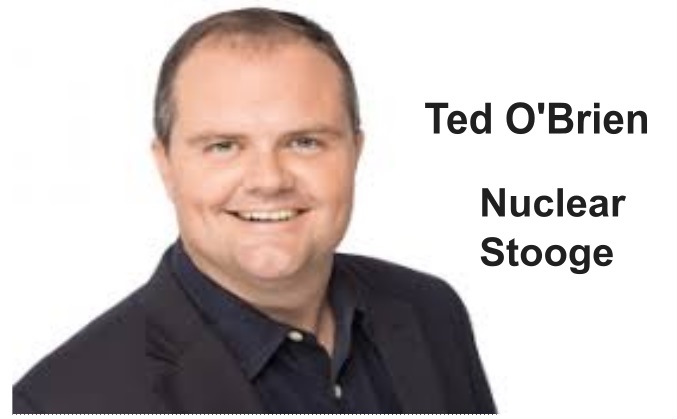
Ted O’Brien says a bunch of silly things
The federal Coalition’s shadow energy minister Ted O’Brien was the lead speaker at a forum on the sidelines of COP28 titled ‘Australia’s Nuclear Energy Potential: Joining the Global Journey’.
The forum also heard from representatives of the (so-called) Coalition for Conservation (which flew seven Liberal and National MPs to the summit), the World Nuclear Association, Emirates Nuclear Energy Corporation, the US Nuclear Industry Council; and an Italian SMR start-up called Newcleo.
O’Brien said that a Coalition government would sign the 22-nation declaration with its aspirational goal of tripling nuclear power capacity by 2050.
The Labor government last week joined more than 120 countries in backing a pledge to triple renewable energy and double the rate of energy efficiency by 2030 — a pledge opposed by the Coalition. O’Brien reiterated the Coalition’s opposition to the Labor government’s target of 82 per cent renewable power supply by 2030.
Speaking to The Guardian, former NSW treasurer Matt Kean said “obviously nuclear is a long way away” and Australia should back renewable energy now: “Who knows what might be available in another 20 years — we may have flying cars in 20 years — but that doesn’t mean you base your whole transport around it.”
O’Brien told the COP sideline forum that Australia’s legislation banning nuclear power is “bizarre”. That would be the legislation introduced by John Howard’s Coalition government and left untouched by the Abbott, Turnbull and Morrison Coalition governments over nearly a decade.
O’Brien said Australia’s track record on renewables is something to be “enormously proud of” without noting the Coalition’s decades-long efforts to slow the growth of renewables and to promote fossil fuel power generators.
He failed to mention that fellow Queenslander and Nationals leader David Littleproud recently said he wants a “pause” to the roll out of wind and solar and transmission links and a stop to the “reckless pursuit” of the government’s 82 percent renewables target by 2030.
O’Brien showed a photo of his children, whose existence apparently demonstrates his commitment to a low-carbon, environmentally sustainable future. In case anyone thought he was serious, he said that Australia needs more gas-fired power generation.
O’Brien said nuclear power is one of the fastest ways to decarbonise; that nuclear waste is “so miniscule”; that Australia should develop “capabilities in other areas of the nuclear fuel cycle”; that the Coalition was not interested in old nuclear but rather Generation 3+ (i.e. mostly non-existent) nuclear power; and that COP28 will be remembered as the “nuclear COP”.
World Nuclear Industry Status Report
The December 6 release of the World Nuclear Industry Status Report (WNISR) provided a welcome relief to all the nuclear nonsense at COP28, including O’Brien’s. For over 30 years, these annual reports have provided factual information that irritates the nuclear industry no end.
Continue readingAustralia backs Cop28 promise to triple renewables but not nuclear capacity pledge
More than 115 countries vow to triple renewable energy capacity by 2030 – though not China and India
Adam Morton and Katharine Murphy, Guardian, Sun 3 Dec 2023
Australia has backed a pledge at Cop28 climate summit to triple global renewable energy capacity and double the annual rate of energy efficiency improvements by 2030.
The climate change minister, Chris Bowen, said the Albanese government had joined 117 other countries in making the pledge, reiterating an agreement reached by G20 countries in September.
The renewable energy agreement was one of a series of headline declarations made as more than 100 global leaders arrived in the United Arab Emirates for the opening days of the two-week conference.
Anthony Albanese is not attending, and Bowen is not due to fly to Dubai until later this week for the event’s final week, when ministers will attempt to wrangle a consensus position on how to lift action to tackle the climate crisis in the face of rising geopolitical tensions. Australia was represented at the opening plenary by its climate change ambassador, Kristin Tilley.
Bowen said Australia had joined other major energy exporters, including the US, Canada and Norway, in supporting the renewables and energy efficiency push.
“We know that renewables are the cleanest and cheapest form of energy, and that energy efficiency can also help drive down bills and emissions,” he said in a statement. “For emissions to go down around the world, we need a big international push. Australia has the resources and the smarts to help supply the world with clean energy technologies to drive down those emissions while spurring new Australian industry.”
The renewable energy pledge was welcomed by climate campaigners and analysts. Tim Buckley, director of the independent think tank Clean Energy Finance, said it was excellent to see Australia backing the commitment. He said falling costs had made the transition to renewables “an entirely economically sensible and viable commitment”………………………………………………………………………..
Australia is the chair of the “umbrella group” of countries at the talks, which includes the US, UK, New Zealand, Canada, Ukraine, Israel and Norway. Bowen said he intended “to be quite an active chair” and that meant “bringing other countries with us” to help reach a consensus.
An initial draft Cop text released on Saturday listed included a range of expressions to be debated, including that either fossil fuels or coal should be “phased out” or “phased down”. The same applied to fossil fuel subsidies. Saudi Arabia, China and India have previously resisted calls to agree that all fossil fuels should be phased out.
Australia was also among more than 100 countries to back declarations pledging to strengthen climate action in healthcare and farming. It did not sign up to a commitment by 22 countries, including the US, Canada, Japan and Britain, to triple nuclear energy capacity by 2050.
The Albanese government is hoping to win support for Australia to host Cop31 in 2026 with Pacific countries, but it is unclear whether a decision will be made in Dubai. The UN climate process faces a more pressing decision on where next year’s annual summit will be held. It is due to be hosted in eastern Europe but Russia has blocked agreement on which country will take the reins.
1 This month

of the week – Australians for War Powers Reform (AWPR)
To see nuclear-related stories in greater depth and intensity
 Antinuclear