Adani doesn’t want a “Mega-Mine” any more
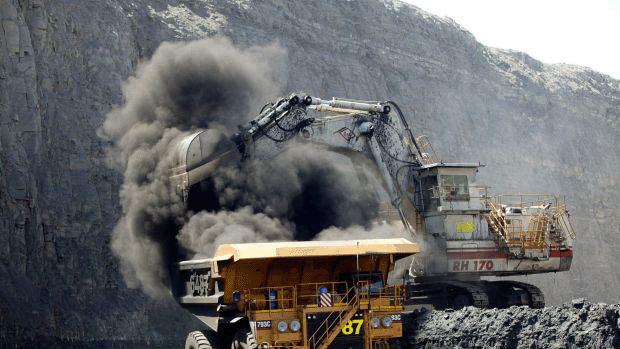 Adani chief rues original plans for ‘mega-mine’ Brisbane Times, By Nick Bonyhady, February 7, 2019 The chief executive of major coal miner Adani says he rues the way the company’s controversial Carmichael coal mine was originally announced as a 60 million tonne mega-mine in 2010 before being scaled down to a 10 million tonne project last year……..
A CFMEU spokeswoman said their official had spoke about central Queensland and that the quote was not a reference to Adani specifically, but that the union supported resource jobs in the state. The Labor Party was contacted for comment.
Mr Dow named the Queensland seats of Flynn, Capricornia, Dawson and Herbert as federal electorates where the mine’s fate would be particularly influential in the election. But Mr Dow also lauded the Coalition for its support of the project, which he said was very nearly underway after being delayed for eight years.
A Queensland government investigation into whether the company breached bore water extraction requirements is ongoing, as is a Federal Court challenge to the validity of a meeting at which indigenous owners approved the company’s indigenous land use agreement.
Adani had sought hundreds of millions of dollars in government loans for the project but its applications were rejected after political pressure from environmental groups……. https://www.brisbanetimes.com.au/business/companies/adani-chief-rues-original-plans-for-mega-mine-20190207-p50wbh.html
Morrison government not recognising the climate impacts already hitting Australia
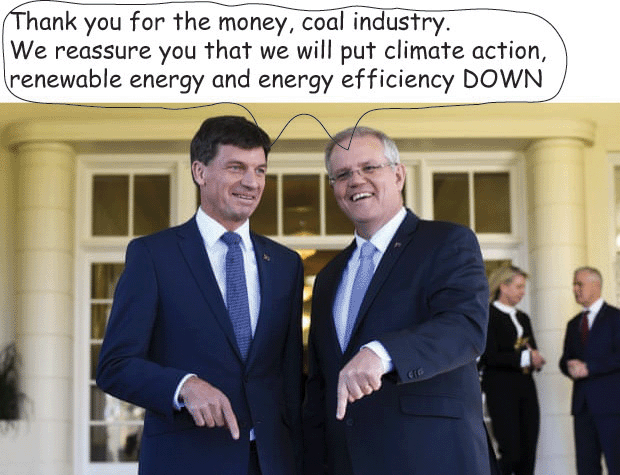 Governments not keeping pace with climate change impacts: scientist, Brisbane Times, By Tony Moore, February 5, 2019 — One of Australia’s leading scientists has warned the Queensland and federal governments that they are not keeping pace with the impacts of climate change. Governments not keeping pace with climate change impacts: scientist, Brisbane Times, By Tony Moore, February 5, 2019 — One of Australia’s leading scientists has warned the Queensland and federal governments that they are not keeping pace with the impacts of climate change.
Queensland’s recent extreme weather – bushfires, heatwaves, coral bleaching, drought, Cyclone Penny, Townsville’s floods – showed the state was clearly experiencing climate change, Professor Ian Lowe said. “What I think is a reason for concern is that the science in the 1980s was saying that – if the [1980] climate models were right – by about 2030 there would be observable changes in climate that would be impossible to ignore,” Professor Lowe said. “Now I think you could say that, if anything, the science of the time was being unreasonably cautious,” he said. I think you would have to be in deep denial not to accept that there are unmistakeable signs of climate change.” Professor Lowe is a member of the Queensland government’s senior climate change body, the Queensland Climate Advisory Council. It is chaired by Queensland Environment Minister Leeanne Enoch, while Queensland Premier Annastacia Palaszczuk, Deputy Premier Jackie Trad, Natural Resources and Mines Minister Anthony Lynham and Queensland’s chief scientist are members. It has met only three times since 2017. ……. Professor Lowe listed coral bleaching, Townsville’s flooding, the Australia-wide heatwaves in January 2019, the unseasonal Queensland bushfires from October to December and the recent fires in Tasmania as examples of extreme weather, triggered by the changing climate. Professor Lowe said the Queensland government was not “keeping pace” with measures to adapt to a changing climate, despite a string of reports since 2015. “As I said before, there isn’t yet the sense of urgency that there should be, either in adaptation, or in mitigation,” he said. He said the federal government was “in complete denial” over the impacts of climate change. Prime Minister Scott Morrison, in Townsville on Tuesday, declined to say whether the torrential rain, described as a one-in-100-year event, was a demonstration of climate change……. https://www.brisbanetimes.com.au/environment/climate-change/governments-not-keeping-pace-with-climate-change-impacts-scientist-20190205-p50vun.html |
Cost of insurance becoming unmanageable in Australia, due to climate change?
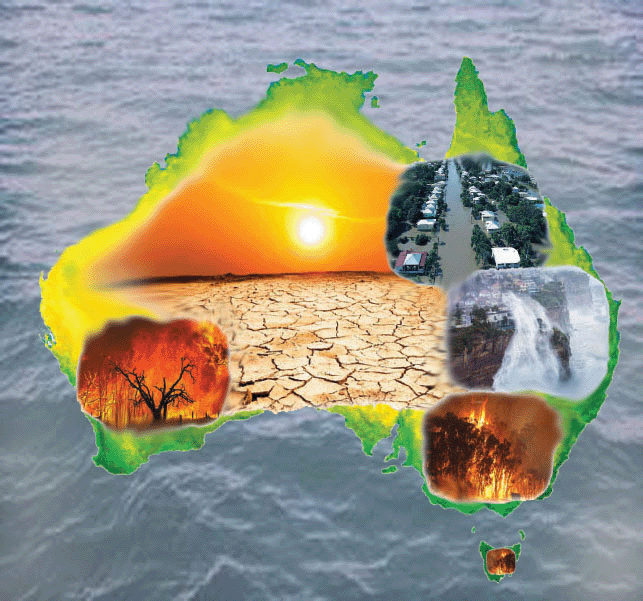 Could climate change make it harder to get insurance in Australia? ABC News The Signal , By Ange Lavoipierre and Stephen Smiley for The Signal, 6 Feb 19, At the moment, Townsville is more or less underwater and large parts of Tasmania are on fire.
Key points:
- There were anecdotal reports of premiums reaching $30,000 after the 2017 Lismore floods
- There is a serious risk some places could become too disaster-prone to insure, according to an expert
- Taxpayers could end up footing the bill
Summer in Australia has always been extreme, but some corners of the country are experiencing climate-driven disasters that are worse than ever — and more of them every year.
Those stories are told in extraordinary detail as they unfold, but once the world looks away, there’s the question of who’ll pay the bill.
So with fires, floods and crazy weather becoming more frequent and severe, is Australia on its way to being uninsurable?
The clean-up can take years and cost millions…….
Could we become too disaster-prone to insure?
The director of the Climate and Energy Program at the Australia Institute, Richie Merzian, says it’s a very real risk.
“We will get to a certain point, somewhere between say 3 degrees or 4 degrees above pre-industrial levels, and a world like that will see situations where cities, entire coastlines, do become uninsurable,” he said.
Mr Merzian said in that case “the basic safety net that’s provided by the private sector just becomes too prohibitively expensive”.
He said in that instance, the burden will fall back on the taxpayer.
“The Government is always the insurer of last resort and then you see these odd situations where everyone will have to pay to keep these towns operating,” Mr Merzian said.
“And we saw that with the Queensland flood levy, where the damages were so big the insurance industry couldn’t possibly cover it.”.
So can it be avoided?
Mr Merzian said it was possible, in the immediate future, to manage the risks to insurers in flood and fire-prone areas.
“Some insurers have basically decided to leave certain markets,” he said.
“Ideally the insurance [companies] that do want to stay in there need to work with the governments to make that happen.
“And that’s where you see more money and effort put into mapping the risks, improving zoning, building better codes and better safety measures.”
Mr Merzian warned that the difficult discussion about whether or not it was even appropriate to rebuild in some disaster-prone areas was not happening in enough places.
“There’s $88 billion at risk in terms of damage from coastal erosion in Australia … but no local council wants to go and tell people who have million-dollar beach houses, ‘you shouldn’t have built here’,” he said. https://www.abc.net.au/news/2019-02-06/could-climate-change-make-australia-uninsurable/10783490
|
|
Canavan takes cheap shots at the UN for Adani
“Canavan and Adani keep saying that Adrian Burragubba and the W&J Council don’t speak for the Traditional Owners. One thing is absolutely certain… Canavan and Adani don’t.
Neither Canavan nor Adani would know land rights if they fell over them. We will persist with our petitioning of various UN bodies because the legislation and processes in Australia fall well short of international laws and standards to which Australia is a signatory.
The Coalition Government has an appalling record on Aboriginal rights, and we operate under a worse native title regime today than when the UN CERD, more than 20 years ago, found the Howard government’s “10 point plan” changes to the Native Title Act were racially discriminatory.
The mining industry’s Resources Minister, Adani and the Coalition Government: fighters for Aboriginal Land Rights? Canavan must think we’re fools if we believe that. He is not going to run W&J business.” wanganjagalingou.com.au/canavan-takes-cheap-shots-at-the-un-for-adani/
Bill Shorten’s climate change policy isn’t ‘ambitious enough’ – Zali Steggall
Independent challenging Tony Abbott says Shorten’s climate change policy isn’t ‘ambitious enough’ The high-profile independent taking on Tony Abbott in Warringah at the coming federal election says Labor’s climate change policy needs to be more ambitious and include an explicit commitment to block the Adani coalmine.In an interview with Guardian Australia’s political podcast, Zali Steggall said the current policy outlined by Bill Shorten was on the right track, but she challenged the opposition to go further. “I don’t think it’s ambitious enough.”
Steggall said Labor, given the potential for a change of government later in the year, needed to include a commitment to block the controversial Queensland coal project. “Our financial institutions aren’t prepared to lend or invest in coal projects, why should the Australia people’s money be invested?”
She said Labor, if it wins this year’s federal contest, needed to use whatever regulatory powers it had available to it to stop the project. “We need an orderly retirement of coal, I don’t think we should be entering new projects,” Steggall said.
“The attention should be with renewables, technology, clean transport, clean energy – not projects like Adani.”
Steggall, a barrister, and former Olympic ski champion, is one of a group of small l liberal independents taking on government frontbenchersin the federal election contest expected in May, and has put Abbott and the Coalition’s record on climate change front and centre of her campaign in the Sydney seat.
The environment movement, and activist groups like GetUp, also want Labor to strengthen its position on the Adani project, an idea Shorten countenanced seriously last year, before stepping back.
Private polling conducted for the environment movement and for the major parties suggests community concern about climate change is currently sitting at levels not seen since the federal election cycle in 2007……. https://www.theguardian.com/australia-news/2019/feb/06/zali-steggall-says-labor-needs-to-commit-to-stopping-adani-coalmine
|
|
How Australia has lost the plot on adapting to climate change
|
Ten years ago, climate adaptation research was gaining steam. Today, it’s gutted, The Conversation, Professor, University of Melbourne February 7, 2019 “……..Between 1997 and 2009 the state [of Victoria] suffered its worst drought on record, and major bushfires in 2003 and 2006-07 burned more than 2 million hectares of forest. Then came Black Saturday, and the year after that saw the start of Australia’s wettest two-year period on record, bringing major floods to the state’s north, as well as to vast swathes of the rest of the country.
In Victoria alone, hundreds of millions of dollars a year were being spent on response and recovery from climate-related events. In government, the view was that things couldn’t go on that way. As climate change accelerated, these costs would only rise. We had to get better at preparing for, and avoiding, the future impacts of rapid climate change. This is what is what we mean by the term “climate adaptation”. Facing up to disastersA decade after Black Saturday, with record floods in Queensland, severe bushfires in Tasmania and Victoria, widespread heatwaves and drought, and a crisis in the Murray-Darling Basin, it is timely to reflect on the state of adaptation policy and practice in Australia. In 2009 the Rudd Labor government had taken up the challenge of reducing greenhouse gas emissions. With Malcolm Turnbull as opposition leader, we seemed headed for a bipartisan national solution ahead of the Copenhagen climate summit in December. Governments, meanwhile, agreed that adaptation was more a state and local responsibility. Different parts of Australia faced different climate risks. Communities and industries in those regions had different vulnerabilities and adaptive capacities and needed locally driven initiatives. Led by the Brumby government in Victoria, state governments developed an adaptation policy framework and sought federal financial support to implement it. This included research on climate adaptation. The federal government put A$50 million into a new National Climate Change Adaptation Research Facility, based in Queensland, alongside the CSIRO Adaptation Flagship which was set up in 2007. The Victorian Government invested A$5 million in VCCCAR. The state faced local risks: more heatwaves, floods, storms, bushfires and rising sea levels, and my colleagues and I found there was plenty of information on climate impacts. The question was: what can policy-makers, communities, businesses and individuals do in practical terms to plan and prepare? Getting to workFrom 2009 until June 2014, researchers from across disciplines in four universities collaborated with state and local governments, industry and the community to lay the groundwork for better decisions in a changing climate. We held 20 regional and metropolitan consultation events and hosted visiting international experts on urban design, flood, drought, and community planning. Annual forums brought together researchers, practitioners, consultants and industry to share knowledge and engage in collective discussion on adaptation options. We worked with eight government departments, driving the message that adapting to climate change wasn’t just an “environmental” problem and needed responses across government. All involved considered the VCCCAR a success. It improved knowledge about climate adaptation options and confidence in making climate decisions. The results fed into Victoria’s 2013 Climate Change Adaptation Plan, as well as policies for urban design and natural resource management, and practices in the local government and community sectors. I hoped the centre would continue to provide a foundation for future adaptation policy and practice. Funding cutsIn the 2014 state budget the Napthine government chose not to continue funding the VCCCAR. Soon after, the Abbott federal government reduced the funding and scope of its national counterpart, and funding ended last year. Meanwhile, CSIRO chief executive Larry Marshall argued that climate science was less important than the need for innovation and turning inventions into benefits for society. Along with other areas of climate science, the Adaptation Flagship was cut, its staff let go or redirected. From a strong presence in 2014, climate adaptation has become almost invisible in the national research landscape. In the current chaos of climate policy, adaptation has been downgraded. There is a national strategy but little high-level policy attention. State governments have shifted their focus to energy, investing in renewables and energy security. Climate change was largely ignored in developing the Murray-Darling Basin Plan. Despite this lack of policy leadership, many organisations are adapting. Local governments with the resources are addressing their particular challenges, and building resilience. Our public transport now functions better in heatwaves, and climate change is being considered in new transport infrastructure. The public is more aware of heatwave risks, and there is investment in emergency management research, but this is primarily focused on disaster response. Large companies making long-term investments, such as Brisbane Airport, have improved their capacity to consider future climate risks. There are better planning tools and systems for business, and the financeand insurance sectors are seriously considering these risks in investment decisions. Smart rural producers are diversifying, using their resources differently, or shifting to different growing environments. Struggling to copeBut much more is needed. Old buildings and cooling systems are not built to cope with our current temperatures. Small businesses are suffering, but few have capacity to analyse their vulnerabilities or assess responses. The power generation system is under increasing pressure. Warning systems have improved but there is still much to do to design warnings in a way that ensures an appropriate public reaction. Too many people still adopt a “she’ll be right” attitude and ignore warnings, or leave it until the last minute to evacuate. In an internal submission to government in 2014 we proposed a Victorian Climate Resilience Program to provide information and tools for small businesses. Other parts of the program included frameworks for managing risks for local governments, urban greening, building community leadership for resilience, and new conservation approaches in landscapes undergoing rapid change. Investment in climate adaptation pays off. Small investments now can generate payoffs of 3-5:1 in reduced future impacts. A recent business round table report indicates that carefully targeted research and information provision could save state and federal governments A$12.2 billion and reduce the overall economic costs of natural disasters (which are projected to rise to A$23 billion a year by 2050) by more than 50%. Ten years on from Black Saturday, climate change is accelerating. The 2030 climate forecasts made in 2009 have come true in half the time. Today we are living through more and hotter heatwaves, longer droughts, uncontrollable fires, intense downpours and significant shifts in seasonal rainfall patterns. Yes, policy-makers need to focus on reducing greenhouse emissions, but we also need a similar focus on adaptation to maintain functioning and prosperous communities, economies and ecosystems under this rapid change. It is vital that we rebuild our research capacity and learn from our past experiences, to support the partnerships needed to make https://theconversation.com/ten-years-ago-climate-adaptation-research-was-gaining-steam-today-its-gutted-111180 |
|
Former fire chief lashes out at government inaction over climate change
‘Astounded’: former fire chief unloads on politicians over climate change inaction, The Age, By Nicole Hasham, 4 February 2019, Decorated Australian firefighter Greg Mullins says climate change is contributing to bushfires so 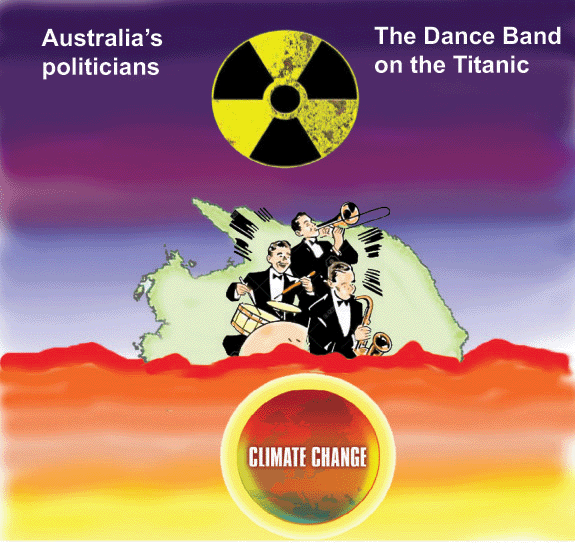 horrendous that homes and lives cannot be protected, and the federal government will not acknowledge the link because it has failed on emissions reduction policy.
The extraordinary comments by Mr Mullins, a former NSW Fire and Rescue Commissioner, coincides with the Tuesday launch of the group Bushfire Survivors for Climate Action, which will lobby the major parties to drastically reduce fossil fuel use and cut greenhouse gas emissions.
Prime Minister Scott Morrison and Opposition Leader Bill Shorten both visited Tasmania on Monday, where catastrophic bushfires had reportedly destroyed eight homes and burnt 190,000 hectares of land as of Monday afternoon. Their visit came on the 10th anniversary of the Victorian Black Saturday bushfires.
The major parties’ pledges on climate change are expected to be a frontline issue at the upcoming federal election, as the public reels from record-high summer temperatures, extreme weather and a long, unforgiving bushfire season.
Fires are a natural phenomenon in the Australian bush, but experts say climate change effects such as heatwaves and changed rainfall patterns mean bushfires are becoming more frequent and extreme.
Mr Mullins said fire seasons “are longer, more severe, and we are getting fires that are much harder to put out”.
“What that means … is there is simply not enough firefighters and fire trucks to do the job, to protect every structure and protect people’s lives,” he said.
“It’s extremely inconvenient for any government that does not have a cogent answer for what they’ll do about climate change, to see the effects of climate change putting more and more people and homes at risk.”
Mr Mullins has 50 years of fire fighting experience, including 39 years with Fire and Rescue NSW and as a volunteer in his youth and in retirement. He has been awarded the prestigious Australian Fire Service Medal and is an officer of the Order of Australia. He is a member of the Climate Council and welcomed the formation of Bushfire Survivors for Climate Action.
Mr Mullins sought to raise the climate change alarm in public comments in 2006 following fires in the Blue Mountains, but says the then-NSW Labor government told him to “pull your head in”.
“They didn’t want public servants coming out saying [the climate change driver] was pretty obvious to us,” he said.
“I feel quite passionately that the word needs to get out about how much the bushfire threat has worsened. I’ve watched it change, and I’ve watched our politicians sit on their hands, from both major parties. I don’t think either of them really have answers or are doing enough.”
NSW Labor has been contacted for comment.
……….A Labor government would reduce carbon emissions by 45 per cent by 2030, based on 2005 levels. The government has pledged to reduce emissions by 26 per cent over the same period, however, the OECD says Australia will miss that target under current policy settings.
GetUp! and the Climate Media Centre are supporting the Bushfire Survivors for Climate Actiongroup.
Black Saturday survivor Ali Griffin lost her home near Yarra Glen during the tragedy, and said: “I don’t want this to happen to anyone else”.
“We know the threat of devastating bushfires is getting worse every year we keep burning coal and heating our planet,” she said.
“Enough is enough, we are sick of the lack of progress on this issue – any politician without a serious plan to tackle climate damage is not fit to hold office.” https://www.theage.com.au/politics/federal/astounded-former-fire-chief-unloads-on-politicians-over-climate-change-inaction-20190204-p50vl0.html
Murray-Darling report shows public authorities must take climate change risk seriously
The Conversation, Graduate Fellow, Steyer-Taylor Center for Energy Policy and Finance, Stanford University, February 4, 2019 The tragic recent events on the Darling River, and the political and policy furore around them, have again highlighted the severe financial and environmental consequences of mismanaging climate risks. The Murray-Darling Royal Commission demonstrates how closely boards of public sector corporate bodies can be scrutinised for their management of these risks.
Public authorities must follow private companies and factor climate risk into their board decision-making. Royal Commissioner Brett Walker has delivered a damning indictment of the Murray Darling Basin Authority’s management of climate-related risks. His report argues that the authority’s senior management and board were “negligent” and fell short of acting with “reasonable care, skill and diligence”. For its part, the authority “rejects the assertion” that it “acted improperly or unlawfully in any way”.
The Royal Commission has also drawn attention to the potentially significant legal and reputational consequences for directors and organisations whose climate risk management is deemed to have fallen short of a rising bar.
It’s the public sector’s turn
Until recently, scrutiny of how effectively large and influential organisations are responding to climate risks has focused mostly on the private sector.
In Australia it is widely acknowledged among legal experts that private company directors’ duty of “due care and diligence” requires them to consider foreseeable climate risks that intersect with the interests of the company. Indeed, Australia’s companies regulator, ASIC, has called for directors to take a “probative and proactive” approach to these risks.
The recent focus on management of the Murray-Darling Basin again highlights the crucial role public sector corporations (or “public authorities” as we call them) also play in our overall responses to climate change – and the consequences when things go wrong……….https://theconversation.com/murray-darling-report-shows-public-authorities-must-take-climate-change-risk-seriously-110990
We’ve always had floods and bushfires, but climate change is making them worse
Queensland floods: Townsville reels under record water levels as more rain arrives, There are several more days to go in this 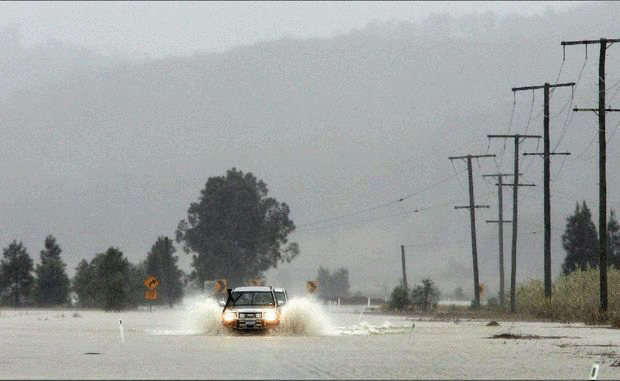 flood event, Bureau of Meteorology warns, Guardian, 2 Feb 2019,
Queensland authorities have said the state’s north was entering “unprecedented territory” as monsoon rains battered the city of Townsville, setting record flood levels and destroying homes.
Homes and businesses have been destroyed as flash floods washed through streets, sweeping away cars, equipment and livestock……..https://www.theguardian.com/australia-news/2019/feb/02/queensland-floods-townsville-reels-under-record-water-levels-as-more-rain-arrives
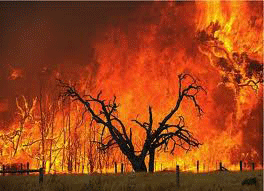 Bushfires threaten homes across Victoria , The Age, By Nicole Precel, 3 February 2019,Out-of-control bushfires threatened homes and lives on Sunday as more than 1000 firefighters battled major blazes across Victoria.Firefighters were stretched to the limit, fighting several large fires throughout the state.
A fire in Hepburn, in central Victoria was the major focus for the day with residents warned at daybreak to evacuate the town.
Two firefighters who were fighting the Hepburn fires were treated for heat exhaustion and over-exertion and were taken to hospital as a precaution.
Elsewhere, as almost 50 new fires sparked, emergency warnings were issued at various times for fires including days-old blazes in Timbarra in Gippsland and Grantville on the Bass Coast……..
As of Sunday afternoon, there were 69 aircraft working “very, very hard” and “effectively”.
The fires were fanned by soaring temperatures, hitting 43.3 degrees in the Mallee, 43.1 degrees in Hopetoun, 42.2 in Mildura, 41.1 at Melbourne Airport and 38.2 in Melbourne’s CBD.
The Bureau of Meteorology’s Richard Russell said high winds and thunderstorms were expected throughout the night……….. https://www.theage.com.au/national/victoria/bushfires-threaten-homes-across-victoria-20190203-p50vf8.html
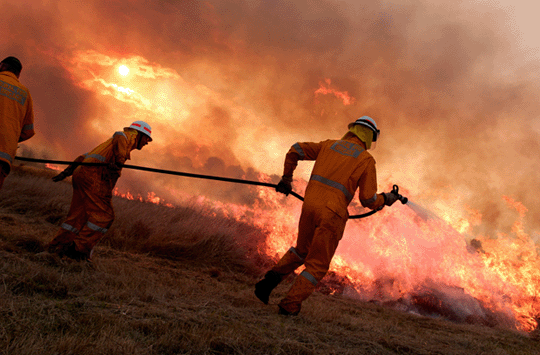 Tasmania’s fire disaster revealed in satellite images showing the extent of the damage
It’s easy to get warning fatigue, and, with only a handful or properties impacted so far, dismiss the fires as all bark and no bite.
But satellite images reveal the scale of the destruction so far.
The Gell River blaze, in the state’s south-west, was the first to start, ignited by a dry lightning strike in late December.
“It seems really like ancient history,” professor of pyrogeography and fire service at the University of Tasmania David Bowman said.
“It started at the end of last year and escalated in early January, so we’re looking at a fire situation that’s now gone for a full calendar month.”
Images taken by the European Space Agency’s Sentinel-2 satellite on January 3 show what seems, relative to the lakes around it, like a small blackened patch of wilderness……..
“There are multiple major fire events occurring simultaneously, which is extremely challenging for firefighters and fire managers because of the requirement to spread resources and make very difficult prioritising decisions.” …….
“This is definitely a historic event, it’s unprecedented,” Professor Bowman said.
“The area burnt is very substantial, I can barely keep up with the numbers.”
This week the fire service did put a number on it — 187,000 hectares.
At the same time as the Central Plateau fire ramped up, the Tahune fire was also burning out of control.
Of all the fires burning across Tasmania, this one has caused the most displacement, forcing hundreds of people to evacuate from communities in the Huon Valley south of Hobart.
Since last week, firefighters have issued almost daily warnings to residents, cautioning that only those prepared to defend their properties should stay behind.
A satellite image taken on January 30 shows how the fire, having burnt through more than 56,000 hectares, was still sending smoke over towns to its east. …..https://www.abc.net.au/news/2019-02-02/tasmanian-bushfires-from-the-air-satellite-images/10771528
Climate change is back as a big issue in Australian federal politics
Climate change is a burning issue (again) in voters’ minds, Guardian, Katharine Murphy @murpharoo, 2 Feb 19, The Coalition has no choice but to try and fix the self-created disaster that is its climate policy. his piece of backroom intelligence shouldn’t come as a surprise, given the summer we are all still enduring. Record high temperatures, the hottest January on record; storms; floods in some places, droughts in others; mass fish kills in ailing rivers.Climate change is back as a vote-changing issue – top of mind for many Australian voters. Private polling conducted for the environment movement and for the major parties suggests community concern about climate change is currently sitting at levels not seen since the federal election cycle in 2007.
If you can remember the events of 2007, you’ll recall that John Howard was forced into a significant about-face on the issue. Within sight of the election that swept Kevin Rudd into power, Howard signed the Liberal party up to emissions trading, a “world’s best-practice” cap and trade scheme, and declared Australia must prepare for a “low-carbon future”.
he research doing the rounds as the major parties bed down their war rooms for the May contest puts climate change in the top-two issues of concern nationally. Women, particularly, are alarmed by the ongoing policy inaction, and that’s bad for the Liberals because the party’s standing among women is already depressed courtesy of the unhinged shenanigans of the past 12 months.
But there’s some nuance in the research. In marginal seats in outer suburban areas – the seats that often determine the outcome of federal elections – cost of living pressures still rank higher than climate change. But people insist that climate is registering in the top-three concerns in several outer suburban seats, where the issue is normally dormant.
The political consequence of all this is pretty obvious. The strength of community concern about climate change leaves the Morrison government vulnerable. The Coalition’s policy record on climate change is appalling. There is no other word for it. Absolutely, indefensibly, appalling…….
Independents such as Zali Steggall and Oliver Yates are thumping the government on climate change, both as a thing in itself and as a proxy for dysfunction within the Liberal party which is imposing costs on the citizenry……… https://www.theguardian.com/australia-news/2019/feb/02/climate-change-a-burning-issue-again-in-voters-minds
Sydney to host international climate conference for women in 2020
 Sydney wins bid to host major climate conference for women in 2020, Brisbane Times, https://www.brisbanetimes.com.au/environment/climate-change/sydney-wins-bid-to-host-major-climate-conference-for-women-in-2020-20190203-p50vd2.html, By Peter Hannam 3 February 2019 Hundreds of climate leaders are expected to flock to Sydney next year after the City of Sydney won its bid to host a global conference for women.
The C40 group, representing 94 cities home to more than 700 million people, has selected Sydney to host its Women4Climate Conference in April 2020.
Lord Mayor Clover Moore said cities are responsible for a “staggering 75 to 80
per cent” of the world’s greenhouse gas emissions, making action in cities to cut carbon pollution crucial.
“Many of the world’s biggest cities are setting ambitious targets and policies to reduce
greenhouse gas emissions, proving effective action on climate change and strong
economic growth are compatible,” Cr Moore said.
“Shamefully, our own national government has a history of wilful negligence and Australian
politicians, both state and federal, are presiding over a climate disaster.”
Polling, including by the Lowy Institute, suggest concern about climate change is at the highest level since the end of the Millennium Drought.
Those numbers may well rise after a summer of extremes, from mass fish kills on the Darling River, raging fires in Tasmania, extensive flooding in Queensland and record heat for Australia in December and January.
The Women4Climate aims to empower young female leaders to take action to protect the environment, with a focus on mentoring, research and technology.
Sydney Council is expected to endorse the proposal to host next year’s conference when it votes on the city’s budget on February 11, with Cr Moore’s Independent Team set to use its majority to support the plan.
Climate change is here, in Australia, as temperatures rise faster than predicted
Australia’s extreme heat is sign of things to come, scientists warn https://www.theguardian.com/australia-news/2019/feb/01/australia-extreme-heat-sign-of-things-to-come-scientists-warn-climate
Hottest month ever shows temperatures rising faster than predicted, say climate experts Australia sweltered through the hottest month in its history in January, spurring mass deaths of fish, fire warnings and concerns among climate scientists that extreme heat is hitting faster and harder than anticipated.
For the first time since records began, the country’s mean temperature in January exceeded 30C (86F), according to the Bureau of Meteorology (BoM), which said daily extremes – in some places just short of 50C – were unprecedented.
“There’s been so many records it’s really hard to count,” said Andrew Watkins, a senior climatologist at BoM, after January registered Australia’s warmest month for mean, maximum and minimum temperatures.
This followed the country’s warmest December on record, with heatwaves in every Australian state and territory. With colour-coded heat maps of the country resembling blazing red furnaces for much of the month, the authorities have recently issued a special report on the extraordinary heat.
A persistent high-pressure system in the Tasman Sea that blocked cold fronts and cooler air from reaching the country’s south, and a delayed monsoon in the north, contributed to the heatwave.
Climate change is the long-term driver. “The warming trend which has seen Australian temperatures increase by more than 1C in the last 100 years also contributed to the unusually warm conditions,” Watkins said.
The bureau’s monthly report said the heatwaves were unprecedented in their scale and duration. The highest temperatures of the month were recorded in Augusta on the south-west coast, where thermometers registered 49.5C , but the most relentless heat was in Birdsville, Queensland, which endured 10 consecutive days above 45C.
This was compounded by drought. Large parts of Australia received only 20% of their normal rainfall, particularly throughout the south-east in Victoria and parts of NSW and South Australia.
Menindee in far-west NSW had four days in a row of temperatures above 47C. This was the site of December and January’s mass fish kills on the Darling River. Hundreds of thousands of native fish, including Murray cod, golden perch and bony bream, died around the Menindee weir. The authorities blamed “thermal stratification” as sudden shifts in temperature – first hot, then cold – caused algae blooms and choked the water of oxygen.
After the most recent fish die-off on 27 January, the Labor leader, Bill Shorten, said the Murray-Darling was “facing the makings of an ecological disaster”. He said: “This is not standard, this is not normal. This is a disaster.”
In parts of western Queensland and western NSW, there have been long strings of more than 40 days of temperatures above 40C.
Cloncurry had 43 days in a row that exceeded 40C. Birdsville had 16 days in January of temperatures higher than 45C including 10 days in a row.
NSW, the Australian Capital Territory, Victoria and the Northern Territory all had their warmest January on record.
The meteorological agency has warned that temperatures are set to rise further in the years ahead as a result of climate change. In its report last month, it said warming was contributing to a long-term increase in the frequency of extreme heat, fire weather and drought.
“Australia is already experiencing climate change now and there are impacts being experienced or felt across many communities and across many sectors,” said Helen Cleugh, the director of the Commonwealth Scientific and Industrial Research Organisation, which collaborated on the report.
The study, which is updated every two years, found that Australia’s fire seasons have lengthened – in places by months – and become more severe. From April to October, there has been a broad shift to more arid conditions in south-eastern and south-western Australia. Sea levels have already risen by 20cm and ocean temperatures are up by 1C, which is causing acidification – 10 times faster than at any time in 300m years – which has damaged the corals of the Great Barrier Reef.
Australian government fudging the facts to make its climate policy look good
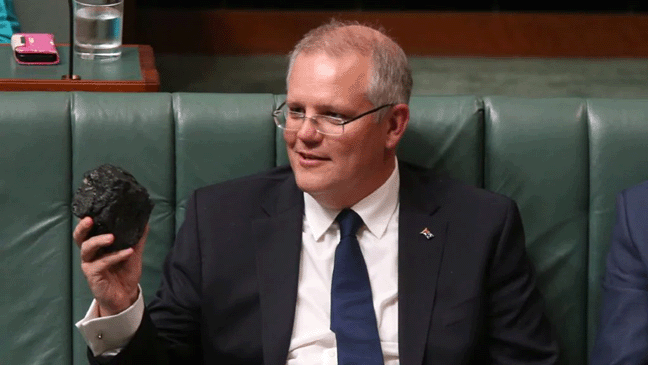 Australia is counting on cooking the books to meet its climate targets , The Convesation, Senior Industry Fellow, RMIT University, January 31, 2019 A new OECD report has warned that Australia risks falling short of its 2030 emissions target unless it implements “a major effort to move to a low-carbon model”.
This view is consistent both with official government projections released late last year, and independent analysis of Australia’s emissions trajectory. Yet the government still insists we are on track, with Prime Minister Scott Morrison claiming as recently as November that the 2030 target will be reached “in a canter”.
The government is indeed poised to deliver on the “letter of the law” of its Paris commitment if two things play out. First, if it claims credit from overdelivering on Australia’s 2010 and 2020 commitments. And second, if the “low demand” scenario is the one that eventuates.
How would this scenario actually eventuate?
Let’s leave aside the technical question of whether it’s legitimate to count past performance towards future emissions targets, and focus for now on how the low-demand economic scenario might become reality.
The government’s report contains no discussion on the basis of the “low demand” scenario. But history suggests the annual baseline estimates of 2030 emissions have overestimated future emissions, with revisions downwards over time. For example, the 2018 projection for 2030 emissions is 28% lower than the 2012 projection for the same date (see figure 2 here).
In the real world, meanwhile, change is evident. Households and businesses are installing solar panels, not least to guard against high power bills. Businesses are signing power purchase agreements with renewable energy suppliers for much the same reason. State and local governments are pursuing increasingly ambitious clean energy and climate policies. Some energy-intensive industries may be driven offshore by our high gas prices.
Other studies also support the idea that Australia may indeed outperform its baseline emission scenario. ANU researchers recently predicted that “emissions in the electricity sector will decline by more than 26% in 2020-21, and will meet Australia’s entire Paris target of 26% reduction across all sectors of the economy (not just “electricity’s fair share”) in 2024-25”.
The government’s baseline electricity scenario uses the Australian Electricity Market Operator’s “neutral” scenario. But AEMO’s “weak” scenario would see 2030 demand in the National Electricity Market 18% lower than the neutral scenario (see figure 13 here).
Of course, many of these changes are happening in spite of the government’s policy settings, rather than because of them. Still, a win’s a win!
Emissions in context
This is partly because of the plan to use prior credit for previous emissions targets to help get us across the line for 2030. This may be allowed under the international rules. But we would be leveraging extremely weak earlier commitments.
For example, Australia’s 2010 Kyoto Protocol target of an 8% increase in emissions was laughably weak in comparison with the developed world average target of a 5% cut. Our 2020 5% reduction target is also well below the aspirations of most other countries. What’s more, several major nations have declared that they will exclude past “overachievements” from their 2020 commitments.
The government has obfuscated the issue further by deliberately conflating our electricity emission reductions target, which will be easily met, with our overall economy-wide target, which presents a much tougher challenge.
There’s more. Australia’s Paris pledge to reduce emissions from 2005 levels by 26-28% between 2021 and 2030 is inconsistent with our global responsibilities and with climate science. The target was agreed to by the then prime minister Tony Abbott in 2015 as the minimum needed to look credible. But as the Climate Change Authority pointed out, a 2030 target of 40-60% below 2000 levels is more scientifically responsible. https://theconversation.com/australia-is-counting-on-cooking-the-books-to-meet-its-climate-targets-110768
Australia’s Energy Minster Angus Taylor ready to subsidise new coal projects
Angus Taylor prepares to underwrite coal-fired power By Phillip Coorey, Fin Rev, 01 Feb 2019 Energy Minster Angus Taylor has all but confirmed the Morrison government is prepared to underwrite new coal-fired power stations, at the same time moderate Liberal MPs are urging the government to adopt a policy on climate change.Mr Taylor released a list 66 potential power generation projects seeking taxpayer support after the government called for expressions of interests to provide “reliable” or “fair dinkum” power.
Of the projects submitted, 10 rely on coal…….
The coal proponents are looking for an indemnity against future climate policy or a guarantee from the government it will act as a buyer of last resort.
Labor opposes coal having any part in Australia’s future energy mix and is focused on renewable energy with back-up capacity. https://www.afr.com/news/politics/angus-taylor-prepares-to-underwrite-coalfired-power-20190201-h1arje?fbclid=IwAR1hVPmlF8TPUOS0exOvr3h5qg-2m0ZfdPN-9InstSG2dud0lNHPRXGR8yU
|
|
Olympian Zali Steggall’s main policy will be climate action, as contests Tony Abbott’s Warringah election seat
 Climate key in Olympian’s bid for NSW seat, SBS News 28 Jan 19, Climate change will be one of Olympian Zali Steggall’s main policies as she contests Tony Abbott’s Sydney seat of Warringah in the federal election.The barrister and former world champion skier on Sunday launched her campaign to run as an independent in the upcoming election in a seat she described as socially progressive and caring.
The 1998 Winter Olympics bronze medallist said Sydney’s northern beaches need a voice from “the sensible centre”……..Ms Steggall will make climate change policy a key issue, one which Mr Abbott dismissed saying locals cared about a northern beaches tunnel, lowered living costs, border security and power prices……https://www.sbs.com.au/news/climate-key-in-olympian-s-bid-for-nsw-seat
1 This month
7 April – WEBINAR – Australia and the Doomsday Clock – Preventing nuclear war through NoFirstUse and other policies
Online | Tuesday April 7, 4:00-5:30pm, Australian Eastern Time / 8:00-9:30am Central Europe Time
– Access the registration link
15 April – Zoom –Nuclear Power is Not the Solution
Apr 15, 2026 01:00 AM in Canberra, Melbourne, Sydney

Join the International Physicians for the Prevention of Nuclear War (IPPNW) on Tuesday, April 14th for a timely webinar exploring the risks associated with nuclear power and challenging the myth that it offers a simple, safe, carbon-free solution to the climate crisis

21 April Webinar: No Nuclear Weapons in Australia
Start: 2026-04-21 18:00:00 UTC Canberra, Melbourne, Sydney (GMT+10:00)
End: 2026-04-21 19:30:00 UTC Canberra, Melbourne, Sydney (GMT+10:00)
Event Type: Virtual
A virtual link will be communicated before the event.
Host Contact Info: australia@icanw.org

of the week – Australians for War Powers Reform (AWPR)
To see nuclear-related stories in greater depth and intensity
 Antinuclear