Australian government deception on climate change policy
Cooking the books on climate change policy, The Age, 7 Jan 18, Eryk Bagshaw
The Turnbull government’s climate change policy review would have you believe we are well on our way to reaching our international commitment of a 26-28 per cent reduction by 2030.
wo reports released on the same day, from the same government department with two very different sets of findings.
The Turnbull government’s climate change policy review would have you believe we are well on our way to reaching our international commitment of a 26-28 per cent reduction by 2030.
While the policy review states: “we have a record of meeting and beating our emissions reduction targets and are on track to meet our 2030 target,” the department’s emissions report admits clearly: “Australia’s emissions have risen in the past three years.” …….
An independent analysis commissioned by the Greens suggests the size of the abatement is now so great that it would require us to take all cars off the road or cows off farms, not in a decade, but tomorrow.
The laughable proposition underscores the size of the task in the decade to come.
The first step in addressing that gap is admitting that it exists. Which why the deliberate omission of a chart in a review that clearly shows Australia sailing way above its targets in the climate change policy reviews is so striking.
The department and Environment Minister Josh Frydenberg consulted no less than 270 stakeholders and received 357 submissions but the government’s obfuscation in omitting the offending chart from its final policy review is remarkable.
By pretending it doesn’t exist, it has given themselves room to move.
Into that space falls the government’s concessions to “stakeholders”, aka big business, which have been carefully worded to essentially allows companies to increase their emissions if their production does. ……http://www.theage.com.au/business/comment-and-analysis/cooking-the-books-on-climate-change-policy-20171229-h0ba0h.html
Keating government considered, but rejected, a carbon tax
The papers note the Australian government was under increasing pressure from Europe and Pacific island nations to take tougher steps to reduce carbon dioxide emissions.
The truth was that the “no regrets” policy made Australia’s efforts to cut emissions ineffectual, as officials acknowledged in the cabinet papers.
Among the policy responses considered was a carbon or energy tax
Cabinet papers: Keating MPs considered carbon tax to tackle climate change https://www.theguardian.com/australia-news/2018/jan/01/cabinet-papers-keating-mps-considered-carbon-tax-to-tackle-climate-change
Cabinet debated how to cling on to government’s ‘no regrets’ policy while maintaining Australia’s influence at international bargaining table, Guardian, Anne Davies, Australia’s response to climate change and the challenge of meeting its international obligations proved as difficult for the Keating government in 1994 and 1995 as it would for future governments.
Cabinet papers released by the Australian National Archives on Monday show that much of the debate in the Keating cabinet was about how to cling on to the government’s “no regrets” policy while maintaining Australia’s influence at the international bargaining table.
The “no regrets” policy meant Australia would consider only measures that involved cutting emissions without any adverse impact on the economy or trade competitiveness. That ruled out most measures to tax fossil fuels, which would increase the cost of electricity.
It meant Australia relied mainly on creating carbon sinks by limiting land-clearing and planting trees.
Australia had signed on to targets at an international conference in Toronto in 1990 on the basis that the convention would recognise Australia’s high dependence on fossil fuels.
Adani coal megamine is not viable: why do they persist with it?
 The Numbers Don’t Stack Up: W&J’s Rights on the Chopping Block for Adani’s ‘Non Viable’ Project, New Matilda, By John Quiggin on Adani Changes its Plans
In the context of shifting policy settings and coal markets, Adani has changed its plans. The original Adani proposal involved production of 60 million tonnes of coal from W&J Country in the Galilee Basin, and with an expected life of 90 years.
This was at first downgraded to 40 million tonnes of coal by 2022, with an expected life of 60 years, and then further reduced to 25 million tonnes of coal.
This revised so-called ‘Stage 1’ project would defer expansion of the Abbot Point terminal, alongside establishment of an initial, smaller mine.
Given the very unlikely possibility that coal will actually be in demand for electricity generation beyond 2050, the difference in duration is immaterial. However, these reductions in scale do have important implications for the viability of the rail line.
Capital investment for the life of the original mine project was expected to total US $21.5 billion. This total figure continues to be regularly cited, despite the significant downsizing that has since occurred.
Adani has, to date, invested approximately US $3.5 billion in this project, of which approximately US $2.1 billion financed the purchase of the Abbot Point T1 coal terminal. The remainder was associated with the acquisition of the Carmichael mine site.
A large portion of Adani’s total investment is what economists like to call ‘sunk’: that is, it is investment that would be written off if the Carmichael mine project failed to proceed. The only terms in which Adani could recoup these funds was if it could find a buyer for its assets. Adani’s unwillingness to write off such a large investment is likely one reason it has persisted with the project.
But the Numbers Don’t Stack Up
With its new scaled down project proposal, alongside global coal price fluctuations and the very real market access challenges in India, and elsewhere, just how do Adani’s numbers stack up?
Let’s start with estimates on the sale price for Carmichael coal.
As of October 2017, the price of Australian thermal coal was approximately $US97/tonne. Futures markets predict a decline in this price over coming years. Reflecting this trend, the futures price for delivery in February 2020, a possible start date for shipments from the project, is $US81/tonne.
However, Tim Buckley of IEEFA has estimated that the lower quality of the Carmichael mine’s coal output will result in a 30 per cent discount in revenue per tonne.
On this basis, the price of coal from the Carmichael mine – assuming exports begin in 2020 – will deliver just $A74 tonne.
But what will it cost to produce?
In its original analysis, Adani – based on advice from McCullough Robertson in January 2015 – estimated costs of US $38.70/tonne, although other analyses suggest the cost may be higher. Significantly, this figure does not include the costs of rail transport and ship loading. And of course, such figures fail to capture the environmental costs of Adani’s proposed mega mine nor do they measure the irreplaceable loss of Country for Traditional Owners if this mine were to proceed.
Putting these ‘externalities’ aside, this suggests a cost of A $50/tonne in 2015, or $A55, updating for inflation at an annual rate of 2 per cent.
Based on these figures, the price for Carmichael coal – net of all operational costs – would be approximately $10/tonne. If royalties were paid at the standard rate, the net return would be just $3/tonne. That’s a very small return for the destruction of Country and walk over of Traditional Owners rights………..
If It’s Not Viable, Why Would the Project Proceed?
The analysis above shows that, even under highly favourable assumptions, the Adani Carmichael project will be unable to generate sufficient returns to cover interest at commercial rates, or to repay capital to lenders and investors.
This analysis therefore raises the question; why does Adani Enterprises choose to proceed with such a project?
Three possible answers present themselves.
The first is that Adani does not in fact intend to proceed with the project in the near future. Rather, the project is being kept alive with relatively modest expenditure to avoid writing off the large amounts already invested, and to maintain an option in the hope that ‘something will turn up’, such as an unexpected and sustained increase in the price Adani can realize for coal.
A second hypothesis is that the complexity of the Adani corporate structure is such that Adani could construct the proposed rail line almost entirely with public funds provided on concessional terms, then hope that other coal mines in the Basin would render it profitable.
The apparent transfer of ownership of the rail project to an Adani-controlled company in the Cayman Islands supports this idea.
A third possibility, is that by making continuous new demands on governments for concessions of various kinds, Adani will eventually be able to blame government policy for the project’s failure, and on this basis extract compensation. If this is the strategy, it has so far been foiled by the abject compliance of governments at all levels.
The Adani mine-rail-port project is not commercially viable, even under the most optimistic assumptions. That Adani has failed to achieve final close reflects the dubious economics on which this project is based
While much remains obscure, it is clear that any public funds advanced to the project – a project that does not have the consent of the Traditional Owners – will be at high risk of loss.
There is no future for exploitative developmentalism. The economy of the future will depend on sustainable management of resources, a task in which Indigenous communities must play a central role.
This follows the general (though not universal) recognition of the principle, following the Mabo decision, that Indigenous people have the right to play a role in determining the appropriate use of their land.
But this is not simply a nice ideal that will come about through sensible public policy development. This is a brutal contest for land and resources that started with colonisation.
W&J claimants fighting the State Government, Adani and their backers, are at the leading edge of this contest and the latest in the long historical land grab in Australia. https://newmatilda.com/2017/12/24/the-numbers-dont-stack-up-wjs-rights-on-the-chopping-block-for-adanis-non-viable-project/
Very few Australians approve of Turnbull’s climate “policies” – poll shows
 Ipsos poll: Only 18 per cent think Turnbull government is doing a good job on climate change, SMH, Matt Wade, 26 Dec 17, One in two Australians believe climate change is already damaging the Great Barrier Reef and causing more extreme storms, floods and droughts.
But only 18 per cent think the Turnbull government is doing a good job tackling global warming, a new poll has found.
An annual survey by Ipsos, which has probed public opinion on climate change for the past 12 years, shows eight in 10 agree human activity is contributing to climate change – 42 per cent say humans are mainly or entirely responsible while 38 per cent believe climate change is caused partly by humans and partly by natural processes.
Just 3 per cent of respondents think there is no such thing as climate change, a share that has hardly shifted during the past decade. ………
Those aged less than 50 are much more likely to think climate change is mostly or entirely caused by human activity than those aged over 50.
Australians are sceptical about letting market forces alone determine how much power is generated from renewable sources. Only 27 per cent supported a deregulated, “market only” approach with no national target for the uptake of renewable energy.
Seven in 10 were in favour of the federal government setting a national target for renewable energy use (32 per cent strongly support this) with just 15 per cent opposed…..http://www.smh.com.au/national/ipsos-poll-only-18-per-cent-think-turnbull-government-is-doing-a-good-job-on-climate-change-20171222-h09e5t.html
Australian government’s hugely disappointing Climate Policy Review

(picture at left – apologies to frogs – there is no truth in the story that they will stay in heating water)
The federal Climate Policy Review: a recipe for business as usual https://theconversation.com/the-federal-climate-policy-review-a-recipe-for-business-as-usual-89372 The Conversation The federal government’s newly released Climate Policy Review is hugely disappointing, but far from surprising. It does not depart from what the Turnbull government has been saying for some time: it plans to loosen compliance obligations for emissions-intensive companies even further, reintroduce international carbon offsets, and implement the planned National Energy Guarantee. Continue reading
Labor and Greens slam Coalition climate review
Guardian, Eleanor Ainge Roy, 20 Dec 17, In the shadow of a cabinet reshuffle yesterday, the government released a long-anticipated review of its climate policies which foreshadows loosening the current safeguard mechanism for pollution levels.
Labor and the Greens blasted the new annual emissions projections, which predict Australia will increase its emissions all the way to 2030 and beyond, and called the Coalition’s action on climate change woefully inadequate. “When you look at those numbers you really do start to understand why [the government] would sneak them out, because they are a shocking set of numbers,” the shadow climate change minister, Mark Butler, said.
Butler also condemned the permissive signal on the safeguards mechanism in the review, as did the Greens’ climate spokesman, Adam Bandt, who noted the government wanted to weaken its “flawed” emissions reduction fund by allowing companies’ pollution baselines to be increased. “The data is devastating and the policy review is a travesty,” Bandt said. “Pollution is going up, we won’t meet even our paltry Paris targets and the government’s only plan is to make matters worse by allowing companies to buy dodgy permits from pig farms in China instead of cutting Australia’s emissions.”…..https://www.theguardian.com/australia-news/2017/dec/20/morning-mail-labor-and-greens-slam-coalition-climate-review
BHP to exit World Coal Association over differences in climate and energy policy.
BHP Billiton breaks ties with World Coal Association over climate change, energy policy differences https://thewest.com.au/business/mining/bhp-billiton-breaks-ties-with-world-coal-association-over-climate-change-energy-policy-differences-ng-b88695252z
AAPBHP Billiton will remain a member of the Minerals Council of Australia for now but has decided to exit the World Coal Association over differences in climate and energy policy.
The stance follows a push by BHP investors in September for the company to review its relationship with industry bodies advocating “obstructive or misleading” policy positions on climate change and energy.
The Australasian Centre for Corporate Responsibility, a not-for profit association, filed a resolution at BHP’s annual general meeting seeking to end the Minerals Council membership, which attracted about 9 per cent of votes.
In a report published on Tuesday, BHP said a review of 21 industry association memberships showed it held materially different positions over climate and energy policy with three lobby groups — the Minerals Council, the US Chamber of Commerce and the World Coal Association.
Key among the issues is the Minerals Councils’ push for energy policy that prioritises costs and reliability over emissions reduction, and encouraging coal power plant development over other sources.
Despite this, BHP said it has decided to remain with the Minerals Council for now, given the high level of benefit it derives from the membership.
It will, however, ask the Minerals Council to refrain from policy advocacy in these areas, and has threatened to review membership in 12 months time if the lobby group does not agree.
Given the scale of its operations in Australia, BHP is the biggest funding source for the Minerals Council. The miner said it has decided to exit the World Coal Association, given the differences and the narrower activities that benefit the company.
BHP said it will discuss the nature of its policy differences with the US Chamber of Commerce, prior to taking a final decision by the end of March 2018.
Responding to BHP’s decision, Australasian Centre for Corporate Responsibility executive director Brynn O’Brien said it is extraordinary that the world’s biggest miner has signalled an intention to exit the world’s peak coal lobby.
“This is a message that even organisations, like BHP, with large coal assets, do not value aggressive anti-climate lobbying,” he said.
“However, BHP’s equivocation in relation to membership of the MCA points to the highly charged environment in which climate policy is made in Australia.”
Computer modelling is valuable for fire prevention: prescribed burning is inadequate
Unfortunately, due to climate change, we are going to see a lot more catastrophic days in the future in Tasmania and indeed globally.
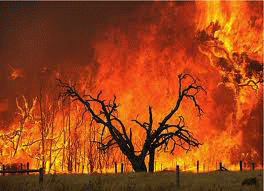 To fight the catastrophic fires of the future, we need to look beyond prescribed burning California is burning – a sentence we’ve heard far too often this year. Sydney is currently on bushfire alert, as firefighters battle a fire in the Hunter Valley region and temperatures are set to top 40℃.
A cocktail of factors, from climate change to centuries of ignoring indigenous burning practises, means that catastrophic fires are likely to become more common.
One of Australia’s favourite fire prevention measures is prescribed burning – using carefully controlled fires to clear out flammable materials. We’re almost obsessed with it. Indeed, it seems the outcome of every major inquiry is that we need to do more of it.
The Royal Commission inquiry that followed Victoria’s 2009 Black Saturday fires recommended that 5% of all public land in Victoria be treated per year – a doctrine that was subsequently dropped due to impracticality.
Yet our research, published today in the International Journal of Wildland Fire, modelled thousands of fires in Tasmania and found that nearly a third of the state would have to be burned to effectively lower the risk of bushfires.
The question of how much to burn and where is a puzzle we must solve, especially given the inherent risk, issues caused by smoke smoke and shrinking weather windows for safe burning due to climate change.
Why use computer simulations?
The major problem fire science faces is gathering data. Landscape-scale experiments involving extreme fire are rare, for obvious reasons of risk and cost. When a major bushfire happens, all the resources go into putting it out and protecting people. Nobody has the time to painstakingly collect data on how fast it is moving and what it is burning. We are therefore restricted to a few limited data sources to reconstruct the behaviour and impact of fire: we can analyse the scar on the landscape after a fire, look at case studies, or run simulations of computer models. Continue reading
Queensland Premier’s first act will be to veto Adani railway line loan
Annastacia Palaszczuk to officially veto Adani railway loan after swearing in
Letter confirming veto will be sent to Malcolm Turnbull as Liberal National party elects new leadership team, Guardian, Amy Remeikis, 12 Dec 17, The Queensland premier, Annastacia Palaszczuk, will move to officially veto any loan to the Indian mining company Adani from the Northern Australia Infrastructure Facility, as soon as she and her new government are sworn into office.
After almost two weeks of vote-counting, Labor was declared the winner of the 25 November poll on Friday, returning to parliament with a majority for the first time under Palaszczuk’s leadership.
A letter confirming the Adani veto, which marked a turning point in Labor’s campaign, will be sent to the prime minister immediately after Queensland’s governor swears in the new state government on Tuesday……
The move to veto the Naif loan has frustrated the federal government, particularly the minister for resources and northern Australia, Matt Canavan, who last week told News Corp the Queensland government decision was motivated by “xenophobia” and “racisim”, comments Bill Shorten’s office labelled “unhinged”…….
She further vowed to stop all direct taxpayer funds going to the mine and its associated infrastructure……. https://www.theguardian.com/australia-news/2017/dec/12/annastacia-palaszczuk-to-officially-veto-adani-railway-loan-after-swearing-in
Despite the Turnbull government, Australia quietly waking up to the existential threat of climate change
And as 2017 draws towards a close, Environment and Energy Minister Josh Frydenberg is putting the final touches to a review of Australia’s climate policies due for release by month’s end…..
Scrutiny
While festive seasonal distractions may dim the chance of an immediate and close scrutiny of his climate review, the challenges for the Turnbull government will still be waiting when politicians reconvene in the new year.
International attention will also remain, whether at this week’s One Planet Summit in France to assess the progress on the Paris climate deal two years on, or late in 2018, when all nations will be pressed to increase their ambition to curb the greenhouse gas emissions driving global warming.
On the emissions front, Frydenberg has already had his options significantly reduced.
The government’s signature National Energy Guarantee aimed at providing a more reliable, affordable and sustainable electricity supply locks the power sector into the same 26-28 per cent pollution reduction that the whole economy is supposed to track.
Even if Frydenberg can convince the states to sign up – a huge ask unless there is a major power outage over the summer – such an approach won’t be the best.
“Electricity production in OECD countries is always part of the cheapest options to decarbonise the economy, and it’s also a big source of emissions,” said Yann Robiou du Pont, a researcher at Melbourne University’s Australian-German Climate & Energy College.
“There are fewer assets to transform and they’re usually closer related to governmental decision-making.”
In Australia’s case, the electricity sector is the largest source of emissions, accounting for about a third of the total, and home to many ageing and relatively dirty coal-fired power plants.
Another big source, land clearing, is again on the increase in states such as Queensland and NSW……..
Mr Robiou du Pont notes the Climate Change Authority’s own recommendation that Australia’s fair contribution to emission cuts would be much higher than the Abbott-Turnbull government’s offer, given the country’s high per capita pollution and also relative wealth – if not political will – to transform its economy.
The authority – which the Coalition government tried but failed to abolish – called for a 25 per cent cut of 2005-level emissions by 2020, and 54 per cent by 2030. That’s roughly double the government’s ambition.
‘Not serious’
Mark Butler, Labor’s climate spokesman, said his party is sticking with a 45 per cent emissions reduction goal that “is consistent with the Paris Accord goal of limiting global warming to below two degrees”.
“It is clear that the government’s approach of a pro rata allocation of abatement between sectors will ensure the costs of meeting any emission reduction target will be higher than they need to be,” Butler said.
“The electricity sector has a lower cost of abatement than most other sectors in the form of renewable energy, and renewable energy is already the cheapest option to replace ageing coal-fired power stations that will inevitably retire,” he said.
(Energy giant AGL is expected to announce details within days of what its plans are post-2022, when it closes the ailing Liddell coal-fired power station in the Hunter Valley.)
Sectors like manufacturing and livestock agriculture have a much larger cost of abatement and few ready-to-deploy abatement technologies.
“The government’s insistence each sector meets targets based on a pro rata division of the national emission reduction target just confirms they do not take climate change seriously,” Butler said.http://www.smh.com.au/environment/climate-change/existential-threat-climate-change-risks-finally-grab-australias-attention-20171206-h00am7.html
Policy delay -“the new form of climate denialism”.
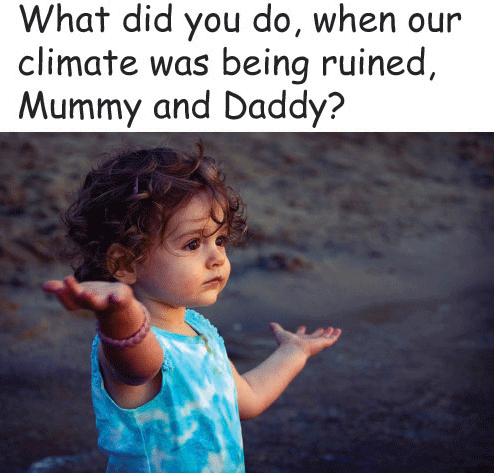 ‘Existential threat’: climate change risks finally grab Australia’s attention, SMH, Peter Hannam, 10 Dec 17 “………...‘New denialism’
Submissions to recent and ongoing Senate inquiries also indicate that whichever parties take government at the next election, many agencies already have preparations underway to adapt to climate change.
Peter Whish-Wilson – the Greens’ spokesperson for Healthy Oceans who led a Senate inquiry into the impact of climate change on the marine environment that last week released its report – said policy delay was “the new form of climate denialism”.
“Whether you stick your head under the water up on the Great Barrier Reef and see the devastation first-hand or you talk to the defence force personnel involved in planning for natural disasters in the Pacific, you know that the effects of global warming are upon us and that without action the future is looking grim,” Whish-Wilson said.
“We now need to think about the increase of marine heatwaves as part of the range of climate impacts we need to prepare for, like we do with bushfires and droughts,” he said.
‘Threat-multiplier’
For its part, the Defence Department’s report to a separate Senate inquiry into the implications of climate change for Australia’s national security detailed how it expects the “threat-multiplier” effect will hinder its “warfighting role”.
“The national security threats that may emerge include inter-group rivalries, water, food and resource shortages and irregular migration,” it said. “Many of the states in Australia’s region face some or all of these challenges, in addition to being vulnerable to climate change impacts such as temperature and sea level rise.”
Defence noted how it deployed 1000 staff to help Fiji recover from its $2.5 billion hit from Cyclone Winston, a category-5 storm in 2016. The HMAS Canberra was part of the deployment, along with planes that delivered 520 tonnes of humanitarian aid.
In its submission, the Department of Immigration and Border Protection said “climate change effects could permanently alter normal business, including the accessibility of assets and capability”.
Interestingly, it noted that “there is no internationally agreed position on expanding the current definition of a refugee or impetus to create a new international protection obligation to encompass people displaced by climate change”………
Pacific nations are watching with concern the Australian and Queensland governments’ efforts to promote the huge Adani-owned Carmichael mine, which threatens to open up a massive new coal province.
“The execution of the Adani project will be a huge carbon bomb for us in the Pacific,” Fruean said.
She dismissed the characterisation of funds from rich nations to help her people cope with worse weather extremes and rising sea levels.
“I see it as climate debt,” she said. “We wouldn’t need that aid if it weren’t for these countries investing in fossil fuels, and really creating the damage that we’re seeing in our islands today.” http://www.smh.com.au/environment/climate-change/existential-threat-climate-change-risks-finally-grab-australias-attention-20171206-h00am7.html
Traditional Owners fighting Adani make demands of new Labor Govt
New Queensland polling released showing support for mine delay wanganjagalingou.com.au/wj-make-demands-of-new-labor-govt-on-adani/ ‘Brisbane, 8 December 2017.
‘With the announcement of a new majority Qld Labor government, and
with the National Native Title Tribunal set to decide today whether to register Adani’s sham Indigenous Land Use Agreement,
the Wangan and Jagalingou Traditional Owners Council have presented a clear set of demands.
‘Wangan and Jagalingou (W&J) Traditional Owners Council Spokesperson Adrian Burragubba said,
‘“Our fight to protect our country and heritage will continue until Premier Annastacia Palaszczuk acknowledges
that we are the people from that land, and Adani does not have the consent it requires from us for this destructive mine.
‘“We call on the Palaszczuk Government to stand up for our rights and not the interests of Adani.
We have written to our more than 100,000 supporters in the wider community this morning,
asking them to press the Premier and Deputy Premier to demand that the returned Palaszczuk Government –
‘acknowledge that Adani and the Queensland Government do not have the consent of W&J Traditional Owners for the Carmichael mine
remove Queensland’s ‘signature’ from Adani’s contested Indigenous Land Use Agreement
rule out extinguishing Native Title to allow Adani to proceed, even if the ILUA is registered by the NNTT
stop opposing the rightful W&J Traditional Owners in court and wait for all our cases to be heard, and
end Adani’s special treatment – which will enable the destruction of W&J country and heritage – including keeping the Premier’s election promise to veto Adani’s $1BN taxpayer-funded loan”’
‘“This follows an an authorisation meeting of our Claim Group on 2 December at which,
for the fourth time since 2012, our people voted unanimously to reject an Indigenous Land Use Agreement (ILUA) with Adani. … ‘
For Australia’s cities, climate change is already here

Heatwaves, infrastructure and resilient, The Saturday Paper Greg Foyster 9 Dec 17 It’s 5pm on a Friday after a week of 40-degree days in Melbourne, and commuters are lined up at platforms on Flinders Street Station, desperate to get home.
But something’s wrong – all the departure screens are blank. Commuters check their smartphones, craning sunburnt necks. Train tracks have buckled, carriage airconditioners have conked out, and now a bushfire threatens transmission lines to the east, the city’s umbilical link with Latrobe Valley power stations. As blackouts cascade across the suburbs, Twitter bristles with the hashtag #Meltbourne. More than half a million people are stranded.
This scenario is fiction, but based on fact. On February 6, 2009, after a string of 40-degree days, telecommunications, public transport, power and lifts really did start to fail. “The city itself very nearly failed,” explains Melbourne Lord Mayor Robert Doyle. “We somehow got through that Friday night and got the 850,000 people who were in the centre of the city home. Black Saturday was the next day.”
Doyle shared this anecdote at the opening of Refuge, an arts event held last month that turned North Melbourne Town Hall into a heatwave emergency relief centre. It’s part of the city’s new “resilience” strategy, published in May 2016, to prepare for disasters.
Sydney is also working on a resilience plan, Continue reading
Australia’s top companies ignore climate change, and we let them
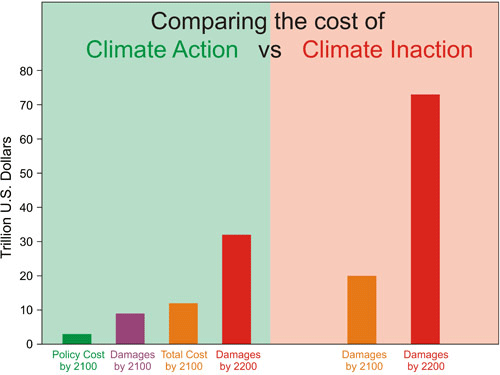
the mis- or non-management of climate risk is rampant in corporate Australia.
Whether the situation stays like this is up to investors
 http://www.smh.com.au/business/markets/companies-ignore-climate-change-and-we-ve-let-them-get-away-with-it-20171208-p4yxjg.html Julien Vincent , 8 Dec 17
Last week, APRA Executive Board member Geoff Summerhayes warned the transition to a low carbon economy is already underway and “institutions that fail to adequately plan for this transition put their own futures in jeopardy, with subsequent consequences for their account holders, members or policyholders.”
The speech followed a Centre for Policy Development discussion paper on how companies can follow the recommendations of the Financial Stability Board’s Task Force on Climate-related Financial Disclosures (TCFD).
The TCFD has set the standard for climate risk disclosure since its draft recommendations were released a year ago. Its final recommendations were backed by over 100 companies with a combined market capitalisation of over $3 trillion, which should give an idea to how seriously the TCFD is being taken.
But is it though? Market Forces has just examined the ASX top 50 companies’ responses to the TCFD. Only seven had delivered on the key recommendation to disclose information on how their company performs in a scenario where global warming is held below 2°C, while 31 don’t even mention the TCFD recommendations, let alone implement them.
It isn’t the first warning sign that corporate Australia is failing to manage climate risk. Continue reading
Adani coal project in a financial pickle, as Australian and Chinese banks refuse funding
 Is this the end of the road for Adani’s Australian megamine?
Australian and Chinese banks have turned it down, and analysts say Adani’s failure to secure funding for the Carmichael mine leaves it high and dry, Guardian, Michael Slezak, 7 Dec 17 , Adani’s operations in Australia appear to be hanging on by a thread, as activists prove effective at undermining the company’s chances of getting the finance it needs.
China seems to have ruled out funding for the mine, which means it’s not just Adani’s proposed Carmichael coalmine that is under threat, but also its existing Abbot Point coal terminal, which sits near Bowen, behind the Great Barrier Reef.
The campaign against the mine has been long. Environmentalists first tried to use Australia’s environmental laws to block it from going ahead, and then failing that, focused on pressuring financial institutions, first here, and then around the world.
The news that Beijing has left Adani out to dry comes as on-the-ground protests against construction of the mine pick up. Two Greens MPs, Jeremy Buckingham and Dawn Walker, have been arrested in Queensland for disrupting the company’s activities.
Is China’s move the end of the road for Adani’s mega coalmine in Australia, and will the Adani Group be left with billions of dollars in stranded assets?
Environmental laws fail to halt mine
Despite the mine threatening to destroy some of the best remaining habitat of threatened species of birds and lizards, federal environmental laws proved unable to stop the mine in the face of a government that wanted it to go ahead.
The initial federal approval for the mine was overturned after it was revealed the then-minister for the environment, Greg Hunt, had ignored his own department’s advice about the mine’s impact on two vulnerable species, the yakka skink and the ornamental snake.
But Australia’s environmental law leaves very little opportunity for challenging the merits of a minister’s decision – it only allows for challenges on whether those decisions considered everything required by the law. As a result, the minister needed only approve it again, after formally considering the impact on the two species.
Another court challenge argued the approval was invalid because the emissions caused by the mine – which would be greater than those of New York City – were a threat to the Great Barrier Reef. Hunt argued in court, successfully, that there was no definite link between coal from Adani mine and climate change.
It became apparent Australia’s environmental laws were unable to stop a project like this if the government of the day was determined to push it through……. https://www.theguardian.com/environment/2017/dec/07/is-this-the-end-of-the-road-for-adanis-australian-megamine
1 This month
7 April – WEBINAR – Australia and the Doomsday Clock – Preventing nuclear war through NoFirstUse and other policies
Online | Tuesday April 7, 4:00-5:30pm, Australian Eastern Time / 8:00-9:30am Central Europe Time
– Access the registration link
15 April – Zoom –Nuclear Power is Not the Solution
Apr 15, 2026 01:00 AM in Canberra, Melbourne, Sydney

Join the International Physicians for the Prevention of Nuclear War (IPPNW) on Tuesday, April 14th for a timely webinar exploring the risks associated with nuclear power and challenging the myth that it offers a simple, safe, carbon-free solution to the climate crisis

21 April Webinar: No Nuclear Weapons in Australia
Start: 2026-04-21 18:00:00 UTC Canberra, Melbourne, Sydney (GMT+10:00)
End: 2026-04-21 19:30:00 UTC Canberra, Melbourne, Sydney (GMT+10:00)
Event Type: Virtual
A virtual link will be communicated before the event.
Host Contact Info: australia@icanw.org

of the week – Australians for War Powers Reform (AWPR)
To see nuclear-related stories in greater depth and intensity
 Antinuclear