Climate change – unseasonably hot weather made bushfires near Lucas Heights nuclear reactor become “apocalyptic” blazes
Apocalyptic blaze surrounding nuclear reactor sets off emergency
AUSTRALIA is struggling to contain a growing bushfire that is racing towards a nuclear reactor, amid fears that the blaze could expand beyond their control. By OLI SMITH Apr 16, 2018
More than 500 Australia firefighters are struggling to tackle a massive bushfire, with several residents urged to seek shelters as evacuation is now “too late”.
Scenes of the blaze, which started yesterday, have been described as “apocalyptic” after the fire ripped through nearly 2,500 hectares of land close to the suburbs of Sydney.
Firefighters failed to stop the out-of-control blaze from burning through a major military base – and a nuclear reactor is the next at-risk location.
The New South Wales Rural Fire Service (RFS) said it was concerned that flying embers could spark even more blazes……
The unseasonably hot Autumn in south-eastern Australia has been blamed for worsening the bushfire after record temperatures for April.
Shane Fitzsimmons, of the RFS, warned that strong 60km per hour winds are expected to push towards residential homes.
He said that the country’s largest army barracks at Holsworthy, where stockpiles of fuel, ammunition and explosive materials are kept, had been hit by the fire.
Australia to join global health and climate change initiative
 https://www.eurekalert.org/pub_releases/2018-04/uos-atj041218.php UNIVERSITY OF SYDNEY
The Lancet Countdown report on health and climate change was published in October 2017 by The Lancet and will be updated annually through to 2030.
It tracks progress on health and climate change across 40 indicators divided into five categories: climate change impacts, exposures and vulnerability; adaptation planning and resilience for health; mitigation actions and health co-benefits; economics and finance; and public and political engagement.
Dr Ying Zhang, a senior lecturer in the University of Sydney’s School of Public Health, and Associate Professor Paul Beggs, from Macquarie University, wrote in the MJA that, from an Australian perspective, “with our high level of carbon emissions per capita, it will be important to reflect on our progress and how it compares with that of other countries, especially high-income countries”.
“A group of Australian experts from multiple disciplines is commencing work on our first national countdown report,” Zhang and Beggs wrote.
“The project recognises the importance of the climate change challenge in Australia, including its relevance to human health, and also the unique breadth and depth of the Australian expertise in climate change and human health.
“The Australian countdown will mirror the five domain sections of the Lancet Countdown, adopt the indicators used–where feasible and relevant to Australia–and include any useful additional indicators.
“The inaugural Australian report is planned for release in late 2018 and is expected to be updated annually. We hope to raise awareness of health issues related to climate change among Australian medical professionals, who play a key role in reducing their risks,” the authors concluded.
“The Australian countdown is also envisioned as a timely endeavour that will accelerate the Australian government response to climate change and its recognition of the health benefits of urgent climate action.”
The University of Sydney appointed Dr Tony Capon as the world’s first professor of planetary health in 2016. Learn more about the mission and activities of the University of Sydney’s Planetary Health Platform.
Accelerating rate of heat increasing in oceans, especially around Australia
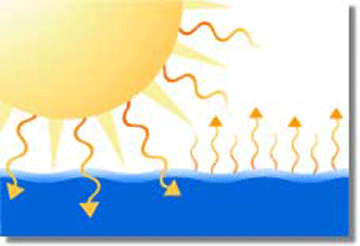 ‘Concerning’: Marine heatwaves increasing, especially near Australia, https://www.smh.com.au/environment/climate-change/marine-heatwaves-australia-tasman-sea-climate-20180410-p4z8qq.html, By Peter Hannam,
Marine heatwaves are increasing in their frequency and duration at an accelerating rate in many parts of the world, especially around Australia, a team of international scientists has found.
The number of oceanic heatwave days a year has increased by 54 per cent in the past century globally, the researchers determined, using data of sea-surface temperatures from long-established sites and satellites.
“We have seen an increasing trend in the frequency and duration [of marine heatwaves], and that trend has accelerated in the past 30 years or so,” said Lisa Alexander, associate professor at University of NSW’s Climate Change Research Centre, and an author of the paper published in Nature Communications on Wednesday.
Rather than a precursor, the number of heatwave days may even be an underestimate of what is to come as the planet warms, Professor Alexander said. “We could see it accelerated even more, given what we’ve seen recently,” she said.
Episodes of extreme heat over land have been studied more closely than those beneath the waves. Oceans, though, not only absorb about 93 per cent of the additional heat being trapped by rising greenhouse gas levels, they are also the main driver of the Earth’s climate.
Thank goodness we have the oceans as this massive sink [for both heat and carbon dioxide] but they are also changing too, and we tend to forget that,” said Sarah Perkins-Kirkpatrick, an author of the paper and also a researcher at the UNSW CCRC.
Dr Perkins-Kirkpatrick likened the oceans to the tropics, where temperatures typically move within a narrow band. Even moderate increases can have big impacts on humans and ecosystems alike.
The paper, which defined heatwaves as at least five consecutive days with sea-surface temperatures in the top 10 per cent of warmth over a 30-year period, found such events were on the increase in most parts of the world.
Global hot spots
Australia was home, along with the north Pacific and north Atlantic, of some of the global ocean hot spots.
While coral bleaching from extended heat over the Great Barrier Reef and elsewhere in recent years had drawn international attention, many other regions had seen “substantial ecological and economic impacts”, as fishing and tourism industries they support were hit, the paper said.
For instance, an extreme event off the Western Australia coast in 2011 led to large-scale effects in the Ningaloo region. Kelp forests south of Ningaloo were hammered and are yet to recover.
“You only need to have that one event to have this complete shift in the ecological environments,” Dr Perkins-Kirkpatrick said, noting such changes have tended to be less dramatic on land.
“Will it ever change back? Have we reached the point of no return for certain marine environments?” she said. “There are a lot of unknowns there, but it’s quite concerning.”
Coral bleaching events have garnered much of the attention but many other marine species, including kelp forests off Tasmania, can be vulnerable to changing conditions.
“[Corals] are the sort of poster child for ecological change, and other systems aren’t maybe as pretty to look at,” Professor Alexander said. “But [others] are equally as important in the ecosystems and food chains”.
Tasman Sea heat
The westward boundaries of the continents tend to be where oceans are warming fastest, including off the east Australian coast.
The Tasman Sea had experienced an increase in heatwave events even before this past summer’s record burst, that fell outside the researchers’ period of study.
In a special climate statement released last month by the Bureau of Meteorology and New Zealand’s National Institute of Water and Atmospheric Research, the agencies found the south Tasman Sea recorded sea-surface anomalies of as much as 2.12 degrees last December and 1.96 degrees in January.
Those readings were compared with a 1981-2010 baseline – and broke the record for those months by about a degree – an unusual departure from the norm for ocean readings.
Unseasonable heat wave in Southern Australia
 Record temperatures forecast as unseasonable heatwave hits southern Australia, ABC News , 10 Apr 18, By Camron Slessor Record-breaking temperatures will continue in southern parts of Australia this week, with Adelaide set to cop the brunt of the heat today.
South Australia’s record prolonged heat wave
Prolonged SA heat could break records, Herald Sun Caitlin Guilfoyle, Australian Associated Press, April 7, 2018
Antarctica’s great ice sheet being eroded by warm water circulating underneath
 Antarctica retreating across the sea floor, EurekAlert , UNIVERSITY OF LEEDS , 3 April 18 Antarctica’s great ice sheet is losing ground as it is eroded by warm ocean water circulating beneath its floating edge, a new study has found.
Research by the UK Centre for Polar Observation and Modelling (CPOM) at the University of Leeds has produced the first complete map of how the ice sheet’s submarine edge, or “grounding line”, is shifting. Most Antarctic glaciers flow straight into the ocean in deep submarine troughs, the grounding line is the place where their base leaves the sea floor and begins to float.
Their study, published today in Nature Geoscience, shows that the Southern Ocean melted 1,463 km2 of Antarctica’s underwater ice between 2010 and 2016 – an area the size of Greater London.
The team, led by Dr Hannes Konrad from the University of Leeds, found that grounding line retreat has been extreme at eight of the ice sheet’s 65 biggest glaciers. The pace of deglaciation since the last ice age is roughly 25 metres per year. The retreat of the grounding line at these glaciers is more than five times that rate.
The biggest changes were seen in West Antarctica, where more than a fifth of the ice sheet has retreated across the sea floor faster than the pace of deglaciation……….https://www.eurekalert.org/pub_releases/2018-04/uol-ara032918.php
Victoria: peat fires near Cobden could continue burning for months
Peat fires burning near Cobden could smoulder for months, cause further evacuations ABC South West Vic By Matt Neal 24 Mar 18
Global bank HSBC warns that Australia is especially vulnerable to climate change
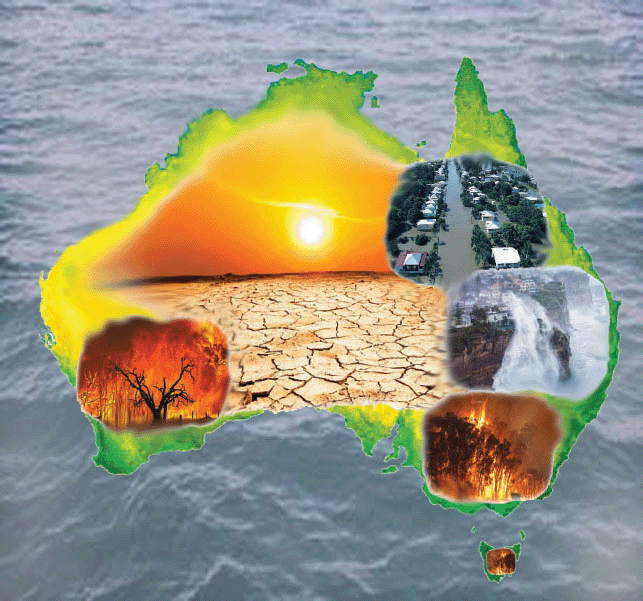
Australia one of the countries most exposed to climate change, bank warns https://www.smh.com.au/environment/climate-change/australia-one-of-the-countries-most-exposed-to-climate-change-bank-warns-20180322-p4z5n8.html By Cole Latimer,
A new report by the bank, titled Fragile Planet, has ranked 67 countries for their exposure to climate change risks. Australia scored poorly, with the largest percentage rise in deaths attributable to climate change in the developed world.
Combining data from the World Bank and EM-DAT, the International Disaster Database which calculates economic damage estimates, HSBC said fatalities attributable to climate change-linked events such as stronger storms, floods, or heat-related incidents surged from 0.36 per cent of the population between 1997 and 2006 to 3.41 per cent between 2007 and 2016.
At the same time, the number of people impacted by climate change events surged from 3.25 to 15.25 per 1000 of the population.
Israel and the US were the only developed countries with a bigger share of the population impacted by climate change-related events such as floods, storms, hurricanes, and wildfires.
Globally, the World Health Organisation forecasts that around 250,000 additional deaths annually will be attributable to climate change.
HSBC developed the report as a tool for investors to provide in-depth information on countries’ climate change risk profiles, on their energy issues, risks to business operations, supply and demand and logistics as well as their long-term sustainable development issues.
Australia was ranked as highly sensitive to the physical risks of climate change, with predictions of more storms, floods, rain and bushfires. New Zealand ranked as one the nations least exposed to those risks.
Hurting the economy
Late last year, Deutsche Bank also developed a tool to forecast where its investments across the globe may be impacted by natural disasters brought on by climate change.
The German bank’s economic modelling estimated that if carbon emissions aren’t reduced throughout this century, per capita GDP will be 23 per cent lower than it otherwise would be.
Principal Advisor at The Australia Institute, Mark Ogge, said Australia’s industries and infrastructure, such as coastal based business, roads and rail, and both commercial residential assets, are at significant risk from climate change-related events.
“There’s up to $236 billion of infrastructure at risk from a one-metre sea level rise alone,” Mr Ogge said. Temperature increases also put Australia’s tourism industry at risk, with a rising number of days above 35 degrees celsius in holiday destinations such as Far North Queensland, he added.
Australia is the only developed market that ranked within the top ten in HSBC’s report for energy transition issues due to its high levels of fossil fuel exports – particularly coal – and is one of the few countries that has seen these exports growing as a percentage of their gross domestic product.
HSBC sees risks to the nation’s economy as Australia attempts to shift its energy and economic system, currently underpinned by fossil fuels, to one with a greater mix of renewables.
“Many countries and other actors are at risk of seeing parts of their old energy economy becoming effectively ‘stranded assets’ – or economically non-viable – given the relative economics of alternatives and new breakthrough technologies,” the HSBC report stated.
“Managing the transition to a lower carbon economy is key to mitigating downside risks,” the bank said. “We think achieving diversification is key.”
he good news
However, it is not all bad news. Australia was ranked amongst the top three nations – along with New Zealand and Norway – with the greatest potential to respond to climate change and financially prepare the country for a changing environment.
Despite Australia’s frequent drought conditions, it was seen as a market with adequate water resources availability, while Singapore was the developed market most at risk over water availability.
Bill Shorten – so weak and wishy-washy on Adani coal megamine project
Bill Shorten’s stance on Adani coalmine leaves voters cold – Guardian Essential poll
Highest level of support was for Greens’ anti-Adani position with Turnbull government’s position second
https://www.theguardian.com/australia-news/2018/mar/13/bill-shortens-stance-on-adani-coalmine-leaves-voters-cold-guardian-essential-poll
Michael Brull
The ALP’s ‘on-again off-again’ position on the Carmichael mega-mine is entirely consistent with the party’s recent history
https://newmatilda.com/2018/03/12/bill-shorten-waffles-adani-labor-pocket-big-coal/
Our Future | Beach culture a casualty of climate change industry.
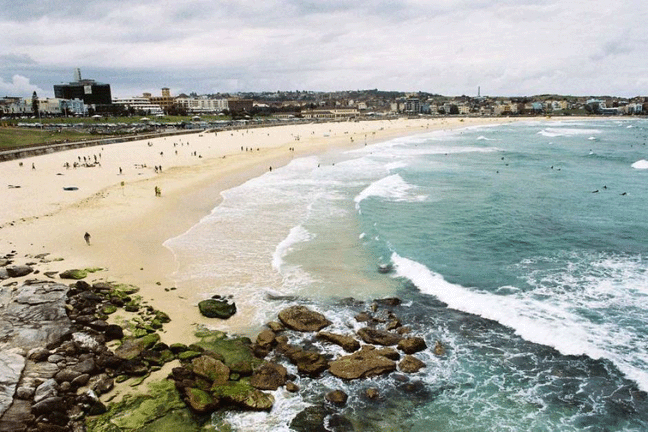
http://www.examiner.com.au/story/5273210/beach-culture-a-casualty-of-changing-climate/?cs=97 Dr David Rissik , 11 Mar 18,
Beaches are important for most Australians. Not only are they an escape for many during the summer, but they’re also the heart of our nation’s tourism industry.
With rising seas beaches and foreshores could be lost, and without beaches to attract tourists, local surf clubs and restaurants may lose their primary source of income.
In some areas houses could be flooded frequently and others undermined through beach erosion, leaving residents to either re-locate or cough up huge financial costs.
Ecosystems will also be impacted as creatures and environments struggle to cope with changing tides and warmer waters.
The impacts are known so well, yet there continues to be development in inappropriate areas, putting homes, lives and businesses at risk.
Some councils and governments are starting to assess the impacts climate change may have, but others have not even considered the risks.
So now, it’s up to businesses, industry, and communities to get the ball rolling.
Raising this issue at work, council meetings or creating awareness groups are great ways to inspire action.
There are many resources that can help you learn more and get started. The National Climate Change Adaptation Research Facility’s (NCCARF) CoastAdapt provides information about climate change on the coast and how we can respond.
But unless we begin to seriously address the risks of climate change, our coastal and beach lifestyle may change forever.
Dr David Rissik is an adjunct Professor with National Climate Change Adaptation Research Facility (NCCARF).
Queensland premier backs renewables over Adani
Queensland’s premier has talked up gas and renewable energy when asked about the Adani coal mine, on her first day back from a trade mission to the United States.
Federal Labor Leader Bill Shorten this week cast further doubt on Adani’s ability to raise funding for the project and whether a future Labor government would support the project.
Annastacia Palaszczuk on Friday said she hadn’t spoken to Mr Shorten since returning from the US, but reiterated the $16.5 billion mine had to stand up by itself without taxpayer money.
“There are other resource industries investing in Queensland, the gas industry is investing in Queensland, we have $20 billion worth of renewable energy on our books,” Ms Palaszczuk told reporters in Brisbane
“I hope a lot of resource company’s projects go ahead, but money talks, and the money is talking by investing in renewables.”
Ms Palaszczuk deflected questions about the proposed coal mine in Queensland’s Galilee Basin, instead pointing to interest from US investors in her government’s 50 per cent renewable energy target.
The premier said she had also met with the CEOs of a number of gas companies in the US as part of her government’s push to use gas as a transition fuel between coal and renewables.
Australians Mobilise to Stop Indian Coal Project
By Kalinga Seneviratne
‘A peoples’ movement is gathering steam across Australia
to stop a project by an Indian company to establish
Australia’s biggest ever coal mining project …
‘The protest movement … argues that
Australia needs to cut greenhouse gas creating coal exports
rather than opening more mines. …
‘The protest movement has formed alliances among conservation groups such as
the Australian Conservation Foundation,
Australian Marine Conservation Foundation,
Greenpeace and the Bob Brown Foundation …
‘There is even a ‘Sydney Knitting Nannies’ Group
– women in their 60s and 70s – supporting the campaign and
in Sydney along there are 500 active campaign groups, ….
‘traditional owners of the land – Wangan and Jagalingou Aboriginal people
– have taken their ‘native title’ claims to the Federal Court of Australia.
The hearing is scheduled for March 2018. … ‘
Read more of Kalinga’s comprehensive & informative article:
www.indepthnews.net/index.php/the-world/asia-pacific/1693-australians-mobilise-to-stop-indian-coal-project
Climate change denialists: is Australia’s new Deputy PM one of those?
Is Australia’s new Deputy PM another anti-wind climate denier? REneweconomy, By Sophie Vorrath on 27 February 2018
So Barnaby Joyce has gone; resigned from the position of Leader of the National Party and deputy prime minister of Australia, taking with him his climate scepticism, general dislike of renewables, and love of all things coal.
But is his replacement – Michael McCormack – any different? Quite possibly not. Here’s what we know, so far:
The Coalition’s minister for veterans affairs, and the newly installed minister for infrastructure and transport, McCormack joined parliament as a Nationals MP in 2010, after being elected to the House of Representatives for Riverina, in New South Wales.
He is the first Nationals leader since 1990 not to have worked as a farmer, although he is the son of a farmer.
McCormack started his working life in the media, rising from cadet journalist at the local Wagga paper the Daily Advertiser, to the position of editor.
He has some shady opinions on climate change.
In his first speech to parliament in 2010, McCormack he referred to climate science as “the nonsense we hear so often spoken by so many who base their views on mere assumptions of what might or might not happen.”
And he said: “When it does not rain for years on end, it does not mean it will not rain again. It does not mean we all need to listen to a government grant-seeking academic sprouting doom and gloom about climate changing irreversibly.”
He also referred repeatedly to that old Dorothea Mackellar poem – “I love a sunburnt country” – that some people seem to believe is a legitimate counter argument to decades of scientific research.
In 2012, he made an impassioned speech against the Labor government’s Carbon Pricing scheme:……..
is McCormack still a climate denier and wind farm hater? The answer is… we don’t know yet if he has evolved any.
Greens MP Adam Bandt tried to ask the new Deputy Prime Minister about his position on climate change during Parliament’s Question Time, but got shut down by the House Speaker:
“The member for Melbourne has been in the House long enough to know that he needs to ask ministers about issues for which they are responsible, not about first speeches, not about any other speeches. The member for Melbourne can resume his seat. The Deputy Prime Minister, as far as I am aware with the tabling of the new ministerial responsibilities, is still the Minister for Veterans Affairs and he is the Minister for Infrastructure and Transport, and that question in no way goes to his responsibilities. We will go to the next question.”
That’s a stunning statement – to suggest that ministries of infrastructure and transport “in no way” are linked to climate change.
RE has emailed and phoned McCormack’s office to ask if he still holds any or all of the above views. Or if he had changed them like he did on his strident attack on homosexuality that he later apologised for. We will keep you posted. http://reneweconomy.com.au/is-australias-new-deputy-pm-another-anti-wind-climate-denier-56686/
A Labor government could revoke Adani’s licence for coal mine expansion
Adani mine licence could be revoked under Labor government, Geoff Cousins says Bill Shorten told him, ABC News 27 Feb 8
Businessman and environmentalist Geoff Cousins says Opposition Leader Bill Shorten told him that if Labor wins government it could revoke the Adani mine licence.
Mr Cousins, former president of the Australian Conservation Foundation, told 7.30 that Mr Shorten made the statement to him privately last month.
“The key statement was that, ‘When we are in government, if the evidence is as compelling as we presently believe it to be regarding the approval of the Adani mine, we will revoke the licence, as allowed in the act. That’s a clear policy’,” Mr Cousins said.
“He told me he intended to speak to his colleagues.”
He said the conversation took place when Mr Shorten asked him for advice about the environmental impact of the Adani mine in Queensland’s Galilee Basin.
Mr Cousins said he spent two days in north Queensland with Mr Shorten — at the Labor leader’s request — to discuss the matter.
“He said he wanted to learn as much as he could first hand about the mine and the impacts on the reef and climate change issues and so on,” Mr Cousins said.
“He said the reason he wanted to get that first-hand knowledge was because he was planning a firmer policy position on Adani.”
According to Mr Cousins, at the end of the two days Mr Shorten told him he would discuss the policy with his colleagues.
Mr Cousins said he was speaking out publicly to “increase the pressure” on Labor to make a decision.
“It’s pretty clear there is some kind of resistance in his party to him leading on this issue,” he said………
The Adani mine has been a major headache for Mr Shorten and the Labor Party.
In rural Queensland the party faces a very real electoral threat from One Nation and wants to be seen as offering jobs and economic growth.
But at the same time it is trying to appeal to voters in the inner-Melbourne electorate of Batman, which could fall to the Greens in a by-election in just over a fortnight. http://www.abc.net.au/news/2018-02-27/geoff-cousins-accuses-bill-shorten-of-reneging-on-adani-deal/9490238
Ozone level drop in lower stratosphere – caused by climate change?
 Ozone is missing from the atmosphere and scientists don’t know why ABC Science, By science reporter Belinda Smith, 6 Feb 18
Key points:
- In 30 years since the Montreal Protocol phased out CFCs, ozone at the poles and upper stratosphere has started to mend
- New analysis shows ozone levels in the lower stratosphere have been in decline
- Atmospheric chemists suspect climate change, volcanic activity and reactive compounds might be behind the drop
The ozone layer high above Antarctica might be mending nicely, but the rest of the world tells a different story.
A long-term overview of satellite data shows that ozone levels are actually dropping in the lower stratosphere: the layer of the atmosphere about 10 to 20 kilometres above Earth’s surface.
The effect was seen across most of the world, too: as far north as the Scottish highlands and as far south as the southernmost tip of Chile.
And while atmospheric chemists can’t yet put their finger on the ozone-draining culprit, global warming is likely playing a leading role, according to atmospheric chemist Stephen Wilson from University of Wollongong.
Overall, the total amount of ozone in the entire atmosphere appears to be holding steady, but that’s because ozone levels in the troposphere — the lower part of the atmosphere, where we live — are rising.
And that’s not good news.
Ozone doesn’t belong down here and the increase in tropospheric ozone is mostly due to air pollution, commented Robyn Schofield, an atmospheric chemist from the University of Melbourne.
“[Burning fossil fuels] produces nitrogen oxides and they go on to produce ozone,” she said.
Breathing ozone not only damages our lungs, it’s bad for crops too, she added…….http://www.abc.net.au/news/science/2018-02-06/lower-stratosphere-atmosphere-ozone-layer-decline-climate/9400164
6 Feb 18, Key points:
- In 30 years since the Montreal Protocol phased out CFCs, ozone at the poles and upper stratosphere has started to mend
- New analysis shows ozone levels in the lower stratosphere have been in decline
- Atmospheric chemists suspect climate change, volcanic activity and reactive compounds might be behind the drop
The ozone layer high above Antarctica might be mending nicely, but the rest of the world tells a different story.
A long-term overview of satellite data shows that ozone levels are actually dropping in the lower stratosphere: the layer of the atmosphere about 10 to 20 kilometres above Earth’s surface.
The effect was seen across most of the world, too: as far north as the Scottish highlands and as far south as the southernmost tip of Chile.
And while atmospheric chemists can’t yet put their finger on the ozone-draining culprit, global warming is likely playing a leading role, according to atmospheric chemist Stephen Wilson from University of Wollongong.
Overall, the total amount of ozone in the entire atmosphere appears to be holding steady, but that’s because ozone levels in the troposphere — the lower part of the atmosphere, where we live — are rising.
And that’s not good news.
Ozone doesn’t belong down here and the increase in tropospheric ozone is mostly due to air pollution, commented Robyn Schofield, an atmospheric chemist from the University of Melbourne.
“[Burning fossil fuels] produces nitrogen oxides and they go on to produce ozone,” she said.
Breathing ozone not only damages our lungs, it’s bad for crops too, she added…….http://www.abc.net.au/news/science/2018-02-06/lower-stratosphere-atmosphere-ozone-layer-decline-climate/9400164
1 This month



Help Aunty Sue Protect Her Land and Sacred Sites From Destructive Rocket Testing.
.

Australians deserve the truth
about
AUKUS – https://aukuspublicinquiry.com/

PETITION – To: Prime Minister Anthony Albanese and the Australian Labor Government

of the week – Australians for War Powers Reform (AWPR)
To see nuclear-related stories in greater depth and intensity

