Pacific Islanders call on Australia and other nations, as climate change submerges islands
Pacific Island nations urge world leaders to act as islands expected to sink
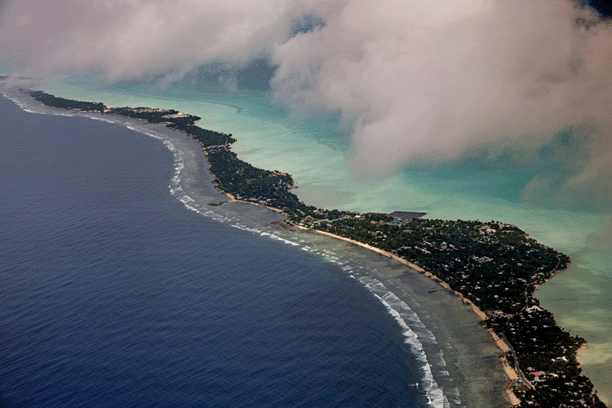
AUSTRALIA’S tropical island neighbours may exist today, but their leaders have urged us to help them from sinking. news.com.au, Matt Young@MattYoung 14 Nov 17 A LARGE swath of Pacific Island nations are slowly being eaten away until residents will be forced to evacuate and the islands eventually sink into the sea — and it’s coming sooner than we think.
This modern-day Atlantis is thanks to sea levels across small island nations that have seen a dramatic rise over the past few decades, a rate of up to 3-4 times larger than the global average. Tuvalu, in the western Pacific Ocean, will reportedly be uninhabitable by 2050, while its island neighbour Kiribati, is expected to be fully submerged by 2100.
The Maldives, which has the lowest elevation in the world and a population of 427,000, may also have sunk by the end of the century.
It has led experts — including Professor Tim Flannery, climate change expert and Professor at La Trobe University — to believe we are “on a trajectory that will see those nations compromised”.
Five reef islands in the Solomon Islands have already been lost forever while a further six have been completely eroded. Last year, the island of Nuatambu had already lost half of its habitable area.
Professor Flannery told news.com.au The Maldives, Kiribati, Marshall Islands, Tokelau and Tuvalu were most at risk.
“It’s very much on their minds, they’re trying to work out how to deal with it,” Mr Flannery told news.com.au.
Scientists are convinced more and more of these tiny islands at risk of sinking into the sea in the next 30 years and Pacific Island leaders have gathered to urge its neighbours, including Australia, to take action to save their dwindling nations……http://www.news.com.au/technology/environment/pacific-island-nations-urge-world-leaders-to-act-as-islands-expected-to-sink/news-story/9416ac1726d1f8d02a1ae435924e364f
Australian World Heritage sites at special climate change risk- International Union for Conservation of Nature(IUCN)
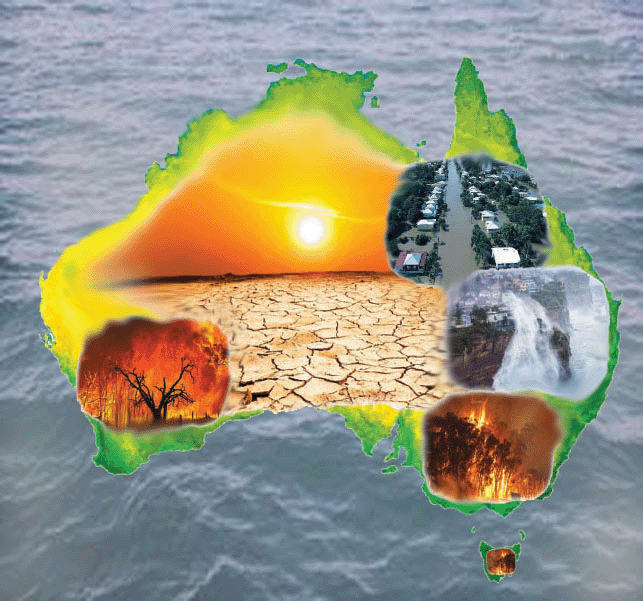 From the Everglades to Kilimanjaro, climate change is destroying world wonders
Number of natural world heritage sites at serious risk from global warming has doubled in three years, says the IUCN, including the Great Barrier Reef and spectacular karst caves in Europe, Guardian, Damian Carrington 14 Nov 17, From the Everglades in the US to the Great Barrier Reef in Australia, climate change is destroying the many of the greatest wonders of the natural world.
A new report on Monday from the International Union for Conservation of Nature(IUCN) reveals that the number of natural world heritage sites being damaged and at risk from global warming has almost doubled to 62 in the past three years.
Those at high risk include iconic places from the Galapagos Islands to the central Amazon and less well known but equally vibrant and unique sites such as the karst caves of Hungary and Slovakia and the monarch butterfly reserves in Mexico.
Coral reefs are particularly badly affected by rising ocean temperatures, from the Seychelles to Belize, where the northern hemisphere’s biggest reef is situated. Global heating is also causing mountain glaciers to rapidly shrink, from Kilimanjaro in Tanzania to the Rocky Mountains in Canada and the Swiss Alps Jungfrau-Aletsch – home to the largest Alpine glacier.
Other ecosystems being damaged are wetlands, such as the Everglades, where sea level is rising as the ocean warms and salt water is intruding. In the Sundarbans mangrove forest on the delta of the Ganges, Brahmaputra and Meghna rivers on the Bay of Bengal, two islands have already been submerged and a dozen more are threatened. Fiercer storms are also increasing the risk of devastation.
Australia is especially exposed as it has 10 natural heritage sites where climate change damage is rated as high or very high risk, from its Gondwana rainforests to Shark Bay in western Australia and islands such as Fraser and Macquarie.
The new IUCN report was launched at the UN climate summit being held in Bonn, Germany, where the world’s nations are working to put the 2015 landmark Paris agreement into operation.
“Protection of world heritage sites is an international responsibility of the same governments that have signed up to the Paris agreement,” said Inger Andersen, IUCN director general. “This report sends them a clear message: climate change acts fast and is not sparing the finest treasures of our planet. This underlines the need for urgent and ambitious national commitments and actions to implement the Paris agreement.”
Climate change is one of a range of factors that mean about a third of the world’s 241 natural heritage sites are being damaged, with invasive alien species being the top threat. Then, after global warming, comes unsustainable tourism, followed by other problems like poaching and construction…… https://www.theguardian.com/environment/2017/nov/13/from-the-everglades-to-kilimanjaro-climate-change-is-destroying-world-wonders
Australia business leaders Michael Myer and Geoff Manchester oppose Adani’s coal mine project
THEY know how to make a million and these two successful Australian businessman say claims about Adani’s coal mine are delusional. 14 Nov 17
OPPOSITION to Adani’s coal mine continues to build as two prominent Australian business leaders come out against the project.
Entrepreneur and philanthropist Michael Myer of the prominent Myer retailing family, and Intrepid Travel founder and chief executive officer Geoff Manchester, have both decided to speak out against the $16.5 billion project in Queensland’s Galilee Basin.
The two men share similar concerns but were not aware of the other’s views before going public.
“The mine itself is an outrage,” Mr Myer told news.com.au.
“It’s a stranded asset … and the proponent (Gautam) Adani is basically doing a very good job at conning our politicians at all levels of government.”
But he said the fact that governments were subsidising the project was also concerning. Federal, state and local governments have all agreed to, or are considering, providing the project with financial assistance.
Mr Myer said the economics of the project did not stack up and the leading supporters of the project were politicians, not those in the business world.
“The whole line that this is good for Queensland jobs is farcical and delusional,” Mr Myer said.
“It doesn’t stack up economically and as time goes on the economics get even worse.”
While the governments have continued to spruik the “10,000 jobs” that will be created, Adani’s own expert has admitted the figure will be closer to 1400 once jobs lost in other areas are taken into consideration.
Mr Myer believes the 10,000 number is “mythical” and the real number will likely be even less than 1400 as many operations can now be automated.
These jobs could also come at the expense of others.
At risk is Australia’s lucrative tourism industry with many concerned about the impacts of climate change on the Great Barrier Reef.
“Tourism operators are very concerned about this because we’ve already seen some negative impact on the Great Barrier Reef from bleaching in the last couple of years,” Intrepid CEO Geoff Manchester said.
“We’ve already had seen some local tourism operators impacted.”
Intrepid runs tours around the world so Mr Manchester is not too worried about his own business but he said the reef was of huge importance to Australia.
“We are coming into an era of potential growth in Australia, Asian countries are becoming more wealthy and travelling in larger numbers,” he said.
Mr Manchester said Asian tourists, especially those who lived in polluted cities, wanted to experience nature and animals they would not necessarily see in their home countries. This provided Australia with a significant opportunity to boost its economy.
“People are less interested in owning things and are becoming more interested in experiences,” he said.
“They see travel as part of life rather than a luxury that you only do when you can afford it.”
As leaders in their industries, both men said they wanted to voice their opposition publicly to the mine and a potential $1 billion concessional loan that the Northern Australia Infrastructure Facility is considering.
“There are lots of tourism businesses in Australia and it’s hard for them to get together and speak with one voice, we hope to speak up for them,” Mr Manchester said.
“We are a private, significantly sized company and I feel we have a duty to speak out against it.
“Hopefully this will make other companies feel more comfortable about speaking out as well.”
Mr Manchester said tourism was the biggest employer in Australia.
“It seems wrong to be threatening the (tourism) industry, and wrong to be subsidising the (coal) industry.”
Their remarks come as another entrepreneur warned Australia’s economy had serious problems.
In analysis published in news.com.au today Matt Barrie and Craig Tindale point out that coal consumption in China had dropped three years in a row, and in January 2017, 100 coal fired power plants were cancelled.
“China has announced that it is spending a whopping $360 billion on renewables through 2020, and this year is implementing the world’s biggest cap-and-trade carbon market to curb emissions,” the authors noted.
“Blind to the reality of this situation, Australia is ramping up coal production while China commits to ending coal imports in the very near future in what can only be described as a last-ditch “dig it up now, or never” situation.”
According to the Australian Bureau of Statistics, in 2015-16 the entire Australian mining industry which includes coal, oil and gas, iron ore, the mining of metallic and nonmetallic minerals and exploration and support services made $179 billion in revenue.
But it had $171 billion in costs, which meant it delivered an operating profit before tax of $7 billion — representing a wafer thin 3.9 per cent margin on an operating basis.
“Collectively, the entire Australian mining industry (ex-services) would be loss making in 2016-17 if revenue continued to drop and costs stayed the same,” the authors said.
Mr Myer said companies like BHP were now getting out of coal assets because they could see the writing on the wall.
“China and India both have to, and are, decarbonising their economies,” he said.
“So the notion that Adani is going to build this mine and produce 60 million tonnes a year (of coal), it’s delusional.”
Instead of giving Adani a $1 billion taxpayer-funded loan, Mr Myer said putting the money towards something like a Tesla Gigafactory to produce lithium-ion batteries, would create far more long term jobs than a coal mine.
“It could piggyback an electric vehicle factory,” he said. “That’s the future and that’s where the state should be investing.”
The Australian Government’s Northern Australia Infrastructure Facility will be making a decision soon on whether to grant a $1 billion loan to Adani to build a 388km rail link to Abbot Point.
The Queensland Government has already agreed to a royalty deal that may allow Adani to defer the royalties it pays to the government.
Premier Annastacia Palaszczuk has said the royalties will be paid in full but has left option the possibility of royalties being deferred for the first few years.
Meanwhile local councils have been falling over themselves trying to accommodate the mine, with Townsville and Rockhampton councils both putting in at least $15 million each to fund an airstrip at the Carmichael mine.
Financial peril for Adani’s Carmichael mine company
Profits of Adani’s Carmichael mine company tumble, leaving it in financial peril
Owner of Carmichael project can’t walk away from mine without descending further into distress, says energy expert, Guardian, Michael Slezak, 14 Nov 17, Profits of Adani Enterprises – the company in Adani Group’s complex structure that owns the proposed Carmichael coalmine – have collapsed almost 50% year-on-year, according to a half-yearly report released this week which does not mention the mine.
The results further show the company is in financial distress, according to Tim Buckley from the Institute of Energy Economics and Financial Analysis, who says they also reveal the company can’t walk away from the unviable Carmichael project without descending further into financial distress.
The Carmichael coalmine, which would be the largest ever built in Australia, has struggled to find financing for either the mine itself or the associated infrastructure such as the rail line that would transport coal to an export terminal on the Great Barrier Reef.
Every major Australian bank has said it will not be involved in the project, and the company has been seeking subsidised government finance from the Australian government and possibly also from China.
“If they tried to exit the project now, they would either have to write it off or find someone willing to buy it,” said Buckley.
If the project was written off or sold for significantly less than its current book value of US$1.15bn, the company would find it increasingly hard to finance its many other projects around the region, said Buckley.
Currently, the Adani Enterprises Limited – which is the only publicly listed company in the Adani Group – has a book value of just under US$2.3bn. Meanwhile, its latest report shows its debt has risen by almost US$400m to US$3.83bn………https://www.theguardian.com/business/2017/nov/15/profits-of-adanis-carmichael-mine-company-tumble-leaving-it-in-financial-peril
Australia’s Friends of the Earth continues to reject Australia’s Pro-Nuclear Lobbying
Green Groups Urge Negotiators in Bonn – \Reject Australia’s Pro-Nuclear Lobbying\ http://www.foe.org.au/media-releases/2001-media-release/green-groups-urge-negotiators-in-bonn—reject-australias-pro-nuclear-lobbying
July 17, 2001

 The Australian Government’s hypocrisy and disregard for less developed countries has again come under international scrutiny at the high-level climate negotiations in Bonn, Germany.
Australia is one of only a few countries actively lobbying for the inclusion of nuclear power in Joint Implementation projects in the Kyoto Protocol. Safety, health and cost concerns have resulted in strong community opposition to nuclear power in Australia, which has never built a nuclear power station itself. The government is now arguing that the Kyoto Protocol should subsidise nuclear power in non-industrialised countries.
The motivation is largely economic; as one of the world’s largest suppliers of uranium, the Government hopes that increased use of nuclear power will increase uranium exports. The Australian Government’s short-term political agenda has led it to put economic self-interest ahead of the integrity of the Protocol and the development of clean and safe alternative energy in non-industrialised countries.
Australian environment groups have urged Parties to the Climate Convention to reject Australia’s proposal that nuclear power be eligible for inclusion in Joint Implementation and Clean Development Mechanism projects. Money spent on nuclear power will be diverted away from renewable energy and energy efficiency, which are the real solutions to climate change and sustainable development.
Australia can expect ‘increased bushfire and storm danger’ due to climate change
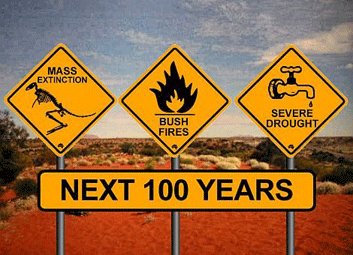 Climate change causing ‘increased bushfire and storm danger’ across Australia https://www.9news.com.au/national/2017/11/09/17/50/extreme-weather-is-getting-worse-in-south-east-australia
Turnbull’s climate policies ‘immoral’ says former Clean Energy Finance chief Oliver Yates
Former Clean Energy finance chief Oliver Yates slams Turnbull government’s ‘immoral’ climate policies, SMH, Nicole Hasham, 7 Nov 17, A Liberal Party veteran and former head of the federal government’s green bank has unleashed on his party’s “immoral” climate change policies, saying they “knowingly and willingly inflict damage on others”.
Ex-Macquarie banker Oliver Yates, chief executive of the government’s $10 billion Clean Energy Finance Corporation until April this year, said far-right members had hijacked the party and that “reform from the outside” may be required – in the form of a rival party that better reflects core Liberal values……
“If we don’t address climate change and start to reduce our emissions, then it’s likely that billions of families could be forced to move home unnecessarily,” Mr Yates said.
He “cannot understand how Liberals would knowingly inflict damage on others when they have a perfectly workable economic cure in front of them” – the adoption of clean energy.
Mr Yates lives in the inner-Melbourne electorate of Kooyong, held by Environment and Energy Minister Josh Frydenberg. A life-long member of the Liberal Party, he is the son of former federal Liberal MP William Yates and began campaigning for the party at the age of nine. He is the independent director of several emerging renewable energy companies. http://www.smh.com.au/federal-politics/political-news/former-clean-energy-finance-chief-oliver-yates-slams-turnbull-governments-immoral-climate-policies-20171106-gzfobv.html
Australia lagging on climate change action: Western Australia to experience extreme weather
Climate Council report says WA is suffering impacts of warming world as Australia falls further behind on climate change https://thewest.com.au/news/wa/climate-council-report-says-wa-is-suffering-impacts-of-warming-world-as-australia-falls-further-behind-on-climate-change-ng-b88652279z Shane Wright, Economics EditorAustralia is now falling well behind the rest of the world in dealing with climate change, a report out today shows, with WA in the firing line from some of the worst impacts of a warming world.The report from the Climate Council shows that greenhouse gas emissions in Australia resumed climbing in March 2015, with the country at a substantial risk of failing to meet its generous targets under the Paris Agreement.
This week, the World Meteorological Association said that this year was on track to be the third hottest on record and the hottest year not to be affected by an El Nino weather pattern.
According to the Climate Council, the window of opportunity to limit runaway temperature increases through the rest of the century was closing, with political inaction mostly to blame.
Climate Council chief executive Amanda McKenzie said the Federal Government was clearly failing to deal with climate change given the increase in greenhouse gas emissions on its watch.
She said the Government’s planned National Energy Guarantee would also not lead to reductions in greenhouse emissions. “This is a critical warning that the window of opportunity for the Federal Government to tackle climate change is closing,” she said.
“The vague offering of a National Energy Guarantee will not seriously deal with Australia’s climbing pollution levels. Australia cannot accept anything less than a long-term, bipartisan policy framework that turns away from fossil fuels, and embraces the inevitable clean energy future.”
The council’s report said parts of WA were clearly suffering from the impact of climate change which had resulted in a sharp increase since the middle of last century in the number of hot days and extremely hot days.
Apart from killing an increasing number of Australians, extreme weather had hit WA wildlife, with the deaths of thousands of zebra finches, budgerigars and Carnaby’s black cockatoos tied to heatwaves in 2009 and 2010.
The council said apart from the direct impact on the environment, climate change would pose a risk to Australia’s tourism sector.
Adani still could get Australian tax-payers loan for Queensland coal megamine
Why Adani may still get its government loan, The Conversation, Senior Lecturer in Law, University of Tasmania Even though Queensland Premier Annastacia Palaszczuk announced she would be vetoing the around A$1 billion loan to Adani for a rail link to its proposed Carmichael coal mine, funds could still flow to the company.
Currently in caretaker mode for the Queensland election, the premier would need the consent of the opposition party to exercise such a right. That is very unlikely given the LNP’s longstanding support of Adani’s mine.
This means any veto could not be exercised until late November, or more realistically, December 2017.
As the Northern Australia Infrastructure Facility (NAIF) loan doesn’t need state approval (but rather explicit veto) it could also mean the money will make its way to Adani, without any direct action by the state government.
How would Commonwealth money make its way to Adani?
The NAIF body was established in 2016 and administers A$5 billion in Commonwealth funds. It’s been empowered to award grants to the northern states and Northern Territory for infrastructure projects. Practically, however, these jurisdictions are used as financial conduits to pass this money to large corporations operating in northern Australia.
The NAIF is established under the “tied-grants” provision of the Constitution, Section 96, which states:
…the [Commonwealth] parliament may grant financial assistance to any state on such terms and conditions as the [Commonwealth] parliament thinks fit……….
Does Palaszczuk have a ‘veto’ power?
The premier’s reasoning for the veto is a continuation of her government’s legacy of having “no role to date in the federal government’s NAIF Loan Assessment Process for Adani” and no “role in the future”.
These statements seem to be contrary to earlier ones by the Queensland treasurer, Curtis Pitt, that the government would “do what is required” to facilitate Commonwealth funds going to Adani. In fact, as early as November 2016, Pitt declared in state parliament:
Since we came to office, we have been working very closely with the Commonwealth government to facilitate … the NAIF – in North Queensland… It is through the NAIF facility, which the state wholeheartedly supports, that Adani can get the infrastructure support that it needs.
As a result, it would seem that everything needed to pass the NAIF funds to Adani is provided for. The only thing to actively stop it is a formal, written statement by Palaszczuk to the NAIF refusing the loan (not to the prime minister as she claimed). Given Palaszczuk’s statement that she intends to write this statement, it is clear that no formal notice has yet been issued to the NAIF……..
unless the Queensland opposition takes the very unlikely step of agreeing to a veto, Palaszczuk would appear to lack the power to issue one herself until after the election.
In the interim, NAIF has no legal restrictions on issuing the loan and, with the apparent agreement of the Queensland treasury, this money is likely to flow through to Adani. While Palaszczuk can say her government gave no active assistance to Adani, without active measures to block the loan, it would certainly be a silent partner in the process. https://theconversation.com/why-adani-may-still-get-its-government-loan-86926?utm_source=twitter&utm_medium=twitterbutton
Pacific Islands leaders will pressure Australia at UN climate meeting
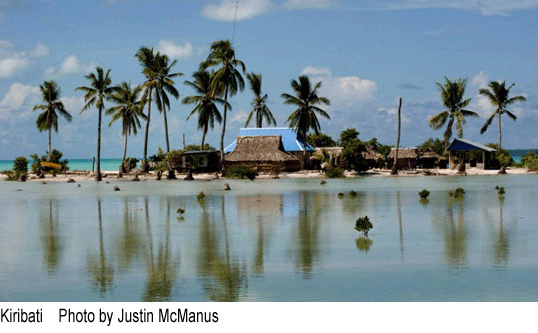 UN climate meeting: Pacific Islands leaders set to put heat on Australia http://www.sbs.com.au/news/article/2017/11/04/un-climate-meeting-pacific-islands-leaders-set-put-heat-australia Germany is hosting UN climate talks this week, but the main focus will be the front line of global warning – the Pacific region. By Rosemary Bolger
Federal Minister For Coal, Matt Canavan, says that Adani Coal megamine project is now in jeopardy
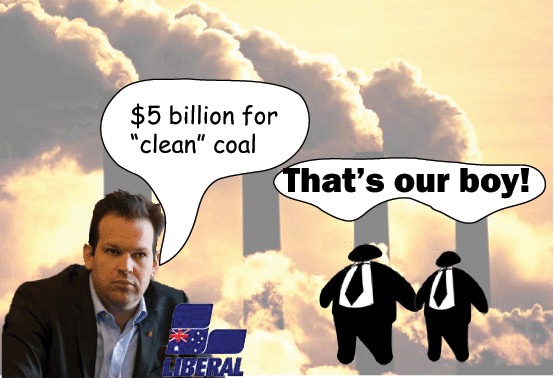 Adani mine: Annastacia Palaszczuk’s loan veto decision ‘jeopardises mine project and jobs’ ABC, AM By Katherine Gregory, 6 Nov 17, The Queensland Premier’s announcement that Labor would not support a concessional Federal Government loan for the Adani coal mine could stop the multi-billion-dollar project and jeopardises the thousands of jobs it would create, the Federal Coalition says.
Annastacia Palaszczuk made the shock announcement last night to eliminate any perceived conflict of interest after it was revealed her partner had links to the loan application.
Ms Palaszczuk has revealed her partner, Shaun Drabsch, worked on Adani’s application to the Northern Australia Infrastructure Fund (NAIF) with his employer, PricewaterhouseCoopers (PwC), which acted for the Indian mining company.
She said he worked on the project after it had received government approvals and although she had followed advice of the Integrity Commissioner, she said it was her decision to exercise her government’s “veto” to not support the loan.
The Indian mining giant is seeking $1 billion from the NAIF to build a rail link for its planned Carmichael coal mine in north Queensland.
The Premier, fighting for re-election on November 25, said she made the announcement because the Liberal National Party (LNP) in Canberra was poised to launch a smear campaign against her……..
Federal Northern Australia Minister Matt Canavan said the Premier’s decision could jeopardise the mine.
“The rules are clear here that for a loan to be made under the Northern Australia infrastructure facility, a state government must sign the project’s finance documents and co-operate with us……… http://www.abc.net.au/news/2017-11-04/palaszczuks-adani-loan-veto-decision-jeopardises-mine-project/9118054
Australia set to sabotage UN climate talks? AGAIN!- theme for this week

Yes – it’s true – Australia is sending fossil-fuel-and-nuclear stooge Josh Frydenberg off to Germany to  sabotage the UN climate conference!
Ever since Kyoto, 1997, when the Australian delegation kept everybody up until 4 a.m to make sure of watering down climate action, Australia has been ?proudly subverting international climate action.
Frydenberg is adept at twisting things, to make himself look good, while he’s really no more than an agent for the polluting industries. He might find this harder than usual, in Bonn, where the Murdoch media does not hold sway.
Frydenbeg might find that the Pacific Islanders’ case for action on climate will be better received than his advocacy for Australia’s coal industry.
Look – we’re an international disgrace on our punishment of refugees. We’v e long been an international disgrace on our climate inaction.
Here’s hoping that Frydenberg and the rest of the Australian polluting shills don’t succeed again.
IT’S TIME THAT AUSTRALIA JOINED OUR ISLAND NEIGHBOURS AND THE WORLD IN FIGHTING CLIMATE CHANGE
Queensland Premier will not support Australian government funding for Adani coal megamine rail line
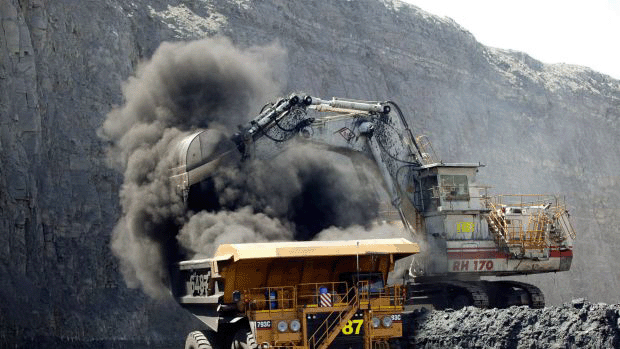 Adani: Premier Annastacia Palaszczuk withdraws Government involvement in mine funding Queensland Premier Annastacia Palaszczuk has announced her Government will have “no role in the future” of an assessment of a $1 billion loan to Adani for its Carmichael coal mine. ABC News 3 Nov 17
The Northern Australia Infrastructure Fund (NAIF) is considering an application by the Indian company for concessional Commonwealth funds for a rail link.
Ms Palaszczuk late on Friday revealed her partner, Shaun Drabsch, worked on the application to the NAIF with his employer, PricewaterhouseCoopers (PwC), which acted for Adani.
She denied there was a conflict of interest and said her decision to exercise her government’s “veto” to not support the loan came as the Liberal National Party (LNP) in Canberra was poised to launch a smear campaign against her in the run-down to the November 25 state election.
“This afternoon I announce that my Government has had no role to date in the Federal Government’s assessment process for Adani — now we will have no role in the future,” she said.
“To action my decision, I propose to write to the Prime Minister to notify him that my Government will exercise its ‘veto’ to not support the NAIF loan — and to remove doubt about any perception of conflict.”…….http://www.abc.net.au/news/2017-11-03/premier-annastacia-palaszczuk-veto-qld-government-adani-brisbane/9117594
Australia’s sorry history of hypocrisy at the international climate conferences
At the Bonn talks, Australia will cop (sorry) some flak for its lack of reductions ambition, and action.
It will win its usual disproportionate share of those “fossil fool” awards so beloved of activists.
COP this This year’s “Conference of the Parties” (COP) is happening in Bonn, Germany, (where the UN’s less-publicised “in between” climate meetings happen). But it is chaired by Fiji, which is not holding the meeting on its own (threatened) shores because of the logistical difficulty of hosting the tens of thousands of delegates.
Earlier this year Australia threw in A$6 million to help the Fijians with organisational costs.
But anyone who follows climate diplomacy knows that Australia has a chequered record at COP meetings, and hasn’t always been so generous when it comes to the negotiations themselves. So how has Australia fared at previous summits, and what’s on the table this time? Continue reading
Minerals Council of Australia is cross with United Nations – for not including nuclear power in climate action
Nuke ban at UN riles miners
The Minerals Council of Australia has slammed the UN for blocking the nuclear industry from a clean energy forum. .. (subscribers only)
http://www.theaustralian.com.au/business/mining-energy/nuclear-ban-at-un-summit-riles-miners/news-story/5ad7fd0028f64c9d7eca45749d5ea638
1 This month
Chernobyl: The Lost Tapes – A good documentary on Chernobyl on SBS available On Demand for the next 3 weeks– https://www.sbs.com.au/ondemand/tv-program/chernobyl-the-lost-tapes/2352741955560
15 April – Zoom –Nuclear Power is Not the Solution
Apr 15, 2026 01:00 AM in Canberra, Melbourne, Sydney

Join the International Physicians for the Prevention of Nuclear War (IPPNW) on Tuesday, April 14th for a timely webinar exploring the risks associated with nuclear power and challenging the myth that it offers a simple, safe, carbon-free solution to the climate crisis

21 April Webinar: No Nuclear Weapons in Australia
Start: 2026-04-21 18:00:00 UTC Canberra, Melbourne, Sydney (GMT+10:00)
End: 2026-04-21 19:30:00 UTC Canberra, Melbourne, Sydney (GMT+10:00)
Event Type: Virtual
A virtual link will be communicated before the event.
Host Contact Info: australia@icanw.org

of the week – Australians for War Powers Reform (AWPR)
To see nuclear-related stories in greater depth and intensity
 Antinuclear