World’s unstoppable movement on climate change action – explained at Ecocity 2017 World Summit in Melbourne
 Ecocity 2017 World Summit: Cities forge ahead on climate change action http://www.heraldsun.com.au/news/ecocity-2017-world-summit-cities-forge-ahead-on-climate-change-action/news-story/586aeb5ddd424192ca4643f81aad3f6a IAN ROYALL, Herald Sun July 12, 2017 THE great cities of the world are forging ahead with action on climate change despite US President Donald Trump’s stance on the issue, a global conference in Melbourne has been told.
Greenhouse gas emissions of Australian States; – Queensland’s the worst
Queensland remains Australia’s biggest greenhouse gas emitter, Brisbane Times, Tony Moore, 12 July 17
Queensland is still Australia’s biggest emitter of greenhouse gasses, according to the latest research released by the federal government.
Those emissions come mainly from coal and gas burned for electricity generation, transport and from land clearing, according to the annual National Greenhouse Accounts. The information, released in May, shows Queensland contributes 28.3 per cent of Australia’s national greenhouse emissions.
Queensland’s carbon emissions increased 0.8 per cent between 2014 and 2015 to 152.1 million tonnes of carbon dioxide equivalent greenhouse gas emissions.
On Tuesday, the Queensland government announced two plans to reduce carbon emissions by 30 per cent by 2030 and to a “net zero” by 2050 compared with 2005 levels.
Australia’s carbon emitters
- Queensland – 28.3 per cent of the nation’s emissions (up 0.8 per cent).
- New South Wales – 24.8 per cent (down 11.6 per cent).
- Victoria – 22.3 per cent (up 2 two per cent).
- Western Australia – 16.1 per cent (up 30.5 per cent).
- South Australia – 5.6 per cent (down 2 per cent).
- Northern Territory – 2.4 per cent (down 24.7 per cent).
- Australian Capital Territory – 0.3 per cent (up 11.2 per cent).
- Tasmania – 0.2 per cent (down 95.4 per cent).
- External territories – 0.01 per cent (up by 151 per cent). Australia’s external territories include Norfolk Island, Christmas Island, Cocos (Keeling) Islands, Heard and McDonald Islands and the Coral Sea Islands…….
The statistics show the biggest contributor to Queensland’s 152 million tonnes of greenhouse gas emissions in 2015 came from stationary energy sources, including electricity generation and manufacturing. Land use changes came a far third.
Overall in Queensland, the greenhouse gas figures showed 55 million tones of greenhouse gas emissions (26.1 per cent) came from energy industries………..http://www.brisbanetimes.com.au/queensland/queensland-remains-australias-biggest-greenhouse-gas-emitter-20170711-gx951t.html
No plans for real development of Adani coal mine expansion. Adani family will benefit most, if it happens
 Adani’s Carmichael coal mine has slow ‘official start’ planned, leaked document shows, ABC News, by Stephen Long , 9 Jul 17 Flanked by Commonwealth and Queensland politicians, the giant Indian conglomerate Adani last month announced that its board had given final investment approval to its controversial mega-mine in North Queensland, and declared the “official start” of the Carmichael coal mining project.
But what does that mean in practice? For the moment, it seems, not much.
The ABC has obtained the plan of operations for the Carmichael coal mine project submitted to the Queensland Government last month.
It covers just six months and involves next to nothing: just re-establishing signage at the site, recommissioning an existing temporary camp and installing some additional demountable buildings.
“The plan of operations will be amended in due course to include all early works related to commencement of construction activities for the mine and related infrastructure works,” it says.
The lack of a substantive plan for development of the mine “is a huge embarrassment for the Adani cheer squad including the Prime Minister, the Premier of Queensland and [Minister for Resources and Northern Australia] Matt Canavan, who have bent over backwards to get this project over the line,” said Rick Humphries, co-ordinator of the mine rehabilitation campaign for the Lock the Gate Alliance — a group established by farmers to fight “inappropriate” coal and gas mining.
“It only really commits Adani to maintaining the existing temporary camp and looking after the signs and roads,” he said.
“It raises serious doubts about the project’s financial viability……..
Adani’s mine project, if it were to proceed to full scale, would be the largest-ever coal mining development in Australia and the biggest export coal project in the world, involving a series of open cut mines and underground pit with a capacity of 60 million tonnes a year.
Adani would also have to build an additional port at the Abbot Point Coal Terminal — which it owns — to accommodate output from the mine, though there has been speculation that Adani intends to scale down the mining venture to less than half the initial planned capacity.
Despite the question marks about Adani’s ability to finance the venture there are clear incentives for the Adani family to make the project happen.
An “overarching royalty deed” at the project will see $2 from each tonne of coal mined beyond the first 400,000 tonnes each year go a private company ultimately owned by an Adani family entity registered in the Cayman Islands.
This could potentially mean that hundreds of millions, or billions of dollars, from the venture could flow to the Adani family rather than to shareholders of the publicly-listed company that owns the Carmichael mine.
The ABC has also been told that the response of Adani’s billionaire chairman Gautam Adani to years of activism and opposition to the mine in Australia is a determination to see the project realised. http://www.abc.net.au/news/2017-07-10/adani-queensland-coal-mine-plan-raises-doubts-on-viability/8691020
Climate Change Authority has now lost all of its climate scientists
Climate Change Authority loses last climate scientist, Guardian, Graham Readfearn. 6 July 17 David Karoly says without an expert to replace him, the CCA will struggle to fulfil its legal mandate. Imagine, if you will, a government board to champion Australian arts without any artists on it, or an agency to advise on medical research without any medical researchers.
Or perhaps even, imagine a government authority set up to provide expertise on climate policy without any actual climate scientists.
Well you don’t have to imagine that last one, because that’s what we now have – the government’s Climate Change Authority is now sansclimate scientist.
Prof David Karoly, of the University of Melbourne, has just finished his term on the authority’s board – the only member to stick it out for the full five years.
Karoly says without someone to replace him, the authority will struggle to fulfil its legal mandate. He told me:
it [the government] won’t replace Karoly and will instead just rely on the chief scientist, Alan Finkel, to act as a go-between, which of course is much more efficient and logical than actually having a climate scientist right there in the room. That would be silly, right?…….
Under the former Liberal leader Tony Abbott, the government vowed to axe the authority entirely – but couldn’t get enough support in parliament. So instead, if you believe its former insiders, the authority was carefully manipulated and undermined.
As Hamilton put it, the CCA became “dominated by people who want action, but not too much action”. https://www.theguardian.com/environment/planet-oz/2017/jul/05/climate-change-authority-loses-last-climate-scientist
Australia Institute takes up the challenge of climate change research and communication
The Australia Institute to Continue Legacy as Climate Institute Shuts its Doors. Pro Bono Australia 3 Jul 17 Australia’s first non-government organisation to focus solely on climate change has shut its doors after more than a decade of climate advocacy work, passing the baton on to the Australia Institute. Monday, 3rd July 2017at 4:26 pm
Wendy Williams, Journalist, The Climate Institute, which was founded in 2005, closed on Friday due to a lack of funding.
Any remaining funds and intellectual property are set to be transferred to the Australia Institute, to “help carry forward the Australia Institute’s climate change-related research and advocacy”.
Mark Wootton, chair of the Climate Institute board said the Australia Institute was chosen from a short-list of strong candidates to continue the legacy.
“I am pleased to announce that, following the closure of the Climate Institute on 30 June, its significant remaining funds and intellectual property will be transferred to the Australia Institute, to help carry forward the Australia Institute’s climate change-related research and advocacy,” Wootton said.
“The Australia Institute shares our commitment to relevant, robust research, innovative communication and well-targeted advocacy….
At the time it was founded the Climate Institute was the only non-government organisation focused solely on climate change.
Through its Climate of the Nation series, the institute conducted what is now the longest trend survey of the attitudes of Australians to climate change and its solutions……
The Australia Institute announced it would establish a specialist Climate and Energy Program to “secure the ongoing legacy of the Climate Institute efficiently and effectively”.
The new program will also house the recently launched National Energy Emissions Audit. https://probonoaustralia.com.au/news/2017/07/australia-institute-continue-legacy-climate-institute-shuts-doors/
United Nations committee encourages Australia to rethink its support for coal mining industry
In a periodic review of Australia’s performance under a UN treaty on human rights, released this week, the committee noted: “environmental protection has decreased in recent years as shown by the repeal of the Emissions Trading Scheme in 2013, and the State party’s ongoing support to new coal mines and coal-fired power stations”.
In light of this, the committee of 18 international human rights experts encouraged Australia to “review its position in support of coal mines and coal export”.
The Australian government has remained a staunch supporter of the proposed Carmichael mine project, coal from which will generate more carbon emissions than New York City each year it operates.
On a trip to India in April, prime minister Malcolm Turnbull claimed the project would create “tens of thousands of jobs” for Australians – a claim that has been discredited by Adani’s own experts and a Queensland court.
A government infrastructure fund is weighing an application for a near-$1bn loan to Adani for a railway to transport the coal to the coast.
Australian ministers have often argued the Adani mine is backed by a “moral case” for supplying Indians with cheap electricity. The experts on the CESCR are elected by state parties based on their “high moral character”. They include an Indian representative.
The UN recognises that climate change is a threat to human rights. Coal mining and other highly-polluting industries could therefore be viewed as contravening international treaty obligations.
Aside from curbing coal mining, the CESCR recommended Australia’s government immediately introduce new measures to cut its growing carbon emissions and expand renewable energy production. http://www.climatechangenews.com/2017/06/29/un-committee-urges-australia-rethink-support-adani-mine/
Farmers for Climate Action gathering huge support in their fight against Adani coal mine expansion
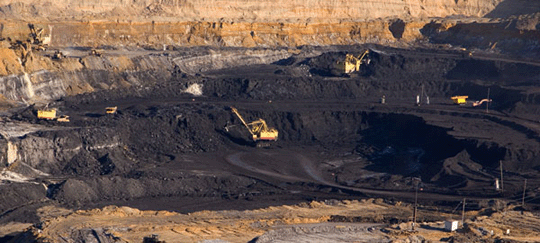 Farmers join fight against Adani coalmine over environmental concerns More than 2,000 farmers and agriculture leaders express concern proposed Carmichael coalmine could affect groundwater, biodiversity and climate change, Guardian, Michael Slezak, 30 June 17, A group of Australian farmers have joined the large coalition of groups fighting against Adani’s giant Carmichael coalmine, after they became concerned about the affects the mine would have on groundwater, biodiversity, rural communities and climate change.
Farmers for Climate Action – a group of more than 2,000 farmers and agriculture leaders concerned about climate change – became the newest group to join the Stop Adani alliance last week, at the same time as one of its members attracted more than 30,000 signatures to a petition calling on the Queensland premier, Annastacia Palaszczuk, to rescind her commitment to give Adani unlimited free access to groundwater used by farmers in the region.
Longreach farmer Angus Emmott launched the petition last week; a few days later he had an accident on his farm and had to be airlifted to hospital. When he checked on the number of signatures on Wednesday, he was shocked to see there were nearly 30,000……
“It’s too big a danger for the future,” Emmott said. “We need clean water. We need good soil. We need food security. And we have the potential to be a leader in renewable energy in Queensland. We don’t need to be reviving an outdated technology.”
Excited by the number of signatures, Emmott decided to try to get a meeting with Palaszczuk and deliver the petition in person. “The doc says I should take it easy after my accident, but as soon as I get the all-clear to travel I’ll fly to Brisbane to deliver the petition in person. I might bring a few other farmers with me too,” he said in an update posted on the petition website.
Emmott said it appeared a lot of farmers have signed the petition, as well as people in cities who share his concerns. He said he hopes to reach 50,000 signatures before he delivers the petition to Palaszczuk.
The Farmers for Climate Action chief executive, Verity Morgan-Schmidt, said the group had decided to join the Stop Adani alliance mainly because of impacts the proposal would have on groundwater, but also because of concerns about biodiversity, rural communities and the climate. The decision brought the number of groups in the Stop Adani alliance to 13.
“No one can tell us, with any confidence, what impact this project could have on water supplies from underground aquifers because there is no independent or government oversight, or trigger levels that would halt mining,” Morgan-Schmidt said…….https://www.theguardian.com/environment/2017/jun/30/farmers-join-fight-against-adani-coalmine-over-environmental-concerns
John Pratt ‘s climate and coal news
-
Wide spread coral decline. #StopAdani #ClimateChange
SECOND YEAR OF BLEACHING IMPACTS GREAT BARRIER REEF – GBRMPA UPDATE 29/5/17 Global coral bleaching over the last two years has led to widespread coral decline and habitat loss on the Great Barrier Reef.
Since December 2015, the Great Barrier Reef has been exposed to above average sea surface temperatures, due to the combined effects of climate change and a strong El Niño.These conditions triggered mass coral bleaching in late summer 2016 and led to an estimated 29 per cent loss of shallow water coral Reef-wide, according to findings by the Great Barrier Reef Marine Park Authority.
Winter sea surface temperatures in 2016 remained above average and, by the beginning of the 2016-17 summer, the accumulated heat stress on the Reef resulted in a second wave of mass bleaching.
Staff from the Marine Park Authority took part in aerial surveys conducted by the ARC Centre of Excellence for Coral Reef Studies, and the results confirmed the extent and severity of the 2017 bleaching event. -
Climate Change Could Spark Another Great Recession! #StopAdani
This Time, It May Be Permanent
Climate change will wreak havoc on the U.S. economy, leading to as much as a 3% decline in national GDP by the end of the 21st century if left unaddressed — and losses will be far higher in some of the country’s poorest areas, according to a new study.
-
Extract from Cairns Regional Council Climate Change Strategy #StopAdani
2.4 Implications for the region
Tourism –
Many tourists visit the region solely because of the natural beauty of its reefs and rainforests.
For Australian climate scientists, climate change is becoming a personal and serious concern
research shows that if there isn’t a reduction in CO2 emissions, there will be up to 50 extra really hot days a year in northern Australia by the end of the century.
Professor David Griggs, who recently retired as director of the Sustainable Development Institute at Monash University, said Australia is in denial about climate change.
“Australians will have to adapt or die,” he said.
 Climate scientists reveal their fears for the future http://www.abc.net.au/news/2017-06-27/climate-scientists-speak-of-their-worst-fears/8631368, Lateline By Kerry Brewster, Cradling her newborn baby girl, heatwave expert Sarah Perkins Kirkpatrick admits to feeling torn between the joy of motherhood and anxiety over her first-born child’s future.
“I always wanted a big family and I’m thrilled. But my happiness is altered by what I know is coming with climate change,” she said.
“I don’t like to scare people but the future’s not looking very good.
“Having a baby makes it personal. Will this child suffer heatstroke just walking to school?”
Dr Perkins Kirkpatrick is one of several climate scientists who Lateline spoke to, seeking a range of opinions from experts at some of the top climate change research units within major universities in Australia. Continue reading
Australian and International Hurdles to Adani Coal Mine Expansion
Final chapter in Adani loan deal, Saturday Paper, Karen Middleton , 24 June 17 “……..While the Queensland government has promised a royalties concession if the development goes ahead, it has also decided not to process the NAIF loan if approved – something that may require federal legislation to circumvent.
And for the Carmichael mine to proceed, the company must have concluded an Indigenous land use agreement, or ILUA, with the area’s native title holders.
Last week, the federal government and Labor combined to pass legislation to reverse a Federal Court ruling that all members of a registered native title claimant group in any relevant area were required to sign an ILUA for it to have force.
The move affected agreements well beyond the Adani ILUA and was welcomed by some Indigenous groups and opposed by others.
That followed Prime Minister Malcolm Turnbull’s promise to Adani owner Gautam Adani during a meeting in India earlier this year that he would fix the native title problems that were preventing the development from proceeding,
 But the Wangan and Jagalingou traditional owners are challenging the ILUA on three other grounds. The court hearing has been set down for next year.
OPPONENTS OF THE MINE ARE GEARING UP TO ARGUE THAT SUCH GLOBAL BAD PUBLICITY SHOULD BE GROUNDS FOR REFUSAL.
Originally, Adani had said it expected to achieve financial close on its Carmichael project by December this year. But recently that date was revised to March – the same month the court is due to hear the ILUA challenge.
What is not clear is whether there is a NAIF deadline by which an applicant must prove it has fulfilled all requirements, or whether an application can remain live for as long as that takes……
In the latest public criticism of the whole proposal, an international group of high-profile conservationists wrote to Malcolm Turnbull late this week urging the government not to proceed.
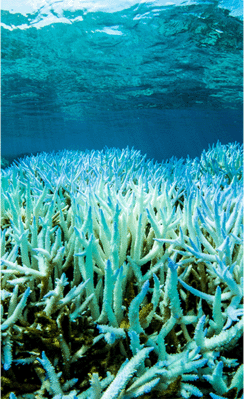 The Ocean Elders, which include ocean explorer Jean-Michel Cousteau, marine biologist Dr Sylvia Earle, businessman Richard Branson and Jordan’s Queen Noor, wrote that the mine would worsen damage to the Great Barrier Reef that Australia, as its custodian, had a global obligation to protect.
The group’s spokeswoman, marine biologist Earle, told ABC Radio that Australia should reject fossil fuels and hence the Carmichael mine, despite its advanced state of official approval.
“It’s never too late as long as the people and as long as rational individuals with power can change course, now that we know what we know,” Earle said.
A prime ministerial spokesman declined to comment on the letter.
One of the conditions of the NAIF approving a loan is that it must not be likely to “cause damage to the Commonwealth Government’s reputation or that of a relevant State or Territory government”.
Opponents of the mine are gearing up to argue that such global bad publicity should be grounds for refusal.
In her speech to the Cairns conference, Sharon Warburton said the NAIF must both reflect government policy and be independent of it.
“First NAIF must align with Commonwealth policy, and that is a whole-of-government position, remembering it is taxpayer funds we are deploying,” Warburton said. “Secondly – importantly – we cannot lend funds if all regulation at both a Commonwealth and state level are not in place.
“The other tremendously important parameter under which we operate is that it was set up to be an independent body making decisions independently of all outside influence.”
Given the attempts at influence being made on all sides of the argument, that may prove to be a challenge. https://www.thesaturdaypaper.com.au/news/economy/2017/06/24/final-chapter-adani-loan-deal/14982264004830
Twists and turns in the saga of Adani loan deal for giant Carmichael coal mine
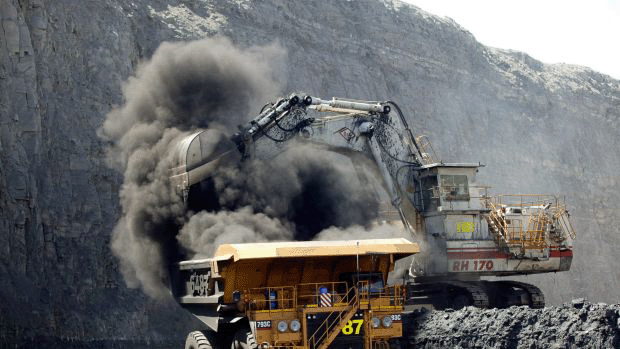 Final chapter in Adani loan deal, Karen Middleton , Saturday Paper, 24 June 17, While the dealings of the government’s Northern Australia Infrastructure Facility remain shrouded in secrecy, pressure mounts over funding for the Adani rail line. “…….Among those addressing the annual Developing Northern Australia conference, held this year in Cairns, was Sharon Warburton, the chairwoman of the somewhat opaque Northern Australia Infrastructure Facility, known as the NAIF.
The NAIF is a $5 billion-government-owned lender, set up to make concessionary loans to companies planning infrastructure projects in northern Australia that are of demonstrated public benefit and would not otherwise be able to proceed…..
The NAIF has not yet lent any money. But Warburton is hinting that it’s close to a decision on at least one application, the one that’s attracted the most controversy and has become an open secret: the request from Indian mining conglomerate Adani for $1 billion to fund a railway line to support its proposed Carmichael coalmine in Queensland’s Galilee Basin.
“We know there is a lot of interest in NAIF and the Adani rail project,” Warburton told the conference on Monday. “I can confirm we are in our due diligence phase on that project.”
That translates as the final stage of assessment, with three other applications apparently also reaching finality. But, Warburton said, she could not say any more about Adani than that…..
Greens senator Larissa Waters said clean coal was “a lie”.
“This is straight from the big tobacco playbook,” Waters said. “Remember ‘light’ cigarettes? To meet the commitment under the Paris Agreement to keep global warming to safe levels, we need to reach zero pollution in the electricity sector transitioning away from coal. Building more coal-fired power stations is simply incompatible with the science.”
Environmental activists continue to mount a strenuous campaign against any kind of coal-fired power and the Adani mine development in particular, on the grounds that it represents an investment in a backwards-looking energy source that will add to Australia’s greenhouse gas emissions and damage the Great Barrier Reef…….
The company has sent mixed messages on whether it needs the NAIF loan to proceed, initially saying it wasn’t essential and then saying it was, a distinction crucial to NAIF’s considerations.
Details of any NAIF decision will only be published after it has been finalised and within 30 days of being taken.
Larissa Waters and Labor senator Murray Watt succeeded last week in establishing a senate inquiry into the NAIF, and Waters is pushing to have Adani called before it.
In recent senate budget estimates committee hearings, Labor and the Greens attempted to extract information on the status of the NAIF’s deliberations in general and the fate of Adani’s bid in particular.
As part of its processes, the NAIF must consult with Infrastructure Australia on projects it proposes to fund.
Greens leader Richard Di Natale asked Infrastructure Australia chief executive Philip Davies whether it had received a submission on the Adani rail line, as per the requirement that it must assess all projects seeking more than $100 million.
Davies said it had not…..
….NAIF director Karla Way-McPhail, who is chief executive of two companies that service the mining industry.
Minister Matt Canavan confirmed to a senate estimates hearing this month that Way-McPhail, who has spoken out in support of opening up the Galilee, was a friend whom he had recommended for the board…..
NAIF chief executive Laurie Walker declined to tell the senate estimates committee whether Way-McPhail or any other NAIF director had recused themselves from any discussions on the grounds of a potential conflict of interest. Walker said that was “not information that I think is appropriate to disclose”.
She said more than six conflicts had been declared…..
The Greens’ main focus has been on the suitability of the loan applicant rather than the assessors.
Larissa Waters wants the government to insert a “suitable person” test into the NAIF’s process for assessing loan bids, arguing she believes it would rule out Adani.
The Greens also want the environmental history test strengthened within environmental law and are calling for Adani’s approvals for the Carmichael project to be reviewed on the basis of “revelations about their environmental and corporate history” in activities overseas.
Waters has produced a private member’s bill to reflect the concerns but the government is not obliged to bring it forward for a vote……
despite Adani having announced with flourish recently that it had taken the final decision to proceed, others argue there are still obstacles to be cleared.
Tim Buckley, a director at the Institute for Energy Economics and Financial Analysis, believes it is not viable without massive taxpayer subsidies.
“The green light that Adani made such a fuss about a couple of weeks ago was actually just a sham,” Buckley told The Saturday Paper.
He has written a paper suggesting “defer, delay and pray” appear to be the company’s unspoken watchwords……despite Adani having announced with flourish recently that it had taken the final decision to proceed, others argue there are still obstacles to be cleared….https://www.thesaturdaypaper.com.au/news/economy/2017/06/24/final-chapter-adani-loan-deal/14982264004830
Great Barrier Reef headed for death, without a reduction in greenhouse gas emissions
UNESCO warns climate change means time is running out for World Heritage Great Barrier Reef http://www.couriermail.com.au/news/queensland/unesco-warns-climate-change-means-time-is-running-out-for-world-heritage-great-barrier-reef/news-story/4765a338156dd9e5b9b2c1d2b357d655?nk=ba26857f63080120cbd5fc74c94d3959-1498465693, Daryl Passmore, The Courier-Mail, June 25, 2017
THE Great Barrier Reef will be dead by the end of this century without a reduction in greenhouse gas emissions, a world-first study warns.
The threat to Australia’s natural wonder is detailed in the first global assessment of climate change impacts on coral, released yesterday by the United Nations Educational, Scientific and Cultural Organisation (UNESCO).
It comes just a month before the World Heritage Committee meets in Poland to consider the condition of the Great Barrier Reef and the effectiveness of a management plan introduced by the Queensland and federal governments to protect it.
“Soaring ocean temperatures in the past three years have subjected 21 of 29 World Heritage reefs to severe and/or repeated heat stress, and caused some of the worst bleaching ever observed at iconic sites like the Great Barrier Reef,’’ it says.
“The analysis predicts that all 29 coral-containing World Heritage sites would cease to exist as functioning coral reef ecosystems by the end of this century under a business-as-usual emissions scenario.”
The report calls on all countries with World Heritage coral reefs to act to reduce net greenhouse emissions to zero in order to save them.
On current trends, the assessment predicts, global warming will increase by 4.3C by 2100.
Under that scenario, the Great Barrier Reef would suffer severe coral bleaching twice a decade by 2035 – “a frequency that will rapidly kill most corals present and prevent successful reproduction necessary for recovery of corals.’’
The diversity of life on reefs has led to them being been dubbed the “rainforests of the sea”. Covering less than 0.1 per cent of the ocean floor, they host more than a quarter of all marine fish species.
Australian Marine Conservation Society spokeswoman Imogen Zethoven said the Great Barrier Reef and other World Heritage reefs were in grave danger from climate change, mainly driven by the burning of coal.
“Yet the Australian government appears hell-bent on making the problem worse by pushing ahead with Adani’s monstrous coal mine (planned for central Queensland), talking up a coal-fired power station next to the Great barrier Reef and failing to do its fair share of global pollution reduction,” she said.
“The majority of Australians believe the state of our reef is a national emergency, but the Australian government doesn’t care.”
Great Barrier Reef’s huge economic value to Australia
Great Barrier Reef ‘too big to fail’ at $56b, Deloitte Access Economics report says http://www.abc.net.au/news/2017-06-26/great-barrier-reef-valued-56b-deloitte/8649936, By Louisa Rebgetz The Great Barrier Reef has a total asset value of $56 billion and is “too big to fail”, according to a new report.
Key points:
- Deloitte Access Economics says GBR has calculated economic, social and iconic value of $56 billion
- Tourism is the biggest contributor to the total asset value making up $29 billion
- But tourist figures are down 50 per cent in the Whitsundays — operators say “this is as bad as it was during the GFC”
Deloitte Access Economics has calculated the economic, social and iconic value of the world heritage site in a report commissioned by the Great Barrier Reef Foundation.
Tourism is the biggest contributor to the total asset value making up $29 billion.
The Great Barrier Reef generates 64,000 jobs in Australia and contributes $6.4 billion dollars to the national economy, the report said.
It states the brand value, or Australians that have not yet visited the Reef but value knowing it exists, as $24 billion.
Recreational users including divers and boaters make up $3 billion.
The report does not include quantified estimates of the value traditional owners place on the Great Barrier Reef and it said governments should consider doing more to protect it.
Climate change remains biggest threat
It also references the back to back coral bleaching events which have devastated the reef and says climate change remains the most serious threat to the entire structure.
“We have already lost around 50 per cent of the corals on the GBR in the last 30 years. Severe changes in the ocean will see a continued decline ahead of us,” the report states.
“Today, our Reef is under threat like never before. Two consecutive years of global coral bleaching are unprecedented, while increasingly frequent extreme weather events and water quality issues continue to affect reef health,” said Dr John Schubert AO, Chair of the Great Barrier Reef Foundation.
Association of Marine Park Tourism Operators executive director Col McKenzie said the reef is crucial to the industry.
“We don’t have an industry without the Barrier Reef being in good condition.”
He said the negative coverage of the reef relating to the destruction caused by Cyclone Debbie earlier this year and the bleaching event is having an impact on visitor numbers.
Mr McKenzie said tourist figures are down 50 per cent in the Whitsundays and it is being felt along the Queensland coast.
A renewed push for climate change action in Australia
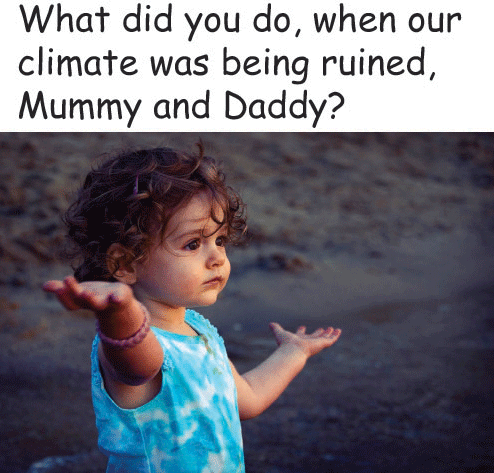 Climate forces consolidate as coal backers rush for government help http://www.theage.com.au/federal-politics/political-news/climate-forces-consolidate-as-coal-backers-rush-for-government-help-20170623-gwx3qy.html, Mark Kenny 22 June 17 Forces on the green-energy side are positioning for a renewed climate change debate in coming months, as the Turnbull government struggles to convince internal dissenters of the need for tougher carbon reduction measures.
The nation’s preeminent advocate of strong laws against carbon emissions, the Climate Institute, will close its doors on June 30 after a dozen years in operation, and transfer its assets and intellectual property to high-profile progressive think tank the Australia Institute.
The financial terms of the new arrangement have been kept confidential.
As the recipient body, the economically-oriented Australia Institute will in turn establish a dedicated “Climate and Energy Program” with the aim of stepping up the public pressure on lawmakers to meet Australia’s obligations under the Paris Accord.
It comes as some opponents of renewable-energy subsidies have called for the government to directly finance investment in coal-fired power.
“As capital increasingly seeks out clean-energy projects with a long and sustainable future, the lions of the free market have become lambs of largesse, so desperate to keep coal going they’d have taxpayers carry an unconscionable risk which is both financial and environmental” he said.
Climate Institute chairman Mark Wootton said the Australia Institute had been selected from a shortlist of strong candidates.
“Its expanded role in the climate change debate comes at a pivotal moment for policy development, economic transformation, and public expectations,” he said.
Chief Scientist Alan Finkel this week told the National Press Club that investors tended to favour new projects in wind and solar over coal because they could be started small and then scaled up as demand rises. His clean energy target proposal is now mired in internal government debate as conservative MPs push for the CET model to be skewed to allow for the subsidisation of new coal generators, or old generators retro-fitted with carbon capture and storage, to qualify for partial clean energy certificates.
Under pressure to reverse rising household electricity prices – driven largely by a scarcity value on local gas – the government has announced plans to mandate reserves for domestic access ahead of export sales – even where that gas is already contracted.
That has raised eyebrows with private capital markets wary of new sovereign risks caused by changing government policy.
The government has also left open the possibility of directly financing new generation coal-fired power, given the absence of private sector investors.
Australia’s peril: ignoring the climate ‘disaster alley’that we are already in
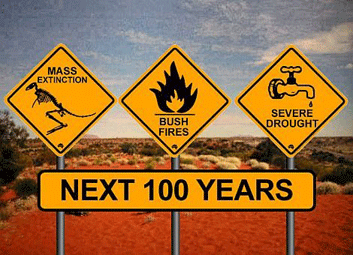 Australia, deep in climate change’s ‘disaster alley’, shirks its moral responsibility http://www.smh.com.au/comment/australia-deep-in-climate-changes-disaster-alley-shirks-its-moral-responsibility-20170621-gwvhs6.html Ian Dunlop,
A government’s first responsibility is to safeguard the people and their future well-being. The ability to do this is threatened by human-induced climate change, the accelerating effects of which are driving political instability and conflict globally. Climate change poses an existential risk to humanity that, unless addressed as an emergency, will have catastrophic consequences.
In military terms, Australia and the adjacent Asia-Pacific region is considered to be “disaster alley”, where the most extreme effects are being experienced. Australia’s leaders either misunderstand or wilfully ignore these risks, which is a profound failure of imagination, far worse than that which triggered the global financial crisis in 2008. Existential risk cannot be managed with conventional, reactive, learn-from-failure techniques. We only play this game once, so we must get it right first time.
This should mean an honest, objective look at the real risks to which we are exposed, guarding especially against more extreme possibilities that would have consequences damaging beyond quantification, and which human civilisation as we know it would be lucky to survive.
Instead, the climate and energy policies that successive Australian governments adopted over the last 20 years, driven largely by ideology and corporate fossil-fuel interests, deliberately refused to acknowledge this existential threat, as the shouting match over the wholly inadequate reforms the Finkel review proposes demonstrates too well. There is overwhelming evidence that we have badly underestimated both the speed and extent of climate change’s effects. In such circumstances, to ignore this threat is a fundamental breach of the responsibility that the community entrusts to political, bureaucratic and corporate leaders. Continue reading
1 This month

of the week – Australians for War Powers Reform (AWPR)
To see nuclear-related stories in greater depth and intensity
 Antinuclear