Flooding the planned nuclear waste dump area
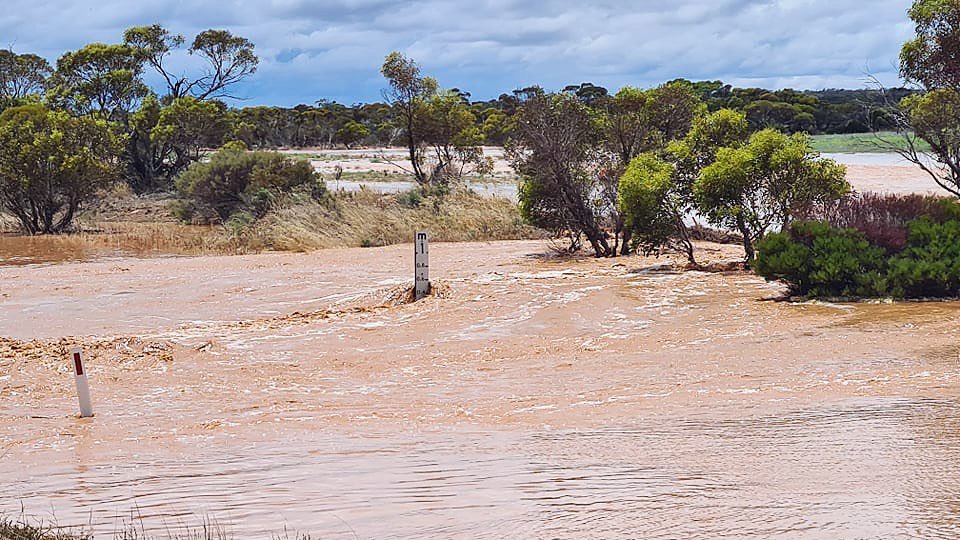
Flooding the Dump Michele Madigan, Sunday Mail, 6 Feb 22,
Well surely that has settled the matter- the Kimba region is a totally unsuitable site for where the federal government is proposing to dumping the nation’s highest-level radioactive waste.
Just out of Kimba, at Buckleboo where the proposed Napandee site actually is, neighbours recorded 185 mm in just the first recent downpour. Some areas received up to 300mm in two days. The Kimba mayor reported ‘massive damage to our roads and general infrastructure.’
The federal government is planning to transport this dangerous radioactive waste half way across the country to simply store it above ground for at least 100 years. The storage sheds will be designed with water outlets to leak.
Despite government assurances, 90% of the waste, measured by radioactivity, is intermediate level waste – toxic for an unimaginable 10,000 years.
In these times of galloping climate change it is certainly optimistic to be talking about ‘once in 100 years’ downpours. How much safer to keep it where it is manufactured in ANSTO’s solid buildings in Lucas Heights outer Sydney, with its on-site nuclear experts and highest-level security.(added ? )
Floods at Kimba: serious doubts that the Australian government has a plan for nuclear waste dump vulnerable to flooding

NUCLEAR WASTE AND FLOODS
Nuclear waste and floods
1. Preventing problems at a nuclear waste dump/store from flooding should be manageable, if and only if project management oversight and regulation is up to the task.
There are serious questions about whether management and regulation of the Australian government’s proposed national nuclear waste dump/store at Kimba in SA would be adequate. The most relevant case study in Australia is the flawed ‘clean up’ of the Maralinga nuclear test site in the late 1990s, overseen by the federal government. Everything that could go wrong, did go wrong. There has been no honesty or transparency about the failures at Maralinga, no attempt to learn from mistakes. Successive governments have simply lied about the problems and tried to cover them up. Expect the same at Kimba. https://nuclear.foe.org.au/flawed-clean-up-of-maralinga/
2. The proposed Kimba dump will be designed to leak. Either barriers prevent leakage, in which case there is a risk of accumulation of infiltrated water resulting in corrosion of waste drums and other such problems. Or, as is the case with the Kimba proposal, there will be water outlets, i.e. it is designed to leak.
3. Even with the expertise and resources available to ANSTO, and the importance of safely managing irradiated/spent nuclear fuel, water infiltration has been a problem at Lucas Heights. In early 1998, it was revealed that “airtight” spent fuel storage canisters had been infiltrated by water – 90 litres in one case – and corrosion had resulted. When canisters were retrieved for closer inspection, three accidents took place (2/3/98, 13/8/98, 1/2/99), all of them involving the dropping of canisters containing spent fuel while trying to transport them from the ‘dry storage’ site to another part of the Lucas Heights site. The public may never have learnt about those accidents if not for the fact that an ANSTO whistleblower told the local press. One of those accidents (1/2/99) subjected four ANSTO staff members to small radiation doses (up to 0.5 mSv).
4. One example of flooding compromising nuclear waste: Flooding at Nine Mile Point. In July 1981, water flooded the Radwaste Processing Building containing highly radioactive waste for Unit 1 at the Nine Mile Point nuclear plant in upstate New York. The flood tipped over 55-gallon metal drums filled with highly radioactive material. The spilled contents contaminated the building’s basement such that workers would receive a lethal radiation dose in about an hour. The Unit 1 reactor had been shut down for over two years and was receiving heightened oversight attention when the Nuclear Regulatory Commission (NRC) investigated the matter. But the NRC was reacting to a television news report about the hazardous condition rather than acting upon its own oversight efforts. The media spotlight resulted in this long over-looked hazard finally being remedied. https://allthingsnuclear.org/dlochbaum/flooding-at-nine-mile-point
5. Another example: Federal health officials agree radioactive waste in St. Louis area may be linked to cancer. The US government confirms some people in the St. Louis area may have a higher risk of getting cancer. A recent health report found some residents who grew up in areas contaminated by radioactive waste decades ago may have increased risk for bone and lung cancers, among other types of the disease. The assessment was conducted by the Agency for Toxic Substances and Disease Registry, a branch of the U.S. Centers for Disease Control and Prevention. Tens of thousands of radioactive waste barrels, many stacked and left open to the elements, contaminated the soil and nearby Coldwater Creek which sometimes flooded the park next to people’s homes. https://www.cbsnews.com/news/radioactive-waste-cancer-federal-health-officials-acknowledge-possible-link/
Kimba flooding: Australian government must immediately abort nuclear waste dump project.
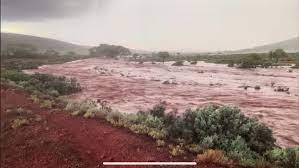
Peter Remta 25 Jan 22, Is this where the federal government should be placing its proposed above ground nuclear waste management facility?
There is no doubt that the sever flooding caused by the heavy rains in South Australia which included the Kimba district is a serious and essential reason for immediately aborting the proposed nuclear
waste management facility at Napandee farm.
From expert advice it is quite clear that Kimba as a whole – and not just Napandee – is far too dangerous to be an installation for theholding of nuclear waste particularly as the results of the present flooding may take up to ten years to overcome without any further flooding
This is especially the case as nuclear isotopes are dispersed and travel freely in water which can affect and contaminate all the surrounding land for many centuries making it completely unusable.
The federal government as the proponent of the Kimba nuclear waste facility cannot deny knowledge of floods and fires as risks for the purposes of the safety requirements for nuclear waste in Australia
As a result of advice by overseas experts that these two major risks are far more pertinent to Australia than other countries with nuclear waste the regulatory bodies should or must include these risks
within the Australian Radioactive Waste Management Framework and other applicable prescriptions and and standards for the longterm management of Australia’s radioactive waste including the storage or disposal of this waste at suitably sited facilities
I informed the officer at ARPANSA in charge of the Kimba facility development about formal inclusion of these risk and the requirement for the long overdue start of the safety case and her response was:
‘‘I think that it is not necessary at this stage however will take you up on the offer when we feel is the right time’‘
In view of the drastic situation that has now developed it is it is imperative that the federal government provides immediate funding to the Kimba community for an independent assessment and review of the government’s proposals
Massive flooding in Kimba district, – the Agricultural (no it’s now the Nuclear Waste) Town of the Year.
Flooding in Kimba district causes a decade’s worth of damage and communities are ‘completely shut off’
ABC North and West SA / By Declan Gooch, Brooke Neindorf, and Marcus Wilson, 23 Jan 22, V
Flooding on South Australia’s Eyre Peninsula has caused “massive, massive damage” to roads and infrastructure and left communities completely isolated.
Key points:
- Some parts of the Kimba district received 300mm of rain over the weekend
- The mayor says there has been “massive” damage to infrastructure
- A local farmer says his property looks like “channel country”
The Kimba district was among the hardest hit by the weekend’s destructive rain, which battered most of regional South Australia.
Mayor Dean Johnson said some areas received up to 300mm throughout Friday and Saturday.
The Bureau of Meteorology said the 160mm officially recorded in the 24 hours to 9am on Saturday was the most rain in a day ever documented there.
“It’s done massive, massive damage to our roads and general infrastructure,” Cr Johnson said.
“It will be some years and perhaps even a decade before we get to repair all of this, I think.”
“There are entire roads and sections of roads that have just been swept away by rivers of water. I can’t paint a much better picture than that. Just cliff edges where there used to be a road.”
He said many of the roads that had been damaged or destroyed were major roads, and the Kimba district was cut off from most directions.
“We’re completely shut off from the rest of the world at the moment. The road to the airport has completely washed away,” Cr Johnson said.
It is one of several regions that have been isolated by floodwater, with authorities scrambling to repair the Olympic Dam Highway that has cut off access to Roxby Downs.
‘You can mistake us for being in channel country at the moment’
Buckleboo, about 30 kilometres from Kimba, was another of the hardest-hit areas and also received its most rain ever recorded in a day.
Local farmer Tristan Baldock said his property had been transformed.
“You can mistake us for being in channel country at the moment, so we’ve got a historic watercourse that’s probably extending 20 kilometres through our property with a series of lagoons,” Mr Baldock said. ……
Will get through’
Cr Johnson said he was confident the region would recover. “The Agricultural Town of the Year is set up for a pretty good growing season next year, I think.”
more https://www.abc.net.au/news/2022-01-24/kimba-floods-eyre-peninsula-damage-isolated-roads-closed/100777084#:~:text=%22It’s%20done%20massive%2C%20massive%20damage,infrastructure%2C%22%20Cr%20Johnson%20said.&text=He%20said%20many%20of%20the,the%20world%20at%20the%20moment.
Flooding in South Australia includes Kimba- what about the nuclear dump sit? and what impact on uranium tailings dams?

This Channel 7 video report mentions Kimba as having had record rain. The ABC report mentions several towns with record rain, but does not mention Kimba
I wonder how this obviously flood-prone area could be selected a the nation’s nuclear waste dump site.
I also wonder how Olympic Dam’s huge dams of radioactive tailings are faring in this flood situation.
This Channel 7 video report mentions Kimba as having had record rain. The ABC report mentions several towns with record rain, but does not mention Kimba
I wonder how this obviously flood-prone area could be selected a the nation’s nuclear waste dump site.
Roads destroyed and homes flooded as rain cuts off towns in South Australia’s north | 7NEWS, 23 Jan 22,
Floodwaters submerge parts of outback SA as rain washes away highway and cars, ABC 23 Jan 22,
Key points:
- Emergency crews have rescued people trapped by floodwaters
- A section of the Olympic Dam Highway was washed away, blocking access between Roxby Downs and Woomera
- The bureau said several spots had recorded “all-time” highest rainfall totals over 24 hours
Entire towns in the state’s Far North are cut off after record-breaking rain. The SES has been flat out responding to hundreds of calls for help, as the heavens opened, destroying roads and inundating homes.
Rescue crews have been kept busy by outback floodwaters and record-breaking rains, which have continued to cause havoc in South Australia’s north and west, washing away roads as well as cars.
The weather bureau said some locations had set “all-time records” in terms of rainfall, while social media is awash with photos and videos of inundated highways.
Several people were rescued by the State Emergency Service (SES) after becoming trapped by floodwaters — including one who was swept 80 metres downstream and waited on top of his semi-submerged car for “at least four hours” as crews travelled to his remote location.
An entire section of the Olympic Dam Highway was also eroded between Pimba and Woomera, cutting off access from Roxby Downs…………………………………………. https://www.abc.net.au/news/2022-01-23/sa-rain-and-floods-wash-away-outback-roads/100776030
‘Everything about the Gulf of St. Lawrence was warmer in 2021’: federal scientist
‘Everything about the Gulf of St. Lawrence was warmer in 2021’: federal scientistWarming ocean temperatures — especially in deep water — set more records in the Gulf of St. Lawrence in 2021, according to climate data released Tuesday by the Department of Fisheries and Oceans.
CSIRO study proves climate change driving Australia’s 800% boom in bushfires.
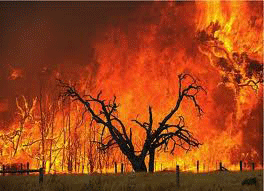
CSIRO study proves climate change driving Australia’s 800% boom in bushfires, The Age, By Mike Foley, November 26, 2021 Climate change is the dominant factor causing the increased size of bushfires in Australia’s forests, according to a landmark study that found the average annual area burned had grown by 800 per cent in the past 32 years.
The peer-reviewed research by the national science agency, CSIRO — published in the prestigious science journal, Nature — reveals evidence showing changes in weather due to global warming were the driving force behind the boom in Australia’s bushfires.
Lead author and CSIRO chief climate research scientist Pep Canadell said the study established the correlation between the Forest Fire Danger Index – which measures weather-related vegetation dryness, air temperature, wind speed and humidity – and the rise in area of forest burned since the 1930s.
“It’s so tight, it’s so strong that clearly when we have these big fire events, they’re run by the climate and the weather,” Dr Canadell said.
Prime Minister Scott Morrison went to the COP26 climate talks in Glasgow to commit Australia to reach net zero emissions by 2050, and to upgrade his expectations for Australia’s 2030 carbon cuts, but he defied a global push to commit to phasing out fossil-fuel use. Instead, the Coalition government is backing a significant expansion of the gas industry, which it predicts will be 13 per cent larger in 2050 than it is now.
Under the federal government’s gas industry strategy, taxpayers will support the private sector to develop viable new gas fields and develop an extensive network of new pipelines and related infrastructure.
The bushfire royal commission identified climate change as a key risk to ongoing bushfire catastrophe but did not make recommendations about reducing greenhouse emissions to curb the threat.
The CSIRO report found other factors have an impact on the extent and intensity of bushfires such as the amount of vegetation or fuel load in a forest, the time elapsed since the last fire, and hazard reduction burning. But Dr Canadell said the study showed the link between weather and climate conditions and the size of bushfires was so tight, it was clear these factors far outweighed all other fire drivers…………….
oyal c
Mega-fires, which burn more than 1 million hectares, have “markedly” increased with three of the four recorded from 1930 occurring since 2000, while the gap between big blazes has had a “rapid decrease”, the study says.
Last year, the bushfire royal commission reported fuel-load management through hazard reduction burning “may have no appreciable effect under extreme conditions” that typically cause loss of life and property. https://www.theage.com.au/politics/federal/csiro-study-proves-climate-change-driving-australia-s-800-percent-boom-in-bushfires-20211126-p59cgr.html
COP 26, especially Australia, has failed First Nations people

At this supposedly historic event, I saw a conference that relied on dated colonial constructs and ignored Indigenous people. I watched the Australian pavilion used to promote gas and carbon capture and storage, sponsored by corporations such as Santos. Outnumbered by fossil fuel lobbyists, First Nations people witnessed an aggressive big business approach to climate negotiations, hardly the turning away from and permanent closure of extractive, polluting industries that we are all calling for.
Guardian 15th Nov 2021
Australia at COP26 – a damaging presence

COP26: it’s half-time at the crucial Glasgow climate change summit – and here’s the score, The Conversation, Wesley Morgan, 5 Nov 21, Research Fellow, Griffith Asia Institute and Climate Council researcher, Griffith University
………………….Missing the moment: The Australian Way
While the rest of the world is getting on with the race to a net-zero emissions economy, Australia is barely out of the starting blocks. Australia brought to Glasgow the same 2030 emissions target that it took to Paris six years ago – even as key allies pledged much stronger targets.
Prime Minister Scott Morrison arrived with scant plans to accompany his last-minute announcement on net-zero by 2050. The strategy titled The Australian Way, which comprised little more than a brochure, failed to provide a credible pathway to that target. It was met with derision across the world.
On the way to Glasgow, at the G20 leaders meeting in Rome, Australia blocked global momentum to reduce emissions by resisting calls for a phase out of coal power. Australia also refused to sign on to the global pledge on methane.
Worse still, Australia is using COP26 to actively promote fossil fuels. Federal Energy Minister Angus Taylor says the summit is a chance to promote investment in Australian gas projects, and Australian fossil fuel company Santos was prominently branded at the venue’s Australia Pavilion.
The federal government is promoting carbon capture and storage as a climate solution, despite it being widely regarded as a licence to prolong the use of fossil fuels. The technology is also eye-wateringly expensive and not yet proven at scale……. https://theconversation.com/cop26-its-half-time-at-the-crucial-glasgow-climate-change-summit-and-heres-the-score-170869
Australia’s credibility at a low point, with Scott Morrison’s lying and appalling performance at COP26
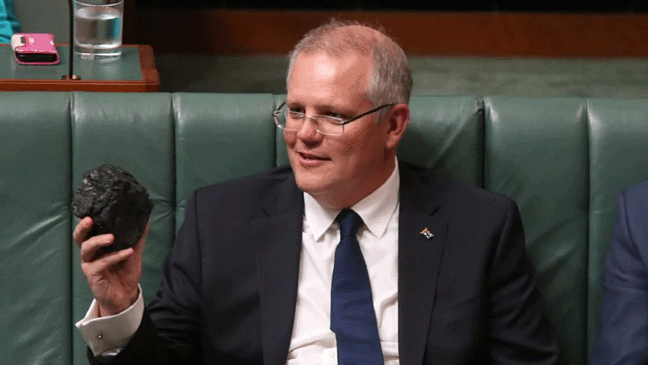
Bonne chance? Australia might need it on AUKUS nuclear submarines deal https://www.canberratimes.com.au/story/7492847/bonne-chance-australia-might-need-it/ 2 Oct 21,
The AUKUS nuclear submarines deal had better pay off, because the costs for Australia are beginning to appear far greater than first suggested.
In case Prime Minister Scott Morrison really thought some time, and some space, would quell Emmanuel Macron’s anger at the announcement – which abruptly ended a $90 billion submarines contract with France’s Naval Group – the French president disabused him of that idea on Sunday.
Mr Macron knew very well what he was doing when he spoke to Australian journalists about the AUKUS deal, and Mr Morrison’s actions. There was an air of calm calculation about his words. If his intent was to express the depth of his disappointment, the damage the nuclear submarines deal had done to the Australia-France relationship, and to raise questions about Mr Morrison’s handling of the AUKUS move, then he was bang on target.
He didn’t overplay his anger, and even couched his disapproval of Mr Morrison’s actions with a respectful recognition of Australia and France’s friendship and shared history.
With two words, he also highlighted what is becoming increasingly clear about the AUKUS nuclear submarines arrangement: As an exercise in Australian defence procurement, it appears chimeric.
“Good luck,” he said, noting that far from a signed contract, Australia right now has to wait 18 months for a review before the next steps in its new quest for submarines. Bonne chance, Australia.
This is where the nation sits less than a couple of months after the AUKUS deal, in a region with heightening geopolitical tensions and unresolved questions about Australia’s ability to defend itself. Australia is falling out with its friends (France), while its closest ally gives a different version of events in the lead-up to the AUKUS announcement (it was “clumsy”, Joe Biden says).
In hindsight, the AUKUS announcement seems true to form for Mr Morrison. It was high in marketing, fanfare and gloss, but lacking in substance, ham-fisted in execution and questionable in the respect it afforded to those who deserved it.
Add Australia’s reputation as obstructing progress in international climate talks, its pathetically bare minimum net zero by 2050 position, and its refusal to support international agreements phasing out coal, and the nation cuts an increasingly lonely figure on the world stage.
Mr Morrison’s trip overseas for both G20 and COP26 is, at this stage, disastrous. Australia’s credibility seems to be ebbing, not just because of AUKUS but on climate action, too. Middle powers cannot afford to put their reputations at risk like this.
Scott Morrison’s ‘net zero plan’ includes small nuclear reactors
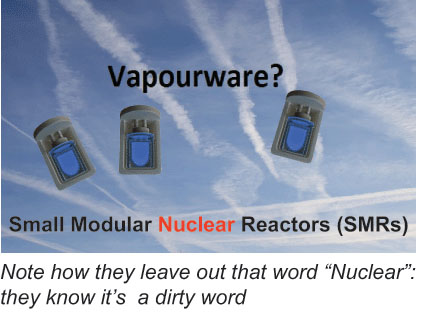
Australia’s net zero plan includes ‘small, modular nuclear reactors’ Paul Osborne, 27 Oct 21, Australia will closely watch the development of small modular nuclear reactors as the government seeks to achieve net-zero emissions by 2050. The Morrison government’s emissions plan released on Tuesday said “all technologies” were on the table.
…….. The plan noted that Australia was working with the UK on low emissions technology, including research into small modular reactors.
Prime Minister Scott Morrison told Perth radio 6PR on Tuesday he did not intend to lift the current ban on nuclear power in Australia…….https://inqld.com.au/news/2021/10/27/australias-net-zero-plan-includes-small-modular-nuclear-reactors/
Australia will closely watch the development of small modular nuclear reactors as the government seeks to achieve net-zero emissions by 2050. The Morrison government’s emissions plan released on Tuesday said “all technologies” were on the table.
National Party did a secret climate deal with Morrison, but nuclear power was not included.

Some Nationals had been pushing for nuclear to be included as part of Australia’s clean energy mix. But ahead of the meeting, Nationals deputy leader David Littleproud indicated it would not be part of the plan.
Nationals provide in-principle support for a net zero 2050 target, nuclear not part of plan, ABC News, By political reporter Stephanie Borys 24 Oct 21, The Nationals have given their in-principle support to back a target of net zero emissions by 2050, just days before Prime Minister Scott Morrison is due to fly to Glasgow for global climate talks.
Key points:
- Mr Joyce says a majority of Nationals members and senators are on board with the plan
- He says most concerns with the climate plan have been allayed
- Cabinet will meet to sign off on the plan, which Mr Morrison will take to Glasgow
The party met on Sunday afternoon to discuss its ongoing concerns about adopting the policy, with some worried it could result in job losses in regional areas…….
The Nationals met for just over two hours and all 21 members and senators spoke on the matter but no formal vote was held…..
………Federal Cabinet will meet within days to formally sign off on the plan, which the Prime Minister will then take to the Glasgow climate summit.
What did the Nationals get inserted into the climate plan?
There are conditions attached to the Nationals backing net zero emissions by 2050, but those details remain a secret.
Just days ago, the junior Coalition partner presented a list of demands to the Prime Minister about the proposed climate change policy.
The Nationals have not publicly outlined the changes they want. Mr Joyce again refused to provide details about what Mr Morrison had offered or agreed to.
……….. Opposition Leader Anthony Albanese said Australians deserved to know the details of the deal.
Some Nationals had been pushing for nuclear to be included as part of Australia’s clean energy mix. But ahead of the meeting, Nationals deputy leader David Littleproud indicated it would not be part of the plan.
“You have got to educate before you legislate and we’ve got to bring the community with us,” he said
“They are not there with us at this stage; unfortunately, they are getting their education from Chernobyl and The Simpsons.
“That takes time to build that education up,” he said.
New South Wales Liberal Treasurer Matt Kean said the proposal did not stack up on practical or economic grounds, and that his government had been told by experts it would take at least 15 years to train the workforce.
“People talking about nuclear to solve our current needs are chasing a unicorn,” he said…… https://www.abc.net.au/news/2021-10-24/nationals-provide-in-principle-support-for-net-zero-2050-target/100564192
National Party may demand that nuclear power be part of Scott Morrison’s ”net zero by 2050” aim.

Nationals may put nuclear energy on the agenda as the party negotiates Scott Morrison’s net zero proposal, The Nationals could put nuclear power on the agenda as part of Scott Morrison’s proposed net zero by 2050 target, the chair of the Environment and Energy Committee said. Sky News Tyrone Clarke, Digital Reporter, October 21, 2021 – Liberal MP Ted O’Brien has flagged the possibility of the Nationals pushing nuclear energy on the agenda as the Coalition debates Prime Minister Scott Morrison’s net zero proposal.
The Nationals party room met again on Thursday afternoon to finalise a set of climate demands to be presented to Mr Morrison as the Prime Minister hopes to take a net zero target to the upcoming COP26 summit in Glasgow.
Deputy Prime Minister Barnaby Joyce has remained tight-lipped about his party’s preferences towards the policy, but has categorically ruled out committing to a more aggressive 2030 emissions reduction target.
But Mr O’Brien said nuclear power had the backing of many Nationals members and could be on a list of demands set to head to the Prime Minister’s desk…………………. https://www.skynews.com.au/australia-news/politics/nationals-may-put-nuclear-energy-on-the-agenda-as-the-party-negotiates-scott-morrisons-net-zero-proposal/news-story/0d476f4bbec9af57ecfb6eab864b8930
1 This month

of the week – Australians for War Powers Reform (AWPR)
To see nuclear-related stories in greater depth and intensity
 Antinuclear