Energy, climate, emissions news 21 May 17
National
Summer energy crisis looms without reforms, Grattan Institute warns
Panicking politicians who make kneejerk decisions to bolster Australia’s energy security run the risk of fuelling a power crisis with more blackouts and restrictions, a Grattan Institute report says.
http://www.abc.net.au/news/2017-05-21/grattan-institute-warns-of-looming-summer-energy-crisis/8545522
New coalmines will worsen poverty and escalate climate change, report finds
Oxfam attacks Australia’s ‘climate policy paralysis’ and urges it to promise no new coalmines and end public subsidies
https://www.theguardian.com/environment/2017/may/22/new-coalmines-will-worsen-poverty-and-escalate-climate-change-report-finds
Cheap way to cut emissions
Graham Lloyd
Land clearing – Australia could meet a 2C warming target under the Paris agreement at no cost to business.
http://www.theaustralian.com.au/national-affairs/climate/land-management-changes-the-lowcost-way-to-cut-emissions/news-story/eaa311fadd2d5963774b94c3bcf9bb95
Australia isn’t trying to stop global warming. We’re subsidising it.
 Palaszczuk and Turnbull governments are Adani mine’s lonely fans, Canberra Times, Ebony Bennett, 20 May 17 Australia isn’t trying to stop global warming. We’re subsidising it.
While the ACT is on track to source 100 per cent of our electricity from renewable energy by 2020, Queensland’s state government is doubling down on the No. 1 contributor to climate change: coal. Despite banks, economists and Australians in general showing little interest in handing Indian coal giant Adani billions of dollars to dig up a heap of carbon, many politicians just can’t seem to wait to throw your money at it. The Queensland government’s enthusiasm is exceeded only by that of Turnbull government ministers, who have taken to fondling lumps of coal on the floor of Parliament.
Ten days before the last Queensland election, then opposition leader Annastacia Palaszczuk blasted the Newman’s government for picking winners and losers, warning: “What we’re seeing at the moment is Campbell Newman throwing a bucket of taxpayers’ cash … at one particular company [Adani].”
She further promised that “Queenslander taxpayers’ money is not going to be used to fund commercial operations”. She then went on to win the election in one of Australia’s biggest political upsets.
Coal subsidies are unpopular
Despite being elected on a “no subsidies” platform, the Palaszczuk government has since offered Adani free water (in the form of an unlimited, unchallengeable water licence), free coal (in the form of a reported $320 million “royalty holiday”) and a possible 39-year raincheck on the clean-up bill. It’s also on track for a $1 billion subsidised loan for its rail line from the federal government’s Northern Australia Infrastructure Facility.
At this rate, we’ll soon be paying Adani to dig up our coal. And voters don’t appear to be impressed. Continue reading
Turnbull government budget ignores health impacts of climate change
 Shortsighted Budget 2017 ignores health impacts of climate change, Independent Australia Kristine Barnden 19 May 2017, The Turnbull Government has once again prioritised growing the economy over human lives, writes Dr Kris Barnden.
ACTION TO PROTECT AUSTRALIA from climate change was a policy free zone in the 2017 Budget. Despite strong scientific and economic consensus on the urgent need to transition away from fossil fuels, our government has prioritized efforts to grow the economy using a business as usual approach.
Doctors have been speaking out about the adverse health effects of climate change, as well as the health co-benefits of policies aimed at mitigating and adapting to climate change. In Australia, air pollution from coal fired power stations contributes a significant proportion of the over 3000 deaths per annum from pollution and a plea has been made by doctors for a rapid transition away from coal fired power.
Agriculture is another area where actions to reduce green house gas emissions are likely to be associated with multiple benefits, including health. In last week’s Budget, agriculture and regional Australia are seen as winners only from expenditure on rail. However, we need to recognize that agriculture is an important contributor to greenhouse emissions and also extremely vulnerable to their effects as recognized by the farming industry. These factors are budgetary items and need to be built into national financial policy. Indeed as President Obama has noted, food security is a world issue and we carry responsibility as a food exporter……….
Agriculture, the environment, the economy and human health interact at many levels, and we face significant difficulties on all fronts. All will be affected by climate change, and we cannot afford to consider each in isolation. We need strong leadership, and the ability to look beyond short term political and ideological considerations to longer term gains.
Dr Kristine Barnden is a member of the management committee of Doctors for the Environment Australia. https://independentaustralia.net/politics/politics-display/budget-2017-ignores-health-impacts-of-climate-change,10314
Adani Carmichael coal mine: climate, health and economics are against it
 Climate Council: climate, health and economics are against Carmichael mine https://theconversation.com/climate-council-climate-health-and-economics-are-against-carmichael-mine-77940, Emeritus professor, Fenner School of Environment and Society, Australian National University, Head of School, School of Public Health and Social Work, Queensland University of Technology May 19, 2017 Despite the overwhelming evidence that fossil fuels are killing the Great Barrier Reef and making many extreme weather events worse; despite the emphatic thumbs-down from the finance sector; and despite the growing awareness of the serious health impacts of coal, the proposed Carmichael coal mine staggers on, zombie-like, amid reports it has been offered a deferment of A$320 million in royalty payments.
A new Climate Council report, Risky Business: Health, Climate and Economic Risks of the Carmichael Coalmine, makes an emphatic case against development of the proposed mine, or of any other coal deposits in Queensland’s Galilee Basin, or indeed elsewhere around the world.
Burning coal is a major contributor to climate change. Australia is already reeling from the escalating impacts of a warming climate. Heatwaves and other extreme weather events are worsening. The Great Barrier Reef has suffered consecutive mass bleaching events in 2016 and 2017. Climate change is likely making drought conditions worse in the agricultural belts of southwest and southeast Australia. Our coastal regions are increasingly exposed to erosion and flooding as sea level rises.
If we are to slow these disturbing trends and stabilise the climate at a level with which we might be able to cope, only a relatively small amount of the world’s remaining coal, oil and gas reserves can actually be used.
The majority must be left unburned in the ground, without developing vast new coal deposits such as those in the Galilee Basin.
On budget
The amount of fossil fuels we can burn for a given temperature target (such as the 1.5℃ and 2℃ targets of the Paris climate agreement) is known as the “carbon budget”.
To give ourselves just a 50% chance of staying within the 2℃ Paris target, we can burn only 38% of the world’s existing fossil fuel reserves. When this budget is apportioned among the various types of fossil fuels, coal is the big loser, because it is more emissions-intensive than other fuels. Nearly 90% of the world’s existing coal reserves must be left in the ground to stay within the 2℃ budget.
When the carbon budget is apportioned by region to maximise the economic benefit of the remaining budget, Australian coal in particular is a big loser. More than 95% of Australia’s existing coal reserves cannot be burned, and the development of new deposits, such as the Galilee Basin, is ruled out.
The health case
Exploiting coal is very harmful to human health, with serious impacts all the way through the process from mining to combustion. Recently the life-threatening “black lung” (coal workers’ pneumoconiosis) has re-emerged in Queensland, with 21 reported cases. Across Australia, the estimated costs of health damages associated with the combustion of coal amount to A$2.6 billion per year.
In India, the country to which coal from the proposed Carmichael mine would likely be exported, coal combustion already takes a heavy toll. An estimated 80,000-115,000 deaths, as well as 20 million cases of asthma, were attributed to pollutants emitted from coal-fired power stations in 2010-11. Up to 10,000 children under the age of five died because of coal pollution in 2012 alone.
Compared with the domestic coal resources in India, Carmichael coal will not reduce these health risks much at all. Galilee Basin coal is of poorer quality than that from other regions of Australia. Its estimated ash content of about 26% is double the Australian benchmark.
This is bad news for children in India or in any other country that ends up burning it.
The economics
The economic case for the Carmichael mine doesn’t stack up either. Converging global trends all point to rapidly reducing demand for coal.
The cost of renewable energy is plummeting, and efficient and increasingly affordable storage technologies are emerging. Coal demand in China is dropping as it ramps up the rollout of renewables. India is moving towards energy independence, and is eyeing its northern neighbour’s push towards renewables.
All of these trends greatly increase the risk that any new coal developments will become stranded assets. It’s little wonder that the financial sector has turned a cold shoulder to the Carmichael mine, and Galilee Basin coal development in general. Some 17 banks worldwide, including the “big four” in Australia, have ruled out any investment in the Carmichael mine.
From any perspective – climate, health, economy – the proposed mine is hard to justify. And yet the project keeps on keeping on.
Australia’s Attorney General Brandis intervenes in W and J court action against Adani
 Traditional Owners fighting Adani appalled at improper political interference http://wanganjagalingou.com.au/brandis-intervenes-in-indigenous-court-action-against-adani/
“The Attorney General, George Brandis, has intervened in a Federal Court hearing in which the Traditional Owners fighting Adani’s proposed coal mine are seeking to strike out a fake agreement Adani claims to have for the mine to proceed.
“Senator Brandis’ intervention follows his second failure to rush through changes to the Native Title Act….
“Senior spokesperson for the Wangan and Jagalingou (W&J)Traditional Owners Council, Adrian Burragubba, said,
““The Attorney General has made an extraordinary and political intervention in matters before the court. Intervening in our case shows Brandis is working in billionaire Adani’s interests, not ensuring the proper administration of justice. Again, Brandis is making Native Title all about Adani’s mine instead of good law reform. …
“Youth spokesperson for the W&J Traditional Owners Council, MsMurrawah Johnson, said,
““Adani didn’t negotiate and achieve the free prior informed consent of the W&J people. The meeting, which Adani and its barrackers claim achieved consent, with a 294 to 1 vote, is as fake as its ILUA.
It is not a true expression of the W&J Traditional Owners.
““Over 220 of the attendees at Adani’s meeting are people who have never been involved in the W&J claim or decision making, and who are identified with other nations and claims, or didn’t identify an apical descent line. …
“Lawyer for the W&J Traditional Owners Council, Mr Colin Hardie, said,
“My clients have four strong grounds against Adani’s purported ILUA. …
19 May climate news in Australia
National
Time for the climate policy review we had to have
Peter Castellas
It’s time to get serious about climate policy, and set Australia up to make the most of the zero carbon transition that is undoubtedly underway.
http://reneweconomy.com.au/time-climate-policy-review-23038/
Australia risking its international standing over climate change inaction: Marshall Islands
The President of the Marshall Islands compares Australia to a “big brother or big sister” openly mocking science on climate change, saying inaction “weakens your ability to be a force for good on the world stage”.
http://www.abc.net.au/news/2017-05-17/marshall-islands-urge-australia-to-support-climate-change/8533434
Lucy Manne
Banks are walking away from mining projects that harm our planet, and our people. But one Australian Government organisation still isn’t getting the message
https://newmatilda.com/2017/05/17/propping-up-climate-destruction-human-rights-abuses-efic-abroad/
The Brisbane suburbs that will suffer ‘extreme’ temperature rises under infill
http://www.brisbanetimes.com.au/queensland/the-brisbane-suburbs-that-will-suffer-extreme-temperature-rises-under-infill-20170517-gw76m0.html
All coral reefs could be dead by 2050
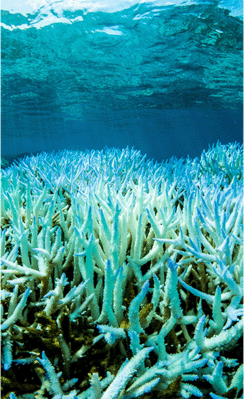 Dahr Jamail | Coral Reefs Could All Die Off by 2050, May 15, 2017, By Dahr Jamail, Truthout | Report “…… over the last two years, the Great Barrier Reef, which is so dear to Miller and countless others who revel in the beauty and mysteries of the oceans, has been dying off at an unprecedented rate due primarily to warming ocean waters.
Coral bleaching occurs when corals become stressed by warmer-than-normal water, causing them to expel symbiotic algae that live in their tissues, from which they get their energy. Coral turns completely white when it bleaches. If it remains bleached long enough, it dies.
One scientist has already gone so far as to declare the Great Barrier Reef is now in a “terminal stage.” Most of those studying the reef agree that what is happening is unprecedented. This is because, at a minimum, two-thirds of the 1,400-mile long reef bleached out last year, which led to 22 percent of it dying. Now another bleaching event has resulted in at least two-thirds of the reef bleached again.
“The bleaching this year has moved much farther south and has taken scientists by surprise in its severity and extent,” Miller said. And he fears the state of the reef could be even worse than scientists realize, since only aerial surveys have been conducted to assess the damage and no research vessel is currently active on the reef to provide finer details.
With ocean temperatures rising across the globe as anthropogenic climate disruption (ACD) continues to pick up speed, the Great Barrier Reef, the largest coral ecosystem on Earth, may well be an example of what is happening to all of the coral on the planet.
“This Is New for All of Us”…….. Continue reading
The plight of Kiribati Island – desperate need for Australia’s help
Our country will vanish’: Pacific islanders bring desperate message to Australia, Guardian, 14 May 17, Kiribati and other low-lying countries are under threat from climate change, and while their people would rather stay behind, they may be left with no choice “……… i-Kiribati man Erietera Aram is in Australia delivering his message about the reality of climate change in his country, and of its immediacy. Each discussion, he says, is like a drop of water, adding to the one before it, slowly building understanding of the existential threat to his people and place.
“Climate change is not something off in the future, it’s not a problem for later. We are living it now,” he says.
The archipelago of Kiribati – 33 tiny coral atolls spanning 3.5m square kilometres of ocean – is the world’s lowest-lying country, with an average height above sea level of just two metres.
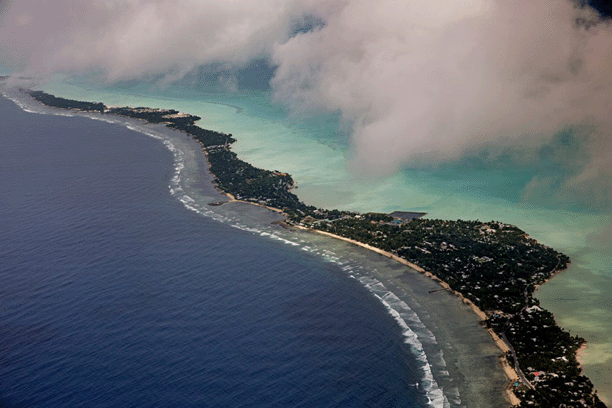
Most of the 113,000 i-Kiribati live crammed on to Tarawa, the administrative centre, a chain of islets that curve in a horseshoe shape around a lagoon.
“My place is very small,” Aram says. “If you stand in the middle, you can see water on both sides. We are vulnerable. One tsunami, one tsunami and our whole country will disappear.”
Already, there is less and less of Kiribati for its inhabitants. The coastline is regularly being lost to king tides and to creeping sea levels, and in a very real sense, there is nowhere to go.
The loss of land is causing conflict – Tarawa is growing ever more densely crowded, as families living on the coastline are forced inwards, infringing on another’s claim.
The next round of multinational climate talks in November – COP 23 – will be chaired by Fiji, and is expected to swing particular focus of the global climate debate to the Pacific, where comparatively minuscule amounts of carbon are produced, but the effects of climate change have been felt first, and most acutely.
Assuming the COP presidency, the Fijian prime minister, Frank Bainimarama, said he would “bring a particular perspective to these negotiations on behalf of some of those who are most vulnerable to the effects of climate change – Pacific Islanders and the residents of other small island developing states and low-lying areas of the world”…….https://www.theguardian.com/world/2017/may/14/our-country-will-vanish-pacific-islanders-bring-desperate-message-to-australia
The enormous problem of Adani’s mine rehabilitation plans
‘Monumental experiment’: Concerns raised over Adani’s mine rehab plans, Brisbane Times, Peter Hannam , 15 May 17 Mine rehabilitation plans for the proposed giant Carmichael coal mine in Queensland fall far short of best practice and will expose the environment and taxpayers to huge risks, according to anti-mine group Lock the Gate.
On its submitted plans, the $16 billion-plus mine would disturb some 280 square kilometres of land, with 1.85 billion tonnes of potentially acid-forming material unearthed, and six giant voids left unfilled, Lock the Gate said in a new report. Some 88 kilometres of streams would also be disrupted and not restored.
“This is a monumental experiment on altering a landscape to a scale we’ve never seen before and believing a company that is saying already it doesn’t think it can put it back to remotely close to what was there before,” said Rick Humphries, co-ordinator of the group’s mine rehabilitation reform campaign.
“We are asking them to be shifted from a low-end, minimalist cheapest [rehab] option to leading practice,” said Mr Humphries, an environmental scientist who previously helped Rio Tinto develop their rehab plans.
The federal and state governments are backing the giant mine, which could produce as much as 60 million tonnes of coal for export a year. Carmichael’s development could also help open up other coal mines in the Galilee Basin.
A report last week by the NSW Auditor-General found that state’s mine rehabilitation guarantees held by the government to be inadequate and requirements for restoring land after a mine’s closure to be vague. The state’s rules, though, were superior to those in Queensland and Victoria, it said…….
According to Lock the Gate, Adani wouldn’t have to begin rehabilitation work until 39 years into its operations, well shy of the “continuous” rehab work that is considered best practice.
Adani may be offered as much as $1 billion in loans from the federal government to help build the rail link from the mine to the coast. Its board still aims to give its final investment decision in the next few weeks, the spokesman said.
Financial closure would then be sought by the end of the year, and pre-construction works starting by the September quarter, he said. http://www.brisbanetimes.com.au/environment/monumental-experiment-concerns-raised-over-adanis-mine-rehab-plans-20170513-gw46v9.html
Internationally respected Australian climate scientist calls on CSIRO to get back to a science culture
 CSIRO: Time for a ‘science culture’ again, says leading climatologist John Church ABC, Gregg Borschmann for The Science Show 13 May 17
“The commitments … we’re locking in — in terms of future climate change, both for sea level but also for temperatures and impacts on society — you can see these impacts accelerating, but we’re not making a lot of headway on real mitigation efforts,” Dr Church said.
He said the threshold for locking in long-term global sea-level rise would be crossed if carbon emissions continue unabated into the 22nd century.
In addition, there will be significant contributions from Antarctica plus smaller country contributions from melting of glaciers and ocean thermal expansion.
“We won’t get to tens of metres of sea level rise in 500 years, but we’ll be on that path of very substantial sea level rises if we don’t start mitigating emissions as urgently as we possibly can.” http://www.abc.net.au/news/science/2017-05-13/time-for-a-science-culture-again-at-csiro:-john-church/8516770
Malcolm Turnbull has now dropped all pretense of acting on climate change
 Turnbull abandons fig leaf and stands naked on climate policy, REneweconomy, By Giles Parkinson on 10 May 2017 You would think that with all the hoo-ha about the scandalous increases in electricity prices that it would have rated some sort of mention in the budget. You know, one of the biggest cost inputs for business being addressed in the government’s economic centrepiece.
But no. The 2nd Morrison/Turnbull fiscal document blithely ignores the issue, despite the fact that their lack of policy direction in the last few years has been the major contributor to the price surges that are scorching household and business budgets.
There’s some pointless extra money for coal seam gas, the removal of some funds for carbon capture (finally) and some previously promised funds for solar thermal (about time), and even another thought bubble on Snowy Hydro – this time to buy it out from the state governments. See Matt Rose’s article for more details.
But there is nothing on climate change, no grand vision on energy. There are no new funds for the Direct Action policy that Turnbull had once ridiculed as a fig leaf for a climate action, and nothing on what might take Australia along the path to the pledge it signed in the Paris deal – effectively to reach zero net emissions by 2050.

As Labor’s Mark Butler noted this morning, the Coalition’s climate change policy has officially gone from that fig-leaf to a non-existent farce.
Nearly three years after celebrating the dumping the carbon price (above), slashing the RET and ignoring expert advice (CCA and the Climate Council), the Coalition government has no actual policy, on energy or climate, and its negligence is adding to the stunning rise in electricity prices it is trying to blame on everything and everyone else.
“Malcolm Turnbull, the Prime Minister who once said he didn’t want to lead a Liberal Party that didn’t feel as strongly about climate change as he did, is now the Prime Minister who has completely dropped any pretence of attempting to combat climate change,” Butler says in his statement, noting that climate change did not rate a single mention in the Budget speech.
“As the central pillar of the Direct Action policy, the Emission Reduction Fund, runs out of funds, this budget delivers ZERO new policies or funding to drive down pollution and combat climate change. This budget allocates more new money to the Department of the House of Representatives than it does to tackling climate change.
“Budgets are about choices and priorities, and this budget makes it perfectly clear the Turnbull government isn’t choosing a safe climate because they don’t think it is a priority. This budget finally makes official what we already know; this Liberal government is failing all future generations of Australians.”
We took big slabs of Butler’s comments because we don’t think we could say it any better……. http://reneweconomy.com.au/turnbull-abandons-fig-leaf-and-stands-naked-on-climate-policy-79879/
Australia likely to lose National Climate Change Adaptation Research Facility
Nobody Mentioned It, But Do We Stand To Lose Our Best Defence Against Climate Change? Huff Post, Good luck, Australia. We’re going to need it. You’ve probably never heard of the National Climate Change Adaptation Research Facility. We hadn’t. And after reading the 2017 Federal Budget, the indications are we never will again.Here’s why this matters.
This means it’s Australia’s only government-funded body which takes established climate science, assesses the likely impacts of climate change, then tells us what the heck we should do about it.
Budget Paper No. 2 confirms confirms that its modest funding of $600,000 will continue for another year.
The Government will provide $0.6 million in 2017‑18 to the Commonwealth Scientific and Industrial Research Organisation and National Climate Change Adaptation Research Facility. This measure supports existing online platforms that inform decision makers seeking to adapt to changes in climate.
And then? Well down on page 57 of the Environment Portfolio Budget Statements, the funding looks like it dries up after the end of the 2017/18 financial year. No more NCCARF. It may merge with the CSIRO, or it may just be lost.
“I think it’s got another year to find a funding mechanism that is stable, that’s my reading of the situation,” NCARFF Director Professor Jean Palutikof told HuffPost Australia…….
Australian Conservation Foundation CEO Kelly O’Shanassy told HuffPost Australia that NCCARF was now “a research facility without funding for research”.
“The budget commitment is for $600,000 next year with CSIRO to maintain an online database of specific parts of its research. It has no funding after that.”………
More broadly, this was a budget in which the term “climate change” barely rated a mention.
“There’s nothing on climate change and very little on the environment. It’s like someone’s gone ‘Control Alt Delete’ and the whole thing’s disappeared from the budget papers,” Greens Senator Sarah Hanson-Young told HuffPost Australia politics editor Karen Barlow.
Gemma Borgo-Caratti, the National Director of the Australian Youth Climate Coalition, said “the Budget ignores climate change which in turn handballs Australia’s biggest problem to the next generation to deal with”.
Greenpeace Asia Pacific said “the Turnbull government has continued to ignore climate change and the need to fund renewable energy at a time when the country is demanding leadership on the most serious threat of our age”……http://www.huffingtonpost.com.au/2017/05/10/nobody-mentioned-it-but-we-stand-to-lose-our-best-defense-again_a_22078630/
On the whole, the Turnbull budget ignores climate change, and fails to plan for long term energy system
Other announcements included the Government reaffirming their $110m loan commitment for the solar thermal project in Port Augusta.
Most of the package will go to measures that will accelerate exploration and assessment of onshore gas and lay the groundwork for new gas pipelines.
It is clear from this budget that the Coalition government is failing to undertake the longer term strategic thinking that is needed to transform Australia’s energy system and wider economy to address Australia’s growing emissions
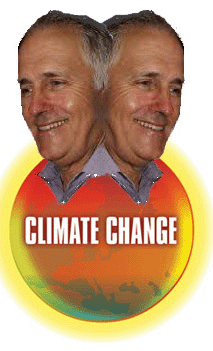 Turnbull’s budget ignores energy crisis and dodges climate http://reneweconomy.com.au/turnbulls-budget-ignores-energy-crisis-dodges-climate-24886/ By Matthew Rose on 10 May 2017
Unfortunately, the second budget of the Turnbull Government continues their dire management of Australia’s energy and climate change policy. By the government’s own admission, they are in the grip of an ‘energy crisis’ largely concerning east coast gas supplies. The energy sector overall has been plagued by policy uncertainty.
Earlier in the week the Energy and Environment Minister admitted Australia wouldn’t meet its Paris Commitment of net zero emissions by 2050 and instead the end of the century was a more realistic ambition.
This ambition ignores the overwhelming scientific evidence that net zero emissions by the end of the century is totally inadequate in avoiding extremely dangerous climate change. It is inconsistent with the Paris Agreement goal of holding global warming well below 2 degrees and to pursue a 1.5-degree limit. In short, it is a grossly negligent position from Australia’s environment minister.
Despite these self-identified challenges the Federal Budget fails to address them. The current centrepiece of the Government’s climate policy the Emission Reduction Fund (ERF) remains under a cloud with no further funding allocated in the Budget. Continue reading
Health dangers from climate change are already with us
Health and climate change, The Saturday Paper, The World Health Organisation’s director-general describes climate change as ‘the fifth horseman’ of the apocalypse, as doctors are encouraged to speak out more about illness and death caused by extreme weather. By Marie McInerney. 6 May 17, “……….The World Health Organisation is clear, declaring climate change “the defining issue” for this century. The WHO’s director-general, Dr Margaret Chan, has described it as “the fifth horseman” of the apocalypse, a new threat riding across the public health landscape.
The health risks posed for Australia have been catalogued by the Climate and Health Alliance (CAHA), a coalition of health and social policy groups that has developed a framework for a national strategy on climate, health and wellbeing in the absence of government or departmental leadership.
At the top of the list of risks are increasing frequency and ferocity of extreme weather events such as heatwaves, floods and storms such as cyclone Debbie. A warmer climate and changing rainfall patterns will increase the range and prevalence of food, water and vector-borne diseases. The evidence also warns of mental health impacts, worsening allergies and asthma, disrupted food and water supplies, and health issues for people who work in the outdoors or respond to escalating disasters.
Groups such as CAHA say a big struggle on climate change has been to persuade people that it’s not just an environmental issue, and that the health urgency is personal and immediate.
That’s where Dr Bastian Seidel sees a role for GPs as “climate witnesses”. Seidel moved to Tasmania a decade ago from Germany and was recently elected president of the Royal Australian College of General Practitioners, Australia’s largest medical organisation.
He says not a day goes by in his rural Huon Valley practice that he doesn’t hear about a climate change impact for his patients. Seasons are now pretty much unpredictable. He sees cherry farmers struggling to get crops out at Christmas, graziers dealing with prolonged drought, salmon producers worried about unseasonably hot weather. Hayfever cases now seem to go all year round.
The trouble is, he says, that not enough questions are being asked – by politicians, the media, public service, and also the medical profession – about what is causing these shifts and what health services need to do about them.
Seidel points to the recent thunderstorm asthma outbreak in Victoria that resulted in nine deaths and overwhelmed services – Victoria’s health minister Jill Hennessy likened it to 150 bombs going off in different places at once. While the government’s report into the event briefly acknowledges the influence of climate change on key conditions, Seidel says there was barely any scrutiny of its role.
“It looks like climate change has almost become the Voldemort of health impact research and policy – it shall not be named,” he says.
Seidel says GPs have to be bold enough to nominate climate change as a cause of illness and to campaign to have health policies “blueprinted” against climate change effects.
A priority example, he says, is the federal government’s Closing the Gap report. While many Aboriginal and Torres Strait Islander people and communities are at heightened risk from climate change, he says the term is only mentioned once in the 2017 report – in reference to the number of Indigenous employees at the Climate Change Authority.
While others may still shy away from the debate, Simon Judkins sees speaking out on climate change as a growing professional responsibility based on two core principles of healthcare: that prevention is better than cure, and that doctors have a duty of care for patients such as Ruby and others most immediately susceptible to climate change effects.
“Obviously there is the science to support, and we are scientists,” he said. “But we also need to advocate for the people we look after. The people who are going to be most affected by climate change are those who need a very robust public health system and GP support system because they can’t buy their way out of this. We do have a voice that is hopefully respected and I don’t think we use that voice enough in this space.” https://www.thesaturdaypaper.com.au/2017/05/06/health-and-climate-change/14939928004580
6 May Australia: climate and Adani news
 Unable to keep up with all this – but here are some headlines
Daniel Gocher
If gas is the transition fuel to a low carbon economy, then why on earth does Santos base its business plan on a catastrophic 4°C pathway?
http://reneweconomy.com.au/4-degrees-separation-santos-proves-gas-not-climate-solution-87779/
The impact of climate change on the Great Barrier Reef.
The corals of the reef have been bleached white for a second year in a row
http://www.environmentalhealthnews.org/t/-995200128361633114
Help for coral at tipping point
Tourists have been pitching in underwater to save coral damaged by Cyclone Debbie on the Great Barrier Reef.
http://www.theaustralian.com.au/national-affairs/climate/helping-hand-as-coral-hits-tipping-point/news-story/0c863220c57a4108a2eef6291e51b300
The Australian Workers’ Union has backed the provision of a $900 million concessional loan for the Adani rail link.
http://www.theaustralian.com.au/news/nation/shorten-isolated-as-unions-back-adani-loan/news-story/64540cbf645a9ac09ab4b5923cdf4c18
1 This month
Chernobyl: The Lost Tapes – A good documentary on Chernobyl on SBS available On Demand for the next 3 weeks– https://www.sbs.com.au/ondemand/tv-program/chernobyl-the-lost-tapes/2352741955560
15 April – Zoom –Nuclear Power is Not the Solution
Apr 15, 2026 01:00 AM in Canberra, Melbourne, Sydney

Join the International Physicians for the Prevention of Nuclear War (IPPNW) on Tuesday, April 14th for a timely webinar exploring the risks associated with nuclear power and challenging the myth that it offers a simple, safe, carbon-free solution to the climate crisis

21 April Webinar: No Nuclear Weapons in Australia
Start: 2026-04-21 18:00:00 UTC Canberra, Melbourne, Sydney (GMT+10:00)
End: 2026-04-21 19:30:00 UTC Canberra, Melbourne, Sydney (GMT+10:00)
Event Type: Virtual
A virtual link will be communicated before the event.
Host Contact Info: australia@icanw.org

of the week – Australians for War Powers Reform (AWPR)
To see nuclear-related stories in greater depth and intensity
 Antinuclear