High Profile Members of Climate Change Authority slam ‘Untrue and dangerous’ report
 ‘Untrue and dangerous’: Climate Change Authority board at war over own advice, The Age, 5 Sept 16 Adam Morton High-profile members of the federal government’s Climate Change Authority have launched a stinging critique of their colleagues, accusing them of giving “untrue and dangerous” advice that ignores what science demands.
Board members David Karoly, an internationally recognised scientist, and Clive Hamilton, an academic and author, have published a dissenting report criticising the authority’s advice to the government released last week.
The split is over whether the authority’s role is to give unflinching science-based advice or, after years of policy failure in Canberra, recommend what is politically achievable.
It follows then environment minister Greg Hunt’s appointment of five new board members last year, including former Coalition politicians.
The dissenting pair accuse the authority of failing to give independent guidance, and instead basing its report on “a reading from a political crystal ball”……..
Professor Karoly said the authority’s report failed to meet its terms of reference and was a recipe for further delay.
“It makes recommendations that are not soundly based on climate science,” he said.
Professor Hamilton, a former Greens candidate, said it gave the impression Australia had plenty of time to introduce measures that could bring down emissions sharply.
- “This is untrue and dangerous. Given this, we felt we had no choice but to write our own report,” he said…….
Climate Change Authority Special Review: Minority Report
 BY CLIMATE COUNCIL 05.09.2016 Last week, the Climate Change Authority (CCA) published its report on how Australia should deliver on its international climate commitments.
Meaningless climate weasel words from Environment Minister Josh Frydenberg
 Gaping chasm between Coalition’s climate mantra and the real debate, Guardian, Lenore Taylor, 3 Sept 16 Like the emperor with no clothes, Josh Frydenberg is continuing the grand parade, insisting that Australia is making a successful transition.
Amost every group with a financial, intellectual or ethical interest in salvaging a workable climate policy is now deep in an urgent debate about how Australia can break a decade of policy paralysis. Everyone except the Turnbull government, that is.
The debate, involving big business, small business, investors, the government’s own independent climate advisers, academics, environmentalists, the welfare lobby and the unions, is predicated on the obvious conclusion that our policy – as it stands – cannot deliver the cuts to greenhouse emissions that are domestically necessary and which Australia has promised internationally.
But like the emperor with no clothes, continuing with the grand parade even after the whole crowd has finally declared him naked, the new environment and energy minister, Josh Frydenberg, still insists Australia is “transitioning successfully with the policies we already have in place”. Continue reading
G20: Which country is worst on climate change action? Oh it’s Australia, AGAIN!
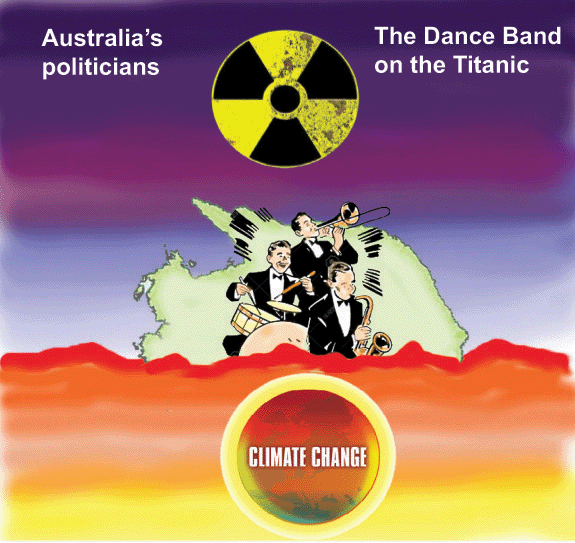 The report notes that if every country emulated Australia’s level of ambition, global warming would likely exceed 4C.
It also said that Australia’s currently implemented policy measures were not set to achieve even those inadequate targets and instead would rise to about 27% above 2005 levels by 2030, rather than the targeted 26 to 28% below 2005 levels.
Australia worst among G20 when it comes to action on climate change, report finds
Australia the only country to receive a rating of ‘very poor’ in a majority of categories in Climate Transparency scorecard, Guardian, Michael Slezak, 1 Sept 16, Australia is the worst country among the G20 when it comes to action on climate change, according to a comprehensive assessment before the G20 summit in China.
Under China’s leadership, this weekend’s G20 in the eastern city of Hangzhou has had a strong focus on climate-related issues.
By analysing the policies and actions of each of the 20 countries, which together produce 75% of the world’s greenhouse gas emissions, Climate Transparency produced a report, scorecard and series of country profiles detailing their findings, revealing Australia was not pulling its weight.
On the scorecard, Australia was the only country to receive a rating of “very poor” in a majority of categories.
Australia was given the worst possible rating of “very poor” for its performance on emissions trends, carbon intensity, share of renewables in its energy supply and overall climate policy.
It was rated as “poor” in every other category: for its energy intensity, share of coal in energy supply and electricity emissions intensity. Continue reading
Climate Change Authority’ s review on Australia’s climate goals and policies
Towards a climate policy toolkit: special review on Australia’s climate goals and policies, Australian Policy Online Climate Change Authority 31 August 2016 The Climate Change Authority is pleased to release the third and final report of its Special Review into the actions or policies that Australia should take to implement outcomes flowing from the historic Paris climate change agreement……..The emissions reduction policy toolkit needs to take account of Australia’s climate policy history, be suited to the emissions opportunities and challenges in individual sectors and be able to be scaled up in the future to meet the emission reduction challenges in the Paris Agreement…….
The Authority is also recommending that an enhanced safeguard mechanism be put in place as an effective, pragmatic and durable way of reducing emissions across a range of industrial, manufacturing and resource sectors. For households, vehicles and buildings, the Authority recommends that energy efficiency standards be put in place or strengthened.
For the land sector, the Authority found that voluntary offsets are the best tool for the task, given the large number of landholders and the differences between farming operations. In this report, as flagged in the Authority’s Special Review final report on targets, the Authority has not sought to provide further advice on emissions reduction targets. Emissions reduction targets are very important parts of the emissions reduction armoury but without effective policy action they will remain aspirational rather than determinative for the way ahead.
Australian govt’s environment and energy committee chaired by climate sceptic
Climate sceptic MP appointed chair of environment and energy committee
Liberal Craig Kelly will lead backbench committee that provides advice and feedback on legislation and policies, Guardian, Gabrielle Chan, 29 Aug 16, The climate sceptic Liberal MP Craig Kelly has been appointed chairman of the backbench environment and energy committee, with National party MP Kevin Hogan as secretary.
The committee will provide feedback on legislation and policies relating to the environment and energy, including to the minister, Josh Frydenberg.
Kelly served on the committee during the last parliament and previously invited climate sceptics to “balance” a presentation given by top climate scientists…….https://www.theguardian.com/australia-news/2016/aug/29/climate-sceptic-mp-appointed-chair-of-environment-and-energy-committee
Liberal Chairman of Coalition’s environment policy committee a proud climate sceptic, suggests nuclear power
Coalition environment committee chairman takes aim at solar subsidies Craig Kelly says he wants wind and solar funding to be redirected to research into ‘technological breakthroughs’ because existing renewables had ‘little effect’, Guardian, Gabrielle Chan, 31 Aug 16, The Liberal chairman of the Coalition’s environment policy committee, Craig Kelly, has questioned solar and wind power subsidies and would like a cost-benefit analysis of future emission reductions policy, due to be reviewed next year.
Kelly was named chairman of the environment and energy committee at the party room meeting on Monday, making him responsible for coordinating backbench feedback to the government on climate and energy policy.
 He said he was proud to be a climate sceptic rather than “wallow in groupthink, to be a sheep, or a lemming”. Kelly described himself as in the “Bjorn Lomborg” camp, suggesting wind and solar funding should be channelled into “further research” because those current renewables like wind and solar power had “diminishing returns”………
Kelly said in considering the price of power, the option of nuclear power should be considered……..https://www.theguardian.com/environment/2016/aug/31/coalition-environment-committee-chairman-takes-aim-at-solar-subsidies
Underground Coal Gasification (UCG) a disaster for climate
Friends of the Earth has recently released a report called ‘Fuelling the Fire: the chequered history of Underground Coal Gasification and Coal Chemicals around the world’
The report draws together evidence of UCG test projects over the last three decades and highlights how destructive UCG and Coal Chemicals are
Fuelling the fire: New coal technologies like UCG spell disaster for climate https://independentaustralia.net/environment/environment-display/fuelling-the-fire-new-coal-technologies-like-ucg-spell-disaster-for-climate-,9393 Cam Walker 26 August 2016, Given UCG’s disastrous history including Linc Energy’s irreversible environmental damage in Queensland, Friends of the Earth is calling for a moratorium on all UCG projects in Australia. Cam Walker fromFriends of the Earth reports.
IN RECENT years Australia, like many countries around the planet, has seen a major expansion in the development of unconventional oil and gas drilling.
These are oil and gas resources which cannot be produced by conventional processes (that is, through using the natural pressure of the wells to release the resource trapped in a coal or rock seam).
Until the 1990s, production of conventionaloil and gas kept prices relatively stable, so there was limited incentive to develop technologies to explore and produce unconventional oil and gas resources.
In the 2000s, prices started to increase, and with known reserves starting to peak, it was clear that this trend would continue into the future.
As debate increasingly focused on energy independence, a number of countries who consume large volumes of fossil energy such as the USA, Canada and China started to realise they had potentially enormous volumes of unconventional oil and gas. This in turn lead to a major development effort that saw a huge expansion in the use of hydraulic fracturing (‘fracking’) to access methane in shale beds to produce gas in the USA and elsewhere.
Australia also has major reserves of oil and gas which could potentially yield through the use of unconventional drilling methods. Here the unconventional gas resource includes coal seam gas (CSG), shale gas and tight gas. Exploration for CSG in Australia began in 1976 in Queensland’s Bowen Basin. The industry took hold, initially in Queensland, where there are currently around 4,000 onshore gas rigs. More than 37% of the Australian landmass is currently under exploration permit or application for coal or gas.
The UCG industry has been strongly resisted by regional communities and environmental groups around the country and the many dangers of fracking are well documented. This has resulted in moratoriums on fracking in states such as Victoria. Continue reading
Another dumb Resources Minister supports ‘clean coal’ myth
 Coalition climate numbskulls back again flogging CCS at a cost of $209 billion Lachlan Barker, Independent Australia 25 August 2016, The Coalition’s latest brainsnap of flogging Carbon Capture and Storage (CCS) as a solution to CO2 emissions from coal-fired power stations will set the taxpayer back an eye-watering $209 billion, says Lachlan Barker. “…… the utterly ludicrous notion of Carbon Capture and Storage (CCS), as a solution to CO2 emissions from coal fired power stations has raised its idiot head once more.
The CCS process involves capturing the CO2 emitted from the burner chamber, compressing it, and sequestering it underground.
 Resources Minister Matt Canavan recently handed out $23.7 million to various bodies around the country to (once more) discover CCS can never work. So I can tell you right here, right now, CCS is not feasible in any way — financially, ecologically or in an engineering sense.
However since Canavan has done this thing, once more we are all forced to go through the mill of showing why CCS is an utterly fallacious idea.
The Massachusetts Institute of Technology (MIT) has an excellent reference page for CCS, so I’ve distilled the Power Plants CCS Projects page down for you here: [excellent charts and graphs on original]……..https://independentaustralia.net/politics/politics-display/coalition-climate-numbskulls-back-again-flogging-ccs-at-a-cost-of-209-billion,9394
Climate Change Adaptation – South Australia in the lead
National Climate Adaptation Conference 2016, Day Three – Sean Kidney
SOUTH AUSTRALIA: LEADING ON CLIMATE CHANGE ADAPTATION The Climate group, August 2016. Sandy Pitcher, Chief Executive of South Australia’s Department of Environment, Water and Natural Resources, reflects on the achievements of Australia’s preeminent climate change forum, the Climate Adaptation 2016 conference, which took place in Adelaide in July.
The Climate Adaptation 2016 conference provided an unprecedented opportunity for South Australia to highlight the important progress being made on climate change adaptation in our state, and learn from others in Australia and around the world.
The conference was presented by the National Climate Change Adaptation Research Facility and the Commonwealth Scientific and Industrial Research Organisation, with the South Australian Government – a member of The Climate Group’s States & Regions Alliance, the platinum sponsor. It attracted around 490 policy makers, researchers and practitioners and the debate focused on the challenges and opportunities presented by climate change adaptation.
The innovation that we’re seeing mainly happens at the local level, and can be shared at conferences like this. It is a crucial way, for us in South Australia and beyond, to share ideas, catalyze local action, and bring key influencers together.
ADAPTATION IS A VERY KEY TENANT TO ANY FUTURE STRATEGY – THERE ARE MANY PEOPLE WHO ARE GOING TO BE IMPACTED BY A CHANGING CLIMATE
South Australia has long been recognized as a global leader on climate action, and our work in climate change adaptation is central to our efforts.
Our award-winning adaptation framework is based on a collaborative, regional approach involving partnerships between local government, regional development committees and natural resources management boards, who are working together to develop well-informed adaptation solutions for their communities.
Currently, in each of the State’s regions, five climate adaptation plans have been completed with the remainder due to be finalized by the end of the year….https://www.theclimategroup.org/news/south-australia-leading-climate-change-adaptation
154 scientists press Australian government for urgent action on climate change
154 Australian scientists demand climate policy that matches the science https://theconversation.com/154-australian-scientists-demand-climate-policy-that-matches-the-science-64359
- James WhitmoreEditor, Environment & Energy, The Conversation
Interviewed
- Andrew Glikson Earth and paleo-climate scientist, Australian National University
- Andrew Blakers Professor of Engineering, Australian National University
- Lesley Hughes Professor, Department of Biological Sciences, Macquarie University
August 25, 2016 154 Australian experts have signed on open letter to Prime Minister Malcolm Turnbull demanding urgent action on climate change that matches the dire warnings coming from climate scientists.
The letter, organised by Australian National University climatologist Andrew Glikson, calls on the federal government to make “meaningful reductions of Australia’s peak carbon emissions and coal exports, while there is still time”.
Signatories include leading climate and environmental scientists such as the Climate Council’s Tim Flannery, Will Steffen, and Lesley Hughes, as well as reef scientists Ove Hoegh-Guldberg and Charlie Veron.
They point out that July 2016 was the hottest month ever recorded, and followed a nine-month streak of record-breaking months. Average carbon dioxide concentrations in the atmosphere reached 400 parts per million (ppm) in 2015, and are rising at a rate of nearly 3 ppm each year.
The world is already witnessing the effects of climate change, the letter argues, including an increase in extreme weather events, melting of the polar ice sheets, and ocean acidification.
Australia, along with 179 other nations, has signed the climate treatybrokered in Paris last year, aiming to limit average global warming to “well below 2℃ above pre-industrial levels and to pursue efforts to limit the temperature increase to 1.5℃”.
However Glikson warned that “the Paris Agreement, being non-binding, is in danger of not being fulfilled by many of the signatories”. The deal will not enter into force until it is ratified by 55 nations accounting for at least 55% of the world’s greenhouse emissions.
Glikson called for action to “transition from carbon-emitting technologies to alternative clean energy as fast as possible, and focus technology on draw-down (sequestration) of greenhouse gases from the atmosphere”.
Australia’s current greenhouse gas target, which it took to December’s Paris climate summit, calls for emissions to be reduced by 26-28% below 2005 levels by 2030. It has been widely criticised by experts as not ambitious enough.
Andrew Blakers, professor of engineering at the Australian National University, said Australia could reduce emissions by two-thirds by 2030 “at negligible cost”.
He said the falling cost of renewable energy, particularly solar and wind, the replacement of gas with electricity for heating, and the advent of electric vehicles would eliminate most emissions. Solar and wind installation, currently at 1 gigawatt each year, would need to be increased to 2.5 gigawatts each year to reach 100% renewable energy by 2030.
Remaining emissions, from shipping, aviation, and industry, could be eliminated after 2030 at slightly higher costs.
Lesley Hughes, a member of the Climate Council and professor at Macquarie University, said there were a number of factors causing the gap between science and policy, including vested interests, perception of economic downsides of climate action, ideological biases, and inertia in the system from current investment in fossil fuels. But she said the “most important issue” was the difficulty in convincing people to act to reduce risk decades in the future.
The Climate Change Authority, which advises the government on climate policy, in 2014 recommended Australia adopt a target of 40-60% below 2000 levels by 2030.
In a report released yesterday, The Climate Institute highlighted that aiming for 1.5℃ instead of 2℃ would avoid longer heatwaves and droughts, and give the Great Barrier Reef a better chance of survival.
The institute recommended that Australia adopt an emissions reduction target of 65% below 2005 levels by 2030 and phase out coal power by 2035.
Australia in grave danger if global warming exceeds 2 C
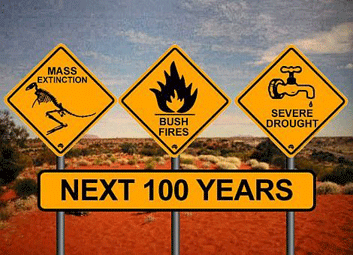 Keeping global warming to 1.5C, not 2C, will make a crucial difference to Australia, report says, The Conversation, James Whitmore, August 24, 2016 , Australia could avoid punishingly long heatwaves and boost the Great Barrier Reef’s chances of survival by helping to limit global warming to 1.5℃ rather than 2℃, according to a report released by the Climate Institute today.
Australia, along with 179 other countries, has formally signed the Paris climate agreement. The deal, which has not yet come into force, commits nations to limit Earth’s warming to “well below 2℃” and to aim for 1.5℃ beyond pre-industrial temperatures.
The new research, compiled by the international agency Climate Analytics, suggests that limiting global warming to 1.5℃ rather than letting it reach 2℃ could make a significant difference to the severity of extreme weather events in Australia. Heatwaves in southern Australia would be an average of five days shorter, and the hottest days a degree cooler. In the north, hot spells would be 20-30 days shorter than the 60-day heatwaves potentially in store if warming hits 2℃……..
University of Melbourne researcher Andrew King, who studies climate extremes, said the report “paints a grim picture for the future”, given that Australia is already experiencing climate-driven events such as this year’sunprecedented bleaching on the Great Barrier Reef.
“There are many benefits if warming could be limited to 1.5℃, with less frequent and intense extreme weather. On the other hand, we are entering the unknown if we allow warming to surpass 2℃, as tipping points in the Earth’s climate system make accurate predictions difficult to make,” Dr King said.
The report predicts that half of the world’s identified tipping points – such as the collapse of polar ice sheets and the drying out of the Amazon rainforest – would be crossed under 2℃ warming, compared with 20% of them at 1.5℃………
Stronger targets
In a separate report, the Climate Institute recommends that Australia adopt greenhouse gas targets of 45% below 2005 levels by 2025, and 65% by 2030, if it is to do its fair share in achieving the Paris Agreement’s goals.
The institute also recommended that Australia phase out coal-fired electricity generation by 2025, increase renewable generation to 50% by 2030, and double energy productivity by 2030.
It argues for a carbon price, and urges politicians to factor the costs and benefits of climate change and climate action formally into all policy decisions.
Australia’s current climate target under the Paris Agreement is 26-28% below 2005 levels by 2030. Labor has proposed a 45% target, and the Greens zero or negative emissions within a generation.
Australia will review its climate policies in 2017, ahead of the first global stocktake of nations’ Paris Agreement targets in 2018…….https://theconversation.com/keeping-global-warming-to-1-5c-not-2c-will-make-a-crucial-difference-to-australia-report-says-64287
Media coverage given to serial climate denying pest Sen. Malcolm Roberts
“Campaign of intimidation” One of the academics on the receiving end of Roberts complaints, John Cook, of the University of Queensland, told DeSmog:
Beneath the public attacks on climate science, scientists are also subject to a more insidious campaign of intimidation, otherwise known as the subterranean war on science. This takes the form of complaints to universities to get scientists fired, complaints to journals to get papers retracted and FOIrequests to pick through scientists’ emails.
Sen. Malcolm Roberts: Climate denier, conspiracy nut and serial pest, Independent Australia DeSmog Blog 15 August 2016 One Nation’s Senator Malcolm Roberts has spent countless hours harassing scientists, researchers and politicians with rantings about climate change conspiracy theories. DeSmogBlog‘s Graham Readfearnreports.
MALCOLM ROBERTS is a former Australian mining consultant who thinks the United Nations is using the “scam” of human-caused climate change as a cover story while it builds an all-powerful world government.
He’s also just been elected as an Australian Senator.
Roberts will sit in Australia’s upper house as a member of the far-right One Nation party that wants to ban Muslim immigration and investigate climate scientists for “fraud and corruption”.
Since his election, Roberts has been given blanket coverage in the Australian media, with high profile interviews on flagship shows on the publicly funded ABC. Continue reading
Climate facts refute One Nation’s Malcolm Roberts’ claims
 One Nation’s Malcolm Roberts is in denial about the facts of climate change http://www.skepticalscience.com/One-Nation-Malcolm-Roberts-denial-about-facts-climate-change.html 5 August 2016 by John Cook This article was originally published on The Conversation. Read the original article.
The notion that climate science denial is no longer a part of Australian politics was swept away yesterday by One Nation Senator-Elect Malcolm Roberts.
In his inaugural press conference, Roberts claimed that “[t]here’s not one piece of empirical evidence anywhere, anywhere, showing that humans cause, through CO₂ production, climate change”.
He also promoted conspiracy theories that the CSIRO and Bureau of Meteorology are corrupt accomplices in climate conspiracy driven by the United Nations.
His claims conflict with many independent lines of evidence for human-caused global warming. Coincidentally, the University of Queensland is releasing a free online coursethis month examining the psychology and techniques of climate science denial. The very first video lecture addresses Roberts’ central claim, summarising the empirical evidence that humans are causing climate change.
UQx DENIAL101x 1.2.1.1 Consensus of Evidence
Scientists have observed various human fingerprints in recent climate change, documented in many peer-reviewed scientific papers.
Satellites measure less heat escaping to space at the exact wavelengths at which CO₂ absorbs energy. The upper atmosphere is cooling at the same time that the loweratmosphere is warming – a distinct pattern unique to greenhouse warming. Human activity is also changing the very structure of the atmosphere.
Not only do these unique fingerprints confirm humanity’s role in recent climate change, they also rule out other potential natural contributors. If the Sun caused global warming, we would expect to see days warming faster than nights, and summers warming faster than winters.
Instead we observe the opposite: nights are warming faster than days, and winters are warming faster than summers, which is a greenhouse pattern predicted by John Tyndallas long ago as 1859.
Similarly, if global warming were caused by internal variability, we would expect to seeheat shuffling around the climate system with no net build-up. Instead, scientists observe our climate system accumulating heat at a rate of more than four atomic bombs per second.
Our scientific understanding grows stronger when many independent lines of evidence all point to a single, consistent conclusion. In the case of climate change, the “consensus of evidence” has led 97% of climate scientists to agree that humans are causing global warming.
The scientific consensus on climate change has also been endorsed by many scientific organisations all over the world, including the national science academies of 80 countries
Is it a conspiracy?
How does one dismiss a global scientific consensus built on a robust body of empirical evidence?
There are five characteristics of science denial. These common traits are seen when people reject climate science, the benefits of vaccination, or the research linking smoking to cancer.
The techniques of denial are: fake experts; logical fallacies; impossible expectations; cherrypicking; and conspiracy theories. This is summarised in the acronym FLICC.
UQx DENIAL101x 1.4.3.1 Five Characteristics of Science Denial
Several studies have linked climate science denial and conspiratorial thinking. If a person disagrees with a global scientific consensus, they’ll typically believe that the scientists are all engaging in a conspiracy to deceive them.
Malcolm Roberts’ conspiracy theories have been well documented and were once again on offer in yesterday’s speech. He espouses a conspiracy that encompasses the CSIRO, Bureau of Meteorology, international banking families, the United Nations and Al Gore.
Unfortunately, I am not optimistic that the evidence for human-caused global warming will persuade Malcolm Roberts. The scientific evidence from psychology tells us that scientific evidence is largely ineffective on those who dismiss climate science with conspiracy theories.
My own research found that communicating the science of climate change to those who exhibit conspiratorial thinking can even be counterproductive, activating their distrust of scientists and strengthening their denial of the evidence.
Furthermore, conspiratorial thinking is self-sealing. When conspiracy theorists are presented evidence that there is no conspiracy, they often respond by broadening the conspiracy to include that evidence. In other words, they interpret evidence against a conspiracy as evidence for the conspiracy.
Our course on climate science denial will be much more useful to those who are open to scientific evidence and curious about the research into the causes and impacts of climate change and the psychology of climate science denial.
Farmers welcome partial backtrack on CSIRO climate cuts, but call for all jobs to be reinstated
By Anna Vidot Farmers have welcomed a partial backtrack on CSIRO cuts, but have called on the Government to invest more in climate change adaptation research for agriculture……..http://www.abc.net.au/news/2016-08-04/farmers-welcome-partial-csiro-backtrack-on-climate/7691088
1 This month

of the week – Australians for War Powers Reform (AWPR)
To see nuclear-related stories in greater depth and intensity
 Antinuclear