Heavens to Betsy! Murdoch media suddenly discovers that wind and solar power are great for Australia!
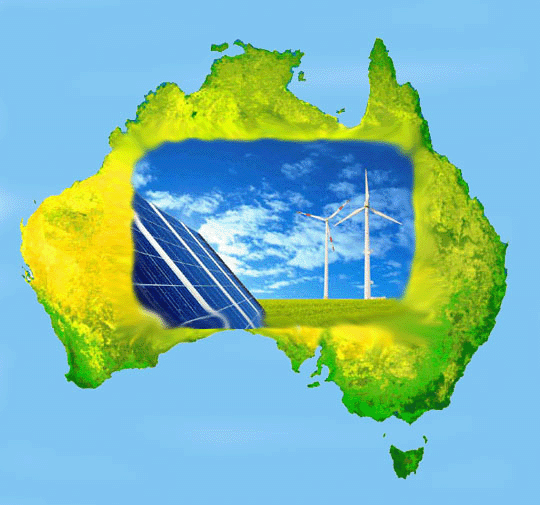 How we’re riding a wind and solar wave to energy future, PAUL GARVEY, THE AUSTRALIAN, FEBRUARY 21, 2020 A nationwide wave of wind and solar projects has Australia on track to become one of the world’s biggest users of renewable energy, defying predictions a Canberra policy vacuum would make Australia a global climate laggard.
Such is the frenzy of new projects that parts of the electricity grid are struggling to accommodate the power now being generated, with a growing backlog of proposed developments waiting for grid infrastructure and battery technology to catch up…. (subscribers only) https://www.theaustralian.com.au/nation/politics/how-were-riding-a-wind-and-solar-wave-to-energy-future/news-story/18e3d0e0f69c81a14d3655a26e8914c3
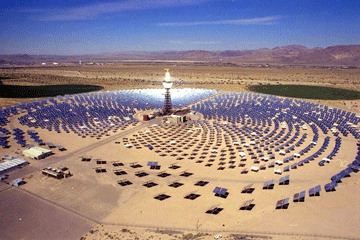
Solar thermal energy the way forward for Australia- says nuclear expert
Dr Wilson described nuclear power as simply “too risky”.
He also said the cost factor was also a major deterrent from going nuclear.
“It’s not the cost of building it. They are expensive to build and they are expensive to run but it’s the cost of demolition when it gets to the end of its life,” he said.
“Nuclear is not cheap, it’s not safe, and will be destructive to key Queensland industries like agriculture and tourism.”
|
Solar thermal power the way forward for Australia despite hiccups, nuclear expert says
https://www.abc.net.au/news/2020-02-18/solar-thermal-power-should-be-major-export-expert-says/11971938?fbclid=IwAR3zjCStZwOvdHFGY0EtSWxu4oQ0i43QAgm6O9S5YNW5I3KKna370tb7KtQ ABC Radio Brisbane
By Rebeka Powell 19 Feb 2020, As the world looks to Germany as a shining example of how to shift away from polluting coal power, a Queensland-based nuclear expert says solar thermal power is the way forward for Australia. Key points:
Paul Wilson is an electrical and control systems engineer with almost five decades’ experience who has previously made submissions to the parliamentary inquiry into nuclear power. Dr Wilson told ABC Radio Brisbane’s Steve Austin he was disappointed Australia was not showing leadership or innovation in renewables. “We’re very good in Australia at innovation and at engineering and I think we should take a leaf out of the German book,” he told the Drive program. “And they’re basically trying to systematically close down their coal mining industry but they’re doing it by replacing jobs. So they’re deliberately setting out, for every job that is lost in coal mining, they’re trying to create another job. Continue reading |
Greens leader Adam Bandt seeks new deal with “renewable mining and manufacturing” sector
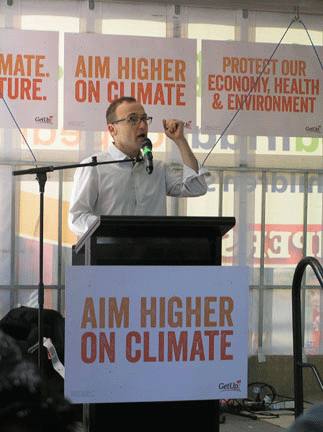 New Greens leader Adam Bandt will tour Australia’s mining regions to promote his plan to create a “renewable mining and manufacturing” sector and repair his party’s poor relations with resources industry workers. THE AUSTRALIAN , RICHARD FERGUSON FEBRUARY 16, 2020
New Greens leader Adam Bandt will tour Australia’s mining regions to promote his plan to create a “renewable mining and manufacturing” sector and repair his party’s poor relations with resources industry workers.
Mr Bandt — who started his tenure as leader saying big business was “killing people” — wants to shift the mining sector towards lithium and process materials such as iron ore in Australia to build a domestic “zero-carbon” manufacturing industry…. (subscribers only)
South Australia’s renewable energy future hampered by lack of electricity infrastructure
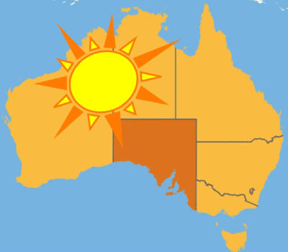 South Australia’s renewable energy future hampered by lack of electricity infrastructure https://www.abc.net.au/news/2020-02-11/sa-renewables-future-hampered-lack-of-instructure/11935392
By Emma Pedler and Lucy Robinson South Australia’s drive to be the national leader in renewable energy is being hampered by infrastructure unable to support the future growth potential, according to economist Ross Garnaut.
Key points:
- A lack of infrastructure is undermining SA’s goal to lead the nation in renewable energy, experts say
- A windfarm that was approved almost 20 years ago was never developed because of a lack of support for large-scale operations
- State officials say a proactive approach to infrastructure would attract businesses and create jobs
Dr Garnaut highlighted the Eyre Peninsula and Spencer Gulf as two of the regions most likely to be able to both create renewable energy and house the industries that want to use it.
But he said the region would not be able to capitalise on opportunities without high voltage transmission infrastructure similar to the interconnector recently approved to link SA and New South Wales.
“We need lots more of that kind of infrastructure … so that we can bring together at single points a range of high quality wind and high quality solar, so that we can balance the requirements of different parts of the region,” he said Continue reading
#ScottyFromMarketing and his crew – blind to the economics of renewable energy
were at it again, warning that increased climate action would lead to
“higher taxes and higher electricity prices” and implying it was the
desire only of “those in the inner city”. Of course, this is nothing
more than marketing fluff. You could be forgiven for thinking that they
must have missed the memo on the record take-up of ultra-cheap solar and
wind power, now generating nearly 20 per cent of Australia’s electricity
supply, with more than 50 per cent renewables expected by 2030.
In 2020 Adelaide City Council to become South Australia’s first carbon neutral local government
 Renewable energy to fully power city council, INDAILY , Stephanie Richards, 5 Feb 20,
Adelaide City Council says it will become South Australia’s first carbon neutral local government by the end of this year following the signing of a “landmark” renewable power purchase agreement.
Lord Mayor Sandy Verschoor this morning announced the council had entered into an agreement with Melbourne-based energy retailer Flow Power to source all its electricity from solar and wind power.
The contract means all council-owned infrastructure and buildings – including street lights, libraries, community centres and Town Hall – will be powered by 100 per cent renewable energy from July.
The switch is expected to slash the council’s current carbon emissions – more than half of which are tied to electricity use – by 11,000 tonnes each year.
Verschoor told reporters this morning the agreement would result in a 20 per cent reduction to the council’s electricity costs, however she said she was “not allowed to talk dollars” due to commercial confidentiality.
She said the agreement would mean the council would become carbon neutral-certified by the end of this year, joining the already-certified Brisbane, Sydney and Melbourne city councils.
Carbon neutrality, or having a net-zero carbon footprint, is achieved when the amount of greenhouse gas emissions emitted into the atmosphere is balanced by the amount being removed.
“This partnership will not only save our ratepayers money, it helps cement Adelaide’s international clean and green reputation,” Verschoor said…….. https://indaily.com.au/news/local/2020/02/05/renewable-energy-to-fully-power-city-council/
Scott Morrison, in the grip of fossil fuel lobby, is wrong about more gas for Australia
So, Scott Morrison, let’s come clean and let the public know that there’s no domestic case for increasing gas extraction. Given that gas extraction threatens landscapes and has a major problem with emissions, it’s better we leave it in the ground
The prime minister, Scott Morrison, surrounded by advisers out of the fossil fuel industry, is stuck in a time warp.
His claim that “there is no credible energy transition plan, for an economy like Australia in particular, that does not involve the greater use of gas as an important transition fuel” is demonstrably wrong. There are many. Continue reading
Australia May Add Record Amount of Renewable Power in 2020,
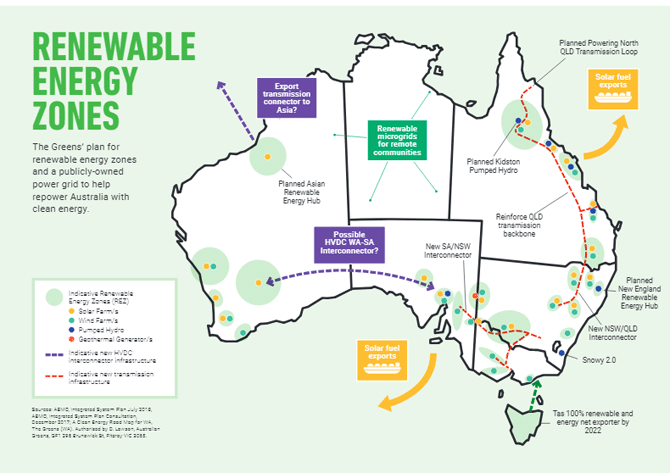
Australia May Add Record Amount of Renewable Power in 2020, Bloomberg, By James Thornhill, January 21, 2020
-
Corporate demand for clean electricity driving growth: Rystad
- Policy uncertainty seen undermining longer term expansion
Australia is set to add a record amount of renewable power in 2020, driven by growing corporate demand for clean electricity and to fill generation gaps created by the retirement of aging coal-fired plants.
New markets are expected to unlock growth as pilot hydrogen projects start and oil, gas and mining projects invest in off-grid renewables generation, according to Rystad Energy. The positive outlook would be a rebound for Australia’s clean energy developers after a sharp drop in investment in 2019.
“We expect the industry to bounce back in the second half of 2020,” Rystad said in a media release, citing projects with corporate power purchase agreements and the winners of government auction schemes that are scheduled to start construction this year.
Nearly 2 gigawatts of large-scale solar projects and 1.6 gigawatts of wind power are due to complete commissioning in the year ahead, up nearly 40% on 2019 levels. Wind and solar developers are also lining up to replace the Liddell coal plant in New South Wales, which is due to close by April 2023.
Still, developers may face headwinds over the longer term. The industry has already met the government’s 2020 target for renewable generation and there is no new target to replace it. Meanwhile, the profitability of projects located a long way from major demand centers has been hit by marginal loss factors — the amount of power lost along transmission lines.
Losing Momentum
Australia renewables investment fell 38% last year “While the outlook for the commissioning of new projects still looks solid in 2020, there is a risk that activity tails off in the years ahead as the impact of falling investment starts to feed through,” said BloombergNEF analyst Leonard Quong. AT TOP https://www.bloomberg.com/news/articles/2020-01-21/australia-may-add-record-amount-of-renewable-power-in-2020

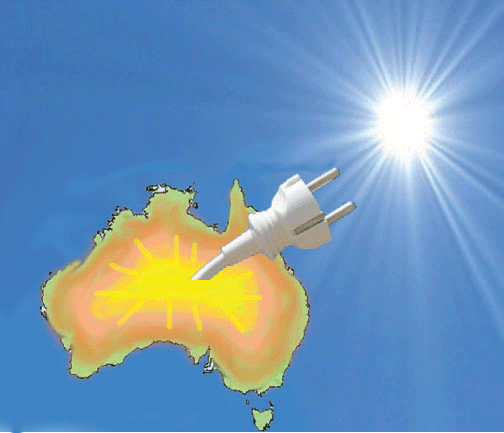
Australia’s future as a renewable energy superpower
|
Australia has a real future as a renewables superpower, https://www.canberratimes.com.au/story/6587200/australia-has-a-real-future-as-a-renewables-superpower/?cs=14246Tristan Edis, 19 19 Jan 2020, Amid almost daily complaints from industry about skyrocketing electricity costs, out dropped an announcement recently so counter to the dominant news flow that it seemed beyond belief. Yet there it was in the business pages: Australian software billionaire Mike Cannon-Brookes and iron ore billionaire Andrew “Twiggy” Forrest have a plan to supply a fifth of Singapore’s electricity needs – all of it from solar power – via a 3750-kilometre underwater cable from the Northern Territory. The proposed solar farm, near Tennant Creek, would be the world’s biggest by a comfortable margin. It would stretch as far as the eye can see, across an area equal to more than 20,000 soccer fields.Despite Cannon-Brookes’s self-deprecating description of the project as “batshit insane”, it could actually make technical and economic sense. And it’s not the only mega-renewable energy project being pursued by credible Australian companies with the aim of powering the many hundreds of millions of people living to the north of us. Continue reading |
Australia can have zero emissions and still profit from minerals, says Ross Garnaut
Australia can have zero emissions and still profit from minerals, says Ross Garnaut, ABC NEWS BREAKFAST BY PATRICK WOOD 13 Jan 2020 Australia could have avoided the scale of the devastating bushfires, Professor Ross Garnaut has said as he warned the situation would continue to worsen if there wasn’t global action on climate change, something he said didn’t have to come at the expense of the economy.Key points:
The economist said he “strongly endorsed” Prime Minister Scott Morrison’s focus on reducing emissions without damaging the economy, and believed Australian industries could still reap the benefits of the country’s mineral resources in a zero-emissions world. As this bushfire season has claimed lives and thousands of homes, Professor Garnaut has become a focus on the debate around climate change and the Government’s response.That is because in 2008 he conducted a widescale review into the impact of climate change on Australia and its economy, and came to a conclusion: the nation would face a more frequent and intense fire season by 2020. As that prediction comes to pass, the Prime Minister is facing renewed scrutiny on the Government’s climate change policy and whether it will change due to the fires……..
Professor Garnaut said the bushfire crisis could have been avoided if Australia, as part of a global effort, had “done a lot more much earlier”. “The tragedy has been building over a long time,” he said. “Things will continue to get worse … until the world has zero net emissions of greenhouse gases.” In this zero-emissions world, Professor Garnaut argued Australia could be a world leader by processing its minerals locally using renewable energy. “I think the point about avoiding cuts to the economy is a sound one,” he said in response to the Prime Minister’s interview. “The way you make steel in a zero-emissions economy is using renewable energy to make hydrogen, to make steel, instead of using coal.
The way you make aluminium in a zero-emissions world economy is to use renewable energy to turn bauxite and aluminium oxide into aluminium metal. “Australia is by far the biggest exporter of aluminium ores and iron ores, [and] when the world is producing aluminium and iron without emissions, we’ll be the place that’s done. So it will be positive for the economy. “So I strongly endorse the Prime Minister’s focus on getting to zero emissions without damaging our economy. It can do us a lot of good.” Carbon pricing ‘faster and cheaper’The question of how Australia reduces its emissions is still up for debate. He said policies would continue to evolve but did not outline specific plans. Professor Garnaut said putting a price on carbon was a good option, but one he acknowledged was not going to happen with the current Government. “We would have got to low emissions much more cheaply if we’d had an economy-wide carbon price, but you can get there without a carbon price,” he said. “For the time being we have to make progress without a carbon price. We can do that. “We would make faster and cheaper progress later on if later we adopted a carbon price.”He said the current fires could also prompt a shift in the way the country tackled climate change. “My reading of the complex electoral arithmetic of the last election is that on balance the electorate was favouring stronger action on climate change,” he said. “Not in every place. The coal-producing areas in the Hunter Valley and up the Queensland coast were very nervous. “We have to show those communities that there are alternatives … [that] those places can do very well in the zero-emissions economy of the future. “But we’ve actually got to develop the programs that have them doing very well.” https://mobile.abc.net.au/news/2020-01-13/ross-garnaut-on-bushfires-scott-morrison-climate-change/11861846 |
|
It is a big MISTAKE to equate COAL MINING with jobs
It is a big MISTAKE to equate COAL MINING with jobs
 1. Australian Tourism employs 10 times more Australians than does mining
2. There are job vacancies in the setting up and maintaining renewables
3. Australia has an opportunity to Lead the World manufacturing and building the equipment and technological infrastructures and components required to set up renewable and sustainable community and economy e.g.. Let’s build Australian Made solar panels instead of importing them
4. Build our own iron ore processing plants run by green hydrogen/hydro/wind/solar/ To make aluminium Keeping profits and jobs in Australia
5. Build sustainable industry, farming, tourism, land management, water management and houses, towns and cities, Leed the world in recycling and green energy transport solutions Manufacture electric cars, buses, commercial vehicles There are so many jobs to be had and created in zero emissions
The world would flock here and pay us to advise and share our sustainable progressive technology and solutions
6. Eco tourism would not only create even more jobs for Austalians boosting the industries that benefit ie. restaurants, bakeries, farmers etc The tourism industry would bring even more billions of $$$$ into Australia
Malcolm Turnbull blasts government’s ‘right-wing’ over energy policy sabotage
Former Prime Minister Malcolm Turnbull has blasted the “right wing” of the Morrison federal government for bringing down his signature energy policy, calling for it to be “reinstated now”.
On Monday, a Twitter user challenged Mr Turnbull for only “calling for coherent energy policies now [he’s] out of government”
The former PM responded by defending his proposed National Energy Guarantee (NEG), which faced opposition in government ranks and was later ditched.
“The National Energy Guarantee was a coherent integration of climate and energy policy,” he tweeted.
“It was sabotaged by the right-wing of the Coalition and their supporters in the media and coal lobby and finally abandoned by Morrison Government. It should be reinstated now.”
The policy was intended to deal with rising energy prices as well as cutting emissions.
Mr Turnbull was later dumped as the leader and his successor Scott Morrison announced the NEG “is dead”…… https://www.sbs.com.au/news/malcolm-turnbull-blasts-government-s-right-wing-over-energy-policy-sabotage
Even within a pro nuclear propaganda article, admission that renewables are a better bet
|
“…… Roger Dargaville, a Senior Lecturer in Resources Engineering with the Department of Civil Engineering at Monash University, is more confident of the standalone capability of renewables. In 2018, the proportion of Australia’s total electricity generated from renewables passed 20 per cent for the first time, with clean energy contributing 21.3 per cent of total electricity generation. This was an increase compared to 2017, when renewables were responsible for 17 per cent of total electricity generation. And there’s more in the pipeline. “As we approach the 2020 renewable energy target of at least 33,000 GWh per year, we have seen a rush of new projects. After that, most of the states have renewable targets of 50 per cent or more that, combined with the continuing falling prices of PV, should lead to a continuation of the trend.” Dargaville said many published studies already show that 100 per cent renewable systems are technically achievable, cost-effective and reliable, without having to resort to nuclear power….” Australia’s review of its energy mix resurrects the nuclear power debate, by Create Digital, 10 Dec 19 |
|
Power bills to fall by $40 as New South Wales Central West becomes wind and solar power hub,
|
Power bills to fall by $40 as Central West becomes wind and solar power hub, Central West Daily News, David Fitzsimons 26 Nov 19
The Central West will become the focus of wind and solar energy generation in NSW under a state government plan that would see 450 construction jobs created and household electricity bills cut by $40 a year. Energy Minister Matt Kean said Australia’s first Renewable Energy Zone would be developed in the Central West over the next few years. Mr Kean said the 3000 megawatt pilot program was aimed at attracting up to $4.4 billion in private sector investment into the region for clean energy generation…….
The Central West project is the first of three planned for NSW as part of the NSW Electricity Strategy which was unveiled by Mr Kean. It said the Central West was chosen for the pilot because it has “significant existing investment and investor interest.”…… https://www.centralwesterndaily.com.au/story/6508798/power-bills-to-drop-by-40-as-central-west-becomes-hub-for-wind-and-solar-power/?fbclid=IwAR0WqMLLb5ODbAA0EU-h8VPtnfVoU8PYrvFIEhNhuTeOVKunqnhR4f3PWms |
|
|
How are Australian States progressing on renewable energy? South Australia way ahead
South Australia leading the nation in renewable energy, https://thenewdaily.com.au/news/national/2019/11/25/renewable-energy-winners/ Samantha Dick
South Australia is shifting to renewable energy faster than any other state or territory.
This is despite the federal government’s “lack of leadership” and continued support for major fossil fuel projects, says the Climate Council.
|
Progress is based on how much electricity is derived from renewable energy, proportion of households with rooftop solar, large-scale wind and solar capacity per capita, and policies to support the transition. South Australia earned this year’s top spot for generating more than half of its electricity from wind and solar, and for setting a target of net 100 per cent renewable energy in the 2030s. Following closely in second place was the Australian Capital Territory, which is on track for 100 per cent renewable energy from 2020. The ACT has also announced impressive plans to achieve net zero emissions by 2045 by cutting emissions from transport and cities. Tasmania was in third place for making headwinds toward 100 per cent renewable energy by 2022, and for researching three pumped hydro sites that could supply energy to Victoria over the next 10 to 15 years. Victoria was ranked fourth, winning points for planning the nation’s most ambitious large-scale wind and solar projects, and for legislating a renewable energy target of 50 per cent by 2030. However, more than 80 per cent of the state’s power still comes from fossil fuels, meaning it has a long way to go to catch up to the frontrunners. Further behind in fifth place was Queensland, where nearly half of Australia’s large-scale renewable energy projects were completed last year. But despite making big improvements, the Queensland government lost marks for continuing to support new fossil-fuel projects like the Adani coal mine. The Adani coal mine, backed by the federal government, will put out an estimated 7.7 billion tonnes of greenhouse gases over 60 years through extracting 2.3 billion tonnes of coal. It is also unlikely the Sunshine State will meet its target of 50 per cent renewable energy by 2030.
|
|
1 This month

of the week – Australians for War Powers Reform (AWPR)
To see nuclear-related stories in greater depth and intensity
 Antinuclear